
Friday, July 30, 2010

Neglected Poets: James Reeves

James Reeves (1909-1978) devoted his life to poetry -- as a poet, an editor, an anthologist, a teacher, and a critic.  But his devotion was a quiet one.  Hence, his poetry does not receive the attention that it deserves.  I urge you to seek it out, for I believe that you will find it rewarding.  The poems below may all be found in his Collected Poems: 1929-1974 (Heinemann 1974).

                    Things to Come

The shadow of a fat man in the moonlight
   Precedes me on the road down which I go;
And should I turn and run, he would pursue me:
   This is the man whom I must get to know.
                                      Stanley Roy Badmin (1906-1989)
                           "The Abbey Barn, Doulting, Somerset" (1930) 

To put the following poem in context, it may be helpful to know that it was written by Reeves after the death of his wife Mary (1910-1966).  He dedicated his Collected Poems to her.              

                         To Not Love

One looked at life in the prince style, shunning pain.
Now one has seen too much not to fear more.
Apprehensive, it seems, for all one loves,
One asks only to not love, to not love.

                         Stanley Roy Badmin, "Fallen Mill Sails" (1931)

                       Bestiary

Happy the quick-eyed lizard that pursues
   Its creviced zigzag race
Amid the epic ruins of a temple
   Leaving no trace.

Happy the weasel in the moonlit churchyard
   Twisting a vibrant thread
Of narrow life between the mounds that hide
   The important dead.

Close to the complex fabric of their world
   The small beasts live who shun
The spaces where the huge ones bellow, fight,
   And snore in the sun.

How admirable the modest and the frugal,
   The small, the neat, the furtive.
How troublesome the mammoths of the world,
   Gross and assertive.

Happy should we live in the interstices
   Of a declining age,
Even while the impudent masters of decision
   Trample and rage.

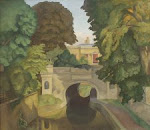
                                     Stanley Roy Badmin, "Priory Pond"

                              Precept

Dwell in some decent corner of your being,
Where plates are orderly set and talk is quiet,
Not in its devious crooked corridors
Nor in its halls of riot.         

Wednesday, July 28, 2010

An Interlude: The Hesperian Gardens

An interlude from my recent less-than-sanguine posts about the meaning of Life (involving Messrs. Henley, Belloc, and Larkin) is in order.  Fortunately, the Hesperian Gardens are close at hand.  I recently came upon this:

                                     Cadogan Gardens

     Out of the fog a dim figure accosted me.  'I beg your pardon, Sir, but could you tell me how to get to Cadogan Gardens?'
     'Cadogan Gardens?  I am afraid I am lost myself.  Perhaps, Sir,' I added (we two seemed oddly intimate in that white world of mystery together), 'perhaps, Sir, you can tell me where I can find the Gardens I am looking for?'  I breathed their name.
     'Hesperian Gardens?' the voice repeated.  'I don't think I have ever heard of Hesperian Gardens.'
     'Oh, surely!' I cried, 'the Gardens of the Sunset and the singing Maidens!'

Logan Pearsall Smith, More Trivia (1921).


"Hesperian Gardens"  in turn brought to mind a poem by Derek Mahon:

               The Blackbird

One morning in the month of June
I was coming out of this door
And found myself in a garden,
A sanctuary of light and air
Transplanted from the Hesperides,
No sound of machinery anywhere,
When from a bramble bush a hidden
Blackbird suddenly gave tongue,
Its diffident, resilient song
Breaking the silence of the seas.

Derek Mahon, Selected Poems (The Gallery Press/Viking 1991).

Monday, July 26, 2010

Life Explained, Part Three: "On That Green Evening When Our Death Begins"

It may not come as a surprise that Philip Larkin has provided us with a mordant explanation of What Life Is Like.  But an admirer of Larkin (me, for instance) might add:  "Yes, mordant and witty and  laceratingly honest and -- perhaps -- an explanation which may be absolutely true (at least for 'one man once')."

                    Continuing to Live

Continuing to live -- that is, repeat
A habit formed to get necessaries --
Is nearly always losing, or going without.
     It varies.

This loss of interest, hair, and enterprise --
Ah, if the game were poker, yes,
You might discard them, draw a full house!
     But it's chess.

And once you have walked the length of your mind, what
You command is clear as a lading-list.
Anything else must not, for you, be thought
     To exist.

And what's the profit?  Only that, in time,
We half-identify the blind impress
All our behavings bear, may trace it home.
     But to confess,

On that green evening when our death begins,
Just what it was, is hardly satisfying,
Since it applied only to one man once,
     And that one dying.

Philip Larkin, Collected Poems (Faber and Faber/The Marvell Press 1988).
                                     William Baziotes, "Scepter" (1960)  

Saturday, July 24, 2010

Life Explained, Part Two: "Life Is A Long Discovery, Isn't It?"

Hilaire Belloc (1870-1953) could be a bit sardonic at times.  (Perhaps I am understating the case.)  Let's just say that he viewed the world with the proverbial gimlet eye.  But a  humorous gimlet eye.  Please bear this in mind as you consider the explanation of Life offered by him in the following poem:

                      Discovery

Life is a long discovery, isn't it?
You only get your wisdom bit by bit.
If you have luck you find in early youth
How dangerous it is to tell the Truth;
And next you learn how dignity and peace
Are the ripe fruits of patient avarice.
You find that middle life goes racing past.
You find despair: and, at the very last,
You find as you are giving up the ghost
That those who loved you best despised you most.

As a coda to "Discovery," please consider the following poem, which, I admit, doesn't exactly support my contention that Belloc had a fun-loving side:

                 From the Latin (but not so pagan)

Blessed is he that has come to the heart of the world and is humble.
He shall stand alone; and beneath
His feet are implacable fate, and panic at night, and the strumble
Of the hungry river of death.

(By the way, the Oxford English Dictionary lists only one instance of the use of "strumble" in this sense:  Belloc's poem.) 

To do Belloc justice, I feel compelled to demonstrate that he did, indeed, have a sense of humor.  Here is (I believe) the best political poem ever written -- one which applies to all places at all times, even though it was written in the context of a parliamentary election in England:

                   On a General Election

The accursed power which stands on Privilege
(And goes with Women, and Champagne and Bridge)
Broke -- and Democracy resumed her reign:
(Which goes with Bridge, and Women and Champagne).

In other words, Belloc beat Pete Townshend to the punch by 50 years or so:  "Meet the new boss.  Same as the old boss."

                                       William-Adolphe Bouguereau
                                "Orestes Pursued by the Furies" (1862)

Thursday, July 22, 2010

Leopardi: Perpetual Adolescence

I am certainly not the first to notice -- or to bemoan -- the perpetual adolescence of my generation (that is, the Baby Boom Generation).  And I readily acknowledge that I cannot exempt myself from my own condemnation.  (That being said, I can unequivocally state that I have never worn a baseball cap backwards.)  

However, reading one of Giacomo Leopardi's Thoughts (Pensieri) a few years ago, I had occasion to consider whether I was being too harsh on my generation.  To wit:  is it possible that life itself is much more adolescent, much more childish, than we imagined it would be when we "grew up"?  Here is Leopardi:

"Assuredly that which first, and perhaps above everything else, strikes with wonder the minds of well-educated young men on their entrance into the world, is the frivolity of the ordinary occupations, the pastimes, the talk, the inclinations, and the dispositions of society in general.  Most of them, it is true, soon become accustomed to this frivolous mode of life, and adapt themselves to it, though not without pain and difficulty.  It appears to them at first that they have become children again; and so it really is for those who have been well-educated and who possess good natural abilities.

Such persons, when they commence to live, as it is called, must, as it were, retrace their course and infantilise themselves as much as possible.  They discover that it was a delusion to imagine that it was their business to become men in their thoughts and actions and to put away all remnants of childhood.  For, on the contrary, men in general, however old they grow in years, always continue to live in great part like children."

Giacomo Leopardi, Pensieri, LXX, in Essays, Dialogues and Thoughts (translated by James Thomson) (1905), pages 366-367.

So, am I being too hard on my generation?  Is perpetual adolescence the way of the world?  Could it be --  perish the thought! -- that Baby Boomers are not distinctively immature?  I shall leave that determination to posterity.

                                  Stanley Spencer, "The Bridge" (1920)

Tuesday, July 20, 2010

"Full Fathom Five To The Soul's Ocean Cave"

Henry Newbolt (1862-1938) is best known for his historical and narrative poems: "Drake's Drum," "He Fell Among Thieves," "Vitai Lampada," and others.  But not all of his poems are of this type.  I owe my acquaintance with the following poem to Kingsley Amis, who included it in The Amis Anthology (1988).  In a note to the poem, Amis suggests that it "shows Newbolt trying to develop a new, contemplative manner" later in his life.

The poem is open to the charge of "sentimentality," I suppose.  But please stay with it.  About half-way through (when an echo of Shakespeare arrives), it takes a turn that (I believe, at least) makes it memorable.

                                The Nightjar

We loved our Nightjar, but she would not stay with us.
We had found her lying as dead, but soft and warm,
Under the apple tree beside the old thatched wall.
Two days we kept her in a basket by the fire,
Fed her, and thought she well might live -- till suddenly
In the very moment of most confiding hope
She raised herself all tense, quivered and drooped and died.
Tears sprang into my eyes -- why not? the heart of man
Soon sets itself to love a living companion,
The more so if by chance it asks some care of him.
And this one had the kind of loveliness that goes
Far deeper than the optic nerve -- full fathom five
To the soul's ocean cave, where Wonder and Reason
Tell their alternate dreams of how the world was made.
So wonderful she was -- her wings the wings of night
But powdered here and there with tiny golden clouds
And wave-line markings like sea-ripples on the sand.
O how I wish I might never forget that bird --
Never!
                     But even now, like all beauty of earth,
She is fading from me into the dusk of Time.

Sunday, July 18, 2010

Life Explained, Part One: "Madam Life's A Piece In Bloom"

As I get older, I find that my attention span is getting shorter.  This may explain why I find myself drawn to poems that explain Life in a few brief lines.  I am not talking about Paradise Lost (or Regained, for that matter), The Faerie QueeneThe Prelude, or Four Quartets.  No, I am in search of a distillation of Life in, say, twenty lines or less.  Humor is welcome.  As is practical advice on how to live (and die).

Which brings us to William Ernest Henley (1849-1903).  Henley is best known for "Invictus," that uplifting Victorian paean to self-sufficient selfhood:  "My head is bloody, but unbowed"; "I am the master of my fate:/I am the captain of my soul," etcetera.  But there is more to Henley than "Invictus."  To prove that this is so, I give you the following (untitled) poem explaining Life in sixteen lines:

Madam Life's a piece in bloom
   Death goes dogging everywhere:
She's the tenant of the room,
   He's the ruffian on the stair.

You shall see her as a friend,
   You shall bilk him once and twice;
But he'll trap you in the end,
   And he'll stick you for her price.

With his kneebones at your chest,
   And his knuckles in your throat,
You would reason -- plead -- protest!
   Clutching at her petticoat;

But she's heard it all before,
   Well she knows you've had your fun,
Gingerly she gains the door,
   And your little job is done.

W. E. Henley, The Works of W. E. Henley, Volume I: Poems (1908).  "Invictus" was written in 1875.  "Madam Life's a piece in bloom" was written in 1877.
               William Hogarth, A Rake's Progress: The Tavern (1735)

Friday, July 16, 2010

For Andrew Young: "His Last Autumn"

The following poem is by Leslie Norris (1921-2006):

                    His Last Autumn
      (for Andrew Young, 1885-1971)

He had never known such an autumn.
At his slow feet were apples
Redder than sun, and small flowers,
Their names no longer thought of,

Grew afresh in his recovered innocence.
His eyes had taken colour of the speedwell.
Looking at the sea, he felt its
Lifting pull as he dived, years deep,

Where slant light picked the rocks
With brilliants.  It was the distant
Road of his boyhood we drove along
On sunny afternoons, it was the laid

Dust of his past that rose beneath
Our wheels.  Tranquilly the weather
Lingered, warm day after warm day.
He was dead when the cold weather came.

                                                            Speedwell

Norris compiled and edited Andrew Young: Remembrance and Homage (1978), which contains poems by thirteen poets in honor of Young.  Previously, Leonard Clark edited Andrew Young: Prospect of a Poet (1957), which consists of essays and tributes by fourteen writers.

Wednesday, July 14, 2010

Kingsley Amis: "Instead Of An Epilogue"

Kingsley Amis concluded his Memoirs with a poem.  I beg your indulgence for posting the poem in its entirety, but I do so for three reasons:  (1) it is, I think, a beautiful poem; (2) given its placement at the end of the Memoirs, it has, I fear, been overlooked; and (3) it reveals a side of Amis that has, unfortunately, been lost in the stereotypical view of him as a curmudgeon.  Amis dedicated the poem "To H."  "H" is Hilary Bardwell, his first wife.  They were divorced in 1965.  Late in his life, Amis lived with her and her husband.  She died this past June 24.

               Instead of an Epilogue

To H.

I.

In 1932 when I was ten
In my grandmother's garden in Camberwell
I saw a Camberwell Beauty butterfly
Sitting on a clump of Michaelmas daisies.
I recognised it because I'd seen a picture
Showing its brownish wings with creamy edges
In a boy's paper or on a cigarette-card
Earlier that week.  And I remember thinking,
What else would you expect?  Everyone knows
Camberwell Beauties come from Camberwell;
That's why they're called that.  Yes, I was ten.

II.

In 1940 when I was eighteen
In Marlborough, going out one winter's morning
To walk to school, I saw that every twig,
Every leaf in the vicar's privet hedge
And every stalk and stem was covered in
A thin layer of ice as clear as glass
Because the rain had frozen as it landed.
The sun shone and the trees and shrubs shone back
Like pale flames with orange and green sparkles.
Freak weather conditions, people said,
And one was always hearing about them.

III.

In '46 when I was twenty-four
I met someone harmless, someone defenceless,
But till then whole, unadapted within;
Awkward, gentle, healthy, straight-backed,
Who spoke to say something, laughed when amused;
If things went wrong, feared she might be at fault,
Whose eye I could have met for ever then,
Oh yes, and who was also beautiful.
Well, that was much as women were meant to be,
I thought, and set about looking further.
How can we tell, with nothing to compare?

Kingsley Amis, Memoirs (Hutchinson/Summit Books 1991).

                                                 Camberwell Beauty

Monday, July 12, 2010

Lapis Lazuli: "The Whole Blue Sky"

Lapis lazuli -- that exotic and redolent substance -- makes an appearance in poems by three "major" poets: "Lapis Lazuli" by W. B. Yeats, "The Bishop Orders His Tomb at Saint Praxed's Church" by Robert Browning ("Some lump, ah God, of lapis lazuli"), and "This Solitude of Cataracts" by Wallace Stevens ("To be a bronze man breathing under archaic lapis").  But I humbly submit that Yeats, Browning, and Stevens cannot hold a candle to Andrew Young:

                    The Nest

Four blue stones in this thrush's nest
I leave, content to make the best
Of turquoise, lapis lazuli
Or for that matter of the whole blue sky.