Showing posts with label John Piper. Show all posts

Thursday, February 27, 2014

Remember

Earlier this month I posted the following poem from The Greek Anthology:

This stone, beloved Sabinus, on thy grave
     Memorial small of our great love shall be.
I still shall seek thee lost; from Lethe's wave
     Oh! drink not thou forgetfulness -- of me.

Anonymous (translated by Goldwin Smith), in Henry Wellesley (editor), Anthologia Polyglotta: A Selection of Versions in Various Languages, Chiefly from The Greek Anthology (1849).

I realize that some may find the poem to be slight:  four lines by a nameless ancient poet translated by a Victorian historian who dabbled in poetry. And I suspect that those who have knowledge of the original Greek text may find the translation wanting (and/or florid).  Yes, I understand.  But it keeps haunting me, and I cannot let it go.

But I will not destroy it by dissecting it.  I will only say that this is marvelous:  "I still shall seek thee lost."  As is this:  "Memorial small of our great love shall be."  Translation or not, the poem bridges the millennia and reminds us that we are all one and the same.  From an unknown Greek poet in an antique land to a translator in Victorian England to readers in the 21st century:  nothing has changed.

John Piper
"Tombstones, Holy Trinity Churchyard, Hinton-in-the-Hedges" (1940)

William Johnson Cory, whose wonderful translation of a poem by Callimachus appeared here recently, wrote a poem in Greek which he then translated into English.  It is an appropriate companion to the first poem. From the other side of the grave.

                                   Remember

You come not, as aforetime, to the headstone every day,
And I, who died, I do not chide because, my friend, you play;
Only, in playing, think of him who once was kind and dear,
And, if you see a beauteous thing, just say, he is not here.

William Johnson Cory, Ionica (1891).

Cory has captured the spirit and tone of the poems in The Greek Anthology very well:  that characteristic mixture of emotion and stoicism (lower case) -- restrained passion, with an underlying foundation of dignity and decency.  Ancient, not modern.

John Piper, "Exterior of the Church of St. Denis, Faxton" (1940)

In his essay "The Charm of the Greek Anthology" (in More Literary Recreations), Edward Cook perceptively pairs Cory's "Remember" with a poem of the same title by Christina Rossetti (which has previously been posted here, but is always worth revisiting).

                       Remember

Remember me when I am gone away,
     Gone far away into the silent land;
     When you can no more hold me by the hand,
Nor I half turn to go yet turning stay.
Remember me when no more day by day
     You tell me of our future that you planned:
     Only remember me; you understand
It will be late to counsel then or pray.
Yet if you should forget me for a while
     And afterwards remember, do not grieve:
     For if the darkness and corruption leave
     A vestige of the thoughts that once I had,
Better by far you should forget and smile
     Than that you should remember and be sad.

Christina Rossetti, Goblin Market and Other Poems (1862).

John Piper, "Tithe Barn, Great Coxwell, Berkshire" (1940)

Saturday, November 24, 2012

"November Eves"

I am writing this in the cold clime in which I was born, visiting relatives for Thanksgiving.  Yesterday, the temperature dropped about 25 degrees in the space of 12 hours or so.  Borne on an icy wind, snow arrived in the evening.

This morning, a childhood of winters came rushing back.  "The snows of yesteryear" and all that.  Not in minute detail, but in the form of emotion. The sort of emotion that sank down into your bones decades ago, without your knowing it.  Now, here it is again, all of it.

                      John Piper, "The Tithe Barn, Great Coxwell" (c. 1940)

                November Eves

November Evenings!  Damp and still
They used to cloak Leckhampton hill,
And lie down close on the grey plain,
And dim the dripping window-pane,
And send queer winds like Harlequins
That seized our elms for violins
And struck a note so sharp and low
Even a child could feel the woe.

Now fire chased shadow round the room;
Tables and chairs grew vast in gloom:
We crept about like mice, while Nurse
Sat mending, solemn as a hearse,
And even our unlearned eyes
Half closed with choking memories.

Is it the mist or the dead leaves,
Or the dead men -- November eves?

James Elroy Flecker, The Old Ships (1917).

                    John Piper, "The River Approach, Fawley Court" (1940)

The fairy tale feeling of Flecker's poem is reminiscent of a poem by Louis MacNeice.

                             The Riddle

'What is it that goes round and round the house'
The riddle began.  A wolf, we thought, or a ghost?
Our cold backs turned to the chink in the kitchen shutter,
The range made our small scared faces warm as toast.

But now the cook is dead and the cooking, no doubt, electric,
No room for draught or dream, for child or mouse,
Though we, in another place, still put ourselves the question:
What is it that goes round and round the house?

Louis MacNeice, Solstices (1961).

                                                      John Piper
      "Tombstones, Holy Trinity Churchyard, Hinton-in-the-Hedges (1940)

Saturday, November 10, 2012

"November Dream"

At times, autumn has a dream-like feel to it.  This may have something to do with its mix of changefulness and stillness, a quality that I mentioned in a recent post.  Moreover, as is the case with any good dream (as opposed to a nightmare), we are reluctant to leave it behind.

How lovely it would be to be forever fixed in a grove of yellows and oranges and reds, the leaves trickling down as squirrels gambol overhead.  On the other hand, the essence of autumn's beauty is its disappearance, isn't it?

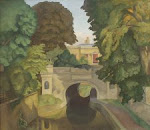
         John Piper, "The Bridge at Tyringham, Buckinghamshire" (1940)

                   November Dream

I wake to sycamore's yellowing leaves against the grey
Of cloud and London brick,
Day's solid walls and faintly luminous sky;
And still I almost see, in mind's eye,
Last night's woodland way
I followed under boughs of gold
Bathed in another light than these
That stand outside my window's narrow space.
No separation set me there, as here, apart
From dream's afresh-created sky and trees.
In that remembered country I was there indeed
While here, in body locked away,
Touch solid wood, wet leaves, earth-coloured flowers
And all is other that I feel and see;
Yet this world we call real, that has no place.

Kathleen Raine, The Oval Portrait (1977).

          John Piper, "Exterior of the Church of St Denis, Faxton" (1940)