
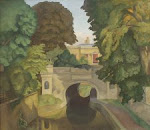
Are poetry and art trivial and of no account in an age of barbarism? Of course not. They are never more important than in times such as these. The barbarians have no conception of what it means to be human. Poetry and art embody all that is good and humane in civilization. They stand as a direct reproach to, and a repudiation of, evil and barbarity. Moreover, evil and barbarity cannot touch them.
St. Ursanne
Leaving the viaduct on the left, and coming over the hill,
We came to a small town, four towers at the corners,
The streets narrow and not dark,
The children playing in green gardens by the waterside.
Was it at the Swan or the White Horse that we stopped?
We walked up to the church and the stone cloister,
Grass growing among the tangle of votive ribbons,
The wax flowers and the twisted wire.
We heard the town-crier ringing a bell under the town clock --
Something about a wandering cow and a job for a waggoner,
Then we looked at the watermill by the stone bridge,
And went back for a Rossi or a Cinzano.
That was at Eastertide, and the fields and meadows
Mellow with cowslips: there were boys on bicycles
With bandoliers of jonquils, and there was an old lady
With a basket of primroses and violets.
It was a quiet town, and not yet broken,
The people kindly, and the priest "a good one as priests go,"
There was a football team, and a lad who enters from the country in the
morning,
Singing: Ohé Oh, Ohé Oh!
Michael Roberts, Orion Marches (Faber and Faber 1939).
The poem was first published in April of 1938, on the eve of that generation's age of barbarism. The horror and suffering that followed are incomprehensible, and cannot be minimized or forgotten. But do they render the poem irrelevant? Quite the opposite. The human world of the poem remains unchanged.

John Maclauchlan Milne (1886-1957)
"Mountainous Landscape with Fir Trees and a Lake" (1931)
In this post I intend to give mountains their due after my recent paeans to seasides. But "St. Ursanne" brings to mind a wonderful seaside poem by R. S. Thomas that has appeared here in the past. In both poems, a quotidian scene casually unfolds before us. (I do not use "quotidian" in a pejorative sense.) Nothing of importance takes place. Or so it seems. Yet both scenes contain all of the beauty and truth of life.
Abersoch
There was that headland, asleep on the sea,
The air full of thunder and the far air
Brittle with lightning; there was that girl
Riding her cycle, hair at half-mast,
And the men smoking, the dinghies at rest
On the calm tide. There were people going
About their business, while the storm grew
Louder and nearer and did not break.
Why do I remember these few things,
That were rumours of life, not life itself
That was being lived fiercely, where the storm raged?
Was it just that the girl smiled,
Though not at me, and the men smoking
Had the look of those who have come safely home?
R. S. Thomas, Tares (Rupert Hart-Davis 1961).

John Maclauchlan Milne, "Loch Tulla" (1933)
A good poem is a complex and ever-evolving thing. It has its origin in the minute particulars of the poet's personal experience of the world. Those particulars are reconstituted and transformed through the poet's act of imagination. A good poem is also an act of preservation: it preserves the poet's imaginative response to a unique set of particulars. This begins as a wholly personal act on the part of the poet: Michael Roberts and R. S. Thomas felt compelled to preserve their experiences of a particular day in St. Ursanne and of a particular day in Abersoch. But, by reading their poems, we in turn preserve and perpetuate those experiences.
Each of us comes to a poem with our own unique set of feelings, thoughts, and circumstances, all of which influence how we react to the poem. This does not mean that we change the poem into what we want it to be. (This is where most modern "literary criticism" goes wrong.) Rather, the poem, which was a wholly personal act of imagination and preservation by the poet, now awakens a wholly personal response in each of us.
At this point, one of the wonders and beauties of poetry emerges: each poem carries with it the possibility of commencing a never-ending and ever-multiplying chain of human responses.
Rioupéroux
High and solemn mountains guard Rioupéroux,
Small untidy village where the river drives a mill:
Frail as wood anemones, white and frail were you,
And drooping a little, like the slender daffodil.
Oh I will go to France again, and tramp the valley through,
And I will change these gentle clothes for clog and corduroy,
And work with the mill-hands of black Rioupéroux,
And walk with you, and talk with you, like any other boy.
James Elroy Flecker, The Bridge of Fire: Poems (Elkin Mathews 1907).
There you have it: by reading "Rioupéroux" we have just preserved and prolonged a sequence of human interaction that began when the poem was published in 1907. James Elroy Flecker died of tuberculosis in 1915 at the age of 30. But we have just renewed his life as a poet.

John Maclauchlan Milne, "Cioch na h-Oighe" (1942)
Bernard Spencer wrote the following lovely and moving poem after his wife Nora died of complications from tuberculosis in 1947. Prior to her death, they had been planning a holiday in the Alps.
At Courmayeur
This climbers' valley with its wayside shrines
(the young crowned Mother and her dying flowers)
became our theme for weeks. Do you remember
the letters that we wrote and how we planned
the journey there and chose our hotel; ours
was to be one "among the pines"?
Guesses went wide; but zigzag past that ridge
the road climbs from the Roman town; there stand
the glittering peaks, and one, the God, immensely
tossing the clouds around his shoulders; here
are what you asked for, summer pastures and
an air with glaciers in its edge.
Under all sounds is mountain water falling;
at night, the river seems to draw much closer;
darling, how did you think I could forget you,
you who for ever stayed behind? Your absence
comes back as hard as rocks. Just now it was
those hangdown flowers that meant recalling.
Bernard Spencer, With Luck Lasting (Hodder & Stoughton 1963).
The lines "darling, how did you think I could forget you,/you who for ever stayed behind?" refer to the couple's frequent separations due to Spencer's foreign postings while he was employed by the British Council. This included a long separation during the Second World War, when he was stranded in Greece and Egypt, while she remained in England.
Thus ends our brief Alpine tour (with a detour to Wales). St. Ursanne, Abersoch, Rioupéroux, and Courmayeur as seen through the eyes of poets: all beyond the reach of evil and untouchable by barbarism.

John Maclauchlan Milne, "Lairig Ghru" (1931)


