From a letter of June 27, 1788, from William Cowper to his close friend Lady Hesketh:
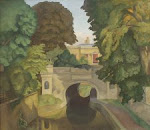
"I must tell you a feat of my dog Beau. Walking by the river side, I observed some water-lilies floating at a little distance from the bank. They are a large white flower, with an orange-coloured eye, very beautiful. I had a desire to gather one, and, having your long cane in my hand, by the help of it endeavoured to bring one of them within my reach. But the attempt proved vain, and I walked forward.
Beau had all the while observed me very attentively. Returning soon after toward the same place, I observed him plunge into the river, while I was about forty yards distant from him; and, when I had nearly reached the spot, he swam to land with a lily in his mouth, which he came and laid at my foot."
Cowper thereafter wrote a poem about Beau ("my spaniel, prettiest of his race") and the water-lily: "The Dog and the Water-Lily: No Fable." Here are the last four stanzas of the poem:
My ramble finished, I return'd.
Beau trotting far before
The floating wreath again discern'd,
And plunging left the shore.
I saw him with that lily cropp'd
Impatient swim to meet
My quick approach, and soon he dropp'd
The treasure at my feet.
Charm'd with the sight, the world, I cried,
Shall hear of this thy deed,
My dog shall mortify the pride
Of man's superior breed;
But, chief, myself I will enjoin,
Awake at duty's call,
To show a love as prompt as thine
To Him who gives me all.
In memory of Emi (March, 1995 - August, 2009).
She brought us countless lilies.
Monday, August 30, 2010
Saturday, August 28, 2010
"One Comes Across The Strangest Things In Walks"
Ivor Gurney admired Walt Whitman. I suspect (and this is pure speculation on my part given my limited knowledge of Gurney) that one of the things that Gurney liked about Whitman was Whitman's (seemingly) stream-of-consciousness cataloguing of what one stumbles upon in the world. Here is a wonderful example from Gurney:
Encounters
One comes across the strangest things in walks:
Fragments of abbey tithe barns fixed in modern,
With Dutch-sort houses, where the water baulks,
Weired up, and brick-kilns broken among fern;
Old troughs, great stone cisterns priests might have blessed
For mere liking, most worthy mounting-stones;
Black timber in red brick, surprisingly placed
Where hill-stone was looked for; and a manor's bones
Spied in the frame of some wisteria'd house;
And mill-falls and sedge-pools, and Saxon faces;
Stream sources happened upon in unlikely places;
And Roman-looking hills of small degree.
The surprise, the good in dignity of poplars
At a road's end, or the white Cotswold scars --
Sheets spread out spotless against the hazel-tree.
And toothless old men, bubbling over with jokes,
And deadly serious once the speaking finished.
Beauty is less, after all, than strange comical folks,
And the wonder of them never and never can become diminished.
Published in The London Mercury, Volume VI, Number 36 (October, 1922).
I hesitate to call attention to one small piece of the marvelous whole, but I cannot help but observe what a beautiful touch it is for Gurney to write "never and never" in the final line rather than simply "never."
Robin Tanner, "June" (1946)
Encounters
One comes across the strangest things in walks:
Fragments of abbey tithe barns fixed in modern,
With Dutch-sort houses, where the water baulks,
Weired up, and brick-kilns broken among fern;
Old troughs, great stone cisterns priests might have blessed
For mere liking, most worthy mounting-stones;
Black timber in red brick, surprisingly placed
Where hill-stone was looked for; and a manor's bones
Spied in the frame of some wisteria'd house;
And mill-falls and sedge-pools, and Saxon faces;
Stream sources happened upon in unlikely places;
And Roman-looking hills of small degree.
The surprise, the good in dignity of poplars
At a road's end, or the white Cotswold scars --
Sheets spread out spotless against the hazel-tree.
And toothless old men, bubbling over with jokes,
And deadly serious once the speaking finished.
Beauty is less, after all, than strange comical folks,
And the wonder of them never and never can become diminished.
Published in The London Mercury, Volume VI, Number 36 (October, 1922).
I hesitate to call attention to one small piece of the marvelous whole, but I cannot help but observe what a beautiful touch it is for Gurney to write "never and never" in the final line rather than simply "never."
Robin Tanner, "June" (1946)
Thursday, August 26, 2010
Euphrasy: "The Land Of Life To Look At And Explore"
I had never seen the word "euphrasy" until I came across it in this poem by Siegfried Sassoon:
Euphrasy
The large untidy February skies --
Some cheerful starlings screeling on a tree --
West wind and low-shot sunlight in my eyes --
Is this decline for me?
The feel of winter finishing once more --
Sense of the present as a tale half told --
The land of life to look at and explore --
Is this, then, to grow old?
Common Chords (1950). Sassoon wrote the poem in 1949, at the age of 63.
Stanley Roy Badmin, "February"
According to the Oxford English Dictionary, "euphrasy" is "a plant, Euphrasia officinalis, formerly held in high repute for its medicinal virtues in the treatment of diseases of the eye." "Eye-bright" is "the popular name of the plant." The OED states that "euphrasy" may be used figuratively, and provides an example from Frederick Faber's Bethlehem (1865): "Eyes which have been touched with the special euphrasy of heaven." A few years after encountering Sassoon's poem, I discovered that Walter de la Mare, who was a friend of Sassoon's, also wrote a poem titled "Euphrasy." It appears in de la Mare's 1938 collection, Memory and Other Poems.
Euphrasy/Eye-Bright
Euphrasy
The large untidy February skies --
Some cheerful starlings screeling on a tree --
West wind and low-shot sunlight in my eyes --
Is this decline for me?
The feel of winter finishing once more --
Sense of the present as a tale half told --
The land of life to look at and explore --
Is this, then, to grow old?
Common Chords (1950). Sassoon wrote the poem in 1949, at the age of 63.
Stanley Roy Badmin, "February"
According to the Oxford English Dictionary, "euphrasy" is "a plant, Euphrasia officinalis, formerly held in high repute for its medicinal virtues in the treatment of diseases of the eye." "Eye-bright" is "the popular name of the plant." The OED states that "euphrasy" may be used figuratively, and provides an example from Frederick Faber's Bethlehem (1865): "Eyes which have been touched with the special euphrasy of heaven." A few years after encountering Sassoon's poem, I discovered that Walter de la Mare, who was a friend of Sassoon's, also wrote a poem titled "Euphrasy." It appears in de la Mare's 1938 collection, Memory and Other Poems.
Euphrasy/Eye-Bright
Labels:
OED,
Siegfried Sassoon,
Stanley Roy Badmin,
Walter de la Mare
Tuesday, August 24, 2010
Edmund Blunden: "Report On Experience"
In an earlier post (March 22, 2010), I quoted these lines from Edmund Blunden's poem "The Sunlit Vale":
I saw the sunlit vale, and the pastoral fairy-tale;
The sweet and bitter scent of the may drifted by;
And never have I seen such a bright bewildering green,
But it looked like a lie,
Like a kindly meant lie.
Poems: 1914-1930 (1930). When the poem was originally published in The London Mercury of October, 1929, it was titled "The Failure." Blunden changed the title to "The Sunlit Vale" when it was published in Poems: 1914-1930.
Edmund Blunden in December of 1916
The feelings expressed in these lines are explored at greater length in Blunden's "Report on Experience":
Report on Experience
I have been young, and now am not too old;
And I have seen the righteous forsaken,
His health, his honour and his quality taken.
This is not what we were formerly told.
I have seen a green country, useful to the race,
Knocked silly with guns and mines, its villages vanished,
Even the last rat and last kestrel banished --
God bless us all, this was peculiar grace.
I knew Seraphina; Nature gave her hue,
Glance, sympathy, note, like one from Eden.
I saw her smile warp, heard her lyric deaden;
She turned to harlotry; -- this I took to be new.
Say what you will, our God sees how they run.
These disillusions are His curious proving
That He loves humanity and will go on loving;
Over there are faith, life, virtue in the sun.
Near and Far (1929).
Edmund Blunden (lower right) in 1917
Blunden was by all accounts a kind, gentle man with a gift for friendship. His poetry and prose are characterized by loving attention to the natural world. But -- to borrow a word from the title of the book for which Blunden will likely be remembered -- the "undertones" of his war experience were never distant. If you read Undertones of War, you understand why it could not be otherwise.
James McIntosh Patrick, "Springtime in Eskdale" (1935)
I saw the sunlit vale, and the pastoral fairy-tale;
The sweet and bitter scent of the may drifted by;
And never have I seen such a bright bewildering green,
But it looked like a lie,
Like a kindly meant lie.
Poems: 1914-1930 (1930). When the poem was originally published in The London Mercury of October, 1929, it was titled "The Failure." Blunden changed the title to "The Sunlit Vale" when it was published in Poems: 1914-1930.
Edmund Blunden in December of 1916
The feelings expressed in these lines are explored at greater length in Blunden's "Report on Experience":
Report on Experience
I have been young, and now am not too old;
And I have seen the righteous forsaken,
His health, his honour and his quality taken.
This is not what we were formerly told.
I have seen a green country, useful to the race,
Knocked silly with guns and mines, its villages vanished,
Even the last rat and last kestrel banished --
God bless us all, this was peculiar grace.
I knew Seraphina; Nature gave her hue,
Glance, sympathy, note, like one from Eden.
I saw her smile warp, heard her lyric deaden;
She turned to harlotry; -- this I took to be new.
Say what you will, our God sees how they run.
These disillusions are His curious proving
That He loves humanity and will go on loving;
Over there are faith, life, virtue in the sun.
Near and Far (1929).
Edmund Blunden (lower right) in 1917
Blunden was by all accounts a kind, gentle man with a gift for friendship. His poetry and prose are characterized by loving attention to the natural world. But -- to borrow a word from the title of the book for which Blunden will likely be remembered -- the "undertones" of his war experience were never distant. If you read Undertones of War, you understand why it could not be otherwise.
James McIntosh Patrick, "Springtime in Eskdale" (1935)
Labels:
Edmund Blunden,
James McIntosh Patrick,
World War I
Sunday, August 22, 2010
"Friday Night In The Royal Station Hotel"
The combination (in my previous post) of Philip Larkin and a scene set in an English hotel brought to mind one of my favorite Larkin poems. I have never stayed in a Royal Station Hotel, but I have stayed in an American hotel or two that reminded me of the mood conjured up by Larkin. The hotel stationery is a lovely touch: who among us has not been seduced by the romantic redolence of hotel stationery? (Even, perhaps, in the Hull Royal Station Hotel.)
Friday Night in the Royal Station Hotel
Light spreads darkly downwards from the high
Clusters of lights over empty chairs
That face each other, coloured differently.
Through open doors, the dining-room declares
A larger loneliness of knives and glass
And silence laid like carpet. A porter reads
An unsold evening paper. Hours pass,
And all the salesmen have gone back to Leeds,
Leaving full ashtrays in the Conference Room.
In shoeless corridors, the lights burn. How
Isolated, like a fort, it is --
The headed paper, made for writing home
(If home existed) letters of exile: Now
Night comes on. Waves fold behind villages.
High Windows (Faber and Faber 1974).
Friday Night in the Royal Station Hotel
Light spreads darkly downwards from the high
Clusters of lights over empty chairs
That face each other, coloured differently.
Through open doors, the dining-room declares
A larger loneliness of knives and glass
And silence laid like carpet. A porter reads
An unsold evening paper. Hours pass,
And all the salesmen have gone back to Leeds,
Leaving full ashtrays in the Conference Room.
In shoeless corridors, the lights burn. How
Isolated, like a fort, it is --
The headed paper, made for writing home
(If home existed) letters of exile: Now
Night comes on. Waves fold behind villages.
High Windows (Faber and Faber 1974).
Friday, August 20, 2010
John Cowper Powys: "In A Hotel Writing-Room"
I first came across "In a Hotel Writing-Room" in Philip Larkin's infamous anthology The Oxford Book of Twentieth-Century English Verse. I say "infamous" because, when the anthology was published in 1973, Larkin was nearly universally excoriated for producing what was regarded as a reactionary, old-fashioned collection which virtually ignored the existence of "modernism." (In other words, the anthology is wonderful.) I suspect that Larkin compiled it with some glee -- much as he delighted in playing the curmudgeonly, conservative misanthrope in his interviews. (Which is not to say that he was not at times curmudgeonly, conservative, and misanthropic -- but I do believe that he was wont to be "naughty," as W. H. Auden once told him.)
But, to return to the poem at hand. It is the only poem by John Cowper Powys (1872-1963) that Larkin included in the anthology. (Powys is, after all, better known for his fiction than for his poetry.) Because I enjoyed the poem, I sought out Powys's other poems in order to find out what I had been missing. I discovered that "In a Hotel Writing-Room" is Powys's finest poem. There are others that are interesting, but nothing approaches it in its creativity and use of language. (I have done the same sort of exploration with respect to other lesser-known poets included in the anthology, and I have had the same experience: Larkin's judgment is -- in the humble opinion of this common reader -- unerring.)
In any event, here is the poem:
In a Hotel Writing-Room
We artists have strange nerves!
That man in front of me,
I had been hating him
Implacably,
Just for the lines and curves
Of his unconscious face,
Lines that brought no disgrace
Upon humanity.
But when that same man spoke,
And with a grunt and wheeze
Asked me how many cs
Had the word "Necessity,"
The cord of my hatred broke.
"For how's a beggar to tell"
He said; -- and I loved him for it --
"With a word as long as hell,
If no wise blighter tells us?"
-- "You are right, my friend. We may score it
Over and over with c;
But at last it is not we
Who spell 'Necessity,'
But Necessity who spells us!"
He smiled. I smiled. And between
Your artist and your drummer
Swept, on a breeze of summer,
A wave of sympathy;
And we even came to wonder
Where -- in the name of thunder --
We had met before this scene.
John Cowper Powys, Wolf's-Bane: Rhymes (1916).
Royal Station Hotel, York
But, to return to the poem at hand. It is the only poem by John Cowper Powys (1872-1963) that Larkin included in the anthology. (Powys is, after all, better known for his fiction than for his poetry.) Because I enjoyed the poem, I sought out Powys's other poems in order to find out what I had been missing. I discovered that "In a Hotel Writing-Room" is Powys's finest poem. There are others that are interesting, but nothing approaches it in its creativity and use of language. (I have done the same sort of exploration with respect to other lesser-known poets included in the anthology, and I have had the same experience: Larkin's judgment is -- in the humble opinion of this common reader -- unerring.)
In any event, here is the poem:
In a Hotel Writing-Room
We artists have strange nerves!
That man in front of me,
I had been hating him
Implacably,
Just for the lines and curves
Of his unconscious face,
Lines that brought no disgrace
Upon humanity.
But when that same man spoke,
And with a grunt and wheeze
Asked me how many cs
Had the word "Necessity,"
The cord of my hatred broke.
"For how's a beggar to tell"
He said; -- and I loved him for it --
"With a word as long as hell,
If no wise blighter tells us?"
-- "You are right, my friend. We may score it
Over and over with c;
But at last it is not we
Who spell 'Necessity,'
But Necessity who spells us!"
He smiled. I smiled. And between
Your artist and your drummer
Swept, on a breeze of summer,
A wave of sympathy;
And we even came to wonder
Where -- in the name of thunder --
We had met before this scene.
John Cowper Powys, Wolf's-Bane: Rhymes (1916).
Royal Station Hotel, York
Labels:
John Cowper Powys,
Philip Larkin,
W. H. Auden
Wednesday, August 18, 2010
James Reeves: "Important Insects"
My post on Thomas Hardy's and Walter de la Mare's poems involving insects put me in mind of a poem by James Reeves. Sorry, but I am unable to offer any thematic connections between the three poems other than . . . insects.
Important Insects
Important insects clamber to the top
Of stalks; look round with uninquiring eyes
And find the world incomprehensible;
Then totter back to earth and circumscribe
Irregular territories pointlessly.
Some insects narcissistically assume
Patterns of spots or stripes or burnished sheen
For purposes of sex or camouflage,
Some tweet or rasp, though most are without speech
Except a low, subliminal, mindless chatter.
Take heart: those scientists are wrong who find
Elements of the human in their systems,
Despite their busy, devious trafficking
Important insects simply do not matter.
The Questioning Tiger (1964).
Jan van Kessel the Younger
"Fruit and Insects" (17th century)
Important Insects
Important insects clamber to the top
Of stalks; look round with uninquiring eyes
And find the world incomprehensible;
Then totter back to earth and circumscribe
Irregular territories pointlessly.
Some insects narcissistically assume
Patterns of spots or stripes or burnished sheen
For purposes of sex or camouflage,
Some tweet or rasp, though most are without speech
Except a low, subliminal, mindless chatter.
Take heart: those scientists are wrong who find
Elements of the human in their systems,
Despite their busy, devious trafficking
Important insects simply do not matter.
The Questioning Tiger (1964).
Jan van Kessel the Younger
"Fruit and Insects" (17th century)
Labels:
James Reeves,
Jan van Kessel,
Thomas Hardy,
Walter de la Mare
Monday, August 16, 2010
Ink, Insects, And Candlelight: Thomas Hardy And Walter De La Mare
For no other reason than that it is now August, I recently revisited the following poem by Thomas Hardy:
An August Midnight
I
A shaded lamp and a waving blind,
And the beat of a clock from a distant floor:
On this scene enter -- winged, horned, and spined --
A longlegs, a moth, and a dumbledore;
While 'mid my page there idly stands
A sleepy fly, that rubs its hands . . .
II
Thus meet we five, in this still place,
At this point of time, at this point in space.
-- My guests parade my new-penned ink,
Or bang at the lamp-glass, whirl, and sink.
'God's humblest, they!' I muse. Yet why?
They know Earth-secrets that know not I.
Graham Sutherland, "Lammas" (1926)
After reading the poem, it occurred to me that, within the past year or so, I had read another poem that featured ink, insects, and candlelight. At my age, notions such as this often arrive without particulars. However, I have found that, if I quietly refer the notion to my brain, and patiently wait, the particulars will usually arrive later. In time, I remembered the poem. It is by Walter de la Mare:
Unwitting
This evening to my manuscript
Flitted a tiny fly;
At the wet ink sedately sipped,
Then seemed to put the matter by,
Mindless of him who wrote it, and
His scrutinizing eye --
That any consciousness indeed
Its actions could descry! . . .
Silence; and wavering candlelight;
Night; and a starless sky.
Inward Companion (1950). (The ellipses are in the original.)
Stanley Roy Badmin
"Evening Light Near Sevenoaks, Kent" (1930)
An August Midnight
I
A shaded lamp and a waving blind,
And the beat of a clock from a distant floor:
On this scene enter -- winged, horned, and spined --
A longlegs, a moth, and a dumbledore;
While 'mid my page there idly stands
A sleepy fly, that rubs its hands . . .
II
Thus meet we five, in this still place,
At this point of time, at this point in space.
-- My guests parade my new-penned ink,
Or bang at the lamp-glass, whirl, and sink.
'God's humblest, they!' I muse. Yet why?
They know Earth-secrets that know not I.
Graham Sutherland, "Lammas" (1926)
After reading the poem, it occurred to me that, within the past year or so, I had read another poem that featured ink, insects, and candlelight. At my age, notions such as this often arrive without particulars. However, I have found that, if I quietly refer the notion to my brain, and patiently wait, the particulars will usually arrive later. In time, I remembered the poem. It is by Walter de la Mare:
Unwitting
This evening to my manuscript
Flitted a tiny fly;
At the wet ink sedately sipped,
Then seemed to put the matter by,
Mindless of him who wrote it, and
His scrutinizing eye --
That any consciousness indeed
Its actions could descry! . . .
Silence; and wavering candlelight;
Night; and a starless sky.
Inward Companion (1950). (The ellipses are in the original.)
Stanley Roy Badmin
"Evening Light Near Sevenoaks, Kent" (1930)
Saturday, August 14, 2010
How To Live, Part Two: "Leave Them Alone"
What shall we do about those persons, institutions, and cultural (so to speak) phenomena that get on our nerves? We each have our own set of irritants, and, if we are not careful, they can drive us to distraction. Here is some advice from Patrick Kavanagh (1906-1967):
Leave Them Alone
There's nothing happening that you hate
That's really worthwhile slamming;
Be patient. If you only wait
You'll see time gently damning
Newspaper bedlamites who raised
Each day the devil's howl,
Versifiers who had seized
The poet's begging bowl;
The whole hysterical passing show
The hour apotheosised
Into a cul-de-sac will go
And be not even despised.
William Baziotes, "The Flesh Eaters" (1952)
Leave Them Alone
There's nothing happening that you hate
That's really worthwhile slamming;
Be patient. If you only wait
You'll see time gently damning
Newspaper bedlamites who raised
Each day the devil's howl,
Versifiers who had seized
The poet's begging bowl;
The whole hysterical passing show
The hour apotheosised
Into a cul-de-sac will go
And be not even despised.
William Baziotes, "The Flesh Eaters" (1952)
Labels:
How To Live,
Patrick Kavanagh,
William Baziotes
Thursday, August 12, 2010
Clothes-Lines: Andrew Young And Edward Thomas
Should anyone ever decide to compile an anthology of poems that take laundry as their subject, they may wish to consider the following two poems. First, from Andrew Young:
The Shepherd's Hut
The smear of blue peat smoke
That staggered on the wind and broke,
The only sign of life,
Where was the shepherd's wife,
Who left those flapping clothes to dry,
Taking no thought for her family?
For, as they bellied out
And limbs took shape and waved about,
I thought, She little knows
That ghosts are trying on her children's clothes.
Stanley Spencer, "The Scarecrow, Cookham" (1934)
And, from Edward Thomas, a few lines from "Up in the Wind":
But no one's moved the wood from off the hill
There at the back, although it makes a noise
When the wind blows, as if a train were running
The other side, a train that never stops
Or ends. And the linen crackles on the line
Like a wood fire rising.
Thomas wrote "Up in the Wind" in December of 1914. One of his field notebooks contains this entry for November 27, 1914: "Clothes on the line violently blowing in wind crackle like a rising woodfire."
Stanley Spencer, "Southwold" (1937)
The Shepherd's Hut
The smear of blue peat smoke
That staggered on the wind and broke,
The only sign of life,
Where was the shepherd's wife,
Who left those flapping clothes to dry,
Taking no thought for her family?
For, as they bellied out
And limbs took shape and waved about,
I thought, She little knows
That ghosts are trying on her children's clothes.
Stanley Spencer, "The Scarecrow, Cookham" (1934)
And, from Edward Thomas, a few lines from "Up in the Wind":
But no one's moved the wood from off the hill
There at the back, although it makes a noise
When the wind blows, as if a train were running
The other side, a train that never stops
Or ends. And the linen crackles on the line
Like a wood fire rising.
Thomas wrote "Up in the Wind" in December of 1914. One of his field notebooks contains this entry for November 27, 1914: "Clothes on the line violently blowing in wind crackle like a rising woodfire."
Stanley Spencer, "Southwold" (1937)
Subscribe to:
Posts (Atom)


