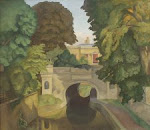

William Wordsworth's meditation on the soothing qualities of moving water leads me to one of my favorite poems by Wallace Stevens. (Come to think of it, it is one of my favorite poems period.) It begins with two lovely variations on Heraclitus's well-known dictum: "You cannot step into the same river twice." Stevens then heads off in his own beautiful direction.
This Solitude of Cataracts
He never felt twice the same about the flecked river,
Which kept flowing and never the same way twice, flowing
Through many places, as if it stood still in one,
Fixed like a lake on which the wild ducks fluttered,
Ruffling its common reflections, thought-like Monadnocks.
There seemed to be an apostrophe that was not spoken.
There was so much that was real that was not real at all.
He wanted to feel the same way over and over.
He wanted the river to go on flowing the same way,
To keep on flowing. He wanted to walk beside it,
Under the buttonwoods, beneath a moon nailed fast.
He wanted his heart to stop beating and his mind to rest
In a permanent realization, without any wild ducks
Or mountains that were not mountains, just to know how it would be,
Just to know how it would feel, released from destruction,
To be a bronze man breathing under archaic lapis,
Without the oscillations of planetary pass-pass,
Breathing his bronzen breath at the azury center of time.
Wallace Stevens, The Auroras of Autumn (1950).
With regard to "thought-like Monadnocks," Stevens writes:
The expression "thought-like Monadnocks" can best be explained by changing it into "Monadnock-like thoughts." The image of a mountain deep in the surface of a lake acquires a secondary character. From the sheen of the surface it becomes slightly unreal: thought-like. Mt. Monadnock is a New England mountain. It is in New Hampshire.
Wallace Stevens, Letter to Renato Poggioli (March 4, 1954), Holly Stevens (editor), Letters of Wallace Stevens (1966), page 823. Poggioli was a publisher who was preparing a translation of Stevens's poems into Italian. Stevens normally avoided such direct explications of his poems.
Stevens also writes:
In this same poem there is the following phrase which may not be perfectly clear to your translator: "the oscillations of planetary pass-pass." It means the seeming-to-go-round of the planets by day and night.
Ibid.
For Stevens, a river usually stands for the world in which we live:
Call it, once more, a river, an unnamed flowing,
Space-filled, reflecting the seasons, the folk-lore
Of each of the senses; call it, again and again,
The river that flows nowhere, like a sea.
Wallace Stevens, "The River of Rivers in Connecticut" (the final four lines).
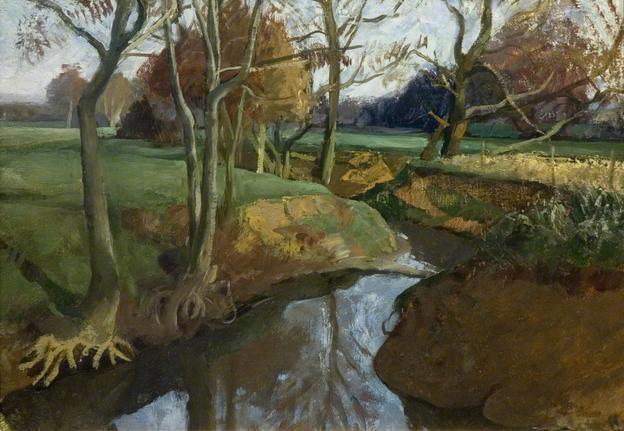
John Aldridge, "The River Pant Near Sculpin's Bridge" (1961)
Sunday, July 31, 2011
Friday, July 29, 2011
"The Unremitting Voice Of Nightly Streams"
Carrying further the observations of Philip Larkin and Patrick Kavanagh on the beneficent qualities of water, let us consider a poem written by William Wordsworth late in his life. The conventional wisdom is that Wordsworth's best years as a poet came to an end around the time that he turned 40 (in 1810). Even Matthew Arnold, who greatly admired Wordsworth's poetry, accedes to this view: "Wordsworth composed verses during a space of some sixty years; and it is no exaggeration to say that within one single decade of those years, between 1798 and 1808, almost all his really first-rate work was produced." (Essays in Criticism, Second Series, "Wordsworth.")
However, there are still gems to be found in Wordsworth's later years. The following poem was written in 1846, when Wordsworth was 76. It is untitled.
The unremitting voice of nightly streams
That wastes so oft, we think, its tuneful powers,
If neither soothing to the worm that gleams
Through dewy grass, nor small birds hushed in bowers,
Nor unto silent leaves and drowsy flowers, --
That voice of unpretending harmony
(For who what is shall measure by what seems
To be, or not to be,
Or tax high Heaven with prodigality?)
Wants not a healing influence that can creep
Into the human breast, and mix with sleep
To regulate the motion of our dreams
For kindly issues -- as through every clime
Was felt near murmuring brooks in earliest time;
As, at this day, the rudest swains who dwell
Where torrents roar, or hear the tinkling knell
Of water-breaks, with grateful heart could tell.
William Wordsworth, The Poetical Works, Volume Four (edited by Ernest de Selincourt and Helen Darbyshire) (1947).
The thought expressed in the poem is a lovely one: the sound of moving water enters our dreams as we sleep and takes us to peaceful places. However, I sometimes feel that Wordsworth should have left out the parenthetical aside that appears in Lines 7 through 9. I find the syntax and the meaning of the lines a bit strange and out-of-place. Moreover, cutting them out would reduce the poem to 14 lines, and potentially turn it into a fine sonnet.
Francis Towne
"Waterfall near Ambleside" (1786)
However, there are still gems to be found in Wordsworth's later years. The following poem was written in 1846, when Wordsworth was 76. It is untitled.
The unremitting voice of nightly streams
That wastes so oft, we think, its tuneful powers,
If neither soothing to the worm that gleams
Through dewy grass, nor small birds hushed in bowers,
Nor unto silent leaves and drowsy flowers, --
That voice of unpretending harmony
(For who what is shall measure by what seems
To be, or not to be,
Or tax high Heaven with prodigality?)
Wants not a healing influence that can creep
Into the human breast, and mix with sleep
To regulate the motion of our dreams
For kindly issues -- as through every clime
Was felt near murmuring brooks in earliest time;
As, at this day, the rudest swains who dwell
Where torrents roar, or hear the tinkling knell
Of water-breaks, with grateful heart could tell.
William Wordsworth, The Poetical Works, Volume Four (edited by Ernest de Selincourt and Helen Darbyshire) (1947).
The thought expressed in the poem is a lovely one: the sound of moving water enters our dreams as we sleep and takes us to peaceful places. However, I sometimes feel that Wordsworth should have left out the parenthetical aside that appears in Lines 7 through 9. I find the syntax and the meaning of the lines a bit strange and out-of-place. Moreover, cutting them out would reduce the poem to 14 lines, and potentially turn it into a fine sonnet.
Francis Towne
"Waterfall near Ambleside" (1786)
Labels:
Francis Towne,
Patrick Kavanagh,
Philip Larkin,
Wordsworth
Wednesday, July 27, 2011
"Where Any-Angled Light Would Congregate Endlessly"
Patrick Kavanagh's "Is," which appeared in my previous post, contains these lines: "Mention water again/Always virginal,/Always original,/It washes out Original Sin." The lines bring to mind a poem by Philip Larkin, a poem that might seem a bit out of character for Larkin. But every so often he does go off on one of these lyrical excursions.
Water
If I were called in
To construct a religion
I should make use of water.
Going to church
Would entail a fording
To dry, different clothes;
My liturgy would employ
Images of sousing,
A furious devout drench,
And I should raise in the east
A glass of water
Where any-angled light
Would congregate endlessly.
Philip Larkin, The Whitsun Weddings (1964).
Just when you think that Larkin is all dreariness and astringency, out comes something like "Water." As a matter of the simple beauty of words, it is hard to beat the assonance and consonance of "Where any-angled light/Would congregate endlessly." "Endlessly" calls up the close of "High Windows" (written nearly thirteen years after "Water"): "Rather than words comes the thought of high windows:/The sun-comprehending glass,/And beyond it, the deep blue air, that shows/Nothing, and is nowhere, and is endless."
Winslow Homer, "Leaping Trout" (1892)
Water
If I were called in
To construct a religion
I should make use of water.
Going to church
Would entail a fording
To dry, different clothes;
My liturgy would employ
Images of sousing,
A furious devout drench,
And I should raise in the east
A glass of water
Where any-angled light
Would congregate endlessly.
Philip Larkin, The Whitsun Weddings (1964).
Just when you think that Larkin is all dreariness and astringency, out comes something like "Water." As a matter of the simple beauty of words, it is hard to beat the assonance and consonance of "Where any-angled light/Would congregate endlessly." "Endlessly" calls up the close of "High Windows" (written nearly thirteen years after "Water"): "Rather than words comes the thought of high windows:/The sun-comprehending glass,/And beyond it, the deep blue air, that shows/Nothing, and is nowhere, and is endless."
Winslow Homer, "Leaping Trout" (1892)
Labels:
Patrick Kavanagh,
Philip Larkin,
Winslow Homer
Monday, July 25, 2011
How To Live, Part Eight: "The Only True Teaching Subsists In Watching Things Moving Or Just Colour Without Comment From The Scholar"
After being successfully treated for lung cancer in 1954 and 1955, Patrick Kavanagh entered a sort of euphoric era in his poetry. We saw this previously in his poem "The Hospital," in which he asserts that "nothing whatever is by love debarred" and then goes on to enumerate the delights of the Rialto Hospital in Dublin. During this post-cancer period, he wrote what have become known as the "Canal Bank poems," because they were prompted by his walks along the Grand Canal in Dublin. The following poem was written during this time. It is a good piece of advice on How to Live.
Is
The important thing is not
To imagine one ought
Have something to say,
A raison d'etre, a plot for the play.
The only true teaching
Subsists in watching
Things moving or just colour
Without comment from the scholar.
To look on is enough
In the business of love.
Casually remark
On a deer running in a park;
Mention water again
Always virginal,
Always original,
It washes out Original Sin.
Name for the future
The everydays of nature
And without being analytic
Create a great epic.
Girls in red blouses,
Steps up to houses,
Sunlight round gables,
Gossip's young fables,
The life of a street.
O wealthy me! O happy state!
With an inexhaustible theme
I'll die in harness,
I'll die in harness with my scheme.
Patrick Kavanagh, Come Dance with Kitty Stobling and Other Poems (1960).
The lines "Name for the future/The everydays of nature" are reminiscent of a line from "The Hospital": "Naming these things is the love-act and its pledge." And, as Kavanagh speaks in this poem of his "inexhaustible theme," he speaks in "The Hospital" of "the inexhaustible adventure of a gravelled yard."
Derek Clarke, "Runner Beans, Stoughton" (1948)
Is
The important thing is not
To imagine one ought
Have something to say,
A raison d'etre, a plot for the play.
The only true teaching
Subsists in watching
Things moving or just colour
Without comment from the scholar.
To look on is enough
In the business of love.
Casually remark
On a deer running in a park;
Mention water again
Always virginal,
Always original,
It washes out Original Sin.
Name for the future
The everydays of nature
And without being analytic
Create a great epic.
Girls in red blouses,
Steps up to houses,
Sunlight round gables,
Gossip's young fables,
The life of a street.
O wealthy me! O happy state!
With an inexhaustible theme
I'll die in harness,
I'll die in harness with my scheme.
Patrick Kavanagh, Come Dance with Kitty Stobling and Other Poems (1960).
The lines "Name for the future/The everydays of nature" are reminiscent of a line from "The Hospital": "Naming these things is the love-act and its pledge." And, as Kavanagh speaks in this poem of his "inexhaustible theme," he speaks in "The Hospital" of "the inexhaustible adventure of a gravelled yard."
Derek Clarke, "Runner Beans, Stoughton" (1948)
Saturday, July 23, 2011
"Crowded With Thoughts That Need A Settled Home"
Sages often counsel us to avoid too much thinking. This is a piece of advice that we hear from the Stoics on one side of the world to the Taoists on the other. William Wordsworth, who is more prolix than, say, Marcus Aurelius or Lao Tzu, nonetheless has similar thoughts. The following untitled poem is one of a group of five poems that appear under the title "Inscriptions Supposed To Be Found In And Near A Hermit's Cell":
Hast thou seen, with flash incessant,
Bubbles gliding under ice,
Bodied forth and evanescent,
No one knows by what device?
Such are thoughts! -- A wind-swept meadow
Mimicking a troubled sea,
Such is life; and death a shadow
From the rock eternity!
Wordsworth wrote the poem in 1818. He revisited the subject at a later date, in a poem that was not published until 1850, the year of his death.
On the Banks of a Rocky Stream
Behold an emblem of our human mind
Crowded with thoughts that need a settled home,
Yet, like to eddying balls of foam
Within this whirlpool, they each other chase
Round and round, and neither find
An outlet nor a resting-place!
Stranger, if such disquietude be thine,
Fall on thy knees and sue for help divine.
John Aldridge, "Still Life" (1958)
Hast thou seen, with flash incessant,
Bubbles gliding under ice,
Bodied forth and evanescent,
No one knows by what device?
Such are thoughts! -- A wind-swept meadow
Mimicking a troubled sea,
Such is life; and death a shadow
From the rock eternity!
Wordsworth wrote the poem in 1818. He revisited the subject at a later date, in a poem that was not published until 1850, the year of his death.
On the Banks of a Rocky Stream
Behold an emblem of our human mind
Crowded with thoughts that need a settled home,
Yet, like to eddying balls of foam
Within this whirlpool, they each other chase
Round and round, and neither find
An outlet nor a resting-place!
Stranger, if such disquietude be thine,
Fall on thy knees and sue for help divine.
John Aldridge, "Still Life" (1958)
Thursday, July 21, 2011
"I'm Just On The Verge Of Seeing How Life Ought To Be Lived"
I have not forgotten my earlier promise to share Philip Larkin's thoughts on the fifties. (The years of one's life, not the decade of -- where I hail from -- Eisenhower and Elvis and Ozzie & Harriet.) What he has to say is pure Larkin: appalling and hilarious. And directly and clear-sightedly to the point.
Larkin turned 50 on August 9, 1972. On August 11, he wrote to Kingsley Amis:
"Funny being fifty, isn't it. I keep seeing obits of chaps who've passed over 'suddenly, aged 55', 'after a short illness, 56', 'after a long illness bravely borne, aged 57' -- and add ten years on, what's ten years? Compared with eternity aaaaaaaaooooooooghghghghghghg ah gets tuft. No, it doesn't bear thinking about. Lucky I've got a bottle of Smith's Glenlivet handy. I begin to think that, give me another ten or twenty years, I'm just on the verge of seeing how life ought to be lived. I'll be just about ready then."
Anthony Thwaite (editor), Selected Letters of Philip Larkin, 1940-1985 (Faber and Faber 1992), page 462.
As I said, pure Larkin: the gloom, the humor, and -- in the end -- the heart of the matter stated plainly: "give me another ten or twenty years, I'm just on the verge of seeing how life ought to be lived." Some of us might say: "How true."
In the same month, Larkin expressed his thoughts more formally:
The View
The view is fine from fifty,
Experienced climbers say;
So, overweight and shifty,
I turn to face the way
That led me to this day.
Instead of fields and snowcaps
And flowered lanes that twist,
The track breaks at my toe-caps
And drops away in mist.
The view does not exist.
Where has it gone, the lifetime?
Search me. What's left is drear.
Unchilded and unwifed, I'm
Able to view that clear:
So final. And so near.
Philip Larkin, Collected Poems (Faber and Faber 1988). (An unrelated aside: how about that for a rhyme: "lifetime" and "unwifed, I'm"?)
George Mackley, "The Ferry" (1951)
Larkin turned 50 on August 9, 1972. On August 11, he wrote to Kingsley Amis:
"Funny being fifty, isn't it. I keep seeing obits of chaps who've passed over 'suddenly, aged 55', 'after a short illness, 56', 'after a long illness bravely borne, aged 57' -- and add ten years on, what's ten years? Compared with eternity aaaaaaaaooooooooghghghghghghg ah gets tuft. No, it doesn't bear thinking about. Lucky I've got a bottle of Smith's Glenlivet handy. I begin to think that, give me another ten or twenty years, I'm just on the verge of seeing how life ought to be lived. I'll be just about ready then."
Anthony Thwaite (editor), Selected Letters of Philip Larkin, 1940-1985 (Faber and Faber 1992), page 462.
As I said, pure Larkin: the gloom, the humor, and -- in the end -- the heart of the matter stated plainly: "give me another ten or twenty years, I'm just on the verge of seeing how life ought to be lived." Some of us might say: "How true."
In the same month, Larkin expressed his thoughts more formally:
The View
The view is fine from fifty,
Experienced climbers say;
So, overweight and shifty,
I turn to face the way
That led me to this day.
Instead of fields and snowcaps
And flowered lanes that twist,
The track breaks at my toe-caps
And drops away in mist.
The view does not exist.
Where has it gone, the lifetime?
Search me. What's left is drear.
Unchilded and unwifed, I'm
Able to view that clear:
So final. And so near.
Philip Larkin, Collected Poems (Faber and Faber 1988). (An unrelated aside: how about that for a rhyme: "lifetime" and "unwifed, I'm"?)
George Mackley, "The Ferry" (1951)
Labels:
George Mackley,
Kingsley Amis,
Philip Larkin
Tuesday, July 19, 2011
"Rolled Round In Earth's Diurnal Course": Revisiting Wordsworth
At times a poem becomes so familiar that one has difficulty seeing it, hearing it, and feeling it freshly. I have lately been dipping into the five-volume Ernest de Selincourt edition of William Wordsworth's Poetical Works. De Selincourt follows Wordsworth's somewhat eccentric practice of arranging the poems according to theme (as opposed to a chronological arrangement based upon the date of composition or the date of first publication). Thus, we are given "Poems of the Fancy," "Poems of the Imagination," "Poems Founded on the Affections," et cetera.
I have discovered that one advantage to this approach is that one encounters Wordsworth's best-known poems as a matter of happenstance, rather than having them arrive on schedule (so to speak) in, say, Lyrical Ballads or the 1807 Poems in Two Volumes. Therefore, when I came upon the following poem the other day it had a freshness to it that it doesn't usually have.
A slumber did my spirit seal;
I had no human fears:
She seemed a thing that could not feel
The touch of earthly years.
No motion has she now, no force;
She neither hears nor sees;
Rolled round in earth's diurnal course,
With rocks, and stones, and trees.
This is one of Wordsworth's "Lucy poems," and much ink has been spilled over exactly what it "means." I will not get into that. Instead, I will make two observations about the words themselves -- specifically, how they sound (in the mind or in the ear). First, I think that the fifth line teaches us a great deal about what "poetry" consists of. Consider two alternative versions of that line using the same words, but in a different order: "She has no motion now, no force" or "She now has no motion, no force." Then, go back to the original.
A second point to think about: every word in the poem consists of one or two syllables, except one: "diurnal." Of course, this may be mere chance. After all, it is said that Wordsworth wrote the poem in one sitting, and he never made any changes to it thereafter. But think of the weight that "diurnal" bears, and the role that it plays, in relation to all of the other words.
Reading "A slumber did my spirit seal" this time around brings to mind something that Matthew Arnold wrote about Wordsworth:
"I remember hearing [Wordsworth] say that 'Goethe's poetry was not inevitable enough.' The remark is striking and true; no line in Goethe, as Goethe said himself, but its maker knew well how it came there. Wordsworth is right, Goethe's poetry is not inevitable; not inevitable enough. But Wordsworth's poetry, when he is at his best, is inevitable, as inevitable as Nature herself. It might seem that Nature not only gave him the matter for his poem, but wrote his poem for him."
Matthew Arnold, "Wordsworth", Essays in Criticism, Second Series (1888).
Graham Sutherland, "Lammas" (1926)
I have discovered that one advantage to this approach is that one encounters Wordsworth's best-known poems as a matter of happenstance, rather than having them arrive on schedule (so to speak) in, say, Lyrical Ballads or the 1807 Poems in Two Volumes. Therefore, when I came upon the following poem the other day it had a freshness to it that it doesn't usually have.
A slumber did my spirit seal;
I had no human fears:
She seemed a thing that could not feel
The touch of earthly years.
No motion has she now, no force;
She neither hears nor sees;
Rolled round in earth's diurnal course,
With rocks, and stones, and trees.
This is one of Wordsworth's "Lucy poems," and much ink has been spilled over exactly what it "means." I will not get into that. Instead, I will make two observations about the words themselves -- specifically, how they sound (in the mind or in the ear). First, I think that the fifth line teaches us a great deal about what "poetry" consists of. Consider two alternative versions of that line using the same words, but in a different order: "She has no motion now, no force" or "She now has no motion, no force." Then, go back to the original.
A second point to think about: every word in the poem consists of one or two syllables, except one: "diurnal." Of course, this may be mere chance. After all, it is said that Wordsworth wrote the poem in one sitting, and he never made any changes to it thereafter. But think of the weight that "diurnal" bears, and the role that it plays, in relation to all of the other words.
Reading "A slumber did my spirit seal" this time around brings to mind something that Matthew Arnold wrote about Wordsworth:
"I remember hearing [Wordsworth] say that 'Goethe's poetry was not inevitable enough.' The remark is striking and true; no line in Goethe, as Goethe said himself, but its maker knew well how it came there. Wordsworth is right, Goethe's poetry is not inevitable; not inevitable enough. But Wordsworth's poetry, when he is at his best, is inevitable, as inevitable as Nature herself. It might seem that Nature not only gave him the matter for his poem, but wrote his poem for him."
Matthew Arnold, "Wordsworth", Essays in Criticism, Second Series (1888).
Graham Sutherland, "Lammas" (1926)
Labels:
Goethe,
Graham Sutherland,
Matthew Arnold,
Wordsworth
Sunday, July 17, 2011
"Some Corner Of The Heart Where Love For Living Thing Can Find A Place"
Musing upon being in one's fifties is, after all, part of a bigger game. As William Wordsworth reminds us, how one inhabits the years -- whether you are 30 or 50 or 80 -- is the real challenge.
Sonnet
To An Octogenarian
Affections lose their object; Time brings forth
No successors; and, lodged in memory,
If love exist no longer, it must die, --
Wanting accustomed food, must pass from earth,
Or never hope to reach a second birth.
This sad belief, the happiest that is left
To thousands, share not Thou; howe'er bereft,
Scorned, or neglected, fear not such a dearth.
Though poor and destitute of friends thou art,
Perhaps the sole survivor of thy race,
One to whom Heaven assigns that mournful part
The utmost solitude of age to face,
Still shall be left some corner of the heart
Where Love for living Thing can find a place.
William Wordsworth, The Poetical Works (1849).
Wordsworth wrote the poem in 1846, when he was in his 76th year. Was he addressing the poem to himself, as well as to the octogenarian to whom it was dedicated? And is it addressed to all of us potential octogenarians, of any age, as a warning, an admonition?
Arthur Kemp (1906-1968), "House at Dusk"
Sonnet
To An Octogenarian
Affections lose their object; Time brings forth
No successors; and, lodged in memory,
If love exist no longer, it must die, --
Wanting accustomed food, must pass from earth,
Or never hope to reach a second birth.
This sad belief, the happiest that is left
To thousands, share not Thou; howe'er bereft,
Scorned, or neglected, fear not such a dearth.
Though poor and destitute of friends thou art,
Perhaps the sole survivor of thy race,
One to whom Heaven assigns that mournful part
The utmost solitude of age to face,
Still shall be left some corner of the heart
Where Love for living Thing can find a place.
William Wordsworth, The Poetical Works (1849).
Wordsworth wrote the poem in 1846, when he was in his 76th year. Was he addressing the poem to himself, as well as to the octogenarian to whom it was dedicated? And is it addressed to all of us potential octogenarians, of any age, as a warning, an admonition?
Arthur Kemp (1906-1968), "House at Dusk"
Friday, July 15, 2011
"A Quality Of Irresponsibility Peculiar To This Century, Known Sometimes As Modernism"
For Philip Larkin, the baleful influence of "modernism" on 20th century culture was embodied in "the three Ps": Pound, Picasso, and Parker (Charlie). Of course, we should bear in mind that Larkin was wont to play the role of reactionary Philistine in order to get a rise out of people (particularly interviewers). But he was entirely serious. And he was entirely correct.
His best discussion of the subject is found in a somewhat out-of-the-way place: his introduction to All What Jazz, a collection of the record (yes, record) reviews that he wrote for The Daily Telegraph in the Sixties and early Seventies. The discussion occurs in the context of Larkin's explanation of his increasing disenchantment with jazz:
"All I am saying is that the term 'modern,' when applied to art, has a more than chronological meaning: it denotes a quality of irresponsibility peculiar to this century, known sometimes as modernism, and once I had classified modern jazz under this heading I knew where I was. I am sure there are books in which the genesis of modernism is set out in full. My own theory is that it is related to an imbalance between the two tensions from which art springs: these are the tension between the artist and his material, and between the artist and his audience, and that in the last seventy-five years or so the second of these has slackened or even perished. In consequence the artist has become over-concerned with his material (hence an age of technical experiment), and, in isolation, has busied himself with the two principal themes of modernism, mystification and outrage."
Philip Larkin, All What Jazz (Faber and Faber 1970; second edition, 1985), page 23.
Larkin then enumerates (entertainingly) some of the typical products of modernism:
"Piqued at being neglected, he has painted portraits with both eyes on the same side of the nose, or smothered a model with paint and rolled her over a blank canvas. He has designed a dwelling-house to be built underground. He has written poems resembling the kind of pictures typists make with their machines during the coffee break, or a novel in gibberish, or a play in which the characters sit in dustbins. He has made a six-hour film of someone asleep. He has carved human figures with large holes in them. And parallel to this activity ('every idiom has its idiot,' as an American novelist has written) there has grown up a kind of critical journalism designed to put it over."
Ibid. The examples given by Larkin (he was writing in 1968) now seem almost quaint given what has passed for "art" and "literature" in the intervening years.
Larkin closes as follows:
"I dislike such things not because they are new, but because they are irresponsible exploitations of technique in contradiction of human life as we know it. This is my essential criticism of modernism, whether perpetrated by Parker, Pound or Picasso: it helps us neither to enjoy nor endure. It will divert us as long as we are prepared to be mystified or outraged, but maintains its hold only by being more mystifying and more outrageous: it has no lasting power."
Ibid, page 27. Larkin adds a footnote to "Parker, Pound or Picasso" in the above passage: "The reader will have guessed by now that I am using these pleasantly alliterative names to represent not only their rightful owners but every practitioner who might be said to have succeeded them."
Alas, the horses have long been gone from the barn. But, as I have suggested before, perhaps each generation feels that this is so. In any case, as "civilization" and "culture" at large go their merry and horrific way, it is always up to someone -- a monk in a dim cell copying manuscripts in the Dark Ages -- to preserve what is of true value. (Well, that's sorted. I will now descend from the soapbox.)
Robin Tanner, "Martin's Hovel" (1927)
His best discussion of the subject is found in a somewhat out-of-the-way place: his introduction to All What Jazz, a collection of the record (yes, record) reviews that he wrote for The Daily Telegraph in the Sixties and early Seventies. The discussion occurs in the context of Larkin's explanation of his increasing disenchantment with jazz:
"All I am saying is that the term 'modern,' when applied to art, has a more than chronological meaning: it denotes a quality of irresponsibility peculiar to this century, known sometimes as modernism, and once I had classified modern jazz under this heading I knew where I was. I am sure there are books in which the genesis of modernism is set out in full. My own theory is that it is related to an imbalance between the two tensions from which art springs: these are the tension between the artist and his material, and between the artist and his audience, and that in the last seventy-five years or so the second of these has slackened or even perished. In consequence the artist has become over-concerned with his material (hence an age of technical experiment), and, in isolation, has busied himself with the two principal themes of modernism, mystification and outrage."
Philip Larkin, All What Jazz (Faber and Faber 1970; second edition, 1985), page 23.
Larkin then enumerates (entertainingly) some of the typical products of modernism:
"Piqued at being neglected, he has painted portraits with both eyes on the same side of the nose, or smothered a model with paint and rolled her over a blank canvas. He has designed a dwelling-house to be built underground. He has written poems resembling the kind of pictures typists make with their machines during the coffee break, or a novel in gibberish, or a play in which the characters sit in dustbins. He has made a six-hour film of someone asleep. He has carved human figures with large holes in them. And parallel to this activity ('every idiom has its idiot,' as an American novelist has written) there has grown up a kind of critical journalism designed to put it over."
Ibid. The examples given by Larkin (he was writing in 1968) now seem almost quaint given what has passed for "art" and "literature" in the intervening years.
Larkin closes as follows:
"I dislike such things not because they are new, but because they are irresponsible exploitations of technique in contradiction of human life as we know it. This is my essential criticism of modernism, whether perpetrated by Parker, Pound or Picasso: it helps us neither to enjoy nor endure. It will divert us as long as we are prepared to be mystified or outraged, but maintains its hold only by being more mystifying and more outrageous: it has no lasting power."
Ibid, page 27. Larkin adds a footnote to "Parker, Pound or Picasso" in the above passage: "The reader will have guessed by now that I am using these pleasantly alliterative names to represent not only their rightful owners but every practitioner who might be said to have succeeded them."
Alas, the horses have long been gone from the barn. But, as I have suggested before, perhaps each generation feels that this is so. In any case, as "civilization" and "culture" at large go their merry and horrific way, it is always up to someone -- a monk in a dim cell copying manuscripts in the Dark Ages -- to preserve what is of true value. (Well, that's sorted. I will now descend from the soapbox.)
Robin Tanner, "Martin's Hovel" (1927)
Wednesday, July 13, 2011
"There Is A Door I Have Shut Until The End Of The World"
This year I find myself at the midpoint of my fifties. Mind you, I have no complaints. Unlike Dante midway through his life's journey, I do not consider myself to be lost in the midst of a dark wood ("selva oscura"). However, I keep being unwittingly confronted with dire pronouncements about this stage of life. Am I too complacent?
For instance, I discovered by chance that Philip Larkin has some fairly horrific (but, as always, entertaining) things to say about one's fifties. (Yes, I know: what a surprise!) But I shall save Mr. Larkin's thoughts for another time. (Hint: they are contained in a letter to Kingsley Amis. Again: what a surprise!) In addition, while idly perusing a volume by Jorge Luis Borges, I came across a poem that I had read before, but hadn't thought about in quite some time. Who knows why these things return to us when they do?
Limits
There is a line of Verlaine I shall not recall again,
There is a nearby street forbidden to my step,
There is a mirror that has seen me for the last time,
There is a door I have shut until the end of the world.
Among the books in my library (I have them before me)
There are some I shall never reopen.
This summer I complete my fiftieth year:
Death reduces me incessantly.
Jorge Luis Borges, A Personal Anthology (1967). The poem is translated by Anthony Kerrigan.
As I did recently with translations of a poem by Wang Wei, it may be interesting to compare Kerrigan's translation with another translator's version.
Boundaries
There is a line by Verlaine that I will not remember again.
There is a street nearby that is off limits to my feet.
There is a mirror that has seen me for the last time.
There is a door I have closed until the end of the world.
Among the books in my library (I'm looking at them now) are some
I will never open.
This summer I will be fifty years old.
Death is using me up, relentlessly.
Jorge Luis Borges, Selected Poems (1999). The poem is translated by Kenneth Krabbenhoft.
Yikes! Death has been "reducing me incessantly" (or "using me up, relentlessly" -- take your pick) for more than five years now. Little did I know.
Eric Ravilious, "Interior at Furlongs" (1939)
For instance, I discovered by chance that Philip Larkin has some fairly horrific (but, as always, entertaining) things to say about one's fifties. (Yes, I know: what a surprise!) But I shall save Mr. Larkin's thoughts for another time. (Hint: they are contained in a letter to Kingsley Amis. Again: what a surprise!) In addition, while idly perusing a volume by Jorge Luis Borges, I came across a poem that I had read before, but hadn't thought about in quite some time. Who knows why these things return to us when they do?
Limits
There is a line of Verlaine I shall not recall again,
There is a nearby street forbidden to my step,
There is a mirror that has seen me for the last time,
There is a door I have shut until the end of the world.
Among the books in my library (I have them before me)
There are some I shall never reopen.
This summer I complete my fiftieth year:
Death reduces me incessantly.
Jorge Luis Borges, A Personal Anthology (1967). The poem is translated by Anthony Kerrigan.
As I did recently with translations of a poem by Wang Wei, it may be interesting to compare Kerrigan's translation with another translator's version.
Boundaries
There is a line by Verlaine that I will not remember again.
There is a street nearby that is off limits to my feet.
There is a mirror that has seen me for the last time.
There is a door I have closed until the end of the world.
Among the books in my library (I'm looking at them now) are some
I will never open.
This summer I will be fifty years old.
Death is using me up, relentlessly.
Jorge Luis Borges, Selected Poems (1999). The poem is translated by Kenneth Krabbenhoft.
Yikes! Death has been "reducing me incessantly" (or "using me up, relentlessly" -- take your pick) for more than five years now. Little did I know.
Eric Ravilious, "Interior at Furlongs" (1939)
Labels:
Eric Ravilious,
Jorge Luis Borges,
Philip Larkin
Subscribe to:
Posts (Atom)


