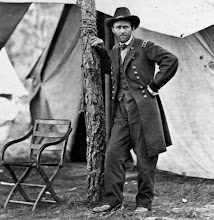
In the country in which I live, we are in the midst of a presidential election campaign. The months between now and the first Tuesday in November lie before us like a yawning abyss. One thing can be stated with absolute certainty and without fear of contradiction: the media will put on a display of "mad agility in compound deceit." (One of my favorite phrases from Saul Bellow. (It is from Mr. Sammler's Planet.) Ten syllables in what may be iambic pentameter. It sounds like something by Shakespeare or Donne. Bellow could have been a poet.)
While at all times protesting their "neutrality." But of course.
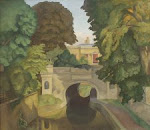
George Price Boyce (1826-1897)
"Newcastle from the Rabbit Banks, Gateshead-on-Tyne" (1864)
The Trade
The language fades. The noise is more
Than ever it has been before,
But all the words grow pale and thin
For lack of sense has done them in.
What wonder, when it is for pay
Millions are spoken every day?
It is the number, not the sense
That brings the speakers pounds and pence.
The words are stretched across the air
Vast distances from here to there,
Or there to here: it does not matter
So long as there is media chatter.
Turn up the sound and let there be
No talking between you and me:
What passes now for human speech
Must come from somewhere out of reach.
C. H. Sisson, What and Who (1994).
Harold Jones, "The Black Door" (c. 1935)
Monday, April 30, 2012
Saturday, April 28, 2012
"So Be Reposed And Praise, Praise, Praise"
Everything is abloom: cherry trees, apple trees, plum trees, pear trees, magnolias, azaleas, tulips, daffodils -- you name it. The grass is deep green and the sky is blue. As I walked through the neighborhood yesterday I thought something along these lines: The world is truly a paradise.
Of course, this sort of feeling cannot last for long. After all, the petals of the cherry blossoms already lie across the grass, the sidewalks, and the cars like a layer of snow. But still . . .
James McIntosh Patrick (1907-1998), "A Castle in Scotland"
Question to Life
Surely you would not ask me to have known
Only the passion of primrose banks in May
Which are merely a point of departure for the play
And yearning poignancy when on their own.
Yet when all is said and done a considerable
Portion of living is found in inanimate
Nature, and a man need not feel miserable
If fate should have decided on this plan of it.
Then there is always the passing gift of affection
Tossed from the windows of high charity
In the office girl and civil servant section
And these are no despisable commodity.
So be reposed and praise, praise, praise
The way it happened and the way it is.
Patrick Kavanagh, Come Dance with Kitty Stobling and Other Poems (1960).
As I have noted before, Patrick Kavanagh experienced a poetic rebirth in the 1950s after his successful surgery for lung cancer in the spring of 1955. During this period he wrote what have come to be known as the "Canal Bank poems." (He wrote many of them during a time when he was wont to take walks along the Grand Canal in Dublin.) Most of the poems are marked by the sort of euphoria that is found in "Question to Life." Other fine examples include "The Hospital" and "Is," which I have previously posted.
Several of the poems are, like "Question to Life," sonnets (or something approaching a sonnet). Please note the rhyming of "inanimate" in line 6 with "this plan of it" in line 8. Very sly! (Evidence of Kavanagh's euphoria, perhaps.)
James McIntosh Patrick, "Boreland Mill, Kirkmichael" (1950)
But, to return to the subject of paradise: "Yet when all is said and done a considerable/Portion of living is found in inanimate/Nature, and a man need not feel miserable/If fate should have decided on this plan of it." Yes. "So be reposed and praise, praise, praise/The way it happened and the way it is." Yes. Despite the cherry blossom petals in the gutter. Despite the news of the world.
James McIntosh Patrick, "Braes o' Lundie"
Of course, this sort of feeling cannot last for long. After all, the petals of the cherry blossoms already lie across the grass, the sidewalks, and the cars like a layer of snow. But still . . .
James McIntosh Patrick (1907-1998), "A Castle in Scotland"
Question to Life
Surely you would not ask me to have known
Only the passion of primrose banks in May
Which are merely a point of departure for the play
And yearning poignancy when on their own.
Yet when all is said and done a considerable
Portion of living is found in inanimate
Nature, and a man need not feel miserable
If fate should have decided on this plan of it.
Then there is always the passing gift of affection
Tossed from the windows of high charity
In the office girl and civil servant section
And these are no despisable commodity.
So be reposed and praise, praise, praise
The way it happened and the way it is.
Patrick Kavanagh, Come Dance with Kitty Stobling and Other Poems (1960).
As I have noted before, Patrick Kavanagh experienced a poetic rebirth in the 1950s after his successful surgery for lung cancer in the spring of 1955. During this period he wrote what have come to be known as the "Canal Bank poems." (He wrote many of them during a time when he was wont to take walks along the Grand Canal in Dublin.) Most of the poems are marked by the sort of euphoria that is found in "Question to Life." Other fine examples include "The Hospital" and "Is," which I have previously posted.
Several of the poems are, like "Question to Life," sonnets (or something approaching a sonnet). Please note the rhyming of "inanimate" in line 6 with "this plan of it" in line 8. Very sly! (Evidence of Kavanagh's euphoria, perhaps.)
James McIntosh Patrick, "Boreland Mill, Kirkmichael" (1950)
But, to return to the subject of paradise: "Yet when all is said and done a considerable/Portion of living is found in inanimate/Nature, and a man need not feel miserable/If fate should have decided on this plan of it." Yes. "So be reposed and praise, praise, praise/The way it happened and the way it is." Yes. Despite the cherry blossom petals in the gutter. Despite the news of the world.
James McIntosh Patrick, "Braes o' Lundie"
Thursday, April 26, 2012
"Blue-Butterfly Day"
I'd like to stay with butterflies a moment longer in order to consider a poem by Robert Frost. I recently posted a haiku by Moritake (1472-1549) in which a butterfly was mistaken for a falling flower:
A fallen flower
Returning to the branch?
It was a butterfly.
Moritake (translated by R. H. Blyth), in R. H. Blyth, Haiku, Volume 1: Eastern Culture (Hokuseido Press 1949), page 24.
The image is a beautiful one. In the following poem, Frost speaks of "flowers that fly," thus echoing (unconsciously, I presume) Moritake. But there is more: Frost's opening image may perhaps be even lovelier. (Not that this is a competition.)
Stanley Spencer
"Englefield House, Cookham" (1951)
Blue-Butterfly Day
It is blue-butterfly day here in spring,
And with these sky-flakes down in flurry on flurry
There is more unmixed color on the wing
Than flowers will show for days unless they hurry.
But these are flowers that fly and all but sing:
And now from having ridden out desire
They lie closed over in the wind and cling
Where wheels have freshly sliced the April mire.
Robert Frost, New Hampshire (1923).
It is fitting that a great poet of snow would think of blue-butterflies as "sky-flakes down in flurry on flurry." And, as one might expect from Frost, there is a twist at the end. Mud and sky.
Perhaps not surprisingly, "Blue-Butterfly Day" is followed in New Hampshire by "The Onset," which is about the first snow of winter. It begins: "Always the same, when on a fated night/At last the gathered snow lets down as white/As may be in dark woods." Nor is it surprising that "The Onset" is in turn followed by "To Earthward." With Frost (save when he is pontificating), one is usually asked to look at all sides of things.
Stanley Spencer
"Cookham from Englefield" (1948)
A fallen flower
Returning to the branch?
It was a butterfly.
Moritake (translated by R. H. Blyth), in R. H. Blyth, Haiku, Volume 1: Eastern Culture (Hokuseido Press 1949), page 24.
The image is a beautiful one. In the following poem, Frost speaks of "flowers that fly," thus echoing (unconsciously, I presume) Moritake. But there is more: Frost's opening image may perhaps be even lovelier. (Not that this is a competition.)
Stanley Spencer
"Englefield House, Cookham" (1951)
Blue-Butterfly Day
It is blue-butterfly day here in spring,
And with these sky-flakes down in flurry on flurry
There is more unmixed color on the wing
Than flowers will show for days unless they hurry.
But these are flowers that fly and all but sing:
And now from having ridden out desire
They lie closed over in the wind and cling
Where wheels have freshly sliced the April mire.
Robert Frost, New Hampshire (1923).
It is fitting that a great poet of snow would think of blue-butterflies as "sky-flakes down in flurry on flurry." And, as one might expect from Frost, there is a twist at the end. Mud and sky.
Perhaps not surprisingly, "Blue-Butterfly Day" is followed in New Hampshire by "The Onset," which is about the first snow of winter. It begins: "Always the same, when on a fated night/At last the gathered snow lets down as white/As may be in dark woods." Nor is it surprising that "The Onset" is in turn followed by "To Earthward." With Frost (save when he is pontificating), one is usually asked to look at all sides of things.
Stanley Spencer
"Cookham from Englefield" (1948)
Tuesday, April 24, 2012
How To Live, Part Fifteen: "A Just Sense Of How Not To Fly"
I am ignorant when it comes to the identity of butterflies. Don't get me wrong: I think that butterflies are lovely. But I don't know their names. Today, while out for a walk, I nearly collided with a creamy white-yellow one that was being blown about in the wind. Was it perhaps a cabbage-white? I wouldn't know. But I like to think it was.
Flying Crooked
The butterfly, a cabbage-white,
(His honest idiocy of flight)
Will never now, it is too late,
Master the art of flying straight,
Yet has -- who knows so well as I? --
A just sense of how not to fly:
He lurches here and here by guess
And God and hope and hopelessness.
Even the aerobatic swift
Has not his flying-crooked gift.
Robert Graves, Poems 1926-1930 (1931).
Paul Nash, "Oxenbridge Pond" (1927-1928)
Butterflies are tricky to watch, aren't they? All that flitting and fluttering, all those sudden turns and reversals, are enough to make you dizzy. But Graves is right: flying crooked is a gift (within a destiny).
Paul Nash, "Mimosa Wood" (1926)
Flying Crooked
The butterfly, a cabbage-white,
(His honest idiocy of flight)
Will never now, it is too late,
Master the art of flying straight,
Yet has -- who knows so well as I? --
A just sense of how not to fly:
He lurches here and here by guess
And God and hope and hopelessness.
Even the aerobatic swift
Has not his flying-crooked gift.
Robert Graves, Poems 1926-1930 (1931).
Paul Nash, "Oxenbridge Pond" (1927-1928)
Butterflies are tricky to watch, aren't they? All that flitting and fluttering, all those sudden turns and reversals, are enough to make you dizzy. But Graves is right: flying crooked is a gift (within a destiny).
Paul Nash, "Mimosa Wood" (1926)
Sunday, April 22, 2012
"The God Of Poetry"
As a general rule, I am wary of Poems About Poetry and Poems About The Writing Of Poetry. It all seems too self-indulgent, self-regarding, and hermetic to me, what with the whole of the world out there to be written about. That being said, as the absolute (but, I hope, benevolent) dictator of this blog, I reserve the right to arbitrarily make exceptions to my arbitrary general rule.
Hence, I present the following Poem About Poetry by Patrick Kavanagh, for whom I am willing to make an exception because he is Patrick Kavanagh. Moreover, the poem takes a skeptical view of the grandiose school of poetry, which also merits an exception to my general rule. And, finally, Kavanagh (not always, but to a great extent) practiced what he is preaching in this poem.
Elsie Barling (1883-1976), "Cornish Mill" (1942)
The God of Poetry
I met a man upon the road
And a solemn man was he,
I said to him: you surely are
The god of poetry.
He never answered my remark,
But solemnly walked on,
Uttering words like 'splendour' and
'Picasso-fingered dawn'.
Then I walked on until I met
Another man and he
Danced with delight -- this surely is
The god of poetry.
All day I walked, all day I searched,
And had no eyes to see
The genuine god who never looks
A bit like poetry.
Patrick Kavanagh, Collected Poems (Allen Lane/Penguin 2004).
Elsie Barling, "Welsh Village"
As evidence that Kavanagh practices what he preaches in "The God of Poetry," I suggest having a look at "Wet Evening in April" (which appeared in my previous post). The following poem (which I have posted before, but which is worth revisiting) is lovely evidence as well.
Consider the Grass Growing
Consider the grass growing
As it grew last year and the year before,
Cool about the ankles like summer rivers,
When we walked on a May evening through the meadows
To watch the mare that was going to foal.
Ibid.
Elsie Barling, "Celtic Landscape"
Hence, I present the following Poem About Poetry by Patrick Kavanagh, for whom I am willing to make an exception because he is Patrick Kavanagh. Moreover, the poem takes a skeptical view of the grandiose school of poetry, which also merits an exception to my general rule. And, finally, Kavanagh (not always, but to a great extent) practiced what he is preaching in this poem.
Elsie Barling (1883-1976), "Cornish Mill" (1942)
The God of Poetry
I met a man upon the road
And a solemn man was he,
I said to him: you surely are
The god of poetry.
He never answered my remark,
But solemnly walked on,
Uttering words like 'splendour' and
'Picasso-fingered dawn'.
Then I walked on until I met
Another man and he
Danced with delight -- this surely is
The god of poetry.
All day I walked, all day I searched,
And had no eyes to see
The genuine god who never looks
A bit like poetry.
Patrick Kavanagh, Collected Poems (Allen Lane/Penguin 2004).
Elsie Barling, "Welsh Village"
As evidence that Kavanagh practices what he preaches in "The God of Poetry," I suggest having a look at "Wet Evening in April" (which appeared in my previous post). The following poem (which I have posted before, but which is worth revisiting) is lovely evidence as well.
Consider the Grass Growing
Consider the grass growing
As it grew last year and the year before,
Cool about the ankles like summer rivers,
When we walked on a May evening through the meadows
To watch the mare that was going to foal.
Ibid.
Elsie Barling, "Celtic Landscape"
Friday, April 20, 2012
"Wet Evening In April"
In this part of the world, one need not wait long for a wet evening in April to come calling. And so, tonight, the following poem by Patrick Kavanagh comes to mind.
Wet Evening in April
The birds sang in the wet trees
And as I listened to them it was a hundred years from now
And I was dead and someone else was listening to them.
But I was glad I had recorded for him the melancholy.
Patrick Kavanagh, Collected Poems (Allen Lane/Penguin 2004).
Charles Ginner, "St John's Church, Chester"
Patrick Kavanagh was more than a little preoccupied with the role of The Poet in society -- perhaps too much so. He wasted a great deal of energy in literary quarreling and in producing satirical verse about the Irish literary and political world. However, I think that "Wet Evening in April" is a lovely evocation of what a poet is capable of doing at his or her best. After all, here we are -- not yet a hundred, but sixty years later -- reading about Patrick Kavanagh's birds singing in the wet April trees. (And thank you, Mr. Kavanagh, for recording the melancholy.)
A serendipitous side-note: I am writing this post on April 19, 2012. In preparing to write the previous paragraph, I thought that I should find out exactly how long it has been since Kavanagh wrote "Wet Evening in April." I checked the Notes to his Collected Poems (edited by Antoinette Quinn) and this is what I found: the poem was first published on April 19, 1952, in Kavanagh's Weekly. Thus, a tiny, but nice, coincidence: the poem was published exactly 60 years ago today.
Charles Ginner, "Hampstead Heath, Spring" (1932)
Wet Evening in April
The birds sang in the wet trees
And as I listened to them it was a hundred years from now
And I was dead and someone else was listening to them.
But I was glad I had recorded for him the melancholy.
Patrick Kavanagh, Collected Poems (Allen Lane/Penguin 2004).
Charles Ginner, "St John's Church, Chester"
Patrick Kavanagh was more than a little preoccupied with the role of The Poet in society -- perhaps too much so. He wasted a great deal of energy in literary quarreling and in producing satirical verse about the Irish literary and political world. However, I think that "Wet Evening in April" is a lovely evocation of what a poet is capable of doing at his or her best. After all, here we are -- not yet a hundred, but sixty years later -- reading about Patrick Kavanagh's birds singing in the wet April trees. (And thank you, Mr. Kavanagh, for recording the melancholy.)
A serendipitous side-note: I am writing this post on April 19, 2012. In preparing to write the previous paragraph, I thought that I should find out exactly how long it has been since Kavanagh wrote "Wet Evening in April." I checked the Notes to his Collected Poems (edited by Antoinette Quinn) and this is what I found: the poem was first published on April 19, 1952, in Kavanagh's Weekly. Thus, a tiny, but nice, coincidence: the poem was published exactly 60 years ago today.
Charles Ginner, "Hampstead Heath, Spring" (1932)
Wednesday, April 18, 2012
"The Blossoms Did Not Betray Me. I Betrayed The Blossoms."
A few months ago, I posted a series of poems in which the poets conveyed their experiences of mistaken identity when it comes to "Frost, Blossoms, Snow, and Moonlight." I neglected to include the following poem by Walter de la Mare in the series. It now seems appropriate.
The Cherry Trees
Under pure skies of April blue I stood,
Where, in wild beauty, cherries were in blow;
And, as sweet fancy willed, see there I could
Boughs thick with blossom, or inch-deep in snow.
Walter de la Mare, Memory and Other Poems (1938).
John Aldridge (1905-1983), "Roofing a New House"
Today was a windy and rainy day, and I fear for the longevity of this year's blossoms. The usual bitter-sweet cherry blossom-spring and leafy-autumn wistfulness arises. Ishikawa Jozan (1583-1672) offers an interesting perspective on this feeling.
Fallen Blossoms on the Eastern Hills
Cherry blossoms filling the ground, sunset filling my eyes:
blossoms vanished, spring old, I feel the passing years.
When blossoms were at their finest I neglected to call.
The blossoms did not betray me. I betrayed the blossoms.
Ishikawa Jozan (translated by Burton Watson), in Burton Watson (editor/translator), Kanshi: The Poetry of Ishikawa Jozan and Other Edo-Period Poets (North Point Press 1990).
John Aldridge, "Landscape" (c. 1940s)
The Cherry Trees
Under pure skies of April blue I stood,
Where, in wild beauty, cherries were in blow;
And, as sweet fancy willed, see there I could
Boughs thick with blossom, or inch-deep in snow.
Walter de la Mare, Memory and Other Poems (1938).
Today was a windy and rainy day, and I fear for the longevity of this year's blossoms. The usual bitter-sweet cherry blossom-spring and leafy-autumn wistfulness arises. Ishikawa Jozan (1583-1672) offers an interesting perspective on this feeling.
Fallen Blossoms on the Eastern Hills
Cherry blossoms filling the ground, sunset filling my eyes:
blossoms vanished, spring old, I feel the passing years.
When blossoms were at their finest I neglected to call.
The blossoms did not betray me. I betrayed the blossoms.
Ishikawa Jozan (translated by Burton Watson), in Burton Watson (editor/translator), Kanshi: The Poetry of Ishikawa Jozan and Other Edo-Period Poets (North Point Press 1990).
Monday, April 16, 2012
"Such Gentle Persistence"
How difficult it is to stop the constant running of the mind! What a challenge it is to simply see. I often remind myself to just look when I am out on my afternoon walk. I always fail miserably.
For instance: cherry blossoms flutter to the ground -- like snowflakes -- in the wind. Does this betoken the remorseless march of Time? Is it a wistful reminder of our mortality? Or is it only cherry blossoms fluttering to the ground in the wind?
Of course, I realize that poetry (and art as a whole) would not exist if we did not try to transform the World. Nevertheless, in the meantime, cherry blossoms (and pear blossoms and plum blossoms and magnolia petals) flutter to the ground in the wind. Like nothing else but themselves.
Laura Knight (1877-1970), "Peach Blossom"
The Wood Anemone
The wood anemone ducks beneath its leaves,
Out early in the year, shadow-boxing the breeze,
Before the bracken overcrowds the woods;
A flower so white it seems to be reflected.
A weightless colour; leaves whose segments are scissored
Away so fine they attach to the stem by a merest thread.
A delicate flower I never saw broken by winds,
It gently persists in a storm,
A sigh that cannot better be defined,
The mere beginning of a feeling too delicate
To even think, let alone articulate.
Such gentle persistence: who is it was turned
Into this flower in a legend I have never heard?
Stanley Cook, Woods Beyond a Cornfield: Collected Poems (Smith/Doorstop Books 1995).
Wilhelm List (1864-1918), "Magnolia"
For instance: cherry blossoms flutter to the ground -- like snowflakes -- in the wind. Does this betoken the remorseless march of Time? Is it a wistful reminder of our mortality? Or is it only cherry blossoms fluttering to the ground in the wind?
Of course, I realize that poetry (and art as a whole) would not exist if we did not try to transform the World. Nevertheless, in the meantime, cherry blossoms (and pear blossoms and plum blossoms and magnolia petals) flutter to the ground in the wind. Like nothing else but themselves.
Laura Knight (1877-1970), "Peach Blossom"
The Wood Anemone
The wood anemone ducks beneath its leaves,
Out early in the year, shadow-boxing the breeze,
Before the bracken overcrowds the woods;
A flower so white it seems to be reflected.
A weightless colour; leaves whose segments are scissored
Away so fine they attach to the stem by a merest thread.
A delicate flower I never saw broken by winds,
It gently persists in a storm,
A sigh that cannot better be defined,
The mere beginning of a feeling too delicate
To even think, let alone articulate.
Such gentle persistence: who is it was turned
Into this flower in a legend I have never heard?
Stanley Cook, Woods Beyond a Cornfield: Collected Poems (Smith/Doorstop Books 1995).
Wilhelm List (1864-1918), "Magnolia"
Saturday, April 14, 2012
Spring: Variations On A Theme
Days come when I feel the need for simple, declarative sentences about the World. On such days, I sometimes read haiku.
When it comes to haiku, one of the first lessons to learn is this: simplicity does not preclude depth and implication. Of course, this applies to poetry -- and art -- as a whole. But haiku is perhaps the extreme instance of the lesson: 3 phrases and 17 syllables in which to encompass the World.
I believe that R. H. Blyth's 4-volume Haiku is still (more than 60 years after its publication) the best study of the cultural, historical, philosophical, and aesthetic background of the art form. In his preface, Blyth provides this preliminary definition:
"Haiku record what Wordsworth calls those 'spots of time,' those moments which for some quite mysterious reason have a peculiar significance. There is a unique quality about the poet's state of feeling on these occasions; it may be very deep, it may be rather shallow, but there is a 'something' about the external things, a 'something' about the inner mind which is unmistakable. Where haiku poets excel all others is in recognizing this 'something' in the most unlikely places and at the most unexpected times.
. . . . . . . . . .
Haiku is a kind of satori, or enlightenment, in which 'we see into the life of things.' We grasp the inexpressible meaning of some quite ordinary thing or fact hitherto entirely overlooked."
R. H. Blyth, Haiku, Volume 1: Eastern Culture (Hokuseido Press 1949), page 8. A side-note: Blyth's reference to Wordsworth reminds me that his knowledge of English poetry was as wide as his knowledge of haiku. The four volumes of Haiku are interspersed with references to English poets and poems. He also wrote an interesting book titled Zen in English Literature and Oriental Classics (1942).
John Lally, "Haddon Hall, Derbyshire" (1954)
Our current season is considered in the following four haiku. All of the translations are by Blyth.
A fallen flower
Returning to the branch?
It was a butterfly.
Moritake (1473-1549).
A cloud of cherry blossoms:
The bell, -- is it Ueno?
Is it Asakusa?
Basho (1644-1694). Ueno and Asakusa are adjacent districts in Tokyo. Ueno was (and is) well-known for its cherry blossoms. Both districts have numerous temples (and, hence, bells).
John Lally, "Landscape with Trees" (1947)
The spring sea,
Gently rising and falling,
The whole day long.
Buson (1716-1783).
The cherry blossoms having fallen,
The temple
Through the branches.
Buson.
John Lally
"St Mary's Church and Ilkeston Town Hall, Derbyshire" (1953)
When it comes to haiku, one of the first lessons to learn is this: simplicity does not preclude depth and implication. Of course, this applies to poetry -- and art -- as a whole. But haiku is perhaps the extreme instance of the lesson: 3 phrases and 17 syllables in which to encompass the World.
I believe that R. H. Blyth's 4-volume Haiku is still (more than 60 years after its publication) the best study of the cultural, historical, philosophical, and aesthetic background of the art form. In his preface, Blyth provides this preliminary definition:
"Haiku record what Wordsworth calls those 'spots of time,' those moments which for some quite mysterious reason have a peculiar significance. There is a unique quality about the poet's state of feeling on these occasions; it may be very deep, it may be rather shallow, but there is a 'something' about the external things, a 'something' about the inner mind which is unmistakable. Where haiku poets excel all others is in recognizing this 'something' in the most unlikely places and at the most unexpected times.
. . . . . . . . . .
Haiku is a kind of satori, or enlightenment, in which 'we see into the life of things.' We grasp the inexpressible meaning of some quite ordinary thing or fact hitherto entirely overlooked."
R. H. Blyth, Haiku, Volume 1: Eastern Culture (Hokuseido Press 1949), page 8. A side-note: Blyth's reference to Wordsworth reminds me that his knowledge of English poetry was as wide as his knowledge of haiku. The four volumes of Haiku are interspersed with references to English poets and poems. He also wrote an interesting book titled Zen in English Literature and Oriental Classics (1942).
John Lally, "Haddon Hall, Derbyshire" (1954)
Our current season is considered in the following four haiku. All of the translations are by Blyth.
A fallen flower
Returning to the branch?
It was a butterfly.
Moritake (1473-1549).
A cloud of cherry blossoms:
The bell, -- is it Ueno?
Is it Asakusa?
Basho (1644-1694). Ueno and Asakusa are adjacent districts in Tokyo. Ueno was (and is) well-known for its cherry blossoms. Both districts have numerous temples (and, hence, bells).
The spring sea,
Gently rising and falling,
The whole day long.
Buson (1716-1783).
The cherry blossoms having fallen,
The temple
Through the branches.
Buson.
"St Mary's Church and Ilkeston Town Hall, Derbyshire" (1953)
Thursday, April 12, 2012
A Proper Place, Part Three: "Discontents In Devon"
Robert Herrick, a Londoner by birth, began serving as vicar of Dean Prior in Devon in 1629. Herrick was wont to complain about this rural location. However, one wonders whether Herrick, who had a playful temperament, did not have his tongue at least partly in cheek when he bemoaned his life in Devon.
To His Household Gods
Rise, household gods, and let us go;
But whither I myself not know.
First, let us dwell on rudest seas;
Next, with severest savages;
Last, let us make our best abode
Where human foot as yet ne'er trod:
Search worlds of ice, and rather there
Dwell than in loathed Devonshire.
Robert Herrick, Hesperides (1648).
David Chatterton, "Devon Scene" (1942)
In 1647, Herrick was removed from his post in Dean Prior due to his alleged royalist sympathies. One would think that he was well rid of the place. However, after the Restoration, Herrick petitioned King Charles II to be reappointed to his vicarage. The petition was granted, and Herrick returned to Dean Prior in 1660. He died there fourteen years later.
Perhaps Devon was Herrick's Proper Place after all. Before he was removed from his post in 1647, he wrote the following poem.
Discontents in Devon
More discontents I never had
Since I was born, than here;
Where I have been, and still am sad,
In this dull Devonshire;
Yet justly too I must confess,
I ne'er invented such
Ennobled numbers for the press
Than where I loathed so much.
Ibid. "Ennobled numbers" is an allusion to Noble Numbers, Herrick's collection of religious poems that was published, together with Hesperides, in 1648.
Robert Bevan, "Burford Farm, Devon" (1918)
The following poem may best reflect Herrick's feelings about Dean Prior and Devon, even though they are not mentioned in the poem.
The Coming of Good Luck
So good luck came, and on my roof did light,
Like noiseless snow, or as the dew of night:
Not all at once, but gently, as the trees
Are by the sunbeams tickled by degrees.
Ibid.
Arthur Henry Andrews (1906-1966), "A Farmhouse in Devon"
To His Household Gods
Rise, household gods, and let us go;
But whither I myself not know.
First, let us dwell on rudest seas;
Next, with severest savages;
Last, let us make our best abode
Where human foot as yet ne'er trod:
Search worlds of ice, and rather there
Dwell than in loathed Devonshire.
Robert Herrick, Hesperides (1648).
David Chatterton, "Devon Scene" (1942)
In 1647, Herrick was removed from his post in Dean Prior due to his alleged royalist sympathies. One would think that he was well rid of the place. However, after the Restoration, Herrick petitioned King Charles II to be reappointed to his vicarage. The petition was granted, and Herrick returned to Dean Prior in 1660. He died there fourteen years later.
Perhaps Devon was Herrick's Proper Place after all. Before he was removed from his post in 1647, he wrote the following poem.
Discontents in Devon
More discontents I never had
Since I was born, than here;
Where I have been, and still am sad,
In this dull Devonshire;
Yet justly too I must confess,
I ne'er invented such
Ennobled numbers for the press
Than where I loathed so much.
Ibid. "Ennobled numbers" is an allusion to Noble Numbers, Herrick's collection of religious poems that was published, together with Hesperides, in 1648.
Robert Bevan, "Burford Farm, Devon" (1918)
The following poem may best reflect Herrick's feelings about Dean Prior and Devon, even though they are not mentioned in the poem.
The Coming of Good Luck
So good luck came, and on my roof did light,
Like noiseless snow, or as the dew of night:
Not all at once, but gently, as the trees
Are by the sunbeams tickled by degrees.
Ibid.
Subscribe to:
Posts (Atom)