Sunday, February 28, 2021

Enchanted Or Disenchanted, Part Seven: Arrival

Last week the first crocuses appeared: two clumps of light purple, dark purple, and white flowers in the muddy far corner of a neighbor's front yard, next to the sidewalk.  This week they have arrived in earnest, blooming everywhere, increasing in number by the day.  More tentatively, a few daffodils with small yellow flowers have emerged here and there.  The tulips still bide their time.

All of this can be explained perfectly well by science, of course.  Or perhaps not.

            The Year's Awakening

How do you know that the pilgrim track
Along the belting zodiac
Swept by the sun in his seeming rounds
Is traced by now to the Fishes' bounds
And into the Ram, when weeks of cloud
Have wrapt the sky in a clammy shroud,
And never as yet a tinct of spring
Has shown in the Earth's apparelling;
        O vespering bird, how do you know,
                How do you know?

How do you know, deep underground,
Hid in your bed from sight and sound,
Without a turn in temperature,
With weather life can scarce endure,
That light has won a fraction's strength,
And day put on some moments' length,
Whereof in merest rote will come,
Weeks hence, mild airs that do not numb;
        O crocus root, how do you know,
                How do you know?

Thomas Hardy, Satires of Circumstance, Lyrics and Reveries, with Miscellaneous Pieces (Macmillan 1914).

In The Varieties of Religious Experience, William James is coy.  One senses that he has a certain sympathy with mysticism (which, for me, is the heart of the book), but he generally remains circumspect with respect to his own feelings until he reaches his "Conclusions."  Then, in the final paragraph, he writes:

"The whole drift of my education goes to persuade me that the world of our present consciousness is only one out of many worlds of consciousness that exist, and that those other worlds must contain experiences which have a meaning for our life also; and that although in the main their experiences and those of this world keep discrete, yet the two become continuous at certain points, and higher energies filter in.  By being faithful in my poor measure to this over-belief, I seem to myself to keep more sane and true."

William James, The Varieties of Religious Experience: A Study in Human Nature (Longmans, Green, and Co. 1902), page 519.

There are those who will think that James does not go far enough. Others will think that he goes too far.  I am simply grateful for this thoughtful articulation of a reasonable way to look at, and live in, the World.  I might quibble with "consciousness" as being too intellectual, abstract, or psychological.  On the other hand, James' philosophy and writings are grounded in psychology (or so it seems to me), so I can understand why he would use the word.  I would lean more toward the presence of "other worlds" of "existence" or "being," rather than "consciousness."  Using either of those words brings immanence into consideration.  But I am far out of my depth at this point.  To wit: please don't ask me what "existence," "being," or "immanence" mean.  I will have no answer.  I have only inarticulable inklings about these things.

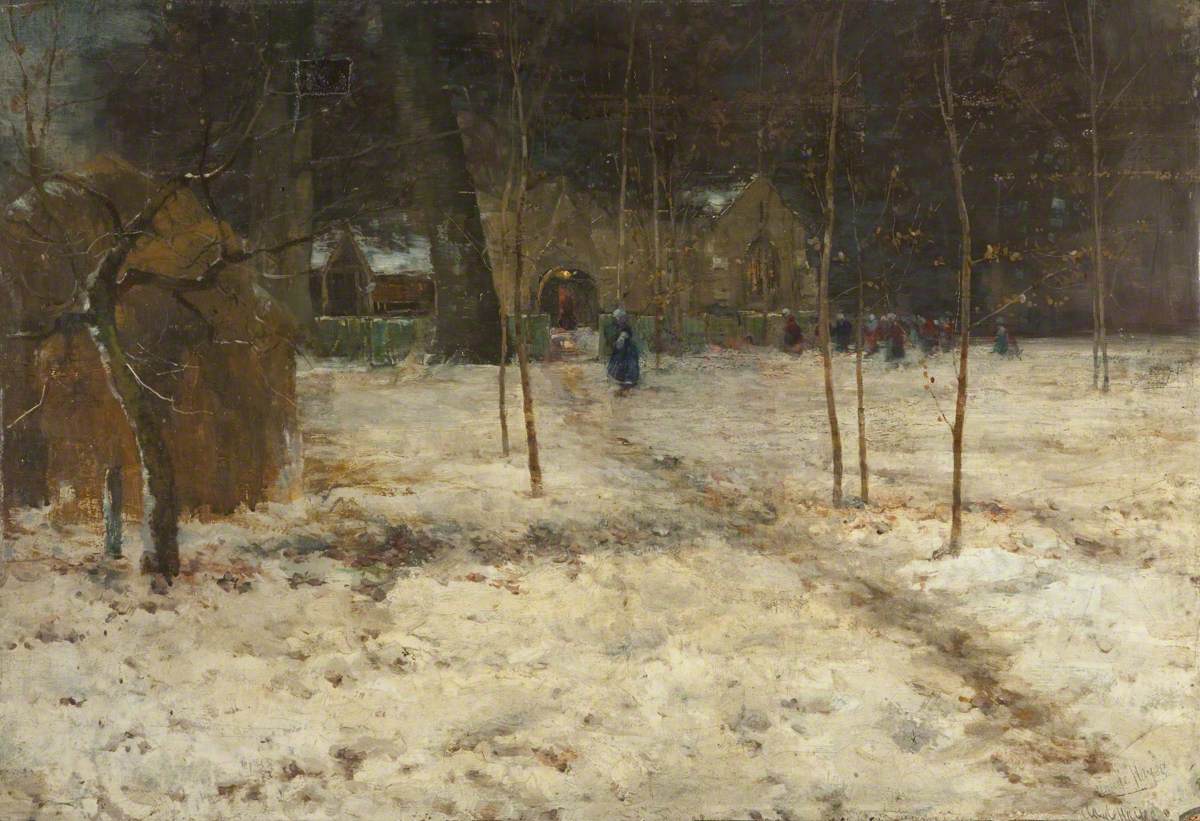
Edward Salter (1835-1934), "Dolerw House and Gardens" (1876)

There is one fine phrase of James' that I have no quibble with whatsoever: "higher energies filter in."  As a Wordsworthian pantheist, I find this thought to be wholly congenial, and true.  For instance: spring is here, regardless of the date on the calendar. Higher energies filter in, bearing messages.  We only need to step out the door to receive them.

          A Contemplation upon Flowers

Brave flowers -- that I could gallant it like you,
          And be as little vain!
You come abroad, and make a harmless shew,
          And to your beds of earth again.
You are not proud:  you know your birth:
For your embroidered garments are from earth.

You do obey your months and times, but I
          Would have it ever spring:
My fate would know no winter, never die,
          Nor think of such a thing.
Oh, that I could my bed of earth but view
And smile, and look as cheerfully as you!

Oh, teach me to see death and not to fear,
          But rather to take truce!
How often have I seen you at a bier,
          And there look fresh and spruce!
You fragrant flowers, then teach me, that my breath
Like yours may sweeten and perfume my death.

Henry King (1592-1669), in Norman Ault (editor), Seventeenth Century Lyrics from the Original Texts (William Sloane 1950).

William James continues the paragraph quoted above as follows:

"I can, of course, put myself into the sectarian scientist's attitude, and imagine vividly that the world of sensations and of scientific laws and objects may be all.  But whenever I do this, I hear that inward monitor of which W. K. Clifford once wrote, whispering the word 'bosh!'  Humbug is humbug, even though it bear the scientific name, and the total expression of human experience, as I view it objectively, invincibly urges me beyond the narrow 'scientific' bounds.  Assuredly, the real world is of a different temperament, -- more intricately built than physical science allows."

William James, The Varieties of Religious Experience: A Study in Human Nature, page 519 (italics in original text).

John Knight (1842-1908), "English Landscape"

James ends the final paragraph of his "Conclusions" with these words (which immediately follow the quotation above):

"So my objective and my subjective conscience both hold me to the over-belief which I express.  Who knows whether the faithfulness of individuals here below to their own poor over-beliefs may not actually help God in turn to be more effectively faithful to his own greater tasks?"

William James, The Varieties of Religious Experience: A Study in Human Nature, p. 519.

The last sentence is absolutely wonderful.  It is revealing (and moving) to see James speak of "faithfulness" in the context of the intellectually distancing term "over-belief."  And the sudden appearance of "God" is startling.  The sentence is beautiful, extraordinary. 

                              In the Fields

Lord, when I look at lovely things which pass,
     Under old trees the shadows of young leaves
Dancing to please the wind along the grass,
     Or the gold stillness of the August sun on the August sheaves,
Can I believe there is a heavenlier world than this?
     And if there is
Will the strange heart of any everlasting thing
     Bring me these dreams that take my breath away?
They come at evening with the home-flying rooks and the scent of hay,
     Over the fields.  They come in Spring.

Charlotte Mew, Complete Poems (edited by John Newton) (Penguin 2000).

Alfred East (1844-1913), "A Bend in the River"

Tuesday, February 16, 2021

Noted In Passing

The Saturday before last was a changeable day.  Lines of dark rain squalls moved from the southwest to the northeast across Puget Sound, followed by intervals of open skies and sunlight.  Lovely.  Not unusual in this part of the world at this time of year.  Ah, but then came the denouement.

At around 4:50 (I looked at my watch), the sun emerged from beneath the last line of white (no longer grey-hearted) clouds over the waters of the Sound.  I happened to be out on my walk, so I stopped beneath a tall, leafless maple to watch the sunset.  However, it was the sky, not the sun, that caught my eye.  Pale blue-yellow at the horizon (just above the Olympic Mountains), it proceeded upward through changing shades of blue.  I followed the deepening progression: powder blue, cornflower blue, azure.  But, at the zenith  -- my head tilted back, the tangled lattice of empty branches overhead set against the depth of the sky -- the names of colors no longer held any meaning.  The eloquent blueness of that patch of sky was beyond the reach of words.  At such times, the only appropriate response is to pay attention, to not turn away.  There is nothing to be said.

A thought by Philippe Jaccottet which appeared in my last post comes to mind: "A thing is beautiful to the extent that it does not let itself be caught."  (Philippe Jaccottet (translated by John Taylor), from "Blazon in Green and White," in Philippe Jaccottet, And, Nonetheless: Selected Prose and Poetry 1990-2009 (Chelsea Editions 2011), page 53.)  A thought by Ludwig Wittgenstein which has appeared here on numerous occasions comes to mind as well: "What we cannot speak about we must pass over in silence."  (Ludwig Wittgenstein, Tractatus Logico-Philosophicus, Proposition 7 (1921) (translated by David Pears and Brian McGuinness).)  An alternative translation: "Whereof one cannot speak, thereof one must be silent." (Translated by C. K. Ogden.)  Yet, here I am, dear readers, providing you with a ten-day old, useless weather report, ending with an inadequate paean to the blue sky.  

Perhaps it is best to approach the beautiful particulars of the World aslant, lest we betray them.

                      The Nest

Four blue stones in this thrush's nest
I leave, content to make the best
Of turquoise, lapis lazuli
Or for that matter of the whole blue sky.

Andrew Young, Collected Poems (Jonathan Cape 1936).

James Craig (1877-1944), "The Kerry Coast" (c. 1928)

"There is a glass bowl with ten goldfish in it on my desk.  I am gazing at it from my bed, as the pain assaults me.  I feel the pain and see the beauty."  Masaoka Shiki (1867-1902) wrote this journal entry on April 15, 1901.  It appears in A Drop of Ink, a journal he wrote from January 24 through May 21, 1901.  His entries over this period were published in the Tokyo daily newspaper Nihon as he wrote them. (Janine Beichman-Yamamoto, "Masaoka Shiki's A Drop of Ink," Monumenta Nipponica, Volume 30, Number 3 (1975), pages 291-315.)  Shiki had been suffering from tuberculosis since 1889, and had been essentially bedridden since 1897.  He died on September 19, 1902, at the age of 34 -- one year and five months after writing this entry.

The poets remind us again and again: Pay attention.  Do not turn away.

               A Dead Mole

Strong-shouldered mole,
That so much lived below the ground,
Dug, fought and loved, hunted and fed,
For you to raise a mound
Was as for us to make a hole;
What wonder now that being dead
Your body lies here stout and square
Buried within the blue vault of the air?

Andrew Young, Collected Poems.

Where would we be without the blue sky, come what may?

"A certain hermit once said, 'There is one thing that even I, who have no worldly entanglements, would be sorry to give up, the beauty of the sky.'  I can understand why he should have felt that way."

Kenkō (1283-1350), Tsurezuregusa, Chapter 20, in Donald Keene (translator), Essays in Idleness: The Tsurezuregusa of Kenkō (Columbia University Press 1967), page 22.

John William Inchbold (1830-1888)
"A Study, in March" (c. 1855)

Between Thursday evening and Saturday afternoon eight or so inches of snow fell.  A warming spell began on Sunday, and on Monday the back garden was alive with birds.  Robins and sparrows, of course. But I also saw a dove beside a bare rose bush, pecking the snowy ground, and a woodpecker atop a post, watching the activity.  They may have been surprised into shelter and silence by the snow, but now -- darting back and forth in brief flight, chattering -- they had no air of winter about them.

Think you, 'mid all this mighty sum
Of things for ever speaking,
That nothing of itself will come,
But we must still be seeking?

William Wordsworth, seventh stanza of "Expostulation and Reply," in Ernest de Selincourt and Helen Darbishire (editors), The Poetical Works of William Wordsworth, Volume Four (Oxford University Press 1947).

And so we make our way through the World.  Beneath an ever-changing sky, blue at times.

     Butterflies a-flutter,
The lullaby changes again and again
     As she walks along.

Masaoka Shiki (translated by R. H. Blyth), in R. H. Blyth, A History of Haiku, Volume Two (Hokuseido Press 1964), page 88.

David Murray (1849-1933), "The Tithe Barns" (1905)

Sunday, January 31, 2021

Significance

A distant, recurring sound on an autumn night.  A human sound, redolent, mysterious, evanescent.

             In Early Autumn, Alone at Night

The leaves of the paulownia move in the cool breeze;
The neighbour's fulling mallet sends out the voice of autumn.
I turn and sleep beneath the eaves;
Waking, the moonlight is half across my couch.  

Po Chü-i (772-846) (translated by R. H. Blyth), in R. H. Blyth, Haiku, Volume 4: Autumn-Winter (Hokuseido Press 1952), page 179.

Another translation of the poem:

            Early Autumn, Alone at Night

Parasol tree by the well, cold leaves stirring;
nearby fulling mallets that speak an autumn sound:
I sleep alone facing the eaves,
wake to find moonlight over half the bed.

Po Chü-i (translated by Burton Watson), in Po Chü-i, Selected Poems (edited and translated by Burton Watson) (Columbia University Press 2000), page 7.

The sound of fulling mallets (or, as they are also called, "fulling blocks") in the night signifies autumn in traditional Chinese poems. "It was customary in the autumn to pound cloth in the process known as fulling to make it suitable for use in winter clothes."  (Burton Watson, The Columbia Book of Chinese Poetry: From Early Times to the Thirteenth Century (Columbia University Press 1984), page 176.) Often, the sound is made by women who are preparing cloth for use in the winter clothes of their lovers or husbands, who are away in the army, anticipating a winter campaign.

A small thing?  Perhaps.  But it gives one pause.  "A thing is beautiful to the extent that it does not let itself be caught."  (Philippe Jaccottet (translated by John Taylor), from "Blazon in Green and White," in Philippe Jaccottet, And, Nonetheless: Selected Prose and Poetry 1990-2009 (Chelsea Editions 2011), page 53.)

Claude Hayes (1852-1922), "Evensong" (1903)

Given the considerable influence of Chinese poetry (particularly the poetry of the T'ang dynasty) on Japanese poetry, fulling blocks are also a common presence in Japanese poems (both waka and haiku) of autumn.  (In Japan, Po Chü-i was the most popular T'ang dynasty poet.  Thus, it is likely that the poem which appears above was well known to Japanese poets.)  The Japanese word for fulling blocks is kinuta. "Kinuta, a wooden mallet and block used to full cloth in the autumn. In poetry, the sound of fulling was associated with the loneliness of a woman left waiting for a traveling husband." (Steven Carter, Traditional Japanese Poetry: An Anthology (Stanford University Press 1991), page 136.)

          Fulling Block

When the wind passes
     in the pines, autumn already
          seems lonely enough —
and then a fulling block echoes
     through Tamakawa Village.

Minamoto no Toshiyori (1055-1129) (translated by Steven Carter), Ibid, page 136.

The poem above is a waka, but the theme appears in haiku as well. For instance:

     Walking along the narrow path,
Listening to the far-off
     Fulling block.

Buson (1716-1784) (translated by R. H. Blyth), in R. H. Blyth, Haiku, Volume 4: Winter-Autumn, page 32.

Buson is chronologically the second of the four traditional great haiku poets: he follows Bashō, and precedes Issa.  The fourth of the greats is Shiki, who wrote this:

     In one house,
A voice of weeping,
     The sound of the fulling block.

Shiki (1867-1902) (translated by R. H. Blyth), Ibid, page 34.

A disembodied sound from somewhere out in the night.  Yet there is a slender human thread.  One pays attention.

     Unheard, these two days,
The fulling block
     Of my neighbour.

Buson (translated by R. H. Blyth), in R. H. Blyth, Haiku, Volume 3: Summer-Autumn (Hokuseido Press 1952), page 336.

George Clausen (1852-1944), "The Village Green at Night"

The World consists of slender threads, doesn't it?  Earlier this week, I saw two sparrows bathing in a puddle, in the morning sun.  I couldn't help but feel they were the first sign of Spring.  Yesterday I noticed that buds have appeared on a row of pear trees in front of a nearby house.  The blue herons have returned to their nests high in the tall pines beside the Ship Canal.  And soon the crocuses will begin to emerge.  "From now on, listening only to the flowers' counsel, antecedent to all knowledge . . ."  (Philippe Jaccottet (translated by Tess Lewis), notebook entry in September, 1983 (ellipses in the original text), in Philippe Jaccottet, The Second Seedtime: Notebooks 1980-1994 (Seagull Books 2017), page 57.)

Why should little things be blamed?
Little things for grace are famed;
Love, the winged and the wild,
Love is but a little child.

Anonymous (translated by Thomas Percival Rogers), in Henry Wellesley (editor), Anthologia Polyglotta: A Selection of Versions in Various Languages, Chiefly from The Greek Anthology (John Murray 1849), page 259.

Slender threads.  Little things.  They all add up.

     The clear voice 
Of the fulling block echoes up
     To the Northern Stars.

Bashō (1644-1694) (translated by R. H. Blyth), in R. H. Blyth, Haiku, Volume 4: Autumn-Winter, p. 31.

Thomas Train (1890-1978), "Headlights"

Monday, January 11, 2021

Presence

As I have remarked here in the past, the feeling that the world is going to Hell in a hand-basket is a timeless feature of human nature. The world has always been, and will always be, going to Hell in a hand-basket.  Still, one pauses: after all, there was someone living an ordinary life in Rome when it was sacked by the barbarians.  It's a matter of timing.  You never know what you're in for.

                                 To Posterity

When books have all seized up like the books in graveyards
And reading and even speaking have been replaced
By other, less difficult, media, we wonder if you
Will find in flowers and fruit the same colour and taste
They held for us for whom they were framed in words,
And will your grass be green, your sky be blue,
Or will your birds be always wingless birds?

Louis MacNeice, Visitations (Faber and Faber 1957).

Thus wrote MacNeice sixty-four years ago.  He was not wrong. Moreover, as I have noted here on several occasions, Wordsworth was not wrong in his preface to the 1802 edition of Lyrical Ballads:

"[A] multitude of causes, unknown to former times, are now acting with a combined force to blunt the discriminating powers of the mind, and, unfitting it for all voluntary exertion, to reduce it to a state of almost savage torpor.  The most effective of these causes are the great national events which are daily taking place, and the increasing accumulation of men in cities, where the uniformity of their occupations produces a craving for extraordinary incident, which the rapid communication of intelligence hourly gratifies."  

Hence, the theme is not new.  Only the technology changes.  So here we are again.  But all is not lost.  Some of us continue to love, and attempt to preserve, what Wordsworth and MacNeice loved (and feared for).  Yet at times one does think of the Roman living contentedly, going about his or her daily business, seeing dust on the horizon, having never heard of Visigoths, Ostrogoths, and Vandals.

William Rothenstein (1872-1945)
"Oakridge Farm, Late Summer" (c. 1925)

I try to keep things in perspective, but since 1968 (the year of the White Album, a memorable World Series between the Tigers and the Cardinals, and nothing else good) I have been of the opinion that the world (as distinguished from the World) is indeed going to Hell in a hand-basket.  However, don't mind me: I suspect I had the same feeling as I emerged bawling from the womb, gasping for air, during the first term of the Eisenhower administration.  Withal, come what may, I have remained quite cheerful.  I simply step outside and take a look around at the World and its beautiful particulars.  How can one be anything but astonished and grateful?

   On Looking Up by Chance at the Constellations

You'll wait a long, long time for anything much
To happen in heaven beyond the floats of cloud
And the Northern Lights that run like tingling nerves.
The sun and moon get crossed, but they never touch,
Nor strike out fire from each other, nor crash out loud.
The planets seem to interfere in their curves,
But nothing ever happens, no harm is done.
We may as well go patiently on with our life,
And look elsewhere than to stars and moon and sun
For the shocks and changes we need to keep us sane.
It is true the longest drouth will end in rain,
The longest peace in China will end in strife.
Still it wouldn't reward the watcher to stay awake
In hopes of seeing the calm of heaven break
On his particular time and personal sight.
That calm seems certainly safe to last tonight.

Robert Frost, West-Running Brook (Henry Holt and Company 1928).

William Rothenstein, "St Martin's Summer"

Nevertheless, one cannot help but take notice of certain things.  Of things that have permanently vanished.  Of irreplaceable things, now broken, that appear to be irreparable.  There's no help for it.  One does notice.  Is this merely a product of growing older, of feeling that it is time to leave the stage, an outdated relic?  Perhaps.  But that denizen of Rome haunts me.

Suddenly, another Roman arrives to remind me:

"If, I say, you separate from the governing principle within you those things which are, as it were, appended to it by its vehement passions, and the times past and future, you make yourself like the firm World of Empedocles, A sphere rejoicing 'midst the circling eddy.  Be solicitous only to live well for the present; and you may go on till death, to spend what remains of life, with tranquillity, with true dignity, and complacence with the divinity within you."

Marcus Aurelius, Meditations, Book XII, Section 3, in Francis Hutcheson and James Moor (translators), The Meditations of the Emperor Marcus Aurelius Antoninus (1742).

Life is ever a matter of attention and gratitude, don't you think?

   On Something Observed

Torn remains of a cobweb,
     one strand dangling down --
a stray petal fluttering by
     has been tangled, caught in its skein,
all day to dance and turn,
     never once resting --
elsewhere in my garden,
     no breeze stirs.

Kokan Shiren (1278-1346) (translated by Burton Watson), in Burton Watson, Japanese Literature in Chinese, Volume 2 (Columbia University Press  1976), page 27.

William Rothenstein, "Oakridge Farm, Late Summer" (1933)

Monday, December 28, 2020

A Choice

Toward the end of November, the robins begin to gather in small flocks for the winter.  One hears the sound of constant twittering in a distant tree.  This seems unusual, since bird-sounds mostly vanish as autumn deepens.  But then one sees them: robins hopping from branch to branch, in conversation, debating their next step.  Once a plan of action has been agreed upon, they leave the tree one by one or in small groups, continuing their daily round.  Our winter companions.  A comforting sight.

                         Time Out

It took that pause to make him realize
The mountain he was climbing had the slant
As of a book held up before his eyes
(And was a text albeit done in plant).
Dwarf cornel, gold-thread, and maianthemum,
He followingly fingered as he read,
The flowers fading on the seed to come;
But the thing was the slope it gave his head:
The same for reading as it was for thought,
So different from the hard and level stare
Of enemies defied and battles fought.
It was the obstinately gentle air
That may be clamored at by cause and sect
But it will have its moment to reflect.

Robert Frost, A Witness Tree (Henry Holt 1942).

Alfred Parsons (1847-1920), "Meadows by the Avon"

Yesterday, near twilight, I walked beside a long puddle filled with intricate, innumerable bare branches, pink-tinged white sunset clouds, and darkening blue sky.  The reflected world seemed to be another world entirely -- beautiful, but out of reach.  A few moments later, still walking, the brilliant puddle now behind me, I realized how completely wrong I had been: what I had seen was the World.  How could it be otherwise?  Do you sometimes find it hard to believe that the World is as beautiful as it is?  It is good to be reminded of one's ignorance.  I receive this reminder every day.  But the World never gives up on me.

"Attachment to the self renders life more opaque.  One moment of complete forgetting and all the screens, one behind the other, become transparent so that you can perceive clarity to its very depths, as far as the eye can see; and at the same time everything becomes weightless.  Thus does the soul truly become a bird."

Philippe Jaccottet (translated by Tess Lewis), notebook entry (May, 1954), in Philippe Jaccottet, Seedtime: Notebooks 1954-1979 (Seagull Books 2013), page 1.

Alfred Parsons, "Poplars in the Thames Valley"

Cloudy winter days sometimes end in a thin band of yellow sky at the edge of the horizon, along the blue-black silhouette of the peaks of the Olympic Mountains, beyond the waters of Puget Sound.  That narrow strip of brightness has a beckoning aspect to it.  A promise of sorts before a long winter night.

Reflections
of stars, on the riverbank?
Plum blossoms.

Sugiwara Sōi (1418-1485) (translated by Steven Carter), in Steven Carter, Haiku Before Haiku: From the Renga Masters to Bashō (Columbia University Press 2011), page 56.

Alfred Parsons,  "On the Cotswolds"

Friday, December 18, 2020

Companion

As autumn departs, a thought: 

All Night Long Regretting
      the End of Autumn

Regret as I may,
even the bell
has a different sound now,
and soon frost will fall
in place of morning dew.

Saigyō (1118-1190) (translated by Burton Watson), in Burton Watson, Saigyō: Poems of a Mountain Home (Columbia University Press 1991), page 84.

I shall never quarrel with my beloved Saigyō, and his thought strikes home.  He and Marcus Aurelius are in agreement: "The world is a continual change."  (Marcus Aurelius, Meditations, Book IV, Section 3, in Francis Hutcheson and James Moor (translators), The Meditations of the Emperor Marcus Aurelius Antoninus (1742).)

And yet.  Last evening I saw a lovely crescent moon high in the southwestern sky over Puget Sound.  Constancy in the midst of change.  Apart from new meteor craters, cosmic debris, and human detritus scattered in a few places, has the moon altered over the millennia for those of us here on the ground, looking upward?  Hasn't it always been our unchanged, unchangeable, reliable companion?
  
     Autumn's bright moon,
However far I walked, still afar off
     In an unknown sky.

Chiyo-ni (1701-1775) (translated by R. H. Blyth), in R. H. Blyth, Haiku, Volume 3: Summer-Autumn (Hokuseido Press 1952), page 388.

Of Chiyo-ni's haiku, Blyth writes: "There is a feeling of separateness here which is not to be denied.  The poetess realizes that she and the moon are two different entities, in a different sky, in a different world."  (Ibid, page 388.)  He then provides a waka which, as Blyth puts it, "expresses that other side of truth":

     Down from the mountain,
The moon
     Accompanied me,
And when I opened the gate,
The moon too entered.

Kotomichi (1798-1868) (translated by R. H. Blyth), Ibid, page 388.

One need not make a choice.  Both are beautiful.  Both are true.

John Aldridge (1905-1983), "Autumn" (1946)

Perhaps Chiyo-ni's view and Kotomichi's view are merged and reconciled in William Wordsworth's lunar encounter in the winter of 1798:

                    A Night-Piece

                            The sky is overspread
With a close veil of one continuous cloud
All whitened by the moon, that just appears,
A dim-seen orb, yet chequers not the ground
With any shadow -- plant, or tower, or tree.
At last a pleasant instantaneous light
Startles the musing man whose eyes are bent
To earth.  He looks around, the clouds are split
Asunder, and above his head he views
The clear moon and the glory of the heavens.
There in a black-blue vault she sails along
Followed by multitudes of stars, that small,
And bright, and sharp along the gloomy vault
Drive as she drives.  How fast they wheel away!
Yet vanish not!  The wind is in the trees;
But they are silent.  Still they roll along
Immeasurably distant, and the vault
Built round by those white clouds, enormous clouds,
Still deepens its interminable depth.
At length the vision closes, and the mind
Not undisturbed by the deep joy it feels,
Which slowly settles into peaceful calm,
Is left to muse upon the solemn scene.

William Wordsworth, 1798 manuscript, in Beth Darlington, "Two Early Texts: A Night-Piece and The Discharged Soldier," in Jonathan Wordsworth (editor), Bicentenary Wordsworth Studies in Memory of John Alban Finch (Cornell University Press 1970), page 431.

1798: that charmed year for William and Dorothy Wordsworth (and for Samuel Taylor Coleridge as well).  Commentators on the poem have noted that it has its origin in a journal entry made by Dorothy on January 25, 1798.  (See, for example: Lucy Newlyn, William and Dorothy Wordsworth: 'All in Each Other' (Oxford University Press 2013), pages 57-59; Kenneth Johnston, The Hidden Wordsworth: Poet, Lover, Rebel, Spy (W. W. Norton 1998), pages 552-553.)  The thought is that William and Dorothy witnessed the scene together while out walking.

"The sky spread over with one continuous cloud, whitened by the light of the moon, which, though her dim shape was seen, did not throw forth so strong a light as to chequer the earth with shadows.  At once the clouds seemed to cleave asunder, and left her in the centre of a black-blue vault.  She sailed along, followed by multitudes of stars, small, and bright, and sharp."

Dorothy Wordsworth, The Grasmere and Alfoxden Journals (Oxford University Press 2002), page 142.

The "vision" recounted by Wordsworth brings to mind one of the fragments of blank verse in his Alfoxden notebook, which he kept during the first three months of 1798:

Of unknown modes of being which on earth,
Or in the heavens, or in the heavens and earth
Exist by mighty combinations, bound
Together by a link, and with a soul
Which makes all one.

William Wordsworth, fragment from the Alfoxden notebook, in Ernest de Selincourt and Helen Darbishire (editors), The Poetical Works of William Wordsworth, Volume 5 (Oxford University Press 1949), pages 340-341.

John Aldridge, "First Frost"

The moon is constant.  But, ah, dear readers, what of us?  

                    The Limit

The silent friendship of the moon
(I misquote Virgil) has kept you company
since that one night or evening
now lost in time, when your restless
eyes first made her out for always
in a patio or a garden since gone to dust.
For always?  I know that someday someone
will find a way of telling you this truth:
"You'll never see the moon aglow again.
You've now attained the limit set for you
by destiny.  No use opening every window
throughout the world.  Too late.  You'll never find her."
Our life is spent discovering and forgetting
that gentle habit of the night.
Take a good look.  It could be the last.

Jorge Luis Borges (translated by Alan Trueblood), in Jorge Luis Borges, Selected Poems (edited by Alexander Coleman) (Viking 1999).

This is no cause for gloom, or melancholy.  Our quickly passing interval of "silent friendship" with the moon, with all the beautiful particulars of the World, is no small thing.  And the thought that the World will go on without us, the moon and the seasons forever coming and going, can be a source of comfort and serenity.

But Saigyō -- wonderful Saigyō -- takes us in another direction altogether:

Were we sure of seeing
a moon like this
in existences to come,
who would be sorry
to leave this life?

Saigyō (translated by Burton Watson), in Burton Watson, Saigyō: Poems of a Mountain Home, page 158.

John Aldridge, "Beslyn's Pond, Great Bardfield"

Thursday, December 3, 2020

Late

I often walk past a long, stately row of thirty tall cottonwoods.  (Yes, once upon a time I counted them.)  They always seem to be the last to lose their leaves.  On a sunny, breezy afternoon, as the season begins to depart, the noble old-timers take on the look of young aspens. Their remaining yellow leaves — high up in swaying boughs — flicker, tremble, and shine in the blue sky, in the honey sunlight.  But now, as December begins, they are nearly empty, and the path beside them is littered in gold.

     Fallen leaves
Come flying from elsewhere:
     Autumn is ending.

Masaoka Shiki (1867-1902) (translated by R. H. Blyth), in R. H. Blyth, Haiku, Volume 3: Summer-Autumn (Hokuseido Press 1952), page 355.

Yet no "Alas!" is called for.  Unannounced and unexpected, gifts are always arriving "from elsewhere," be it autumn, winter, spring, or summer.  Nothing is to be regretted or mourned.  "Earth never grieves!"

Onto the rain porch
     from somewhere outside it comes —
a fallen petal.

Takahama Kyoshi (1874-1959) (translated by Steven Carter), in Steven Carter, Traditional Japanese Poetry: An Anthology (Stanford University Press 1991), page 443.

Edward Waite (1854-1924)
"The Mellow Year Is Hastening To Its Close" (1896)

As the solstice approaches, my afternoon walks have become twilight walks.  All is quiet and dark within the groves of pine trees, save for occasional twitters, or brief songs, from far off in the shadows.  Now and then a solitary crow flies overhead, sometimes silent, sometimes cawing.  The immemorial solitary crow of autumn.

     An autumn evening;
Without a cry,
     A crow passes.

Kishū (1743-1802) (translated by R. H. Blyth) in R. H. Blyth, Haiku, Volume 3: Summer-Autumn, page 345.

At some point in the season, one feels the melancholy pull of decline. The bittersweet wistfulness and wistful bittersweetness of early autumn and high autumn are long gone, irrecoverable.  Funereal but tempting, the late autumn emptiness and darkness beckon.

     Dirge in Woods

A wind sways the pines,
        And below
Not a breath of wild air;
Still as the mosses that glow
On the flooring and over the lines
Of the roots here and there.
The pine-tree drops its dead;
They are quiet, as under the sea.
Overhead, overhead
Rushes life in a race,
As the clouds the clouds chase;
        And we go,
And we drop like the fruits of the tree,
        Even we,
        Even so.

George Meredith,  A Reading of Earth (Macmillan 1888).

Edward Waite, "Autumn Colouring" (1894)

But there shall be no dirges as autumn fades.  As ever in the World of beautiful particulars, departures are followed by arrivals, there is no loss without an attendant gain.  One afternoon this week it seemed for a moment that the long tree shadows laid across the bright green grass of a meadow were the essence of loss and sorrow.  Until one saw the trunks and empty branches of the trees, which had suddenly turned gold in the angled sunlight -- each and every twig glittering, aflame.

               The Last Leaf

I saw how rows of white raindrops
   From bare boughs shone,
And how the storm had stript the leaves
   Forgetting none
Save one left high on a top twig
   Swinging alone;
Then that too bursting into song
   Fled and was gone.

Andrew Young, in Edward Lowbury and Alison Young (editors), The Poetical Works of Andrew Young (Secker & Warburg 1985).

Yes, gifts never cease to arrive from elsewhere.

     Leaning against the tree,
Branches and leaves are few:
     A night of stars.

Masaoka Shiki (translated by R. H. Blyth), in R. H. Blyth, Haiku, Volume 3: Summer-Autumn, page 365.

Edward Waite, "Fall of the Year"

Wednesday, November 18, 2020

How To Live, Part Thirty: Happenstance

A few nights ago, as I drove to a restaurant to pick up dinner, a small grey rabbit, white-tailed, began to cross the street in front of me -- distant, in no danger.  I stopped to let it pass.  Illuminated in the headlights, it paused for a moment, looked in my direction, then continued on, scampering toward the bushes in someone's yard.  We went our separate ways.

"If man were never to fade away like the dews of Adashino, never to vanish like the smoke over Toribeyama, but lingered on forever in the world, how things would lose their power to move us!  The most precious thing in life is its uncertainty."

Kenkō (1283-1350), Tsurezuregusa (Chapter 7), in Donald Keene (translator), Essays in Idleness: The Tsurezuregusa of Kenkō (Columbia University Press 1967), page 7.  

Keene provides this note to "Adashino": "Adashino was the name of a graveyard, apparently situated northwest of Kyoto.  The word adashi (impermanent), contained in the place name, accounted for the frequent use of Adashino in poetry as a symbol of impermanence. The dew is also often used with that meaning."  Ibid, page 8.  With respect to "Toribeyama," Keene notes: "Toribeyama is still the chief graveyard of Kyoto.  Mention of smoke suggests that bodies were cremated there."  Ibid, page 8.

An ancient Chinese burial song comes to mind:

How swiftly it dries,
The dew on the garlic-leaf,
The dew that dries so fast
To-morrow will fall again.
But he whom we carry to the grave
Will never more return.

Anonymous (translated by Arthur Waley), in Arthur Waley, One Hundred and Seventy Chinese Poems (Constable 1918), page 38.

Who knows what will come our way?  In this year, of all years, I need not remind you of that, dear readers.

The wind has brought
     enough fallen leaves
To make a fire.

Ryōkan (1758-1831) (translated by John Stevens), in John Stevens, One Robe, One Bowl: The Zen Poetry of Ryōkan (Weatherhill 1977), page 67.

Alexander Jamieson (1873-1937)
"Halton Lake, Wendover, Buckinghamshire"

Something about the encounter with the rabbit touched my heart: there was a sudden, sighing catch of breath inside me as I watched it move across the road, pause briefly, glance at the headlights, then go on in its careful, intent way.  Why?  What had happened?  Some may say it was merely a rabbit crossing a road, an everyday occurrence. Others may say I'm a sentimental old fool.

I'm afraid I have to conclude that this is where words end.  Think of the handful of luminous moments that remain in your memory.  Your life.  You know them well.  Can you put into words why they are brilliantly clear, unchanged and unchangeable?

"Do not seek to have everything that happens happen as you wish, but wish for everything to happen as it actually does happen, and your life will be serene."

Epictetus, Encheiridion (Section 5), in Epictetus, Discourses, Books III-IV; The Encheiridion (translated by W. A. Oldfather) (Harvard University Press 1928), page 491.

Best to keep silent, wait, and pay attention.  

     Simply trust:
Do not also the petals flutter down,
     Just like that?

Issa (1763-1828) (translated by R. H. Blyth), in R. H. Blyth, Haiku, Volume 2: Spring (Hokuseido Press 1950), page 363.

Alexander Jamieson, "The Old Mill, Weston Turville" (1927)

Just a rabbit crossing a road on a night in late autumn.  Fragile, precious, tenuous, irreplaceable, hung by a gossamer thread.  Fare thee well, dear friend.  Be safe, and live a long rabbit life.

                         Garramor Bay

Now the long wave unfolded falls from the West,
The sandbirds run upon twittering, twinkling feet:
Life is perilous, poised on the lip of a wave,
And the weed that lay yesterday here is clean gone.

O visitor, fugitive creature, thing of a tide,
Make music, my heart, before the long silence.

L. A. G. Strong, Northern Light (Victor Gollancz 1930).

Alexander Jamieson, "Doldowlod on the Wye" (1935)

Thursday, November 5, 2020

Elections

Of course, one should never expect to witness the disappearance of human folly, malice, and bad faith while one is still above ground. "The vale of Soul-making" is no picnic, after all.  Not unexpected are the perennial ways of humanity: it has all been done, seen, and said before.  But it is tiresome nonetheless.  Best to let it all go.

   Autumn Night: Depicting Busyness in the Midst of Silence

White-haired, in clear autumn touched by scenes and emotions,
among hills, moon my companion, living out the last of my life:
night deepens, no lingering echoes from the ten thousand pipes;
all I hear is the sound of the sōzu tapping the rock.

Ishikawa Jōzan (1583-1672) (translated by Burton Watson), in Burton Watson, Kanshi: The Poetry of Ishikawa Jōzan and Other Edo-Period Poets (North Point Press 1990), page 25.  

Watson provides a note on the sōzu: "The sōzu is a device made of a bamboo tube that periodically fills with water from a stream, tips to pour out the water, and then returns to its original position, striking a rock and producing a sharp rapping sound as it does so.  It was intended to scare deer away from the garden."  Ibid, page 25.

Eustace Nash (1886-1969), "Poole Quay from Hamworthy, Dorset"

Watson also provides a note to the phrase "ten thousand pipes" in the third line of the poem:  "The 'ten thousand pipes' . . . is a reference to the famous passage on the noises made by the wind in the forest in the second chapter of Chuang Tzu."  Ibid, page 25.  Here is a portion of the chapter referred to by Watson:

"Tzu-yu said, 'By the piping of earth, then, you mean simply [the sound of] these hollows, and by the piping of man [the sound of] flutes and whistles.  But may I ask about the piping of Heaven?'

"Tzu-ch'i said, 'Blowing on the ten thousand things in a different way, so that each can be itself — all take what they want for themselves, but who does the sounding?'

"Great understanding is broad and unhurried; little understanding is cramped and busy.  Great words are clear and limpid; little words are shrill and quarrelsome.  In sleep, men's spirits go visiting; in waking hours, their bodies hustle.  With everything they meet they become entangled.  Day after day they use their minds in strife, sometimes grandiose, sometimes sly, sometimes petty.  Their little fears are mean and trembly; their great fears are stunned and overwhelming. They bound off like an arrow or a crossbow pellet, certain that they are the arbiters of right and wrong.  They cling to their position as though they had sworn before the gods, sure that they are holding on to victory.  They fade like fall and winter — such is the way they dwindle day by day.  They drown in what they do — you cannot make them turn back.  They grow dark, as though sealed with seals — such are the excesses of their old age.  And when their minds draw near to death, nothing can restore them to the light."

Chuang Tzu (translated by Burton Watson), in Burton Watson, Chuang Tzu: Basic Writings (Columbia University Press 1964), page 32.  The brackets appear in Watson's original text.

Explaining Chuang Tzu's meaning, Watson says this about the use of the word "Heaven" in the passage: "Heaven is not something distinct from earth and man, but a name applied to the natural and spontaneous functioning of the two."  Ibid, page 32.

Charles Kerr (1858-1907), "Carradale"

Yes, it all becomes quite tiresome.  Best to let it go.  The soul's home is in other places.

In paddies among the mountains
girls transplant
rice seedlings —
the sound of their singing
drifts up from far away.

Ryōkan (1758-1831) (translated by Burton Watson), in Burton Watson, Ryōkan: Zen Monk-Poet of Japan (Columbia University Press 1977), page 30.  The poem is a waka.

Robert Coventry (1855-1914), "The Haven" (1908)

Wednesday, October 28, 2020

Leaves

With so many to choose from, I would never attempt to select my "favorite" autumn poem.  They are better thought of as parts of a tapestry.  Or a brocade.

     Unseen by men's eyes,
the colored leaves have scattered
     deep in the mountains:
truly we may say brocade
worn in the darkness of night!

Ki no Tsurayuki (c. 872-945) (translated by Helen Craig McCullough), in Helen Craig McCullough (editor), Kokin Wakashū: The First Imperial Anthology of Japanese Poetry (Stanford University Press 1985), page 73.

A brocade of leaves.  Yes, let the autumn poems come as they may, and fall in random patterns!  That being said, I do have three touchstones that call to me each year.  The following poem invariably arrives with the season's first whispers:

                           The Cranes

The western wind has blown but a few days;
Yet the first leaf already flies from the bough.
On the drying paths I walk in my thin shoes;
In the first cold I have donned my quilted coat.
Through shallow ditches the floods are clearing away;
Through sparse bamboos trickles a slanting light.
In the early dusk, down an alley of green moss,
The garden-boy is leading the cranes home.

Po Chü-i (translated by Arthur Waley), in Arthur Waley, More Translations from the Chinese (George Allen & Unwin 1919), page 57.

Those beguiling tell-tale hints of autumn: tentative, lovely. Inexorable.

Unable to sleep in the pre-dawn hours of the seventh of September, listening to a lone robin singing in the darkness, Edward Thomas later wrote this:

"Gradually I became conscious of nothing but the moan of trees, the monotonous expressionless robin's song, the slightly aching body to which I was, by ties more and more slender, attached.  I felt, I knew, I did not think that there would always be an unknown player, always wind and trees, always a robin singing, always a listener listening in the stark dawn: and I knew also that if I were the listener I should not always lie thus in a safe warm bed thinking myself alive. . . . And so I fell asleep again on the seventh of September."

Edward Thomas, from "Insomnia," in The Last Sheaf (Jonathan Cape 1928), page 43.  The ellipses appear in the original text.  Thomas was most likely writing of the early morning of September 7, 1913.  (Judy Kendall, Edward Thomas: The Origins of His Poetry (University of Wales Press 2012), pages 40-41.)

Samuel Sherwin (1846-1935)
"First Touch of Autumn, Rowditch, Derby" (c. 1917)

Of course, autumn would not be autumn without Thomas Hardy, would it?  And thus each year I return to this:

  Autumn in King's Hintock Park

Here by the baring bough
     Raking up leaves,
Often I ponder how
     Springtime deceives, —
I, an old woman now,
     Raking up leaves.

Here in the avenue
     Raking up leaves,
Lords' ladies pass in view,
     Until one heaves
Sighs at life's russet hue,
     Raking up leaves!

Just as my shape you see
     Raking up leaves,
I saw, when fresh and free,
     Those memory weaves
Into grey ghosts by me,
     Raking up leaves.

Yet, Dear, though one may sigh,
     Raking up leaves,
New leaves will dance on high —
     Earth never grieves! —
Will not, when missed am I
     Raking up leaves.

Thomas Hardy, Time's Laughingstocks and Other Verses (Macmillan 1909).

Very little escaped Hardy's notice.  After the poem was published in The Daily Mail on November 17, 1906, he wrote to a friend: "I happened to be walking, or cycling, through [the park] years ago, when the incident occurred on which the verses are based, and I wrote them out."  (J. O. Bailey, The Poetry of Thomas Hardy: A Handbook and Commentary (University of North Carolina Press 1970), page 207.)  The park was located near the village of Melbury Osmund in Dorset.

"Earth never grieves!"  Something to bear in mind when considering a meditation by Edward Thomas on autumn.

"The scent is that of wood-smoke, of fruit and of some fallen leaves. This is the beginning of the pageant of autumn, of that gradual pompous dying which has no parallel in human life yet draws us to it with sure bonds.  It is a dying of the flesh, and we see it pass through a kind of beauty which we can only call spiritual, of so high and inaccessible a strangeness is it.  The sight of such perfection as is many times achieved before the end awakens the never more than lightly sleeping human desire of permanence.  Now, now is the hour; let things be thus; thus for ever; there is nothing further to be thought of; let these remain.  And yet we have a premonition that remain they must not for more than a little while.  The motion of the autumn is a fall, a surrender, requiring no effort, and therefore the mind cannot long be blind to the cycle of things as in the spring it can when the effort and delight of ascension veils the goal and the decline beyond."

Edward Thomas, The South Country (J. M. Dent 1909), page 272.

William Samuel Jay (1843-1933)
"At the Fall of Leaf, Arundel Park, Sussex" (1883)

My third autumn perennial is by Derek Mahon.  Given that he passed away at the beginning of this month, my visit to it this year comes with sadness.  Yet, we never lose the poets who move us, do we?  I have been living with this poem (and with many others by him) for years, and that will never change.

               Leaves

The prisoners of infinite choice
Have built their house
In a field below the wood
And are at peace.

It is autumn, and dead leaves
On their way to the river
Scratch like birds at the windows
Or tick on the road.

Somewhere there is an afterlife
Of dead leaves,
A stadium filled with an infinite
Rustling and sighing.

Somewhere in the heaven
Of lost futures
The lives we might have led
Have found their own fulfilment.

Derek Mahon, The Snow Party (Oxford University Press 1975).

Just a few weeks ago, when the day was windy the trees still made the sound of the sea, green billows and swells swaying overhead.  Now, a strong breeze brings only a dry rustling, a rattling and scraping of individual leaves, each hold-out with its own voice.  In a dwindling choir.

"In November I returned for a day to a lonely cottage which I had known in the summer, and all its poppies were gone.  Here and there, in the garden, could be found a violet, a primrose, a wood sorrel, flowering; the forget-me-nots and columbines had multiplied and their leaves were dense in the borders; the broad row of cabbages gleamed blue in a brief angry light after rain; the black-currant leaves were of pure, translucent amber at the ends of the branches.  In the little copses the oaks made golden islands in the lakes of leafless ash, and the world was very little in a lasting mist.
*     *     *     *     *
It is a commonplace that each one of us is alone, that every piece of ground where a man stands is a desert island with footprints of unknown creatures all round its shore.  Once or twice in a life we cry out that we know the footprints; we even see the boats of the strangers putting out from the shore; we detect a neighbouring island through the haze, and creatures of like bearing to ourselves moving there.  On that night a high tide had washed every footprint away, and we were satisfied, raising not a languid telescope to the horizon, nor even studying the sands at our feet."

Edward Thomas, from "St. Martin's Summer," in The Heart of England (J. M. Dent 1906), pages 131-132.

Donald Floyd (1892-1965), "The Wye Valley below Wynd Cliff"