Saturday, April 30, 2011

"The World Is A Mist. And Then The World Is Minute And Vast And Clear."

A. S. J. Tessimond's suggestion in "One Almost Might" that we attend to the present moment reminded me of a poem by Elizabeth Bishop.  The poem is about "a student of Blake" whose text is:  "To see a World in a Grain of Sand" (from "Auguries of Innocence"). 

                              Sandpiper

The roaring alongside he takes for granted,
and that every so often the world is bound to shake.
He runs, he runs to the south, finical, awkward,
in a state of controlled panic, a student of Blake.

The beach hisses like fat.  On his left, a sheet
of interrupting water comes and goes
and glazes over his dark and brittle feet.
He runs, he runs straight through it, watching his toes.

-- Watching, rather, the spaces of sand between them,
where (no detail too small) the Atlantic drains
rapidly backwards and downwards.  As he runs,
he stares at the dragging grains.

The world is a mist.  And then the world is
minute and vast and clear.  The tide
is higher or lower.  He couldn't tell you which.
His beak is focussed; he is preoccupied,

looking for something, something, something.
Poor bird, he is obsessed!
The millions of grains are black, white, tan, and gray,
mixed with quartz grains, rose and amethyst.

Elizabeth Bishop, Questions of Travel (1965).

Bishop's use of the word "minute" in line 14 may echo (although I do not wish to get too carried away with this sort of thing) Blake's recurrent use of the phrase "Minute Particulars."  Thus:  "He who would do good to another, must do it in Minute Particulars/General Good is the plea of the scoundrel, hypocrite & flatterer."  Jerusalem, Plate 55, Lines 60-61.  Or:  "He who wishes to see a Vision; a perfect Whole/Must see it in its Minute Particulars."  Jerusalem, Plate 91, Lines 20-21.  It has been suggested that "Minute Particulars" has its source in Boswell's Life of Samuel Johnson, in which Boswell writes:  "minute particulars are frequently characteristic, and always amusing, when they relate to a distinguished man."  But that is more than enough of that.  Let's return to "Sandpiper."

                                        John Nash, "Norfolk Coast"

Thursday, April 28, 2011

"One Almost Might": A. S. J. Tessimond

In the following poem, A. S. J. Tessimond (1902-1962) suggests that we should approach things at a different angle from that proposed by Weldon Kees in "To Build a Quiet City in His Mind."  Rather than constructing something new, perhaps the better course is to slow down and consider things more closely -- unravel a tangled skein.  But Kees and Tessimond may, after all, be seeking the same thing:  peace and quiet. 

                            One Almost Might

Wouldn't you say,
Wouldn't you say: one day,
With a little more time or a little more patience, one might
Disentangle for separate, deliberate, slow delight
One of the moment's hundred strands, unfray
Beginnings from endings, this from that, survey
Say a square inch of the ground one stands on, touch
Part of oneself or a leaf or a sound (not clutch
Or cuff or bruise but touch with finger-tip, ear-
Tip, eyetip, creeping near yet not too near);
Might take up life and lay it on one's palm
And, encircling it in closeness, warmth and calm,
Let it lie still, then stir smooth-softly, and
Tendril by tendril unfold, there on one's hand . . .

One might examine eternity's cross-section
For a second, with slightly more patience, more time for reflection?

A. S. J. Tessimond, The Walls of Glass (1934).  The poem looks relaxed and conversational, but note the rhymed couplets.

                             Robin Tanner, "Wren and Primroses" (1935)

Tuesday, April 26, 2011

"To Build A Quiet City In His Mind": Weldon Kees

Weldon Kees was born in Beatrice, Nebraska in 1914.  In July of 1955, his abandoned car was found near the Golden Gate Bridge in San Francisco.  Although his body was never found, it was assumed that he had committed suicide.  However, an acquaintance claimed to have seen him a few years later in a bar in the Los Angeles area -- the two of them made eye contact, but she said it was clear to her that Kees did not want to be recognized.  The credibility of this anecdote is subject to debate.  Others believed that he disappeared into Mexico.  In any event, he was never heard from again.

Although Kees considered himself to be primarily a poet, he was also an artist (an abstract expressionist), a jazz pianist, a photographer, a filmmaker, and a journalist.  Donald Justice, who rescued Kees's poetry from neglect by assembling a collected edition in 1960, opined that Kees "is one of the bitterest poets in history."  While it is true that his views on American culture and on life in general could be quite scathing, there is also a wit, and an underlying sadness, to his poetry that help to balance out the bitterness perceived by Justice.

         To Build a Quiet City in His Mind

To build a quiet city in his mind:
A single overwhelming wish; to build,
Not hastily, for there is so much wind,
So many eager smilers to be killed,
Obstructions one might overlook in haste:
The ruined structures cluttering the past,

A little at a time and slow is best,
Crawling as though through endless corridors,
Remembering always there are many doors
That open to admit the captured guest
Once only.
                       Yet in spite of loss and guilt
And hurricanes of time, it might be built:

A refuge, permanent, with trees that shade
When all the other cities die and fade.

Weldon Kees, Collected Poems: Revised Edition (edited by Donald Justice) (1975).  The poem is a sonnet.  The line spacing after "Once only" in line 11 appears in the original.

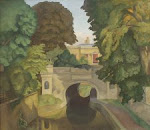
                                     John Aldridge, "Leyden" (c. 1954)       

Sunday, April 24, 2011

"Anyone Happy In This Age And Place Is Daft Or Corrupt"

I have previously noted this conundrum:  Is the world going to Hell in the proverbial handbasket, or is the belief that this is so simply a stage that each generation passes through as it begins to age?  For my part, I believe, first, that the world is in fact going to Hell in a handbasket, and, second, that this belief has absolutely nothing (of course!) to do with my age.  As I have suggested before, my sympathies lie with the views expressed in "On a Vulgar Error" by C. S. Lewis.

Similar sympathies are, perhaps, evident in the following poem by Roy Fuller (1912-1991), which Philip Larkin (ever sly and cheerful) included in The Oxford Book of Twentieth-Century English Verse.  On the other hand, Fuller may be pulling our leg.  Although Fuller -- a committed (pun not intended) socialist in his younger years -- became more conservative as he aged, I am not sure whether he ever fully abandoned his youthful political views.  However, he did look upon modern culture with some skepticism.  In this regard, the essay "Philistines and Jacobins" in his Owls and Artificers: Oxford Lectures on Poetry (1971) is very entertaining.   

                              Translation

Now that the barbarians have got as far as Picra,
And all the new music is written in the twelve-tone scale,
And I am anyway approaching my fortieth birthday,
               I will dissemble no longer.

I will stop expressing my belief in the rosy
Future of man, and accept the evidence
Of a couple of wretched wars and innumerable
               Abortive revolutions.

I will cease to blame the stupidity of the slaves
Upon their masters and nurture, and will say,
Plainly, that they are enemies to culture,
               Advancement and cleanliness.

From progressive organisations, from quarterlies
Devoted to daring verse, from membership of
Committees, from letters of various protest
               I shall withdraw forthwith.

When they call me reactionary I shall smile,
Secure in another dimension.  When they say
'Cinna has ceased to matter' I shall know
               How well I reflect the times.

The ruling class will think I am on their side
And make friendly overtures, but I shall retire
To the side further from Picra and write some poems
               About the doom of the whole boiling.

Anyone happy in this age and place
Is daft or corrupt.  Better to abdicate
From a material and spiritual terrain
               Fit only for barbarians.

Roy Fuller, Counterparts (1954).  Lempriere's Bibliotheca Classica states that Picra was "a lake of Africa, which Alexander crossed when he went to consult the oracle of Ammon."  It is also possible that Fuller is alluding humorously to "hiera picra," which is defined in the OED as "a purgative drug composed of aloes and canella bark."  It is my understanding that "hiera picra" may be translated as "holy bitter" or "sacred bitter."  Gaius Helvius Cinna was a Roman poet who (according to Plutarch) was murdered at Julius Caesar's funeral when he was mistaken for the conspirator Lucius Cornelius Cinna. 

                                                      Henry Raeburn
              "Reverend Robert Walker Skating on Duddingston Loch"
                                                           (c. 1795)               

Friday, April 22, 2011

Lists, Part Three: Michael Longley On Edward Thomas, Edmund Blunden, And Thomas Hardy

Although the following poem by Michael Longley has a list at its physical center, it is far, far more than a "list poem."  The subject is "poetry" -- in a wonderful, touching, ever-expanding number of senses.

                                   Poetry

When he was billeted in a ruined house in Arras
And found a hole in the wall beside his bed
And, rummaging inside, his hand rested on Keats
By Edward Thomas, did Edmund Blunden unearth
A volume which 'the tall, Shelley-like figure'
Gathering up for the last time his latherbrush,
Razor, towel, comb, cardigan, cap comforter,
Water bottle, socks, gas mask, great coat, rifle
And bayonet, hurrying out of the same building
To join his men and march into battle, left
Behind him like a gift, the author's own copy?
When Thomas Hardy died his widow gave Blunden
As a memento of many visits to Max Gate
His treasured copy of Edward Thomas's Poems.

Michael Longley, The Weather in Japan (Jonathan Cape 2000).  Max Gate was Thomas Hardy's home in Dorset.  Blunden visited Hardy there often, sometimes accompanied by Siegfried Sassoon.  (And, on one occasion, by T. E. Lawrence.)

Michael Longley states in a note that "Poetry" is "based on episodes from Edmund Blunden by Barry Webb."  The episodes of which Longley speaks are these:

"One find late in 1918 caused [Blunden] particular pleasure.  Billeted in a ruined house in Arras, he found a hole in the wall by the side of his bed.  Feeling inside, his hand rested on a copy of Edward Thomas's study of John Keats.  Thomas had been killed at the battle of Arras, and Edmund never gave up hope that it was the author's own copy:  'I fancied that I could see the tall, Shelley-like figure of the poet gathering together his equipment for the last time, hastening out of this ruined building to join his men and march into battle, and forgetting his copy of John Keats.'
. . . . . .
On Hardy's death in 1928 his widow presented Edmund with Hardy's treasured copy of Edward Thomas's Poems as a memento of these visits [to Max Gate]."

Barry Webb, Edmund Blunden: A Biography (Yale University Press 1990), pages 56 and 135.

                            Stanley Spencer, "Map Reading" (1927-1932)
                       Sandham Memorial Chapel, Burghclere, Hampshire

Wednesday, April 20, 2011

"Consider The Grass Growing": Patrick Kavanagh

The fields that I pass through on my daily walk are now full of deep-green wild grasses -- things are no longer matted and tangled and grey.  A small item amid the news of the world, but one that bears attending to.

          Consider the Grass Growing

Consider the grass growing
As it grew last year and the year before,
Cool about the ankles like summer rivers
When we walked on a May evening through the meadows
To watch the mare that was going to foal.

Patrick Kavanagh, Selected Poems (1996).  Kavanagh wrote the poem in 1943.

                                  John Brett, "The River Dart" (1866)

Monday, April 18, 2011

"Let Us Go Home Across The Shires": W. S. Graham

My knowledge of the poetry of W. S. Graham (1918-1986) is limited to what I have encountered here and there in anthologies.  I recently came across the following lovely poem by him.

          The Stepping Stones

I have my yellow boots on to walk
Across the shires where I hide
Away from my true people and all
I can't put easily into my life.

So you will see I am stepping on
The stones between the runnels getting
Nowhere nowhere.  It is almost
Embarrassing to be alive alone.

Take my hand and pull me over from
The last stone on to the moss and
The three celandines.  Now my dear
Let us go home across the shires.

W. S. Graham, Collected Poems (Faber and Faber 1979).

I found the poem in The Bloodaxe Book of 20th Century Poetry (Bloodaxe Books 2000), which is edited by Edna Longley.  We owe a debt of gratitude to Longley for her work on the poetry and prose of Edward Thomas, which culminated in The Annotated Collected Poems of 2008.  Her criticism is excellent, and may be found in Poetry and Posterity, Poetry in the Wars, and other volumes.  She is the wife of Michael Longley, whose admiration for Edward Thomas is evident in his own poetry.

                         Richard Eurich, "The Road to Grassington" (1971)

Saturday, April 16, 2011

"Cut Grass Lies Frail"

Now, on sunny afternoons, the peaceful drone of lawn mowers can be heard in the distance.  The scent of freshly-cut grass arrives on the breeze.  White and yellow daffodils border the lawns.  The magnolias and dogwoods are in bloom.  The scene is like something out of a Philip Larkin pastoral.  (Such scenes do exist -- together with a hint of mortality, of course.)

               Cut Grass

Cut grass lies frail:
Brief is the breath
Mown stalks exhale.
Long, long the death

It dies in the white hours
Of young-leafed June
With chestnut flowers,
With hedges snowlike strewn,

White lilac bowed,
Lost lanes of Queen Anne's lace,
And that high-builded cloud
Moving at summer's pace.

Philip Larkin, High Windows (Faber and Faber 1974). 

               Stanley Roy Badmin, "Spring in the West Country" (1963)

Thursday, April 14, 2011

Lists, Part Two: "The Ice-Cream Man"

Michael Longley is a master of listing.  He has said:  "nothing remains ordinary if you look at it for long enough."  In the following poem -- one of his finest, I think -- Longley transforms a list into a profound lament for the human cost of the violence in his native Northern Ireland.     

                          The Ice-cream Man

Rum and raisin, vanilla, butter-scotch, walnut, peach:
You would rhyme off the flavours.  That was before
They murdered the ice-cream man on the Lisburn Road
And you bought carnations to lay outside his shop.
I named for you all the wild flowers of the Burren
I had seen in one day:  thyme, valerian, loosestrife,
Meadowsweet, tway blade, crowfoot, ling, angelica,
Herb robert, marjoram, cow parsley, sundew, vetch,
Mountain avens, wood sage, ragged robin, stitchwort,
Yarrow, lady's bedstraw, bindweed, bog pimpernel.

Michael Longley, Gorse Fires (Cape 1991).

Who would have thought that a simple list of wild flowers could be so heartbreaking?  Or could tell us so much about the value of life?  I take it back: this is, of course, not a "simple" list at all.

                          Eero Jarnefelt, "Pond Water Crowfoot" (1895)   

Tuesday, April 12, 2011

"Love Without Hope": Two Poems On The Same Theme

The following poem is one of Robert Graves's best-known poems -- at any rate, it seems to pop up in anthologies quite a bit.  It shows that, when he isn't in one of his moony, mythological, exasperating "White Goddess" moods, Graves is very good indeed.

                      Love Without Hope

Love without hope, as when the young bird-catcher
Swept off his tall hat to the Squire's own daughter,
So let the imprisoned larks escape and fly
Singing about her head, as she rode by.

Robert Graves, The Welchman's Hose (1925).

For some reason, I thought of "Love Without Hope" in connection with a poem by Joan Barton.  But now I wonder if these two poems are in fact "on the same theme."  In any event . . .

                           The Mistress

The short cut home lay through the cemetery --
A suburban shrubbery swallowing up old graves
Iron palings tipped with rusted fleur-de-lys
A sort of cottage orne at the gates,
Ridiculous and sad;

And lost in their laurel groves,
Eaten up by moss,
Stained marble, flaking stone like hatches down,
The unloved unvisited dead:

In the no-man's-land of dusk a short cut home --
The exultant sense of life a trail of fire
Drawn into that tunnel roofed with the cypress smell
And walled with silence adding year to year:

Too far, too far: always
Under the smothering boughs in airless dark
The spirit dwindled, and the fire
Flickered then failed:

Gently implacably from the shade
The indecipherable dedications spoke
'Dear wife' . . . 'devoted mother' . . .
'Beloved child' . . .

Joan Barton, The Mistress and Other Poems (1972).

                                     Richard Eurich, "Sea Wall" (1985)