All the talk of "falling" -- of leaves and of lives -- in Rainer Maria Rilke's "Autumn" got me to thinking about one of my favorite poems by Derek Mahon. The poem has appeared here previously, but, as I have noted before, I am not averse to circling back on my tracks. My rationalization is (I fear that I am repeating myself again): we are never the same person that we were the last time we read a particular poem. You cannot step into the same river twice, or something along those lines. At least I hope so.
Henry Lamb, "Tea Things" (1932)
Leaves
The prisoners of infinite choice
Have built their house
In a field below the wood
And are at peace.
It is autumn, and dead leaves
On their way to the river
Scratch like birds at the windows
Or tick on the road.
Somewhere there is an afterlife
Of dead leaves,
A stadium filled with an infinite
Rustling and sighing.
Somewhere in the heaven
Of lost futures
The lives we might have led
Have found their own fulfilment.
Derek Mahon, The Snow Party (Oxford University Press 1975).
Thomas Henslow Barnard (1898-1992), "Still Life"
Saturday, September 29, 2012
Thursday, September 27, 2012
Two Autumns
A few years ago, I posted two translations of Rainer Maria Rilke's poem "Herbsttag" ("Autumn Day"). I have since suggested that I find Rilke's poetry to be a bit overwrought for my taste. But I acknowledged that the fault is likely my own for not being able to match his passion. However, when it comes to autumn, a little overwroughtness is acceptable at times.
All of which leads to another poem by Rilke, one that is perhaps less well-known than "Autumn Day." I again offer two translations, since the different approaches of translators can be interesting.
Samuel Palmer, "The Weald of Kent" (c. 1833)
Autumn
The leaves are falling, falling from far away,
as though a distant garden died above us;
they fall, fall with denial in their wave.
And through the night the hard earth falls
farther than the stars in solitude.
We all are falling. Here, this hand falls.
And see -- there goes another. It's in us all.
And yet there's One whose gently holding hands
let this falling fall and never land.
Rainer Maria Rilke (translated by William Gass), in William Gass, Reading Rilke: Reflections on the Problems of Translation (Knopf 1999).
Samuel Palmer, "Pastoral with a Horse-Chestnut Tree"
Fall
after Rilke
The leaves are falling, falling from trees
in dying gardens far above us; as if their slow
free-fall was the sky declining.
And tonight this heavy earth is falling away
from all the other stars, drawing into silence.
We are all falling now. My hand, my heart,
stall and drift in darkness, see-sawing down.
And some still believe there is one who sifts and holds
the leaves, the lives, of all those softly falling.
Rainer Maria Rilke (translated by Robin Robertson), in The Times Literary Supplement (July 30, 1999).
There are certainly a great number of variations between Gass's version and Robertson's version. This may be attributable to the fact that Robertson identifies his version as being "after Rilke." When a translation is described as being "after [insert name of poet]" this is usually a signal from the translator to the reader that the translation is not "literal," and that some artistic license has been employed. (I realize that the phrase "literal translation" is an oxymoron.) In any case, I am in no position to render an opinion on either translation since I have no German.
However, at least the translators do agree on two things: "the leaves are falling" and "we all are falling"/"we are all falling now." I think that we can assent to both of those statements.
Samuel Palmer, "The Timber Wain" (c. 1833)
All of which leads to another poem by Rilke, one that is perhaps less well-known than "Autumn Day." I again offer two translations, since the different approaches of translators can be interesting.
Samuel Palmer, "The Weald of Kent" (c. 1833)
Autumn
The leaves are falling, falling from far away,
as though a distant garden died above us;
they fall, fall with denial in their wave.
And through the night the hard earth falls
farther than the stars in solitude.
We all are falling. Here, this hand falls.
And see -- there goes another. It's in us all.
And yet there's One whose gently holding hands
let this falling fall and never land.
Rainer Maria Rilke (translated by William Gass), in William Gass, Reading Rilke: Reflections on the Problems of Translation (Knopf 1999).
Samuel Palmer, "Pastoral with a Horse-Chestnut Tree"
Fall
after Rilke
The leaves are falling, falling from trees
in dying gardens far above us; as if their slow
free-fall was the sky declining.
And tonight this heavy earth is falling away
from all the other stars, drawing into silence.
We are all falling now. My hand, my heart,
stall and drift in darkness, see-sawing down.
And some still believe there is one who sifts and holds
the leaves, the lives, of all those softly falling.
Rainer Maria Rilke (translated by Robin Robertson), in The Times Literary Supplement (July 30, 1999).
There are certainly a great number of variations between Gass's version and Robertson's version. This may be attributable to the fact that Robertson identifies his version as being "after Rilke." When a translation is described as being "after [insert name of poet]" this is usually a signal from the translator to the reader that the translation is not "literal," and that some artistic license has been employed. (I realize that the phrase "literal translation" is an oxymoron.) In any case, I am in no position to render an opinion on either translation since I have no German.
However, at least the translators do agree on two things: "the leaves are falling" and "we all are falling"/"we are all falling now." I think that we can assent to both of those statements.
Samuel Palmer, "The Timber Wain" (c. 1833)
Tuesday, September 25, 2012
"Autumn Silences The Turtle Dove; -- In Blank Autumn Who Could Speak Of Love?"
There are two sides to Christina Rossetti. On the one hand, she can seem to be a fairly "typical" Victorian poet: sentimental and/or pious. (As I have noted before, a large number of Rossetti's poems consist of devotional verse.) I hasten to add that the fact that a poem may be sentimental and/or pious does not mean that it cannot be a good poem. Rossetti wrote many fine poems of this sort.
Autumn
Fade tender lily,
Fade O crimson rose,
Fade every flower
Sweetest flower that blows.
Go chilly Autumn,
Come O Winter cold;
Let the green things die away
Into common mould.
Birth follows hard on death,
Life on withering:
Hasten, we shall come the sooner
Back to pleasant Spring.
Christina Rossetti, The Complete Poems (Penguin 2001).
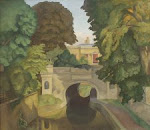
William Ratcliffe (1870-1955), "Regent's Canal at Hammersmith"
On the other hand, Rossetti can be as complex, deep, penetrating, and emotional as any poet you care to name. When you read one of these poems, you realize that you are in another world altogether.
Autumn
Care flieth,
Hope and fear together,
Love dieth
In the Autumn weather.
For a friend
Even care is pleasant;
When fear doth end
Hope is no more present:
Autumn silences the turtle dove; --
In blank Autumn who could speak of love?
Ibid.
Well, now, what is that all about? Is it about lost or unrequited love? Is it about the ways of God? Or is it simply a poem about autumn? It sounds Elizabethan, like something (dare I say?) that Shakespeare or Donne might have written. It sounds ancient and timeless.
William Ratcliffe, "Bodinnick, Fowey"
Autumn
Fade tender lily,
Fade O crimson rose,
Fade every flower
Sweetest flower that blows.
Go chilly Autumn,
Come O Winter cold;
Let the green things die away
Into common mould.
Birth follows hard on death,
Life on withering:
Hasten, we shall come the sooner
Back to pleasant Spring.
Christina Rossetti, The Complete Poems (Penguin 2001).
William Ratcliffe (1870-1955), "Regent's Canal at Hammersmith"
On the other hand, Rossetti can be as complex, deep, penetrating, and emotional as any poet you care to name. When you read one of these poems, you realize that you are in another world altogether.
Autumn
Care flieth,
Hope and fear together,
Love dieth
In the Autumn weather.
For a friend
Even care is pleasant;
When fear doth end
Hope is no more present:
Autumn silences the turtle dove; --
In blank Autumn who could speak of love?
Ibid.
Well, now, what is that all about? Is it about lost or unrequited love? Is it about the ways of God? Or is it simply a poem about autumn? It sounds Elizabethan, like something (dare I say?) that Shakespeare or Donne might have written. It sounds ancient and timeless.
William Ratcliffe, "Bodinnick, Fowey"
Sunday, September 23, 2012
Perspective, Part Three: "Our Windows, Too, Are Clouded Glass"
We live in a world of shameless self-promotion, overweening egotism, and dubious, spurious, and/or ill-gotten "accomplishments." What evidence supports this assertion? Any head-of-state that you can name. And any "celebrity" that you can name.
Of course, this has always been the way of the world. However, this age differs significantly from previous ages: in our time, these people insert themselves into our consciousness in electronic ways that are pervasive and well-nigh unavoidable. Unless, say, one chooses to repair to a yurt on an empty, wind-swept steppe somewhere in Mongolia. (Provided that the steppe is free of cellphone towers, of course.)
In the absence of an avenue of escape, one needs perspective. One needs to remind oneself that these sorts of people are not normal. They have nothing to do with real life, or with our lives. Humility and empathy are alien to them. Thus, they would not know what to make of a poem such as the following. Never in a million years would it occur to them that Charlotte Mew is trying to tell us something about ourselves, something that we ignore at peril to our souls.
Duncan Grant, "Still Life" (1957)
On the Asylum Road
Theirs is the house whose windows -- every pane --
Are made of darkly stained or clouded glass:
Sometimes you come upon them in the lane,
The saddest crowd that you will ever pass.
But still we merry town or village folk
Throw to their scattered stare a kindly grin,
And think no shame to stop and crack a joke
With the incarnate wages of man's sin.
None but ourselves in our long gallery we meet,
The moor-hen stepping from her reeds with dainty feet,
The hare-bell bowing on his stem,
Dance not with us; their pulses beat
To fainter music; nor do we to them
Make their life sweet.
The gayest crowd that they will ever pass
Are we to brother-shadows in the lane:
Our windows, too, are clouded glass
To them, yes, every pane!
Charlotte Mew, The Farmer's Bride (1916).
Duncan Grant, "Girl at the Piano" (1940)
Of course, this has always been the way of the world. However, this age differs significantly from previous ages: in our time, these people insert themselves into our consciousness in electronic ways that are pervasive and well-nigh unavoidable. Unless, say, one chooses to repair to a yurt on an empty, wind-swept steppe somewhere in Mongolia. (Provided that the steppe is free of cellphone towers, of course.)
In the absence of an avenue of escape, one needs perspective. One needs to remind oneself that these sorts of people are not normal. They have nothing to do with real life, or with our lives. Humility and empathy are alien to them. Thus, they would not know what to make of a poem such as the following. Never in a million years would it occur to them that Charlotte Mew is trying to tell us something about ourselves, something that we ignore at peril to our souls.
Duncan Grant, "Still Life" (1957)
On the Asylum Road
Theirs is the house whose windows -- every pane --
Are made of darkly stained or clouded glass:
Sometimes you come upon them in the lane,
The saddest crowd that you will ever pass.
But still we merry town or village folk
Throw to their scattered stare a kindly grin,
And think no shame to stop and crack a joke
With the incarnate wages of man's sin.
None but ourselves in our long gallery we meet,
The moor-hen stepping from her reeds with dainty feet,
The hare-bell bowing on his stem,
Dance not with us; their pulses beat
To fainter music; nor do we to them
Make their life sweet.
The gayest crowd that they will ever pass
Are we to brother-shadows in the lane:
Our windows, too, are clouded glass
To them, yes, every pane!
Charlotte Mew, The Farmer's Bride (1916).
Duncan Grant, "Girl at the Piano" (1940)
Friday, September 21, 2012
"Autumn Is Here, It Is"
In accordance with the movements of the heavenly bodies and the tyranny of the calendar, autumn will arrive this weekend. Now is a good time to take stock.
Perhaps we should think of this time of year as a culmination, not as a descent. Having said that, I acknowledge that culmination and descent will be just a hair's-breadth away from each other over the next few months -- until the last leaf spins from a bare tree sometime in December.
John Aldridge, "The Pink Farm" (1940)
Autumn
Fragile, notice that
As autumn starts, a light
Frost crisps up at night
And next day, for a while,
White covers path and lawn.
"Autumn is here, it is,"
Sings the stoical blackbird
But by noon pure gold is tossed
On everything. Leaves fall
As if they meant to rise.
Nothing of nature's lost,
The birth, the blight of things,
The bud, the stretching wings.
Elizabeth Jennings, Celebrations and Elegies (Carcanet 1982).
John Aldridge, "Artichokes and Cathay Quinces" (1967)
Perhaps we should think of this time of year as a culmination, not as a descent. Having said that, I acknowledge that culmination and descent will be just a hair's-breadth away from each other over the next few months -- until the last leaf spins from a bare tree sometime in December.
John Aldridge, "The Pink Farm" (1940)
Autumn
Fragile, notice that
As autumn starts, a light
Frost crisps up at night
And next day, for a while,
White covers path and lawn.
"Autumn is here, it is,"
Sings the stoical blackbird
But by noon pure gold is tossed
On everything. Leaves fall
As if they meant to rise.
Nothing of nature's lost,
The birth, the blight of things,
The bud, the stretching wings.
Elizabeth Jennings, Celebrations and Elegies (Carcanet 1982).
John Aldridge, "Artichokes and Cathay Quinces" (1967)
Wednesday, September 19, 2012
"Palmistry"
Poetry helps us to pay closer attention to the World around us.
By "the World," I mean anything out there that we can see, hear, smell, touch, or taste.
The World does not -- I repeat: does not -- include any of the following: politics, popular entertainment, the media, sociology, psychology, and the scientific method. These are, at best, distractions. Most often, they are pernicious deceptions.
I claim absolutely no originality with respect to these observations. We all know these things. But the distractions and deceptions that surround us are seductive and powerful. Thus, for instance, it is highly likely that, this very evening, I will sit down in front of the television and watch an episode of "The World's Dumbest Criminals," "American Pickers," or "Ice Road Truckers." (I apologize to all of my non-American readers for those arcane references.)
Poetry helps us to pay closer attention to the World around us. If we let it.
Frederick William Hayes, "Rocks in the Colwyn" (c. 1881)
Palmistry
I lifted from the ground my grass-pressed hand
And pondered, as its strange new lines I scanned,
What is foretold? What hope, what fear,
What strife, what passion is prefigured here?
Andrew Young, Winter Harvest (1933).
Frederick William Hayes, "The Rivals from Llanddwyn" (c. 1884)
When all the reeds are swaying in the wind
How can you tell which reeds the otters bend?
Michael Longley, Selected Poems (Jonathan Cape 1998).
Frederick William Hayes, "A Waterfall" (c. 1880)
By "the World," I mean anything out there that we can see, hear, smell, touch, or taste.
The World does not -- I repeat: does not -- include any of the following: politics, popular entertainment, the media, sociology, psychology, and the scientific method. These are, at best, distractions. Most often, they are pernicious deceptions.
I claim absolutely no originality with respect to these observations. We all know these things. But the distractions and deceptions that surround us are seductive and powerful. Thus, for instance, it is highly likely that, this very evening, I will sit down in front of the television and watch an episode of "The World's Dumbest Criminals," "American Pickers," or "Ice Road Truckers." (I apologize to all of my non-American readers for those arcane references.)
Poetry helps us to pay closer attention to the World around us. If we let it.
Frederick William Hayes, "Rocks in the Colwyn" (c. 1881)
Palmistry
I lifted from the ground my grass-pressed hand
And pondered, as its strange new lines I scanned,
What is foretold? What hope, what fear,
What strife, what passion is prefigured here?
Andrew Young, Winter Harvest (1933).
Frederick William Hayes, "The Rivals from Llanddwyn" (c. 1884)
When all the reeds are swaying in the wind
How can you tell which reeds the otters bend?
Michael Longley, Selected Poems (Jonathan Cape 1998).
Frederick William Hayes, "A Waterfall" (c. 1880)
Monday, September 17, 2012
"The Long September Evening Dies"
As one might expect, the "Decadent" poets of the 1890s -- with their wistfulness, melancholy, and obsession with death -- found autumn to be congenial. I confess that I, too, am a pushover for the autumnal dreamland (without the death). Thus, although some might find it old-fashioned, quaint, and predictable, I am quite fond of the following poem by Arthur Symons, which has it all: "mist-enfolded lanes," "a few faint stars," "lingering twilight" (which, of course, "wanes"), and a "darkening vale" -- not to mention "lover with lover wandering."
Christopher Nevinson (1889-1946), "Near Leatherhead, Surrey"
Autumn Twilight
The long September evening dies
In mist along the fields and lanes;
Only a few faint stars surprise
The lingering twilight as it wanes.
Night creeps across the darkening vale;
On the horizon tree by tree
Fades into shadowy skies as pale
As moonlight on a shadowy sea.
And, down the mist-enfolded lanes,
Grown pensive now with evening,
See, lingering as the twilight wanes,
Lover with lover wandering.
Arthur Symons, London Nights (1895). Symons indicates in a note that the poem was written on September 12, 1891.
Christopher Nevinson, "The Weir, Charenton"
Christopher Nevinson (1889-1946), "Near Leatherhead, Surrey"
Autumn Twilight
The long September evening dies
In mist along the fields and lanes;
Only a few faint stars surprise
The lingering twilight as it wanes.
Night creeps across the darkening vale;
On the horizon tree by tree
Fades into shadowy skies as pale
As moonlight on a shadowy sea.
And, down the mist-enfolded lanes,
Grown pensive now with evening,
See, lingering as the twilight wanes,
Lover with lover wandering.
Arthur Symons, London Nights (1895). Symons indicates in a note that the poem was written on September 12, 1891.
Christopher Nevinson, "The Weir, Charenton"
Saturday, September 15, 2012
"Like All Unheeded Beautiful Things That Pass Under The Leaves Of Life, Just Touching The Grass"
F. W. Harvey (1888-1957) and Ivor Gurney were friends. They grew up together in Gloucestershire and shared a love of its countryside. They both served in the Gloucestershire Regiment during the First World War. Gurney composed musical settings for a few of Harvey's poems.
The following poem by Harvey is, I think, a good companion piece to Gurney's "Quiet Talk" (which appeared in my previous post): the wind is the subject of both, and both poems have a summer-into-autumn feel.
Hubert Lindsay Wellington (1879-1967)
"Overhanging Tree, Frampton Mansell, Gloucestershire" (1915)
Swift Beauty
Wind that is in orchards
Playing with apple-trees
Soon will be leagues away
In the old rookeries.
Vaguely it arises,
Swiftly it hurries hence: --
Like sudden beauty
Blown over sense:
Like all unheeded
Beautiful things that pass
Under the leaves of life,
Just touching the grass.
F. W. Harvey, September and Other Poems (1925).
Harvey's verse was, on the whole, fairly traditional and conventional. However, I sense a bit of influence from the more adventuresome Gurney in "Swift Beauty." "Like sudden beauty/Blown over sense" has a Gurney feel to it, as does the final stanza.
Hubert Lindsay Wellington, "Farm at Uley, Gloucestershire" (1932)
Labels:
F. W. Harvey,
Hubert Lindsay Wellington,
Ivor Gurney
Thursday, September 13, 2012
"Before Their Death Trees Have Their Full Delight"
The sudden shifts in mood and imagery in Ivor Gurney's poetry (both between poems and within a poem) can sometimes be disconcerting and puzzling. It is tempting to ascribe these shifts to Gurney's struggles with mental illness. But one should be wary of this temptation. I do not think that it is helpful to classify certain of Gurney's poems (e.g., those that seem calm or lucid) as "sane" poems and others (e.g., those that seem manic or disjointed) as "insane" poems.
For a while, I attempted to make such a distinction. But I gave it up. First, I realized that it was both futile and speculative to try to deduce Gurney's mental state at the time when he wrote a particular poem. Second -- and more importantly -- I decided that it was unfair to Gurney. He is what he is, and we owe it to him to accept him as he is. (I have reached the same conclusion when it comes to John Clare, whose fate was remarkably, and sadly, similar to Gurney's.)
Thus, here is a poem about summer-into-autumn. We can say about it what we can say about all of Gurney's poems: they came from his heart (and from Gloucestershire).
Bertha Ridley Bell (1898-1955)
"Interior of a Cottage at Brockhampton, Gloucestershire"
Quiet Talk
Tree-talk is breathing quietly today
Of coming autumn and the staleness over --
Pause of high summer when the year's at stay,
And the wind's sick that now moves like a lover.
On valley ridges where our beeches cluster
Or changing ashes guarding slopes of plough,
He goes now sure of heart, now with a fluster
Of teasing purpose. Night shall find him grow
To dark strength and a cruel spoiling will.
First he will baffle streams and dull their bright,
Cower and threaten both about the hill --
Before their death trees have their full delight.
P. J. Kavanagh (editor), Collected Poems of Ivor Gurney (Oxford University Press 1982).
Bertha Ridley Bell
"The Artist's Cottage, Brockhampton, Gloucestershire"
For a while, I attempted to make such a distinction. But I gave it up. First, I realized that it was both futile and speculative to try to deduce Gurney's mental state at the time when he wrote a particular poem. Second -- and more importantly -- I decided that it was unfair to Gurney. He is what he is, and we owe it to him to accept him as he is. (I have reached the same conclusion when it comes to John Clare, whose fate was remarkably, and sadly, similar to Gurney's.)
Thus, here is a poem about summer-into-autumn. We can say about it what we can say about all of Gurney's poems: they came from his heart (and from Gloucestershire).
Bertha Ridley Bell (1898-1955)
"Interior of a Cottage at Brockhampton, Gloucestershire"
Quiet Talk
Tree-talk is breathing quietly today
Of coming autumn and the staleness over --
Pause of high summer when the year's at stay,
And the wind's sick that now moves like a lover.
On valley ridges where our beeches cluster
Or changing ashes guarding slopes of plough,
He goes now sure of heart, now with a fluster
Of teasing purpose. Night shall find him grow
To dark strength and a cruel spoiling will.
First he will baffle streams and dull their bright,
Cower and threaten both about the hill --
Before their death trees have their full delight.
P. J. Kavanagh (editor), Collected Poems of Ivor Gurney (Oxford University Press 1982).
Bertha Ridley Bell
"The Artist's Cottage, Brockhampton, Gloucestershire"
Tuesday, September 11, 2012
Blue
As a lover of autumn, I am guilty of attributing powers to the season that it probably does not possess. For instance, it seems to me that colors are more vivid this time of year. I ascribe this (with absolutely no scientific evidence to support my view) to the slanting yellow sunlight and the cool, atmosphere-cleansing winds of this time of year.
Thus, on a clear, breezy day, the waters of Puget Sound seem the bluest of all blues: azure, cerulean, cobalt, lapis lazuli, and ultramarine rolled into one. With a few white-caps, sails, and seagulls for contrast.
Henry Moore, "Catspaws Off The Land" (1885)
L'Oiseau Bleu
The lake lay blue below the hill.
O'er it, as I looked, there flew
Across the waters, cold and still,
A bird whose wings were palest blue.
The sky above was blue at last,
The sky beneath me blue in blue.
A moment, ere the bird had passed,
It caught his image as he flew.
Theresa Whistler (editor), The Collected Poems of Mary Coleridge (Rupert Hart-Davis 1954). My high school and college French at last comes in handy: "l'oiseau" is "the bird"; "bleu" is "blue."
For another fine evocation of blue, I recommend Andrew Young's "The Nest," which has appeared here previously.
James Dickson Innes, "Arenig, North Wales" (1913)
Thus, on a clear, breezy day, the waters of Puget Sound seem the bluest of all blues: azure, cerulean, cobalt, lapis lazuli, and ultramarine rolled into one. With a few white-caps, sails, and seagulls for contrast.
Henry Moore, "Catspaws Off The Land" (1885)
L'Oiseau Bleu
The lake lay blue below the hill.
O'er it, as I looked, there flew
Across the waters, cold and still,
A bird whose wings were palest blue.
The sky above was blue at last,
The sky beneath me blue in blue.
A moment, ere the bird had passed,
It caught his image as he flew.
Theresa Whistler (editor), The Collected Poems of Mary Coleridge (Rupert Hart-Davis 1954). My high school and college French at last comes in handy: "l'oiseau" is "the bird"; "bleu" is "blue."
For another fine evocation of blue, I recommend Andrew Young's "The Nest," which has appeared here previously.
James Dickson Innes, "Arenig, North Wales" (1913)
Labels:
Andrew Young,
Mary Coleridge,
Victorian Poetry
Subscribe to:
Posts (Atom)