Saturday, October 31, 2015

"When All The World Is On The Wane"

The waning of autumn's magnificence brings sadness with it.  But it also provides an annual lesson in how to gracefully accept loss and change. The story is an ancient one:  we would not be sad if we had not loved.

                             Last Week in October

     The trees are undressing, and fling in many places --
     On the gray road, the roof, the window-sill --
     Their radiant robes and ribbons and yellow laces;
     A leaf each second so is flung at will,
Here, there, another and another, still and still.

     A spider's web has caught one while downcoming,
     That stays there dangling when the rest pass on;
     Like a suspended criminal hangs he, mumming
     In golden garb, while one yet green, high yon,
Trembles, as fearing such a fate for himself anon.

Thomas Hardy, Human Shows, Far Phantasies, Songs, and Trifles (Macmillan 1925).

A side-note:  Hardy's likening of the "dangling" leaf to "a suspended criminal" is not a mere fancy on Hardy's part:  he witnessed two public hangings in his teenage years.  His second wife Florence's "biography" of him (which is, in fact, an autobiography written by Hardy) contains the following passage:

"One summer morning at Bockhampton, just before he sat down to breakfast, he remembered that a man was to be hanged at eight o'clock at Dorchester.  He took up the big brass telescope that had been handed on in the family, and hastened to a hill on the heath a quarter of a mile from the house, whence he looked towards the town.  The sun behind his back shone straight on the white stone façade of the gaol, the gallows upon it, and the form of the murderer in white fustian, the executioner and officials in dark clothing, and the crowd below, being invisible at this distance of three miles.  At the moment of his placing the glass to his eye the white figure dropped downwards, and the faint note of the town clock struck eight.

"The whole thing had been so sudden that the glass nearly fell from Hardy's hands.  He seemed alone on the heath with the hanged man; and he crept homeward wishing he had not been so curious.  It was the second and last execution he witnessed, the first having been that of a woman two or three years earlier, when he stood close to the gallows."

Thomas Hardy, The Life and Work of Thomas Hardy (edited by Michael Millgate) (Macmillan 1985), pages 32-33.

At another time, Hardy described the hanging of the woman:

"I went there really for a jaunt.  The hanging itself did not move me at all. But I sat on after the others went away, not thinking, but looking at the figure (it was a woman) turning slowly round on the rope.  And then it began to rain, and then I saw -- they had put a cloth over the face -- how, as the cloth got wet, her features came through it.  That was extraordinary. A boy had climbed up into a tree nearby, and when she dropped he came down in a faint like an apple dropping from the tree.  It was curious the two dropping together."

Elliott Felkin, "Days with Thomas Hardy," Encounter (April 1962) (italics in original), reprinted in Martin Ray (editor), Thomas Hardy Remembered (Ashgate 2007), pages 202-203.

Edward Waite, "The mellow year is hastening to its close" (1896)

Christina Rossetti's poetry is characterized by a continual movement back and forth between loss and faith.  What gives this movement its beauty and its emotional resonance is the overarching and underlying love that links the two together.  This love is both mortal and Immortal.  In her poetry, mortal love is ever threatened by loss.

                 An October Garden

In my Autumn garden I was fain
     To mourn among my scattered roses;
     Alas for that last rosebud which uncloses
To Autumn's languid sun and rain
When all the world is on the wane!
     Which has not felt the sweet constraint of June,
     Nor heard the nightingale in tune.

Broad-faced asters by my garden walk,
     You are but coarse compared with roses:
     More choice, more dear that rosebud which uncloses
Faint-scented, pinched, upon its stalk,
That least and last which cold winds balk;
     A rose it is tho' least and last of all,
     A rose to me tho' at the fall.

Christina Rossetti, A Pageant and Other Poems (1881).

I would categorize "An October Garden" as one of Rossetti's secular poems: it is an Elizabethan-sounding contemplation on the transient beauty of the rose, a symbol of love and life and loss.  In contrast, she also wrote a large number of devotional poems in which she articulates her belief that religious faith can provide solace for, and can ultimately redeem, the inevitable loss of mortal love and life.

Edward Waite, "Autumn Colouring" (1894)

In her finest poems, Rossetti combines the secular and the religious into something that is uniquely evocative, enigmatic, and beautiful.  In her collection A Pageant and Other Poems, "An October Garden" is immediately followed by this:

                      "Summer Is Ended"

To think that this meaningless thing was ever a rose,
            Scentless, colourless, this!
     Will it ever be thus (who knows?)
                  Thus with our bliss,
          If we wait till the close?

Tho' we care not to wait for the end, there comes the end
            Sooner, later, at last,
     Which nothing can mar, nothing mend:
                  An end locked fast,
          Bent we cannot re-bend.

Christina Rossetti, Ibid.  The source of the title is the Book of Jeremiah 8:20 (King James Version):  "The harvest is past, the summer is ended, and we are not saved."  Christina Rossetti, The Complete Poems (edited by R. W. Crump and Betty Flowers) (Penguin 2001), page 960.

As in "An October Garden," the fading of a final rose is the ostensible subject of the poem.  But "'Summer Is Ended'" operates in an entirely different realm.  The second stanza is breathtaking:  to my mind, it is one of those rare combinations of feeling, thought, and verbal music that remind us of why we read poetry.

Edward Waite, "The Autumn Road (Mitcham Woods, Surrey)"

For Thomas Hardy, religious consolation is not an option that is available to assuage our losses:  we live in a universe of "Crass Casualty" and "purblind Doomsters."  ("Hap," Wessex Poems and Other Verses.)

               The Later Autumn

Gone are the lovers, under the bush
          Stretched at their ease;
          Gone the bees,
Tangling themselves in your hair as they rush
          On the line of your track,
          Leg-laden, back
          With a dip to their hive
          In a prepossessed dive.

Toadsmeat is mangy, frosted, and sere;
          Apples in grass
          Crunch as we pass,
And rot ere the men who make cyder appear.
          Couch-fires abound
          On fallows around,
          And shades far extend
          Like lives soon to end.

Spinning leaves join the remains shrunk and brown
          Of last year's display
          That lie wasting away,
On whose corpses they earlier as scorners gazed down
          From their aery green height:
          Now in the same plight
          They huddle; while yon
          A robin looks on.

Thomas Hardy, Human Shows, Far Phantasies, Songs, and Trifles.

I'm particularly fond of the robin at the end of the poem.  It brings to mind the wonderful birds that appear throughout Hardy's poetry, birds who observe (and often comment upon) the goings on of the World and the antics of its human inhabitants.  "Starlings on the Roof."  "The Darkling Thrush."  Another thrush in "The Reminder."  The thrushes, finches, and nightingales in "Proud Songsters."  The rook, the starling, and the pigeon in "Winter in Durnover Field."  To name but a few.

Hardy's birds signify both timelessness and transience.  As does the loss of autumn.

Edward Waite, "Fall of the Year"

Friday, October 23, 2015

Calm

What a noisy world we live in!  For instance:  cell phone conversations conducted in public places.  I realize that this topic has by now become a cliché, but I think that it serves as a metaphor for all that is wrong with the Modern World:  not only noise, but also -- in no particular order -- impoliteness, obliviousness, and vacuity.

One would think that an ordinary human being could pass through airport security, sit in the waiting area at the departure gate, and ride a shuttle bus to a parking lot without feeling compelled to carry on a phone conversation in the presence of strangers.  Quite often, that does not seem to be the case. And, thanks to the wonders of technology (Progress!), we have an added attraction:  animated mugging for the video camera during the conversation.  Intimacy.  (An aside:  "All Aboard," a fine poem by Charles Tomlinson on this phenomenon, has appeared here previously.)

I confess:  I am conservative by nature and by choice.  Call me a hypocrite (given, for instance, the technology that I am using at this moment), but I never presume that change is a good thing.  Here is one of my curmudgeonly standards of judgment:  I am skeptical of any technological "innovation" that reduces the time and space available for serenity and reverie.

Calm is the morn without a sound,
     Calm as to suit a calmer grief,
     And only thro' the faded leaf
The chestnut pattering to the ground:

Calm and deep peace on this high wold,
     And on these dews that drench the furze,
     And all the silvery gossamers
That twinkle into green and gold:

Calm and still light on yon great plain
     That sweeps with all its autumn bowers,
     And crowded farms and lessening towers,
To mingle with the bounding main:

Calm and deep peace in this wide air,
     These leaves that redden to the fall;
     And in my heart, if calm at all,
If any calm, a calm despair:

Calm on the seas, and silver sleep,
     And waves that sway themselves in rest,
     And dead calm in that noble breast
Which heaves but with the heaving deep.

Alfred Tennyson, Poem XI, In Memoriam (1850).

Lines 15 and 16 are, I think, very moving:  "And in my heart, if calm at all,/If any calm . . ."

Peter Graham, "Wandering Shadows" (1878)

Give technology an inch and it will take a mile.  Technological "advancement" is often sold on the premise that it will be "labor-saving," thus purportedly freeing us up to devote more time and energy to higher human pursuits.  I'd say that this was true of the invention of the wheel.  Is it true of the invention of Twitter or Facebook?

"Men have judged that a king can make rain; we say this contradicts all experience.  Today they judge that aeroplanes and the radio etc. are means for the closer contact of peoples and the spread of culture."

Ludwig Wittgenstein, On Certainty, Paragraph 132 (translated by Denis Paul and G. E. M. Anscombe) (Blackwell 1969).

Aeroplanes.  Radio.  Twitter.  Facebook.

   On Looking Up by Chance at the Constellations

You'll wait a long, long time for anything much
To happen in heaven beyond the floats of cloud
And the Northern Lights that run like tingling nerves.
The sun and moon get crossed, but they never touch,
Nor strike out fire from each other, nor crash out loud.
The planets seem to interfere in their curves,
But nothing ever happens, no harm is done.
We may as well go patiently on with our life,
And look elsewhere than to stars and moon and sun
For the shocks and changes we need to keep us sane.
It is true the longest drouth will end in rain,
The longest peace in China will end in strife.
Still it wouldn't reward the watcher to stay awake
In hopes of seeing the calm of heaven break
On his particular time and personal sight.
That calm seems certainly safe to last tonight.

Robert Frost, West-Running Brook (1928).

John Glover, "Thirlmere" (c. 1820-1830)

I am not a Luddite.  And I do not intend to repair to a yurt out on the windswept steppes of Mongolia any time soon.  (Besides, I suspect that cell phone service and wireless Internet have preceded me there.)  I am not angry with, nor do I consider myself superior to, those who avail themselves of these dazzling technologies.  I simply wonder:  why?  To what end?  Do we realize what we are giving up?

Technology ("information technology" in particular) promotes hyperactivity and distraction.  In contrast, poetry is born of reverie and concentration, and in turn promotes reverie and concentration in the reader.  The choice is ours.

   The House Was Quiet and the World Was Calm

The house was quiet and the world was calm.
The reader became the book; and summer night

Was like the conscious being of the book.
The house was quiet and the world was calm.

The words were spoken as if there was no book,
Except that the reader leaned above the page,

Wanted to lean, wanted much most to be
The scholar to whom his book is true, to whom

The summer night is like a perfection of thought.
The house was quiet because it had to be.

The quiet was part of the meaning, part of the mind:
The access of perfection to the page.

And the world was calm.  The truth in a calm world,
In which there is no other meaning, itself

Is calm, itself is summer and night, itself
Is the reader leaning late and reading there.

Wallace Stevens, Transport to Summer (1947).

Benjamin Leader, "Glyder Fawr, Snowdon Range" (1881)

Three variations on the theme of calm.  Alfred Tennyson would like us to know about the calm he felt as he awaited the arrival by ship of the body of his friend Arthur Henry Hallam, who had died young in Vienna.  Robert Frost would like us to know about the calm that abides in the presence of those dark interstellar spaces that so often haunted him.  "They cannot scare me with their empty spaces/Between stars . . ."  Wallace Stevens would like us to know about Imagination and Reality, how they can -- no, must -- flit back and forth in a calm world, in a quiet house, if we wish to be truly human.

Cell phones and Twitter and Facebook have nothing to do with any of this.

                                        Alcaic

Out in the deep wood, silence and darkness fall,
down through the wet leaves comes the October mist;
     no sound, but only a blackbird scolding,
          making the mist and the darkness listen.

Peter Levi, Collected Poems 1955-75 (Anvil Press 1984).  A side-note:  the four-line "alcaic" stanza is said to have been invented by the Greek poet Alcaeus, and is often used by Horace in his Odes.

"Our civilization is characterized by the word 'progress.'  Progress is its form rather than making progress being one of its features.  Typically it constructs.  It is occupied with building an ever more complicated structure. And even clarity is sought only as a means to this end, not as an end in itself.  For me on the contrary clarity, perspicuity are valuable in themselves."

Ludwig Wittgenstein, Culture and Value (translated by Peter Winch) (Blackwell 1980), page 7e.

John Glover, "View of Patterdale, Westmorland" (1817)

Friday, October 16, 2015

Deciduous

I was born in Minnesota, and I spent the first eleven years of my life there.   Looking back, I think of those years as a vanished deciduous world, a world of oaks and elms and birches and maples.

This week I am in the Blue Ridge Mountains of North Carolina.  I have no connections with this part of the country, but I feel that I have returned to my lost deciduous world.  Nostalgia?  Sentimentality?  Of course.  I always choose nostalgia and sentimentality over modern irony.

In this fair country, the Blue Ridge Parkway in autumn is among the fairest of the fair.  A 400-mile ribbon of road running up near the sky, it alternates between leafy tunnels and breathtaking vistas (a cliché, but no other phrase suffices).

                 Postscript

As life improved, their poems
Grew sadder and sadder.  Was there oil
For the machine?  It was
The vinegar in the poets' cup.

The tins marched to the music
Of the conveyor belt.  A billion
Mouths opened.  Production,
Production, the wheels

Whistled.  Among the forests
Of metal the one human
Sound was the lament of
The poets for deciduous language.

R. S. Thomas, H'm (Macmillan 1972).

William Samuel Jay, "At the Fall of Leaf, Arundel Park, Sussex" (1883)

I resolved to travel light on this trip.  I brought only two pocket-size books of poetry, both anthologies:  The Faber Book of Reflective Verse (Faber and Faber 1984), compiled by Geoffrey Grigson, and Zen Poems (Everyman's Library 1999), compiled by Peter Harris.  Earlier this week, I came across this in the former:

Perplex'd with trifles thro' the vale of life,
Man strives 'gainst man, without a cause for strife;
Armies embattled meet, and thousands bleed,
For some vile spot, which cannot fifty feed.
Squirrels for nuts contend, and, wrong or right,
For the world's empire, kings ambitious fight,
What odds? -- to us 'tis all the self-same thing,
A Nut, a World, a Squirrel, and a King.

Charles Churchill, from "Night: An Epistle to Robert Lloyd" (1761).

Yesterday I walked through the woods of the North Carolina Arboretum, which lies beside the Blue Ridge Parkway, just south of Asheville.  As I have noted here in the past, I admire those who can rattle off the common names, as well as the Latin binomial names, of flora and fauna. I am usually content to remain ignorant, and to simply look.  But, in my deciduous mood, I stopped to read the tree identification markers that are posted at intervals along the trails.

Yes, "a Nut, a World, a Squirrel, and a King."  The message of the Kings (who come in various guises) and of their Worlds (calculated to distract) is, in essence, this:  "Sell your repose."  Yet, all around us, uncountable and everlasting, offering the real message, are these (to name but a few):

Black oak, white oak, bitternut hickory,
Mockernut hickory, hemlock, white pine,
Chestnut oak, Virginia pine, black cherry,
Red maple, sourwood, tuliptree.

Alexander Docharty, "An Autumn Day" (c. 1917)

As I walked through the Arboretum, I could hear the sound of acorns dropping to the ground.  Squirrels and their nuts.  But I didn't think of Charles Churchill's lines.  There was no striving or contending.  It was only the deciduous world being itself, going about its annual, timeless business.

                       The Dependencies

This morning, between two branches of a tree
Beside the door, epeira once again
Has spun and signed his tapestry and trap.
I test his early-warning system and
It works, he scrambles forth in sable with
The yellow hieroglyph that no one knows
The meaning of.  And I remember now
How yesterday at dusk the nighthawks came
Back as they do about this time each year,
Grey squadrons with the slashes white on wings
Cruising for bugs beneath the bellied cloud.
Now soon the monarchs will be drifting south,
And then the geese will go, and then one day
The little garden birds will not be here.
See how many leaves already have
Withered and turned; a few have fallen, too.
Change is continuous on the seamless web,
Yet moments come like this one, when you feel
Upon your heart a signal to attend
The definite announcement of an end
Where one thing ceases and another starts;
When like the spider waiting on the web
You know the intricate dependencies
Spreading in secret through the fabric vast
Of heaven and earth, sending their messages
Ciphered in chemistry to all the kinds,
The whisper down the bloodstream:  it is time.

Howard Nemerov, The Western Approaches (University of Chicago Press 1975).

John Milne Donald, "Autumn Leaves" (1864)

Standing at one of the "overlooks" on the Blue Ridge Parkway beneath infinite blue, with millions of green, gold, and red trees stretching off for hundreds of miles in every direction, one's best course of action is to keep silent.

Our life in this world --
to what shall I compare it?
It's like an echo
     resounding through the mountains
          and off into the empty sky.

Ryōkan (translated by Steven Carter), in Peter Harris (editor), Zen Poems (Everyman's Library 1999).

George Vicat Cole, "Autumn Morning" (1891)

Friday, October 9, 2015

Twilight

Autumn is always the same:  each year we make the same outward and inward passage.  The quickening rise to brilliance.  The inevitable denouement (which is known from the start).  Bittersweet and pensive wistfulness.  Wistful and bittersweet pensiveness.  Pensive and wistful bittersweetness.  We know autumn well.  Or so it seems.

Autumn is never the same:  you are not who you were last autumn.  And who was the person who passed through that long-vanished autumn, x years ago?  That never-to-be-forgotten autumn?  Only a few wispy revenants remain.

            On Inishmaan
            (Isles of Aran)

In the twilight of the year,
Here, about these twilight ways,
When the grey moth night drew near,
Fluttering on a faint flying,
I would linger out the day's
Delicate and moth-grey dying.

Grey, and faint with sleep, the sea
Should enfold me, and release
Some old peace to dwell with me.
I would quiet the long crying
Of my heart with mournful peace,
The grey sea's, in its low sighing.

Arthur Symons, Images of Good and Evil (1899).

Samuel Palmer, "The Weald of Kent" (c. 1833)

"The twilight of the year."  Perfect.  But, as Symons suggests, for all of the loss that attends it, autumn -- like twilight -- can be a source of peace.  Yet it is a peculiar sort of peace:  a combination of exhilaration and sadness, the two of them changing places from moment to moment or, quite often, present together at the same time.
 
                 Into the Twilight

Out-worn heart, in a time out-worn,
Come clear of the nets of wrong and right;
Laugh, heart, again in the grey twilight,
Sigh, heart, again in the dew of the morn.

Your mother Eire is always young,
Dew ever shining and twilight grey;
Though hope fall from you and love decay,
Burning in fires of a slanderous tongue.

Come, heart, where hill is heaped upon hill:
For there the mystical brotherhood
Of sun and moon and hollow and wood
And river and stream work out their will;

And God stands winding His lonely horn,
And time and the world are ever in flight;
And love is less kind than the grey twilight,
And hope is less dear than the dew of the morn.

W. B. Yeats, The Wind Among the Reeds (1899).

I confess that I love this sort of thing.  Unashamedly, unapologetically, and without irony.  What a wrong turning the 20th century was.

Samuel Palmer, "The Harvest Moon" (c. 1833)

Yeats, Symons, and the other poets of the Nineties are in their element when it comes to twilight and autumn.  Hence, as one might expect, autumn twilight brings them to the very heart of the matter:  shadows, fleeting gleams, hopeless love, lost love, murmuring waters, mist, dreams, desires, the moon-washed sea . . .

              Autumn Twilight

The long September evening dies
In mist along the fields and lanes;
Only a few faint stars surprise
The lingering twilight as it wanes.

Night creeps across the darkening vale;
On the horizon tree by tree
Fades into shadowy skies as pale
As moonlight on a shadowy sea.

And, down the mist-enfolded lanes,
Grown pensive now with evening,
See, lingering as the twilight wanes,
Lover with lover wandering.

Arthur Symons, London Nights (1895).

Like Yeats, I would love to live in a "grey twilight" world.  Like Symons, I would love to "linger out the day's/Delicate and moth-grey dying."  Is this quaint daydreaming, mere escapism?  It depends upon what one thinks of the 21st century.

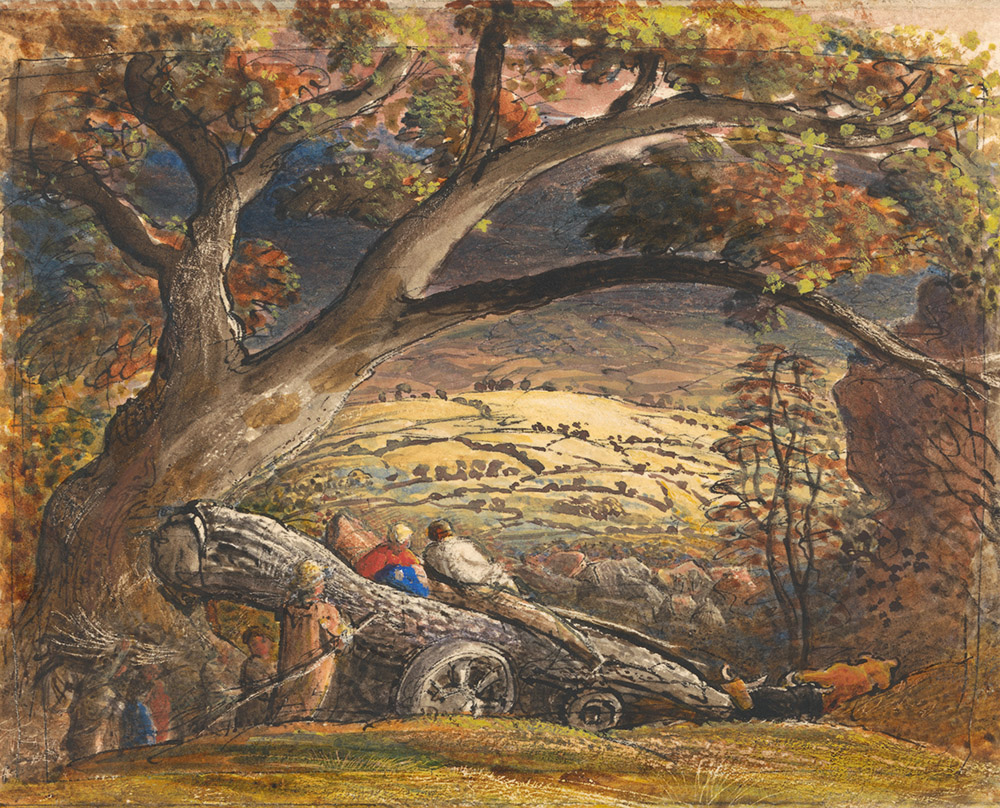
Samuel Palmer, "The Timber Wain" (c. 1833)

Yeats wrote the following poem on the other side of the fin de siècle.  Does it reveal him as having moved beyond the twilight world of the Nineties and its ofttimes autumnal mood?

     The Coming of Wisdom with Time

Though leaves are many, the root is one;
Through all the lying days of my youth
I swayed my leaves and flowers in the sun;
Now I may wither into the truth.

W. B. Yeats, The Green Helmet and Other Poems (1910).

Yeats is implying that a poem such as "Into the Twilight" involved some youthful "lying," some aesthetic "sway[ing]" of "leaves and flowers in the sun."  Yes, that poem, and many like it, were indeed a product of their time.

But what of "the root is one"?  I'm not at all certain that the ever-increasing rhetoric and self-dramatization of Yeats's later poetry brought him any closer to that root.  I think that, at their best, the poets of the Nineties are exactly right about "the root":  twilight and autumn (and, of course, autumn twilight) are indeed at the heart of the matter.  Withering into the truth.

Poetry and art do not "progress."  Has modern art "progressed" beyond Samuel Palmer?  Has contemporary poetry "progressed" beyond the poetry of the Nineties?

Samuel Palmer, "The Gleaning Field" (c. 1833)

Friday, October 2, 2015

Wind. Leaves.

I am of two minds about the wind of autumn.  On the one hand, I long for a windless world in which the brilliant leaves remain where they are, free of change.  On the other hand, the autumn wind has its own evocative beauty: the boughs sway as in spring and summer, but the latticework of light and shadow on the ground is different, as is the rustling overhead.  Then, in time, come the fallen leaves, rattling along the ground, leading us forward or dogging our steps.

I have no choice in the matter, of course.  These thoughts are merely human wishful thinking.  The story of our lives.  The wind does as it pleases.

This week, however, was the best of both worlds:  four days of blue skies, with a steady breeze that cleared the clouds, but which was not strong enough to bring down the leaves, most of which are not yet ready to let go. One might imagine that this could go on for ever.

          Swift Beauty

Wind that is in orchards
     Playing with apple-trees
Soon will be leagues away
     In the old rookeries.

Vaguely it arises,
     Swiftly it hurries hence: --
Like sudden beauty
     Blown over sense:

Like all unheeded
     Beautiful things that pass
Under the leaves of life,
     Just touching the grass.

F. W. Harvey, September and Other Poems (Sidgwick and Jackson 1925).

James McIntosh Patrick, "Autumn, Kinnordy" (1936)

Passing through sublimity, autumn brings us to simplicity.

The wind has brought
     enough fallen leaves
To make a fire.

Ryōkan (translated by John Stevens), in John Stevens, One Robe, One Bowl: The Zen Poetry of Ryōkan (Weatherhill 1977), page 67.

There is a message in this simplicity, but I shan't be dogmatic about it.  I will only say that the messengers from the non-natural world try their best to complicate life, when it is actually very simple. "Everything passes and vanishes;/Everything leaves its trace."

     Blowing from the west,
Fallen leaves gather
     In the east.

Buson (translated by R. H. Blyth), in R. H. Blyth, Haiku, Volume 4: Autumn-Winter (Hokuseido Press 1952), page 362.

Is it a matter of "what to make of a diminished thing"?  (Robert Frost, "The Oven Bird.")  Perhaps.  But here is another way of looking at it:  "Now I can see certain simplicities/In the darkening rust and tarnish of the time,/And say over the certain simplicities."  (Howard Nemerov, "A Spell before Winter.")

James McIntosh Patrick, "Wellbank, Rossie Priory"

On the road to simplicity, one departs from the Land of Know-It-Alls and the Kingdom of Opinions.  Ah, what a relief that is!  No more explanations, no more agendas, no more hectoring.  No more "news."  A wondrously unknowable world.

               Nobody Knows

Often I've heard the Wind sigh
     By the ivied orchard wall,
Over the leaves in the dark night,
     Breathe a sighing call,
And faint away in the silence,
     While I, in my bed,
Wondered, 'twixt dreaming and waking,
     What it said.

Nobody knows what the Wind is,
     Under the height of the sky,
Where the hosts of the stars keep far away house
     And its wave sweeps by --
Just a great wave of the air,
     Tossing the leaves in its sea,
And foaming under the eaves of the roof
     That covers me.

And so we live under deep water,
     All of us, beasts and men,
And our bodies are buried down under the sand,
     When we go again;
And leave, like the fishes, our shells,
     And float on the Wind and away,
To where, o'er the marvellous tides of the air,
     Burns day.

Walter de la Mare, Peacock Pie: A Book of Rhymes (1913).

"Nobody Knows" appears in one of Walter de la Mare's collections of "children's verse."  But de la Mare's poems for children are like Christina Rossetti's "nursery rhymes":  they are ostensibly directed at an audience of children, but the wisdom of the poems belies this seeming limitation.

Who has seen the wind?
     Neither I nor you:
But when the leaves hang trembling
     The wind is passing thro'.

Who has seen the wind?
     Neither you nor I:
But when the trees bow down their heads
     The wind is passing by.

Christina Rossetti, Sing-Song: A Nursery Rhyme Book (1872).

James McIntosh Patrick, "Stobo Kirk, Peeblesshire" (1936)

And, yes, what is autumn without a visit to mortality?  We all know what lies at the heart of the season's sublimity, what gives the wind and the leaves their wistful and bittersweet beauty.  Autumn is, after all, life itself, presented to us for a few breathtaking days that rush away as we try to hold on to them.

"Undertake each action as one aware he may next moment depart out of life."

Marcus Aurelius (translated by Francis Hutcheson and James Moor), Meditations, Book II, Section 11, in Francis Hutcheson and James Moor, The Meditations of the Emperor Marcus Aurelius Antoninus (1742).

Here is an alternative, perhaps more piquant, translation:

"Manage all your actions and thoughts in such a manner as if you were just going to step into the grave."

Marcus Aurelius (translated by Jeremy Collier), Ibid, in Jeremy Collier, The Emperor Marcus Antoninus, His Conversation with Himself (1702).

What is autumn saying?  The same thing that the World is saying:  Pay attention.  Live.

     The autumn wind is blowing;
We are alive and can see each other,
     You and I.

Masaoka Shiki (translated by R. H. Blyth), in R. H. Blyth, Haiku, Volume 3: Summer-Autumn (Hokuseido Press 1952), page 413.

James McIntosh Patrick, "Byroad near Kingoodie" (1962)

Friday, September 25, 2015

Dwelling

First and foremost, autumn awakens an impulse to run out into the World before it is too late.  Time is passing.  And the duration of autumn's beauty is numbered by the leaves on the trees.

But autumn also awakens a contrary impulse:  an urge to settle in, to turn inward.  Consider the endearing activity of the squirrels at this time of year: when I see them intently scurrying about among the fallen leaves, I think of the long nights that await both them and us. Yes, it is time to make ready a burrow, a nest, a refuge.

This little house
No smaller than the world
Nor I lonely
Dwelling in all that is.

Kathleen Raine, from "Short Poems," The Oracle in the Heart (Dolmen Press 1980).

But, whether our movement be outward or inward, I suspect that for most of us the emotional tenor of either movement is the same:  that pensive, wistful, and bittersweet autumnal feeling that we have come to know so well.  It only deepens with the years.  But this is not a bad thing.  Far from it.  Many of us live for autumn.

"They seek retirements in the country, on the sea-coasts, or mountains: you too used to be fond of such things.  But this is all from ignorance.  A man may any hour he pleases retire into himself; and nowhere will he find a place of more quiet and leisure than in his own soul:  especially if he has that furniture within, the view of which immediately gives him the fullest tranquillity.  By tranquillity, I mean the most graceful order.  Allow yourself continually this retirement, and refresh and renew your self."

Marcus Aurelius, Meditations, Book IV, Section 3 (translated by Francis Hutcheson and James Moor), in Francis Hutcheson and James Moor, The Meditations of the Emperor Marcus Aurelius Antoninus (1742).

Paul Drury, "September" (1928)

As I have noted here on more than one occasion, I see nothing wrong with sentimentality.  The default modern posture is irony.  The essence of modern irony is self-regarding knowingness and distance from life.  Who needs that?  I will take sentimentality over irony any day.  It is a matter of choosing warmth over coldness.

"The unspeakable blessedness of having a home!  Much as my imagination has dwelt upon it for thirty years, I never knew how deep and exquisite a joy could lie in the assurance that one is at home for ever.  Again and again I come back upon this thought; nothing but Death can oust me from my abiding place.  And Death I would fain learn to regard as a friend, who will but intensify the peace I now relish."

George Gissing, The Private Papers of Henry Ryecroft (1903), page 112.

"A Quiet Normal Life."  Isn't this what most of us want?  "Here in his house and in his room,/In his chair, the most tranquil thought grew peaked . . ."

                    Her Room

At first, not breathed on,
Not a leaf or a flower knew you were gone,
Then, one by one,

The little things put away,
The glass tray
Of medicines empty,

The poems still loved
Long after sight failed
With other closed books shelved,

And from your cabinet
Remembrances to one and another friend
Who will forget

How the little owl, the rose-bowl,
The Brig-o' Doone paperweight,
The Japanese tea-set

Lived on their shelf, just here,
So long, and there,
Binding memories together,

Binding your love,
Husband and daughter in an old photograph,
Your woven texture of life

A torn cobweb dusted down,
Swept from the silent room
That was home.

Kathleen Raine, The Oval Portrait and Other Poems (Enitharmon Press 1977).

Robin Tanner, "The Gamekeeper's Cottage" (1928)

The outward and inward movements of autumn take place within a larger context, of course.  The seasonal round feels as if it will go on for ever.  The wistfulness of autumn is, we know, a prelude to "the bleak mid-winter," which has its own charms, but which will in turn awaken in us thoughts of "the cherry hung with snow."  And so it beautifully goes.

There is, though, a deeper theme at work beneath it all.

                       Words in the Air

The clear air said:  'I was your home once
but other guests have taken your place;
where will you go who liked it here so much?
You looked at me through the thick dust
of the earth, and your eyes were known to me.
You sang sometimes, you even whispered low
to someone else who was often asleep,
you told her the light of the earth
was too pure not to point a direction
which somehow avoided death.  You imagined
yourself advancing in that direction;
but now I no longer hear you.  What have you done?
Above all, what is your lover going to think?'

And she, his friend, replied through tears of happiness:
'He has changed into the shade that pleased him best.'

Philippe Jaccottet (translated by Derek Mahon), in Derek Mahon, Words in the Air: A Selection of Poems by Philippe Jaccottet (The Gallery Press 1998).

Paul Drury, "March Morning" (1933)

Inhabitants of the air?  Yes.  There's no getting around that.  But, in the meantime, here we are.

My hut lies in the middle of a dense forest;
Every year the green ivy grows longer.
No news of the affairs of men,
Only the occasional song of a woodcutter.
The sun shines and I mend my robe;
When the moon comes out I read Buddhist poems.
I have nothing to report, my friends.
If you want to find the meaning, stop chasing after so many things.

Ryōkan (1758-1831) (translated by John Stevens), in John Stevens, One Robe, One Bowl: The Zen Poetry of Ryōkan (Weatherhill 1977), page 43.

Robin Tanner, "Martin's Hovel" (1927)

Friday, September 18, 2015

Glimmers

A few days ago, when I got into my car, I noticed a tiny, barely visible brown spider hanging by a thread from my rear-view mirror.  As I watched, the thread lengthened and the spider swung downward towards the dashboard.  It landed, and crawled into an air vent.

"Continually regard the World as one living thing, composed of one substance and one soul.  And reflect how all things have relation to its one perception; how it does all things by one impulse; how all things are the joint causes of all that come into being; and how closely they are interwoven and knit together."

Marcus Aurelius, Meditations, Book IV, Section 40 (translated by Hastings Crossley), in Hastings Crossley, The Fourth Book of the Meditations of Marcus Aurelius Antoninus (1882), page 35.

     A lantern
Entered a house
     On the withered moor.

Masaoka Shiki (translated by R. H. Blyth), in R. H. Blyth, Haiku, Volume 4: Autumn-Winter (Hokuseido Press 1952), page 283.

Norman Garstin, "Moulin de la Ville, Quimperlé" (1901)

We live in a politicized world.  Those who participate in that world talk and talk and talk.  The underlying premise of all this talk is:  I am right; you are wrong.  It is a world of nursed grievances and perceived injustices. Nursing these grievances and perceiving these injustices enables the politicized to feel better about themselves:  Look at me.  I am enlightened and concerned.  I care.

The politicized world has nothing whatsoever to do with the individual human soul.

                       Distances

Swifts turn in the heights of the air;
higher still turn the invisible stars.
When day withdraws to the ends of the earth
their fires shine on a dark expanse of sand.

We live in a world of motion and distance.
The heart flies from tree to bird,
from bird to distant star,
from star to love; and love grows
in the quiet house, turning and working,
servant of thought, a lamp held in one hand.

Philippe Jaccottet (translated by Derek Mahon), in Derek Mahon, Words in the Air: A Selection of Poems by Phillipe Jaccottet (The Gallery Press 1998).

     The long night;
A light passes along
     Outside the shōji.

 Masaoka Shiki (translated by R. H. Blyth), in R. H. Blyth, Haiku, Volume 3: Summer-Autumn (Hokuseido Press  1952), page 356.

Harriet Backer, "By Lamplight" (1890)

A meadow that I pass through on my afternoon walk is dotted with clumps of flowering weeds:  purple, yellow, and white.  Their names are unknown to me.  I am content to remain ignorant.  I needn't know their names to think of them as companions.

     The names unknown,
But to every weed its flower,
     And loveliness.

Sampū (translated by R. H. Blyth), in R. H. Blyth, Haiku, Volume 4: Autumn-Winter, page 123.

As I looked at the flowers this week, it occurred to me that these random galaxies of purple, yellow, and white will remain, returning each year in late summer and early autumn, long after I have turned into dust.  This was not an occasion for alarm.  Instead, the thought was a restful and comforting one.

"That which remembers and that which is remembered are alike creatures of a day."

Marcus Aurelius, Meditations, Book IV, Section 35 (translated by Hastings Crossley), in Hastings Crossley, The Fourth Book of the Meditations of Marcus Aurelius Antoninus, page 31.

     The light in the next room also
Goes out;
     The night is chill.

Masaoka Shiki (translated by R. H. Blyth), in R. H. Blyth, Haiku, Volume 3: Summer-Autumn, page 328.

Terrick Williams, "Quiet Twilight, Honfleur" (c. 1922)

We are surrounded by, and headed towards, darkness.  To me, this darkness has an intimate feel to it.  It is not a political or a historical darkness.  It cannot be explained by Science.  Filling one's life with distractions will not cause the darkness to vanish.

                       House Fear

Always -- I tell you this they learned --
Always at night when they returned
To the lonely house from far away
To lamps unlighted and fire gone gray,
They learned to rattle the lock and key
To give whatever might chance to be
Warning and time to be off in flight:
And preferring the out- to the in-door night,
They learned to leave the house-door wide
Until they had lit the lamp inside.

Robert Frost, from "The Hill Wife," Mountain Interval (1916).

The darkness is not tragic, nor is it romantic.  It is not a cause for despair, nor is it a cause for celebration.  But it cannot be dispelled.

Because this darkness is intimate, each of us must find our own way of becoming acquainted with it.  But we are not companionless.  We are all in this together.

                                 Anchored at Night in a Creek

I climbed upon the river embankment, and stood there in the darkness;
The river breeze and frosty air chilled me.
When I turned and looked where the boat lay deep in the creek,
Among the flowers of reed and lespedeza was one point of light.

Po Chu-i (translated by R. H. Blyth), Ibid, page 334.  "Lespedeza" is commonly known as "bush clover."  It blooms at this time of year.

     Loneliness;
After the fireworks,
     A falling star.

Masaoka Shiki (translated by R. H. Blyth), in R. H. Blyth, Haiku, Volume 4: Autumn-Winter, page 24.

Algernon Newton, "The Surrey Canal, Camberwell" (1935)

Friday, September 11, 2015

Pause

The goal of the purveyors of popular culture is to steal Time from us. Popular culture is always about the pursuit of the newest and the latest chimera.  It loathes quiet space and reverie.  Hence the freneticism we see around us.  Mind you, it has always been this way.  Modern technology merely speeds up the proliferation and demise of the distractions provided to us by the thieves of Time.

Space was holy to
pilgrims of old, till the plane
stopped all that nonsense.

W. H. Auden, from "Shorts I," Epistle to a Godson and Other Poems (Faber and Faber 1972).

Gilbert Spencer (1892-1979) "The Cottage Window"

Let me be clear:  I do not claim to view popular culture from an Olympian height.  I am definitely not above it all.  How could I be?  I was born in the United States of America in the middle of the 1950s.  It has been a non-stop carnival of distraction since my arrival during the first term of the Eisenhower Administration.

I have no complaints.  I have the ability to choose.  And I am in no position to adopt an ironic, superior attitude to what goes on in this land, as long as no one is harmed in the process.

At some point, however, one wants to get off the Tilt-A-Whirl.

In willow shade
where clear water flows
by the wayside --
"Just a while!" I said
as I stopped to rest.

Saigyō (translated by Burton Watson), in Burton Watson, Saigyō: Poems of a Mountain Home (Columbia University Press 1991), page 61.

William Ratcliffe, "Cottage Interior" (1920)

"Space was holy to pilgrims of old."  Auden seems to have had physical space in mind -- the distances we travel.  But I think the notion of temporal space is apt as well.

We have to be jealous of the temporal space that we are allotted, for, in the end, it is all that we have.  Popular culture abhors a vacuum.  I would humbly suggest that this is where poetry and art come in.  Poets and artists create a space -- an arrested, timeless moment -- that then becomes available to all of us.  But, with all that is going on around us, it requires an act of will to inhabit that moment.

                         One Almost Might

Wouldn't you say,
Wouldn't you say:  one day,
With a little more time or a little more patience, one might
Disentangle for separate, deliberate, slow delight
One of the moment's hundred strands, unfray
Beginnings from endings, this from that, survey
Say a square inch of the ground one stands on, touch
Part of oneself or a leaf or a sound (not clutch
Or cuff or bruise but touch with finger-tip, ear-
Tip, eyetip, creeping near yet not too near);
Might take up life and lay it on one's palm
And, encircling it in closeness, warmth and calm,
Let it lie still, then stir smooth-softly, and
Tendril by tendril unfold, there on one's hand . . .

One might examine eternity's cross-section
For a second, with slightly more patience, more time for reflection?

A. S. J. Tessimond, The Walls of Glass (Methuen 1934).

Tessimond's poetry is full of references (both approving and disapproving) to the popular culture of his day, and he worked for a time as a copywriter in the advertising business.  He does not hold himself aloof from the modern world, nor does he disparage his fellow denizens.  He knows that we are all in this together.  As in these two poems, he often reflects in a wistful, affecting fashion about what has gone missing from our lives.

                           Empty Room

The clock disserts on punctuation, syntax.
The clock's voice, thin and dry, asserts, repeats.
The clock insists:  a lecturer demonstrating,
Loudly, with finger raised, when the class has gone.

But time flows through the room, light flows through the room
Like someone picking flowers, like someone whistling
Without a tune, like talk in front of a fire,
Like a woman knitting or a child snipping at paper.

A. S. J. Tessimond, Ibid.

Anthony Eyton, "A Kitchen Range" (c. 1984)

Looking back at what I have written in this post, I fear that I sound annoyingly haughty or high-minded on the subject of popular culture.  But, as I said above, I have no complaints.  I am wholly a product of it, it is where I live, and I take the good with the bad.  Please take what I have written as an admonition to myself.  Something along these lines:

"Some think that sloth, one of the capital sins, means ordinary laziness," I began.  "Sticking in the mud.  Sleeping at the switch.  But sloth has to cover a great deal of despair.  Sloth is really a busy condition, hyperactive.  This activity drives off the wonderful rest or balance without which there can be no poetry or art or thought -- none of the highest human functions.  These slothful sinners are not able to acquiesce in their own being, as some philosophers say.  They labor because rest terrifies them.  The old philosophy distinguished between knowledge achieved by effort (ratio) and knowledge received (intellectus) by the listening soul that can hear the essence of things and comes to understand the marvelous.  But this calls for unusual strength of soul.  The more so since society claims more and more and more of your inner self and infects you with its restlessness.  It trains you in distraction, colonizes consciousness as fast as consciousness advances.  The true poise, that of contemplation or imagination, sits right on the border of sleep and dreaming."

Saul Bellow, Humboldt's Gift (Viking 1975), page 306.

                    Five Minutes

"I'm having five minutes," he said,
Fitting the shelter of the cobble wall
Over his shoulders like a cape.  His head
Was wrapped in a cap as green
As the lichened stone he sat on.  The winter wind
Whined in the ashes like a saw,
And thorn and briar shook their red
Badges of hip and haw;
The fields were white with smoke of blowing lime;
Rusty iron brackets of sorel stood
In grass grey as the whiskers round an old dog's nose.
"Just five minutes," he said;
And the next day I heard that he was dead,
Having five minutes to the end of time.

Norman Nicholson, The Pot Geranium and Other Poems (Faber and Faber 1954).

Harold Jones, "The Black Door" (c. 1935)

Saturday, September 5, 2015

"The First Winds Of Autumn"

As I have observed here in the past, the turning of the seasons is a matter of emotion and of sensory impressions.  The seasons come to our hearts when they come, regardless of equinoxes and solstices, or of dates on the calendar.

Last week, I received the first hint that autumn was imminent.  As I walked towards a favorite tree, I noticed a single spray of bright red leaves amidst its uppermost boughs.  Then, just as I passed into the tree's shadow, a lone red leaf fluttered down in front of me and landed at my feet.  This was a lovely and gentle signal.

This week, autumn arrived in earnest.  As I passed through a meadow on my afternoon walk, a row of trees on my left, a sudden breeze crossed the field from the west.  There was no mistaking the underlying chill -- however subtle -- in that breeze.  Autumn had arrived.

Even in a person
most times indifferent
to things around him
they waken feelings --
the first winds of autumn.

Saigyō (1118-1190) (translated by Burton Watson), in Burton Watston, Saigyō: Poems of a Mountain Home (Columbia University Press 1991), page 67.

In the original Japanese, the word that Burton Watson translates as "feelings" is kokoro.  Kokoro is a wonderful word which means both "heart, feelings" and "mind, mentality."  Kodansha's Romanized Japanese-English Dictionary (Kodansha 1993), page 263.  I like to think of it as an amalgam:  something along the lines of "heart-mind-soul."

Note that Saigyō uses kokoro, not a value-laden word such as "sadness" or "happiness."  Kokoro is perfect, for it covers any and all of the emotions that may arise when we feel the first winds of autumn.

George Vicat Cole, "Iffley Mill" (1884)

The image of Robert Frost as a kindly, homily-spinning nature poet is by now a cliché.  It is an image that Frost worked hard to create, probably to throw us off track.  In fact, Nature and the Universe are often indifferent, and sometimes even threatening, in Frost's poetry.

                   Now Close the Windows

Now close the windows and hush all the fields:
     If the trees must, let them silently toss;
No bird is singing now, and if there is,
     Be it my loss.

It will be long ere the marshes resume,
     It will be long ere the earliest bird:
So close the windows and not hear the wind,
     But see all wind-stirred.

Robert Frost, A Boy's Will (1913).

I've never known quite what to make of this poem.  It appears to be set in autumn, just before the onset of winter:  is there something foreboding in that prospect that makes the speaker want to shut out Nature?  On the other hand, the speaker only desires Nature to be silent:  he remains willing to "see all wind-stirred."  There is something beautiful in seeing the trees "silently toss," isn't there?  Is Frost telling us that we ought to keep all of our senses awake to what is around us?  At this point I feel myself venturing close to "explanation" and "explication," the death of poetry. Time to stop.

Trevor Makinson, "Maryhill Goods Yard"

As long-time readers of this blog know, I am very fond of the Poets of the Nineties, particularly Arthur Symons and Ernest Dowson.  Their dreamy world of wistful longing is one that I am willing to dwell in for days at a time.

Although the Poets of the Nineties are certainly not "nature poets," they are quite good at teasing out the emotional implications of those parts of Nature that are dear to their hearts:  twilight, mists, autumn, birds twittering in the shadows, the sound of a stream flowing in the distance, wind . . .

                    The Lovers of the Wind

Can any man be quiet in his soul
And love the wind?  Men love the sea, the hills:
The bright sea drags them under, and the hills
Beckon them up into the deadly air;
They have sharp joys, and a sure end of them.
But he who loves the wind is like a man
Who loves a ghost, and by a loveliness
Ever unseen is haunted, and he sees
No dewdrop shaken from a blade of grass,
No handle lifted, yet she comes and goes,
And breathes beside him.  And the man, because
Something, he knows, is nearer than his breath
To bodily life, and nearer to himself
Than his own soul, loves with exceeding fear.
And so is every man that loves the wind.
How shall a man be quiet in his soul
When a more restless spirit than a bird's
Cries to him, and his heart answers the cry?
Therefore have fear, all ye who love the wind.
There is no promise in the voice of the wind,
It is a seeking and a pleading voice
That wanders asking in an unknown tongue
Infinite unimaginable things.
Shall not the lovers of the wind become
Even as the wind is, gatherers of the dust,
Hunters of the impossible, like men
Who go by night into the woods with nets
To snare the shadow of the moon in pools?

Arthur Symons, The Fool of the World and Other Poems (1906).

I realize that this sort of thing is not everybody's cup of tea.  But I think it is a wonderful poem.  It is the sort of poem that only a poet of the Nineties could write.  I love the repetitions (a characteristic Nineties technique): "Can any man be quiet in his soul;" "How shall a man be quiet in his soul." And: "he who loves the wind;" "every man that loves the wind;" "all ye who love the wind;" "the lovers of the wind."  I love the fact that Symons uses the word "soul" three times.  It is a crucial word in Nineties poetry.  And what a lovely image at the end:  "like men/Who go by night into the woods with nets/To snare the shadow of the moon in pools."  Yes, there is something in the poetry of the Nineties that cannot be found anywhere else.

Walter Goodin, "The River Beverley" (1938)

A return to spareness is in order as we consider autumn, and what follows.

     To the Roaring Wind

What syllable are you seeking,
Vocalissimus,
In the distances of sleep?
Speak it.

Wallace Stevens, Harmonium (1923).

This poem provides a good counterpoint to Saigyō's poem.  Stevens was not one to talk openly of "feelings."  At first thought, I would not associate the word "kokoro" with Stevens's poetry:  it is a pretty cerebral business.  Yet I think my first thought does Stevens a disservice:  he has a different way of bringing "feelings" and emotions into his poetry.  But they are there.

Thomas Train (1890-1978), "Headlights"

Saturday, August 29, 2015

Longing

It was a clear, windy autumn morning on the western shore of the Isle of Skye.  I paused.  The person I was with continued walking through a green field toward the ruins of a grey stone tower that stood on the edge of a cliff. Beyond her, the waters of the Little Minch were brilliant blue and white-capped, stretching to the Outer Hebrides in the distance.  There was no one else around.

As the moment unfolded, I knew that it was perfect.  At the same instant, I felt a sudden awareness of the passing of time.  This awareness came in the form of a catch of breath.  It was immediately followed by a longing, a longing for I knew not what.  The wind buffeted in my ears.  I continued walking.

That was long ago, and I was young.  But the autumn morning on Skye was not my first encounter with this peculiar sort of longing, nor was it the last.

The moment returned to me this week after I read this:

     I am in Kyoto,
Yet at the voice of the hototogisu,
     Longing for Kyoto.

Bashō (translated by R. H. Blyth), in R. H. Blyth, Haiku, Volume 3: Summer-Autumn (Hokuseido Press 1952), page 175.

"The hototogisu corresponds more or less to the English cuckoo.  The breast of the male is blackish, with white blotches.  The breast of the female is white, the inside of the mouth red; it has a crest of hair on the head. . . . From early summer, it sings day and night, and ceases in autumn."

Ibid, page 161.

John Nash (1893-1977), "Dorset Landscape" (1930)

Here is an alternative translation:

     Even in Kyoto --
hearing the cuckoo's cry --
     I long for Kyoto.

Bashō (translated by Robert Hass), in Robert Hass (editor), The Essential Haiku: Versions of Bashō, Buson, and Issa (The Ecco Press 1994), page 11.

The original Japanese is simple (on the surface):

     kyō nite mo  
kyō natsukashi ya   
     hototogisu

Kyō is an earlier name for Kyoto; nite is "in;" mo is "even;" natsukashi is "long-for;" ya is a particle of emphasis (similar to "!" in English, but less emphatic; there is a softer aesthetic element to it); hototogisu is "cuckoo." Note that there is no reference to the cuckoo's "voice" or "cry":  those are interpolations made by Blyth and Hass.

The following translation perhaps captures best the deep simplicity of the original:

even in Kyoto
I long for Kyoto --
a hototogisu

Bashō (translated by Makoto Ueda), in Makoto Ueda, Bashō and His Interpreters: Selected Hokku with Commentary (Stanford University Press 1991), page 294.

John Nash, "The Barn, Wormingford" (1954)

The standard interpretation of Bashō's haiku is that the Kyoto that is longed for is the old, vanished Kyoto.  Thus, Blyth writes:  "Bashō is at this moment living in Kyoto, but at the sound of the voice of the hototogisu a wave of yearning flows over him for the past, the Kyoto of dead and gone poets of old."  Blyth, Haiku, Volume 3: Summer-Autumn, page 175.

Perhaps.  But I wonder if the "longing" of which Bashō writes is the sort of longing that I experienced for a moment on the Isle of Skye.  A Japanese commenter on the haiku articulates what I am trying to get at:  "Somehow we tend to feel nostalgic in early summer, when hototogisu cry.  At times we get homesick, too, while in our own home."  Nunami Keion (1877-1927) (translated by Makoto Ueda), in Ueda, Bashō and His Interpreters: Selected Hokku with Commentary, page 294.

"At times we get homesick, too, while in our own home."  Exactly.

          Nostalgia for the Present

At that very instant:
Oh, what I would not give for the joy
of being at your side in Iceland
inside the great unmoving daytime
and of sharing this now
the way one shares music
or the taste of fruit.
At that very instant
the man was at her side in Iceland.

Jorge Luis Borges (translated by Alan Trueblood), in Jorge Luis Borges, Selected Poems (edited by Alexander Coleman) (Viking 1999).

Borges's phrase hits the nail on the head:  "Nostalgia for the Present."

A longing for the present in the present.  Which makes no sense, of course. But it happens.

John Nash, "A Gloucestershire Landscape" (1914)

There is a dreamlike quality to this experience.  But, at the same time, the present moment -- and everything that surrounds you at that moment -- is crystal clear and luminous.  You will never be more wide awake.

                              Abersoch

There was that headland, asleep on the sea,
The air full of thunder and the far air
Brittle with lightning; there was that girl
Riding her cycle, hair at half-mast,
And the men smoking, the dinghies at rest
On the calm tide.  There were people going
About their business, while the storm grew
Louder and nearer and did not break.

Why do I remember these few things,
That were rumours of life, not life itself
That was being lived fiercely, where the storm raged?
Was it just that the girl smiled,
Though not at me, and the men smoking
Had the look of those who have come safely home?

R. S. Thomas, Tares (Rupert Hart-Davis 1961).

John Nash, "Mill Building, Boxted" (1962)