
Monday, April 11, 2022

In Perpetuity

Once again, dear readers, it is time to return to my favorite poem of April.  Discovering a poem we love is a wonderful thing, but even more wonderful is the poem's continuing presence in our life over the years.  We are not the same, the world is not the same, as when we last visited the poem.  Who knows what awaits us when we arrive the next time?
                    Wet Evening in April

The birds sang in the wet trees
And as I listened to them it was a hundred years from now
And I was dead and someone else was listening to them.
But I was glad I had recorded for him the melancholy.

Patrick Kavanagh, Collected Poems (edited by Antoinette Quinn) (Penguin 2005).  The poem was first published in Kavanagh's Weekly on April 19, 1952.  Ibid, page 280.

No doubt I am a creature of habit, stuck in my settled ways.  But "Wet Evening in April" never ceases to move me, whether I return to it in April as a ritual, or whether it unaccountably rises to the surface of its own accord, in any season, at any moment.

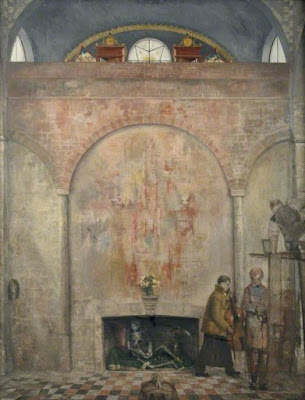
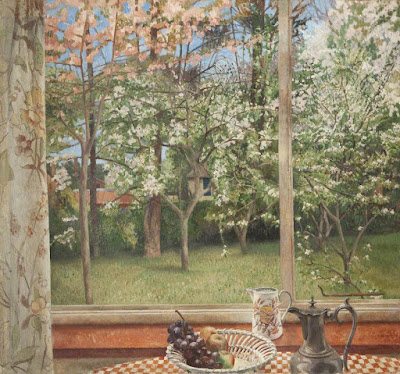
Richard Eurich (1903-1992), "The Window"

"But it is a sort of April weather life that we lead in this world.  A little sunshine is generally the prelude to a storm."  (William Cowper, letter to Walter Bagot (January 3, 1787), in James King and Charles Ryskamp (editors), The Letters and Prose Writings of William Cowper, Volume III: Letters 1787-1791 (Oxford University Press 1982), pages 5-6.)  So it was in this part of the world yesterday afternoon, as I walked through alternating showers and sunlight, the waters of Puget Sound by turns dark gray and dazzling.  So it is in the world at large.

Withal, there is an ever-present thread of beauty and truth running through our April weather life, through the April weather life of the world.  Poetry is an instance of the existence of that thread.

                    Homage to Arthur Waley

Seattle weather: it has rained for weeks in this town,
The dampness breeding moths and a gray summer.
I sit in the smoky room reading your book again,
My eyes raw, hearing the trains steaming below me
In the wet yard, and I wonder if you are still alive.
Turning the worn pages, reading once more:
"By misty waters and rainy sands, while the yellow dusk thickens."

Weldon Kees, in The Collected Poems of Weldon Kees (edited by Donald Justice) (University of Nebraska Press 1975).  The poem was first published in 1943.

As long time (and much appreciated!) readers of this blog may recall, Arthur Waley is one of my favorite translators of Chinese poetry into English (along with Burton Watson), and his translations have appeared here on many occasions.  Thus, I was delighted when I first came across Kees' poem (most likely on a rainy day in Seattle).

The quotation from Waley in the final line is from Waley's translation of a four-line poem (chüeh-chü) by Po Chü-i:

A bend of the river brings into view two triumphal arches;
That is the gate in the western wall of the suburbs of Hsün-yang.
I have still to travel in my solitary boat three or four leagues --
By misty waters and rainy sands, while the yellow dusk thickens.

Po Chü-i (772-846) (translated by Arthur Waley), in Arthur Waley, One Hundred and Seventy Chinese Poems (Constable 1918).  The poem is untitled.  It appears in a two-poem sequence titled "Arriving at Hsün-yang."  (By the way, Waley was in fact "still alive" when Kees wrote the poem: he died in 1966 at the age of 76.)

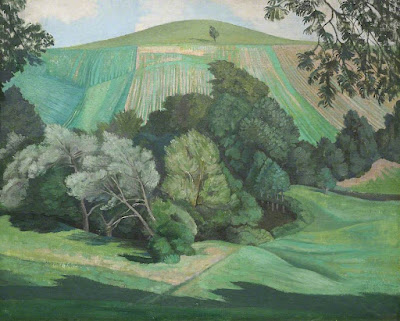
Richard Eurich, "The Rose" (1960)

Patrick Kavanagh meditates upon someone not yet born who will be listening to birds singing in wet trees in April a hundred years in the future, when Kavanagh will be long gone.  By virtue of the art of Arthur Waley, Weldon Kees reads a poem written by Po Chü-i a thousand years ago in China.  However fragile and contingent the world is, we mustn't forget this abiding thread.

   To a Poet a Thousand Years Hence

I who am dead a thousand years,
   And wrote this sweet archaic song,
Send you my words for messengers
   The way I shall not pass along.

I care not if you bridge the seas,
   Or ride secure the cruel sky,
Or build consummate palaces
   Of metal or of masonry.

But have you wine and music still,
   And statues and a bright-eyed love,
And foolish thoughts of good and ill,
   And prayers to them who sit above?

How shall we conquer?  Like a wind
   That falls at eve our fancies blow,
And old Maeonides the blind
   Said it three thousand years ago.

O friend unseen, unborn, unknown,
   Student of our sweet English tongue,
Read out my words at night, alone:
   I was a poet, I was young.

Since I can never see your face,
   And never shake you by the hand,
I send my soul through time and space
   To greet you.  You will understand.

James Elroy Flecker, in John Squire (editor), The Collected Poems of James Elroy Flecker (Secker and Warburg 1947).

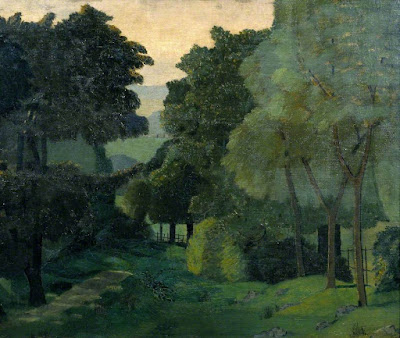
Richard Eurich, "The Road to Grassington" (1971)

Saturday, March 26, 2022

Empires. Animula. Blossoms and Warblers.

Given the situation in which the world now finds itself, I had thought to descant upon the folly and evil of self-appointed emperors and their imaginary, ultimately chimerical empires.  I had intended to begin with this:

        The Fort of Rathangan

The fort over against the oak-wood,
Once it was Bruidge's, it was Cathal's,
It was Aed's, it was Ailill's,
It was Conaing's, it was Cuilíne's,
And it was Maeldúin's:
The fort remains after each in his turn --
And the kings asleep in the ground.

Anonymous (translated by Kuno Meyer), in Kuno Meyer (editor), Selections from Ancient Irish Poetry (Constable 1913).  I first discovered the poem in Walter de la Mare's anthology Come Hither: A Collection of Rhymes and Poems for the Young of All Ages (Constable 1923).

I planned to eventually arrive at this:

                         In Yüeh Viewing the Past

Kou-chien, king of Yüeh, came back from the broken land of Wu;
his brave men returned to their homes, all in robes of brocade.
Ladies in waiting like flowers filled his spring palace
where now only the partridges fly.

Li Po (701-762) (translated by Burton Watson), in Burton Watson (editor), The Columbia Book of Chinese Poetry: From Early Times to the Thirteenth Century (Columbia University Press 1984).

But I soon realized, dear readers, that I would only be telling you something you already know.  Moreover, of what value is historical "perspective" (or the "perspective" of immutable human nature) when singular and irreplaceable lives are being lost, or forever damaged, at this moment?  I no longer had any heart for the project.  "Perspective" is an inappropriate indulgence for someone who is out of harm's way, living in a place that is not at war.

James McIntosh Patrick (1907-1998), "A Castle in Scotland"

Around the same time, for reasons unknown, I remembered this:

            Animula 

No one knows, no one cares --
An old soul
In a narrow cottage,
A parlour,
A kitchen,
And upstairs
A narrow bedroom,
A narrow bed --
A particle of immemorial life.

James Reeves, Poems and Paraphrases (Heinemann 1972).  "Animula" is usually translated into English as "little soul."  

Reeves' poem prompted me to return to a poem purportedly written by the Emperor Hadrian (ah, an emperor) on his deathbed.  The poem begins: "animula vagula blandula."  It has been translated into English dozens of times over the centuries.  My favorite version is that of Henry Vaughan:

My soul, my pleasant soul and witty,
The guest and consort of my body,
Into what place now all alone
Naked and sad wilt thou be gone?
No mirth, no wit, as heretofore,
Nor jests wilt thou afford me more.

Henry Vaughan, "Man in Darkness, or, A Discourse of Death," in The Mount of Olives: or, Solitary Devotions (1652), in Donald Dickson, Alan Rudrum, and Robert Wilcher (editors), The Works of Henry Vaughan, Volume I: Introduction and Texts, 1646-1652 (Oxford University Press 2018), page 318.

As a preface to his translation of the poem, Vaughan writes:

"You may believe, he was royally accommodated, and wanted nothing which this world could afford; but how far he was from receiving any comfort in his death from that pompous and fruitless abundance, you shall learn from his own mouth, consider (I pray) what he speaks, for they are the words of a dying man, and spoken by him to his departing soul."

Ibid, page 318.

Finally, Hadrian and Vaughan led me to T. S. Eliot's "Animula," and, in particular, these lines:

'Issues from the hand of God, the simple soul'
To a flat world of changing lights and noise,
To light, dark, dry or damp, chilly or warm;
Moving between the legs of tables and of chairs,
Rising or falling, grasping at kisses and toys,
Advancing boldly, sudden to take alarm,
Retreating to the corner of arm and knee,
Eager to be reassured, taking pleasure
In the fragrant brilliance of the Christmas tree,
Pleasure in the wind, the sunlight and the sea.
     *     *     *     *     *
Issues from the hand of time the simple soul
Irresolute and selfish, misshapen, lame,
Unable to fare forward or retreat, 
Fearing the warm reality, the offered good,
Denying the importunity of the blood,
Shadow of its own shadows, spectre in its own gloom,
Leaving disordered papers in a dusty room;
Living first in the silence after the viaticum.

T. S. Eliot, "Animula," lines 1-10 and 24-31, in Collected Poems 1909-1935 (Harcourt, Brace and Company 1936).

James McIntosh Patrick, "Springtime in Eskdale" (1935)

There is yet another way of considering this matter: "You are a little soul, carrying around a corpse, as Epictetus used to say."  Marcus Aurelius, Meditations, Book IV, Section 41 (translated by W. A. Oldfather).

Marcus Aurelius' quotation from Epictetus may be read in light of the section of the Meditations which immediately precedes it, and which is quite wonderful:

"Cease not to think of the Universe as one living Being, possessed of a single Substance and a single Soul; and how all things trace back to its single sentience; and how it does all things by a single impulse; and how all existing things are joint causes of all things that come into existence; and how intertwined in the fabric is the thread and how closely woven the web."

Marcus Aurelius, Meditations, Book IV, Section 40 (translated by C. R. Haines).

Empires.  Animula.  And yesterday afternoon I walked through Spring, which persists in being here, despite everything.  "How intertwined in the fabric is the thread and how closely woven the web."

A man of the Way comes rapping at my brushwood gate,
wants to discuss the essentials of Zen experience.
Don't take it wrong if this mountain monk's too lazy to open his
     mouth:
late spring warblers singing their heart out, a village of drifting
     petals.

Jakushitsu Genkō (1290-1367) (translated by Burton Watson), in Burton Watson, "Poems by Jakushitsu Genkō," The Rainbow World: Japan in Essays and Translations (Broken Moon Press 1990), page 127.

What are we to do?  "It's a sad and beautiful world."  (Mark Linkous (performing as Sparklehorse), "Sad and Beautiful World.")

To a mountain village
   at nightfall on a spring day
      I came and saw this:
blossoms scattering on echoes
   from the vespers bell.

Nōin (988-1050) (translated by Steven Carter), in Steven Carter (editor), Traditional Japanese Poetry: An Anthology (Stanford University Press 1991), page 134.

James McIntosh Patrick, "A City Garden" (1940)

Friday, March 4, 2022

Gulls

I am content to live my life in accordance with certain truisms.  For instance: Human nature has never changed, and never will.  And one of its corollaries: Yet man is born unto trouble, as the sparks fly upward.  Both of these seem quite apt in light of the events of the past week.  

I suspect that the utility of truisms becomes more apparent as one ages.  This is not necessarily a matter of attaining wisdom (I can attest to that).  Rather, it reflects a paring away of that which is inessential, beside the point.  There is little time left.  Why expend any of it on the sophistries of the world?

                      The Truisms

His father gave him a box of truisms
Shaped like a coffin, then his father died;
The truisms remained on the mantelpiece
As wooden as the playbox they had been packed in
Or that other his father skulked inside.

Then he left home, left the truisms behind him
Still on the mantelpiece, met love, met war,
Sordor, disappointment, defeat, betrayal,
Till through disbeliefs he arrived at a house
He could not remember seeing before.

And he walked straight in; it was where he had come from
And something told him the way to behave.
He raised his hand and blessed his home;
The truisms flew and perched on his shoulders
And a tall tree sprouted from his father's grave.

Louis MacNeice, Solstices (Faber and Faber 1961).

Charles Ginner (1878-1952), "Hartland Point from Boscastle" (1941)

The truisms mostly provide a framework for the world of humans, happenstance, and history, the world of fortune and of fate.  As for the World -- the World of beautiful particulars -- that is something else entirely.  I expect no explanations, answers, or solutions to arrive.  That being said, I am always on the lookout for glimmers and glimpses, calls and whispers, from near or far.  Yesterday, I came across thousands of tangled bare branches, a few passing white clouds, and a blue sky -- all floating on the surface of a puddle along the edge of a pathway.  Birdsong was with me wherever I walked.

Still, there are truisms that apply both to the world and the World.  For example: One thing leads to another.  As I have noted here in the past, one of the charms of poetry is that you never know where a poem will take you.  A few mornings ago, I read this:

        Evening Rain by the Bridge

Showering, the rain by the bridge,
Under shadow, at nightfall is not yet hushed.
A fisherman in straw coat waits hesitant on the bluff;
The monks' gong sounds across the central stream.
Sad and still, bush clover at twilight --
Blue into the distance, water oats in autumn.
How beautiful is the clear shallow water!
Tranquil: a single sand gull.

Ichū Tsūjo (1349-1429) (translated by Marian Ury), in Marian Ury, Poems of the Five Mountains: An Introduction to the Literature of the Zen Monasteries (Center for Japanese Studies, University of Michigan 1992).

The poem is a kanshi: a poem written in Chinese characters by a Japanese poet.  The writing of kanshi developed due to the popularity of classical Chinese poetry in Japan.  A kanshi replicates the formal structures and prosodic features of Chinese poetry (the number of lines in a particular lyric form, the prescribed number of characters in each line, as well as requirements relating to rhyme, tonal patterns, and verbal parallelisms).  

Although very few of the Japanese poets who wrote kanshi were fluent in, or spoke, Chinese, they were familiar with Chinese characters (known as kanji in Japanese) given that the characters are used in the Japanese writing system.  For many years (particularly during the 14th and 15th centuries), the writing of kanshi was popular among Zen Buddhist monks due to Zen's origin in Chinese Ch'an Buddhism.  A number of these monks had traveled to China to study Ch'an, and, while living there, had also grown fond of Chinese poetry.

Charles Ginner, "Dahlias and Cornflowers" (1929)

Ichū Tsūjo's "Tranquil: a single sand gull" soon brought to mind one of Tu Fu's best-known, most-beloved poems:

   A Traveler at Night Writes His Thoughts

Delicate grasses, faint wind on the bank;
stark mast, a lone night boat:
stars hang down, over broad fields sweeping;
the moon boils up, on the great river flowing.
Fame -- how can my writings win me that?
Office -- age and sickness have brought it to an end.
Fluttering, fluttering -- where is my likeness?
Sky and earth and one sandy gull.

Tu Fu (712-770) (translated by Burton Watson), in Burton Watson, The Columbia Book of Chinese Poetry: From Early Times to the Thirteenth Century (Columbia University Press 1984).

Very little has been written about Ichū Tsūjo in English, so I am not qualified to opine upon his familiarity either with Chinese poetry in general or with Tu Fu's poetry in particular.  However, I suspect that he was familiar with both Tu Fu's poetry and with "A Traveler at Night Writes His Thoughts."  I would also not be surprised if "Tranquil: a single sand gull" is a conscious echo of "Fluttering, fluttering -- where is my likeness?/Sky and earth and one sandy gull."

Charles Ginner, "Novar Cottage, Bearley, Warwickshire" (1933)

Tu Fu's "one sandy gull" in turn brought me to this, one of my favorite poems of spring:

   The Chinese Restaurant in Portrush

Before the first visitor comes the spring
Softening the sharp air of the coast
In time for the first seasonal 'invasion.'
Today the place is as it might have been,
Gentle and almost hospitable.  A girl
Strides past the Northern Counties Hotel,
Light-footed, swinging a book-bag,
And the doors that were shut all winter
Against the north wind and the sea-mist
Lie open to the street, where one
By one the gulls go window-shopping
And an old wolfhound dozes in the sun.

While I sit with my paper and prawn chow mein
Under a framed photograph of Hong Kong
The proprietor of the Chinese restaurant
Stands at the door as if the world were young,
Watching the first yacht hoist a sail
-- An ideogram on sea-cloud -- and the light
Of heaven upon the hills of Donegal;
And whistles a little tune, dreaming of home.

Derek Mahon, Collected Poems (The Gallery Press 1999).

Gulls.  One thing leads to another: from the banks of a village stream in 14th century Japan, to a boat anchored in a great river in 8th century China, and, finally, to a seaside town in 20th century Northern Ireland.  Are such journeys idle indulgences in a world of misery, calamity, and evil?  Or are such journeys absolute necessities in a world of misery, calamity, and evil?

Charles Ginner, "Yellow Chrysanthemums" (1929)

Tuesday, February 8, 2022

Revelation

My afternoon walk takes me through a grove of pines.  Beside a turning of the path is a small group of bushes, sheltered beneath the boughs overhead, growing amid years of fallen needles and leaves. The bushes are widely-spaced, open-branched candelabras, varying between four to eight feet tall.  Over time, they have become a harbinger of spring, for they are often the bearers of the first green buds of late winter.  

And so it is again: a few days ago, as I idly made my way, I noticed buds at the tip of nearly every twig, each lit by the low sun, most still folded tight, others already unfolding.  Before long, small white blossoms will appear.  I was startled by this sudden green presence. Sleepwalking once again.  But the World always finds a way to shake us awake.

          A Thicket in Lleyn

I was no tree walking.
I was still.  They ignored me,
the birds, the migrants
on their way south.  They re-leafed
the trees, budding them
with their notes.  They filtered through
the boughs like sunlight,
looked at me from three feet
off, their eyes blackberry bright,
not seeing me, not detaching me
from the withies, where I was
caged and they free.
                                     They would have perched
on me, had I had nourishment
in my fissures.  As it was,
they netted me in their shadows,
brushed me with sound, feathering the arrows
of their own bows, and were gone,
leaving me to reflect on the answer
to a question I had not asked.
"A repetition in time of the eternal
I AM."  Say it.  Don't be shy.
Escape from your mortal cage
in thought.  Your migrations will never 
be over.  Between two truths
there is only the mind to fly with.
Navigate by such stars as are not
leaves falling from life's
deciduous tree, but spray from the fountain
of the imagination, endlessly
replenishing itself out of its own waters.

R. S. Thomas, Experimenting with an Amen (Macmillan 1986).

Duncan Grant (1885-1978), "Charleston Barn" (1942)

"A repetition in time of the eternal I AM" is a variation by Thomas on Coleridge's definition of "the primary Imagination": "The primary IMAGINATION I hold to be the living Power and prime Agent of all human Perception, and as a repetition in the finite mind of the eternal act of creation in the infinite I AM."  (Samuel Taylor Coleridge, Biographia Literaria (1817) (edited by Adam Roberts) (Edinburgh University Press 2014), page 205.)  Thomas' alteration of the language is interesting, for he seems to broaden the scope of Coleridge's conception: Coleridge is seeking to define the nature of "the Primary Imagination," but Thomas expands this into an observation on the nature of our existence.

However, I shouldn't get too carried away with this parsing of words, for I would never wish to sell Coleridge short when it comes to contemplations upon eternity or upon the eternal and infinite "I AM": they are arguably in the foreground and background of all his thought and work.  For instance, one finds them again in the final sentence of Biographia Literaria:

"It is Night, sacred Night! the upraised Eye views only the starry Heaven which manifests itself alone: and the outward Beholding is fixed on the sparks twinkling in the aweful depth, though Suns of other Worlds, only to preserve the Soul steady and collected in its pure Act of inward Adoration to the great I AM, and to the filial WORD that re-affirmeth it from Eternity to Eternity, whose choral Echo is the Universe."

Ibid, page 414.  ("Aweful" is an archaic spelling often used by Coleridge, particularly in his younger years.  He uses it in this sense: "Solemnly impressive; sublimely majestic."  (The Oxford English Dictionary, Second Edition (Clarendon Press 1989), page 833.)  The spelling appears odd to modern eyes, but the presence of "awe" in the word is lovely.  It's a shame that this sense of the word has been lost.)

With respect to Coleridge and "eternity," words written soon after Coleridge's death by Charles Lamb, his friend from childhood, are telling and touching:

"When I heard of the death of Coleridge, it was without grief.  It seemed to me that he long had been on the confines of the next world, — that he had a hunger for eternity.  I grieved then that I could not grieve.  But, since, I feel how great a part he was of me.  His great and dear spirit haunts me.  I cannot think a thought, I cannot make a criticism on men and books, without an ineffectual turning and reference to him.  He was the proof and touchstone of all my cognitions. . . . Never saw I his likeness, nor probably the world can see again."

Charles Lamb, in E. V. Lucas, The Life of Charles Lamb, Volume II (Methuen 1905), page 266.  Coleridge died on July 25, 1834.  Lamb's remarks were written in November of that year, "in the album of Mr. Keymer, a bookseller."  Ibid.  Lamb died soon after, on December 27.

Duncan Grant, "The Doorway" (1929)

A recurring theme in the poetry of R. S. Thomas (one might even say the theme of his poetry) is the obdurate silence of God, and Thomas' impatience with, and ultimate acceptance of, that silence.  The fact that Thomas was an Anglican priest certainly adds an interesting and deeper dimension to the situation.  

At the same time, however, Thomas' preoccupation with this baffling, provocative, and powerful silence takes place in a World of immanence.  And, at unexpected times and in unexpected places, all suddenly becomes clear: Something is there.  As in "A Thicket in Lleyn."  Or as in this:

                 Arrival

Not conscious
       that you have been seeking
              suddenly
       you come upon it

the village in the Welsh hills
              dust free
       with no road out
but the one you came in by.

              A bird chimes
       from a green tree
the hour that is no hour
       you know.  The river dawdles
to hold a mirror for you
where you may see yourself
       as you are, a traveller
              with the moon's halo
       above him, who has arrived
       after long journeying where he
              began, catching this
       one truth by surprise
that there is everything to look forward to.

R. S. Thomas, Later Poems (Macmillan 1983).

Duncan Grant, "Laughton Castle" (c. 1930)

"He had a hunger for eternity."  There are worse things to hunger after.  And "there is everything to look forward to."  All of this inevitably brings me to my favorite poem by Thomas, which has appeared here six times over the past eleven years.  So please bear with me, dear readers: it needs to be here.

             The Bright Field

I have seen the sun break through 
to illuminate a small field
for a while, and gone my way
and forgotten it.  But that was the pearl
of great price, the one field that had
the treasure in it.  I realize now 
that I must give all that I have
to possess it.  Life is not hurrying

on to a receding future, nor hankering after
an imagined past.  It is the turning
aside like Moses to the miracle
of the lit bush, to a brightness
that seemed as transitory as your youth
once, but is the eternity that awaits you.

R. S. Thomas, Laboratories of the Spirit (Macmillan 1975).

Duncan Grant, "Girl at the Piano" (1940)

Sunday, January 23, 2022

Web

I came across this a few days ago: "Even a man who is perfectly adjusted to a deranged society can prepare himself, if he so desires, to become adjusted to the Nature of Things."  It comes from Aldous Huxley's foreword to the first English translation of Hubert Benoit's The Supreme Doctrine: Psychological Studies in Zen Thought (Routledge & Kegan Paul 1955).  I encountered the sentence in "The Frontiers of Criticism," an essay by T. S. Eliot which was published in 1956, and later collected in his On Poetry and Poets (Faber and Faber 1957).  It should be noted that Eliot did not quote the final clause of Huxley's sentence: "as it manifests itself in the universe at large and in his own mind-body."

Given the current state of affairs in the world (the spectacle of madness we witness on a daily basis), the phrase "a deranged society" immediately caught my attention, as did Eliot's reference to The Supreme Doctrine as "that remarkable book."  (T. S. Eliot, On Poetry and Poets, page 116.)  I haven't read Benoit's book, but Huxley argues that Benoit "has offered a searching criticism of Western psychology and Western psychotherapy as they appear in the light of Zen." Based upon the summary provided in Huxley's foreword, and having now read some portions of The Supreme Doctrine that can be found on the internet, it would appear that Benoit feels that Western psychology and psychotherapy leave something crucial out of account.  This seems accurate.

But, in thinking further about the wonderful sentence from Huxley and the excerpts I have read from The Supreme Doctrine, it all seems too abstract to me.  Far too many words.  Still, Huxley's "a deranged society" is right on the mark, as is the idea that, if one is "perfectly adjusted" to that society, such an adjustment means absolutely nothing when deciding how to live one's life, how to preserve one's soul.

My no doubt simplistic view is that, when it comes to dealing with a deranged society, the solution is to step outside into the World.  I suppose this is the Wordsworthian pantheist in me.  Or perhaps I should say the Wordsworthian-Coleridgean pantheist (circa 1797 through 1799).

I have returned to  Coleridge's notebooks the past month, and happened upon this:

"On St Herbert's Island I saw a large Spider with most beautiful legs floating in the air on his Back by a single Thread which he was spinning out, and still as he spun, heaving in the air, as if the air beneath were a pavement elastic to his Strokes/ -- from the Top of a very high Tree he had spun his Line, at length reached the Bottom, tied his Thread round a piece of Grass, & re-ascended, to spin another/a net to hang as a fisherman's Sea net hangs in the Sun & Wind, to dry."

Samuel Taylor Coleridge, in Kathleen Coburn (editor), The Notebooks of Samuel Taylor Coleridge, Volume 1: 1794-1804 (Pantheon Books 1957), Notebook Entry 1598 (October 1803).

W. G. Poole, "Savernake Forest" (1938)

It all begins and ends with the beautiful particulars of the World. "The paradise of Flowers' & Butterflies' Spirits."  (Samuel Taylor Coleridge, Ibid, Notebook Entry 1736 (December 1803).)  And, as Coleridge reveals in his previous notebook entry, the paradise of spiders' Spirits as well.  He was not the first to notice.

                    The Spider

There is craft in this smallest insect,
with strands of web spinning out his thoughts;
in his tiny body finding rest,
and with the wind lightly turning.
Before the eaves he stakes out his broad earth;
for a moment on the hedge top lives through his life.
The ten thousand things should all be thus,
the way the Creator meant us to be.

Sugawara no Michizane (845-903) (translated by Burton Watson), in Burton Watson, Japanese Literature in Chinese, Volume 1: Poetry and Prose in Chinese by Japanese Writers of the Early Period (Columbia University Press 1975), page 107.

"For a moment on the hedge top lives through his life."  Lovely.  The beautiful particulars of the World are, like us, contingent and evanescent, but they are sufficient to keep us attentive and enthralled for a lifetime, if we choose.

          No Jewel

No jewel from the rock
Is lovely as the dew,
Flashing with flamelike red
With sea-like blue.

No web the merchant weaves
Can rival hers --
The silk the spider spins
Across the furze.

Walter de la Mare, Bells and Grass: A Book of Rhymes (Faber and Faber 1941).

Leslie Duncan (b. 1932), "Birchwood"

I'm not certain about the notion of becoming "adjusted to the Nature of Things, as it manifests itself in the universe at large and in [one's] own mind-body."  It seems to me that attentiveness and gratitude are what is required, not "adjustment," although I may be quibbling with words.  In any case, paying attention and being grateful is a daily struggle (and, speaking for myself, a matter of daily failure).  Yet the World goes on being the World, and has always done so.  It patiently awaits us. 

All the while, of course, the lower-case world goes on in its wonted way.  "Deranged society" follows upon "deranged society."  Human nature has never changed, and never will.  Best then to dwell with our companions the spiders.  And with the poets who pay attention to them.

   On Something Observed

Torn remains of a cobweb,
     one strand dangling down --
a stray petal fluttering by
     has been tangled, caught in its skein,
all day to dance and turn,
     never once resting --
elsewhere in my garden,
     no breeze stirs.

Kokan Shiren (1278-1346) (translated by Burton Watson), in Burton Watson, Japanese Literature in Chinese, Volume 2: Poetry and Prose in Chinese by Japanese Writers of the Later Period (Columbia University Press 1976), page 27.

Yes, the World awaits us, but it is reticent.  We shouldn't expect it to spell things out for us.  And yet, messages do arrive.  Glimmers. "Quiet stream, with all its eddies, & the moonlight playing on them, quiet as if they were Ideas in the divine mind anterior to the Creation." (Samuel Taylor Coleridge, in Kathleen Coburn (editor), The Notebooks of Samuel Taylor Coleridge, Volume 1: 1794-1804, Notebook Entry 1154 (March - April 1802).)  

spider -- what is it, 
what is it you are crying?
autumn wind

Bashō (1644-1694) (translated by Makoto Ueda), in Makoto Ueda, Bashō and His Interpreters: Selected Hokku with Commentary (Stanford University Press 1991), page 54.

Dudley Holland (1915-1956), "Winter Morning" (1945)

All of this unfolds, as I suggested above, within a context of contingency and evanescence.  Coleridge captures this in another beautiful notebook entry: "September 1 -- the beards of Thistle & dandelions flying above the lonely mountains like life, & I saw them thro' the Trees skimming the lake like Swallows --"  (Samuel Taylor Coleridge, in Kathleen Coburn (editor), The Notebooks of Samuel Taylor Coleridge, Volume 1: 1794-1804, Notebook Entry 799 (September 1800).)  ". . . like life."  Wonderful.

Drops of dew
strung on filaments
of spider web --
such are the trappings
that deck out this world

Saigyō (1118-1190) (translated by Burton Watson), in Burton Watson, Saigyō: Poems of a Mountain Home (Columbia University Press 1991), page 200.

Charles Cundall (1890-1971), "Temeside, Ludlow" (1923)

Friday, December 31, 2021

What Matters

In my post of November 30, I mentioned the green fields we are fortunate to have throughout winter in this part of the World. Whether the day is dull grey or bright blue, I never tire of that green. I suppose I am easy to please.  But always grateful, or so I hope.

Earlier this week, the fields came to mind when I happened upon this:

                       Fragrant Grass

Fragrant grass, who knows who planted you,
Already spread in several clumps there by the terrace?
You have no mind to compete with the world --
What need is there for this deep rich green?

Wang An-shih (1021-1086) (translated by Burton Watson), in Kōjirō Yoshikawa, An Introduction to Sung Poetry (translated by Burton Watson) (Harvard University Press 1967), page 97.

John Nash (1893-1977), "Dorset Landscape" (c. 1930)

Today, as the sun descended toward the long dark silhouette of the distant mountain peaks, I watched a million bare twigs and branches turn to gold in the late afternoon light.  At the end of my walk, a thin line of crimson clouds lay along the far horizon.

"Every one of those impressions is the impression of the individual in his isolation, each mind keeping as a solitary prisoner its own dream of a world."  (Walter Pater, The Renaissance: Studies in Art and Poetry (Macmillan 1893), page 249.)  Well, yes, true.  Nonetheless, the World is there.  It is not a chimera.  As Wang An-shih beautifully reminds us.

The green is always with us.  And I grow fonder and fonder of the ever green World with each passing year.  Where would we be without the green?

Happy New Year, dear readers, I wish you all the best.

John Nash, "A Path through Trees" (c. 1915)

Sunday, December 19, 2021

Revenants

It's wonderful how a poem you have long been familiar with -- a poem you think you "know" -- suddenly and unexpectedly moves you.  I have recently been browsing in The New Oxford Book of Victorian Verse, visiting old standbys and hoping to make new discoveries.  Among the former, I happened upon this:

                    Rondeau

Jenny kissed me when we met,
     Jumping from the chair she sat in;
Time, you thief, who love to get
     Sweets into your list, put that in:
Say I'm weary, say I'm sad,
     Say that health and wealth have missed me,
Say I'm growing old, but add,
     Jenny kissed me.

Leigh Hunt (1784-1859), in Christopher Ricks (editor), The New Oxford Book of Victorian Verse (Oxford University Press 1987).

A nice but slight thing, one might think.  Written by someone who is not usually thought of as a poet.  It is a standard presence in anthologies of all sorts, and, once read, is likely to be passed over as the years go by.  But I had been away from it for a long time.  So I decided to stop and read it.

And, unaccountably, it struck a chord with me.  Was it the cast of light in the sky that day?  The season?  Senescence?  The state of the world?  Who knows.  But I do know that catch of breath, that heart-pause: Well, then, here is life.

George Charlton (1899-1979)
"The Churchyard at Leonard Stanley, Gloucestershire: Spring" (1942)

As you have heard me say here before, dear readers: "In poetry, one thing leads to another."  After reading "Rondeau," this presently came to mind:

                           Memory

Is Memory most of miseries miserable,
Or the one flower of ease in bitterest hell?

Dante Gabriel Rossetti (1828-1882), in William Rossetti (editor), The Collected Works of Dante Gabriel Rossetti, Volume I (Ellis and Scrutton 1886).

Rossetti's meditation on memory is significantly less sanguine than Hunt's lovely preservation of a passing, ostensibly prosaic moment.  (Although Hunt has no illusions about the quiddities of life.)  I suspect that Rossetti's complicated and fraught romantic life might be the source of his gloominess.  Yet, still, even "one flower of ease in bitterest hell" is something.  And, in a life, it might be enough.

George Charlton
"The Churchyard at Leonard Stanley, Gloucestershire: Summer"

If we are fortunate, in time each of us ends up with a handful of these never-fading flowers.  I am not speaking of memories in general, which rise and fall within us incessantly.  Rather, I am thinking of the select few charmed revenants of our life, the moments of timelessness and of absolute clarity which haunt us, whether we want them to or not.  The winnowing process that leads to the handful is a mystery.  We play no conscious role in that process.  Oh, yes, what remains with us comes from within us.  But these moments -- which are indeed our life -- have a life of their own.

                        Revaluation

Now I remember nothing of our love
So well as the crushed bracken and the wings
Of doves among dim branches far above --
Strange how the count of time revalues things!

Patrick MacDonogh, Poems (edited by Derek Mahon) (The Gallery Press 2001).

George Charlton
"The Churchyard at Leonard Stanley, Gloucestershire: Autumn"

Are these revenants as close as we come in this World to beauty and truth?

                      While You Slept

You never knew what I saw while you slept.
We drove up a wide green stone-filled valley.
Around us were empty heather mountains.
A white river curved quickly beside us.
I thought to wake you when I saw the cairn --
A granite pillar of that country's past --
But I let you sleep without that history.
You did, however, travel through that place:
I can tell you that your eyes were at rest
As the momentous world moved beyond you,
And that you breathed in peace that quarter hour.
We seldom know what is irreplaceable.
You sang old songs for me, then fell asleep.
I worried about what you were missing.
But you missed nothing.  And I was the one who slept.

sip (Glen Coe, Scotland, c. 1986.  For JAH.)

George Charlton
"The Churchyard at Leonard Stanley, Gloucestershire: Winter"

Tuesday, November 30, 2021

November

In this wet but temperate corner of the world, the short meadow grass, which turned pale-yellow and dry in the summer sun, is now green again.  The autumn and winter rains have arrived.  Over the weekend, I walked past a row of tall big-leaf maples -- a dozen or so, all of them emptied of leaves.  I was struck by the sight of the stout, grey and brown parti-colored trunks rising out of the deep-green grass.  

November was coming to an end, but the scene was one of illimitable life.  The long column of wide trunks stretched ahead beside the pathway, anchored in a sweep of bright grass, a canopy of countless empty branches overhead.  It was a matter of color and of light: the grey and brown of the trunks set against the green of the grass.  It felt like Spring.

               At Common Dawn

At common dawn there is a voice of bird
So sweet, 'tis kin to pain;
For love of earthly life it needs be heard,
And lets not sleep again.

This bird I did one time at midnight hear
In wet November wood
Say to himself his lyric faint and clear
As one at daybreak should.

He ceased; the covert breathed no other sound,
Nor moody answer made;
But all the world at beauty's worship found,
Was waking in the glade.

Vivian Locke Ellis, in Walter de la Mare (editor), Come Hither: A Collection of Rhymes and Poems for the Young of All Ages, Volume Two (Constable 1923), page 81.

John Aldridge (1905-1983), "Beslyn's Pond, Great Bardfield"

Friday, November 12, 2021

Reticence

I'm spending this week in the high desert to the east of the Cascades, in the town of Bend, Oregon.  A wide and open World of plains, buttes, and peaks, of Ponderosa pines, sagebrush, tufts of wild grass, and junipers.  A mostly quiet World.  Of course, the other world is continually going about its business, and it lurks here in this computer, and over there across the room in an iPhone.  

In the mornings and evenings, I travel to Japan to visit Kenkō and Ryōkan.  A quiet World as well.

"When people meet they are never silent a moment.  There is always talk about something.  If you listen to their conversations, most of what they say is meaningless chatter.  Their gossip about society and their criticisms of other people cause much harm and little profit, either for themselves or others.  When people are gabbling over these things, they never seem to realize that it does neither party any good."

Kenkō (1283-1350) (translated by Donald Keene), Tsurezuregusa, Chapter 164, in Donald Keene (editor and translator), Essays in Idleness: The Tsurezuregusa of Kenkō (Columbia University Press 1967), page 143.

During the last three decades of his life Ryōkan lived in a small hut in the hills near the Sea of Japan.  He was a kind and sociable man, but he was alone most of the time.

Twilight — the only conversation
     on this hill
Is the wind blowing through the pines.

Ryōkan (1758-1831) (translated by John Stevens), in John Stevens (editor and translator), One Robe, One Bowl: The Zen Poetry of Ryōkan (Weatherhill 1977), page 76.

David Murray (1849-1933), "Landscape" (1885)

One tries to keep the noisy world at arm's length and at bay, but the sheer volume of words is unstoppable and insidious, and always will be.  Being weak-willed, I am often undone by the briefest of forays into the electronic world: words, words, and ever more words (including the words I am writing at this moment).  One comes to value reticence.

"I wonder what feelings inspire a man to complain of 'having nothing to do.'  I am happiest when I have nothing to distract me and I am completely alone. . . . Even if a man has not yet discovered the path of enlightenment, as long as he removes himself from his worldly ties, leads a quiet life, and maintains his peace of mind by avoiding entanglements, he may be said to be happy, at least for the time being."

Kenkō (translated by Donald Keene), Tsurezuregusa, Chapter 75, in Donald Keene, Essays in Idleness: The Tsurezuregusa of Kenkō, pages 66-67.

Ryōkan found his path of enlightenment in the hills, but it was never an easy one, and he never claimed that it was the only path.

My hut lies in the middle of a dense forest;
Every year the green ivy grows longer.
No news of the affairs of men,
Only the occasional song of a woodcutter.
The sun shines and I mend my robe;
When the moon comes out I read Buddhist poems.
I have nothing to report, my friends.
If you want to find the meaning, stop chasing after so many things.

Ryōkan (translated by John Stevens), in John Stevens, One Robe, One Bowl: The Zen Poetry of Ryōkan, page 43.

David Murray, "Crofts on the Island of Lewis" (1921)

Sunday, October 31, 2021

Leaves

Ah, ever redolent autumn, realm of memory and of reflection!  Who knows what the leaves -- fallen, falling, or holding fast -- will awaken or evoke?

A few days ago I walked past a big-leaf maple.  About thirty feet tall, it had only a few hundred yellow and brown leaves remaining on its branches.  I stopped to look up at the leaves, which were set against a blue sky scattered with white and grey clouds, remnants of a storm that had recently passed through.  The blue above was bright, illuminated by the rays of the late afternoon sun, which was hidden by the clouds.  The yellow emanations from an unseen source seemed to give the blue a greater depth, a greater distance. Unreachably beautiful.

As I looked, suddenly, but only for an instant, I was a child on a cold autumn afternoon in Minnesota, gazing up at the leaves of a tree against a blue and grey sky.  1962?  1963?  I couldn't say.  But I was not "remembering" that childhood day in Minnesota: in that instant, I was there.  It was a matter of feeling, not of recollection.  I was in two times and in two places at once.  For better or worse, nothing had changed.  There I was and here I am.  One and the same.  And then the instant was gone.

                  Leaves

The prisoners of infinite choice
Have built their house
In a field below the wood
And are at peace.

It is autumn, and dead leaves
On their way to the river
Scratch like birds at the windows
Or tick on the road.

Somewhere there is an afterlife
Of dead leaves,
A stadium filled with an infinite
Rustling and sighing.

Somewhere in the heaven
Of lost futures
The lives we might have led
Have found their own fulfilment.

Derek Mahon, The Snow Party (Oxford University Press 1975).

William Samuel Jay (1843-1933)
"At the Fall of Leaf, Arundel Park, Sussex" (1883)

My beloved tree tunnels are not what they were three months ago. But they remain lovely.  The leaves that are left still rustle in the wind, but in a different key.  One walks toward, and into, an open, mottled world of gold and red and brown, a patchwork of colors overhead and at one's feet, not into a closed, deep-green world.  The light and air within take on the color of the leaves.  "The world is a continual change," Marcus Aurelius tells us.  (Meditations, Book IV, Section 3; translated by Francis Hutcheson and James Moor, 1742.) "Earth never grieves!"  So Thomas Hardy reminds us.  ("Autumn in King's Hintock Park.")  And, finally, Ryōkan quietly says: "The wind has brought/enough fallen leaves/to make a fire."  (Translated by John Stevens, 1977.)  Nothing is awry.

                       Under Trees

Yellow tunnels under the trees, long avenues
Long as the whole of time:
A single aimless man
Carries a black garden broom.
He is too far to hear him
Wading through the leaves, down autumn
Tunnels, under yellow leaves, long avenues.

Geoffrey Grigson, The Collected Poems of Geoffrey Grigson 1924-1962 (Phoenix House 1963).

John Milne Donald (1819-1866), "Autumn Leaves" (1864)