Saturday, June 20, 2020

Ever-present

In mid-May, the ants emerged from hibernation and immediately embarked upon their yearly castle-building.  Early in June, the first pink blossoms opened on the wild rose bushes.  As the meadow grasses grew tall, the swallows arrived, and now each afternoon they skim quickly over the fields, curving, climbing, and diving for insects. The past week or so, right on schedule, the purplish-pink sweet peas began to bloom, and, as always, they are making their way onto the paths from the edges of the meadows.

Imagine that: the World just goes on being the World.  Beautiful, mysterious, unfathomable.  Taciturn, yet eloquent with Immanence.

               Nobody Knows

Often I've heard the Wind sigh
     By the ivied orchard wall,
Over the leaves in the dark night,
     Breathe a sighing call,
And faint away in the silence,
     While I, in my bed,
Wondered, 'twixt dreaming and waking,
     What it said.

Nobody knows what the Wind is,
     Under the height of the sky,
Where the hosts of the stars keep far away house
     And its wave sweeps by --
Just a great wave of the air,
     Tossing the leaves in its sea,
And foaming under the eaves of the roof
     That covers me.

And so we live under deep water,
     All of us, beasts and men,
And our bodies are buried down under the sand,
     When we go again;
And leave, like the fishes, our shells,
     And float on the Wind and away,
To where, o'er the marvellous tides of the air,
     Burns day.

Walter de la Mare, Peacock Pie: A Book of Rhymes (Constable 1913).

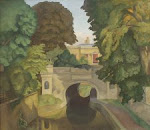
Robert Ball (1918-2009), "Mrs Barclay's Pond, Harborne" (1949)

Thursday, June 11, 2020

Dew

And so, dear readers, our eventful year continues.  I tell myself that I should keep my counsel as the arsonists, statue-topplers, building-defacers, and looters articulate their deeply-held convictions about how the rest of us ought to think, feel, and live.  Their actions speak for themselves.  No gloss is necessary.  Yet I will say that two words have been in my mind over the past week or so:  "emptiness" and "vacuity."  As well as this:  "They have inquired and considered little, and do not always feel their own ignorance.  They are not much accustomed to be interrogated by others; and seem never to have thought upon interrogating themselves."  Samuel Johnson, A Journey to the Western Islands of Scotland (1775), page 272.

The evil and lack of human decency on display are nothing new, alas. They are part of human nature -- always have been, always will be. One chooses one's path.

                                The Nightjar

We loved our Nightjar, but she would not stay with us.
We had found her lying as dead, but soft and warm,
Under the apple tree beside the old thatched wall.
Two days we kept her in a basket by the fire,
Fed her, and thought she well might live -- till suddenly
In the very moment of most confiding hope
She raised herself all tense, quivered and drooped and died.
Tears sprang into my eyes -- why not? the heart of man
Soon sets itself to love a living companion,
The more so if by chance it asks some care of him.
And this one had the kind of loveliness that goes
Far deeper than the optic nerve -- full fathom five
To the soul's ocean cave, where Wonder and Reason
Tell their alternate dreams of how the world was made.
So wonderful she was -- her wings the wings of night
But powdered here and there with tiny golden clouds
And wave-line markings like sea-ripples on the sand.
O how I wish I might never forget that bird --
Never!
                    But even now, like all beauty of earth,
She is fading from me into the dusk of Time.

Henry Newbolt (1862-1938), A Perpetual Memory and Other Poems (John Murray 1939).

Herbert Hughes-Stanton (1870-1937)
"The Mill in the Valley" (1892)

Wednesday, June 3, 2020

Choristers

The wild grasses that cover the meadows are deep green and growing tall.  Scattered amidst the swaying green, close to the ground, are small pinkish-purple wildflowers.  You have to look closely, or you will miss them.  Their name is unknown to me.  But I am acquainted with them, and I look forward to their arrival each May.

     Among the grasses,
A flower blooms white,
     Its name unknown.

Masaoka Shiki (1867-1902) (translated by R. H. Blyth), in R. H. Blyth, Haiku, Volume 1: Eastern Culture (Hokuseido Press 1949), page 289.

There are those who seek to know the names of each of the beautiful particulars of the World, and I admire and envy their curiosity and diligence.  I wish them well.  We are all in pursuit of beauty, and I am in no position to say one path is better than another.  But I am, and shall remain, blissfully ignorant when it comes to the names of most of those beautiful particulars.  Thus, "the small pinkish-purple wildflower that comes in May" will suffice for me.

     The names unknown,
But to every weed its flower,
     And loveliness.

Sampū (1647-1732) (translated by R. H. Blyth), in R. H. Blyth, Haiku, Volume 4: Autumn-Winter (Hokuseido Press 1952), page 123.

Stanley Spencer (1891-1959)
"The Ferry Hotel Lawn, Cookham" (1936)

Despite the inevitable importunities of Events, as magnified and distorted by the clamor, bad faith, and ultimate emptiness of "news," the World -- the real World -- quietly runs its serene course, and always will.  Nameless, profound.  We can attend to it, or not.  The choice is ours.

               The Knight in the Wood

The thing itself was rough and crudely done,
Cut in coarse stone, spitefully placed aside
As merest lumber, where the light was worst
On a back staircase.  Overlooked it lay
In a great Roman palace crammed with art.
It had no number in the list of gems,
Weeded away long since, pushed out and banished,
Before insipid Guidos over-sweet
And Dolce's rose sensationalities,
And curly chirping angels spruce as birds.
And yet the motive of this thing ill-hewn
And hardly seen did touch me.  O, indeed,
The skill-less hand that carved it had belonged
To a most yearning and bewildered brain:
There was such desolation in the work;
And through its utter failure the thing spoke
With more of human message, heart to heart,
Than all these faultless, smirking, skin-deep saints,
In artificial troubles picturesque,
And martyred sweetly, not one curl awry --
Listen; a clumsy knight, who rode alone
Upon a stumbling jade in a great wood
Belated.  The poor beast with head low-bowed
Snuffing the treacherous ground.  The rider leant
Forward to sound the marish with his lance.
You saw the place was deadly; that doomed pair,
The wretched rider and the hide-bound steed,
Feared to advance, feared to return -- That's all!

John Leicester Warren, Rehearsals: A Book of Verses (Strahan & Company 1870). (A side-note: "marish" (line 25) is not a misspelling. It is a precursor of "marsh.")

Stanley Spencer, "Rock Gardens, Cookham Dene" (1947)

How the World presents itself to us is ever a source of surprise and mystery, isn't it?  We need to be attentive and receptive, for it often appears in a humble guise, without pretense, making no demands, easily missed.

                    Aboard a Boat, Listening to Insects

As though delighting, as though grieving, each with its own song --
an idler, listening, finds his ears washed completely clean.
As the boat draws away from grassy banks, they grow more distant,
till the many varied voices become one single voice.

Ōkubo Shibutsu (1767-1837) (translated by Burton Watson), in Burton Watson, Kanshi: The Poetry of Ishikawa Jōzan and Other Edo-Period Poets (North Point Press 1990), page 92).

Stanley Spencer, "Scarecrow, Cookham" (1934)

Saturday, May 23, 2020

Interval

"Days are where we live."  "For the days are long -- /From the first milk van/To the last shout in the night,/An eternity."  In the end, our life is a tangled skein of days.  From this welter, what can we retrieve, what remains with us?  Not days, but a handful of isolated, charmed moments.

The moments return, unaccountably, unbidden, in brilliant clarity. The days and years drop away.  Ah, yes.  So that was my life.  You may have known this at the time.  If so, you are fortunate.  Or you may come to know it only as a heart-catching pang of recognition -- distant, long-lost, but better late than never.

                                The Ash Grove

Half of the grove stood dead, and those that yet lived made
Little more than the dead ones made of shade.
If they led to a house, long before they had seen its fall:
But they welcomed me; I was glad without cause and delayed.

Scarce a hundred paces under the trees was the interval --
Paces each sweeter than sweetest miles -- but nothing at all,
Not even the spirits of memory and fear with restless wing,
Could climb down in to molest me over the wall

That I passed through at either end without noticing.
And now an ash grove far from those hills can bring
The same tranquillity in which I wander a ghost
With a ghostly gladness, as if I heard a girl sing

The song of the Ash Grove soft as love uncrossed,
And then in a crowd or in distance it were lost,
But the moment unveiled something unwilling to die
And I had what most I desired, without search or desert or cost.

Edward Thomas, The Annotated Collected Poems (edited by Edna Longley) (Bloodaxe Books 2008).

Duncan Grant (1885-1978), "Girl at the Piano" (1940)


"The way leads on . . . The road leads on."  "Does the road wind up-hill all the way?/Yes, to the very end."  Life is a journey.  We've heard that often.  Yet it is a few brief intervals of lucent stillness that ultimately stay with us.  "Scarce a hundred paces under the trees was the interval."  Evanescent.  But enough.  An aspect of eternity.

                            On the Road

Our roof was grapes and the broad hands of the vine
as we two drank in the vine-chinky shade
of harvest France;
and wherever the white road led we could not care,
it had brought us there
to the arbour built on a valley side where time,
if time any more existed, was that river
of so profound a current, it at once
both flowed and stayed.

We two.  And nothing in the whole world was lacking.
It is later one realizes.  I forget
the exact year or what we said.  But the place
for a lifetime glows with noon.  There are the rustic
table and the benches set; beyond the river
forests as soft as fallen clouds, and in
our wine and eyes I remember other noons.
It is a lot to say, nothing was lacking;
river, sun and leaves, and I am making
words to say 'grapes' and 'her skin.'

Bernard Spencer, With Luck Lasting (Hodder and Stoughton 1963).

Duncan Grant, "The Doorway" (1929)

Wednesday, May 13, 2020

Mystery

As I have mentioned here before, I often give myself this piece of advice as I begin my daily walk:  Stop thinking.  Pay attention.  I fail miserably each time, of course.  But the World always finds new and beautiful ways to gently shake us by the shoulders and whisper: "Wake up, pilgrim."  It is coy and persistent.  It demands nothing of us, but it is not going away.

Thus, on a recent afternoon, as I strolled in a daydream, I suddenly awoke to the sound of birdsong from all quarters of the earth and sky. An unrehearsed chorus of anonymous and solitary singers in a green and blue World, each of them singular and irreplaceable.

The notes they sang were "synonyms for joy," certainly.  But, coming from everywhere, in all their variations, unceasing yet uninsistent, the notes were something else as well.  Later that evening, this came to mind:  "One feels the life of that which gives life as it is."

                           The Wood

I walked a nut-wood's gloom.  And overhead
A pigeon's wing beat on the hidden boughs,
And shrews upon shy tunnelling woke thin
Late winter leaves with trickling sound.  Across
My narrow path I saw the carrier ants
Burdened with little pieces of bright straw.
These things I heard and saw, with senses fine
For all the little traffic of the wood,
While everywhere, above me, underfoot,
And haunting every avenue of leaves,
Was mystery, unresting, taciturn.
           .         .         .         .         .
And haunting the lucidities of life
That are my daily beauty, moves a theme,
Beating along my undiscovered mind.

John Drinkwater, Loyalties (Sidgwick & Jackson 1919).  The ellipses appear in the original.

Alfred Thornton (1863-1939)
"Hill Farm, Painswick, Gloucestershire"

"One feels the life of that which gives life as it is."  After I returned home from my walk, I noticed birds singing in the back garden.  They sang until the last pale light in the sky faded away.

     All the long day --
Yet not long enough for the skylark,
     Singing, singing.

Bashō (translated by R. H. Blyth), in R. H. Blyth, Haiku, Volume 2: Spring (Hokuseido Press 1950), page 195.

Alfred Thornton, "The Upper Severn"

Thursday, April 30, 2020

Beneficence

A path I often follow takes me past a row of six willows.  They stand at the edge of a wide meadow which slopes down to the bluffs above Puget Sound.  I suspect the trees were planted sometime in the previous century, when what is now a city park was an army post.  I have wondered whether they were placed there by someone far away from home who longed for the willows of their past.  I have thought about the thousands of soldiers who transited through the post during World War II on their way to the Pacific.  A willow is a redolent thing.

Over the last month, their leaves have gone from yellow-green to green-yellow to full green.  As I walked beside them on a windy day earlier this week, their boughs tossed and swayed with the deep sound of summer.  As I came to the final willow in the row, a single green leaf floated down in front of me.

A random occurrence.  Just one of those things.

               Shinto

When sorrow lays us low
for a second we are saved
by humble windfalls
of mindfulness or memory:
the taste of a fruit, the taste of water,
that face given back to us by a dream,
the first jasmine of November,
the endless yearning of the compass,
a book we thought was lost,
the throb of a hexameter,
the slight key that opens a house to us,
the smell of a library, or of sandalwood,
the former name of a street,
the colors of a map,
an unforeseen etymology,
the smoothness of a filed fingernail,
the date we were looking for,
the twelve dark bell-strokes, tolling as we count,
a sudden physical pain.

Eight million Shinto deities
travel secretly throughout the earth.
Those modest gods touch us --
touch us and move on.

Jorge Luis Borges (translated by Hoyt Rogers), in Jorge Luis Borges, Selected Poems (edited by Alexander Coleman) (Viking 1999).

Harald Sohlberg (1869-1935), "Flower Meadow in the North" (1905)

Tuesday, April 21, 2020

Here

What most human beings want is a little peace and quiet, don't you think?  Although we may be caught up in unwonted Events at the present time, the cultivation of "A Quiet Normal Life" goes on. Marcus Aurelius is correct: "The things themselves reach not to the soul, but stand without, still and motionless.  All your perturbation comes from inward opinions about them."  Meditations, Book IV, Section 3 (translated by Francis Hutcheson and James Moor, 1742). This is a roundabout way of telling you, dear readers, that it is once again time (begging your forbearance) to revisit my "April poem" (companion to my May, August, and November poems):

                    Wet Evening in April

The birds sang in the wet trees
And as I listened to them it was a hundred years from now
And I was dead and someone else was listening to them.
But I was glad I had recorded for him the melancholy.

Patrick Kavanagh, Collected Poems (edited by Antoinette Quinn) (Penguin 2004).

Most Aprils when I return to "Wet Evening in April" the weather in this part of the world is in harmony with the setting and the mood of the poem.  Thus, on more than one occasion I have read the poem on a rainy evening as birds converse in the trees before they settle down for the night.  But this April has been gratuitously brilliant, and on my walk this afternoon I passed through a "bee-loud glade," and the trees in all directions whispered: "Begin afresh, afresh, afresh."  I'm afraid I cannot muster any melancholy.  Yet the poem is as beautiful as ever.  We never know who we will be, or where we will find ourselves, when we revisit a poem, do we?

Robert Fowler (1853-1926), "Knaresborough"

The Events come and go, and take us or leave us.  But Patrick Kavanagh and Marcus Aurelius intimate that there is more to each of us than meets the eye.  The Events are not us.  Philippe Jaccottet brings this to our attention as well: "The imperceptible movement of an invisible soul and the enormous sun."  Philippe Jaccottet, notebook entry (October, 1967), in Seedtime: Notebooks, 1954-79 (translated by Tess Lewis) (Seagull Books 2013), page 159.  And this:

"Attachment to the self renders life more opaque.  One moment of complete forgetting and all the screens, one behind the other, become transparent so that you can perceive clarity to its very depths, as far as the eye can see; and at the same time everything becomes weightless.  Thus does the soul truly become a bird."

Philippe Jaccottet, notebook entry (May, 1954), Ibid, page 1.

In each moment, the Events are absent, meaningless.  There is more afoot in the World.

     The spring rain:
Between the trees is seen
     A path to the sea.

Otsuji (1881-1920) (translated by R. H. Blyth), in R. H. Blyth, Haiku, Volume 2: Spring (Hokuseido Press 1950), page 104.

William Mouncey (1852-1901), "Kirkcudbright Harbour"

Sunday, April 12, 2020

Events

Odd, the feeling of appearing to be at the whim of Events.  Surprising, disconcerting, interesting, and by turns a great deal else.  One's thoughts range from "Am I going to perish in the plague?" to "What if I run out of toilet paper?"  Not to minimize the situation in which we find ourselves, but those two queries (or ones of a similar nature and import) could have been posed a year ago -- or at any time between the present moment and the moment when each of us emerged out of the darkness into the bright World.

Well, then, here we are.  The Events have arrived.  Or perhaps they have been with us all along.  What shall we do?  Think back.  Hasn't that always been the pertinent question?

                              History

Sometimes, when walls and occupation seem
A prison merely, a dark barrier
Between me everywhere
And life, or the larger province of the mind,
As dreams confined,
As the trouble of a dream,
I seek to make again a life long gone,
To be
My mind's approach and consolation,
To give it form's lucidity,
Resilient form, as porcelain pieces thrown
In buried China by a wrist unknown,
Or mirrored brigs upon Fowey sea.

Then to my memory comes nothing great
Of purpose, or debate,
Or perfect end,
Pomp, nor love's rapture, nor heroic hours to spend --
But most, and strangely, for long and so much have I seen,
Comes back an afternoon
Of a June
Sunday at Elsfield, that is up on a green
Hill, and there,
Through a little farm parlour door,
A floor
Of red tiles and blue,
And the air
Sweet with the hot June sun cascading through
The vine-leaves under the glass, and a scarlet fume
Of geranium flower, and soft and yellow bloom
Of musk, and stains of scarlet and yellow glass.

Such are the things remain
Quietly, and for ever, in the brain,
And the things that they choose for history-making pass.

John Drinkwater, Loyalties (Sidgwick & Jackson 1919).

Harold Jones (1904-1992), "The Black Door"

In this part of the world, we are walking in the warm sunlight amidst snow showers of pink and white petals -- cherry, plum, and pear. What else can one do?

     Simply trust:
Do not also the petals flutter down,
     Just like that?

Issa (1763-1827) (translated by R. H. Blyth), in R. H. Blyth, Haiku, Volume 2: Spring (Hokuseido Press 1950), page 363.

Adrian Paul Allinson (1890-1959), "The Cornish April"

Saturday, April 4, 2020

Another April

"But it is a sort of April weather life that we lead in this world.  A little sunshine is generally the prelude to a storm."  Thus wrote William Cowper in a letter dated January 3, 1787.  And now, here we are: another April.  More of the same, don't you think?

Yesterday was the sort of April day described by Cowper.  In the evening, I drove to a neighborhood sushi restaurant to pick up dinner.  (Although restaurants are closed for dining, take out is still permitted, and it makes sense to support family-owned businesses.) Just then the sun was out, but it would soon set beyond Puget Sound and the Olympic Mountains, both at my back.  The street I took runs straight down a long steep hill, levels out for a few blocks, then runs straight up another steep hill to the east.  From the top of the hill, I could see the cherry trees -- in peak white bloom -- lining both sides of the street that climbs the opposite slope.  The slope, and the houses on it, were covered in sunlight.  A rainbow suddenly appeared above the hill on the other side of the valley.  Descending, I passed blooming cherry trees, and, here and there, tall magnolia trees full of large pink-white blossoms.

Another April.  More of the same.  A paradise.

            A Short Ode

All things then stood before us
        as they were,
Not in comparison,
But each most rare;
The 'tree, of many, one,'
The lock of hair,
The weir in the morning sun,
The hill in the darkening air,
Each in its soleness, then and there,
Created one; that one, creation's care.

Edmund Blunden, A Hong Kong House: Poems 1951-1961 (Collins 1962).

The quotation in line 5 comes from William Wordsworth's "Ode: Intimations of Immortality from Recollections of Early Childhood": "But there's a tree, of many, one,/A single field which I have look'd upon,/Both of them speak of something that is gone."  I presume this reference accounts for Blunden's title (contrasting his ode of ten lines with Wordsworth's of over 200 lines).

Samuel Llewellyn (1858-1941), "Sailing at Blakeney" (c. 1938)

As is my usual practice, I have been doing my best to avoid "news."  I hear about things such as "lockdowns" by word-of-mouth.  But snippets inevitably seep through the interstices, despite my vigilance. For instance, I have recently been seeing and hearing the word "unprecedented" quite often.  "Unprecedented."  Is that so?

As is also my usual practice, I have been reading a poem soon after waking up each morning.  Yesterday morning I read this, a haiku of which I have long been fond:

     A night of stars;
The cherry blossoms are falling
     On the water of the rice seedlings.

Buson (1716-1783) (translated by R. H. Blyth), in R. H. Blyth, Haiku, Volume 2: Spring (Hokuseido Press 1950), page 170.

I fell asleep last night thinking about stars in a dark sky and cherry blossom petals floating in dark water among rice seedlings.  Today I went out for a walk.  In puddles left by yesterday's rain, I saw blue sky, white clouds, and infinitely intricate tree branches, floating at my feet.  Another April.  Unprecedented.

Christopher Sanders (1905-1991)
"Sunlight Through a Willow Tree at Kew" (c. 1958)

Saturday, March 28, 2020

Light

"Tightly-folded bud."  This is the first line of Philip Larkin's "Born Yesterday," which was written in January of 1954 "for Sally Amis" (Kingsley Amis' daughter) to celebrate her birth.  I thought of the line each afternoon this past week as I walked past the low-hanging branches of trees that are now in bud.  As I write this, two lines by Larkin from "The Trees" (that lovely poem of spring) come to mind: "The trees are coming into leaf/Like something almost being said." Everything changes.  Every thing changes.  Nothing changes.

               Gift

Some ask the world
        and are diminished
in the receiving
        of it.  You gave me

only this small pool
        that the more I drink
from, the more overflows
        me with sourceless light.

R. S. Thomas, Experimenting with an Amen (Macmillan 1986).

Bertram Priestman (1868-1951)
"The Sun-Veiled Hills of Wharfedale" (1917)

Thousands of buds at the tips of twigs, yet each in its own singularity: delicate and full of intent.  "Tightly-folded bud."  A flower of leaf. Mostly shades of green, though often streaked, speckled, or swirled with browns or yellows or reds.  Suspended beneath the sky, precarious.  But lucent, potent with life.  And, from all around, the singing of robins.

               The Bright Field

I have seen the sun break through
to illuminate a small field
for a while, and gone my way
and forgotten it.  But that was the pearl
of great price, the one field that had
the treasure in it.  I realize now
that I must give all that I have
to possess it.  Life is not hurrying

on to a receding future, nor hankering after
an imagined past.  It is the turning
aside like Moses to the miracle
of the lit bush, to a brightness
that seemed as transitory as your youth
once, but is the eternity that awaits you.

R. S. Thomas, Laboratories of the Spirit (Macmillan 1975).

Francis Armstrong (1849-1920), "Cader Idris, Snowdonia" (1918)