Showing posts with label C. S. Calverley. Show all posts

Thursday, April 3, 2014

Peace

A few posts ago, I offered this bit of wisdom from Joseph Conrad:  "When once the truth is grasped that one's own personality is only a ridiculous and aimless masquerade of something hopelessly unknown the attainment of serenity is not very far off."  Joseph Conrad, Letter to Edward Garnett (March 23, 1896), in Edward Garnett, Letters from Joseph Conrad, 1895-1924 (1928), page 46.  I remarked in the post that it was nice that Conrad used the word "serenity" rather than "happiness."

Happiness is overpromoted and overrated.  I cannot presume to speak for the universal order of things, but I venture to say that we are not put on Earth to be happy.  A quick look at popular culture (wherever you hail from) will convince you that "the pursuit of happiness" is a hollow business indeed.  "Distracted from distraction by distraction."

Serenity is another matter entirely.  As are peace of mind, tranquillity, and repose.  One can be sad but serene, unhappy but tranquil.  Peace of mind and repose can be maintained amid cacophony and chaos (the normal state of the world).

James Bateman (1893-1959), "Haytime in the Cotswolds"

Which is not to say that the attainment of serenity is easy, or, once attained, permanent.

                                          Peace

When will you ever, Peace, wild wooddove, shy wings shut,
Your round me roaming end, and under be my boughs?
When, when, Peace, will you, Peace?  I'll not play hypocrite

To own my heart:  I yield you do come sometimes; but
That piecemeal peace is poor peace.  What pure peace allows
Alarms of wars, the daunting wars, the death of it?

O surely, reaving Peace, my Lord should leave in lieu
Some good!  And so he does leave Patience exquisite,
That plumes to Peace thereafter.  And when Peace here does house
He comes with work to do, he does not come to coo,
                                         He comes to brood and sit.

Gerard Manley Hopkins, in W. H. Gardner and N. H. MacKenzie (editors), The Poems of Gerard Manley Hopkins (Oxford University Press, Fourth Edition, 1967).  In a letter to Robert Bridges, Hopkins stated that "reave [line 7] is for rob, plunder, carry off."  Ibid, page 278.

"Your round me roaming end" is very nice.  As is:  "And so he does leave Patience exquisite,/That plumes to Peace thereafter."  Yes, the pursuit of happiness tends to breed impatience.

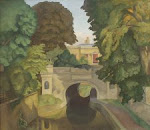
Thomas Henslow Barnard, "Landscape with Ludlow Castle" (1952)

Charles Stuart Calverley wrote light verse and comic verse.  Thus, as I have noted in a previous post, we are perhaps supposed to view the subject of the following poem as a figure of fun.  However, I've never thought so.  I greatly admire him, and I would be pleased to follow in his footsteps.

                       Peace
                     A Study

He stood, a worn-out City clerk --
     Who'd toiled, and seen no holiday,
For forty years from dawn to dark --
     Alone beside Caermarthen Bay.

He felt the salt spray on his lips;
     Heard children's voices on the sands;
Up the sun's path he saw the ships
     Sail on and on to other lands;

And laughed aloud.  Each sight and sound
     To him was joy too deep for tears;
He sat him on the beach, and bound
     A blue bandana round his ears:

And thought how, posted near his door,
     His own green door on Camden Hill,
Two bands at least, most likely more,
     Were mingling at their own sweet will

Verdi with Vance.  And at the thought
     He laughed again, and softly drew
That Morning Herald that he'd bought
     Forth from his breast, and read it through.

C. S. Calverley, Fly Leaves (1872).

Adrian Paul Allinson (1890-1959), "The Cornish April"

Friday, August 6, 2010

By The Sea: "Peace -- A Study"

C. S. Calverley (1831-1884) wrote verse parodies and light verse.  The following poem is often found in anthologies of "comic" verse, and the clerk in the poem is thus regarded as a comic figure.  But I beg to differ.  I confess that all my sympathies lie with the clerk, and that I feel nothing but goodwill toward him.  This no doubt puts me at cross-purposes with "authorial intention" and, moreover, suggests that I am slow on the uptake.  That may be so.  But I like the clerk.  And I feel a kinship with him.

                       Peace
                     A study

He stood, a worn-out City clerk --
  Who'd toil'd, and seen no holiday,
For forty years from dawn to dark --
   Alone beside Caermarthen Bay.

He felt the salt spray on his lips;
   Heard children's voices on the sands;
Up the sun's path he saw the ships
   Sail on and on to other lands;

And laugh'd aloud.  Each sight and sound
   To him was joy too deep for tears;
He sat him on the beach, and bound
   A blue bandana round his ears,

And thought how, posted near his door,
   His own green door on Camden Hill,
Two bands at least, most likely more,
   Were mingling at their own sweet will

Verdi with Vance.  And at the thought
   He laugh'd again, and softly drew
That Morning Herald that he'd bought
   Forth from his breast, and read it through.

(An aside: it has been suggested that line 10 is intended to be an echo of the final line of Wordsworth's "Ode: Intimations of Immortality from Recollections of Early Childhood":  "Thoughts that do often lie too deep for tears.")

                                          John Brett (1831-1902)
         "The British Channel Seen From The Dorsetshire Cliffs" (1871)

Thursday, March 11, 2010

The Disappearance Of "For Ever": A Lament

There was a time (say, prior to the middle of the 19th century) when the word that we now write as "forever" was written "for ever."  Ah, how I long for those days!

Why? Perhaps it is because of my innate conservatism, my resistance to change.  Perhaps I am merely being eccentric.  But, please note that my objection to "forever" is not based upon etymology, lexicography, or proper or improper English usage.  No, my objection to "forever" is based solely upon aesthetics: I find "for ever" to be much more beautiful, elegant, and pleasing than "forever."  Call me a reactionary, but if "for ever" was acceptable to Samuel Johnson, it certainly ought to be acceptable to us.

I recently discovered that I am not the only one who has pondered the merits of "for ever" versus "forever."  (We are never as unique as we think we are.)  I came upon a poem by Charles Stuart Calverley (1831-1884), who was well-known in Victorian England for his humorous verse.  Here is the poem:

             "Forever"

Forever; 'tis a single word!
   Our rude forefathers deemed it two:
Can you imagine so absurd
   A view!

Forever!  What abysms of woe
   The word reveals, what frenzy, what
Despair!  For ever (printed so)
   Did not.

It looks, ah me! how trite and tame!
   It fails to sadden or appal
Or solace - it is not the same
   At all.

O thou to whom it first occurred
   To solder the disjoined, and dower
Thy native language with a word
   Of power:

We bless thee!  Whether far or near
   Thy dwelling, whether dark or fair
Thy kingly brow, is neither here
   Nor there.

But in men's hearts shall be thy throne,
   While the great pulse of England beats.
Thou coiner of a word unknown
   To Keats!

And nevermore must printer do
   As men did long ago; but run
"For" into "ever," bidding two
   Be one.

Forever!  passion-fraught, it throws
   O'er the dim page a gloom, a glamour:
It's sweet, it's strange; and I suppose
   It's grammar.

Forever!  'Tis a single word!
   And yet our fathers deemed it two:
Nor am I confident they erred;
   Are you?