
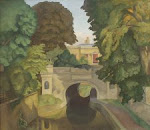
This attraction was heightened by the importance of "spleen" to the French Symbolist poets from whom the poets of the Nineties took their lead. For example, both Charles Baudelaire and Paul Verlaine wrote poems with that title. Not surprisingly, the Decadents tried their hands at translating the poems. Three versions of Verlaine's "Spleen" follow -- by John Gray, Ernest Dowson, and Arthur Symons.
Spleen
The roses every one were red,
And all the ivy leaves were black.
Sweet, do not even stir your head,
Or all of my despairs come back.
The sky is too blue, too delicate:
Too soft the air, too green the sea.
I fear -- how long had I to wait! --
That you will tear yourself from me.
The shining box-leaves weary me,
The varnished holly's glistening,
The stretch of infinite country;
So, saving you, does everything.
John Gray, Silverpoints (1893).

Spleen
Around were all the roses red,
The ivy all around was black.
Dear, so thou only move thine head,
Shall all mine old despairs awake!
Too blue, too tender was the sky,
The air too soft, too green the sea.
Always I fear, I know not why,
Some lamentable flight from thee.
I am so tired of holly-sprays
And weary of the bright box-tree,
Of all the endless country ways;
Of everything alas! save thee.
Ernest Dowson, Decorations (1899).

John William Inchbold, "Springtime in Spain, near Gordella" (1869)
Spleen
The roses were all red,
The ivy was all black:
Dear, if you turn your head,
All my despairs come back.
The sky was too blue, too kind,
The sea too green, and the air
Too calm: and I know in my mind
I shall wake and not find you there.
I am tired of the box-tree's shine
And the holly's, that never will pass,
And the plain's unending line,
And of all but you, alas!
Arthur Symons, Knave of Hearts (1913).
I prefer Gray's version. This is solely a matter of emotion, and is not based upon any knowledge of the French original. Dowson's version seems a bit overwrought, and Symons's seems a bit flat. Of course, it could certainly be said that choosing between the three is a matter of "six of one, half a dozen of the other."

"The Moorland (Dewar-stone, Dartmoor)" (1854)

