Showing posts with label World War I. Show all posts

Monday, November 11, 2013

Remembrance Day: "The Silver Thrush No More Crying Canada -- Canada For The Memory"

For all of the heartbreaking personal anguish evident in Ivor Gurney's war poetry, what moves me most deeply in the poetry is his compassion for, and his ever-enduring memory of, those who were with him.  On this Remembrance Day, the following poems by Gurney seem appropriate.

Cecil Constant Philip Lawson, "Moving Up" (c. 1916-1918)
                           
                              Canadians

We marched, and saw a company of Canadians
Their coats weighed eighty pounds at least, we saw them
Faces infinitely grimed in, with almost dead hands
Bent, slouching downwards to billets comfortless and dim.
Cave dwellers last of tribes they seemed, and a pity
Even from us just relieved (much as they were), left us.
Somme, what a desolation's damned land, what iniquity
Of mere being.  There of what youth that country bereft us;
Plagues of evil lay in Death's Valley we also had
Forded that up to the thighs in chill mud almost still-stood
As they had gone -- and endured day as night without sun.
Gone for five days then any sign of life glow
As the notched stumps or the gray clouds (then) we stood;
Dead past death from first hour and the needed mood
Of level pain shifting continually to and fro.
Saskatchewan, Ontario, Quebec, Stewart White ran in
My own mind; what in others?  These men who finely
Perhaps had chosen danger for reckless and fine chance
Fate had sent for suffering and dwelling obscenely
Vermin eaten, fed beastly, in vile ditches meanly.
(Backwoods or clean Quebec for defiled, ruined, man-killing France
And the silver thrush no more crying Canada -- Canada for the memory.

Ivor Gurney, Selected Poems (edited by George Walter) (J. M. Dent 1996).

"Death's Valley" (line 9) (also referred to as "Death Valley") was the name given to a terrain feature on the Somme battlefield.  The punctuation (or lack thereof), including the lack of a closing parenthesis at the end of the last line, reflect Gurney's typescript. The poem was not published during his lifetime.

Cecil Constant Philip Lawson, "Arras" (c. 1917-1918)

                           First Time In

After the dread tales and red yarns of the Line
Anything might have come to us; but the divine
Afterglow brought us up to a Welsh colony
Hiding in sandbag ditches, whispering consolatory
Soft foreign things.  Then we were taken in
To low huts candle-lit shaded close by slitten
Oilsheets, and there but boys gave us kind welcome;
So that we looked out as from the edge of home.
Sang us Welsh things, and changed all former notions
To human hopeful things.  And the next days' guns
Nor any line-pangs ever quite could blot out
That strangely beautiful entry to War's rout,
Candles they gave us precious and shared over-rations --
Ulysses found little more in his wanderings without doubt.
'David of the white rock', the 'Slumber Song' so soft, and that
Beautiful tune to which roguish words by Welsh pit boys
Are sung -- but never more beautiful than here under the guns' noise.

Ivor Gurney, Ibid.

The tenderness is touching, especially as contrasted with the harrowing circumstances.  "A Welsh colony/Hiding in sandbag ditches, whispering consolatory/Soft foreign things" is very lovely and affecting.  "David of the White Rock" ("Dafydd y Garreg Wen") and "Slumber Song" ("Suo Gan") are traditional Welsh songs.  Gurney the musician and composer would likely have been beguiled by the singing.

Cecil Constant Philip Lawson, "Somme" (c. 1916-1918)

Finally, there is this sonnet, which is one of Gurney's best-known poems.

                              Strange Hells

There are strange Hells within the minds War made
Not so often, not so humiliatingly afraid
As one would have expected -- the racket and fear guns made.
One Hell the Gloucester soldiers they quite put out;
Their first bombardment, when in combined black shout
Of fury, guns aligned, they ducked lower their heads --
And sang with diaphragms fixed beyond all dreads,
That tin and stretched-wire tinkle, that blither of tune;
'Apres la guerre fini' till Hell all had come down.
12 inch -- 6 inch and 18 pounders hammering Hell's thunders.

Where are They now on State-doles, or showing shop-patterns
Or walking town to town sore in borrowed tatterns
Or begged.  Some civic routine one never learns.
The heart burns -- but has to keep out of face how heart burns.

Ivor Gurney, Ibid.

The final two lines are, of course, remarkable -- and devastating.  First comes: "Some civic routine one never learns."  On a first reading, this could possibly have a hint of wryness about it.  Possibly.  But then comes this: "The heart burns -- but has to keep out of face how heart burns."  One would have to have a heart of stone not to be moved.  There are things that we will never come close to fathoming because we were not there, but which can still bring a tear to the eye.

Cecil Constant Philip Lawson, "Sanctuary Wood" (c. 1916-1917)

Tuesday, April 10, 2012

"The Flowers Left Thick At Nightfall In The Wood"

Edward Thomas wrote the following poem on April 6, 1915.  It is set in "Eastertide."  As I noted in my previous post, Thomas died on Easter Monday, April 9, 1917 -- two years after he wrote the poem.  Thus, an already poignant poem is made more so by the circumstances and timing of Thomas's death.

          In Memoriam (Easter, 1915)

The flowers left thick at nightfall in the wood
This Eastertide call into mind the men,
Now far from home, who, with their sweethearts, should
Have gathered them and will do never again.

Edna Longley (editor), Edward Thomas: The Annotated Collected Poems (Bloodaxe Books 2008).

                    Stanley Spencer, "Bellrope Meadow, Cookham" (1936)

Thomas wrote no poems after he was posted to France in January of 1917. And he did not return.  Hence, he never wrote any "battle" or "trench" poems along the lines of those written by Sassoon, Blunden, Owen, and Rosenberg.  However, he was keenly aware of the losses that were being felt, as "In Memoriam" makes clear.  These losses are also apparent in the following lines from his untitled poem which begins "As the team's head-brass flashed out on the turn."  The dialogue is between a man ploughing a field and the narrator of the poem.
. . . . .
'One of my mates is dead.  The second day
In France they killed him.  It was back in March,
The very night of the blizzard, too.  Now if
He had stayed here we should have moved the tree.'
'And I should not have sat here.  Everything
Would have been different.  For it would have been
Another world.'  'Ay, and a better, though
If we could see all all might seem good.'
. . . . .
Ibid.

      Stanley Spencer, "Bluebells, Cornflowers and Rhododendrons" (1945)

Sunday, April 8, 2012

"These Things Go Too Deep For Mere Words"

Easter Monday falls on April 9 this year.  Easter Monday also fell on April 9 in 1917.  Edward Thomas was killed that day at the Battle of Arras.

In her memoirs, his friend Eleanor Farjeon writes:

When Helen [Thomas] came to know Edward's Captain, Franklin Lushington, he told her that as Edward stood by his dugout lighting his pipe all the Germans had retreated, but a last shell they sent over passed so close to him that the blast of air stopped his heart.  'He told me,' Helen writes, 'there was no wound and his beloved body was not injured.  This was borne out by the fact that when the contents of his pockets were returned to me -- a bundle of letters, a note-book and the Shakespeare Sonnets I had given him, they were all strangely creased as though subject to some terrible pressure, most strange to see.  There was no wound or disfigurement at all.  He just died standing there in the early morning after the battle.'  Captain Lushington told Helen that Edward could have had a job 'back and safe, but he chose the dangerous front observation post.'

Eleanor Farjeon, Edward Thomas: The Last Four Years (Oxford University Press 1958), page 263.

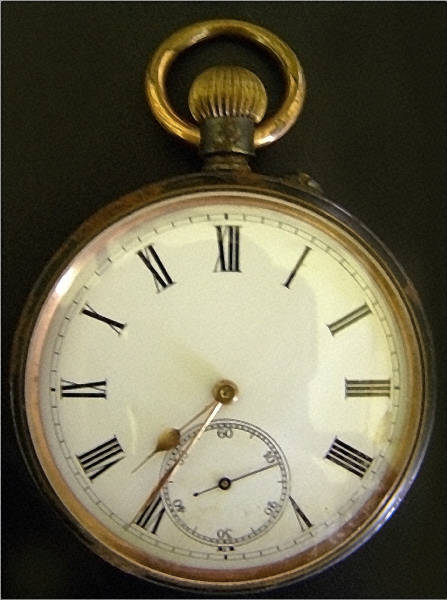
                                         Edward Thomas's Pocket Watch
                                        Cardiff University Library Archive

On April 10, 1917, Captain Lushington wrote this in a letter to Helen Thomas:

I cannot express to you adequately in words how deep our sympathy is for you and your children in your great loss.  These things go too deep for mere words.  We, officers and men, all mourn our own loss.  Your husband was very greatly loved in this battery, and his going has been a personal loss to each of us.  He was rather older than most of the officers and we all looked up to him as the kind of father of our happy family.

He was always the same, quietly cheerful, and ready to do any job that was going with the same steadfast unassuming spirit.  The day before his death we were rather heavily shelled and he had a very narrow shave.  But he went about his work quite quietly and ordinarily as if nothing was happening.  I wish I could convey to you the picture of him, a picture we had all learnt to love, of the old clay pipe, gum boots, oilskin coat, and steel helmet.
. . . . .
We buried him in a little military cemetery a few hundred yards from the battery:  the exact spot will be notified to you by the parson.  As we stood by his grave the sun came and the guns round seemed to stop firing for a short time.  This typified to me what stood out most in your husband's character -- the spirit of quiet, sunny, unassuming cheerfulness.

Ibid, pages 263-264.

                                 Cecil Lawson, "Outside Arras" (c. 1917)

Many poems have been written in memory of Edward Thomas.  My favorite is by his friend Walter de la Mare.  As I have noted before, the poem is remarkable in conveying (in eight short lines) the pain of the loss suffered by those who knew and loved Thomas, as well as something essential about Thomas himself.

                 To E. T.: 1917

You sleep too well -- too far away,
   For sorrowing word to soothe or wound;
Your very quiet seems to say
   How longed-for a peace you have found.

Else, had not death so lured you on,
   You would have grieved -- 'twixt joy and fear --
To know how my small loving son
   Had wept for you, my dear.

Walter de la Mare, Motley and Other Poems (1918).

                                       Cecil Lawson, "Arras" (c. 1917)

Tuesday, August 24, 2010

Edmund Blunden: "Report On Experience"

In an earlier post (March 22, 2010), I quoted these lines from Edmund Blunden's poem "The Sunlit Vale":

I saw the sunlit vale, and the pastoral fairy-tale;
The sweet and bitter scent of the may drifted by;
And never have I seen such a bright bewildering green,
          But it looked like a lie,
          Like a kindly meant lie.

Poems: 1914-1930 (1930)When the poem was originally published in The London Mercury of October, 1929, it was titled "The Failure."  Blunden changed the title to "The Sunlit Vale" when it was published in Poems: 1914-1930.

                                Edmund Blunden in December of 1916

The feelings expressed in these lines are explored at greater length in Blunden's "Report on Experience":

                  Report on Experience

I have been young, and now am not too old;
And I have seen the righteous forsaken,
His health, his honour and his quality taken.
   This is not what we were formerly told.

I have seen a green country, useful to the race,
Knocked silly with guns and mines, its villages vanished,
Even the last rat and last kestrel banished --
   God bless us all, this was peculiar grace.

I knew Seraphina; Nature gave her hue,
Glance, sympathy, note, like one from Eden.
I saw her smile warp, heard her lyric deaden;
   She turned to harlotry;  -- this I took to be new.

Say what you will, our God sees how they run.
These disillusions are His curious proving
That He loves humanity and will go on loving;
   Over there are faith, life, virtue in the sun.

Near and Far (1929).

                                Edmund Blunden (lower right) in 1917

Blunden was by all accounts a kind, gentle man with a gift for friendship.  His poetry and prose are characterized by loving attention to the natural world.  But -- to borrow a word from the title of the book for which Blunden will likely be remembered -- the "undertones" of his war experience were never distant.  If you read Undertones of War, you understand why it could not be otherwise.

                James McIntosh Patrick, "Springtime in Eskdale" (1935)

Monday, June 28, 2010

The Summer Of 1914: John Nash, Philip Larkin, And Edward Thomas

My previous post included this painting by John Nash (1893-1977):


It is titled "A Gloucestershire Landscape."  Nash painted it in the summer of 1914.  The date put me in mind of Philip Larkin's poem "MCMXIV."  These are the concluding stanzas:

And the countryside not caring:
The place-names all hazed over
With flowering grasses, and fields
Shadowing Domesday lines
Under wheat's restless silence;
The differently-dressed servants
With tiny rooms in huge houses,
The dust behind limousines;

Never such innocence,
Never before or since,
As changed itself to past
Without a word -- the men
Leaving the gardens tidy,
The thousands of marriages
Lasting a little while longer:
Never such innocence again.

("The thousands of marriages/Lasting a little while longer":  these are two of the most beautiful and moving lines in Larkin's poetry, I think.  And how about "wheat's restless silence"?  Larkin is not usually thought of as a "nature poet," but it is hard to beat that.)

                                            Recruits at Exeter, 1914
             
On June 24 of 1914, Edward Thomas made the following entry in one of his notebooks:

"Then we stopped at Adlestrop, through the willows could be heard a chain of blackbirds songs at 12.45 and one thrush and no man seen, only a hiss of engine letting off steam.

Stopping outside Campden by banks of long grass willowherb and meadowsweet, extraordinary silence between the two periods of travel -- looking out on grey dry stones between metals and the shining metals and over it all the elms willows and long grass -- one man clears his throat -- a greater than rustic silence.  No house in view.  Stop only for a minute till signal is up."  

This entry, of course, marks the genesis of "Adlestrop," the final stanza of which brings us back to Nash's Gloucestershire:

And for that minute a blackbird sang
Close by, and round him, mistier,
Farther and farther, all the birds
Of Oxfordshire and Gloucestershire. 

Wednesday, April 28, 2010

"The Only Brother I Ever Had": Robert Frost and Edward Thomas

It is generally recognized that but for his friendship with Robert Frost (they met in October of 1913, when Frost was living in England) -- and his decision in 1914 to enlist -- Edward Thomas would not have begun writing poetry.  That story has been told many times elsewhere (see, for example, Into My Own: The English Years of Robert Frost (1988) by John Walsh), so I will not repeat it here.

What I find remarkable is the strength of the connection between Frost and Thomas.  In a letter to Edward Garnett (who was also a friend of Thomas) after Thomas's death, Frost wrote:

"Edward Thomas was the only brother I ever had.  I fail to see how we can have been so much to each other, he an Englishman and I an American and our first meeting put off till we were both in middle life.  I hadn't a plan for the future that didn't include him."

Frost, Selected Letters (1964), quoted in Jay Parini, Robert Frost: A Life (1999), page 179.  Regarding the final sentence above, it should be noted that, prior to his enlistment, Thomas was seriously considering emigrating to America with his family in order to live near Frost and his family in New Hampshire.  In another letter, Frost wrote:  "We were together to the exclusion of every other person and interest all through 1914 -- 1914 was our year.  I never had, never shall have another year of such friendship."  Walsh, Into My Own, pages 180-181.

Even more touching is Frost's letter to Thomas's wife Helen after Frost learned of Thomas's death (Frost had since moved back to America):

"I knew from the moment when I first met him at his unhappiest that he would some day clear his mind and save his life. . . . I have had four wonderful years with him.  I know he has done this all for you:  he is all yours.  But you must let me cry my cry for him as if he were almost all mine too."

Robert Frost: A Life, pages 178-179.  But the last words should be from Frost's poetry.  He published this poem in 1920:

                     To E. T.

I slumbered with your poems on my breast,
Spread open as I dropped them half-read through
Like dove wings on a figure on a tomb
To see if in a dream they brought of you,

I might not have the chance I missed in life
Through some delay, and call you to your face
First soldier, and then poet, and then both,
Who died a soldier-poet of your race.

I meant, you meant, that nothing should remain
Unsaid between us, brother, and this remained --
And one thing more that was not then to say:
The Victory for what it lost and gained.

You went to meet the shell's embrace of fire
On Vimy Ridge; and when you fell that day
The war seemed over more for you than me,
But now for me than you -- the other way.

How over, though, for even me who knew
The foe thrust back unsafe beyond the Rhine,
If I was not to speak of it to you
And see you pleased once more with words of mine?

Thursday, April 22, 2010

Edmund Blunden and Thomas Hardy

Edmund Blunden first met Thomas Hardy in July of 1922 at Max Gate.  The meeting was arranged by Siegfried Sassoon.  Sassoon noticed similarities between Blunden and Hardy:

He has a good deal in common with old Hardy.  A simplicity and honesty beyond praise, and a quality of being one with his work to which he has such a noble devotion.
. . .
Seeing T. H. soon after my visit to Blunden makes me aware of certain similarities in them.  B. of course is sensitive in the same way as T. H.  They share a sort of old-fashioned seriousness about everything connected with authorship.  Both are fundamentally countrified and homely.  Even in outward appearance they have a similarly bird-like quality.  Both enjoy talking about simple things.  It is a sublime freedom from sophistication.  My own spontaneously affectionate feeling for them both is identical.  With each of them I feel unembarrassed and able to chatter about commonplace matters in a commonplace way.  Two little 'men of genius.'  One is eighty-two and the other barely twenty-five.  Yet the difference in their ages seems a mere tiresome accident (as it is).  . . .  This affinity of B. and H. is one of the strangest things I have experienced.  Also both are essentially modest and unassuming.

Siegfried Sassoon, Diaries (edited by Rupert Hart-Davis).


Sassoon was correct about the "affinity" between Blunden and Hardy: the first visit went well, and Blunden and Hardy became friends.  (According to Barry Webb, Blunden's biographer, Hardy's sheep-dog Wessex "took an instant liking to Edmund -- an unusual reaction to strangers on Wessex's part."  Edmund Blunden: A Biography (1990), page 134.)  A year later, Blunden and Sassoon spent a week near Max Gate, visiting Hardy daily.

And, finally, there is this:  "On Hardy's death in 1928 his widow presented Edmund with Hardy's treasured copy of Edward Thomas's Poems as a memento of these visits."  Ibid, page 135.  This touching incident is included by Michael Longley in his wonderful poem "Poetry" (from The Weather in Japan), which brings together Blunden, Thomas, and Hardy.  The poem is centered upon another incident that appears in Webb's biography of Blunden (an incident that would be a fit subject for a poem by Hardy, come to think of it):

One find late in 1918 caused [Blunden] particular pleasure.  Billeted in a ruined house in Arras, he found a hole in the wall by the side of his bed.  Feeling inside, his hand rested on a copy of Edward Thomas's study of John Keats.  Thomas had been killed at the battle of Arras, and Edmund never gave up hope that it was the author's own copy:  "I fancied that I could see the tall, Shelley-like figure of the poet gathering together his equipment for the last time, hastening out of this ruined building to join his men and march into battle, and forgetting his copy of John Keats."

Webb, Edmund Blunden: A Biography, page 56; the quotation from Blunden is from an "autobiographical reminiscence" found in Blunden's papers.
     

Saturday, April 10, 2010

Edmund Blunden: "Things Quiet And Unconcerned"

Edmund Blunden is buried in the Holy Trinity churchyard in the village of Long Melford, Suffolk.


In addition to the phrase "Beloved Poet," these lines (from his poem "The Seers") are carved on his gravestone:
          I live still
          to love still
          things quiet
          & unconcerned.

The words bring to mind this poem by Ivor Gurney:

                 The Escape

I believe in the increasing of life: whatever
Leads to the seeing of small trifles,
Real, beautiful, is good; and an act never
Is worthier than in freeing spirit that stifles
Under ingratitude's weight, nor is anything done
Wiselier than the moving or breaking to sight
Of a thing hidden under by custom -- revealed,
Fulfilled, used (sound-fashioned) any way out to delight:
Trefoil -- hedge sparrow -- the stars on the edge at night.


Considering what these two gentle souls endured (something which we can never come near to grasping), perhaps we can learn a thing or two from them about the value of "things quiet and unconcerned" and of "small trifles."

Wednesday, March 31, 2010

Neglected Poets: Siegfried Sassoon

It may seem odd to identify Siegfried Sassoon as a "neglected poet."  His poems and memoirs of the First World War have certainly not been forgotten (particularly Memoirs of an Infantry Officer and several much-anthologized poems:  "Base Details," "The General," "Attack," "'Blighters'," "The Dug-Out," "To Any Dead Officer," "Suicide in the Trenches").  Further, his personality - the "fox-hunting man" who was known as "Mad Jack" in the trenches for his bravery and recklessness; the war protester who nevertheless wished to return to the front due to his love for the men he led - still holds interest:  three substantial biographies have been written about him within the past 10 years or so.


However, I believe that Sassoon is a "neglected poet" when it comes to the poetry that he wrote after the War.  Bear in mind that he was born in 1886 and died in 1967 - just short of 81.  During most of the 49 years of his life after the War he continued to write poetry, and, although he was certainly a well-known personage, his poetry was generally viewed by critics as out-of-fashion (or, more commonly, was simply ignored).

I readily admit that I, too, viewed him simply as a "War Poet" - until I read Siegfried Sassoon: A Poet's Pilgrimage by D. Felicitas Corrigan (published in 1973).  The book combines extracts of Sassoon's writing (some of it previously unpublished) with a biographical narrative that places the pieces in context.  I discovered that there was a great deal that I had missed in Sassoon.  Here is a small part of what I found.

                   Release

One winter's end I much bemused my head
In tasked attempts to drive it up to date
With what the undelighting moderns said
   Forecasting human fate.

And then, with nothing unforeseen to say
And no belief or unbelief to bring,
Came, in its old unintellectual way,
   The first real day of spring.

Sequences (1956).  This poem was originally published in 1950 in a volume titled Common Chords.

'When I'm alone' -- the words tripped off his tongue
As though to be alone were nothing strange.
'When I was young,' he said; 'when I was young . . .'

I thought of age, and loneliness, and change.
I thought how strange we grow when we're alone,
And how unlike the selves that meet, and talk,
And blow the candles out, and say good-night.
Alone . . . The word is life endured and known.
It is the stillness where our spirits walk
And all but inmost faith is overthrown.

Collected Poems (1961).  According to Sassoon, this poem was written in December of 1924.

Friday, March 26, 2010

Edmund Blunden: 'Trench Nomenclature'

As I said in a recent post, reading Edmund Blunden's Undertones of War is heart-breaking.  But I am also always amazed at the humor that persisted under the horrific conditions:  you have to shake your head and smile sometimes.

For instance: the naming of trenches and other military locations.  Blunden mentions the following trenches: Jacob's Ladder; Kentish Caves; Half Moon Street; St. Martin's Lane; Haymarket; Piccadilly; Esperanto Terrace; Coney Street; The Great Wall of China.  In addition to the trenches, Blunden mentions Valley Cottages (a battalion headquarters); Oskar Copse and Wilde Wood (adjacent battlefield features); Ocean Villas (a play on the name of a village - Auchonvillers - near the trenches).

Blunden includes a poem entitled 'Trench Nomenclature' in the final section of  Undertones of War.  Here are the first two lines and the final two lines of the poem:

Genius named them, as I live!  What but genius could compress
In a title what man's humour said to man's supreme distress?
. . .
Ah, such names and apparitions! name on name! What's in a name?
From the fabled vase the genie in his cloud of horror came.

Monday, March 22, 2010

Edmund Blunden: Undertones of War

Edmund Blunden's memoir of life in the trenches - Undertones of War - is, as one might expect, horrific and heart-breaking.  The style of Undertones is interesting: there is no invective or savage satire.  Rather, Blunden's tone is matter-of-fact, and even a bit wry.  And certainly elegiac. But the steady accumulation of exactly-rendered detail and incident is ultimately devastating.  First, a bit of background.
After attending Oxford, Blunden volunteered for the army in 1915.  He was on the front lines with the Royal Sussex Regiment by May of 1916 - at the age of nineteen.  He spent two years on the front.  His nickname in the trenches was "Rabbit."  He was awarded the Military Cross for bravery.

Blunden's method in Undertones is revealed in the following passage:

"Do I loiter too long among little things?  It may be so, but those whom I foresee as my readers will pardon the propensity.  Each circumstance of the British experience that is still with me has ceased for me to be big or little . . . Kenward the corporal and I saw a sentry crouching and peering one way and another like a birdboy in an October storm.  He spoke, grinned and shivered; we passed; and duly the sentry was hit by a shell.  So that in this vicinity a peculiar difficulty would exist for the artist to select the sights, faces, words, incidents, which characterized the time.  The art is rather to collect them, in their original form of incoherence."

Here are two of the "little things" that Blunden remembers:

"Darkness clammy and complete, save for the flames of shells, masked that movement, but one stunted willow tree at which the track changed direction must haunt the memories of some of us.  Trees in the battlefield are already described by Dante."

"Climbing the dirty little road over the steep bank, one immediately entered the land of despair.  Bodies, bodies and their useless gear heaped the gross waste ground; the slimy road was soon only a mud track which passed a whitish tumulus of ruin with lurking entrances, some spikes that had been pine-trees, a bricked cellar or two, and died out. . . . The shell-holes were mostly small lakes of what was no doubt merely rusty water, but had a red and foul semblance of blood.  Paths glistened weakly from tenable point to point.  Of the dead, one was conspicuous.  He was a Scottish soldier, and was kneeling, facing east, so that one could scarcely credit death in him; he was seen at some little distance from the usual tracks, and no one had much time in Thiepval just then for sight-seeing, or burying.  Death could not kneel so, I thought, and approaching I ascertained with a sudden shrivelling of spirit that Death could and did."

Undertones of War (1928), pages 157, 97-98.

Having witnessed these landscapes, it is small wonder that Blunden the poet (and he was primarily a poet throughout his life) would later write these lines in his poem "The Sunlit Vale":

I saw the sunlit vale, and the pastoral fairy-tale;
The sweet and bitter scent of the may drifted by;
And never have I seen such a bright bewildering green,
   But it looked like a lie,
   Like a kindly meant lie.