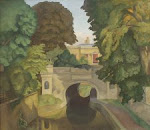

Showing posts with label Geoffrey Scott. Show all posts

Monday, October 21, 2019

Nevertheless

Autumn encourages reflection, don't you think?  More so than any other season, perhaps.  All of this passing and vanishing, all of this melancholy beauty and beautiful melancholy.  Even haiku poets, who tend not to be self-referential, are liable to look inward.

     The autumn of my life;
The moon is a flawless moon,
     Nevertheless --

Issa (translated by R. H. Blyth), in R. H. Blyth, Haiku, Volume 3: Summer-Autumn (Hokuseido Press 1952), page 396.  Although the phrase "the autumn of my life" could be written at any time of the year, the reference to "a flawless moon" places the poem in autumn.

The final word of the poem is nagara, which Blyth translates as "nevertheless."  Following his translation of the haiku, Blyth notes: "Issa was fond of using nagara."  Ibid, page 396.  However, he does not mention Issa's use of the word in what is likely Issa's best-known poem, although he does translate the poem later in the same volume:

     This dewdrop world --
It may be a dewdrop,
     And yet -- and yet --

Issa (translated by R. H. Blyth), Ibid, page 433.

Nagara appears twice at the end of the haiku, this time translated by Blyth as "and yet," rather than as "nevertheless."  Blyth writes:  "This verse has the prescript, 'Losing a beloved child.'  This child was Sato-jo, and Issa's feelings at this time are portrayed in Oragaharu [a prose diary containing haiku].  He had already lost two or three children when this baby girl died."  Ibid, page 433.  Issa's moving description of his daughter's sudden illness and death appears in an earlier post.

Here is an alternative translation of the haiku:

     The world of dew
is the world of dew.
     And yet, and yet --

Issa (translated by Robert Hass), in Robert Hass, The Essential Haiku: Versions of Bashō, Buson, and Issa (The Ecco Press 1994), page 228.

Autumn is indeed the season of "and yet -- and yet --" and of "nevertheless."  A song by Mark Linkous (performing as Sparklehorse) comes to mind:  "Sad and Beautiful World."

Edward Waite (1854-1924)
"The Mellow Year Is Hastening To Its Close" (1896)

Depending upon one's mood at the moment, or one's overall view of life, "nevertheless" may be an exclamation of joy, a cry of despair, or a sigh of acceptance (or some combination of each of these, in varying degrees).  Consider, for instance, this haiku by Bashō:

     This autumn,
How old I am getting:
     Ah, the clouds, the birds!

Bashō (translated by R. H. Blyth), in R. H. Blyth, Haiku, Volume 3: Summer-Autumn, page 334.

Bashō wrote the poem on November 13, 1694, during his final illness. He died two weeks later, at the age of 50.  The poem is preceded by this title:  "A wanderer's thought."  (Makoto Ueda, Bashō and His Interpreters: Selected Hokku with Commentary (Stanford University Press 1991), page 407.)

Nagara does not appear in the haiku.  However, "Ah, the clouds, the birds!" functions as a "nevertheless," as an "and yet -- and yet --," to Bashō's opening observation.  But what sort of "nevertheless" is this? One of joy, despair, or acceptance?  Well, that's best left for each of us to decide.

Edward Waite, "Autumn Colouring" (1894)

What a wonderful and breathtaking circumstance:  each year, the seasons play out for us the arc of our life.  This beautiful and mysterious gift should give us pause.  One might fancy that we are part of something that is beyond our ken, and beyond words.  In the meantime, autumn and winter and spring and summer come and go, each with its own "and yet -- and yet --," its own "nevertheless."  How lucky we are.

              Return

Leaves talked in the tree
"It will be,"
Wind with lifted tune
"Soon,"
A squirrel shook the bough,
"Quick," "Now."

Branch is not changed:
Stands the high stairway where the squirrel ranged,
Just as it stood.
Wind, on fallen key,
"It had to be;"
Leaves drift through the wood.

Geoffrey Scott (1884-1929), Poems (Oxford University Press 1931).

Edward Waite, "Fall of the Year"

Wednesday, October 11, 2017

Visitants

Everyone we have ever known remains with us.  Nothing we have ever experienced vanishes.  This is not simply a matter of our ability to retain memories, be they good or bad.  Rather, these people and these moments have a life of their own.  When these visitants have a mind to, they return.  We do not need to summon them.

                    Boats of Cane

A traveller once told
How to an inland water slanting come
Slim boats of cane from rivers of Cathay,
With trembling mast so slight,
It seemed God made them with a hand of air
To sail upon His light;
And there
Soft they unload a jar of jade and gold
In the cold dawn when birds are dumb,
And then away,
And speak no word and seek no pay,
Away they steal
And leave no ripple at the keel.

So the tale is writ;
And now, remembering you, I think of it.

Geoffrey Scott, Poems (Oxford University Press 1931).

W. G. Poole, "Plant Against a Winter Landscape" (1938)

Some may view their visitants with trepidation.  To wit:  "When the night-processions flit/Through the mind."  Yes, we are all quite familiar with those night-processions, aren't we?  I can state with assurance that they only lengthen as we grow older.

                                           Ghosts

Mazing around my mind like moths at a shaded candle,
     In my heart like lost bats in a cave fluttering,
Mock ye the charm whereby I thought reverently to lay you,
     When to the wall I nail'd your reticent effigys?

Robert Bridges, October and Other Poems (Heinemann 1920).

I fully understand such feelings, and I have done my fair share of shutting doors and closing the curtains on (as well as running away from) the moths, bats, and reticent (or not-so-reticent) effigys that return from out of the past.  But, in time, one comes to the conclusion that it is best to let them pay their visits.  We ought not to view our ghosts as chain-rattling, moaning Jacob Marleys.  After all, where would we be without them?  They are who we are.

                         Revaluation

Now I remember nothing of our love
So well as the crushed bracken and the wings
Of doves among dim branches far above --
Strange how the count of time revalues things!

Patrick MacDonogh, Poems (edited by Derek Mahon) (The Gallery Press 2001).

Leslie Duncan, "Birchwood"

Welcoming these revenants, we might be pleasantly surprised at the keenness and the clarity of the long-vanished "spots of time" (to use Wordsworth's phrase) that they bring with them.  The immediacy can be breathtaking.  Years, decades, vanish in an instant.

                 The Woodspurge

The wind flapped loose, the wind was still,
Shaken out dead from tree and hill:
I had walked on at the wind's will, --
I sat now, for the wind was still.

Between my knees my forehead was, --
My lips drawn in, said not Alas!
My hair was over in the grass,
My naked ears heard the day pass.

My eyes, wide open, had the run
Of some ten weeds to fix upon;
Among those few, out of the sun,
The woodspurge flowered, three cups in one.

From perfect grief there need not be
Wisdom or even memory:
One thing then learnt remains to me, --
The woodspurge has a cup of three.

Dante Gabriel Rossetti, Poems (F. S. Ellis 1870).

Why do some things continually return to us, while so much else seems to vanish?  Why that moment?

                    Green Slates
                      (Penpethy)

It happened once, before the duller
     Loomings of life defined them,
I searched for slates of greenish colour
     A quarry where men mined them;

And saw, the while I peered around there,
     In the quarry standing
A form against the slate background there,
     Of fairness eye-commanding.

And now, though fifty years have flown me,
     With all their dreams and duties,
And strange-pipped dice my hand has thrown me,
     And dust are all her beauties,

Green slates -- seen high on roofs, or lower
     In waggon, truck, or lorry --
Cry out:  "Our home was where you saw her
     Standing in the quarry!"

Thomas Hardy, Human Shows, Far Phantasies, Songs, and Trifles (Macmillan 1925).

This is typical of Hardy, isn't it?  He once wrote of himself:  "I believe it would be said by people who knew me well that I have a faculty (possibly not uncommon) for burying an emotion in my heart or brain for forty years, and exhuming it at the end of that time as fresh as when interred."  (Thomas Hardy, The Life and Work of Thomas Hardy (edited by Michael Millgate) (Macmillan 1985), page 408.)  Hardy suggests that his "faculty" is "possibly not uncommon," but I think not:  he was remarkably conversant with the past events of his life, down to the smallest detail. From his earliest years, he was always looking.  And he forgot nothing. Although we may lack Hardy's special gift, I think we all share the ability to "exhume" moments out of our past that have long been "interred."  (A characteristic choice of words by Hardy, given his fondness for graveyards and ghosts.)

James Cowie (1886-1956), "Pastoral"

As I noted in a recent post, I never use the word "commonplace" in a pejorative sense.  The same is true of the word "prosaic."  The visitants from our past often (perhaps nearly always) move us because they arise out of, or are intertwined with, that which is commonplace or prosaic.  We have no way of knowing what moments will come to define our lives, nor what part of each moment will haunt us all our days.

The blossom of a woodspurge.  "The crushed bracken and the wings/Of doves among dim branches far above."  Green slates.  A bamboo sleeping mat.

          Bamboo Mat

I cannot bear to put away
the bamboo sleeping mat --

that first night I brought you home,
I watched you roll it out.

Yüan Chen (779-831) (translated by Sam Hamill), in Sam Hamill, Crossing the Yellow River: Three Hundred Poems from the Chinese (BOA Editions 2000).  Yüan Chen wrote the poem after the death of his wife.

Dudley Holland (1915-1956), "Winter Morning" (1945)

Thursday, April 24, 2014

Perspective, Part Fifteen: Beetles

Yesterday was one of those expansive April days.  The slate-grey waters of Puget Sound were silver-ribboned and cloud-shadowed.  Across the fields, the young yellow-green leaves of the deciduous trees stood forth against the dark green boughs of the evergreens. The phrase "Pied Beauty" came to mind, thus:

                           Pied Beauty

Glory be to God for dappled things --
   For skies of couple-colour as a brinded cow;
      For rose-moles all in stipple upon trout that swim;
Fresh-firecoal chestnut-falls; finches' wings;
   Landscape plotted and pieced -- fold, fallow, and plough;
      And all trades, their gear and tackle and trim.

All things counter, original, spare, strange;
   Whatever is fickle, freckled (who knows how?)
      With swift, slow; sweet, sour; adazzle, dim;
He fathers-forth whose beauty is past change:
                                                    Praise him.

Gerard Manley Hopkins, in W. H. Gardner and N. H. MacKenzie (editors), The Poems of Gerard Manley Hopkins (Oxford University Press, Fourth Edition, 1967).  "Brinded" (line 2) is not a misprint: it is an "early form of 'brindled,' streaked."  Ibid, page 269.

John Inchbold, "The Moorland (Dewar-stone, Dartmoor)" (1854)

While the expansiveness of the day drew me outward and upward, I still had thought for the ground beneath my feet.  At this time of year it seems alive -- warm with life.  Lines from John Drinkwater's "The Wood," which appeared here a few months ago, are apt:

While everywhere, above me, underfoot,
And haunting every avenue of leaves,
Was mystery, unresting, taciturn.

Caught up in our own small worlds, we need to spare a thought now and then for the countless worlds above, around, and below us.

John Inchbold, "Anstey's Cove, Devon" (1854)

                              Worlds

Through the pale green forest of tall bracken-stalks,
Whose interwoven fronds, a jade-green sky,
Above me glimmer, infinitely high,
Towards my giant hand a beetle walks
In glistening emerald mail; and as I lie
Watching his progress through huge grassy blades
And over pebble boulders, my own world fades
And shrinks to the vision of a beetle's eye.

Within that forest world of twilight green
Ambushed with unknown perils, one endless day
I travel down the beetle-trail between
Huge glossy boles through green infinity . . .
Till flashes a glimpse of blue sea through the bracken asway,
And my world is again a tumult of windy sea.

Wilfrid Gibson, Neighbours (1920).

Gibson's beetle-world brings to mind the opening stanza of Geoffrey Scott's "All Our Joy Is Enough":

All we make is enough
Barely to seem
A bee's din,
A beetle-scheme --
Sleepy stuff
For God to dream:
Begin.

John Inchbold, "Bolton Abbey" (1853)

Saturday, April 13, 2013

Perspective, Part Five: "A Handful Of Sand"

My previous post amounted to a rant of sorts about political beings.  Some perspective is in order, both for myself -- for being on a high horse -- and for political beings (left, right, or center) the world over.

               Recording Thoughts

Years ago I retired to rest,
did some modest building in this crinkle of the mountain.
Here in the woods, no noise, no trash;
in front of my eaves, a stream of pure water.
In the past I hoped to profit by opening books;
now I'm used to playing games in the dirt.
What is there that's not a children's pastime?
Confucius, Lao Tzu -- a handful of sand.

Ishikawa Jozan (1583-1672) (translated by Burton Watson), in Burton Watson, Kanshi: The Poetry of Ishikawa Jozan and Other Edo-Period Poets (North Point Press 1990).

Richard Eurich, "Boats at Lyme Regis" (1937)

Or, as put differently by Geoffrey Scott:

    All Our Joy Is Enough

All we make is enough
Barely to seem
A bee's din,
A beetle-scheme --
Sleepy stuff
For God to dream:
Begin.

All our joy is enough
At most to fill
A thimble cup
A little wind puff
Can shake, can spill:
Fill it up;
Be still.

All we know is enough;
Though written wide,
Small spider yet
With tangled stride
Will soon be off
The page's side:
Forget.

Harold Monro (editor), Twentieth Century Poetry (1933).

Richard Eurich, "Lyme Regis" (1930)

Wednesday, December 29, 2010

Life Explained, Part Ten: "All We Make Is Enough Barely To Seem A Bee's Din, A Beetle-Scheme"

I first encountered Geoffrey Scott (1884-1929) as the editor of the Boswell journals that were discovered in the 1920s at Malahide Castle in Ireland.  Unfortunately, he died unexpectedly at an early age before completing the project. I later discovered that Scott had also written poetry.  Here is a poem of Scott's that offers a quiet view of what to expect from Life.

     All Our Joy Is Enough

All we make is enough
Barely to seem
A bee's din,
A beetle-scheme --
Sleepy stuff
For God to dream:
Begin.

All our joy is enough
At most to fill
A thimble cup
A little wind puff
Can shake, can spill:
Fill it up;
Be still.

All we know is enough;
Though written wide,
Small spider yet
With tangled stride
Will soon be off
The page's side:
Forget.

Modern Poetry 1922-1934: An Anthology (1934).

                         Graham Sutherland, "Oast House" (1932)