Showing posts with label George Mackley. Show all posts

Thursday, July 21, 2011

"I'm Just On The Verge Of Seeing How Life Ought To Be Lived"

I have not forgotten my earlier promise to share Philip Larkin's thoughts on the fifties.  (The years of one's life, not the decade of -- where I hail from -- Eisenhower and Elvis and Ozzie & Harriet.)  What he has to say is pure Larkin:  appalling and hilarious.  And directly and clear-sightedly to the point. 

Larkin turned 50 on August 9, 1972.  On August 11, he wrote to Kingsley Amis:

"Funny being fifty, isn't it.  I keep seeing obits of chaps who've passed over 'suddenly, aged 55', 'after a short illness, 56', 'after a long illness bravely borne, aged 57' -- and add ten years on, what's ten years?  Compared with eternity aaaaaaaaooooooooghghghghghghg ah gets tuft.  No, it doesn't bear thinking about.  Lucky I've got a bottle of Smith's Glenlivet handy.  I begin to think that, give me another ten or twenty years, I'm just on the verge of seeing how life ought to be lived.  I'll be just about ready then."

Anthony Thwaite (editor), Selected Letters of Philip Larkin, 1940-1985 (Faber and Faber 1992), page 462.

As I said, pure Larkin:  the gloom, the humor, and -- in the end -- the heart of the matter stated plainly:  "give me another ten or twenty years, I'm just on the verge of seeing how life ought to be lived."  Some of us might say:  "How true." 

In the same month, Larkin expressed his thoughts more formally:

               The View

The view is fine from fifty,
     Experienced climbers say;
So, overweight and shifty,
     I turn to face the way
     That led me to this day.

Instead of fields and snowcaps
     And flowered lanes that twist,
The track breaks at my toe-caps
     And drops away in mist.
     The view does not exist.

Where has it gone, the lifetime?
     Search me.  What's left is drear.
Unchilded and unwifed, I'm
     Able to view that clear:
     So final.  And so near.

Philip Larkin, Collected Poems (Faber and Faber 1988).  (An unrelated aside:  how about that for a rhyme:  "lifetime" and "unwifed, I'm"?)

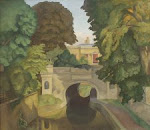
                                     George Mackley, "The Ferry" (1951)

Monday, September 20, 2010

"On The Hurry Of This Time"

Recently, I have seen a spate of articles about the adverse impact that technology (e.g., the Internet, PDAs, etc.) may be having upon us.  In particular, there has been much talk of the impact of these things upon our attention spans and our reading habits.  Because I am a Luddite by temperament, I tend to sympathize with these sorts of concerns.  (Given the fact that I am writing these words on a blog, I realize that charges of hypocrisy may be in order.)

However, part of me realizes that we need to put these concerns into perspective.  Not in the sense that they may not have some validity, but in the sense that each "modern" generation (or at least a portion of that generation) believes that things are moving too fast and that the world is undergoing a unique technological transformation that will permanently change (for the worse) humanity.  In other words, a portion of each "modern" generation feels that the world is going to Hell in the proverbial handbasket.

                             George Mackley, "The House by the Lake"

Poets often feel this way.  In his Preface to Lyrical Ballads, William Wordsworth writes:

[A] multitude of causes, unknown to former times, are now acting with a combined force to blunt the discriminating powers of the mind, and unfitting it for all voluntary exertion to reduce it to a state of almost savage torpor.  The most effective of these causes are the great national events which are daily taking place, and the increasing accumulation of men in cities, where the uniformity of their occupations produces a craving for extraordinary incident, which the rapid communication of intelligence hourly gratifies.

William Wordsworth, Lyrical Ballads (1800).  Sound familiar?

                                         George Mackley, "Drawbridge"

Here, on a smaller scale, is a poem from the Victorian era by Austin Dobson (1840-1921):

       On the Hurry of This Time

With slower pen men used to write,
Of old, when "letters" were "polite";
   In Anna's, or in George's days,
   They could afford to turn a phrase,
Or trim a straggling theme aright.

They knew not steam; electric light
Not yet had dazed their calmer sight; --
   They meted out both blame and praise
          With slower pen.

Too swiftly now the Hours take flight!
What's read at morn is dead at night:
   Scant space have we for Art's delays,
   Whose breathless thought so briefly stays,
We may not work -- ah! would we might! --
          With slower pen.

Vignettes in Rhyme and Other Verses (1880).

Tuesday, April 20, 2010

Wind. Leaves.

A benefit and bane of growing older: certain items of experience become yoked together, whether you want them to be or not.  A happy example: whenever I read one of these poems, it reminds me of the other two.

     Kayenta, Arizona, May 1977

I fall asleep to the sound of rain,
But there is no rain in the desert.
The leaves of the trader's little cottonwoods
Turn, turn in the wind.

Janet Lewis, The Selected Poems of Janet Lewis, edited by R. L. Barth (2000).

        The Wind in the Tree

She has decided that she no longer loves me.
There is nothing to be done.  I long ago
As a child thought the tree sighed 'Do I know
Whether my motion makes the wind that moves me?'

F. T. Prince, Poems (1938).

And, finally, the last stanza of "The Trees" by Philip Larkin:

Yet still the unresting castles thresh
In fullgrown thickness every May.
Last year is dead, they seem to say,
Begin afresh, afresh, afresh.

High Windows (1974).

                 George Mackley (1900-1983), The House by the Lake