Showing posts with label Leopardi. Show all posts

Saturday, September 4, 2021

Enchanted Or Disenchanted, Part Eight: Exile

Is the World we live in enchanted or disenchanted?  Happily, we cannot think, or reason, our way to an answer to this question. Moreover, the answer may be beyond words, which is appropriate. The World is mostly reticent.  But, if we pay attention to it, we may receive glimpses, glimmers, inklings. 

And, in the end, the answer we may stumble upon applies only to a single soul: our own.  Still, we may encounter kindred souls in our travels.  What would we do without them?
"What a marvelous time it was when everything was alive, according to human imagination, and humanly alive, in other words inhabited or formed by beings like ourselves; when it was taken as certain that in the deserted woods lived the beautiful Hamadryads and fauns and woodland deities and Pan, etc., and, on entering and seeing everything as solitude, you still believed that everything was inhabited and that Naiads lived in the springs, etc., and embracing a tree you felt it almost palpitating between your hands and believed it was a man or a woman like Cyparissus, etc., and the same with flowers, etc., just as children do."

Giacomo Leopardi, Zibaldone (translated by Kathleen Baldwin, Richard Dixon, David Gibbons, Ann Goldstein, Gerard Slowey, Martin Thom, and Pamela Williams) (Farrar, Straus and Giroux 2013), page 69.

As an unrepentant Wordsworthian pantheist (the Wordsworth of 1797 through 1807) and a lover of the poems in The Greek Anthology, I fully concur with Leopardi's thoughts.  How far we have fallen!  But some may say: "What of Progress?"  Ah, yes, "Progress."  We now find ourselves in the hands of political, scientific, technological, and media "experts."  That seems to be working quite well.

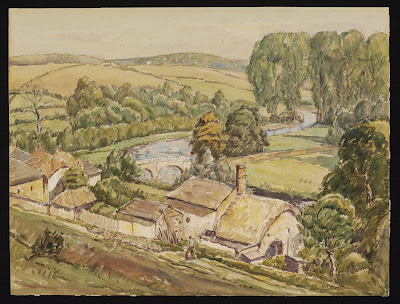
H. S. Merritt, "Woodford Bridge in the Avon Valley" (c. 1942)

I am also wholly in sympathy with Walter de la Mare:

                         Exile

Had the gods loved me I had lain
     Where darnel is, and thorn,
And the wild night-bird's nightlong strain
     Trembles in boughs forlorn.

Nay, but they loved me not; and I
     Must needs a stranger be,
Whose every exiled day gone by
     Aches with their memory.

Walter de la Mare, The Listeners and Other Poems (Constable 1912).

The pang of exile from a lost, ever unreachable world is a thread that runs throughout de la Mare's poetry.  But it never leads to a slighting of the World as we find it.  Nor does it lead to despair, or to lack of love for the beautiful particulars of the World.  Thus: "Now is the all-sufficing all/Wherein to love the lovely well,/Whate'er befall." ("Now.")  Or this: "Look thy last on all things lovely,/Every hour." ("Fare Well.")  

And, despite the sadness and the sense of irremediable loss expressed in "Exile," de la Mare still catches glimpses of the lost world in the English countryside:

           Echo 

Seven sweet notes
In the moonlight pale
Warbled a leaf-hidden
Nightingale:
And Echo in hiding
By an old green wall
Under the willows
Sighed back them all.

Walter de la Mare, Bells and Grass: A Book of Rhymes (Faber and Faber 1941).

This brings to mind a lovely poem from The Greek Anthology:

High up the mountain-meadow, Echo with never a tongue
Sings back to each bird in answer the song each bird hath sung.

Satyrus (c. 1st century B.C. - 1st century A.D.) (translated by F. L. Lucas), in F. L. Lucas (editor), Greek Poetry for Everyman (J. M. Dent 1951), page 358.

There is no telling what one might suddenly see out in a field:

                            Flood Water

What saw I -- crouching by that pool of water
     Bright-blue in the flooded grass,
Of ash-white sea-birds the remote resort, and
     April's looking-glass? --
Was it mere image of a dream-dazed eye --
That startled Naiad -- as the train swept by?

Walter de la Mare, Inward Companion: Poems (Faber and Faber 1950).

H. S. Merritt, "Bowerchalke" (c. 1942)

The ironic moderns among us have "progressed" too far to take any of this seriously.  They fancy themselves to be unillusioned and undeceived.  Products of the so-called "Age of Enlightenment."

Leopardi again: "[T]here has never been an age so tainted and corrupted that it did not believe itself to stand at the pinnacle of civilization and social perfection, and to be an example to the other ages, and, in particular, superior in every respect to all past ages, and at the farthest point in space yet traveled by the human spirit." (Giacomo Leopardi, Zibaldone, page 395.)  

Enchanted or disenchanted?  Each of us makes a choice in this matter every day.

                       Ionic

That we've broken their statues,
that we've driven them out of their temples,
doesn't mean at all that the gods are dead.
O land of Ionia, they're still in love with you,
their souls still keep your memory.
When an August dawn wakes over you,
your atmosphere is potent with their life,
and sometimes a young ethereal figure,
indistinct, in rapid flight,
wings across your hills.

C. P. Cavafy, Collected Poems (translated by Edmund Keeley and Philip Sherrard) (Princeton University Press 1975).

H. S. Merritt, "Wishford, Wylye Valley" (c. 1942)

Saturday, September 19, 2020

Awake

For most of the past week the foghorns of the ships out on Puget Sound have been blowing day and night.  Not on account of any fog banks, but in order to make their way safely through the wildfire smoke enveloping sky and water and earth.  Centuries ago, an event such as this might have called for a sacrifice to the gods in order to avert an impending apocalypse.  Or prompted a hurried journey to the oracle at Delphi for a quick consultation.  We moderns, emptied of enchantment, politicize events of this sort.  Oh, how I long for the gods and the oracles.

It is enough to drive one into the arms of Giacomo Leopardi for relief: "What is life?  The journey of a crippled and sick man walking with a heavy load on his back up steep mountains and through wild, rugged, arduous places, in snow, ice, rain, wind, burning sun, for many days without ever resting night and day to end at a precipice or ditch, in which inevitably he falls."  (Giacomo Leopardi, Zibaldone, pages 4162-4163 (January 17, 1826) (edited by Michael Caesar and Franco D'Intino) (Farrar, Straus and Giroux 2013), page 1809.)

Or, alternatively, one can pay a visit to Leopardi's soulmate, the always antic Arthur Schopenhauer:  "Awakened to life out of the night of unconsciousness, the will finds itself as an individual in an endless and boundless world, among innumerable individuals, all striving, suffering, and erring; and, as if through a troubled dream, it hurries back to the old unconsciousness."  (Arthur Schopenhauer, "On the Vanity and Suffering of Life," in The World as Will and Representation, Volume II (1844) (translated by E. F. J. Payne) (The Falcon's Wing Press 1958), page 573.)  Schopenhauer wrote of Leopardi:  "[E]verywhere his theme is the mockery and wretchedness of this existence.  He presents it on every page of his works, yet in such a multiplicity of forms and applications, with such a wealth of imagery, that he never wearies us, but, on the contrary, has a diverting and stimulating effect."  (Ibid, page 588.)  Two peas in a pod.

But I'm afraid Leopardi and Schopenhauer simply won't do.  As entertaining as they are (their harrowing doom shot through with truth, and so unremittingly dire that one cannot help but smile), I have continued to spend most of my time with Walter de la Mare and the Japanese poets.  Calmness and equanimity.  A few days ago, I read this:

                  The Last Chapter

I am living more alone now than I did;
This life tends inward, as the body ages;
And what is left of its strange book to read 
Quickens in interest with the last few pages.

Problems abound.  Its authorship?  A sequel?
Its hero-villain, whose ways so little mend?
The plot? still dark.  The style? a shade unequal.
And what of the dénouement?  And, the end?

No, no, have done!  Lay the thumbed thing aside;
Forget its horrors, folly, incitements, lies;
In silence and in solitude abide,
And con what yet may bless your inward eyes.

Pace, still, for pace with you, companion goes,
Though now, through dulled and inattentive ear,
No more -- as when a child's -- your sick heart knows
His infinite energy and beauty near.

His, too, a World, though viewless save in glimpse;
He, too, a book of imagery bears;
And, as your halting foot beside him limps,
Mark you whose badge and livery he wears.

Walter de la Mare, Memory and Other Poems (Constable 1938).

Harry Epworth Allen (1894-1958)
"A Derbyshire Farmstead" (c. 1933-1934)

Who, then, is this "companion" keeping pace with de la Mare?  His poetry is full of such secret sharers:  shadows, strangers, wayfarers, wraiths, ghosts.  I am content to leave the question unanswered, but I have inklings.

                         Things to Come

The shadow of a fat man in the moonlight
     Precedes me on the road down which I go;
And should I turn and run, he would pursue me:
     This is the man whom I must get to know.

James Reeves, The Questioning Tiger (Heinemann 1964).

"The man whom I must get to know."  This brings to mind the purported death-bed poem of the Emperor Hadrian, which begins: animula vagula blandula.  The poem has been translated many times.  Here is Matthew Prior's version:

Poor little, pretty, flutt'ring thing,
     Must we no longer live together?
And dost thou prune thy trembling wing,
     To take thy flight thou know'st not whither?

Thy humorous vein, thy pleasing folly
     Lies all neglected, all forgot:
And pensive, wav'ring, melancholy,
     Thou dread'st and hop'st thou know'st not what.

Matthew Prior, Poems on Several Occasions (1709).

Finally, I cannot forbear bringing in Marcus Aurelius: "You are a little soul, carrying around a corpse, as Epictetus used to say." Marcus Aurelius (translated by W. A. Oldfather), Meditations, Book IV, Section 41.  

These are things we each must puzzle out in our own solitude. Hence, dear readers, please feel free to ignore my meanderings.  I am willing to leave de la Mare's "companion" a mystery.  Which is what the World is, what our life is, as de la Mare so often reminds us in his poems.  Which is what we are to ourselves?

Harry Epworth Allen, "Summer" (1940)

"The Last Chapter" was published when de la Mare was 65 years old. Yet, despite its self-elegiac subject matter and tone, he lived another eighteen years, and never lost his love for the beautiful particulars of the World.  In the year prior to his death, he said to a visitor: "My days are getting shorter.  But there is more and more magic.  More than in all poetry.  Everything is increasingly wonderful and beautiful."  (Theresa Whistler, Imagination of the Heart: The Life of Walter de la Mare (Duckworth 1993), page 443.)  The plea to us to love the World while we can is a constant refrain in his poetry.  It appears in what are perhaps his best-known lines: "Look thy last on all things lovely,/Every hour." 

He reminds us once more in his final volume of poems, published when he was in his eightieth year:

               Now

The longed-for summer goes;
Dwindles away
To its last rose,
Its narrowest day.

No heaven-sweet air but must die;
Softlier float,
Breathe lingeringly
Its final note.

Oh, what dull truths to tell!
Now is the all-sufficing all
Wherein to love the lovely well,
Whate'er befall.

Walter de la Mare, O Lovely England and Other Poems (Faber and Faber 1953).

Perhaps de la Mare sold himself short in the lines from "The Last Chapter" about his "companion": "No more -- as when a child's -- your sick heart knows/His infinite energy and beauty near."  The poetry he wrote before and after these lines belies this thought: I find no waning of energy or beauty in de la Mare from beginning to end. Thoughts such as those in "The Last Chapter" inevitably come and go as one ages.  But I do not think de la Mare ever lost his passion for the World.  He gently but firmly reminds us again and again to love, to pay attention to, and to be grateful for what is before us Now.

Harry Epworth Allen, "The Road to the Hills"

Monday, October 29, 2018

Small Gods

For the past month or so, I have been reading ancient Greek poetry in translation -- mostly poems from The Greek Anthology, but other lyric poetry as well.  I recently came across these lovely lines by Hesiod:

To spirits thrice ten thousand by God's will 'tis assigned
Through all the fruitful earth to watch o'er humankind.
Deathless, hidden in darkness, wandering everywhere,
They watch all judgments given, all evil that men dare.

Hesiod (translated by F. L. Lucas), from Works and Days (lines 252-255), in F. L. Lucas, Greek Poetry for Everyman (J. M. Dent 1951), page 205.

The lines brought to mind a passage from Giacomo Leopardi's Zibaldone, the collection of thoughts that Leopardi entered in notebooks between 1817 and 1832:

"What a marvelous time it was when everything was alive, according to human imagination, and humanly alive, in other words inhabited or formed by beings like ourselves; when it was taken as certain that in the deserted woods lived the beautiful Hamadryads and fauns and woodland deities and Pan, etc., and, on entering and seeing everything as solitude, you still believed that everything was inhabited and that Naiads lived in the springs, etc., and embracing a tree you felt it almost palpitating between your hands and believed it was a man or a woman like Cyparissus, etc., and the same with flowers, etc., just as children do."

Giacomo Leopardi, Zibaldone (translated by Kathleen Baldwin, Richard Dixon, David Gibbons, Ann Goldstein, Gerard Slowey, Martin Thom, and Pamela Williams) (Farrar, Straus and Giroux 2013), page 69.

Leopardi is perhaps best known for his dire and unremitting pessimism about the nature of human existence.  His philosophical pessimism has an important historical element.  He believes that the modern world (for Leopardi, who lived from 1798 to 1837, the modern world was the first three decades of the nineteenth century) is a shadow of its ancient former self -- to wit, the world of Greece and the world of Rome.  Leopardi held this view at the tail end of the so-called Age of Enlightenment.  Where, then, does that leave us?

I turn to Hesiod again:

Earth bare the long-ridged mountains, within whose fair depths dwell
The Nymphs divine, in the valleys that run 'neath peak and fell.

Hesiod (translated by F. L. Lucas), from Theogony (lines 129-130), in F. L. Lucas, Greek Poetry for Everyman, page 206.  "Bare" is used in the sense of "bore," or "gave birth to."

Leopold Rothaug (1868-1959), "Classical Landscape" (1939)

I can hear, faintly, the cry of enlightened moderns (which, dear readers, may include some (most?) of you):  "But we have progressed beyond such fanciful fairy tales!  Get with the program."  Ah, yes, I am well aware of the "progress" humanity has made in the intervening centuries.  I can look around and see all that we have wrought.  Which is why I do my best to look for Immanence in the beautiful particulars of the World.  Which is why I am open to the possibility of small gods dwelling in vales, meadows, groves, springs, and rills.

I am the god of the little things,
     In whom you will surely find,
If you call upon me in season,
     A little god who is kind.
You must not ask of me great things,
     But what is in my control,
I, Tychon, god of the humble,
     May grant to a simple soul.

Perses (4th century B.C.) (translated by Rennell Rodd), in Rennell Rodd, Love, Worship and Death: Some Renderings from The Greek Anthology (Edward Arnold 1919), page 23.

Here is an alternative translation:

Little am I among lesser gods; but call in season
     Even on me, and I hearken.  Yet ask me for nothing grand.
Things that a god of the people may look to give in reason,
     When a poor labourer prays him -- these lie in Tychon's hand.

Perses (translated by F. L. Lucas), in F. L. Lucas, Greek Poetry for Everyman, page 280.

The humble, nature-dwelling gods who appear in the poems of The Greek Anthology generally wish us well, and have no hidden agendas.  Is this simply a human attempt to put a benign face upon nature, to construct a comforting fiction?  Perhaps.  Mortality is, after all, the thread that runs through the Anthology, and through most of ancient Greek verse.  But it seems to me that Leopardi's observation is beautifully correct:  the Greeks viewed -- and inhabited -- the World in a way that we can never fully comprehend.

Here at the three-ways, near the foam-white strand,
I, Hermes, by the breezy orchard stand.
Rest from the road to weary men I bring:
Beneath me wells a cool, untroubled spring.

Anyte (3rd century B.C.) (translated by Robert Furness), in Robert Furness, Translations from The Greek Anthology (Jonathan Cape 1931), page 39.

Another translation of the same poem:

Beside the grey sea-shingle, here at the cross-roads' meeting,
     I, Hermes, stand and wait, where the windswept orchard grows.
I give, to wanderers weary, rest from the road and greeting:
     Cool and unpolluted from my spring the water flows.

Anyte (translated by F. L. Lucas), in F. L. Lucas, Greek Poetry for Everyman, page 319.

This much is certain:  we are not entitled to think of the ancient Greeks as "naive" or "quaint," nor are we in a position to patronize them.  Look around you.

I, Pan the Shoreman, on this foreland wet,
Pan, warden of this good anchorage, was set
By fishermen.  Anon I mind the creel;
Anon I watch these long-shore netters' weal.
But sail you on; and I shall send behind,
For this beneficence, a gentle wind.

Archias (1st to 2nd century A.D.) (translated by Robert Furness), in Robert Furness, Translations from The Greek Anthology, page 43.

Friedrich König (1857-1941), "The Silent Pond" (1910)

Have I taken leave of my senses?  That is entirely possible.  Or perhaps I am not willing to foreclose any possibilities.  Think of it as a pantheistic variation on Pascal's Wager.  Or let's just say that I am persuaded by this poem, of which I am quite fond, and which has appeared here in the past.

                         Ionic

That we've broken their statues,
that we've driven them out of their temples,
doesn't mean at all that the gods are dead.
O land of Ionia, they're still in love with you,
their souls still keep your memory.
When an August dawn wakes over you,
your atmosphere is potent with their life,
and sometimes a young ethereal figure
indistinct, in rapid flight,
wings across your hills.

C. P. Cavafy (translated by Edmund Keeley and Philip Sherrard), Collected Poems (Princeton University Press 1975), page 63.

Leopold Rothaug, "Far Away" (1945)

Hesiod's phrase "spirits thrice ten thousand," in addition to bringing to mind the passage from Leopardi, prompted me to think of this as well:

                 Shinto

When sorrow lays us low
for a second we are saved
by humble windfalls
of mindfulness or memory:
the taste of a fruit, the taste of water,
that face given back to us by a dream,
the first jasmine of November,
the endless yearning of the compass,
a book we thought was lost,
the throb of a hexameter,
the slight key that opens a house to us,
the smell of a library, or of sandalwood,
the former name of a street,
the colors of a map,
an unforeseen etymology,
the smoothness of a filed fingernail,
the date we were looking for,
the twelve dark bell-strokes, tolling as we count,
a sudden physical pain.

Eight million Shinto deities
travel secretly throughout the earth.
Those modest gods touch us --
touch us and move on.

Jorge Luis Borges (translated by Hoyt Rogers), in Jorge Luis Borges, Selected Poems (edited by Alexander Coleman) (Viking 1999), page 451.

As I walked down an avenue of emptying trees recently, it occurred to me that our life unfolds between the dry leaves scattered on the ground and the limitless sky overheard (on that day, blue, streaked with long wispy lines of white cloud feathers).  This is where the small gods may dwell.  "Thrice ten thousand" or "eight million," who can say?

Ferdinand Brunner (1870-1945), "The Summer Morning" (1913)

Sunday, October 14, 2018

What The Leaves Say

We have now well and truly entered the season of bittersweet wistfulness, the season of wistful bittersweetness.  Is there anything more heartbreakingly beautiful than a sunny, wind-swept brilliant autumn day?  Here, in this corner of the World, we have had five of them in succession, with more on the way.  How can so much joy and so much sadness abide together?

"A brilliant autumn day."  "The brilliant autumn sky."  "The brilliant autumn leaves."  Yes, cliché after cliché:  at times like these, I am only capable of evocation, not exact and accurate description.  I will offer this as an excuse:  you had to have been there; words fail.  Of course, dear reader, you can say the same thing to me, from wherever you are.  Each of us has our own "brilliant autumn day," incommunicable, ineffable.  Some beauty (all beauty?) is beyond words.  In the presence of autumn, anything other than silence is a diminishment.

Still, we have the human urge to articulate . . . something.  What, for instance, do the leaves say?

                  Imitation

Far from your own little bough,
Poor little frail little leaf,
Where are you going? -- The wind
Has plucked me from the beech where I was born.
It rises once more, and bears me
In the air from the wood to the fields,
And from the valley up into the hills.
I am a wanderer
For ever: that is all that I can say.
I go where everything goes,
I go where by nature's law
Wanders the leaf of the rose,
Wanders the leaf of the bay.

Giacomo Leopardi (translated by J. G. Nichols), in Giacomo Leopardi, The Canti (Carcanet Press 1994).

The poem is a translation of "La Feuille" ("The Leaf") by the French poet Antoine-Vincent Arnault (1766-1834).  Hence the title "Imitation."

John Milne Donald (1819-1866), "Autumn Leaves" (1864)

On leaves, Wallace Stevens (he of the wonderful poem titles) gives us this:  "Continual Conversation with a Silent Man."  There are "many meanings in the leaves,//Brought down to one below the eaves . . . It is not a voice that is under the eaves./It is not speech, the sound we hear//In this conversation, but the sound/Of things and their motion."  A caveat, however:  Stevens was of two (or three or four) minds about this conversation with the World.  Thus, for example, there is this from "The Motive for Metaphor":  "You like it under the trees in autumn,/Because everything is half dead./The wind moves like a cripple among the leaves/And repeats words without meaning." (As for the identity of the "silent man" in this "continual conversation," that is something else altogether, and is beyond my ken.)

Yet, if the leaves are saying something, why not listen?  The message may be beguiling.  It may be comforting.  Or full of portent.

            Fast Fall the Leaves

Fast fall the leaves: this never says
To that, "Alas! how brief our days!"
All have alike enjoy'd the sun,
And each repeats, "So much is won:
Where we are falling, millions more
Have dropt, nor weep that life is o'er."

Walter Savage Landor, Dry Sticks (James Nichol 1858).

Alexander Docharty (1862-1940), "An Autumn Day" (1917)

"I sometimes look upon all things in inanimate Nature as pensive mutes."  (Thomas Hardy, The Life and Work of Thomas Hardy (edited by Michael Millgate) (Macmillan 1985), page 117.)  So wrote Thomas Hardy in a notebook entry made on May 30, 1877, in his thirty-sixth year.  He lived nearly 51 more years.  As one might expect, during that half-century Hardy's thoughts on the volubility of inanimate Nature underwent further elaboration and qualification, as evidenced in his poetry.  (He, like Wallace Stevens, was of many minds.)  Moreover, as is characteristic of Hardy, the observation contains its own qualifications.  "I sometimes look upon . . ."  And, of course, "pensive mutes":  incapable of speech, but nevertheless capable of thought and reflection.

This brings us in a roundabout way to a poem which has appeared here several times in the past.

   Autumn in King's Hintock Park

Here by the baring bough
     Raking up leaves,
Often I ponder how
     Springtime deceives, --
I, an old woman now,
     Raking up leaves.

Here in the avenue
     Raking up leaves,
Lords' ladies pass in view,
     Until one heaves
Sighs at life's russet hue,
     Raking up leaves!

Just as my shape you see
     Raking up leaves,
I saw, when fresh and free,
     Those memory weaves
Into grey ghosts by me,
     Raking up leaves.

Yet, Dear, though one may sigh,
     Raking up leaves,
New leaves will dance on high --
     Earth never grieves! --
Will not, when missed am I
     Raking up leaves.

Thomas Hardy, Time's Laughingstocks and Other Verses (Macmillan 1909).

"Earth never grieves!" is what the poem leads to.  But, for me, the loveliest and most affecting words in the poem are the six words that come next:  "Will not, when missed am I."  Simple, piercing, serene. Is this what the leaves say?  You will have lived your life well if you can come to speak those words and know their truth in your heart.

William Samuel Jay (1843-1933)
"At the Fall of Leaf, Arundel Park, Sussex" (1883)

Saturday, June 9, 2018

Arrival

The World is reticent.  It keeps its own counsel.  And yet it is capable of communicating directly with us in an instant.  Perhaps I am being presumptuous, but I believe we have all experienced moments that have brought us, however briefly, close to the heart of the World.

                Islands

These new songs that I sing
     Were islands in the sea
That never missed a spring,
     No, nor a century.

A starry voyager,
     I to these islands come
Knowing not by what star
     I am at last come home.

Andrew Young, in Edward Lowbury and Alison Young (editors), The Poetical Works of Andrew Young (Secker & Warburg 1985).  The poem was originally published in Thirty-One Poems (John G. Wilson 1922).

These moments of communication do not involve the use of words. Words are a merely human peculiarity -- a necessary and beautiful peculiarity.  How else could we survive our short space of time here? But the feeling of arriving at the heart of the World is, alas and amen (to borrow from Walter de la Mare), beyond words.

William Bradley Lamond (1857-1924), "Forest Track"

Still, poets do their best to capture these rare moments with the tools that are available to humans.  Failure is inevitable.  But that is no reason for the poets to stop trying.  Or for us to cavil when their efforts fall short.  Words are not enough.  We can only be grateful for the approximate manifestations of Beauty and Truth that the poets bring to us.

As a context for the work of poets, and, more broadly, for how we place ourselves in the World on a daily basis, consider this:

"Proposition 6.52.  We feel that even when all possible scientific questions have been answered, the problems of life remain completely untouched.  Of course there are then no questions left, and this itself is the answer.

"6.521.  The solution of the problem of life is seen in the vanishing of the problem.

"(Is not this the reason why those who have found after a long period of doubt that the sense of life became clear to them have then been unable to say what constituted that sense?)

"6.522.  There are, indeed, things that cannot be put into words.  They make themselves manifest.  They are what is mystical."

Ludwig Wittgenstein (translated by David Pears and Brian McGuinness), Tractatus Logico-Philosophicus (1921).  The italics appear in the original text.

Wittgenstein's term "the sense of life" (in German, "der Sinn des Lebens") is a lovely way of describing what we may experience during one of those moments when the World communicates with us.  And, although science-enamored, ironic moderns may not like it, "mystical" is an entirely appropriate word to use when contemplating the possibility of arriving at a place where "the sense of life" becomes clear to us.

In the meantime, the poets, on our behalf, do their best to articulate those "things that cannot be put into words."

                           Infinity

This lonely hill was ever dear to me,
And this green hedge, that hides so large a part
Of the remote horizon from my view.
But as I sit and gaze, my mind conceives
Unending spaces, silences unearthly,
And deepest peace, wherein the heart almost
Draws nigh to fear.  And as I hear the wind
Rustling among the branches, I compare
That everlasting silence with this sound:
Eternity is mine, and all past ages,
And this age living still, with all its noise.
So in immensity my thought is drowned,
And sweet it is to founder in this sea.

Giacomo Leopardi (translated by Iris Origo), in Iris Origo, The Vagabond Path (Chatto & Windus 1972), page 182.

Leopardi's "silences unearthly" and "everlasting silence" bring to mind Wittgenstein's final proposition in Tractatus Logico-Philosophicus:  "What we cannot speak about we must pass over in silence."

William Bradley Lamond, "A Coastal Village"

At times, there is nothing to be said.  "There are, indeed, things that cannot be put into words."  As human beings who traffic in language, this is hard for us to imagine.  But I would suggest that finding our way to the heart of the World requires the abandonment of certain things upon which we habitually rely.  Words, for instance.  Perhaps even more.

"Attachment to the self renders life more opaque.  One moment of complete forgetting and all the screens, one behind the other, become transparent so that you can perceive clarity to its very depths, as far as the eye can see; and at the same time everything becomes weightless.  Thus does the soul truly become a bird."

Philippe Jaccottet (translated by Tess Lewis), notebook entry in May of 1954, in Seedtime: Notebooks, 1954-1979 (Seagull Books 2013), page 1.

Easier said than done.  I certainly would never claim to have attained the states of which Jaccottet and Wittgenstein speak.  At the most, fleeting glimmers and glimpses.  Inklings.  But what they say rings true to me.  I still hope to stumble upon the heart of the World.  For now, the poets keep me headed in the right direction.

                 Arrival

Not conscious
       that you have been seeking
              suddenly
       you come upon it

the village in the Welsh hills
              dust free
       with no road out
but the one you came in by.

              A bird chimes
       from a green tree
the hour that is no hour
       you know.  The river dawdles
to hold a mirror for you
where you may see yourself
       as you are, a traveller
              with the moon's halo
       above him, who has arrived
       after long journeying where he
              began, catching this
       one truth by surprise
that there is everything to look forward to.

R. S. Thomas, Later Poems (Macmillan 1983).

William Bradley Lamond, "Farm Scene"

Friday, June 5, 2015

A Leaf

Spring has peaked.  Summer is near.  Yet earlier this week I found myself pondering the falling of the leaves.  My out-of-season thoughts were prompted by having come across this:

                    Imitation

Far from your own little bough,
Poor little frail little leaf,
Where are you going? -- The wind
Has plucked me from the beech where I was born.
It rises once more, and bears me
In the air from the wood to the fields,
And from the valley up into the hills.
I am a wanderer
For ever:  that is all that I can say.
I go where everything goes,
I go where by nature's law
Wanders the leaf of the rose,
Wanders the leaf of the bay.

Giacomo Leopardi (translated by J. G. Nichols), in Giacomo Leopardi, The Canti, With a Selection of His Prose (Carcanet 1994).  The poem is titled "Imitation" because it is a translation by Leopardi from a poem in French ("La Feuille": "The Leaf") by Antoine-Vincent Arnault (1766-1834).

I consider Leopardi to be the King of Pessimism.  To wit:

"What is life?  The journey of a crippled and sick man walking with a heavy load on his back up steep mountains and through wild, rugged, arduous places, in snow, ice, rain, wind, burning sun, for many days without ever resting night and day to end at a precipice or ditch, in which inevitably he falls."

Giacomo Leopardi, Zibaldone (edited by Michael Caesar and Franco D'Intino), 4162-4163 (January 17, 1826) (Farrar, Straus and Giroux 2013), page 1809.

Yes, I know:  Whew!  And, mind you, this is the proverbial tip of the iceberg.  Leopardi, like Schopenhauer (who, not surprisingly, greatly admired him), ultimately came to the conclusion that, given our fate, we would be better off if we had never been born.  Again:  Whew!  

In light of all this, the life of the ever-wandering leaf in "Imitation" seems like a carefree stroll in the park, doesn't it?

David Bates, "A Beech Wood, Malvern, Worcestershire" (1889)

Leopardi's poem brought to mind one of my favorite poems by Derek Mahon (or by anybody, for that matter), which has appeared here before (in autumn).

                    Leaves

The prisoners of infinite choice
Have built their house
In a field below the wood
And are at peace.

It is autumn, and dead leaves
On their way to the river
Scratch like birds at the windows
Or tick on the road.

Somewhere there is an afterlife
Of dead leaves,
A stadium filled with an infinite
Rustling and sighing.

Somewhere in the heaven
Of lost futures
The lives we might have led
Have found their own fulfilment.

Derek Mahon, Poems 1962-1978 (Oxford University Press 1979).

As I have suggested in the past, one thing leads to another when it comes to poetry.  Perhaps it was Leopardi's line "I go where everything goes" that led me on to "Leaves," with its "dead leaves/On their way to the river."  In any case, I was now sunk deep in autumn, while outside all was green and blue and bright.

John Gardiner Crawford
"Little Burn, Bonskeid" (1980)

Six poems later in Leopardi's The Canti, I found this autumnal reverie:

     Fragment: From the Greek of Simonides

All human things last only a short time;
The old blind man of Chios
Spoke but the simple truth:
As are the lives of leaves,
So are the lives of men.
But few there are who take
Those words to heart; while everyone receives
Unruly hope, the child
Of youth, to live with him.
As long as our first age
Is fresh and blooming still,
The vacant headstrong soul
Will nourish many pleasant dreams, all vain,
Careless of death and age; the healthy man
Has no regard for illness or disease.
But he must be a fool
Who cannot see how rapidly youth flies,
How close the cradle lies
To the funereal fire.
So you who are about
To step into the land
Where Pluto holds his court,
Enjoy, since life is short,
The pleasures hard at hand.

Giacomo Leopardi (translated by J. G. Nichols), in Giacomo Leopardi, The Canti, With a Selection of His Prose.

Coincidentally, I posted a different translation of Simonides's poem last October.  As I noted at the time, the "man of Chios" (line 2) refers to Homer, who was traditionally thought to have been born on Chios, an island in the Aegean Sea in the region known as Ionia.  The lines "As are the lives of leaves/So are the lives of men" echo a passage in Book VI of The Iliad.  The passage was rendered by Alexander Pope as follows:

Like leaves on trees the race of man is found,
Now green in youth, now with'ring on the ground:
Another race the foll'wing spring supplies,
They fall successive, and successive rise;
So generations in their course decay,
So flourish these, when those are passed away.

Here is a modern translation by Robert Fagles:

Like the generations of leaves, the lives of mortal men.
Now the wind scatters the old leaves across the earth,
now the living timber bursts with the new buds
and spring comes round again.  And so with men:
as one generation comes to life, another dies away.

Alec Dixon, "Autumn, High Beach, Essex" (1988)

As long-time (and much-appreciated!) readers may have noticed, I am wont to present a coda to the topic at hand by presenting a brief Chinese or Japanese poem that seems to get to the heart of the matter.  Thus, the following haiku brings our autumnal idyll to a close.

     People are few;
A leaf falls here,
     Falls there.

Issa (translated by R. H. Blyth), in R. H. Blyth, Haiku, Volume 4: Autumn-Winter (Hokuseido Press 1952), page 364.

What Issa has to say does not supplant what Leopardi or Mahon or Simonides or Homer have to say.  But he provides a lovely distillation that puts everything into perspective.

Come to think of it, here is a final thought by Leopardi:

"His amusement was to count the stars as he walked."

Giacomo Leopardi, Zibaldone, 280 (October 16, 1820), page 185.

Further perspective.

John Inchbold, "A Study, in March" (1855)

Thursday, August 22, 2013

Perspective, Part Eleven: "His Heart Is Tranquil, From It Springs A Dreamy Watchfulness Of Tranquil Things"

Perhaps I am deluding myself -- or whistling past the graveyard -- but I believe that, apart from aching joints, growing old has its compensations. For instance, humanity's fixations and follies (my own included) can be viewed from a somewhat-Olympian distance.

Mind you, I don't claim to be of a calm, disinterested, and equable temperament:  I am often moved to sorrow or dismay or anger at the latest display of humanity's diabolical capabilities and inanity.  Our perverse inventiveness is, alas, endless.  But the existence of those diabolical capabilities and of that inanity no longer comes as a surprise.  Thus it is, thus it was, and thus it always will be.

There's no great mystery here, is there?  One is best advised to attend to one's own soul.  A place to start:

                 . . . we should be careful

Of each other, we should be kind
While there is still time.

Philip Larkin, "The Mower," Collected Poems (Faber and Faber 1988).

Harold Hussey, "Dove House, Hurley" (1940)

         From My Window

An old man leaning on a gate
Over a London mews -- to contemplate --
Is it the sky above -- the stones below?
     Is it remembrance of the years gone by,
     Or thinking forward to futurity
That holds him so?

Day after day he stands,
Quietly folded are the quiet hands,
Rarely he speaks.
     Hath he so near the hour when Time shall end,
     So much to spend?
What is it he seeks?

Whate'er he be,
He is become to me
A form of rest.
     I think his heart is tranquil, from it springs
     A dreamy watchfulness of tranquil things,
And not unblest.

Mary Coleridge, The Collected Poems of Mary Coleridge (edited by Theresa Whistler) (Rupert Hart-Davis 1954).

Harold Hussey, "Tithe Barn near Hurley" (1940)

The following passage is apt, I think.

"One of the advantages of old age is liberty.  Pisistratus asked Solon, who opposed him, on what he grounded his liberty?  Upon my old-age, he replied, which has no longer any thing to fear.

The latter season sets us free from the tyranny of opinion.  When we are young, we think only of living in the conceit of others.  We must establish our reputations, and give ourselves an honorable place in the imagination of others; and we must even be happy in their idea.  Such happiness is not real; -- it is not ourselves we consult, but others.

In a later period, we return to ourselves, and this return has its sweets.  We begin to consult and to confide in ourselves.  We escape from fortune and from illusion.  Men have lost their prerogative of deceiving us.  We have learnt to know them, and to know ourselves; to profit from our own faults, which instruct us as much as those of others.  We begin to see our error, in having set so high a value upon men."

Marchioness de Lambert (Anne-Therese de Marguenat de Courcelles), Essays on Friendship and Old-Age (translated by Eliza Ball Hayley) (1780), pages 128-130.  I owe my awareness of this passage to Giacomo Leopardi, who quotes from it in Zibaldone (page 633; February 9, 1821).

Harold Hussey, "The Post Office, Hurley" (1940)

But I wouldn't wish to suggest that this growing old business is always a bed of roses.  A poem by Norman MacCaig provides a fitting counterpoint and caution.

     In an Edinburgh Pub

An old fellow, hunched over a half pint
I hope he's remembering.
I hope he's not thinking.

Which comes first?

Memory, as always,
Lazarus of the past --

who comes sad or joyful,
but always carrying with him
a whiff of grave clothes.

Ewen McCaig (editor), The Poems of Norman MacCaig (Polygon 2009).

Harold Hussey, "The Thames near Hurley" (1940)

Monday, August 19, 2013

Perspective, Part Ten: "O Little Waking Hour Of Life Out Of Sleep!"

Cosmic facts and theories leave me cold.  My interest is not piqued when I hear a scientist proclaim in wonder that some heavenly body in the universe is x billion light years away from Earth or that our solar system constitutes x-trillionth of the total matter in the universe and that each of us in turn constitutes x-quadrillionth of the total matter in the solar system. To borrow from Walker Percy, I believe that our time is better spent figuring out how to get through an ordinary Wednesday afternoon.

Still, I understand the allure of cosmic immensity.  I have fond memories of sitting in a dark planetarium on a school trip, listening to the narrator intone about the grandeur and the mystery of the universe as the constellations spun through their seasons overhead.  And more than once I have pondered the fact that the starlight reaching our eyes tonight began its journey here hundreds or thousands of years ago.  Which means, of course, that the starlight beginning its journey tonight will arrive here long after we have turned to dust.  I have not yet decided whether these facts are edifying or frightening.  I suppose they could be both.

Algernon Newton, "The House by the Canal" (1945)

As a young man, Giacomo Leopardi was wont to take a Romantic view of our cosmic situation.  "His amusement was to count the stars as he walked."  Zibaldone, page 280 (October 16, 1820).  Or this: "A house hanging in the air suspended by ropes from a star."  Zibaldone, page 256 (October 1, 1820).  He wrote the following poem in 1819, when he was 21. (Some perspective: Keats turned 24 in that year.)

                       The Infinite

This lonely hill was always dear to me,
And this hedgerow, that hides so large a part
Of the far sky-line from my view.  Sitting and gazing,
I fashion in my mind what lie beyond --
Unearthly silences, and endless space,
And very deepest quiet; then for a while
The heart is not afraid.  And when I hear
The wind come blustering among the trees
I set that voice against this infinite silence:
And then I call to mind Eternity,
The ages that are dead, and the living present
And all the noise of it.  And thus it is
In that immensity my thought is drowned:
And sweet to me the foundering in that sea.

Giacomo Leopardi (translated by John Heath-Stubbs), in Giacomo Leopardi, Selected Prose and Poetry (edited and translated by Iris Origo and John Heath-Stubbs) (1966).

Algernon Newton, "The Regent's Park Canal, Paddington" (1930)

For comparison, here is another translation:

                           Infinity

This lonely hill was always dear to me,
and this hedgerow, which cuts off the view
of so much of the last horizon.
But sitting here and gazing, I can see
beyond, in my mind's eye, unending spaces,
and superhuman silences, and depthless calm,
till what I feel
is almost fear.  And when I hear
the wind stir in these branches, I begin
comparing that endless stillness with this noise:
and the eternal comes to mind,
and the dead seasons, and the present
living one, and how it sounds.
So my mind sinks in this immensity:
and foundering is sweet in such a sea.

Giacomo Leopardi, Canti (translated by Jonathan Galassi) (Farrar Straus Giroux 2010).

The different approaches to a phrase in lines 7 and 8 of the original ("ove per poco/Il cor non si spaura") are puzzling to this non-Italian speaker. Heath-Stubbs gives us: "then for a while/The heart is not afraid." Galassi gives us:  "till what I feel/is almost fear."  Frederick Townsend (in his 1887 translation) gives us:  "and for a moment I am calm."  The choice between "not afraid" and "almost fear" and "calm" leaves me perplexed.  I would opt for "calm" solely for emotional reasons (and with absolutely no linguistic authority), but what do I know?

Algernon Newton, "Canal Scene, Maida Vale" (1947)

Here is another way to look at cosmic immensity:  less Romantic perhaps, but dreamy and resigned (with a melancholy sigh) in a lovely 1890s fashion.

                         Epilogue

O little waking hour of life out of sleep!
When I consider the many million years
I was not yet, and the many million years
I shall not be, it is easy to think of the sleep
I shall sleep for the second time without hopes or fears.
Surely my sleep for the million years was deep?
I remember no dreams from the million years, and it seems
I may sleep for as many million years without dreams.

Arthur Symons, Images of Good and Evil (1899).

Algernon Newton, "The Surrey Canal, Camberwell" (1935)

Friday, August 16, 2013

Enchanted Or Disenchanted, Part Two: "Humanly Alive"

In a recent post, I used C. P. Cavafy's poem "Ionic" to raise the question whether we live in a disenchanted world.  I am not suggesting that, like Yeats, we go searching for fairies in the gloaming.  But it is worthwhile to consider how much the deification of Progress and Science has cost us in terms of human truth.

"What a marvelous time it was when everything was alive, according to human imagination, and humanly alive, in other words inhabited or formed by beings like ourselves; when it was taken as certain that in the deserted woods lived the beautiful Hamadryads and fauns and woodland deities and Pan, etc., and, on entering and seeing everything as solitude, you still believed that everything was inhabited and that Naiads lived in the springs, etc., and embracing a tree you felt it almost palpitating between your hands and believed it was a man or a woman like Cyparissus, etc., and the same with flowers, etc., just as children do."

Giacomo Leopardi, Zibaldone (Farrar, Straus and Giroux 2013), page 77.

Yes, I realize there is no turning back.  And I also realize that the soft golden light of Classical Greece is itself a myth.  For instance, we know from Herodotus that, when the Persian heralds sent by Darius asked the Athenians and the Spartans for a tribute of earth and water (signifying obeisance), the Athenians threw the herald into a barathrum ("pit of punishment") and the Spartans threw theirs into a well.  The heralds were told (a paraphrase):  "There's plenty of earth and water down there." Herodotus, The Histories, Book VII, Chapter 133.  Thus, I harbor no illusions.  (Well, perhaps a few.)  But we have lost something.

Charles Mahoney (1903-1968)
"Adam and Eve in the Garden of Eden" (c. 1936)

                    Echoes of Hellas

O choir of Tempe mute these many years,
O fountain lutes of lyric Hippocrene,
On whose polluted brink no Muse is seen.
No more, between the gleaming vales, one hears

Apollo's footfall or the sobbing tears
Of Daphne budding finger-tips of green.
No nymphs are bathing with their huntress Queen
In the warm shallows of the mountain meres,

Great Pan is dead:  he perished long ago:
His reedy pipes these uplands never heard.
What trembling sounds from yonder coppice come?

Some ravished queen, who tells the dale her woe?
Nay, since the maids Pierian here are dumb,
The nightingale is nothing but a bird.

John Leicester Warren (Lord de Tabley), Collected Poems (1903).

A note:  I have previously posted John Leicester Warren's poem "The Knight in the Wood," which I highly recommend.

Charles Mahoney, "The Artist's Hand"

               Nostalgias

The chair squeaks in a high wind,
Rain falls from its branches;
The kettle yearns for the mountain,
The soap for the sea.
In a tiny stone church
On a desolate headland
A lost tribe is singing 'Abide With Me'.

Derek Mahon, Selected Poems (Penguin/The Gallery Press 1991).

Charles Mahoney, "The Garden" (1950)

Tuesday, August 13, 2013

A Proper Place, Part Four: "The Whole Of You Has Been Transformed Into Feeling"

I am easily pleased.  For instance, I am always delighted when, having read something that gave me pause, I thereafter stumble upon something else in the same vein.  A couple of weeks ago, I read this:

                       In the Same Space

The setting of houses, cafes, the neighborhood
that I've seen and walked through years on end:

I created you while I was happy, while I was sad,
with so many incidents, so many details.

And, for me, the whole of you has been transformed into feeling.

C. P. Cavafy, Collected Poems (translated by Edmund Keeley and Philip Sherrard) (Princeton University Press 1975).

Charles Holmes, "A Warehouse" (1921)

Last week I was browsing through the just-published English translation of Giacomo Leopardi's Zibaldone, and I came across this:

"Often changing my place of abode, where I stayed for longer or shorter periods, either months or years, I saw that I was never content, I never felt centered, I never settled into any place, however excellent it was, until I had memories that I could attach to that certain place, to the rooms in which I lived, to the streets, to the houses that I visited.  Such memories consisted of nothing other than being able to say:  here I was a certain time ago; here, a certain number of months ago, I did, I saw, I heard, that certain thing; a thing which would otherwise have been of no importance at all.

But the recollection, the possibility of my recalling it, made it important and sweet to me.  And it is clear that only as time passed could I have this ability and abundance of recollections connected with places where I lived, and over time it would never fail me.  Therefore I was always sad in any place for the first months, and as time passed I found myself increasingly content and affectionate toward whatever place.  Through recollection, it became almost like my place of birth."

Giacomo Leopardi, Zibaldone (July 23, 1827; Florence) (Farrar, Straus and Giroux 2013), page 1,911.

A side-note:  up until last month, only fragments of Zibaldone (which is usually translated as "hodge-podge" or "hotch-potch") had been translated into English.  Now, as a result of the efforts of the Leopardi Centre of the University of Birmingham, all 4,526 pages of Leopardi's journal are available in English.  Although Leopardi is not everyone's cup of tea (a hint: Schopenhauer greatly admired him), I highly recommend Zibaldone.

Charles Holmes, "The Yellow Wall, Blackburn" (1932)

                            Strange Service

Little did I dream, England, that you bore me
Under the Cotswold hills beside the water meadows,
To do you dreadful service, here, beyond your borders
And your enfolding seas.

I was a dreamer ever, and bound to your dear service,
Meditating deep, I thought on your secret beauty,
As through a child's face one may see the clear spirit
Miraculously shining.

Your hills not only hills, but friends of mine and kindly,
Your tiny knolls and orchards hidden beside the river
Muddy and strongly-flowing, with shy and tiny streamlets
Safe in its bosom.

Now these are memories only, and your skies and rushy sky-pools
Fragile mirrors easily broken by moving airs . . .
In my deep heart for ever goes on your daily being,
And uses consecrate.

Think on me too, O Mother, who wrest my soul to serve you
In strange and fearful ways beyond your encircling waters;
None but you can know my heart, its tears and sacrifice;
None, but you, repay.

Ivor Gurney, Severn & Somme (1917).

Charles Holmes, "Bude Canal" (1915)

Saturday, July 20, 2013

Trees And Epitaphs

This afternoon I walked down a green tunnel of trees.  Is there anything lovelier than to stand beneath a tree in summer looking up through the interlaced leaves into a blue sky?  Especially if the leaves are rustling in a breeze?  I can think of no better way to spend Eternity.

Which leads me to Thomas Hardy.  Although I don't know why.

John Constable, "Malvern Hall, Warwickshire" (1809)

     A Necessitarian's Epitaph

A world I did not wish to enter
Took me and poised me on my centre,
Made me grimace, and foot, and prance,
As cats on hot bricks have to dance
Strange jigs to keep them from the floor,
Till they sink down and feel no more.

Thomas Hardy, Winter Words in Various Moods and Metres (1928).

J. M. W. Turner
"Buttermere Lake, with Part of Cromackwater, Cumberland" (c. 1798)

        Epitaph on a Pessimist

I'm Smith of Stoke, aged sixty-odd,
     I've lived without a dame
From youth-time on; and would to God
     My dad had done the same.

Thomas Hardy, Human Shows, Far Phantasies, Songs and Trifles (1925).

Hardy includes this note to the poem: "From the French and Greek."  Hardy owned a copy of J. W. Mackail's Select Epigrams from the Greek Anthology (1906), which contains the following translation of a Greek epitaph:  "I Dionysius of Tarsus lie here at sixty, having never married; and I would that my father had not."  J. O. Bailey, The Poetry of Thomas Hardy: A Handbook and Commentary (1970), page 557.  "Dionysius of Tarsus" becomes "Smith of Stoke" in order to bring us up-to-date.

Hardy's sympathetic reading of Schopenhauer is perhaps reflected in "Epitaph on a Pessimist."  Schopenhauer opined that, when all is said and done, not having been born may have been the best option for us.  Giacomo Leopardi, who Schopenhauer admired, came to the same conclusion.  Yes, it sounds harrowing, doesn't it?  But, when you read Schopenhauer and Leopardi, they are two extremely jolly fellows, and are quite entertaining about the whole business.

          Cynic's Epitaph

A race with the sun as he downed
          I ran at evetide,
Intent who should first gain the ground
          And there hide.

He beat me by some minutes then,
          But I triumphed anon,
For when he'd to rise up again
          I stayed on.

Thomas Hardy, Ibid.

"Epitaph on a Pessimist" and "Cynic's Epitaph" were published together in the September, 1925, issue of The London Mercury, when Hardy was 85.

George Lambert, 
"View of Copped Hall in Essex, from Across the Lake" (1746)

Hardy wrote all of these epitaphs when he was in his eighties.  Thus, he would seem to be trying them on for himself.  But we are all cynics and pessimists and necessitarians at some point in our lives, aren't we?  For all of Hardy's supposed pessimism, his compassion for, and his empathy with, his fellow human beings never wavered.  The epitaphs are for him and for each of us.

     A Placid Man's Epitaph

As for my life, I've led it
With fair content and credit:
It said: 'Take this.'  I took it.
Said: 'Leave.'  And I forsook it.
If I had done without it
None would have cared about it,
Or said: 'One has refused it
Who might have meetly used it.'

Thomas Hardy, Winter Words In Various Moods and Metres (1928).

Francis Towne, "Haldon Hall, near Exeter" (1780)

                         Epitaph

I never cared for Life: Life cared for me,
And hence I owed it some fidelity.
It now says, 'Cease; at length thou hast learnt to grind
Sufficient toll for an unwilling mind,
And I dismiss thee -- not without regard
That thou didst ask no ill-advised reward,
Nor sought in me much more than thou couldst find.'

Thomas Hardy, Late Lyrics and Earlier, with Many Other Verses (1922). "Toll" (line 4) is "a proportion of the grain or flour taken by the miller in payment for grinding."  OED.

I think that the final two epitaphs best describe Hardy himself.

John Glover, "Thirlmere" (c. 1820)

Wednesday, September 22, 2010

Herodotus And William Cowper: On Certain Customs Of Thrace

Herodotus relates the following anecdote about the Trausi, who were one of the tribes of Thrace:

"The Trausi in all else resemble the other Thracians, but have customs at births and deaths which I will now describe.  When a child is born all its kindred sit round about it in a circle and weep for the woes it will have to undergo now that it is come into the world, making mention of every ill that falls to the lot of human kind; when, on the other hand, a man has died, they bury him with laughter and rejoicings, and say that now he is free from a host of sufferings, and enjoys the completest happiness."

Herodotus, The Histories, Book V, Chapter 4 (translated by George Rawlinson) (1859).  When I came across this passage, I realized that the Trausi may have anticipated the gloomy conclusion arrived at centuries later by Arthur Schopenhauer and Giacomo Leopardi:  that humans would be better off if they had never been born.  (As I said, gloomy.)

                                               Caspar David Friedrich
                                        "Graveyard under Snow" (1826)

I had not thought about the passage for a while, but recently I came across a poem titled "The Thracian." The poem is a translation by William Cowper of the Latin original, which was written by Vincent Bourne.  Bourne (1695-1747) was an Englishman who wrote poetry in Latin.  Cowper was a pupil of Bourne's at Westminster School.  Later in his life, Cowper translated a number of Bourne's poems.

               The Thracian

Thracian parents, at his birth,
   Mourn their babe with many a tear,
But with undissembled mirth
   Place him breathless on his bier.

Greece and Rome with equal scorn,
   "O the savages!" exclaim,
"Whether they rejoice or mourn,
   "Well entitled to the name!"

But the cause of this concern,
   And this pleasure, would they trace,
Even they might somewhat learn
   From the savages of Thrace.

                                                  Frans Francken
                   "Death Invites the Old Man for a Last Dance" (1635)