Showing posts with label Kathleen Raine. Show all posts

Friday, September 25, 2015

Dwelling

First and foremost, autumn awakens an impulse to run out into the World before it is too late.  Time is passing.  And the duration of autumn's beauty is numbered by the leaves on the trees.

But autumn also awakens a contrary impulse:  an urge to settle in, to turn inward.  Consider the endearing activity of the squirrels at this time of year: when I see them intently scurrying about among the fallen leaves, I think of the long nights that await both them and us. Yes, it is time to make ready a burrow, a nest, a refuge.

This little house
No smaller than the world
Nor I lonely
Dwelling in all that is.

Kathleen Raine, from "Short Poems," The Oracle in the Heart (Dolmen Press 1980).

But, whether our movement be outward or inward, I suspect that for most of us the emotional tenor of either movement is the same:  that pensive, wistful, and bittersweet autumnal feeling that we have come to know so well.  It only deepens with the years.  But this is not a bad thing.  Far from it.  Many of us live for autumn.

"They seek retirements in the country, on the sea-coasts, or mountains: you too used to be fond of such things.  But this is all from ignorance.  A man may any hour he pleases retire into himself; and nowhere will he find a place of more quiet and leisure than in his own soul:  especially if he has that furniture within, the view of which immediately gives him the fullest tranquillity.  By tranquillity, I mean the most graceful order.  Allow yourself continually this retirement, and refresh and renew your self."

Marcus Aurelius, Meditations, Book IV, Section 3 (translated by Francis Hutcheson and James Moor), in Francis Hutcheson and James Moor, The Meditations of the Emperor Marcus Aurelius Antoninus (1742).

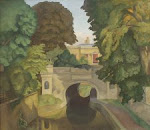
Paul Drury, "September" (1928)

As I have noted here on more than one occasion, I see nothing wrong with sentimentality.  The default modern posture is irony.  The essence of modern irony is self-regarding knowingness and distance from life.  Who needs that?  I will take sentimentality over irony any day.  It is a matter of choosing warmth over coldness.

"The unspeakable blessedness of having a home!  Much as my imagination has dwelt upon it for thirty years, I never knew how deep and exquisite a joy could lie in the assurance that one is at home for ever.  Again and again I come back upon this thought; nothing but Death can oust me from my abiding place.  And Death I would fain learn to regard as a friend, who will but intensify the peace I now relish."

George Gissing, The Private Papers of Henry Ryecroft (1903), page 112.

"A Quiet Normal Life."  Isn't this what most of us want?  "Here in his house and in his room,/In his chair, the most tranquil thought grew peaked . . ."

                    Her Room

At first, not breathed on,
Not a leaf or a flower knew you were gone,
Then, one by one,

The little things put away,
The glass tray
Of medicines empty,

The poems still loved
Long after sight failed
With other closed books shelved,

And from your cabinet
Remembrances to one and another friend
Who will forget

How the little owl, the rose-bowl,
The Brig-o' Doone paperweight,
The Japanese tea-set

Lived on their shelf, just here,
So long, and there,
Binding memories together,

Binding your love,
Husband and daughter in an old photograph,
Your woven texture of life

A torn cobweb dusted down,
Swept from the silent room
That was home.

Kathleen Raine, The Oval Portrait and Other Poems (Enitharmon Press 1977).

Robin Tanner, "The Gamekeeper's Cottage" (1928)

The outward and inward movements of autumn take place within a larger context, of course.  The seasonal round feels as if it will go on for ever.  The wistfulness of autumn is, we know, a prelude to "the bleak mid-winter," which has its own charms, but which will in turn awaken in us thoughts of "the cherry hung with snow."  And so it beautifully goes.

There is, though, a deeper theme at work beneath it all.

                       Words in the Air

The clear air said:  'I was your home once
but other guests have taken your place;
where will you go who liked it here so much?
You looked at me through the thick dust
of the earth, and your eyes were known to me.
You sang sometimes, you even whispered low
to someone else who was often asleep,
you told her the light of the earth
was too pure not to point a direction
which somehow avoided death.  You imagined
yourself advancing in that direction;
but now I no longer hear you.  What have you done?
Above all, what is your lover going to think?'

And she, his friend, replied through tears of happiness:
'He has changed into the shade that pleased him best.'

Philippe Jaccottet (translated by Derek Mahon), in Derek Mahon, Words in the Air: A Selection of Poems by Philippe Jaccottet (The Gallery Press 1998).

Paul Drury, "March Morning" (1933)

Inhabitants of the air?  Yes.  There's no getting around that.  But, in the meantime, here we are.

My hut lies in the middle of a dense forest;
Every year the green ivy grows longer.
No news of the affairs of men,
Only the occasional song of a woodcutter.
The sun shines and I mend my robe;
When the moon comes out I read Buddhist poems.
I have nothing to report, my friends.
If you want to find the meaning, stop chasing after so many things.

Ryōkan (1758-1831) (translated by John Stevens), in John Stevens, One Robe, One Bowl: The Zen Poetry of Ryōkan (Weatherhill 1977), page 43.

Robin Tanner, "Martin's Hovel" (1927)

Thursday, March 26, 2015

Little Things

Yesterday, my afternoon walk began amid a sun shower.  As I walked along a row of trees (budding, but still bare), I was surrounded by veils of rain shot through with sunlight.  The world was a-glitter.  Overhead, a single bird chirped.  I looked, and finally found it:  a lone robin perched on empty black boughs near the top of a 50-foot tall bigleaf maple.

I've read all the books but one
Only remains sacred:  this
Volume of wonders, open
Always before my eyes.

Kathleen Raine, The Oracle in the Heart (The Dolmen Press 1980).

Allan Gwynne-Jones, "Spring Evening, Froxfield" (1922)

I mention the sun shower and the robin not because they are unique, and certainly not to display any special powers of observation on my part, for I have none.  In a week's time, I likely will have forgotten the moment.  In one sense, scenes such as this are commonplace.  Yet that does not render them any less miraculous.

And though a week from now the robin and the sun shower may be "forgotten," will they indeed have vanished from my life?  Or is there a place where these moments reside, and congregate?

Forest is multitude,
But one tree all, one apple-bud
Opens the flower of the world, infinite
Golden stamens and rose petals, here.

Kathleen Raine, Ibid.

Wanting to know all
I overlooked each particle
Containing the whole
Unknowable.

Kathleen Raine, Collected Poems (Counterpoint 2001).

William Wigley (1880-1943), "Mevagissey Quay, Cornwall"

As I turned toward home, I came across a small puddle in the middle of the path.  The puddle contained the whole of the blue sky, all of its stately white clouds.  I often feel that I am not as grateful as I ought to be.

Incredible that anything exists -- this hotch-potch
World of marvels and trivia, and which is which?

Kathleen Raine, Living With Mystery (Golgonooza Press 1992).

I am reminded of a statement by Ludwig Wittgenstein, which has appeared here before, but which is worth repeating, since it provides a nice complement to Raine's poem:  "Not how the world is, is the mystical, but that it is."  An alternative translation is:  "It is not how things are in the world that is mystical, but that it exists."  Ludwig Wittgenstein, Proposition 6.44, Tractatus Logico-Philosophicus (1921) (italics in the original).  The first translation is by C. K. Ogden.  The second is by David Pears and Brian McGuinness.

George Mackley (1900-1983), "Brackie's Burn, Northumberland"

Unbidden, the World bestows great gifts upon us.  But we must be receptive and attentive.  I nearly skipped my afternoon walk yesterday due to the uncertain weather.  I considered taking a nap instead.

We mustn't forget:  it is always possible to wake from a sound sleep and find oneself in a luminous World.

                    On a Boat, Awake at Night

Faint wind rustles reeds and cattails;
I open the hatch, expecting rain -- moon floods the lake.
Boatmen and water birds dream the same dream;
a big fish splashes off like a frightened fox.
It's late -- men and creatures forget each other
while my shadow and I amuse ourselves alone.
Dark tides creep over the flats -- I pity the cold mud-worms;
the setting moon, caught in a willow, lights a dangling spider.
Life passes swiftly, hedged by sorrow;
how long before you've lost it -- a scene like this?
Cocks crow, bells ring, a hundred birds scatter;
drums pound from the bow, shout answers shout.

Su Tung-p'o (1037-1101) (translated by Burton Watson), in Burton Watson, Selected Poems of Su Tung-p'o (Copper Canyon Press 1994). Watson includes the following note to line 12:  "Drums were sounded in the bow when the boat was under way."

To make the imperfect perfect
It is enough to love it.

Kathleen Raine, Living With Mystery.

Claughton Pellew, "The Windmill, Sheringham" (1925)

Friday, November 8, 2013

"Every Day The World Grows Noisier; I, For One, Will Have No Part In That Increasing Clamour"

I have written before in praise of idleness.  One of my favorite apostrophes to idleness appears in George Gissing's The Private Papers of Henry Ryecroft:

"More than half a century of existence has taught me that most of the wrong and folly which darken earth is due to those who cannot possess their souls in quiet; that most of the good which saves mankind from destruction comes of life that is led in thoughtful stillness.  Every day the world grows noisier; I, for one, will have no part in that increasing clamour, and, were it only by my silence, I confer a boon on all."

George Gissing, The Private Papers of Henry Ryecroft (1903), pages 13-14.

This is an elaboration of Pascal's famous dictum:  "I have often said, that all the Misfortune of Men proceeds from their not knowing how to keep themselves quiet in their Chamber."  Blaise Pascal, Pensees (translated by Joseph Walker) (1688).

Alas, those who wish to change the world -- politicians, social engineers, media mouthpieces, and their ilk -- are unlikely to read, much less take heed of, Pascal and Gissing.  Thus, the rest of us must do our best to mitigate the Sisyphean antics and the noisy noisomeness of these busybodies by keeping our wits about us and by remaining idle and quiet.

Percy Horton, "The Road to the Fells, Ambleside" (c. 1943)

Mind you, we shouldn't confuse idleness with inactivity or lassitude, as Andrew Young points out.  One must be vigilant and attentive in order to be idle.

                 Idleness

God, you've so much to do,
To think of, watch and listen to,
That I will let all else go by
And lending ear and eye
Help you to watch how in the combe
Winds sweep dead leaves without a broom;
And rooks in the spring-reddened trees
Restore their villages,
Nest by dark nest
Swaying at rest on the trees' frail unrest;
Or on this limestone wall,
Leaning at ease, with you recall
How once these heavy stones
Swam in the sea as shells and bones;
And hear that owl snore in a tree
Till it grows dark enough for him to see;
In fact, will learn to shirk
No idleness that I may share your work.

Andrew Young, Collected Poems (Rupert Hart-Davis 1960).

A side-note: "Nest by dark nest/Swaying at rest on the trees' frail unrest" is particularly nice, I think.

Percy Horton, "Storm over Loughrigg" (c. 1943)

Indeed, idleness is an essential element of a well-lived life, as pointed out by Kathleen Raine in the following untitled poem.

Your gift of life was idleness,
As you would set day's task aside
To marvel at an opening bud,
Quivering leaf, or spider's veil
On dewy grass in morning spread.
These were your wandering thoughts, that strayed
Across the ever-changing mind
Of airy sky and travelling cloud,
The harebell and the heather hill,
World without end, where you could lose
Memory, identity and name
And all that you beheld, became,
Insect wing and net of stars
Or silver-glistering wind-borne seed
For ever drifting free from time.
What has unbounded life to do
With body's grave and body's womb,
Span of life and little room?

Kathleen Raine, The Oval Portrait (1977).

Percy Horton, "A Corner of Ambleside" (c. 1943)

Saturday, November 2, 2013

A Lost World, Part Three: "Grave Sweet Ancestral Faces"

The following poem by Kathleen Raine has its source in a painting by Samuel Palmer.  I'm guessing that the painting she has in mind is the one that appears immediately below.  However, any number of paintings and engravings by Palmer (a few of which have appeared here previously) evoke a similar atmosphere.  My sense of Palmer is that he knew he was witnessing the passing of a world, and that he wished to preserve what he could of it before it vanished.

Samuel Palmer
"Coming from Evening Church" (1830)

          Returning from Church

That country spire -- Samuel Palmer knew
What world they entered, who,
Kneeling in English village pew,
Were near those angels whose golden effigies looked down
From Gothic vault or hammer-beam.
Grave sweet ancestral faces
Beheld, Sunday by Sunday, a holy place
Few find, who, pausing now
In empty churches, cannot guess
At those deep simple states of grace.

Kathleen Raine, The Oracle in the Heart (1980).

The poem brings to mind Philip Larkin's "Church Going" and J. L. Carr's A Month in the Country, both of which have a similar elegiac feeling.

Robin Tanner, "Harvest Festival" (1930)

The following poem by Derek Mahon goes well, I think, with Raine's poem.

                 Nostalgias

The chair squeaks in a high wind,
Rain falls from its branches;
The kettle yearns for the mountain,
The soap for the sea.
In a tiny stone church
On a desolate headland
A lost tribe is singing 'Abide With Me'.

Derek Mahon, Selected Poems  (Viking/The Gallery Press 1991).

Nowadays, the word "nostalgia" has acquired a vaguely pejorative sense. As has the word "sentimental," with which it is often paired.  At least that's my perception.  But perhaps I'm being defensive, since I do not find anything inherently wrong with nostalgia or sentimentality, as long as we realize that the past was not "better" in all respects than the world in which we presently live.  I'm pleased that we now have electricity and plumbing. Beyond that . . .

Of course, there are those who choose to believe that we have "advanced" beyond those lost times and that human history is an unbroken narrative of "progress," as measured in scientific and political terms.  How quaint and beguiling a notion.

"Men have judged that a king can make rain; we say this contradicts all experience.  Today they judge that aeroplanes and the radio etc. are means for the closer contact of peoples and the spread of culture."

Ludwig Wittgenstein, On Certainty, Paragraph 132 (translated by Denis Paul and G. E. M. Anscombe) (Basil Blackwell 1969).

Samuel Palmer, "A Hilly Scene" (c. 1826)

            New World

New world, I see you dazzle,
Like the sun on a door-knocker
In a straight street inhabited
By people I do not know.

C. H. Sisson, Exactions (Carcanet 1980).

Robin Tanner, "Christmas" (1929)

Saturday, November 10, 2012

"November Dream"

At times, autumn has a dream-like feel to it.  This may have something to do with its mix of changefulness and stillness, a quality that I mentioned in a recent post.  Moreover, as is the case with any good dream (as opposed to a nightmare), we are reluctant to leave it behind.

How lovely it would be to be forever fixed in a grove of yellows and oranges and reds, the leaves trickling down as squirrels gambol overhead.  On the other hand, the essence of autumn's beauty is its disappearance, isn't it?

         John Piper, "The Bridge at Tyringham, Buckinghamshire" (1940)

                   November Dream

I wake to sycamore's yellowing leaves against the grey
Of cloud and London brick,
Day's solid walls and faintly luminous sky;
And still I almost see, in mind's eye,
Last night's woodland way
I followed under boughs of gold
Bathed in another light than these
That stand outside my window's narrow space.
No separation set me there, as here, apart
From dream's afresh-created sky and trees.
In that remembered country I was there indeed
While here, in body locked away,
Touch solid wood, wet leaves, earth-coloured flowers
And all is other that I feel and see;
Yet this world we call real, that has no place.

Kathleen Raine, The Oval Portrait (1977).

          John Piper, "Exterior of the Church of St Denis, Faxton" (1940)

Monday, October 29, 2012

"How Beautifully It Falls"

In my previous post, I blithely asserted, without citing any evidence, that autumn can be the stillest time of year.  One of the things that I had in mind was standing beneath a tree, on a windless day, and seeing a single leaf fall to the ground.

I have previously posted Charles Tomlinson's "Elemental" and "One Day of Autumn," which are lovely evocations of such an event.  As is Andrew Young's "The Leaf," which has also appeared here.  In the following poem, Kathleen Raine ponders the implications of such a leaf-fall.

                         James McIntosh Patrick, "Glamis Village" (1939)

            The Leaf

'How beautifully it falls,' you said,
As a leaf turned and twirled
On invisible wind upheld,
How airily to ground
Prolongs its flight.

You for a leaf-fall forgot
Old age, loneliness,
Body's weary frame,
Crippled hands, failing sense,
Unkind world and its pain.

What did that small leaf sign
To you, troth its gold
Plight 'twixt you and what unseen
Messenger to the heart
From a fair, simple land?

Kathleen Raine, The Oval Portrait (1977).

In considering the possible relationship between a single leaf and a single life, it may be helpful to know that Raine was a devotee of the poetry of William Blake.  Thus, Blake's "To see a World in a Grain of Sand" (from "Auguries of Innocence") may be at play in the background of the poem.

                      James McIntosh Patrick, "Autumn, Kinnordy" (1936)

Tuesday, October 23, 2012

Idleness

I think of idleness as a good thing.  I do not associate idleness with lassitude, laziness, or sloth.  Rather, I associate it with repose, reverie, and contemplation.

People who carry on cellphone conversations in public are in dire need of idleness.  People who walk through the world with their head down, peering at their iPhone while scrolling and tapping, are in dire need of repose, reverie, and contemplation.

These thoughts may mark me out as a reactionary anachronism.  For my younger readers, I offer the following anecdote in order to provide some perspective on my fuddy-duddyness.  Long ago, in my early years of practicing law, I received letters from clients and opposing counsel.  These letters arrived in envelopes that had stamps on them.  I would take a couple of days to consider how to respond to each letter.  I would then write a letter in reply, place it in an envelope, put a stamp on the envelope, and deposit it in a mailbox.  I'm not pulling your leg.

Yes, I come from an ancient world.  A lost world.  Hence my fondness for idleness.

                          Paul Gauguin, "Landscape at Pont-Aven" (1886)

                  Period

It was a time when wise men
Were not silent, but stifled
By vast noise.  They took refuge
In books that were not read.

Two counsellors had the ear
Of the public.  One cried 'Buy'
Day and night, and the other,
More plausibly, 'Sell your repose.'

R. S. Thomas, H'm (1972).

                  Paul Gauguin, "Cove Opposite Pont-Aven Harbor" (1888)

Your gift of life was idleness,
As you would set day's task aside
To marvel at an opening bud,
Quivering leaf, or spider's veil
On dewy grass in morning spread.
These were your wandering thoughts, that strayed
Across the ever-changing mind
Of airy sky and travelling cloud,
The harebell and the heather hill,
World without end, where you could lose
Memory, identity and name
And all that you beheld, became,
Insect wing and net of stars
Or silver-glistering wind-borne seed
For ever drifting free from time.
What has unbounded life to do
With body's grave and body's womb,
Span of life and little room?

Kathleen Raine, The Oval Portrait (1977).  The poem is untitled.

                          Paul Gauguin, "Upstream of Pont-Aven" (1888)