
Showing posts with label Progress. Show all posts

Sunday, February 9, 2014

Winter Into Spring, Part Seven: "Mystery, Unresting, Taciturn"

Lo and behold: yesterday I saw the first crocuses of the year.  Purple and yellow they were, on a sunny patch of ground facing westward.  They seem a trifle premature in this week's freezing weather.  And tonight the snow has begun to fall.  Ah, but what do I know?

There is ever a mystery to all this, isn't there?  And our ability to put names to it, to "explain" it -- in the language of Science -- means nothing.

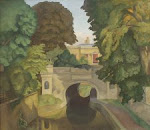
John Aldridge (1905-1983), "February Afternoon"

                         The Wood

I walked a nut-wood's gloom.  And overhead
A pigeon's wing beat on the hidden boughs,
And shrews upon shy tunnelling woke thin
Late winter leaves with trickling sound.  Across
My narrow path I saw the carrier ants
Burdened with little pieces of bright straw.
These things I heard and saw, with senses fine
For all the little traffic of the wood,
While everywhere, above me, underfoot,
And haunting every avenue of leaves,
Was mystery, unresting, taciturn.
          .          .          .          .          .
And haunting the lucidities of life
That are my daily beauty, moves a theme
Beating along my undiscovered mind.

John Drinkwater, Loyalties (1919).  The ellipses are in the original.

As long-time readers of this blog know, I tend to be skeptical of the primacy of Science in our modern world, and the claims that are made for it in the name of "progress."  (See, for example:  Wittgenstein and "Progress"; Edmund Blunden and  "Progress"; R. S. Thomas and "Progress.")  I should be clear that I am not opposed to the practice of science that leads to cures for diseases, efficient plumbing, and The Wonders of the Internet.

But I am opposed to the utopian belief (which is what it is: a belief -- no different than any sincerely-held religious belief) that Science, by "explaining" all, will ameliorate our ills, improve our lives, and, ultimately, bring us to the gates of Paradise.  Alas (for true believers), scientific "explanation" leaves one tiny thing out of account:  the human soul -- individual, indissoluble, and inexplicable.  As it happens, this tiny omission invalidates the whole utopian project.  For which we can all be grateful.  Oh, well, back to the drawing board . . .

John Aldridge, "Bridge, February" (1963)

               In the Conservatory

A bird's nest lined with leaves and moss
Kept here through the winter . . .
                  Spring come, I find among leaf-mould
A brown mouse -- the tail an unlikely flourish --
Modelling the letter 'C'
As if it stood for Comfort,
Though it lay there fixed and cold.

Clive Wilmer, The Times Literary Supplement (December 8, 2006).

John Aldridge, "Beslyn's Pond, Great Bardfield"

Monday, September 20, 2010

"On The Hurry Of This Time"

Recently, I have seen a spate of articles about the adverse impact that technology (e.g., the Internet, PDAs, etc.) may be having upon us.  In particular, there has been much talk of the impact of these things upon our attention spans and our reading habits.  Because I am a Luddite by temperament, I tend to sympathize with these sorts of concerns.  (Given the fact that I am writing these words on a blog, I realize that charges of hypocrisy may be in order.)

However, part of me realizes that we need to put these concerns into perspective.  Not in the sense that they may not have some validity, but in the sense that each "modern" generation (or at least a portion of that generation) believes that things are moving too fast and that the world is undergoing a unique technological transformation that will permanently change (for the worse) humanity.  In other words, a portion of each "modern" generation feels that the world is going to Hell in the proverbial handbasket.

                             George Mackley, "The House by the Lake"

Poets often feel this way.  In his Preface to Lyrical Ballads, William Wordsworth writes:

[A] multitude of causes, unknown to former times, are now acting with a combined force to blunt the discriminating powers of the mind, and unfitting it for all voluntary exertion to reduce it to a state of almost savage torpor.  The most effective of these causes are the great national events which are daily taking place, and the increasing accumulation of men in cities, where the uniformity of their occupations produces a craving for extraordinary incident, which the rapid communication of intelligence hourly gratifies.

William Wordsworth, Lyrical Ballads (1800).  Sound familiar?

                                         George Mackley, "Drawbridge"

Here, on a smaller scale, is a poem from the Victorian era by Austin Dobson (1840-1921):

       On the Hurry of This Time

With slower pen men used to write,
Of old, when "letters" were "polite";
   In Anna's, or in George's days,
   They could afford to turn a phrase,
Or trim a straggling theme aright.

They knew not steam; electric light
Not yet had dazed their calmer sight; --
   They meted out both blame and praise
          With slower pen.

Too swiftly now the Hours take flight!
What's read at morn is dead at night:
   Scant space have we for Art's delays,
   Whose breathless thought so briefly stays,
We may not work -- ah! would we might! --
          With slower pen.

Vignettes in Rhyme and Other Verses (1880).

Sunday, May 30, 2010

Louis MacNeice and "Progress"

I acknowledge that I am a hypocrite:  how can someone who maintains a blog on the Internet presume to raise doubts about "progress"?  "In for a penny, in for a pound."  Or something like that.  And yet, and yet . .

                    To Posterity

When books have all seized up like the books in graveyards
And reading and even speaking have been replaced
By other, less difficult, media, we wonder if you
Will find in flowers and fruit the same colour and taste
They held for us for whom they were framed in words,
And will your grass be green, your sky be blue,
Or will your birds be always wingless birds?

Louis MacNeice, Visitations (1957).

Tuesday, May 4, 2010

R. S. Thomas and "Progress": "Deciduous Language"

I had intended to leave the topic of "progress" after hearing from Ludwig Wittgenstein and Edmund Blunden in the previous two posts.  However, I then recalled a poem by R. S. Thomas that bears on the subject.  (R. S. Thomas being who he was, his thoughts -- as one might expect -- are not exactly cheery.)  With his words, we shall say farewell to "progress" for now.

          Postscript

As life improved, their poems
Grew sadder and sadder.  Was there oil
For the machine?  It was
The vinegar in the poets' cup.

The tins marched to the music
Of the conveyor belt.  A billion
Mouths opened.  Production,
Production, the wheels

Whistled.  Among the forests
Of metal the one human
Sound was the lament of
The poets for deciduous language.

                           The "Beacon of Progress": A Closer View

Sunday, May 2, 2010

Edmund Blunden and "Progress": "Mere moonlight in the last green loneliness"

In the previous post, we heard Ludwig Wittgenstein express skepticism about the nature of "progress" in our time.  In the following poem, Edmund Blunden sounds a similar note:

                    Minority Report

That you have given us others endless means
To modify the dreariness of living,
Machines which even change men to machines;
That you have been most honourable in giving;
That thanks to you we roar through space at speed
Past dreams of wisest science not long since,
And listen in to news we hardly need,
And rumours which might make Horatius wince,
Of modes of sudden death devised by you,
And promising protection against those --
All this and more I know, and what is due
Of praise would offer, couched more fitly in prose.
But such incompetence and such caprice
Clog human nature that, for all your kindness,
Some shun loud-speakers as uncertain peace,
And fear flood-lighting is a form of blindness;
The televisionary world to come,
The petrol-driven world already made,
Appear not to afford these types a crumb
Of comfort.  You will win; be not dismayed.
Let those pursue their fantasy, and press
For obsolete illusion, let them seek
Mere moonlight in the last green loneliness;
Your van will be arriving there next week.

Edmund Blunden, An Elegy and Other Poems (1937).

                                         The "Beacon of Progress"
A proposed 1,500-foot-tall structure designed by a professor of architecture from MIT, circa 1900.  It was never built.

Friday, April 30, 2010

Wittgenstein and "Progress"

I admire Ludwig Wittgenstein.  I do not admire the pack of academic philosophers, theorists, and other hyenas who have systematically misunderstood and misrepresented what he actually said.  Wittgenstein noticed the initial stages of this phenomenon, and he was angered and appalled.

Given the intellectual temper of our times, things have only gotten worse.  However -- have no fear! -- I do not intend to wade into that particular morass.  For a succinct discussion of the subject, I recommend Bryan Magee's Confessions of a Philosopher (1998), which contains a chapter recounting Magee's dismay and shock at the manner in which supposedly intelligent people ignored what was staring them in the face.

All that I wish to do is to suggest that we read Wittgenstein -- and listen to what he says.  Ignore the intermediaries.  And, as background, bear in mind stray facts like these: Tolstoy and Samuel Johnson (particularly the Prayers and Meditations) were important to him; he loved to watch American movies; he avidly read American detective stories.

This passage is from a draft of Wittgenstein's foreword to Philosophical Remarks (1930):

"This book is written for those who are in sympathy with the spirit in which it is written.  This is not, I believe, the spirit of the main current of European and American civilization.  The spirit of this civilization makes itself manifest in the industry, architecture and music of our time, in its fascism and socialism, and it is alien and uncongenial to the author.  This is not a value judgment.  It is not, it is true, as though he accepted what nowadays passes for architecture as architecture, or did not approach what is called modern music with the greatest suspicion (though without understanding its language), but still, the disappearance of the arts does not justify judging disparagingly the human beings who make up this civilization.
. . . . .
I realize then that the disappearance of a culture does not signify the disappearance of human value, but simply of certain means of expressing this value, yet the fact remains that I have no sympathy for the current of European civilization and do not understand its goals, if it has any.  So I am really writing for friends who are scattered throughout the corners of the globe.

It is all one to me whether or not the typical western scientist understands or appreciates my work, since he will not in any case understand the spirit in which I write.  Our civilization is characterized by the word 'progress'.  Progress is its form rather than making progress being one of its features.  Typically it constructs.  It is occupied with building an ever more complicated structure.  And even clarity is sought only as a means to this end, not as an end in itself.  For me on the contrary clarity, perspicuity are valuable in themselves.

I am not interested in constructing a building, so much as having a perspicuous view of the foundations of possible buildings.

So, I am not aiming at the same target as the scientists and my way of thinking is different from theirs."


Again, my hope is that we read Wittgenstein, and forget about his interpreters.  And, always remember: clarity and perspicuity are very important words in his thought and writing.