
Showing posts with label Sami Mansei. Show all posts

Friday, September 27, 2019

Departures

At a certain point in one's life, the deaths begin to accumulate, don't they?  Family members and relatives, close and distant.  Friends, acquaintances, work colleagues, classmates, neighbors.  In the public sphere, nearly every week brings news of the deaths of musicians, assorted entertainers, sports heroes, and other figures who one "grew up with."  (Ah, the vanishing rock stars, carrying away our youth!)

One grieves to a greater or a lesser extent, but, on a purely self-interested level, one also begins to get the message.  Something along these lines:

     An autumn evening;
Without a cry,
     A crow passes.

Kishū (translated by R. H. Blyth), in R. H. Blyth, Haiku, Volume 3: Summer-Autumn (Hokuseido Press 1952), page 345.

Or, in the context of a different season, this:

     Spring has departed;
Where has it gone,
     The moored boat?

Buson (1716-1784) (translated by R. H. Blyth), in R. H. Blyth, A History of Haiku, Volume 1 (Hokuseido Press 1963), page 286.

Buson's haiku leads naturally to this waka, which was written nine centuries before Buson's time (the continuity of Japanese poetry is a wonderful thing):

Our life in this world --
to what shall I compare it?
It is like a boat
     rowing out at break of day,
leaving not a trace behind.

Sami Mansei (early 8th century) (translated by Steven Carter), in Steven Carter, Traditional Japanese Poetry: An Anthology (Stanford University Press 1991), page 51.

Joseph Farquharson (1846-1935), "Corn Stooks" (c. 1880)

In his Meditations, Marcus Aurelius now and then posts lists of the illustrious and not-so-illustrious dead in order to remind himself that all is vanity and that all living things, including the emperor of Rome, are evanescent bubbles.  For instance:

"Hippocrates, after conquering many diseases, yielded to a disease at last.  The Chaldeans foretold the fatal hours of multitudes, and fate afterwards carried themselves away.  Alexander, Pompey, and Caius Caesar, who so often razed whole cities, and cut off in battle so many myriads of horse and foot, at last departed from this life themselves. Heraclitus, who wrote so much about the conflagration of the universe, died swollen with water, and bedaubed with ox-dung. Vermin destroyed Democritus, and another sort of vermin destroyed Socrates."

Marcus Aurelius (translated by Francis Hutcheson and James Moor), Meditations, Book III, Section 3, in Francis Hutcheson and James Moor, The Meditations of the Emperor Marcus Aurelius Antoninus (1742).

I understand what the emperor is getting at:  "Then stop, and ask, where are they all now?  Smoke, and ashes, and an old tale; or, perhaps, not even a tale."  (Meditations, Book XII, Section 27.)  Yes, understood.  But, as Marcus knew, this recognition is only the starting point for leading a good life and arriving at a good death. And now, Philip Larkin chimes in:  "Death is no different whined at than withstood."  ("Aubade.")  Yes, understood as well.  One will never be prepared.  With an apology for being self-referential:  "How little we know!  It leaves you breathless."

In the meantime, I prefer lovely intimations.  A crow passing silently overhead in the evening sky of autumn.  A still pond and a departed boat.  A seaside town in late September.

       September in Great Yarmouth

The woodwind whistles down the shore
Piping the stragglers home; the gulls
Snaffle and bolt their final mouthfuls.
Only the youngsters call for more.

Chimneys breathe and beaches empty,
Everyone queues for the inland cold --
Middle-aged parents growing old
And teenage kids becoming twenty.

Now the first few spots of rain
Spatter the sports page in the gutter.
Council workmen stab the litter.
You have sown and reaped; now sow again.

The band packs in, the banners drop,
The ice-cream stiffens in its cone.
The boatman lifts his megaphone:
"Come in, fifteen, your time is up."

Derek Mahon, Poems 1962-1978 (Oxford University Press 1979).

Joseph Farquharson, "Harvesting, Forest of Birse" (c. 1900)

Wednesday, February 8, 2017

Boat

A certain segment of the American population has worked itself into quite a tizzy over our new political state of affairs.  How can I tell?  The old standby clichés are being paraded on a daily basis.  "Hitler"!  "Nazi"!  "Fascism"! And we mustn't forget:  "Nineteen Eighty-Four"!   "Orwellian"!  (Because this is high volume outrage, exclamation marks are mandatory.)

Words such as these empty our culture of all reason and reasonableness.     I am tempted to embark upon a rant at this point, but I have no desire to add to the clamor.  Instead, the words of Marcus Aurelius come to mind:

"Say thus to thyself every morning:  today I may have to do with some intermeddler in other men's affairs, with an ungrateful man; an insolent, or a crafty, or an envious, or an unsociable selfish man.  These bad qualities have befallen them through their ignorance of what things are truly good or evil.  But I have fully comprehended the nature of good, as only what is beautiful and honourable; and of evil, that it is always deformed and shameful; and the nature of those persons too who mistake their aim; that they are my kinsmen, by partaking, not of the same blood or seed, but of the same intelligent divine part; and that I cannot be hurt by any of them, since none of them can involve me in anything dishonourable or deformed.

"I cannot be angry at my kinsmen, or hate them.  We were formed by nature for mutual assistance, as the two feet, the hands, the eyelids, the upper and lower rows of teeth.  Opposition to each other is contrary to nature:  All anger and aversion is an opposition."

Marcus Aurelius, Meditations, Book II, Section 1, in Francis Hutcheson and James Moor (translators), The Meditations of the Emperor Marcus Aurelius Antoninus (1742), pages 62-63.

Our time here is short.  Were we placed here to repeat meaningless clichés?

Our life in this world --
to what shall I compare it?
It is like a boat
     rowing out at break of day,
leaving not a trace behind.

Sami Mansei (early 8th century) (translated by Steven Carter), in Steven Carter, Traditional Japanese Poetry: An Anthology (Stanford University Press 1991), page 51.

William Ratcliffe, "Cottage Interior" (1920)

Please do not read any political partisanship into these thoughts, dear reader.  As I mentioned in my post of November 11, I did not vote in the presidential election.  Moreover, as I have stated here on more than one occasion, this is not a political blog.  But I have often commented on the destruction of the human by the politicization of people's lives.  Hence:  the shouting of contentless clichés in the streets and through the electronic air.

A thought by Epictetus:

"That which gives men disquiet, and makes their lives miserable, is not the nature of things as they really are, but the notions and opinions which they form to themselves concerning them."

Epictetus, The Enchiridion, Section 5, in  George Stanhope (translator), Epictetus, His Morals, with Simplicius, His Comment (Fifth Edition, 1741), page 60.

The politicization of culture and of human beings involves the creation of competing fictitious versions of reality.  This contrived way of viewing the world persuades the politicized that their lives are defined, even validated, by the political beliefs they espouse.  In a politicized world of empty words, where does the individual human soul fit in?  It doesn't.

One cannot be sure of living
     even until the evening.

In the dim dawn light
     I watch the waves in the wake
          of a departing boat.

Shinkei (1406-1475) (translated by Steven Carter), in Steven Carter, Traditional Japanese Poetry: An Anthology, page 291.

Anthony Eyton, "A Kitchen Range" (1984)

As I have noted here in the past, I am quite content to live my life in accordance with certain truisms.  Why?  Because they are true.  Here is a truism by which I try to live (failing every day):  The best way to effect change is through individual acts of kindness and decency.

"Spend your time no longer in discoursing on what are the qualities of the good man, but in actually being such."

Marcus Aurelius, Meditations, Book X, Section 16, in Francis Hutcheson and James Moor (translators), The Meditations of the Emperor Marcus Aurelius Antoninus, page 243.

Most of us know these things.  Human beings have known them for millennia.  But we are diverted by trifles.  The identity of the President of the United States is a trifle, as is the identity of the Prime Minister of X, the Premier of Y, and the Emperor of Z.  Another truism:  Life is too short for trifles of this sort.

Over waves now at peace --
a boat seen rowing away.

Sōgi (1421-1502) (translated by Steven Carter), in Steven Carter, Traditional Japanese Poetry: An Anthology, page 318.

Gilbert Spencer (1892-1979), "The Cottage Window"

Thursday, October 6, 2016

Adrift

A few posts ago, I considered Matthew Arnold's use of the "Sea of Life" metaphor in his poetry.  Recently, however, my thoughts have turned to a more homely image of life:  a boat adrift on calm waters.  I have in mind a wooden rowboat.  Or perhaps, even though I am not a sailor, a small wooden sailboat.

Our life in this world --
to what shall I compare it?
It is like a boat
     rowing out at break of day,
leaving not a trace behind.

Sami Mansei (8th century) (translated by Steven Carter), in Steven Carter, Traditional Japanese Poetry: An Anthology (Stanford University Press 1991).

I prefer this image to that of a three-masted Ship of Life, under full sail, cleaving the stormy waves of Time, et cetera.  We all know the inevitable end of such a journey:  "As a rule, everyone ultimately reaches port with masts and rigging gone."  (Arthur Schopenhauer (translated by E. F. J. Payne), "Additional Remarks on the Doctrine of the Vanity of Existence," Parerga and Paralipomena, Volume 2 (Oxford University Press 1974; originally published in 1851), page 284.)  An oceanic circumnavigation is far too dramatic.  I fancy this instead:  "a boat amid the ripples, drifting, rocking."  (Christina Rossetti, "Pastime.")

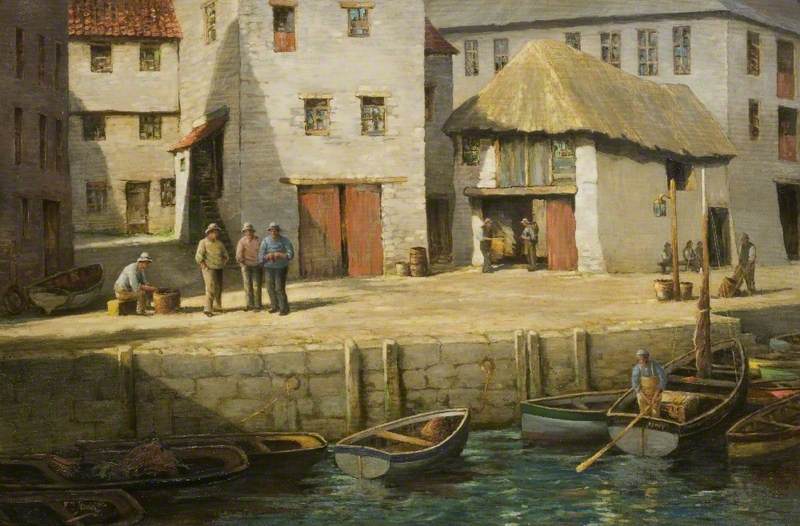
Frank Jowett (1879-1943), "In Mevagissey Harbour, Cornwall"

Sami Mansei's boat is "rowing out at break of day," bound for a preordained end.  But it is in no hurry, and the scene is suffused with tranquility.  There is a great deal to be said for idle drifting, with a bit of occasional rowing. We will arrive when we arrive.

"These men you wander around with -- none will give you any good advice. All they have are petty words, the kind that poison a man.  No one understands, no one comprehends -- so who can give any help to anyone else?  The clever man wears himself out, the wise man worries.  But the man of no ability has nothing he seeks.  He eats his fill and wanders idly about.  Drifting like an unmoored boat, emptily and idly he wanders along."

Chuang Tzu (translated by Burton Watson), in Burton Watson, The Complete Works of Chuang Tzu (Columbia University Press 1968), page 354.

Be assured:  Chuang Tzu is advising us that "the man of no ability" who "emptily and idly . . . wanders along" -- "drifting like an unmoored boat" -- deserves our approbation, not our condemnation.  "The clever man" and "the wise man" have both got it all wrong.

                                     July

Naught moves but clouds, and in the glassy lake
Their doubles and the shadow of my boat.
The boat itself stirs only when I break
This drowse of heat and solitude afloat
To prove if what I see be bird or mote,
Or learn if yet the shore woods be awake.

Long hours since dawn grew, -- spread, -- and passed on high
And deep below, -- I have watched the cool reeds hung
Over images more cool in imaged sky:
Nothing there was worth thinking of so long;
All that the ring-doves say, far leaves among,
Brims my mind with content thus still to lie.

Edward Thomas, in Edna Longley (editor), Edward Thomas: The Annotated Collected Poems (Bloodaxe Books 2008).  Thomas wrote the poem in May of 1915.  Ibid, page 235.

China in the 4th century B. C., England in 1915, or now:  there is no difference.

Walter Goodin, "Bridlington Harbour, East Riding of Yorkshire" (1951)

Chuang Tzu is correct:  why aspire to be clever or wise?  (Besides, who in their right mind would, or could, claim to be clever or wise?)  If it is serenity and contentment that we seek (I see no reason to grasp after "happiness," whatever that may be), idle drifting seems to be the proper course of action. But one mustn't equate idleness with sloth, disinterest, or ennui:  it is an active state of being that requires attention, patience, receptivity, and humility.  One never knows when a message may arrive.

"Lessons from the world around us:  certain localities, certain moments 'incline' us towards them; there seems to be the pressure of a hand, an invisible hand, urging a change of direction (of the footsteps, the gaze, or the thoughts); the hand could also be a breath, like the breath behind leaves, clouds, sailing boats.  An insinuation, in an undertone like someone whispering 'look,' 'listen,' or merely 'wait'.  But is there still the time, the patience to wait?  And is 'waiting' really the right word?"

Philippe Jaccottet (translated by Mark Treharne), Cherry Tree (Le Cerisier) (The Delos Press 1991), pages 13-14.

Stanhope Forbes, "The Inner Harbour: Abbey Slip" (1921)

Given the distractions of the modern world, Jaccottet asks a valid question: "But is there still the time, the patience to wait?"  Popular culture, the media, and technology all urge us to pursue ephemeral chimeras at ever-increasing speeds.  But each of us has it in us to step into a drifting boat at any moment and to say good-bye to all that (to borrow from Robert Graves). In my experience, this becomes easier as one ages.

                              Evening

When little lights in little ports come out,
Quivering down through water with the stars,
And all the fishing fleet of slender spars
Range at their moorings, veer with tide about;

When race of wind is stilled and sails are furled,
And underneath our single riding-light
The curve of black-ribbed deck gleams palely white,
And slumbrous waters pool a slumbrous world;

-- Then, and then only, have I thought how sweet
Old age might sink upon a windy youth,
Quiet beneath the riding-light of truth,
Weathered through storms, and gracious in retreat.

Vita Sackville-West, Orchard and Vineyard (John Lane 1921).

"Quiet beneath the riding-light of truth."  Well, I doubt that "old age" in itself leads us to the discovery of "the riding-light of truth" (intimations or glimpses of Truth perhaps -- if we pay attention and are lucky).  But, as for "gracious in retreat":  that is a laudable goal, and one that may be attainable as long as we keep our wits about us.

Frank Jowett, "A Sunlight Harbour"

As one who has no wisdom, and who knows nothing, my musings on being able to idly drift on calm waters are purely aspirational.  There may be moments (mere instants) when such a life seems within reach.  They immediately vanish.

Yet, we wouldn't wish it otherwise, would we?

                 Old Crofter

The gate he built last year
hangs by its elbow from the wall.
The oar he shaped this summer
goes through the water with a swirl, a swivel.

The hammer in his great hand
pecks like fowl in the grain.
His haycocks are lopsided.
His lamp stands on the dresser, unlit.

One day the rope he has tied
will slither down the rock
and the boat drift off idly
dwindling away into the Atlantic.

Norman MacCaig, in Ewen McCaig (editor), The Poems of Norman MacCaig (Polygon 2009).

Henry Moore, "Catspaws Off the Land" (1885)