Showing posts with label How To Live. Show all posts

Monday, January 16, 2023

How to Live, Part Thirty-Two: River

Human nature being what it is, the world has always been, and will always be, beset with utopian busybodies who have taken leave of their senses.  (As ever, I draw a strict distinction between the lower-case "world" in which we find ourselves by historical circumstance, and the upper-case "World" of Beauty, Truth, and Immanence.  More on this crucial distinction anon.)  I trust, dear readers, that you know of whom I speak: the new Puritans who, imagining themselves to have attained the highest stage of enlightenment, now presume to re-educate the rest of us, whether we like it or not. 

Because I am in the autumn (or is it, perhaps, winter?) of my life, I should be able to view this state of affairs from an Olympian height, having seen it all before -- to wit, yet another case study in human pathology and folly ("extraordinary popular delusions and the madness of crowds").  Still, I confess that there are times when the effrontery, ignorance, bad faith, and mean-spiritedness of it all tries my patience.  When this happens, one can always turn to poetry for perspective.

          Leave Them Alone

There's nothing happening that you hate
That's really worthwhile slamming;
Be patient.  If you only wait
You'll see time gently damning

Newspaper bedlamites who raised
Each day the devil's howl,
Versifiers who had seized 
The poet's begging bowl.

The whole hysterical passing show 
The hour apotheosized
Into a cul-de-sac will go
And be not even despised.

Patrick Kavanagh, Collected Poems (edited by Antoinette Quinn) (Penguin 2005), page 158.  The poem was first published in May of 1950.  Ibid, page 277.

But is Kavanagh being too sanguine?  A poem by another Irish poet is worth considering as well.

               The Pier

Only a placid sea, and
A pier where no boat comes,
But people stand at the end
And spit into the water,
Dimpling it, and watch a dog
That chins and churns back to land.

I had come here to see
Humbug embark, deported,
Protected from the crowd.
But he has not come today.
And anyway there is no boat
To take him.  And no one cares.
So Humbug still walks our land
On stilts, is still looked up to.

W. R. Rodgers, Awake! and Other Poems (Secker & Warburg 1941), page 10.

Yes, I'm afraid that Humbug will always be with us.  On the other hand, leaving the purveyors of Humbug alone is sound advice.  This is where the "World" versus "world" distinction comes in.

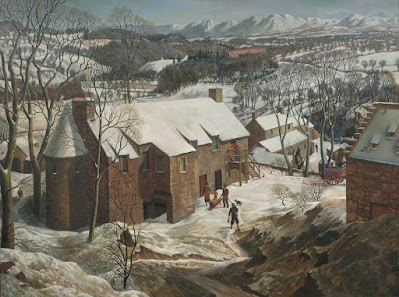
James McIntosh Patrick (1907-1998), "The Ettrick Shepherd" (1936)

W. H. Auden devoted a great deal of attention to the Humbug that walks the modern world on stilts.  This attention was always present in his poems, but it took a turn in the 1940s, as he moved away from the political preoccupations of his younger years, with religion taking on more importance in both his life and poetry.  I don't intend to undertake an examination of Auden's complex views on the state in which humanity found itself in the 20th century.  However, I do think that many of the poems he wrote in the latter half of his life (particularly in the 1950s) can help us to place into perspective the antics (or is "depredations" the better word?) of our current clan of self-anointed saviors and inquisitors.

               The History of Truth

In that ago when being was believing,
Truth was the most of many credibles,
More first, more always, than a bat-winged lion,
A fish-tailed dog or eagle-headed fish,
The least like mortals, doubted by their deaths.

Truth was their model as they strove to build
A world of lasting objects to believe in,
Without believing earthernware and legend,
Archway and song, were truthful or untruthful:
The Truth was there already to be true.

This while when, practical like paper-dishes,
Truth is convertible to kilowatts,
Our last to do by is an anti-model,
Some untruth anyone can give the lie to,
A nothing no one need believe is there.

W. H. Auden, The Complete Works of W. H. Auden: Poems, Volume II: 1940-1973 (edited by Edward Mendelson) (Princeton University Press 2022), pages 485-486.  The poem was likely written in 1958. Ibid, page 987.  Auden preferred "the uncommon alternative form 'earthernware' [line 8] to 'earthenware'."  Ibid.

An earlier poem by Auden complements "The History of Truth" quite well:

                      The Chimeras

Absence of heart -- as in public buildings,
Absence of mind -- as in public speeches,
Absence of worth -- as in goods intended for the public,

Are telltale signs that a chimera has just dined
On someone else; of him, poor foolish fellow,
Not a scrap is left, not even his name.

Indescribable -- being neither this nor that,
Uncountable -- being any number,
Unreal -- being anything but what they are,

And ugly customers for someone to encounter,
It is our fault entirely if we do;
They cannot touch us; it is we who will touch them.

Curious from wantonness -- to see what they are like,
Cruel from fear -- to put a stop to them,
Incredulous from conceit -- to prove they cannot be,

We prod or kick or measure and are lost:
The stronger we are the sooner all is over;
It is our strength with which they gobble us up.

If someone, being chaste, brave, humble,
Get by them safely, he is still in danger,
With pity remembering what once they were,

Of turning back to help them.  Don't.
What they were once was what they would not be;
Not liking what they are not is what now they are.

No one can help them; walk on, keep on walking,
And do not let your goodness self-deceive you:
It is good that they are but not that they are thus.

W. H. Auden, Ibid, pages 375-376.  The poem was written in 1950 in Forio, on the island of Ischia.  Ibid, p. 934.  [As I have mentioned in the past, one of my two fundamental poetical principles is: Explanation and explication are the death of poetry.  But I sometimes violate that principle.  Hence, for anyone who may be interested, I recommend James F. G. Weldon's article "The Infernal Present: Auden's Use of Inferno III in 'The Chimeras,'" which appears in Quaderni d'italianistica, Volume V, No. 1 (1984), pages 97-109.  Weldon persuasively argues that "The Chimeras" echoes Canto III of Dante's Inferno in both text and theme.]

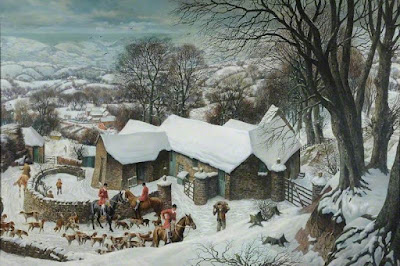
James McIntosh Patrick, "Winter in Angus" (1935)

What, then, is one to do?  As Auden suggests, we should "walk on, keep on walking."  The chimeras -- having nothing to do with Truth (or with Beauty) -- are best left to their fate.  As a baby boomer who grew up with the music of the Sixties and Seventies, these lines come to mind:

It was then that I knew I'd had enough,
Burned my credit card for fuel,
Headed out to where the pavement turns to sand.
With the one-way ticket to the land of truth
And my suitcase in my hand,
How I lost my friends I still don't understand.

Neil Young, "Thrasher," from Neil Young and Crazy Horse, Rust Never Sleeps (1979).

The hermetic life does have a certain appeal.  In my daydreams I can imagine nothing better than to spend my remaining days in a seacoast town or mountain village in Japan, watching the seasons come and go.  But burning one's credit cards for fuel and leaving the pavement behind is not a practical alternative.  Nor do I have the fortitude to become an eremite.

But, most importantly, isn't what a hermit longingly seeks right in front of us at this moment?

On the day after New Year's Day, I was startled to come upon a woolly bear caterpillar making its way across the pathway down which I walked.  In the grey light of the January afternoon its black and dark burnt-orange colors were striking -- seeming more vivid and more beautiful than usual, given the circumstances.  Because the pathway is frequented by both walkers and bicyclists, I picked the traveller up (it immediately rolled itself into a protective ball) and laid it among some fallen leaves beside the trunk of a nearby tree. (As I have noted here in the past, I am not seeking credit for this: it is something we all do.)  Woolly bears hibernate over the winter, so I wondered why it was out for a stroll at this time of year.  But what do I know?  

          The River

Stir not, whisper not,
Trouble not the giver
Of quiet who gives
This calm-flowing river,

Whose whispering willows,
Whose murmuring reeds
Make silence more still
Than the thought it breeds,

Until thought drops down
From the motionless mind
Like a quiet brown leaf
Without any wind;

It falls on the river
And floats with its flowing,
Unhurrying still
Past caring, past knowing.

Ask not, answer not,
Trouble not the giver
Of quiet who gives
This calm-flowing river.

Patrick MacDonogh, Poems (edited by Derek Mahon) (The Gallery Press 2001), page 86.

"This calm-flowing river."  A woolly bear caterpillar unexpectedly appears, bright and beautiful, in the midst of winter.  The chimeras are nowhere to be found.  Therein lies the distinction between the World and the world.

                    The River

And the cobbled water
Of the stream with the trout's indelible
Shadows that winter
Has not erased -- I walk it
Again under a clean
Sky with the fish, speckled like thrushes,
Silently singing among the weed's 
Branches.
                   I bring the heart
Not the mind to the interpretation
Of their music, letting the stream
Comb me, feeling it fresh
In my veins, revisiting the sources
That are as near now
As on the morning I set out from them.

R. S. Thomas,  H'm (Macmillan 1972), page 23.

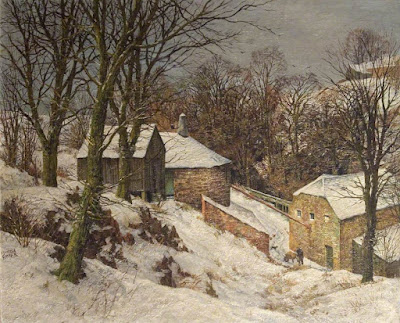
James Mcintosh Patrick, "An Exmoor Farm" (1938)

One afternoon last week I walked down a different path, through a narrow meadow bordered on both sides by groves of pine trees.  My bird companions in winter are small flocks of chattering robins and sparrows who make their accustomed rounds throughout the day. But the meadow and trees were silent as I walked.  Suddenly, a single dove flew out of a bush to my left, landed on the path in front of me, hopped along the path for a few feet, and then flew off into the meadow.

     In the depths of night --
The sound of the river flowing on,
     And the moonlight
Shining clear above the village
Of Mizuno in Yamashiro.

Tonna (1289-1372) (translated by Robert Brower and Steven Carter), in Robert Brower and Steven Carter, Conversations with Shōtetsu (Shōtetsu Monogatari) (Center for Japanese Studies, The University of Michigan 1992), page 120.

James McIntosh Patrick, "Arbirlot Mill, Near Arbroath"

Saturday, September 3, 2022

How to Live, Part Thirty-One: Repose

Reading the poetry of Robert Herrick always helps to put our day-to-day world into perspective.  For instance:

                         Nothing New

Nothing is new: we walk where others went.
There's no vice now, but has his precedent.

Robert Herrick, Hesperides (1648), in Tom Cain and Ruth Connolly (editors), The Complete Poetry of Robert Herrick, Volume I (Oxford University Press 2013), page 132.  

The most recent editors of Hesperides suggest two possible sources for Herrick's poem.  First, Ecclesiastes I.9-10: "The thing that hath been, it is that which shall be; and that which is done is that which shall be done: and there is no new thing under the sun.  Is there any thing whereof it may be said, See, this is new? it hath been already of old time, which was before us."  Second, Juvenal I.147-149: "Posterity will add nothing more to the ways we have, our descendants will do and desire the same things, all vice stands [always] at its high point."  (Tom Cain and Ruth Connolly (editors), The Complete Poetry of Robert Herrick, Volume II (Oxford University Press 2013), page 627.)

Of course, the fact that there is nothing new under the sun provides cold comfort amidst the daily welter -- the horror and the folly -- of the news of the world.  But perhaps we should at least add a line to Herrick's couplet in order to provide a semblance of balance.  Something like this: "There's no virtue now, but has his precedent."

More importantly, beyond the dichotomy of vice and virtue, good and evil, there is -- at any and every moment -- something else, something further, something of another sort altogether.

                 On the Road on a Spring Day

There is no coming, there is no going.
From what quarter departed?  Toward what quarter bound?
Pity him! in the midst of his journey, journeying --
Flowers and willows in spring profusion, everywhere fragrance.

Ryūsen Reisai (d. 1365) (translated by Marian Ury), in Marian Ury (editor), Poems of the Five Mountains: An Introduction to the Literature of the Zen Monasteries (Center for Japanese Studies, University of Michigan 1992), page 33.

John Aldridge (1905-1983), "Roofing a New House"

This "something else" is where words come to an end.  Yet still we persist.  This is what human beings do.

"The old philosophy distinguished between knowledge achieved by effort (ratio) and knowledge received (intellectus) by the listening soul that can hear the essence of things and comes to understand the marvelous.  But this calls for unusual strength of soul.  The more so since society claims more and more and more of your inner self and infects you with its restlessness.  It trains you in distraction, colonizes consciousness as fast as consciousness advances.  The true poise, that of contemplation or imagination, sits right on the border of sleep and dreaming."

Saul Bellow, Humboldt's Gift (Viking 1975), page 306.

Bellow's passage is absolutely wonderful.  Still, he is only reaffirming what has been said before, in many times and places and languages.  And, for all his acuity, eloquence, good humor, and wisdom, we ultimately arrive at this (which, I acknowledge, raises questions about the value of what I am doing at this moment):

The more talking and thinking,
The farther from the truth.

Seng-ts'an (d. 606 A. D.) (translated by R. H. Blyth), in R. H. Blyth, Haiku, Volume 3: Summer-Autumn (Hokuseido Press 1952), page 68.  

Seng-ts'an was the Third Patriarch of Ch'an Buddhism.  The lines appear in a work by him titled Hsin Hsin Ming.  Hsin Hsin Ming has been translated as (for example) "Faith in Mind," "On Trust in the Heart" (Arthur Waley), "Inscription on Trust in the Mind" (Burton Watson), and "Faith Mind Inscription."  (Blyth identifies the source of the lines as "Shin Jin Mei," which is the Japanese transliteration of Hsin Hsin Ming.  The Japanese transliteration of Seng-ts'an is "Sōsan.")

John Aldridge, "February Afternoon"

At some point, does one simply leave the welter behind, turn away, and keep quiet?

                    A Recluse

Here lies (where all at peace may be)
A lover of mere privacy.
Graces and gifts were his; now none
Will keep him from oblivion;
How well they served his hidden ends
Ask those who knew him best, his friends.

He is dead; but even among the quick
This world was never his candlestick.
He envied none; he was content
With self-inflicted banishment.
'Let your light shine!' was never his way:
What then remains but, Welladay!

And yet his very silence proved 
How much he valued what he loved.
There peered from his hazed, hazel eyes
A self in solitude made wise;
As if within the heart may be
All the soul needs for company:
And, having that in safety there,
Finds its reflection everywhere.

Life's tempests must have waxed and waned:
The deep beneath at peace remained.
Full tides that silent well may be
Mark of no less profound a sea.
Age proved his blessing.  It had given
The all that earth implies of heaven;
And found an old man reconciled
To die, as he had lived, a child.

Walter de la Mare, The Burning-Glass and Other Poems (Faber and Faber 1945).

For those of you, dear readers, who may not be acquainted with the poetry and prose of Walter de la Mare, I would suggest that the final two lines of "A Recluse" should not be taken as a criticism of the recluse.  I would argue that, in de la Mare's world, the lines are arguably the highest form of praise (shot through with wistfulness and loss).

John Aldridge, "The Pant Valley, Summer, 1960"

In a deceptive way, it seems so very simple.  It has all been said (and done -- rarely) before.  But Bellow is right: "this calls for unusual strength of soul."  I certainly cannot, and will never, claim to have that strength.  As I have said here in the past, if one is lucky, and in the right place at the right time, one may catch glimpses, see glimmers.  

A dreamy and elusive World it is.  Like late August and early September: afternoon tree shadows lengthening each day across a bright meadow, new umber tints in green leaves, a thin thread of coolness in the wind, a slight but unmistakable change in the angle of the sunlight.

     A butterfly flits
All alone -- and on the field,
     A shadow in the sunlight.

Bashō (1644-1694) (translated by Makoto Ueda), in Makoto Ueda, Bashō (Kodansha 1982), page 50.

John Aldridge, "Beslyn's Pond, Great Bardfield"

Wednesday, November 18, 2020

How To Live, Part Thirty: Happenstance

A few nights ago, as I drove to a restaurant to pick up dinner, a small grey rabbit, white-tailed, began to cross the street in front of me -- distant, in no danger.  I stopped to let it pass.  Illuminated in the headlights, it paused for a moment, looked in my direction, then continued on, scampering toward the bushes in someone's yard.  We went our separate ways.

"If man were never to fade away like the dews of Adashino, never to vanish like the smoke over Toribeyama, but lingered on forever in the world, how things would lose their power to move us!  The most precious thing in life is its uncertainty."

Kenkō (1283-1350), Tsurezuregusa (Chapter 7), in Donald Keene (translator), Essays in Idleness: The Tsurezuregusa of Kenkō (Columbia University Press 1967), page 7.  

Keene provides this note to "Adashino": "Adashino was the name of a graveyard, apparently situated northwest of Kyoto.  The word adashi (impermanent), contained in the place name, accounted for the frequent use of Adashino in poetry as a symbol of impermanence. The dew is also often used with that meaning."  Ibid, page 8.  With respect to "Toribeyama," Keene notes: "Toribeyama is still the chief graveyard of Kyoto.  Mention of smoke suggests that bodies were cremated there."  Ibid, page 8.

An ancient Chinese burial song comes to mind:

How swiftly it dries,
The dew on the garlic-leaf,
The dew that dries so fast
To-morrow will fall again.
But he whom we carry to the grave
Will never more return.

Anonymous (translated by Arthur Waley), in Arthur Waley, One Hundred and Seventy Chinese Poems (Constable 1918), page 38.

Who knows what will come our way?  In this year, of all years, I need not remind you of that, dear readers.

The wind has brought
     enough fallen leaves
To make a fire.

Ryōkan (1758-1831) (translated by John Stevens), in John Stevens, One Robe, One Bowl: The Zen Poetry of Ryōkan (Weatherhill 1977), page 67.

Alexander Jamieson (1873-1937)
"Halton Lake, Wendover, Buckinghamshire"

Something about the encounter with the rabbit touched my heart: there was a sudden, sighing catch of breath inside me as I watched it move across the road, pause briefly, glance at the headlights, then go on in its careful, intent way.  Why?  What had happened?  Some may say it was merely a rabbit crossing a road, an everyday occurrence. Others may say I'm a sentimental old fool.

I'm afraid I have to conclude that this is where words end.  Think of the handful of luminous moments that remain in your memory.  Your life.  You know them well.  Can you put into words why they are brilliantly clear, unchanged and unchangeable?

"Do not seek to have everything that happens happen as you wish, but wish for everything to happen as it actually does happen, and your life will be serene."

Epictetus, Encheiridion (Section 5), in Epictetus, Discourses, Books III-IV; The Encheiridion (translated by W. A. Oldfather) (Harvard University Press 1928), page 491.

Best to keep silent, wait, and pay attention.  

     Simply trust:
Do not also the petals flutter down,
     Just like that?

Issa (1763-1828) (translated by R. H. Blyth), in R. H. Blyth, Haiku, Volume 2: Spring (Hokuseido Press 1950), page 363.

Alexander Jamieson, "The Old Mill, Weston Turville" (1927)

Just a rabbit crossing a road on a night in late autumn.  Fragile, precious, tenuous, irreplaceable, hung by a gossamer thread.  Fare thee well, dear friend.  Be safe, and live a long rabbit life.

                         Garramor Bay

Now the long wave unfolded falls from the West,
The sandbirds run upon twittering, twinkling feet:
Life is perilous, poised on the lip of a wave,
And the weed that lay yesterday here is clean gone.

O visitor, fugitive creature, thing of a tide,
Make music, my heart, before the long silence.

L. A. G. Strong, Northern Light (Victor Gollancz 1930).

Alexander Jamieson, "Doldowlod on the Wye" (1935)

Sunday, July 5, 2020

How To Live, Part Twenty-Nine: Some Things Never Change

I am easy to please.  Each summer, I take delight in watching the tree tunnels I love further deepen, further interlace, as the boughs extend themselves outwards and upwards.  I notice the empty spaces that remain high up in the green and restless canopy, the sky that remains open, and I wonder how many years will pass before new bridges of leaves arch overhead.  Will I be here to see it happen?  Perhaps not. After all, I am merely an onlooker, passing through.  This is neither a lament nor a complaint.  To be aware that one is part of an ever-changing yet timeless World is a source of serenity.

                      The Truisms

His father gave him a box of truisms
Shaped like a coffin, then his father died;
The truisms remained on the mantelpiece
As wooden as the playbox they had been packed in
Or that other his father skulked inside.

Then he left home, left the truisms behind him
Still on the mantelpiece, met love, met war,
Sordor, disappointment, defeat, betrayal,
Till through disbeliefs he arrived at a house
He could not remember seeing before.

And he walked straight in; it was where he had come from
And something told him the way to behave.
He raised his hand and blessed his home;
The truisms flew and perched on his shoulders
And a tall tree sprouted from his father's grave.

Louis MacNeice, Solstices (Faber and Faber 1961).

As is often the case with MacNeice, there is an undertone of ironic knowingness present in "The Truisms," but I am willing to take the poem at face value.  As I have noted here before, I am quite content to live my life in accordance with certain truisms because, well, they are true.

Joshua Anderson Hague (1850-1916), "Landscape in North Wales"

Given the clamor of catastrophe and crisis we human beings are so fond of (2020 is no different than any other year in the history of humanity in this regard), an awareness of the World's continuity is not a bad thing.  It's not as if the World hasn't seen it all before.  Each of us has seen it all before as well, unless we haven't been awake.  

"Whoever lives two or three generations feels like the spectator who, during the fair, sees the performances of all kinds of jugglers and, if he remains seated in the booth, sees them repeated two or three times.  As the tricks were meant only for one performance, they no longer make any impression after the illusion and novelty have vanished."

Arthur Schopenhauer (translated by E. F. J. Payne), "Additional Remarks on the Doctrine of the Suffering of the World," in Parerga and Paralipomena: Short Philosophical Essays, Volume 2 (1851; Oxford University Press 1974), page 299.

            Crofter

Last thing at night
he steps outside to breathe
the smell of winter.

The stars, so shy in summer,
glare down
from a huge emptiness.

In a huge silence he listens
for small sounds.  His eyes
are filled with friendliness.

What's history to him?
He's an emblem of it
in its pure state.

And proves it.  He goes inside.
The door closes and the light
dies in the window.

Norman MacCaig, in Ewen McCaig (editor), The Poems of Norman MacCaig (Polygon 2005).

Joshua Anderson Hague, "Late Autumn"

In January of 2019, I wrote here about the falling of a nearby big-leaf maple in a winter storm.  Yesterday afternoon, I walked past the space it once occupied.  I still feel the loss.  But its companions remain, and I know that in time the emptiness of the air will be filled.

                 Thoughts on T'ien-chin Bridge

The countless great lords and statesmen of past regimes --
later ages know them merely as a list of names.
Only the water under T'ien-chin Bridge
goes on year after year,  making the same sound.

Shao Yung (1011-1077) (translated by Burton Watson), in Burton Watson, The Columbia Book of Chinese Poetry: From Early Times to the Thirteenth Century (Columbia University Press 1984), page 336.

Joshua Anderson Hague, "Haymaking"

Tuesday, July 31, 2018

How To Live, Part Twenty-Eight: Waiting and Watching

As I'm sure is the case with many of you, I have certain poems floating around inside me to which I return again and again: touchstones and talismans that have emerged from the winnowing of life and time.  A trail of breadcrumbs disappearing into -- or leading the way out of -- a dark forest.  Beauty and truth that, if we let them, find their way into an ordinary Wednesday afternoon.

"To those who value it, the one thing certain is that poetry, like wisdom, is a singularly rare thing, that the price of it is above rubies, and that it cannot be gotten for gold.  Once given potential life in words, it need never die; an ardent delight in it, and of this, too, there are many degrees, may be not only the joy of childhood, but a supreme and inexhaustible solace to the aged.  So long as we ourselves remain faithful, it will never prove false."

Walter de la Mare, Poetry in Prose: Warton Lecture on English Poetry, British Academy, 1935 (Oxford University Press 1935), page 42.

Stanhope Alexander Forbes (1857-1947)
"The Inner Harbour, Abbey Slip" (1921)

Thus, one evening last week I suddenly and unaccountably felt the urge to return to this:

          Waiting Both

A star looks down at me,
And says:  "Here I and you
Stand, each in our degree:
What do you mean to do, --
          Mean to do?"

I say:  "For all I know,
Wait, and let Time go by,
Till my change come." -- "Just so,"
The star says:  "So mean I: --
          So mean I."

Thomas Hardy, Human Shows, Far Phantasies, Songs, and Trifles (Macmillan 1925).

"Waiting Both" is the opening poem in a collection that was published in Hardy's 85th year.  I suppose that some (for instance, modern ironists) may find it to be of no interest, or, at best, quaint. Not I.  I may not think of this poem every day, but I know it is constantly with me, and has been since the day I first read it.  This is how poetry works.

"What [poets] say is not chosen to represent what they feel or think, but is itself the very substance of what had before lain dark and unapparent, is itself all that survives of feeling and thought, and cannot be expanded or reduced without dulling or falsification.  If this is not so, and if we do not believe it to be so, then poetry is of no greater importance than wallpaper, or a wayside drink to one who is not thirsty.  But if it is so, then we are on the way to understand why poetry is mighty; for if what poets say is true and not feigning, then of how little account are our ordinary assumptions, our feigned interests, our playful and our serious pastimes spread out between birth and death."

Edward Thomas, Feminine Influence on the Poets (Martin Secker 1910), page 86.

Stanhope Alexander Forbes, "On Paul Hill" (1922)

Still, one must be careful.  Poetry is not life.  Each of us knows this, of course.  "He has read well who has learnt that there is more to read outside books than in them."  Thomas Hardy, notebook entry for November 29, 1875, in The Life and Work of Thomas Hardy (edited by Michael Millgate) (Macmillan 1985), page 110.

Mind you, "Waiting Both" articulates a beautiful truth.  As do all those other poems that are talismans and touchstones and breadcrumbs for us.  But they are nothing without the World.  "May. In an orchard at Closeworth.  Cowslips under trees.  A light proceeds from them, as from Chinese lanterns or glow-worms."  Thomas Hardy, notebook entry for May of 1876, Ibid, page 112.

And so we wait.  And so we watch.  Enough to keep one busy for a lifetime.

waiting for what?
each day     each day
more fallen leaves pile up

Taneda Santōka (1882-1940) (translated by Burton Watson), in Burton Watson, For All My Walking: Free-Verse Haiku of Taneda Santōka, with Excerpts from His Diaries (Columbia University Press 2003), page 102.

The World is a daily miracle of beautiful and inexhaustible particularity amidst beautiful and inexhaustible multiplicity.  There is no better place to bide one's time.

     On Something Observed

Torn remains of a cobweb,
     one strand dangling down --
a stray petal fluttering by
     has been tangled, caught in its skein,
all day to dance and turn,
     never once resting --
elsewhere in my garden,
     no breeze stirs.

Kokan Shiren (1278-1346) (translated by Burton Watson), in Burton Watson, Japanese Literature in Chinese, Volume 2: Poetry and Prose in Chinese by Japanese Writers of the Later Period (Columbia University Press 1976), page 27.

Stanhope Alexander Forbes
"Village Rendezvous, Copperhouse Creek, near Hayle" (1938)

Sunday, January 28, 2018

How To Live, Part Twenty-Seven: Equanimity

I began this series of posts back in August of 2010.  I neglected to note at the outset of the series that I am completely unqualified to provide any advice on "How to Live."  I have never harbored, and will never harbor, any such presumption.  Hence, any advice that appears here is solely attributable to the poets and their poems.  I am merely the befuddled messenger.

A further disclaimer:  as I have stated in the past, I do not believe that the purpose of poetry is to edify.  A poet who sets out to write a poem aimed at teaching us something is doomed to failure.  Thus, for instance, that contradiction in terms known as "political poetry": a soi-disant "poem" that purports to instruct us on the rightness or wrongness of a political belief (left, right, or Martian) does not, under any circumstances, qualify as poetry.  Self-regarding propaganda, yes. Poetry, no.

That being said, we do read poetry for its Beauty and its Truth.  Well, at least I do, although I may be wholly misguided.  Accordingly, the poems that appear in this series are in the nature of memoranda to myself:  they are reminders of the possibilities that Beauty and Truth open up for us.

Here, then, is a bit of good advice about how to live:

                               Precept

Dwell in some decent corner of your being,
Where plates are orderly set and talk is quiet,
Not in its devious crooked corridors
Nor in its halls of riot.

James Reeves, The Questioning Tiger (Heinemann 1964).

Charles Holmes (1868-1936), "Bude Canal" (1915)

Note that Reeves acknowledges that each of us does have "devious crooked corridors" and "halls of riot" within us.  Given that we are wont to hold overly flattering views of ourselves, the recognition that these corridors and halls exist is in itself an important first step.  But this is often a matter of one step forward, two steps back.  Still, most of us try to do our imperfect best.

And once I knew
A hasty man,
So small, so kind, and so perfunctory,
Of such an eager kindness
It flushed his little face with standing shame.

Wherever he came
He poured his alms into a single hand
That was full then empty.  He could not understand.
A foolish or a blessed blindness,
Saint or fool, a better man than you.

Edwin Muir, in Peter Butter (editor), The Complete Poems of Edwin Muir (The Association for Scottish Literary Studies 1991).  The poem is untitled.  Muir wrote it in the final years of his life, and did not publish it during his lifetime.

Perfection is not in the cards for any of us, and the sooner we realize this the better.  "A foolish or a blessed blindness" that leads to the practice of kindness is certainly not a bad thing.  If nothing else, it suggests the presence of humility, which, it seems to me, is a good place from which to begin.

                         From the Latin (but not so pagan)

Blessed is he that has come to the heart of the world and is humble.
He shall stand alone; and beneath
His feet are implacable fate, and panic at night, and the strumble
Of the hungry river of death.

Hilaire Belloc, Sonnets and Verse (Duckworth 1938).

Yes, "there will be dying, there will be dying,/but there is no need to go into that."  At least not yet.

Charles Holmes, "The Yellow Wall, Blackburn" (1932)

We live our lives in "the vale of Soul-making."  In that vale, exalted alpine heights and expansive seaside vistas -- and their wide perspectives -- are few and far between.  Most of our time passes in the manner of an ordinary Wednesday afternoon, waning towards evening, half-lit.  And yet.  Just over a year before writing of "the vale of Soul-making," Keats wrote this:

"I scarcely remember counting upon any Happiness -- I look not for it if it be not in the present hour -- nothing startles me beyond the Moment.  The setting sun will always set me to rights -- or if a Sparrow come before my Window I take part in its existence and pick about the Gravel."

John Keats, letter to Benjamin Bailey, November 22, 1817, in Robert Gittings (editor), Letters of John Keats (Oxford University Press 1970), page 38.

At the risk of making a tenuous connection, a statement made by my favorite mystic may be worth considering at this point:  "If by eternity is understood not endless temporal duration but timelessness, then he lives eternally who lives in the present."  Ludwig Wittgenstein, Proposition 6.4311, Tractatus Logico-Philosophicus (1921) (translated by C. K. Ogden).  An alternative translation is:  "If we take eternity to mean not infinite temporal duration but timelessness, then eternal life belongs to those who live in the present." (Translated by David Pears and Brian McGuinness.)

What Keats and Wittgenstein have to say about living in the present moment is nothing new:  they are repeating wisdom that has been known in all places and at all times.  But this wisdom has to be learned anew by each soul that arrives here.  "Dwell[ing] in some decent corner of your being,/Where plates are orderly set and talk is quiet" is, I think, an essential element of the learning process:  living in the present moment requires presence of mind.  Easier said than done, of course.

                         Rarities

Beauty, and grace, and wit are rare;
     And even intelligence:
But lovelier than hawthorn seen in May,
Or mistletoe berries on Innocent's Day
The face that, open as heaven, doth wear --
With kindness for its sunshine there --
     Good nature and good sense.

Walter de la Mare, Inward Companion and Other Poems (Faber and Faber 1950).

Charles Holmes, "A Warehouse" (1921)

I fear that I have floated too far off into the ether.  Let's face it: inhabiting the present moment on a consistent basis (even without adding "eternity" or "timelessness" into the mix) is not something that most of us are up to.  I know that I'm not.  But something short of that may be enough to bring us a measure of repose.

In this matter of Soul-making we need to proceed in a measured, attentive, and thoughtful fashion.  There are no short-cuts.  Wrong turns and dead-ends are common.  Thus, coming anywhere close to possessing a modicum of "good nature and good sense" is, as de la Mare observes, a rare accomplishment indeed.  Enough work to keep us busy for a lifetime, with no guarantee of success.  Moreover, none of us will ever be in a position to say of ourself that we possess "good nature and good sense."  How could we?  That is for others to decide.

Yet, if we "dwell in some decent corner of [our] being," and if we "come to the heart of the world and [are] humble," we may be headed in the right direction.  And if -- an enormous if -- we are patient, receptive, and fortunate, we may arrive at a place of serenity.

                 From My Window

An old man leaning on a gate
Over a London mews -- to contemplate --
Is it the sky above -- the stones below?
     Is it remembrance of the years gone by,
     Or thinking forward to futurity
That holds him so?

Day after day he stands,
Quietly folded are the quiet hands,
Rarely he speaks.
     Hath he so near the hour when Time shall end,
     So much to spend?
What is it he seeks?

Whate'er he be,
He is become to me
A form of rest.
     I think his heart is tranquil, from it springs
     A dreamy watchfulness of tranquil things,
And not unblest.

Mary Coleridge, in Theresa Whistler (editor), The Collected Poems of Mary Coleridge (Rupert Hart-Davis 1954).  Coleridge wrote the poem in 1907, the year in which she died (at the age of 45).

Charles Holmes, "Scholar Gipsy" (1917)

Wednesday, June 15, 2016

How To Live, Part Twenty-Six: Dwelling

We live in a noisy world.  The noise comes both from outside and from inside.  All we need is a little peace and quiet.  A universal sentiment, don't you think?

Fortunately, we have it in our power to shut out the noise.  Right at this moment.  To cite but one example:  pay no attention to the News of the World.  It is easily done.  Turning off the internal noise is much more difficult.  Often, at the start of my daily walk, I say to myself:  "No thinking."  I inevitably fail.

T'ao Yüan-ming (whose nom de plume was "T'ao Ch'ien," meaning, roughly, "the Recluse") left his position in government to live in the countryside.  His was not a life of comfortable retreat:  he worked as a farmer and had a large family.  His poetry reflects a sense of contentment and tranquility, with occasional bumps in the road (the inevitable consequence of making one's living as a farmer).

I built my hut in a place where people live,
and yet there's no clatter of carriage or horse.
You ask me how that could be?
With a mind remote, the region too grows distant.
I pick chrysanthemums by the eastern hedge,
see the southern mountain, calm and still.
The mountain air is beautiful at close of day,
birds on the wing coming home together.
In all this there's some principle of truth,
but try to define it and you forget the words.

T'ao Ch'ien (365-427) (translated by Burton Watson), in Burton Watson, The Columbia Book of Chinese Poetry: From Early Times to the Thirteenth Century (Columbia University Press 1984).  The poem is untitled.

The truths that one finds in poetry are not limited to a particular place or time.  A conversation between T'ao Ch'ien, a Chinese poet of the 4th and 5th centuries, and Walter de la Mare, an English poet of the 20th century, may, I hope, demonstrate the universality of poetic truth.  Think of de la Mare's poems in this post as both a counterpoint to, and an echo of, T'ao Ch'ien's poem.

                         Days and Moments

The drowsy earth, craving the quiet of night,
Turns her green shoulder from the sun's last ray;
Less than a moment in her solar flight
Now seems, alas! thou fleeting one, life's happiest day.

Walter de la Mare, Inward Companion and Other Poems (Faber and Faber 1950).

Robin Tanner, "The Gamekeeper's Cottage" (1928)

T'ao Ch'ien possessed deep knowledge of Taoism.  Hence, it is not surprising that the final two lines of his poem are reminiscent of Lao Tzu's well-known statement from the Tao te Ching (as translated by Arthur Waley):  "Those who know do not speak; those who speak do not know." Here is another translation of T'ao Ch'ien's poem:

I have built my cottage amid the realm of men
But I hear no din of horses or carriages.
You might ask, "How is this possible?"
A remote heart creates its own hermitage!
Picking chrysanthemums by the eastern hedge,
I perceive the Southern Mountain in the distance.
Marvelous is the mountain air at sunset!
The flitting birds return home in pairs,
In these things is the essence of truth --
I wish to explain but have lost the words.

T'ao Ch'ien (translated by Angela Jung Palandri), in Angela Jung Palandri, "The Taoist Vision: A Study of T'ao Yüan-ming's Nature Poetry," Journal of Chinese Philosophy, Volume 15 (1988).

Some truths cannot be put into words.  These truths are usually the most important truths.  "Forget[ting] the words" or "los[ing] the words" is not necessarily a bad thing:  it may be a sign that you have learned something important.  An observation by Ludwig Wittgenstein (which has appeared here on more than one occasion) complements Lao Tzu and T'ao Ch'ien quite well:  "What we cannot speak about we must pass over in silence." Ludwig Wittgenstein (translated by David Pears and Brian McGuinness), Proposition 7, Tractatus Logico-Philosophicus (1922).

                                      Solitude

     Space beyond space:  stars needling into night:
     Through rack, above, I gaze from Earth below --
Spinning in unintelligible quiet beneath
     A moonlit drift of cloudlets, still as snow.

Walter de la Mare, Inward Companion and Other Poems (Faber and Faber 1950).

Robin Tanner, "June" (1946)

The fourth line of T'ao Ch'ien's poem contains the Chinese character xin. The same character is known as kokoro in Japanese.  The character is a wonderful one:  in both Chinese and Japanese it can mean "heart," but it can also mean "mind."  It can also carry connotations of "spirit," "soul," or "core," which seems appropriate:  heart-mind; mind-heart.  That evanescent and ungraspable thing.  Animula vagula blandula.

Burton Watson elects to translate xin as "mind," as does David Hinton in the following translation of the poem.  Palandri, on the other hand, translates xin as "heart."  Arthur Waley, who produced the first translation of this poem into English (which appears at the end of this post), also elects to use "heart."  This division of opinion suggests that we have no word in English to match the beauty, implication, and subtlety of xin (or kokoro).

I live here in a village house without
all that racket horses and carts stir up,

and you wonder how that could ever be.
Wherever the mind dwells apart is itself

a distant place.  Picking chrysanthemums
at my east fence, I see South Mountain

far off:  air lovely at dusk, birds in flight
returning home.  All this means something,

something absolute:  whenever I start
to explain it, I forget words altogether.

T'ao Ch'ien (translated by David Hinton), in David Hinton, Mountain Home: The Wilderness Poetry of Ancient China (Counterpoint 2002).

                            Unforeseen

Darkness had fallen.  I opened the door:
And lo, a stranger in the empty room --
A marvel of moonlight upon wall and floor . . .
The quiet of mercy?  Or the hush of doom?

Walter de la Mare, Memory and Other Poems (Constable 1938).

Robin Tanner, "Martin's Hovel" (1927)

"Admirable is a person who has nothing that hampers his mind."  Bashō (translated by Makoto Ueda), in Makoto Ueda, Matsuo Bashō (Twayne 1970), page 118.  And why not this as well, given our consideration of xin and kokoro:  "Admirable is a person who has nothing that hampers his heart."  Perhaps this is what T'ao Ch'ien is getting at in line 4:  "a mind remote" (Watson); "a remote heart" (Palandri); "the mind dwells apart" (Hinton).  And, from Arthur Waley in the translation below:  "a heart that is distant."

I built my hut in a zone of human habitation,
Yet near me there sounds no noise of horse or coach.
Would you know how that is possible?
A heart that is distant creates a wilderness round it.
I pluck chrysanthemums under the eastern hedge,
Then gaze long at the distant summer hills.
The mountain air is fresh at the dusk of day;
The flying birds two by two return.
In these things there lies a deep meaning;
Yet when we would express it, words suddenly fail us.

T'ao Ch'ien (translated by Arthur Waley), in Arthur Waley, One Hundred and Seventy Chinese Poems (Constable 1918).

This remoteness or distance of heart or mind is not a matter of coldness, indifference, or self-absorption.  It is a matter of the mind or the heart not being hampered or stifled by the noise of the World, and by the noise that comes from within our ever-buzzing brain.  "Words exist because of meaning; once you've gotten the meaning, you can forget the words. Where can I find a man who has forgotten words so I can have a word with him?" Chuang Tzu (translated by Burton Watson), in Burton Watson, Chuang Tzu: Basic Writings (Columbia University Press 1964), page 140.

                                      Night

That shining moon -- watched by that one faint star:
Sure now am I, beyond the fear of change,
The lovely in life is the familiar,
And only the lovelier for continuing strange.

Walter de la Mare, Memory and Other Poems (Constable 1938).

Robin Tanner, "The Wicket Gate" (1977)

Thursday, April 30, 2015

How To Live, Part Twenty-Five: Senescence

When it comes to aging, we can learn a thing or two from the ancient Chinese poets.  Yes, their poems do occasionally evince a sense of regret for, and a stoic resignation to, the passing of time, the loss of youthful vigor, and the approach of death.  But there is none of that "do not go gentle into that good night" business.  Too histrionic.  Instead, the overall message is that the best way to live out one's closing years is with equanimity, propriety, and serenity.

     In Answer to Vice-Magistrate Zhang

Late in my life I only care for quiet.
A million pressing tasks, I let them go.
I look at myself; I have no long range plans.
To go back to the forest is all I know.
Pine breeze:  I ease my belt.  Hill moon:  I strum
My lute.  You ask -- but I can say no more
About success or failure than the song
The fisherman sings, which comes to the deep shore.

Wang Wei (701-761) (translated by Vikram Seth), in Vikram Seth, Three Chinese Poets (Faber and Faber 1992).

Here is another translation of the same poem.

          An Answer to Assistant Magistrate Zhang

In the sunset years of my life, all I desire is quietude;
The ten thousand affairs of this world no longer involve my heart.
As to my future?  I have no better plan
Than to retreat to my old forest.
There the pine wind will loosen my girdle
And the mountain moon will smile on me as I pluck my lute.
Sir, do you ask the principle behind success and failure?
Listen to the fisherman's song drifting up from the deep river estuary.

Wang Wei (translated by Chang Yin-nan and Lewis Walmsley), in Chang Yin-nan and Lewis Walmsley, Poems by Wang Wei (Charles E. Tuttle Company 1958).

This version sounds more formal and quaint than Seth's version, but I think it is lovely.  I particularly like:  "The ten thousand affairs of this world no longer involve my heart."  (A side-note:  "ten thousand," not "million" (as used by Seth), is the correct literal translation.  It makes sense that Wang Wei would use "ten thousand":  he was a devout Buddhist, and "the ten thousand things" is a phrase that is used in Buddhist thought to describe the distractions of the world.)

John Lawson, "An Ayrshire Stream" (1893)

English translations of Chinese poetry often end up sounding fairly relaxed and colloquial.  However, it is important to remember that traditional Chinese poetry was governed by strict rules of prosody relating to the number of lines, the number of characters per line, end-rhyme, and verbal and tonal parallelism within and across lines.  Wang Wei's poem is in the form known as "regulated verse":  an eight-line poem containing five characters in each line, with a single rhyme appearing at the end of the even-numbered lines.  In addition, verbal parallelism is required in the second and third couplets.

Bearing all of this in mind, consider a third translation of the poem.

     In Response to Vice-Magistrate Zhang

In late years I care for tranquility alone --
A myriad affairs do not concern my heart.
A glance at myself:  there are no long-range plans.
I only know to return to the old forest.
Pine winds blow, loosening my belt;
The mountain moon shines as I pluck my zither.
You ask about reasons for success and failure:
A fisherman's song enters the shore's deeps.

Wang Wei (translated by Pauline Yu), in Pauline Yu, The Poetry of Wang Wei (Indiana University Press 1980).

Yu's use of end-stopped lines of a similar length has the virtue of reproducing the image-by-image and thought-by-thought flow of the original text, and thus to some extent echoes the formal structure of the original.  When it comes to form, perhaps this is the best one can hope to achieve in translation, since the other prosodic features (five characters per line, end-rhyme, and tonal parallelism) are impossible to replicate in English.

James Paterson, "Moniaive" (1885)

As I was writing this post, the following poem by W. B. Yeats came to mind.

   The Old Men Admiring Themselves in the Water

I heard the old, old men say,
"Everything alters,
And one by one we drop away."
They had hands like claws, and their knees
Were twisted like the old thorn-trees
By the waters.
"All that's beautiful drifts away
Like the waters."

W. B. Yeats, In the Seven Woods (Macmillan 1903).

It is wonderful how one can read a poem in one's youth, have it lodge in one's mind, and then have it reappear when one least expects it.  I'm not saying that it came back to me in whole:  first the title floated up, then the phrase "their knees/Were twisted like the old thorn-trees."

Alas, I am not capable of drawing a brilliant parallel between Yeats's poem and Wang Wei's poem to Vice-Magistrate Zhang.  I'll have to simply leave the two of them side-by-side.  Which is perfectly fine.  This morning I looked out over the deep-blue waters of Puget Sound as row after row of brilliant white cumulus clouds moved slowly across a sky-blue sky.  This afternoon, I noticed that the lilacs -- creamy white and soft purple -- have come into bloom.

Sidney Vincent North (1873-1930), "White Houses"

As I have noted in the past, during the Edo Period in Japan (1603-1867) a tradition developed of writing poems in Chinese.  These poems are known as kanshi.  The poets who composed kanshi were steeped in Chinese poetry, and they strictly followed the requirements of Chinese prosody.  Not surprisingly, therefore, the best kanshi often sound like poems written centuries earlier in China.  Yet there is still a Japanese sensibility present, an underlying hint, say, of the unique concreteness and implication of waka and haiku.

The following poem was written by Ishikawa Jozan (1583-1672), who is generally regarded as the finest of the kanshi poets.  It is his last recorded poem.

          Leaning on a Cane, Singing

Leaning on a cane by the wooded village,
trees rising thick all around:
a dog barks in the wake of a beggar;
in front of the farmer, the ox plowing.
A whole lifetime of cold stream waters,
in age and sickness, the evening sun sky --
I have tasted every pleasure of mist and sunset
in these ten-years-short-of-a-hundred.

Ishikawa Jozan (translated by Burton Watson), in Burton Watson, Kanshi: The Poetry of Ishikawa Jozan and Other Edo-Period Poets (North Point Press 1990).

The poem is, coincidentally, written in the same "regulated verse" form as Wang Wei's poem to Vice-Magistrate Zhang:  eight lines, with five characters in each line.  More importantly, the mood of the poem is, I think, quite reminiscent of Wang Wei's poem:  equanimity, propriety, and serenity.

Robert McGown Coventry, "The Haven" (1908)

Tuesday, December 16, 2014

How To Live, Part Twenty-Four: "Quiet Sympathies With Things That Hold An Inarticulate Language"

I recently came across the following remarkable lines by William Wordsworth:

                                          Not useless do I deem
These quiet sympathies with things that hold
An inarticulate language; for the man
Once taught to love such objects as excite
No morbid passions, no disquietude,
No vengeance, and no hatred needs must feel
The joy of that pure principle of love
So deeply that, unsatisfied with aught
Less pure and exquisite, he cannot choose
But seek for objects of a kindred love
In fellow-natures and a kindred joy.
Accordingly he by degrees perceives
His feelings of aversion softened down,
A holy tenderness pervade his frame,
His sanity of reason not impaired,
Say rather all his thoughts now flowing clear,
From a clear fountain flowing, he looks round,
He seeks for good and finds the good he seeks
Till execration and contempt are things
He only knows by name and if he hears
From other mouths the language which they speak
He is compassionate and has no thought
No feeling which can overcome his love.

William Wordsworth, excerpt from manuscript of "The Ruined Cottage," in Ernest de Selincourt and Helen Darbishire (editors), The Poetical Works of William Wordsworth, Volume Five (Oxford University Press 1949), pages 400-401.  The lines were later incorporated, with revisions, into Book IV ("Despondency Corrected") of The Excursion (1814).

James McIntosh Patrick, "Springtime in Eskdale" (1935)

Over the years, I have made only desultory, occasional forays into Wordsworth's lengthy philosophical/narrative poems (e.g., The Prelude, The Excursion, The Recluse).  I confess that their prolixity and their often high-flown rhetoric have been a barrier.  However, a passage such as this makes me feel that I have been remiss, and inexcusably lazy.  Yes, there is some prolixity and rhetoric in these lines, but they are outweighed by the simple truth of what Wordsworth says -- and the beautiful way in which he says it.

Wordsworth wrote this passage at a time when his friendship with Samuel Taylor Coleridge was at its strongest.  Thus, it is not surprising that, in a letter to his brother written in March or April of 1798, Coleridge quotes the first 18 lines of the passage (indicating that Wordsworth had shared the manuscript with him).  Immediately prior to quoting the lines, Coleridge writes:

"I love fields and woods and mountains with almost a visionary fondness. And because I have found benevolence and quietness growing within me as that fondness has increased, therefore I should wish to be the means of implanting it in others, and to destroy the bad passions not by combating them but by keeping them in inaction."

Samuel Taylor Coleridge, Letter to George Coleridge, in Ernest Hartley Coleridge (editor), Letters of Samuel Taylor Coleridge, Volume I (1895), pages 243-244.

James McIntosh Patrick, "Glamis Village" (1939)

For some reason, two poems by R. S. Thomas came to mind as I was mulling over Wordsworth's lines.  I do not consider them to be reiterations of what Wordsworth has to say.  Rather, I think of them as being instances of how Wordsworth's thoughts may play out in our lives.

                    Arrival

Not conscious
         that you have been seeking
                 suddenly
         you come upon it

the village in the Welsh hills
                 dust free
         with no road out
but the one you came in by.

                 A bird chimes
         from a green tree
the hour that is no hour
         you know.  The river dawdles
to hold a mirror for you
where you may see yourself
         as you are, a traveller
                 with the moon's halo
         above him, who has arrived
         after long journeying where he
                 began, catching this
         one truth by surprise
that there is everything to look forward to.

R. S. Thomas, Later Poems (1983).

For me, the most profound, and the loveliest, statement in Wordsworth's passage is this:  "Not useless do I deem/These quiet sympathies with things that hold/An inarticulate language."  I think this statement sets forth a principle (to use Wordsworth's word) that provides the link between Thomas's poems and Wordsworth's meditation.  That principle, as expressed by both Wordsworth and Thomas, requires openness, receptiveness, repose, and contemplation.  Not easy qualities to attain.  A lifetime in the making, and then, if one is lucky, one may finally touch them.  In the meantime, we can only strive.

               The Bright Field

I have seen the sun break through
to illuminate a small field
for a while, and gone my way
and forgotten it.  But that was the pearl
of great price, the one field that had
the treasure in it.  I realize now
that I must give all that I have
to possess it.  Life is not hurrying

on to a receding future, nor hankering after
an imagined past.  It is the turning
aside like Moses to the miracle
of the lit bush, to a brightness
that seemed as transitory as your youth
once, but is the eternity that awaits you.

R. S. Thomas, Laboratories of the Spirit (1975).

Thomas's phrase "the eternity that awaits you" prompts me to think of a statement by Ludwig Wittgenstein that I have posted here on more than one occasion: "If we take eternity to mean not infinite temporal duration but timelessness, then eternal life belongs to those who live in the present." Ludwig Wittgenstein, Tractatus Logico-Philosophicus (1921), Proposition 6.4311 (translated by David Pears and Brian McGuinness).

James McIntosh Patrick, "Boreland Mill, Kirkmichael" (1950)

Everything is right there in front of us, if only we pay attention, if only we look.

     To wake, alive, in this world,
What happiness!
     Winter rain.

Shoha (1727-1771) (translated by R. H. Blyth), in R. H. Blyth, Haiku, Volume 4: Autumn-Winter (Hokuseido Press 1952), page 217.

James McIntosh Patrick, "A City Garden" (1940)

Wednesday, November 26, 2014

How To Live, Part Twenty-Three: Idleness

Most of the pre-modern Chinese poets were civil servants.  Thus, their lives are generally similar in outline.  First came the rigorous civil service examination, which required extensive knowledge of the Chinese poetic tradition, including its strict rules of prosody.  (The next time you are pondering whether humanity has "progressed" over the past few millennia, consider whether the civil servants of the country in which you live are required to demonstrate knowledge of poetry as a condition of employment.)

Next came a career of shifting bureaucratic postings, often to far-flung provinces of the kingdom.  This accounts for the numerous poems of departure, and of longing for home, that appear in Chinese poetry, as well as for the many laments for family members and friends who will never be seen again. These careers were often marked by periods of exile for running afoul of higher authorities, followed by reinstatement, and assignment to yet another remote district.

Finally, if a poet was fortunate, came retirement, often to the countryside. This was seldom a prosperous retirement:  poets might earn some degree of fame, but they were hardly ever wealthy.

I am very fond of the poetry of T'ao Ch'ien (also known as T'ao Yuan-ming) (365-427), whose life followed this course, with a difference that is crucial to his poetry:  he left the civil service after only 13 years, and moved to the country to become a farmer.

A long time ago
I went on a journey,
Right to the corner
Of the Eastern Ocean.
The road there
Was long and winding,
And stormy waves
Barred my path.
What made me
Go this way?
Hunger drove me
Into the World.
I tried hard
To fill my belly,
And even a little
Seemed a lot.
But this was clearly
A bad bargain,
So I went home
And lived in idleness.

T'ao Ch'ien (translated by Arthur Waley), in Arthur Waley, One Hundred and Seventy Chinese Poems (1918).  The poem is untitled.

Roger Fry (1866-1934), "La Salle des Caryatides in the Louvre"

In his translation of the previous poem, Arthur Waley uses the word "idleness" to describe T'ao Ch'ien's life upon his return home to the countryside.  But we should be careful not to take the word in its sometimes pejorative sense.  I, for one, find idleness to be a positive state of being, allied with repose and serenity.  In this, I follow Robert Louis Stevenson:

"Extreme busyness, whether at school or college, kirk or market, is a symptom of deficient vitality; and a faculty for idleness implies a catholic appetite and a strong sense of personal identity."

Robert Louis Stevenson, "An Apology for Idlers," in William Lyon Phelps (editor), Essays of Robert Louis Stevenson (1906), page 27 (italics in the original).  I realize that there is an element of playfulness in Stevenson's essay, but I wholly agree with the sentiment expressed above.

Further, when it comes to traditional Chinese culture, it is essential to consider "idleness" in the context of Taoism and Buddhism, both of which place great emphasis upon a detached, contemplative life.

The following untitled poem by T'ao Ch'ien is the first in a series of four poems in a sequence titled "Returning to My Home in the Country."

In youth I couldn't sing to the common tune;
it was my nature to love the mountains and hills.
By mistake I got caught in that dusty snare,
went away once and stayed thirteen years.
The winging bird longs for its old woods,
the fish in the pond thinks of the deeps it once knew.
I've opened up some waste land by the southern fields;
stupid as ever, I've come home to the country.
My house plot measures ten mou or more,
a grass roof covering eight or nine spans.
Elm and willow shade the back eaves,
peach and damson ranged in front of the hall.
Dim dim, a village of distant neighbors;
drifting drifting, the smoke from settlements.
A dog barks in the deep lanes,
chickens call from the tops of mulberry trees.
Around my door and courtyard, no dust or clutter;
in my empty rooms, leisure enough to spare.
After so long in that cage of mine,
I've come back to things as they are.

T'ao Ch'ien (translated by Burton Watson), in Burton Watson (editor), The Columbia Book of Chinese Poetry: From Early Times to the Thirteenth Century (Columbia University Press 1984).

Watson provides this note to lines 9 and 10:  "The mou, a land measure, differed at different times and places; T'ao's plot was probably about one and a half acres.  A span is the distance between two pillars in a Chinese style house."  Ibid, page 129.  Repetitions of the sort that appear in line 13 ("dim dim") and line 14 ("drifting drifting") are a common feature of Chinese poetry from its earliest days.

Roger Fry, "The Cloister" (1924)

The active "idleness" of a contemplative life of repose is embodied in this untitled poem.

I built my hut in a zone of human habitation,
Yet near me there sounds no noise of horse or coach.
Would you know how that is possible?
A heart that is distant creates a wilderness round it.
I pluck chrysanthemums under the eastern hedge,
Then gaze long at the distant summer hills.
The mountain air is fresh at the dusk of day;
The flying birds two by two return.
In these things there lies a deep meaning;
Yet when we would express it, words suddenly fail us.

T'ao Ch'ien (translated by Arthur Waley), in Arthur Waley, One Hundred and Seventy Chinese Poems (1918).

Line 4 is lovely, but Waley's phrase "a heart that is distant" might be subject to misinterpretation.  I do not think it is intended to suggest coldness or a lack of emotion.  Burton Watson translates the line in this fashion:  "With a mind remote, the region too grows distant."  Waley and Watson are the two best translators of Chinese poetry into English, so their different versions of the line suggest that T'ao Ch'ien's words are subtle. My best guess is that the concept here is one of detachment from worldly affairs:  the "noise" of the World, with which we are all familiar.

Roger Fry, "Market in a Disused Church in France" (1928)