
Now, above us, we have cherry, plum, pear, and magnolia blossoms. At our shoulders we have camellia blooms. And at our feet we have -- joining the previously-arrived crocuses -- daffodils, hyacinths, and a few early tulips. This is only a partial inventory. As for the trees: they are still biding their time, although their branches are tipped with green leaf-buds, at the ready.
Pear Blossoms by the Eastern Palisade
Pear blossoms pale white, willows deep green --
when willow fluff scatters, falling blossoms will fill the town.
Snowy boughs by the eastern palisade set me pondering --
in a lifetime how many springs do we see?
Su Tung-p'o (1036-1101) (translated by Burton Watson), in Burton Watson, Selected Poems of Su Tung-p'o (Copper Canyon Press 1994), page 68.
"Snowy boughs." The confusion of spring fruit tree blossoms with snow-filled branches is a venerable poetic conceit, isn't it?
For instance:
The Cherry Trees
Under pure skies of April blue I stood,
Where, in wild beauty, cherries were in blow;
And, as sweet fancy willed, see there I could
Boughs thick with blossom, or inch-deep in snow.
Walter de la Mare, Memory and Other Poems (Constable 1938). De la Mare uses the word "blow" (line 2) in a sense that is now, alas, considered archaic: "to blossom; to bloom."
This also comes to mind:
Nailsworth Hill
The Moon, that peeped as she came up,
Is clear on top, with all her light;
She rests her chin on Nailsworth Hill,
And, where she looks, the World is white.
White with her light -- or is it Frost,
Or is it Snow her eyes have seen;
Or is it Cherry blossom there,
Where no such trees have ever been?
W. H. Davies, The Loneliest Mountain and Other Poems (Jonathan Cape 1939).

James McIntosh Patrick (1907-1998), "Glamis Village in April"
The blossom-snow confusion leads many of us to return to a poem we visit each spring. Mere habit, perhaps. Or ritual. But, consider this: we are not who we were last spring, are we? We have no way of knowing how the poem will make us feel this spring. There is something to be said for habit and ritual in the midst of a feckless world.
Loveliest of trees, the cherry now
Is hung with bloom along the bough,
And stands about the woodland ride
Wearing white for Eastertide.
Now, of my threescore years and ten,
Twenty will not come again,
And take from seventy years a score,
It only leaves me fifty more.
And since to look at things in bloom
Fifty springs are little room,
About the woodlands I will go
To see the cherry hung with snow.
A. E. Housman, A Shropshire Lad, Poem II (Kegan Paul 1896).
"To see the cherry hung with snow." For some of us, this line is the embodiment of spring. The novelist J. L. Carr (A Month in the Country) served as the headmaster of a primary school in Kettering, Northamptonshire, for fifteen years. Through the streets of Kettering, "under the cherry trees, Carr would march his entire school in the spring, all chanting, 'Loveliest of trees . . .'" (Byron Rogers, The Last Englishman: The Life of J. L. Carr (Aurum Press 2003), page 153.)

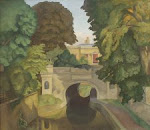
James McIntosh Patrick, "A City Garden" (1940)
So, dear readers, here we are again: at the intersection of Beauty and Evanescence, in the land of bittersweet wistfulness and wistful bittersweetness. Also known as Life.
"In a lifetime how many springs do we see?" Su Tung-p'o wrote that line in 1077. Eight centuries later, in 1895, A. E. Housman wrote: "And since to look at things in bloom/Fifty springs are little room,/About the woodlands I will go/To see the cherry hung with snow." The good poets, in all times and in all places, know what is humanly important, know where our attention should be directed. Human nature was the same in China in 1077 and in England in 1895. And wherever you are at this moment.
Spring Night
Spring night -- one hour worth a thousand gold coins;
clear scent of flowers, shadowy moon.
Songs and flutes upstairs -- threads of sound;
in the garden, a swing, where night is deep and still.
Su Tung-p'o (translated by Burton Watson), in Burton Watson, Selected Poems of Su Tung-P'o, page 19.
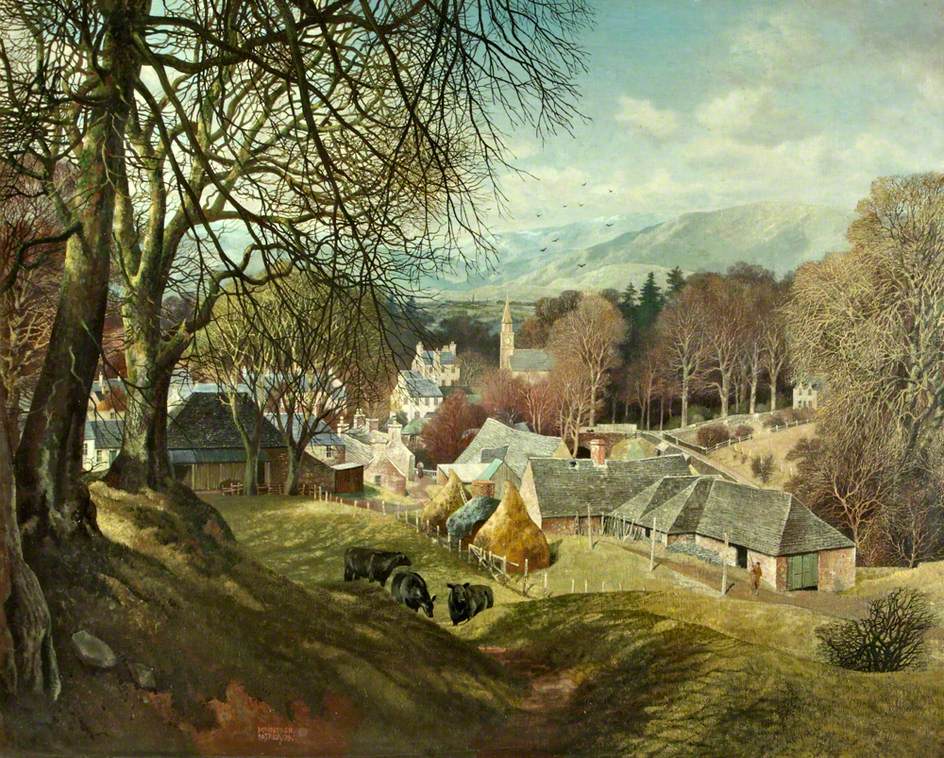
James McIntosh Patrick, "Glamis Village" (1939)


