Showing posts with label Dorothy Wordsworth. Show all posts

Friday, December 18, 2020

Companion

As autumn departs, a thought: 

All Night Long Regretting
      the End of Autumn

Regret as I may,
even the bell
has a different sound now,
and soon frost will fall
in place of morning dew.

Saigyō (1118-1190) (translated by Burton Watson), in Burton Watson, Saigyō: Poems of a Mountain Home (Columbia University Press 1991), page 84.

I shall never quarrel with my beloved Saigyō, and his thought strikes home.  He and Marcus Aurelius are in agreement: "The world is a continual change."  (Marcus Aurelius, Meditations, Book IV, Section 3, in Francis Hutcheson and James Moor (translators), The Meditations of the Emperor Marcus Aurelius Antoninus (1742).)

And yet.  Last evening I saw a lovely crescent moon high in the southwestern sky over Puget Sound.  Constancy in the midst of change.  Apart from new meteor craters, cosmic debris, and human detritus scattered in a few places, has the moon altered over the millennia for those of us here on the ground, looking upward?  Hasn't it always been our unchanged, unchangeable, reliable companion?
  
     Autumn's bright moon,
However far I walked, still afar off
     In an unknown sky.

Chiyo-ni (1701-1775) (translated by R. H. Blyth), in R. H. Blyth, Haiku, Volume 3: Summer-Autumn (Hokuseido Press 1952), page 388.

Of Chiyo-ni's haiku, Blyth writes: "There is a feeling of separateness here which is not to be denied.  The poetess realizes that she and the moon are two different entities, in a different sky, in a different world."  (Ibid, page 388.)  He then provides a waka which, as Blyth puts it, "expresses that other side of truth":

     Down from the mountain,
The moon
     Accompanied me,
And when I opened the gate,
The moon too entered.

Kotomichi (1798-1868) (translated by R. H. Blyth), Ibid, page 388.

One need not make a choice.  Both are beautiful.  Both are true.

John Aldridge (1905-1983), "Autumn" (1946)

Perhaps Chiyo-ni's view and Kotomichi's view are merged and reconciled in William Wordsworth's lunar encounter in the winter of 1798:

                    A Night-Piece

                            The sky is overspread
With a close veil of one continuous cloud
All whitened by the moon, that just appears,
A dim-seen orb, yet chequers not the ground
With any shadow -- plant, or tower, or tree.
At last a pleasant instantaneous light
Startles the musing man whose eyes are bent
To earth.  He looks around, the clouds are split
Asunder, and above his head he views
The clear moon and the glory of the heavens.
There in a black-blue vault she sails along
Followed by multitudes of stars, that small,
And bright, and sharp along the gloomy vault
Drive as she drives.  How fast they wheel away!
Yet vanish not!  The wind is in the trees;
But they are silent.  Still they roll along
Immeasurably distant, and the vault
Built round by those white clouds, enormous clouds,
Still deepens its interminable depth.
At length the vision closes, and the mind
Not undisturbed by the deep joy it feels,
Which slowly settles into peaceful calm,
Is left to muse upon the solemn scene.

William Wordsworth, 1798 manuscript, in Beth Darlington, "Two Early Texts: A Night-Piece and The Discharged Soldier," in Jonathan Wordsworth (editor), Bicentenary Wordsworth Studies in Memory of John Alban Finch (Cornell University Press 1970), page 431.

1798: that charmed year for William and Dorothy Wordsworth (and for Samuel Taylor Coleridge as well).  Commentators on the poem have noted that it has its origin in a journal entry made by Dorothy on January 25, 1798.  (See, for example: Lucy Newlyn, William and Dorothy Wordsworth: 'All in Each Other' (Oxford University Press 2013), pages 57-59; Kenneth Johnston, The Hidden Wordsworth: Poet, Lover, Rebel, Spy (W. W. Norton 1998), pages 552-553.)  The thought is that William and Dorothy witnessed the scene together while out walking.

"The sky spread over with one continuous cloud, whitened by the light of the moon, which, though her dim shape was seen, did not throw forth so strong a light as to chequer the earth with shadows.  At once the clouds seemed to cleave asunder, and left her in the centre of a black-blue vault.  She sailed along, followed by multitudes of stars, small, and bright, and sharp."

Dorothy Wordsworth, The Grasmere and Alfoxden Journals (Oxford University Press 2002), page 142.

The "vision" recounted by Wordsworth brings to mind one of the fragments of blank verse in his Alfoxden notebook, which he kept during the first three months of 1798:

Of unknown modes of being which on earth,
Or in the heavens, or in the heavens and earth
Exist by mighty combinations, bound
Together by a link, and with a soul
Which makes all one.

William Wordsworth, fragment from the Alfoxden notebook, in Ernest de Selincourt and Helen Darbishire (editors), The Poetical Works of William Wordsworth, Volume 5 (Oxford University Press 1949), pages 340-341.

John Aldridge, "First Frost"

The moon is constant.  But, ah, dear readers, what of us?  

                    The Limit

The silent friendship of the moon
(I misquote Virgil) has kept you company
since that one night or evening
now lost in time, when your restless
eyes first made her out for always
in a patio or a garden since gone to dust.
For always?  I know that someday someone
will find a way of telling you this truth:
"You'll never see the moon aglow again.
You've now attained the limit set for you
by destiny.  No use opening every window
throughout the world.  Too late.  You'll never find her."
Our life is spent discovering and forgetting
that gentle habit of the night.
Take a good look.  It could be the last.

Jorge Luis Borges (translated by Alan Trueblood), in Jorge Luis Borges, Selected Poems (edited by Alexander Coleman) (Viking 1999).

This is no cause for gloom, or melancholy.  Our quickly passing interval of "silent friendship" with the moon, with all the beautiful particulars of the World, is no small thing.  And the thought that the World will go on without us, the moon and the seasons forever coming and going, can be a source of comfort and serenity.

But Saigyō -- wonderful Saigyō -- takes us in another direction altogether:

Were we sure of seeing
a moon like this
in existences to come,
who would be sorry
to leave this life?

Saigyō (translated by Burton Watson), in Burton Watson, Saigyō: Poems of a Mountain Home, page 158.

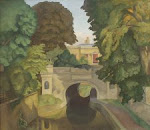
John Aldridge, "Beslyn's Pond, Great Bardfield"

Saturday, February 6, 2016

Peace

In 1802, Dorothy and William Wordsworth were living at Grasmere in the Lake District.  Dorothy's journal entry for April 29 of that year contains this passage:

"We then went to John's Grove, sate a while at first.  Afterwards William lay, and I lay in the trench under the fence -- he with his eyes shut and listening to the waterfalls and the birds.  There was no one waterfall above another -- it was a sound of waters in the air -- the voice of the air.  William heard me breathing and rustling now and then but we both lay still, and unseen by one another -- he thought that it would be as sweet thus to lie so in the grave, to hear the peaceful sounds of the earth and just to know that one's dear friends were near."

Dorothy Wordsworth, The Grasmere and Alfoxden Journals (edited by Pamela Woof) (Oxford University Press 2002), page 92 (italics in original).

Adam Bruce Thomson (1885-1976), "Melrose Abbey" (1953)

The poetic conceit that death is akin to a peaceful sleep is an ancient one, as is its converse:  that sleep is a peaceful rehearsal for death.  I suspect that some moderns among us feel that these conceits are clichés that ought to be dispensed with.  Not I.  Clichés nearly always have an element of human truth in them.  They ought to be cultivated and preserved.

These chairs they have no words to utter,
No fire is in the grate to stir or flutter,
The ceiling and floor are mute as a stone,
My chamber is hush'd and still,
     And I am alone,
     Happy and alone.

Oh who would be afraid of life,
The passion the sorrow and the strife,
     When he may be
     Shelter'd so easily?
May lie in peace on his bed
Happy as they who are dead.

          Half an hour afterwards
I have thoughts that are fed by the sun.
     The things which I see
     Are welcome to me,
     Welcome every one:
I do not wish to lie
     Dead, dead,
Dead without any company;
     Here alone on my bed,
With thoughts that are fed by the sun,
And hopes that are welcome every one,
     Happy am I.

O Life, there is about thee
A deep delicious peace,
I would not be without thee,
     Stay, oh stay!
Yet be thou ever as now,
Sweetness and breath with the quiet of death,
Be but thou ever as now,
     Peace, peace, peace.

William Wordsworth, in Ernest de Selincourt and Helen Darbishire (editors), The Poetical Works of William Wordsworth, Volume Four (Oxford University Press 1947).

The poem is untitled.  It was not published during Wordsworth's lifetime. It was apparently composed in April of 1802, prior to the incident described by Dorothy in her April 29 journal entry.  This time frame is suggested by the following passage in her entry for April 22, which describes a walk taken that day by her, William, and Samuel Taylor Coleridge:

"A fine mild morning -- we walked into Easedale.  The sun shone. . . . The waters were high for there had been a great quantity of rain in the night. . . I then went to the single holly behind that single rock in the field and sate upon the grass till they came from the waterfall.  I saw them there and heard William flinging stones into the river whose roaring was loud even where I was.  When they returned William was repeating the poem 'I have thoughts that are fed by the sun.'  It had been called to his mind by the dying away of the stunning of the waterfall when he came behind a stone."

Dorothy Wordsworth, The Grasmere and Alfoxden Journals, page 89.

"I have thoughts that are fed by the sun" is a wonderful line.  It is worth remembering that Wordsworth had written the first four stanzas of what later came to be known as "Ode: Intimations of Immortality from Recollections of Early Childhood," as well as "My heart leaps up when I behold," just a few weeks earlier, in the final days of March.  It was clearly a charmed time.  "I have thoughts that are fed by the sun" seems to perfectly describe what Wordsworth was experiencing during this period.

Adam Bruce Thomson, "Harvesting in Galloway"

As one who is fond of napping, reverie, daydreaming, and the border between waking and sleeping, Wordsworth's meditation on peace and quiet makes perfect sense to me.  Of course, I fully realize that there are practical considerations:  we do need to get out of bed at some point.

In doing so, perhaps we should seek an equilibrium between "thoughts that are fed by the sun" and "sweetness and breath with the quiet of death." You'll not find me zip-lining through the canopy of a rain forest or across a deep desert gorge any time soon.  But there are ways of going about this that encourage reverie, and that may enable us to attain "peace, peace, peace," even if only momentarily.

               Llananno

I often call there.
There are no poems in it
for me.  But as a gesture
of independence of the speeding
traffic I am a part
of, I stop the car,
turn down the narrow path
to the river, and enter
the church with its clear reflection
beside it.
                  There are few services
now; the screen has nothing
to hide.  Face to face
with no intermediary
between me and God, and only the water's
quiet insistence on a time
older than man, I keep my eyes
open and am not dazzled,
so delicately does the light enter
my soul from the serene presence
that waits for me till I come next.

R. S. Thomas, Laboratories of the Spirit (Macmillan 1975).

Adam Bruce Thomson, "Park and Ruined Abbey" (1961)

If we attend to him, Ivor Gurney continually reminds us that we have it in us to find havens of peace under any circumstances.  Given the difficulties and sorrows of his troubled life, Gurney's ability to fashion these havens serves as a humbling example to the rest of us.  Somehow, he seems to have been able to recover -- if only for a short while -- "thoughts that are fed by the sun" and, with them, some small measure of peace.

The poems that preserve these moments are extremely touching, for we come to them with a sense of (acknowledging that we can never truly know) what he went through to reach these brief respites of serenity. The feeling of hard-won tranquility in these poems is palpable, and moving.  Reading them, I can only hope that, at times, he found his long-sought peace.

                         The Shelter from the Storm

And meantime fearing snow the flocks are brought in,
They are in the barn where stone tiles and wood shelter
From the harm shield; where the rosy-faced farmer's daughter
Goes to visit them.

She pats and fondles all her most favourite first.
Then after that the shivering and unhappy ones --
Spreads hay, looks up at the noble and gray roof vast
And says "This will stop storms."

Her mind is with her books in the low-ceilinged kitchen
Where the twigs blaze. -- and she sees not sheep alone
of the Cotswold, but in the Italian shelters songs repeating
Herdsmen kind, from the blast gone.

Ivor Gurney, in George Walter (editor), Selected Poems (J. M. Dent 1996). The text is as it appears in the original manuscript.  The poem was probably written by Gurney in September of 1926, or thereabouts, although this is not certain.  Ibid, page 105.  It was not published in his lifetime.

The following untitled poem is a lovely companion piece to "The Shelter from the Storm."

Soft rain beats upon my windows
Hardly hammering.
But by the great gusts guessed further off
Up by the bare moor and brambly headland
Heaven and earth make war.

That savage toss of the pine boughs past music
And the roar of the elms. . . .
Here come, in the candle light, soft reminder
Of poetry's truth, while rain beats as softly here
As sleep, or shelter of farms.

Ivor Gurney, Ibid.  The poem was likely written by Gurney in 1926 or 1927. Ibid, page 105.  It was not published in his lifetime.

Adam Bruce Thomson, "Still Life at a Window" (1944)

Monday, December 29, 2014

Ice And Stars

Here we are "in the bleak mid-winter."  I realize that, by the calendar, winter began just a week ago.  But, as a matter of emotion, it feels as though winter begins sometime in mid- to late-November, when the wind whirrs through the empty trees.  Or so it seems to me.

But things are not all that bleak.  The sun has passed through its lowest arc.  The longest night is behind us.  Things are afoot in the heavens. Dorothy Wordsworth wrote this in another season, but it seems apt now: "The crooked arm of the old oak tree points upwards to the moon."  Dorothy Wordsworth, journal entry for March 24, 1798, The Grasmere and Alfoxden Journals (edited by Pamela Woof) (Oxford University Press 2002), page 150.

"Skating on the K.s' pond last night after eating too much ham.  Eight-thirty.  Many stars.  No moon.  Orion's sword and girdle brilliant and all the other constellations whose names I have forgotten or never knew.  I am reminded of my youth and its skating ponds, of the ardor for strength, courage, and purpose excited in me then by the starlight.  It is nearly the same.  My feelings may be less ardent, the stars seem to burn more tenderly these days, but my openmouthed delight in finding them hung above the dark ice is no less."

John Cheever, in Robert Gottlieb (editor), The Journals of John Cheever (Alfred A. Knopf 1991), page  88.

Richard Eurich, "The Frozen Tarn" (1940)

Although I was never much of a skater during my childhood in Minnesota, I can still recall the lakes being turned into skating rinks in the winter.  My fondest memories are of those lakes at night:  a black expanse overhead; the sound of the slicing skates.  (There is another thread in the pattern as well:  my maternal grandparents first met while skating on Lake of the Isles in Minneapolis.)

So through the darkness and the cold we flew,
And not a voice was idle; with the din,
Meanwhile, the precipices rang aloud,
The leafless trees, and every icy crag
Tinkled like iron, while the distant hills
Into the tumult sent an alien sound
Of melancholy, not unnoticed, while the stars,
Eastward, were sparkling clear, and in the west
The orange sky of evening died away.

     Not seldom from the uproar I retired
Into a silent bay, or sportively
Glanced sideway, leaving the tumultuous throng,
To cut across the image of a star
That gleam'd upon the ice:  and oftentimes
When we had given our bodies to the wind,
And all the shadowy banks, on either side,
Came sweeping through the darkness, spinning still
The rapid line of motion; then at once
Have I, reclining back upon my heels,
Stopp'd short, yet still the solitary Cliffs
Wheeled by me, even as if the earth had roll'd
With visible motion her diurnal round;
Behind me did they stretch in solemn train
Feebler and feebler, and I stood and watch'd
Till all was tranquil as a dreamless sleep.

William Wordsworth, The Prelude (1805 manuscript), Book I, lines 465-489, in Ernest de Selincourt and Helen Darbishire (editors), The Prelude (Oxford University Press 1959), page 28.

"As if the earth had roll'd/With visible motion her diurnal round" brings to mind "roll'd round in earth's diurnal course" from "A slumber did my spirit seal," which was written in the same year as the passage quoted above.

David Macbeth Sutherland (1883-1973)
"Winter Landscape, West Cults, Aberdeen" (1940)

A dome of darkness overhead.  Dark depths below.  Between the two, skaters curving on a sheet of ice.  The poetic possibilities are obvious. (More so than, say, ice-fishing.  Although ice-fishing does have its charms.)

      The Midnight Skaters

The hop-poles stand in cones,
     The icy pond lurks under,
The pole-tops steeple to the thrones
     Of stars, sound gulfs of wonder;
But not the tallest there, 'tis said,
Could fathom to this pond's black bed.

Then is not death at watch
     Within those secret waters?
What wants he but to catch
     Earth's heedless sons and daughters?
With but a crystal parapet
Between, he has his engines set.

Then on, blood shouts, on, on,
     Twirl, wheel and whip above him,
Dance on this ball-floor thin and wan,
     Use him as though you love him;
Court him, elude him, reel and pass,
And let him hate you through the glass.

Edmund Blunden, English Poems (1925).

Ronald George Lampitt (1906-1988), "Skating By Moonlight"

Saturday, December 20, 2014

"Unless, While With Admiring Eye We Gaze, We Also Learn To Love"

As I noted in my previous post, William Wordsworth is prone to high-flown rhetoric and prolixity.  But I am willing to cut him some slack.  Why? Because I have always felt that his poetry is animated by a depth of passion one seldom encounters.  That passion is the product of a love of the World, and of a love for the miraculous fact of our existence in the World.

Not surprisingly, "love" (meant in this broader sense) is a word that one comes across again and again in Wordsworth's poetry.  It is a word that goes to the very heart of what Wordsworth thought of as the vocation of "the Poet":

"He is the rock of defence of human nature; an upholder and preserver, carrying everywhere with him relationship and love."

William Wordsworth, Preface to 1802 edition of Lyrical Ballads, with Pastoral and Other Poems, page  xxxvii.  The phrase "relationship and love" is curious (and lovely), isn't it?  I've never quite figured it out.  But that does not stop me from liking it.

Earlier in the Preface, he speaks of "the Poet's art" as being "a task light and easy to him who looks at the world in the spirit of love."  Ibid, page xxxiii.

Wordsworth published the Preface at the age of 32.  Did his passion wane in his later years?  Well, passion does wane, doesn't it?  Yet he wrote this at the age of 72:

Glad sight wherever new with old
Is joined through some dear homeborn tie;
The life of all that we behold
Depends upon that mystery.
Vain is the glory of the sky,
The beauty vain of field and grove,
Unless, while with admiring eye
We gaze, we also learn to love.

William Wordsworth, Poems (1845).

Dane Maw (1909-1989), "Woolverton and Peart Woods" (1970)

Wordsworth's love is not an abstract, free-floating concept.  Through his poetry, it is intimately connected with, and is the product of, the daily miracle of the World around us.  This love, if we pay sufficient attention (a daunting task!), is one we all carry within us.

                       A Night-Piece

                                The sky is overspread
With a close veil of one continuous cloud
All whitened by the moon, that just appears,
A dim-seen orb, yet chequers not the ground
With any shadow -- plant, or tower, or tree.
At last a pleasant instantaneous light
Startles the musing man whose eyes are bent
To earth.  He looks around, the clouds are split
Asunder, and above his head he views
The clear moon and the glory of the heavens.
There in a black-blue vault she sails along
Followed by multitudes of stars, that small,
And bright, and sharp along the gloomy vault
Drive as she drives.  How fast they wheel away!
Yet vanish not!  The wind is in the trees;
But they are silent.  Still they roll along
Immeasurably distant, and the vault
Built round by those white clouds, enormous clouds,
Still deepens its interminable depth.
At length the vision closes, and the mind
Not undisturbed by the deep joy it feels,
Which slowly settles into peaceful calm,
Is left to muse upon the solemn scene.

William Wordsworth, 1798 manuscript, in Beth Darlington, "Two Early Texts: A Night-Piece and The Discharged Soldier," in Jonathan Wordsworth (editor), Bicentenary Wordsworth Studies in Memory of John Alban Finch (Cornell University Press 1970), page 431.

A side-note: as I have noted previously in connection with Samuel Taylor Coleridge's line "The one red leaf, the last of its clan," the journal entries of Wordsworth's sister Dorothy provided, on more than one occasion, the source for poems written by Wordsworth and Coleridge.  Such is the case with "A Night-Piece."  On January 25, 1798, she wrote:

"The sky spread over with one continuous cloud, whitened by the light of the moon, which, though her dim shape was seen, did not throw forth so strong a light as to chequer the earth with shadows.  At once the clouds seemed to cleave asunder, and left her in the centre of a black-blue vault. She sailed  along, followed by multitudes of stars, small, and bright, and sharp."

Dorothy Wordsworth, The Grasmere and Alfoxden Journals (Oxford University Press 2002), page 142.

Dane Maw, "Scottish Landscape, Air Dubh"

Like the other Romantic poets, Wordsworth produced his fair share of paeans to the moon and the stars, and to the other wondrous immensities of the Universe.  But we mustn't forget that his love is catholic.  The minute particulars (to borrow one of William Blake's favorite phrases) are worthy of -- deserve -- our attention.

                       To a Child
            Written in Her Album

Small service is true service while it lasts:
Of humblest Friends, bright Creature! scorn not one:
The Daisy, by the shadow that it casts,
Protects the lingering dew-drop from the Sun.

William Wordsworth, Yarrow Revisited, and Other Poems (1835).

Dane Maw, "Langdale Fells, Westmorland"

Friday, March 22, 2013

"Stepping Westward"

In my previous post, I mentioned Philip Larkin's self-mocking quip about himself:  "Deprivation is for me what daffodils were for Wordsworth."  This got me to thinking, not about deprivation, but about the poetry of William Wordsworth.

In August and September of 1803, Wordsworth, his sister Dorothy, and Samuel Taylor Coleridge went on a tour of Scotland.  Dorothy Wordsworth's journal of the tour contains this entry for September 11 (Coleridge had set off on his own by this point):

The sun had been set for some time, when, being within a quarter of a mile of the ferryman's hut, our path having led us close to the shore of the calm lake, we met two neatly dressed women, without hats, who had probably been taking their Sunday evening's walk.  One of them said to us in a friendly, soft tone of voice, "What! you are stepping westward?"  I cannot describe how affecting this simple expression was in that remote place, with the western sky in front, yet glowing with the departed sun.  William wrote the following poem long after, in remembrance of his feelings and mine.

William Knight (editor), Journals of Dorothy Wordsworth, Volume II (1897), page 105.

James McIntosh Patrick, "Boreland Mill, Kirkmichael" (1950)

               Stepping Westward

"What, you are stepping westward?" -- "Yea."
-- 'Twould be a wildish destiny,
If we, who thus together roam
In a strange Land, and far from home,
Were in this place the guests of Chance:
Yet who would stop, or fear to advance,
Though home or shelter he had none,
With such a sky to lead him on?

The dewy ground was dark and cold;
Behind, all gloomy to behold;
And stepping westward seemed to be
A kind of heavenly destiny:
I liked the greeting; 'twas a sound
Of something without place or bound;
And seemed to give me spiritual right
To travel through that region bright.

The voice was soft, and she who spake
Was walking by her native lake:
The salutation had to me
The very sound of courtesy:
Its power was felt; and while my eye
Was fixed upon the glowing Sky,
The echo of the voice enwrought
A human sweetness with the thought
Of travelling through the world that lay
Before me in my endless way.

William Wordsworth, Poems, in Two Volumes (1807) (italics in original).

Wordsworth prefaced the poem with an introduction that parallels Dorothy Wordsworth's journal entry:

While my Fellow-traveller and I were walking by the side of Loch Ketterine, one fine evening after sunset, in our road to a Hut where, in the course of our Tour, we had been hospitably entertained some weeks before, we met, in one of the loneliest parts of that solitary region, two well-dressed Women, one of whom said to us, by way of greeting, "What, you are stepping westward?"

Ibid, Volume II, page 14.

James McIntosh Patrick, "Stobo Kirk, Peeblesshire" (1936)

A poem like "Stepping Westward" reminds us how revolutionary Wordsworth's poetry was in its day, even though it seems very traditional to us now.  The poem is almost conversational, which is what Wordsworth was after: "the real language of men," as he described it in his 1802 Preface to Lyrical Ballads.  The "poetic diction" that he hoped to "avoid" is nearly absent.

Apart from a few archaisms, I can hear Edward Thomas in "Stepping Westward."  For example:  "In a strange Land, and far from home."  Or: "And stepping westward seemed to be/A kind of heavenly destiny."  And this:  "I liked the greeting; 'twas a sound/Of something without place or bound."  (Robert Frost can be heard in these lines as well, which is no surprise.)  The Thomas echo may also be traceable to Thomas's penchant for writing poems about encountering friendly strangers while walking in the countryside.

I think that Thomas's poetry in many ways brings Wordsworth's best intentions into being.  The last six lines sound like pure Thomas:

                   . . . and while my eye
Was fixed upon the glowing Sky,
The echo of the voice enwrought
A human sweetness with the thought
Of travelling through the world that lay
Before me in my endless way.

James McIntosh Patrick, "Castle in Scotland"

Sunday, November 4, 2012

Dance

A year or so ago, I posted Seamus Heaney's "Postscript," which is about an autumn drive "out west/Into County Clare, along the Flaggy Shore."  The poem concludes as follows:

                      . . . You are neither here nor there,
A hurry through which known and strange things pass
As big soft buffetings come at the car sideways
And catch the heart off guard and blow it open.

Seamus Heaney, The Spirit Level (Faber and Faber 1996).

The following poem by Charles Tomlinson is also about a drive in autumn, a drive in which the wind again plays a part.

                            Charles Ginner, "Spaniard's Corner" (c. 1920)

          Autumn Piece

Baffled
by the choreography of the season
the eye could not
with certainty see
whether it was wind
stripping the leaves or
the leaves were struggling to be free:

They came at you
in decaying spirals
plucked flung and regathered by the same
force that was twisting
the scarves of the vapour trails
dragging all certainties out of course:

As the car resisted it
you felt it in either hand
commanding car, tree, sky,
master of chances,
and at a curve was a red
board said 'Danger':
I thought it said dancer.

Charles Tomlinson, Written on Water (1972).

                                               Charles Ginner, "Rooftops"

Tomlinson's conflation of "danger" and "dance" puts me in mind of Dorothy Wordsworth's description of a last leaf dancing upon a tree, which I have previously posted here:

"William and I drank tea at Coleridge's. . . . Observed nothing particularly interesting. . . . One only leaf upon the top of a tree -- the sole remaining leaf -- danced round and round like a rag blown by the wind."

Both William Wordsworth and Coleridge were wont to appropriate observations made by Dorothy Wordsworth into their own poetry.  Thus, Coleridge later wrote in "Christabel":

The one red leaf, the last of its clan,
That dances as often as dance it can,
Hanging so light, and hanging so high,
On the topmost twig that looks up at the sky.

Samuel Taylor Coleridge, "Christabel."

                                       Charles Ginner, "Red Brick House"

Monday, October 18, 2010

A Single Leaf (Revisited): Dorothy Wordsworth And Samuel Taylor Coleridge

I came upon the following information in Maurice Hewlett's essay "The Crystal Vase," which first appeared in the December, 1919, issue of The London Mercury.  The essay begins as a discussion of the merits of various writers of published letters, journals, and diaries.  However, it soon turns into an appreciation of the journals of Dorothy Wordsworth -- William's sister and Coleridge's friend.  Hewlett notes:  "We may see deeply into ourselves, but she sees deeply into a deeper self than most of us can discern."

Hewlett writes:

   Coleridge was with them most days, or they with him [in the late winter of 1798].  Here is a curious point to note.  Dorothy records:
   "March 7th. -- William and I drank tea at Coleridge's. . . . Observed nothing particularly interesting. . . . One only leaf upon the top of a tree -- the sole remaining leaf -- danced round and round like a rag blown by the wind."
   And Coleridge has in Christabel:
          The one red leaf, the last of its clan,
          That dances as often as dance it can,
          Hanging so light, and hanging so high,
          On the topmost twig that looks up at the sky.

Maurice Hewlett, A Green Shade: A Country Commentary (1920).

I have since discovered that her brother and Coleridge relied upon Dorothy Wordsworth's observations of nature on more than one occasion, putting them to use in their poetry.  But it is best to go to the source and read her journals, which are indeed wonderful.

                                                 John Constable
        "Hampstead Heath, Looking Towards Harrow at Sunset" (1823)