
Showing posts with label Po Chu-i. Show all posts

Friday, November 25, 2022

Passers-by

Reading Chinese poetry of past centuries, one often encounters poems of parting, as well as poems of longing for a family member or friend who is far away in a distant corner of the kingdom, perhaps never to be seen again.  This is attributable to the fact that nearly all of the Chinese poets whose poems have survived were governmental bureaucrats -- but bureaucrats of a sort unknown to us.  They attained their positions only after years of rigorous study of literature and philosophy, culminating in a difficult series of civil service examinations, which many aspirants failed.  One of the chief subjects of examination was poetry: this required knowledge of past poetry, and, importantly, the ability to write poems in accordance with the strict and complex rules of Chinese prosody.  Imagine that.

Over the course of their careers, it was the lot of most poet-civil servants to be suddenly and unexpectedly relocated by the government to obscure cities and provinces in the hinterlands. This was generally due to standard bureaucratic practice: periodic relocations prevented the accumulation of influence and power. Alternatively (and not uncommonly), the relocation was due to the imposition of exile as a punishment for running afoul of the ruling clique -- perhaps by writing a poem containing a too thinly veiled criticism of the clique.  Either way, the life of a poet in governmental service was one of departures and separations.

As but one example, here is one of the best-known, and most admired, poems of farewell:

                Seeing a Friend Off

Green hills sloping from the northern wall,
white water rounding the eastern city:
once parted from this place
the lone weed tumbles ten thousand miles.
Drifting clouds -- a traveler's thoughts;
setting sun -- an old friend's heart.
Wave hands and let us take leave now,
hsiao-hsiao our hesitant horses neighing.

Li Po (701-762) (translated by Burton Watson), in Burton Watson, The Columbia Book of Chinese Poetry: From Early Times to the Thirteenth Century (Columbia University Press 1984), page 212.

George Vicat Cole (1833-1893), "Autumn Morning" (1891)

As is the case with "Seeing a Friend Off," the poems of parting and separation are often affecting and lovely: the sense of loss and sorrow is genuine, and is much more than a matter of poetic convention. Moreover, there is a wider context for the parting and separation, for the loss and sorrow.

     Dreaming that I Went with Li and Yü to Visit Yüan Chen

At night I dreamt I was back in Ch'ang-an;
I saw again the faces of old friends.
And in my dreams, under an April sky,
They led me by the hand to wander in the spring winds.
Together we came to the ward of Peace and Quiet;
We stopped our horses at the gate of Yüan Chen.
Yüan Chen was sitting all alone;
When he saw me coming, a smile came to his face.
He pointed back at the flowers in the western court;
Then opened wine in the northern summer-house.
He seemed to be saying that neither of us had changed;
He seemed to be regretting that joy will not stay;
That our souls had met only for a little while,
To part again with hardly time for greeting.
I woke up and thought him still at my side;
I put out my hand; there was nothing there at all.

Po Chü-i (772-846) (translated by Arthur Waley), in Arthur Waley, More Translations from the Chinese (George Allen & Unwin 1919), page 46.  According to a note by Waley, the poem was "written in exile."  Arthur Waley, Chinese Poems (George Allen & Unwin 1946), page 159.

The phrase "a continual farewell" returned to me when I read Po Chü-i's poem a few days ago.  It appears in the closing lines of W. B. Yeats' poem "Ephemera": "Before us lies eternity; our souls/Are love, and a continual farewell."  "Ephemera" is an autumnal poem ("the yellow leaves/Fell like faint meteors in the gloom") about the pain of the loss of youthful love, written during Yeats' fin de siècle Celtic Twilight period.  It has nothing to do with Chinese poetry.  Yet I think the two lines -- and particularly the beautiful "a continual farewell" -- tell us something about why poems written centuries ago by poet-civil servants in another land continue to speak to us so movingly about our life and fate.

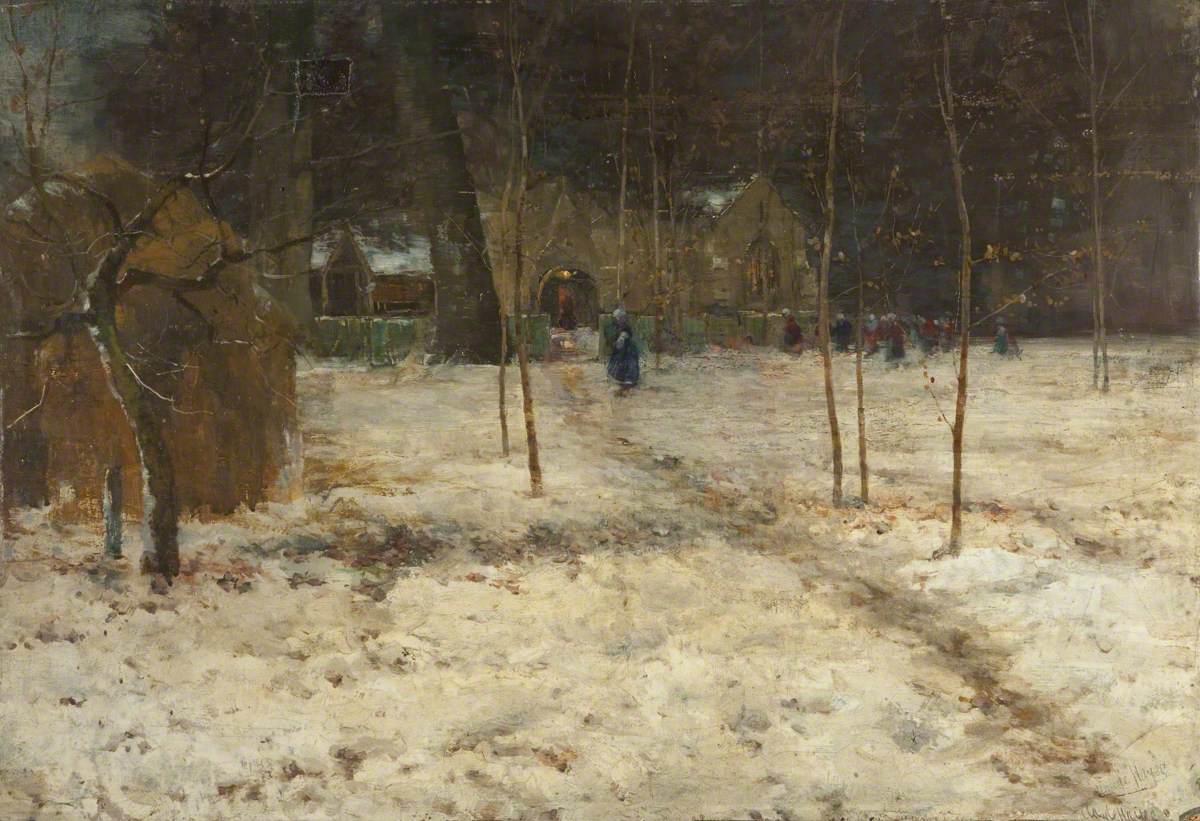
John Haswell (1855-1925), "Whitnash Church"

Yüan Chen (779-831) was Po Chü-i's dearest friend.  After passing their civil service examinations, they spent their younger years together while serving in governmental positions in Ch'ang-an, which was the capital of China at that time.  Over the course of more than three decades, Po Chü-i wrote a number of poems about their separations, which were occasioned by their periodic reassignments and banishments.  This, for instance, is one of the most beloved poems in Chinese literature:

             On Board Ship: Reading Yüan Chen's Poems

I take your poems in my hand and read them beside the candle;
The poems are finished, the candle is low, dawn not yet come.
My eyes smart; I put out the lamp and go on sitting in the dark,
Listening to waves that, driven by the wind, strike the prow of the ship.

Po Chü-i (translated by Arthur Waley), in Arthur Waley, One Hundred and Seventy Chinese Poems (Constable 1918), page 142.

Yüan Chen died at the young age (even for those times) of 52.  Nine years after Yüan Chen's death, Po Chü-i, at the age of 68, wrote this:

   On Hearing Someone Sing a Poem by Yüan Chen

No new poems his brush will trace;
   Even his fame is dead.
His old poems are deep in dust
   At the bottom of boxes and cupboards.
Once lately, when someone was singing,
   Suddenly I heard a verse --
Before I had time to catch the words
   A pain had stabbed my heart.

Po Chü-i (translated by Arthur Waley), in Arthur Waley, Ibid, page 165.

Po Chü-i does not identify which poem of Yüan Chen's he heard being sung.  But, who knows, perhaps it was this, written by Yüan Chen after the death of his wife:

          Bamboo Mat

I cannot bear to put away
the bamboo sleeping mat --

that first night I brought you home,
I watched you roll it out.

Yüan Chen (translated by Sam Hamill), in Sam Hamill, Crossing the Yellow River: Three Hundred Poems from the Chinese (BOA Editions 2000), page 191.

Henry Morley (1869-1937), "Lifting Potatoes near Stirling"

Among poetry's many wonders, perhaps the most wondrous is the echoing and reaffirmation of Beauty and Truth throughout the ages and in all corners of the World.  Every poet writes his or her poems in times which are parlous, full of clamorous madness, and beset with evil, ill-will, duplicity, and bad faith.  Yet through it all runs the serene thread of Beauty and Truth.  "Together we came to the ward of Peace and Quiet."  (Thank you, Po Chü-i and Arthur Waley.)

In the Ninth Century, during the T'ang Dynasty (the greatest period of Chinese poetry), Po Chü-i wrote this about his dream of Yüan Chen:

He seemed to be saying that neither of us had changed;
He seemed to be regretting that joy will not stay;
That our souls had met only for a little while,
To part again with hardly time for greeting.

In Japan, approximately ten centuries later, Ryōkan wrote this:

We meet only to part,
Coming and going like white clouds,
Leaving traces so faint
Hardly a soul notices.

Ryōkan (1758-1831) (translated by John Stevens), in John Stevens, Dewdrops on a Lotus Leaf: Zen Poems of Ryōkan (Shambhala 1996), page 91.

Ryōkan was a Zen Buddhist monk who elected to live a life of penury in a mountain hut.  He was well-educated, and had studied Chinese philosophy and literature.  Chinese poetry had long been admired by Japanese waka and haiku poets, and Po Chü-i was a particular favorite of many of those poets.  It is not unlikely that Ryōkan was familiar with Po Chü-i's poetry.  Had he read "Dreaming that I Went with Li and Yü to Visit Yüan Chen"?  We have no way of knowing.  It would be lovely to discover that Ryōkan did indeed have Po Chü-i's four lines in mind when he wrote his own poem.  But it is also wonderful to think that two human beings -- in different lands and at different times -- recognized, and articulated in a beautiful fashion, a fundamental truth about what it means to live in the World.

And, nearly a century later in Ireland, W. B. Yeats wrote this:

Before us lies eternity; our souls
Are love, and a continual farewell.

W. B. Yeats, "Ephemera," Poems (T. Fisher Unwin 1895).

The thread is continuous and consistent, and remains unbroken: souls; partings; a continual farewell.

For me, who go,
for you who stay behind --
two autumns.

Masaoka Shiki (1867-1902) (translated by Burton Watson), in Masaoka Shiki, Selected Poems (edited by Burton Watson) (Columbia University Press 1997), page 44.

Alfred Parsons (1847-1920), "Meadows by the Avon"

Monday, April 11, 2022

In Perpetuity

Once again, dear readers, it is time to return to my favorite poem of April.  Discovering a poem we love is a wonderful thing, but even more wonderful is the poem's continuing presence in our life over the years.  We are not the same, the world is not the same, as when we last visited the poem.  Who knows what awaits us when we arrive the next time?

                    Wet Evening in April

The birds sang in the wet trees
And as I listened to them it was a hundred years from now
And I was dead and someone else was listening to them.
But I was glad I had recorded for him the melancholy.

Patrick Kavanagh, Collected Poems (edited by Antoinette Quinn) (Penguin 2005).  The poem was first published in Kavanagh's Weekly on April 19, 1952.  Ibid, page 280.

No doubt I am a creature of habit, stuck in my settled ways.  But "Wet Evening in April" never ceases to move me, whether I return to it in April as a ritual, or whether it unaccountably rises to the surface of its own accord, in any season, at any moment.

Richard Eurich (1903-1992), "The Window"

"But it is a sort of April weather life that we lead in this world.  A little sunshine is generally the prelude to a storm."  (William Cowper, letter to Walter Bagot (January 3, 1787), in James King and Charles Ryskamp (editors), The Letters and Prose Writings of William Cowper, Volume III: Letters 1787-1791 (Oxford University Press 1982), pages 5-6.)  So it was in this part of the world yesterday afternoon, as I walked through alternating showers and sunlight, the waters of Puget Sound by turns dark gray and dazzling.  So it is in the world at large.

Withal, there is an ever-present thread of beauty and truth running through our April weather life, through the April weather life of the world.  Poetry is an instance of the existence of that thread.

                    Homage to Arthur Waley

Seattle weather: it has rained for weeks in this town,
The dampness breeding moths and a gray summer.
I sit in the smoky room reading your book again,
My eyes raw, hearing the trains steaming below me
In the wet yard, and I wonder if you are still alive.
Turning the worn pages, reading once more:
"By misty waters and rainy sands, while the yellow dusk thickens."

Weldon Kees, in The Collected Poems of Weldon Kees (edited by Donald Justice) (University of Nebraska Press 1975).  The poem was first published in 1943.

As long time (and much appreciated!) readers of this blog may recall, Arthur Waley is one of my favorite translators of Chinese poetry into English (along with Burton Watson), and his translations have appeared here on many occasions.  Thus, I was delighted when I first came across Kees' poem (most likely on a rainy day in Seattle).

The quotation from Waley in the final line is from Waley's translation of a four-line poem (chüeh-chü) by Po Chü-i:

A bend of the river brings into view two triumphal arches;
That is the gate in the western wall of the suburbs of Hsün-yang.
I have still to travel in my solitary boat three or four leagues --
By misty waters and rainy sands, while the yellow dusk thickens.

Po Chü-i (772-846) (translated by Arthur Waley), in Arthur Waley, One Hundred and Seventy Chinese Poems (Constable 1918).  The poem is untitled.  It appears in a two-poem sequence titled "Arriving at Hsün-yang."  (By the way, Waley was in fact "still alive" when Kees wrote the poem: he died in 1966 at the age of 76.)

Richard Eurich, "The Rose" (1960)

Patrick Kavanagh meditates upon someone not yet born who will be listening to birds singing in wet trees in April a hundred years in the future, when Kavanagh will be long gone.  By virtue of the art of Arthur Waley, Weldon Kees reads a poem written by Po Chü-i a thousand years ago in China.  However fragile and contingent the world is, we mustn't forget this abiding thread.

   To a Poet a Thousand Years Hence

I who am dead a thousand years,
   And wrote this sweet archaic song,
Send you my words for messengers
   The way I shall not pass along.

I care not if you bridge the seas,
   Or ride secure the cruel sky,
Or build consummate palaces
   Of metal or of masonry.

But have you wine and music still,
   And statues and a bright-eyed love,
And foolish thoughts of good and ill,
   And prayers to them who sit above?

How shall we conquer?  Like a wind
   That falls at eve our fancies blow,
And old Maeonides the blind
   Said it three thousand years ago.

O friend unseen, unborn, unknown,
   Student of our sweet English tongue,
Read out my words at night, alone:
   I was a poet, I was young.

Since I can never see your face,
   And never shake you by the hand,
I send my soul through time and space
   To greet you.  You will understand.

James Elroy Flecker, in John Squire (editor), The Collected Poems of James Elroy Flecker (Secker and Warburg 1947).

Richard Eurich, "The Road to Grassington" (1971)

Sunday, January 31, 2021

Significance

A distant, recurring sound on an autumn night.  A human sound, redolent, mysterious, evanescent.

             In Early Autumn, Alone at Night

The leaves of the paulownia move in the cool breeze;
The neighbour's fulling mallet sends out the voice of autumn.
I turn and sleep beneath the eaves;
Waking, the moonlight is half across my couch.  

Po Chü-i (772-846) (translated by R. H. Blyth), in R. H. Blyth, Haiku, Volume 4: Autumn-Winter (Hokuseido Press 1952), page 179.

Another translation of the poem:

            Early Autumn, Alone at Night

Parasol tree by the well, cold leaves stirring;
nearby fulling mallets that speak an autumn sound:
I sleep alone facing the eaves,
wake to find moonlight over half the bed.

Po Chü-i (translated by Burton Watson), in Po Chü-i, Selected Poems (edited and translated by Burton Watson) (Columbia University Press 2000), page 7.

The sound of fulling mallets (or, as they are also called, "fulling blocks") in the night signifies autumn in traditional Chinese poems. "It was customary in the autumn to pound cloth in the process known as fulling to make it suitable for use in winter clothes."  (Burton Watson, The Columbia Book of Chinese Poetry: From Early Times to the Thirteenth Century (Columbia University Press 1984), page 176.) Often, the sound is made by women who are preparing cloth for use in the winter clothes of their lovers or husbands, who are away in the army, anticipating a winter campaign.

A small thing?  Perhaps.  But it gives one pause.  "A thing is beautiful to the extent that it does not let itself be caught."  (Philippe Jaccottet (translated by John Taylor), from "Blazon in Green and White," in Philippe Jaccottet, And, Nonetheless: Selected Prose and Poetry 1990-2009 (Chelsea Editions 2011), page 53.)

Claude Hayes (1852-1922), "Evensong" (1903)

Given the considerable influence of Chinese poetry (particularly the poetry of the T'ang dynasty) on Japanese poetry, fulling blocks are also a common presence in Japanese poems (both waka and haiku) of autumn.  (In Japan, Po Chü-i was the most popular T'ang dynasty poet.  Thus, it is likely that the poem which appears above was well known to Japanese poets.)  The Japanese word for fulling blocks is kinuta. "Kinuta, a wooden mallet and block used to full cloth in the autumn. In poetry, the sound of fulling was associated with the loneliness of a woman left waiting for a traveling husband." (Steven Carter, Traditional Japanese Poetry: An Anthology (Stanford University Press 1991), page 136.)

          Fulling Block

When the wind passes
     in the pines, autumn already
          seems lonely enough —
and then a fulling block echoes
     through Tamakawa Village.

Minamoto no Toshiyori (1055-1129) (translated by Steven Carter), Ibid, page 136.

The poem above is a waka, but the theme appears in haiku as well. For instance:

     Walking along the narrow path,
Listening to the far-off
     Fulling block.

Buson (1716-1784) (translated by R. H. Blyth), in R. H. Blyth, Haiku, Volume 4: Winter-Autumn, page 32.

Buson is chronologically the second of the four traditional great haiku poets: he follows Bashō, and precedes Issa.  The fourth of the greats is Shiki, who wrote this:

     In one house,
A voice of weeping,
     The sound of the fulling block.

Shiki (1867-1902) (translated by R. H. Blyth), Ibid, page 34.

A disembodied sound from somewhere out in the night.  Yet there is a slender human thread.  One pays attention.

     Unheard, these two days,
The fulling block
     Of my neighbour.

Buson (translated by R. H. Blyth), in R. H. Blyth, Haiku, Volume 3: Summer-Autumn (Hokuseido Press 1952), page 336.

George Clausen (1852-1944), "The Village Green at Night"

The World consists of slender threads, doesn't it?  Earlier this week, I saw two sparrows bathing in a puddle, in the morning sun.  I couldn't help but feel they were the first sign of Spring.  Yesterday I noticed that buds have appeared on a row of pear trees in front of a nearby house.  The blue herons have returned to their nests high in the tall pines beside the Ship Canal.  And soon the crocuses will begin to emerge.  "From now on, listening only to the flowers' counsel, antecedent to all knowledge . . ."  (Philippe Jaccottet (translated by Tess Lewis), notebook entry in September, 1983 (ellipses in the original text), in Philippe Jaccottet, The Second Seedtime: Notebooks 1980-1994 (Seagull Books 2017), page 57.)

Why should little things be blamed?
Little things for grace are famed;
Love, the winged and the wild,
Love is but a little child.

Anonymous (translated by Thomas Percival Rogers), in Henry Wellesley (editor), Anthologia Polyglotta: A Selection of Versions in Various Languages, Chiefly from The Greek Anthology (John Murray 1849), page 259.

Slender threads.  Little things.  They all add up.

     The clear voice 
Of the fulling block echoes up
     To the Northern Stars.

Bashō (1644-1694) (translated by R. H. Blyth), in R. H. Blyth, Haiku, Volume 4: Autumn-Winter, p. 31.

Thomas Train (1890-1978), "Headlights"

Wednesday, October 28, 2020

Leaves

With so many to choose from, I would never attempt to select my "favorite" autumn poem.  They are better thought of as parts of a tapestry.  Or a brocade.

     Unseen by men's eyes,
the colored leaves have scattered
     deep in the mountains:
truly we may say brocade
worn in the darkness of night!

Ki no Tsurayuki (c. 872-945) (translated by Helen Craig McCullough), in Helen Craig McCullough (editor), Kokin Wakashū: The First Imperial Anthology of Japanese Poetry (Stanford University Press 1985), page 73.

A brocade of leaves.  Yes, let the autumn poems come as they may, and fall in random patterns!  That being said, I do have three touchstones that call to me each year.  The following poem invariably arrives with the season's first whispers:

                           The Cranes

The western wind has blown but a few days;
Yet the first leaf already flies from the bough.
On the drying paths I walk in my thin shoes;
In the first cold I have donned my quilted coat.
Through shallow ditches the floods are clearing away;
Through sparse bamboos trickles a slanting light.
In the early dusk, down an alley of green moss,
The garden-boy is leading the cranes home.

Po Chü-i (translated by Arthur Waley), in Arthur Waley, More Translations from the Chinese (George Allen & Unwin 1919), page 57.

Those beguiling tell-tale hints of autumn: tentative, lovely. Inexorable.

Unable to sleep in the pre-dawn hours of the seventh of September, listening to a lone robin singing in the darkness, Edward Thomas later wrote this:

"Gradually I became conscious of nothing but the moan of trees, the monotonous expressionless robin's song, the slightly aching body to which I was, by ties more and more slender, attached.  I felt, I knew, I did not think that there would always be an unknown player, always wind and trees, always a robin singing, always a listener listening in the stark dawn: and I knew also that if I were the listener I should not always lie thus in a safe warm bed thinking myself alive. . . . And so I fell asleep again on the seventh of September."

Edward Thomas, from "Insomnia," in The Last Sheaf (Jonathan Cape 1928), page 43.  The ellipses appear in the original text.  Thomas was most likely writing of the early morning of September 7, 1913.  (Judy Kendall, Edward Thomas: The Origins of His Poetry (University of Wales Press 2012), pages 40-41.)

Samuel Sherwin (1846-1935)
"First Touch of Autumn, Rowditch, Derby" (c. 1917)

Of course, autumn would not be autumn without Thomas Hardy, would it?  And thus each year I return to this:

  Autumn in King's Hintock Park

Here by the baring bough
     Raking up leaves,
Often I ponder how
     Springtime deceives, —
I, an old woman now,
     Raking up leaves.

Here in the avenue
     Raking up leaves,
Lords' ladies pass in view,
     Until one heaves
Sighs at life's russet hue,
     Raking up leaves!

Just as my shape you see
     Raking up leaves,
I saw, when fresh and free,
     Those memory weaves
Into grey ghosts by me,
     Raking up leaves.

Yet, Dear, though one may sigh,
     Raking up leaves,
New leaves will dance on high —
     Earth never grieves! —
Will not, when missed am I
     Raking up leaves.

Thomas Hardy, Time's Laughingstocks and Other Verses (Macmillan 1909).

Very little escaped Hardy's notice.  After the poem was published in The Daily Mail on November 17, 1906, he wrote to a friend: "I happened to be walking, or cycling, through [the park] years ago, when the incident occurred on which the verses are based, and I wrote them out."  (J. O. Bailey, The Poetry of Thomas Hardy: A Handbook and Commentary (University of North Carolina Press 1970), page 207.)  The park was located near the village of Melbury Osmund in Dorset.

"Earth never grieves!"  Something to bear in mind when considering a meditation by Edward Thomas on autumn.

"The scent is that of wood-smoke, of fruit and of some fallen leaves. This is the beginning of the pageant of autumn, of that gradual pompous dying which has no parallel in human life yet draws us to it with sure bonds.  It is a dying of the flesh, and we see it pass through a kind of beauty which we can only call spiritual, of so high and inaccessible a strangeness is it.  The sight of such perfection as is many times achieved before the end awakens the never more than lightly sleeping human desire of permanence.  Now, now is the hour; let things be thus; thus for ever; there is nothing further to be thought of; let these remain.  And yet we have a premonition that remain they must not for more than a little while.  The motion of the autumn is a fall, a surrender, requiring no effort, and therefore the mind cannot long be blind to the cycle of things as in the spring it can when the effort and delight of ascension veils the goal and the decline beyond."

Edward Thomas, The South Country (J. M. Dent 1909), page 272.

William Samuel Jay (1843-1933)
"At the Fall of Leaf, Arundel Park, Sussex" (1883)

My third autumn perennial is by Derek Mahon.  Given that he passed away at the beginning of this month, my visit to it this year comes with sadness.  Yet, we never lose the poets who move us, do we?  I have been living with this poem (and with many others by him) for years, and that will never change.

               Leaves

The prisoners of infinite choice
Have built their house
In a field below the wood
And are at peace.

It is autumn, and dead leaves
On their way to the river
Scratch like birds at the windows
Or tick on the road.

Somewhere there is an afterlife
Of dead leaves,
A stadium filled with an infinite
Rustling and sighing.

Somewhere in the heaven
Of lost futures
The lives we might have led
Have found their own fulfilment.

Derek Mahon, The Snow Party (Oxford University Press 1975).

Just a few weeks ago, when the day was windy the trees still made the sound of the sea, green billows and swells swaying overhead.  Now, a strong breeze brings only a dry rustling, a rattling and scraping of individual leaves, each hold-out with its own voice.  In a dwindling choir.

"In November I returned for a day to a lonely cottage which I had known in the summer, and all its poppies were gone.  Here and there, in the garden, could be found a violet, a primrose, a wood sorrel, flowering; the forget-me-nots and columbines had multiplied and their leaves were dense in the borders; the broad row of cabbages gleamed blue in a brief angry light after rain; the black-currant leaves were of pure, translucent amber at the ends of the branches.  In the little copses the oaks made golden islands in the lakes of leafless ash, and the world was very little in a lasting mist.
*     *     *     *     *
It is a commonplace that each one of us is alone, that every piece of ground where a man stands is a desert island with footprints of unknown creatures all round its shore.  Once or twice in a life we cry out that we know the footprints; we even see the boats of the strangers putting out from the shore; we detect a neighbouring island through the haze, and creatures of like bearing to ourselves moving there.  On that night a high tide had washed every footprint away, and we were satisfied, raising not a languid telescope to the horizon, nor even studying the sands at our feet."

Edward Thomas, from "St. Martin's Summer," in The Heart of England (J. M. Dent 1906), pages 131-132.

Donald Floyd (1892-1965), "The Wye Valley below Wynd Cliff"

Friday, November 8, 2019

Abode

I usually pay a visit to Chinese poetry in autumn.  Not necessarily in search of autumn-themed poems (although there is no shortage of those), but rather for the equanimity and serenity one so often finds in Chinese poetry.  Yet, it is autumn, after all, and I look forward to an encounter with wistful bittersweetness and bittersweet wistfulness as well.  The season is what it is.

                    Planting Bamboos

I am not suited for service in a country town;
At my closed door autumn grasses grow.
What could I do to ease a rustic heart?
I planted bamboos, more than a hundred shoots.
When I see their beauty, as they grow by the stream-side,
I feel again as though I lived in the hills,
And many a time when I have not much work
Round their railing I walk till night comes.
Do not say that their roots are still weak,
Do not say that their shade is still small;
Already I feel that both in courtyard and house
Day by day a fresher air moves.
But most I love, lying near the window-side,
To hear in their branches the sound of the autumn wind.

Po Chü-i (772-846) (translated by Arthur Waley), in Arthur Waley, Chinese Poems (George Allen and Unwin 1946), page 124.

As I have noted before, my two favorite translators of Chinese poetry are Waley and Burton Watson.  Here is Watson's translation of the poem:

               Newly Planted Bamboo

Aide to a magistrate, not my sort of job;
I close my gate, let autumn grasses grow.
What delights a man with country tastes like mine?
Planting bamboo, over a hundred stalks!
Gazing at their colors by the terrace stairs,
I think I'm far off in the mountains.
Sometimes, free of public duties,
I wander all day by the railings.
Don't say the roots aren't firm yet,
don't say they make no shade --
already I can feel in house and garden
little by little their pervading coolness.
And most of all I love, lying close by the window,
the sound of autumn wind in the branches.

Po Chü-i (translated by Burton Watson), in Po Chü-i, Selected Poems (Columbia University Press 2000), page 5.

Waley was an Englishman who produced most of his translations of Chinese poetry in the first half of the 20th century (with the lion's share of them completed during, and just after, the First World War). Watson was an American who produced his translations in the second half of the 20th century and on into this century.  I do not find critical assessments using the word "best" to be very useful. Hence, although I am tempted to do so, I will refrain from saying that Waley and Watson are the "best" translators of traditional Chinese poetry.  However, I will say that, in my humble opinion, they have the finest poetic sensibilities of any translators I have come across. These sensibilities (one recognizably English and one recognizably American) are coupled with a fidelity to, and a respect for, the text, form, meaning, and feeling of the original poems.  Their work is a gift to us all.

James Humbert Craig (1877-1944), "Dunlewey, County Donegal"

I have said this before:  it seems to me that simple peace and quiet is what many of us are in search of.  How do we find it?  Plant bamboo. Listen to the sound of the autumn wind in the branches.  This has never been an arcane secret.  Over the centuries, in all places, poets and philosophers, and even a Roman emperor, have placed stepping stones for us.  Following them is another matter entirely, of course.

"They seek retirements in the country, on the sea-coasts, or mountains:  you too used to be fond of such things.  But this is all from ignorance.  A man may any hour he pleases retire into himself; and no where will he find a place of more quiet and leisure than in his own soul."

Marcus Aurelius, Meditations, Book IV, Section 3 (translated by Francis Hutcheson and James Moor), in Francis Hutcheson and James Moor, The Meditations of the Emperor Marcus Aurelius Antoninus (1742).

This observation goes hand-in-hand, I think, with one of the emperor's injunctions:

"Manage all your actions and thoughts in such a manner as if you were just going to step into the grave."

Marcus Aurelius, Meditations, Book II, Section 11 (translated by Jeremy Collier), in Jeremy Collier, The Emperor Marcus Antoninus: His Conversation with Himself (1701).

James Humbert Craig, "Windy Day, Donegal"

The present age (whenever one is alive) is always full of noise, distraction, and false gods.  Our "modern" world is no different, although moderns harbor the self-flattering notion that they are unique beings living in a unique time, the vanguard of "progress" and "enlightenment."  No.  The  particulars of the noise and the distraction may have altered over the millennia (due solely to technology, not to a change in human nature), but the false gods remain the same.  Better to let it all go.

I built my hut in a zone of human habitation,
Yet near me there sounds no noise of horse or coach.
Would you know how that is possible?
A heart that is distant creates a wilderness round it.
I pluck chrysanthemums under the eastern hedge,
Then gaze long at the distant summer hills.
The mountain air is fresh at the dusk of day;
The flying birds two by two return.
In these things there lies a deep meaning;
Yet when we would express it, words suddenly fail us.

T'ao Ch'ien (365-427) (translated by Arthur Waley), in Arthur Waley, One Hundred and Seventy Chinese Poems (Constable 1918), page 76.  The poem is untitled.

This is Burton Watson's translation of the same poem:

I built my hut in a place where people live,
and yet there's no clatter of carriage or horse.
You ask me how that could be?
With a mind remote, the region too grows distant.
I pick chrysanthemums by the eastern hedge,
see the southern mountain, calm and still.
The mountain air is beautiful at close of day,
birds on the wing coming home together.
In all this there's some principle of truth,
but try to define it and you forget the words.

T'ao Ch'ien (translated by Burton Watson), in Burton Watson, The Columbia Book of Chinese Poetry: From Early Times to the Thirteenth Century (Columbia University Press 1984), page 135.

James Humbert Craig, "Drumfresky, Cushendun"

Saturday, June 29, 2019

Companions

I am easy to please.  Mind you, I make no claim to uniqueness of character or to philosophical attainment.  No, any easy-to-pleaseness that I may possess is, I suspect, due in large part to growing old.  I can perhaps trace it back to the day when it occurred to me that, purely as a matter of simple, incontrovertible numerical reckoning, the number of years left to me above ground was now, beyond a doubt, less than the number of years I had already lived.

A thought of this sort tends to focus your attention.  After the initial dismay and wonderment pass ("where did all those years go?"), you may develop a new sense of what is important, what is not.  There is certainly no reason to brood over what is unchangeable:  a boundary has been set.  So be it.  No need to mourn.  At the same time, a feeling of freedom arrives.  And that which is extraneous begins to drop away, day by day.  Vistas open up.  After all, why not live?

                    The Traveler's Moon

A traveler has come from south of the Yangtze;
when he set out, the moon was a mere crescent.
During the long long stages of his journey
three times he saw its clear light rounded.
At dawn he followed a setting moon,
evenings lodged with a moon newly risen.
Who says the moon has no heart?
A thousand long miles it's followed me.
This morning I set out from Wei River Bridge,
by evening had entered the streets of Ch'ang-an.
And now I wonder about the moon --
whose house will that traveler put up at tonight?

Po Chü-i (772-846) (translated by Burton Watson), in Po Chü-i, Selected Poems (Columbia University Press 2000), page 109.

Harald Sohlberg (1869-1935), "Night" (1904)

Each morning, I read a poem to start the day.  One morning this past week I read "The Traveler's Moon."  After doing so, a Japanese waka came immediately to mind.  Or at least the gist of it.  I went to one of my bookshelves, and found it where I suspected it was.

     Down from the mountain,
The moon
     Accompanied me,
And when I opened the gate,
The moon too entered.

Kotomichi (1798-1868) (translated by R. H. Blyth), in R. H. Blyth, Haiku, Volume 3: Summer-Autumn (Hokuseido Press 1952), page 388.

Kotomichi's poem has stayed with me since the day I first read it. How lovely it was to now discover Po Chü-i's poem, and to have the both of them together, paired, for the rest of my life.  At around 8:30 in the morning, my day was already overflowing.  I read no more poems that day.  The two poems deserved to be left alone.  I was content to let them sit.  I am easy to please.

Harald Sohlberg, "Flower Meadow in the North" (1905)

Saturday, September 30, 2017

Nearly. Not Quite Yet.

Here is where we find ourselves:  "Now it is September and the web is woven,/The web is woven and you have to wear it."  Earlier this week, I watched a butter-yellow caterpillar crossing a path, headed toward the dry, leaning grass of a broad meadow.  A few days later, I noticed another caterpillar (this one black, with a dark orange band) veering off a different path, bound for the duff-covered floor of a silent, shadowy grove of tall pines.

Although the autumnal equinox came and went more than a week ago, the final turning has not occurred.  Still, the signs are afoot.

                              The Cranes

The western wind has blown but a few days;
Yet the first leaf already flies from the bough.
On the drying paths I walk in my thin shoes;
In the first cold I have donned my quilted coat.
Through shallow ditches the floods are clearing away;
Through sparse bamboos trickles a slanting light.
In the early dusk, down an alley of green moss,
The garden-boy is leading the cranes home.

Po Chü-i (772-846) (translated by Arthur Waley), in Arthur Waley, More Translations from the Chinese (George Allen & Unwin 1919).

Alexander Sillars Burns (1911-1987), "Afternoon, Wester Ross"

As long-time (and much appreciated!) readers of this blog may recall, I am fond of describing autumn as the season of bittersweet wistfulness and wistful bittersweetness.  Is there a tinge of sadness?  Of course.  More than a tinge, actually.  But this only serves to heighten the beauty.

That which is lovely is lovely because it is departing.  This is true of all of the World's beautiful particulars at all times of the year.  But the pang of departure is keener in autumn.  It is a rueful, yet a happy, pang.  It bears within it the possibility of acceptance and serenity.

          The Trees at Night

Under vague silver moonlight
The trees are lovely and ghostly,
In the pale blue of the night
There are few stars to see.

The leaves are green still, but brown-blent:
They stir not, only known
By a poignant delicate scent
To the lonely moon blown.

The lonely lovely trees sigh
For summer spent and gone:
A few homing leaves drift by,
Poor souls bewildered and wan.

William Kerr, in Edward Marsh (editor), Georgian Poetry 1920-1922 (The Poetry Bookshop 1922).

Adam Bruce Thomson (1885-1976), "Harvesting in Galloway"

The threshold has not yet been crossed.  At the beginning of the past week we enjoyed a cool, brilliant mackerel sky day.  In Japan, the clouds in such a sky are called urokogumo (uroko means "fish-scale"; kumo means "cloud"; the "k" sound of kumo is changed to "g" for euphonic purposes in the compound word):  hence, a fish-scale cloud sky.  In Japanese culture, urokogumo carries with it strong associations of autumn.  I can understand why:  the sight is heart-catching at any time of year, but particularly in autumn, when the blue seems deeper behind the bright white clouds spread across the sky.

Later in the week we had an 80-degree, cloudless day:  a brief Indian summer (as we called it in Minnesota when I was growing up) or St Luke's summer (as it is known in the United Kingdom).  The warm breeze of that day carried a chill thread within it.  Or was this merely my imagination?

             Autumn

Fragile, notice that
As autumn starts, a light
Frost crisps up at night
And next day, for a while,
White covers path and lawn.
"Autumn is here, it is,"
Sings the stoical blackbird
But by noon pure gold is tossed
On everything.  Leaves fall
As if they meant to rise.
Nothing of nature's lost,
The birth, the blight of things,
The bud, the stretching wings.

Elizabeth Jennings, Celebrations and Elegies (Carcanet Press 1982).  For another lovely poem by Jennings on the season, please see "Song at the Beginning of Autumn," which has appeared here in the past.

Ian MacInnes (1922-2003), "Harvest, Innertoon" (1959)

For now, the green canopies remain overhead, although the universe of green has become paler and thinner.  The birds keep up their continual conversation, although their numbers have dwindled.  All is proceeding according to plan.  Constancy amid constant change.

I may speak of autumnal wistfulness, bittersweetness, and sadness, but make no mistake:  my predominant emotions at this time of year are exhilaration, joy, and gratitude.  "We live in a constellation/Of patches and of pitches,/Not in a single world."  How can we be anything but grateful, joyful, and exhilarated?

Even in a person
most times indifferent
to things around him
they waken feelings --
the first winds of autumn.

Saigyō (1118-1190) (translated by Burton Watson), in Burton Watson, Saigyō: Poems of a Mountain Home (Columbia University Press 1991).

Adam Bruce Thomson, "Still Life at a Window" (1944)

Saturday, January 16, 2016

Autumn Interlude

Please bear with me, dear readers.  I've been dwelling in China for the past week.  In autumn.  About 1,200 or so years ago.

                              Autumn Begins

Autumn begins unnoticed.  Nights slowly lengthen,
and little by little, clear winds turn colder and colder,

summer's blaze giving way.  My thatch hut grows still.
At the bottom stair, in bunchgrass, lit dew shimmers.

Meng Hao-jan (689-740) (translated by David Hinton), in David Hinton, Mountain Home: The Wilderness Poetry of Ancient China (Counterpoint 2002), page 42.

Meng Hao-jan spent most of his life in and around Hsiang-yang (also known as "Xiangyang"), which is in the modern-day province of Hubei.  It is a region that was known for its mountains and rivers.  Meng Hao-jan's character and poems were an important influence on the four great poets of the T'ang Dynasty (618-907):  Wang Wei, Li Po, Tu Fu, and Po Chu-i.  Li Po wrote the following poem about him:

     At Yellow Crane Tower Taking Leave of Meng Hao-jan
                          As He Sets Off for Kuang-Ling

My old friend takes leave of the west at Yellow Crane Tower,
in misty third-month blossoms goes downstream to Yang-chou.
The far-off shape of his lone sail disappears in the blue-green void,
and all I see is the long river flowing to the edge of the sky.

Li Po (701-762) (translated by Burton Watson), in Burton Watson, The Columbia Book of Chinese Poetry: From Early Times to the Thirteenth Century (Columbia University Press 1984), page 211.

Herbert Hughes-Stanton, "The Mill in the Valley" (1892)

I suspect that many of us share the urge to now and then visit another place and another time in the company of our favorite poets.  Hence, for some accountable reason, I will periodically feel a sudden hankering to visit Brittany with Ernest Dowson, Cornwall with Arthur Symons, Dorset with Thomas Hardy, Japan with Bashō, Alexandria with C. P. Cavafy, et cetera. Escapism?  No doubt.

This past week, autumn in ancient China has been calling me.

            Alone Beside the Autumn River

All spring, my sorrows grew like lotus leaves.
Now they wither as my autumn sadness grows.

Grief is as long and wide as life.
Watch the autumn river.  Listen to it flow.

Li Shang-yin (813-858) (translated by Sam Hamill), in Sam Hamill, Crossing the Yellow River: Three Hundred Poems from the Chinese (BOA Editions 2000), page 202.

The first three lines of the poem may be too morose for some tastes.  But they are beautifully morose, don't you think?  In any event, the final line redeems all sorrow, sadness, and grief.  One of the wonderful features of classical Chinese poetry is that it continually reminds us to direct our attention to the lovely particulars that lie in front of us, at this moment. What is in front of us at this moment puts everything into perspective. Time-bound timelessness.

Duncan Grant, "Charleston Barn" (1942)

Yes, these poetic journeys to strange lands may indeed include an element of escapism, especially if they also involve time travel.  After all, who, on occasion, does not wish to abandon one's current place and time?  Yet it is usually the case that these excursions, if they are taken in the company of good poets, lead to the proverbial "shock of recognition":  Ah!  I know that World.  We must return to the here and now, but all of these places and times continue to dwell within us, reminding us of the continuity of life and of human experience.

                              The Cranes

The western wind has blown but a few days;
Yet the first leaf already flies from the bough.
On the drying paths I walk in my thin shoes;
In the first cold I have donned my quilted coat.
Through shallow ditches the floods are clearing away;
Through sparse bamboos trickles a slanting light.
In the early dusk, down an alley of green moss,
The garden-boy is leading the cranes home.

Po Chu-i (772-846) (translated by Arthur Waley), in Arthur Waley, More Translations from the Chinese (George Allen & Unwin 1919), page 57.

W. G. Poole, "Savernake Forest" (1939)

Thus, autumn in China 1,200 years ago does not seem at all strange to me. Mind you, this has nothing whatsoever to do with any special powers on my part:  it is entirely attributable to the honesty, sensitivity, and artistry of the poets. Call it a cliché, but, when I read their poems, their world feels like my world.  Another cliché:  I have no doubt that they are telling the truth.  "True and not feigning."  As far as what it means to make one's way through life, nothing has changed over the past twelve centuries.

     Lu-lung Village, Autumn

Refusing worldly worries,
I stroll among village strollers.

Pine winds sing, the evening village
smells of grass, autumn in the air.

A lone bird roams down the sky.
Clouds roll across the river.

You want to know my name?
A hill.  A tree.  An empty drifting boat.

Hsu Hsuan (916-991) (translated by Sam Hamill), in Sam Hamill, Crossing the Yellow River: Three Hundred Poems from the Chinese, page 212.

Roger Fry, "Village in the Valley" (1926)

Friday, September 18, 2015

Glimmers

A few days ago, when I got into my car, I noticed a tiny, barely visible brown spider hanging by a thread from my rear-view mirror.  As I watched, the thread lengthened and the spider swung downward towards the dashboard.  It landed, and crawled into an air vent.

"Continually regard the World as one living thing, composed of one substance and one soul.  And reflect how all things have relation to its one perception; how it does all things by one impulse; how all things are the joint causes of all that come into being; and how closely they are interwoven and knit together."

Marcus Aurelius, Meditations, Book IV, Section 40 (translated by Hastings Crossley), in Hastings Crossley, The Fourth Book of the Meditations of Marcus Aurelius Antoninus (1882), page 35.

     A lantern
Entered a house
     On the withered moor.

Masaoka Shiki (translated by R. H. Blyth), in R. H. Blyth, Haiku, Volume 4: Autumn-Winter (Hokuseido Press 1952), page 283.

Norman Garstin, "Moulin de la Ville, Quimperlé" (1901)

We live in a politicized world.  Those who participate in that world talk and talk and talk.  The underlying premise of all this talk is:  I am right; you are wrong.  It is a world of nursed grievances and perceived injustices. Nursing these grievances and perceiving these injustices enables the politicized to feel better about themselves:  Look at me.  I am enlightened and concerned.  I care.

The politicized world has nothing whatsoever to do with the individual human soul.

                       Distances

Swifts turn in the heights of the air;
higher still turn the invisible stars.
When day withdraws to the ends of the earth
their fires shine on a dark expanse of sand.

We live in a world of motion and distance.
The heart flies from tree to bird,
from bird to distant star,
from star to love; and love grows
in the quiet house, turning and working,
servant of thought, a lamp held in one hand.

Philippe Jaccottet (translated by Derek Mahon), in Derek Mahon, Words in the Air: A Selection of Poems by Phillipe Jaccottet (The Gallery Press 1998).

     The long night;
A light passes along
     Outside the shōji.

 Masaoka Shiki (translated by R. H. Blyth), in R. H. Blyth, Haiku, Volume 3: Summer-Autumn (Hokuseido Press  1952), page 356.

Harriet Backer, "By Lamplight" (1890)

A meadow that I pass through on my afternoon walk is dotted with clumps of flowering weeds:  purple, yellow, and white.  Their names are unknown to me.  I am content to remain ignorant.  I needn't know their names to think of them as companions.

     The names unknown,
But to every weed its flower,
     And loveliness.

Sampū (translated by R. H. Blyth), in R. H. Blyth, Haiku, Volume 4: Autumn-Winter, page 123.

As I looked at the flowers this week, it occurred to me that these random galaxies of purple, yellow, and white will remain, returning each year in late summer and early autumn, long after I have turned into dust.  This was not an occasion for alarm.  Instead, the thought was a restful and comforting one.

"That which remembers and that which is remembered are alike creatures of a day."

Marcus Aurelius, Meditations, Book IV, Section 35 (translated by Hastings Crossley), in Hastings Crossley, The Fourth Book of the Meditations of Marcus Aurelius Antoninus, page 31.

     The light in the next room also
Goes out;
     The night is chill.

Masaoka Shiki (translated by R. H. Blyth), in R. H. Blyth, Haiku, Volume 3: Summer-Autumn, page 328.

Terrick Williams, "Quiet Twilight, Honfleur" (c. 1922)

We are surrounded by, and headed towards, darkness.  To me, this darkness has an intimate feel to it.  It is not a political or a historical darkness.  It cannot be explained by Science.  Filling one's life with distractions will not cause the darkness to vanish.

                       House Fear

Always -- I tell you this they learned --
Always at night when they returned
To the lonely house from far away
To lamps unlighted and fire gone gray,
They learned to rattle the lock and key
To give whatever might chance to be
Warning and time to be off in flight:
And preferring the out- to the in-door night,
They learned to leave the house-door wide
Until they had lit the lamp inside.

Robert Frost, from "The Hill Wife," Mountain Interval (1916).

The darkness is not tragic, nor is it romantic.  It is not a cause for despair, nor is it a cause for celebration.  But it cannot be dispelled.

Because this darkness is intimate, each of us must find our own way of becoming acquainted with it.  But we are not companionless.  We are all in this together.

                                 Anchored at Night in a Creek

I climbed upon the river embankment, and stood there in the darkness;
The river breeze and frosty air chilled me.
When I turned and looked where the boat lay deep in the creek,
Among the flowers of reed and lespedeza was one point of light.

Po Chu-i (translated by R. H. Blyth), Ibid, page 334.  "Lespedeza" is commonly known as "bush clover."  It blooms at this time of year.

     Loneliness;
After the fireworks,
     A falling star.

Masaoka Shiki (translated by R. H. Blyth), in R. H. Blyth, Haiku, Volume 4: Autumn-Winter, page 24.

Algernon Newton, "The Surrey Canal, Camberwell" (1935)

Sunday, August 23, 2015

Evanescence

When it comes to this business of growing old, I have no advice to give. This is the first time I've done it, so what do I know?  I presume that, like life in general, nothing will go as planned.  And I already know the end of the story.  What remains is the filling in of an undetermined amount of blank space.

I do know that wisdom is not guaranteed.  I question the notion that wisdom comes with age.  I suspect that it is more the case that the opportunities for folly decrease with age.

I also know that I am going to try my best not to be querulous.  Yes, above all, I do not wish to be querulous.

        Animal Tranquillity and Decay

                         The little hedgerow birds,
That peck along the road, regard him not.
He travels on, and in his face, his step,
His gait, is one expression:  every limb,
His look and bending figure, all bespeak
A man who does not move with pain, but moves
With thought. -- He is insensibly subdued
To settled quiet:  he is one by whom
All effort seems forgotten; one to whom
Long patience hath such mild composure given,
That patience now doth seem a thing of which
He hath no need.  He is by nature led
To peace so perfect that the young behold
With envy, what the Old Man hardly feels.

William Wordsworth, Poems (1815).

The poem was first published in Lyrical Ballads in 1798, under the title "Old Man Travelling; Animal Tranquillity and Decay, A Sketch."  When originally published, the poem closed with these six additional lines:

I asked him whither he was bound, and what
The object of his journey; he replied
"Sir!  I am going many miles to take
A last leave of my son, a mariner,
Who from a sea-fight has been brought to Falmouth,
And there is dying in an hospital."

William Wordsworth and Samuel Taylor Coleridge, Lyrical Ballads, with a Few Other Poems (1798).

I think that Wordsworth was wise to remove these lines from his final version of the poem.  Taking the lines out transforms the poem from an anecdote -- albeit an affecting one -- into a universal meditation on how we make our way through the world.

David Birch (1895-1968), "Morning in June, the Vale of Dedham, Essex"

A parent will sometimes say to a misbehaving child:  "Act your age!"  The same advice seems apt as we grow old.  We ought not to mistake senescence for juvenescence.

Po Chu-i wrote the following poem at the age of 70.

                  A Dream of Mountaineering

At night, in my dream, I stoutly climbed a mountain,
Going out alone with my staff of holly-wood.
A thousand crags, a hundred hundred valleys --
In my dream-journey none were unexplored
And all the while my feet never grew tired
And my step was as strong as in my young days.
Can it be that when the mind travels backward
The body also returns to its old state?
And can it be, as between body and soul,
That the body may languish, while the soul is still strong?
Soul and body -- both are vanities;
Dreaming and waking -- both alike unreal.
In the day my feet are palsied and tottering;
In the night my steps go striding over the hills.
As day and night are divided in equal parts --
Between the two, I get as much as I lose.

Po Chu-i (translated by Arthur Waley), in Arthur Waley, One Hundred and Seventy Chinese Poems (Constable 1918).

In my country, our candidates for President are sometimes in their sixties or seventies.  Don't they have something better to do with themselves at that age?  They ought to be attending to their souls, not displaying narcissistic megalomania.

My advice to all such candidates, left, right, or Martian: "Act your age!" Haven't they read Wang Wei?  "In the sunset years of my life, all I desire is quietude;/The ten thousand affairs of this world no longer involve my heart."  But who am I to judge?  The souls of politicians are beyond my ken. I only know that politicians are among the ten thousand affairs of this world that no longer involve my heart.

Malcolm Midwood Milne (1887-1954), "Barrow Hill" (1939)

Po Chu-i's suggestion that aging involves a balance is a good one.  No more mountaineering perhaps.  But, if we are fortunate, "the soul is still strong."  Just as one ought not to be querulous, one ought not to be funereal.  After all, the World outside is going to go on being its beautiful and wondrous self, regardless of whether we are young or old.

                        The Rapids

Grieve must my heart.  Age hastens by.
No longing can stay Time's torrent now.
Once would the sun in eastern sky
Pause on the solemn mountain's brow.
Rare flowers he still to bloom may bring,
But day approaches evening;
And ah, how swift their withering!

The birds, that used to sing, sang then
As if in an eternal day;
Ev'n sweeter yet their grace notes, when
Farewell . . . farewell is theirs to say.
Yet, as a thorn its drop of dew
Treasures in shadow, crystal clear,
All that I loved I love anew,
          Now parting draweth near.

Walter de la Mare, The Burning-Glass and Other Poems (Faber and Faber 1945).

As de la Mare suggests, we are entitled to some wistfulness.  The prospect of loss always involves wistfulness.  But, if one lives well -- a big if -- our love of the World will never wane.  Mind you, I don't claim to have "lived well."  Who could ever say that?  Each day is a battle against outer distraction and inner sloth.  We need the World to bring us to our senses.

Alex Kirk (1872-1950)
"Cranborne Chase, Dorset, a View towards Horton Tower" (1935)

We ought to keep our wits about us.  The culture we live in encourages us to worship the false god of Eternal Youth.  Aging provides us with the opportunity to let this false god go.  Just as we should let vanity and self-importance go.  Easier said than done, of course.  A lifetime job.

A bourne awaits us.  I'm not suggesting that we rush towards it.  Dawdling is perfectly fine.  But we should remain mindful of where we are bound.

                         Things to Come

The shadow of a fat man in the moonlight
     Precedes me on the road down which I go;
And should I turn and run, he would pursue me:
     This is the man whom I must get to know.

James Reeves, The Questioning Tiger (Heinemann 1964).

Eric Hesketh Hubbard (1892-1957), "The Cuckmere Valley, East Sussex"

Wednesday, June 10, 2015

Haven

As I suggested in a recent post, we ought not to think so much.

"Thoughts are in a great measure masters of things, and which is more, 'tis in your own power to think as you please:  Therefore don't suffer Opinion to cheat you any longer.  Disengage from the Tyranny of Fancy; and then as if you doubled some dangerous cape, you'll have nothing but a steady course, a smooth sea, and a land-locked bay to receive you."

Marcus Aurelius, Meditations, Book 12, Section 22, in Jeremy Collier (translator), The Emperor Marcus Antoninus, His Conversation with Himself (1702), pages 231-232.

Here is another translation of the same passage:

"Consider that everything is opinion, and opinion is in thy power.  Take away then, when thou choosest, thy opinion, and like a mariner, who has doubled the promontory, thou wilt find calm, everything stable, and a waveless bay."

George Long (translator), The Thoughts of the Emperor M. Aurelius Antoninus (Second Edition 1880), page 201.

Marcus Aurelius does not use "opinion" in our modern sense of, say, "opinions" about the political or social issues of the day.  Rather, his use of the word embodies the key Stoic concept that the only thing over which we have control in life is our own conduct, which includes our impressions of (i. e., our "opinions" about) external circumstances (past, present, and future).  Accordingly, we should not let those impressions run riot.  The world is what it is.  Thinking about what might have been, what ought to be at the moment, or what may lie ahead is a waste of time and energy.

               The Bright Field

I have seen the sun break through
to illuminate a small field
for a while, and gone my way
and forgotten it.  But that was the pearl
of great price, the one field that had
the treasure in it.  I realize now
that I must give all that I have
to possess it.  Life is not hurrying

on to a receding future, nor hankering after
an imagined past.  It is the turning
aside like Moses to the miracle
of the lit bush, to a brightness
that seemed as transitory as your youth
once, but is the eternity that awaits you.

R. S. Thomas, Laboratories of the Spirit (Macmillan 1975).

Christopher Meadows (1863-1947), "Saltcoats Harbour"

It is worth remembering that this is not a unique Stoic concept.  For instance, it is reminiscent of (to me at least) the idea of non-attachment that is found in Buddhism and Taoism.  Modern culture is constantly entreating us to devote our thoughts and attention to chimeras and fantasies (as well as to the media-fueled frenzy of daily "crises").  This is on top of our natural human tendency to worry about the past, the present, and the future.  Enough is enough.

Mind you, I am not claiming to be free of "the Tyranny of Fancy."  Nor am I lying at anchor in a calm harbor of non-attachment.  However, here's a good feature of the aging process:  things drop away; the absurdity and the emptiness of humanity's antics become more apparent with each passing year.  Peace and quiet seem to come of themselves, if one lets them (knock on wood).  "Peace comes dropping slow."  "Like noiseless snow, or as the dew of night."  Or so one hopes.

                    Evening Quiet

Early cicadas stop their trilling;
Points of light, new fireflies, pass to and fro.
The taper burns clear and smokeless;
Beads of bright dew hang on the bamboo mat.
Not yet will I enter the house to sleep,
But walk awhile beneath the eaves.
The rays of the moon slant into the low verandah;
The cool breeze fills the tall trees.
Letting loose the feelings, life flows on easily;
The scene entered deep into my heart.
What is the secret of this state?
To have nothing small in one's mind.

Po Chu-i (translated by R. H. Blyth), in R. H. Blyth, Haiku, Volume 1: Eastern Culture (Hokuseido Press 1949), page 175.

Dane Maw (1909-1989), "Scottish Landscape, Air Dubh"

Like all sound advice, this is easier said than done.  The mind is a perpetual motion machine, isn't it?  For someone like Po Chu-i, the stilling of thoughts can occur out in the backyard at the end of the day.  However, for those of us who are inveterate daydreamers, sunk in reverie (the mind ever humming away), there is a tendency to think:  "If only I could [fill in the blank], then I could begin to live."  Thus, for example, the notion of the perfect place tends to haunt us.

                                        Where?

You are in love with a country
Where people laugh in the sun
And the people are warm as the sunshine and live and move easily
And women with honeycoloured skins and men with no frowns on their
          faces
Sit on white terraces drinking red wine
While the sea spreads peacock feathers on cinnamon sands
And palms weave sunlight into sheaves of gold
And at night the shadows are indigo velvet
And there is dancing to soft, soft, soft guitars
Played by copper fingers under a froth of stars.

Perhaps your country is where you think you will find it.
Or perhaps it has not yet come or perhaps it has gone.
Perhaps it is east of the sun and west of the moon.
Perhaps it is a country called the Hesperides
And Avalon and Atlantis and Eldorado:
A country which Gauguin looked for in Tahiti and Lawrence in Mexico,
And whether they found it only they can say, and they not now.
Perhaps you will find it where you alone can see it,
But if you can see it, though no one else can, it will be there,
It will be yours.

A. S. J. Tessimond, Voices in a Giant City (Heinemann 1947).

Frank Jowett (1879-1943), "A Sunlit Harbour"

But isn't thinking what humans do?  Isn't it in our nature to run through all of the possibilities, to consider all of the choices?  What's more, reading a poem involves thinking.  So does looking at a painting.  This post is arguably nothing but an exercise in escapism via thought.  I understand the point.   And I recognize that Stoicism, Buddhism, and Taoism are sometimes criticized for their "quietism."  (A wonderful word, actually.)

But, again, enough is enough.  We are too often in thrall to "the Tyranny of Fancy."  And "to have nothing small in one's mind" is, I think, something to aspire to.

                         Boats at Night

How lovely is the sound of oars at night
     And unknown voices, borne through windless air,
From shadowy vessels floating out of sight
     Beyond the harbour lantern's broken glare
To those piled rocks that make on the dark wave
     Only a darker stain.  The splashing oars
Slide softly on as in an echoing cave
     And with the whisper of the unseen shores
Mingle their music, till the bell of night
     Murmurs reverberations low and deep
That droop towards the land in swooning flight
     Like whispers from the lazy lips of sleep.
The oars grow faint.  Below the cloud-dim hill
The shadows fade and now the bay is still.

Edward Shanks, The Island of Youth and Other Poems (1921).

"Discharge Opinion, and you are safe; and pray who can hinder you from doing it?"

Marcus Aurelius (translated by Jeremy Collier), Meditations, Book 12, Section 25.

Stanhope Forbes, "The Inner Harbour: Abbey Slip" (1921)