
Showing posts with label Four-Line Poems. Show all posts

Sunday, February 5, 2023

In Passing

"Life passes swiftly, hedged by sorrow;/how long before you've lost it -- a scene like this?"  (Su Tung-p'o (1037-1101), "On a Boat, Awake at Night.")  One of the pleasures of reading classical Chinese lyric (shih) poetry is coming across lovely and evocative lines such as these.  This happens frequently.  Lines of this sort are not intended to be didactic, edifying, or admonitory.  Instead, they arrive quite naturally, as part and parcel of a contemplative poem that may be about, for instance, the beautiful particulars of the World in any season, parting from a friend, or simply passing through an ordinary day.

Interestingly, one sees the same thing occur in classical Japanese poetry and in the poems of The Greek Anthology.  One also notices that the classical Chinese, Japanese, and Greek lyric forms share a common feature: brevity.  The two predominant Chinese lyric forms are the chüeh-chü (four lines) and the lü-shih (eight lines).  The two basic Japanese lyric forms are the waka (five lines and 31 syllables) and the haiku (three lines and 17 syllables). The poems in The Greek Anthology generally range between two, four, six, or eight lines.  In addition, all of these short forms are governed by strict prosodic requirements.  Does this concision and craft encourage pensive reflection?

My thoughts are prompted by revisiting three poems by Shao Yung (1011-1077).  In his day, he was perhaps best known as a Confucian scholar and philosopher.  Yet he was also a fine poet.

               Arriving in Lo-yang Again

Those years, I was a green-youthed wanderer;
today I come again, a white-haired old man.
From those years to today makes one whole lifetime,
and in between, how many things have had their day and gone!

Shao Yung (translated by Burton Watson), in Burton Watson (editor), The Columbia Book of Chinese Poetry: From Early Times to the Thirteenth Century (Columbia University Press 1984), page 335.

This poem, and the two poems by Shao Yung which appear below, are all in the chüeh-chü quatrain form.  This form requires rhyming of the second and fourth lines, as well as compliance with the complex rules of tonal parallelism that are an essential element of traditional Chinese lyric poetry.  Ibid, pages 8-11, 373.

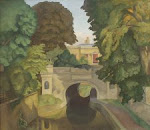
Richard Wyndham (1896-1948), "Summer Landscape" (c. 1932)

But, putting aside matters of form and prosody, it is the affecting and redolent character of these poetic reflections that is so beguiling. Although classical Chinese poetry is, of course, the product of a unique ancient culture and of three interacting philosophies (Confucianism, Taoism, and Buddhism), lines such as "Life passes swiftly, hedged by sorrow;/how long before you've lost it -- a scene like this?" and "From those years to today makes one whole lifetime,/and in between, how many things have had their day and gone!" do not move us because of their cultural origins or because they may arise out of a certain philosophical system.  Rather, they move us because they are True and Beautiful articulations of what it means to be a human being, and to live in, and to be fated to depart from, a wondrous and mysterious World -- at any time and in any place.

                 Thoughts on T'ien-chin Bridge

The countless great lords and statesmen of past regimes --
later ages know them merely as a list of names.
Only the water under T'ien-chin Bridge
goes on year after year, making the same sound.

Shao Yung (translated by Burton Watson), Ibid, page 336.

Richard Wyndham, "Tickerage Mill" (c. 1939)

This past week Spring began to emerge, in a place where I have become accustomed to see it first arrive: in a group of small bushes beside a pathway that passes through a grove of tall pines.  The bushes are sheltered within the dark, quiet, and windless grove, although sunlight and rain do filter through the deep canopy of pine boughs.  One day this week, in the late afternoon yellow light that angled down through the boughs, I noticed bright green leaf buds shining at the tips of the branches of the bushes.

   Song of the Water Willow in Front of Comfortable Den

In front of Comfortable Den, by a little crooked stream,
New rushes, a delicate willow, turn green year by year.
Before my eyes a procession of good sights pass --
Who says that life is so full of wants?

Shao Yung (translated by Burton Watson), in Kōjirō Yoshikawa, An Introduction to Sung Poetry (translated and edited by Burton Watson) (Harvard University Press 1967), page 83.  Shao Yung, who "lived all his life in semi-seclusion," gave his house the name "An-lo-wo," which may be translated as "Comfortable Den."  Ibid.

Richard Wyndham, "The Medway near Tonbridge" (1936)

Friday, May 15, 2015

Humility

A week or so ago, I noticed the annual sign that Spring has arrived in earnest and that Summer is near:  tiny anthills began to emerge along the seams of the sidewalks.  We love Spring for its flowers and its blossoming trees, for its wide skies and its breezes, and for its changeableness.  But, for me at least, there is something reassuring, even touching, in knowing that the ants are once again going about their business.

Yes, I know there is a vast, clamorous World out there.  But, as I have observed on more than one occasion, there is something to be said for appreciating, and cultivating, the commonplace.

                       Reciprocity

I do not think that skies and meadows are
Moral, or that the fixture of a star
Comes of a quiet spirit, or that trees
Have wisdom in their windless silences.
Yet these are things invested in my mood
With constancy, and peace, and fortitude,
That in my troubled season I can cry
Upon the wide composure of the sky,
And envy fields, and wish that I might be
As little daunted as a star or tree.

John Drinkwater, Tides (1917).

We mustn't fall prey to the Pathetic Fallacy, we are told.  But I unabashedly confess that ants are "invested in my mood/With constancy, and peace, and fortitude."  I cannot help myself.  I wait for their reassurance each Spring, and I am comforted when they provide it.

Robert Lillie (1867-1949), "Flower Study, Narcissi"

I have an uneasy feeling that I am about to make a pretentious and annoying Pronouncement About Poetry.  So let me first say that I deplore Pronouncements About Poetry.  That being said, here is my Pronouncement:  one of the benefits of good poetry is that it teaches us humility.

Flower in the crannied wall,
I pluck you out of the crannies,
I hold you here, root and all, in my hand,
Little flower -- but if I could understand
What you are, root and all, and all in all,
I should know what God and man is.

Alfred Tennyson, The Holy Grail and Other Poems (1869).  The poem is untitled.

William Blake preceded Tennyson:  "To see a World in a Grain of Sand/And a Heaven in a Wild Flower."  ("Auguries of Innocence.")  In our ironic "modern" world, this sort of thing is regarded as a cliché.  But it's all true, you know.

Robert Lillie, "Part of My Studio Mantel"

For real humility before the wonder of the World, consider this:

                              Morning Glories

By the well side, morning glories I transplanted,
wild tendrils climbing the rail, angling this way and that:
before I know it the well rope's been completely seized --
now I beg water from the house next door.

Rokunyo (1734-1801) (translated by Burton Watson), in Burton Watson, Kanshi: The Poetry of Ishikawa Jozan and Other Edo-Period Poets (North Point Press 1990), page 48.

Rokunyo's poem was likely inspired by the following well-known haiku:

By morning glories
my well bucket's been seized --
borrowing water.

Chiyo-ni (also known as Kaga no Chiyo) (1703-1775) (translated by Burton Watson), Ibid.

Thus, perhaps Chiyo-ni and Rokunyo would not have plucked the flower in the crannied wall.  This is not intended to be a criticism of Tennyson, by the way.  I've plucked a flower or two in my day.  As it turns out, Japanese poets are themselves of two minds about whether flowers ought to be plucked.

     To pluck it is a pity,
To leave it is a pity,
     Ah, this violet!

Naojo (translated by R. H. Blyth), in R. H. Blyth, Haiku, Volume 2: Spring (Hokuseido Press 1950), page 380.

     The violet:
Held in the hand,
     Yet more lovely.

Koshu (translated by R. H. Blyth), Ibid, page 381.

Whether the flower is plucked or not plucked, the underlying lesson is one of humility.

Robert Lillie, "Japanese Anemones"

I know nothing about how to live.  I have no wisdom to impart.  But I have come to learn that truisms are, well, true.  The commonplace World -- the World right there in front of us at this moment -- is all that we need.  Its wonders are inexhaustible.  We owe it our humility.

                 Life Hurries By

Life hurries by, and who can stay
One winged Hour upon her way?
The broken trellis then restore
And train the woodbine round the door.

Walter Savage Landor, Dry Sticks (1858).

Robert Lillie, "The Paisley Shawl"

Sunday, April 5, 2015

April

I can assure you that my fondness for April is not attributable to the fact that I was born in this month (an Aries born in the Year of the Monkey). No, I am fond of April because of its sprightly fickleness:  anything can happen (even snow in some climes).  In my opinion, it is manifestly not "the cruellest month."

William Cowper is in the main correct about both April and life:  "It is a sort of April-weather life that we lead in this world.  A little sunshine is generally the prelude to a storm."  Still, despite its changefulness and "chancefulness" (Thomas Hardy, "The Temporary the All"), I believe that April carries with it an overall sense of blue- and yellow-hued promise.

                                   April, 1885

Wanton with long delay the gay spring leaping cometh;
The blackthorn starreth now his bough on the eve of May:
All day in the sweet box-tree the bee for pleasure hummeth:
The cuckoo sends afloat his note on the air all day.

Now dewy nights again and rain in gentle shower
At root of tree and flower have quenched the winter's drouth.
On high the hot sun smiles, and banks of cloud uptower
In bulging heads that crowd for miles the dazzling south.

Robert Bridges, The Shorter Poems (1896).

Note the internal rhymes within lines (delay/gay, now/bough, et cetera), the combination of end rhymes and internal rhymes across three lines (cometh/starreth/hummeth, shower/flower/uptower), and the internal rhymes across lines (smiles/miles, cloud/crowd).

Adrian Paul Allinson (1890-1959), "The Cornish April"

On my afternoon walk yesterday, I noticed that the tulips are beginning to peak.  The daffodils are on the wane.  Sidewalks and green lawns are strewn with the fallen creamy-white petals of magnolia trees.  April is a series of arrivals and departures.

              In the Valley

On this first evening of April
Things look wintry still:
Not a leaf on the tree,
Not a cloud in the sky,
Only a young moon high above the clear green west
And a few stars by and by.

Yet Spring inhabits round like a spirit.
I am sure of it
By the swoon on the sense,
By the dazzle on the eye,
By the long, long sigh that traverses my breast
And yet no reason why.

O lovely Quiet, am I never to be blest?
Time, even now you haste.
Between the lamb's bleat and the ewe's reply
A star has come into the sky.

Sylvia Townsend Warner, Time Importuned (1928).

I hadn't noticed this until I placed the two poems together in this post:  "the dazzling south" of Bridges and "the dazzle on the eye" of Warner.  And, coincidentally, Warner employs the same technique of end rhymes and internal rhymes across three lines used by Bridges:  sky/high/by; eye/sigh/why.

Lucien Pissarro, "April, Epping" (1894)

April's mutability is embodied in the trees:  their branches are still mostly bare, but, from a distance, they seem to be enveloped in a yellow-green haze.  Mutability and promise.  "Nature's first green is gold."

                      April

Exactly:  where the winter was
The spring has come:  I see her now
In the fields, and as she goes
The flowers spring, nobody knows how.

C. H. Sisson, What and Who (Carcanet Press 1994).

Victor Elford, "April Sunshine" (1971)

As long-time (and much-appreciated!) readers of this blog may recall, I have a May poem (Philip Larkin's "The Trees"), a November poem (Wallace Stevens's "The Region November"), and an April poem that I annually revisit in each of those months.  Please humor me as we pay a return visit to my April poem.

                      Wet Evening in April

The birds sang in the wet trees
And as I listened to them it was a hundred years from now
And I was dead and someone else was listening to them.
But I was glad I had recorded for him the melancholy.

Patrick Kavanagh, Collected Poems (edited by Antoinette Quinn) (Penguin 2004).  The poem was first published in Kavanagh's Weekly on April 19, 1952.

James McIntosh Patrick (1907-1998), "Glamis Village in April"

Sunday, November 2, 2014

"Those Spring Splendors, Like Dreams, Are Gone Beyond Recall"

There is a plainspoken serenity to traditional Chinese lyrical poetry that provides a beautiful counterpoint to the ofttimes declamatory and rhetorical character of traditional English poetry.  I realize that this is a huge generalization.  I can only say that there comes a time when, in search of peace and quiet, I need to turn from the thinking and the emoting of English verse to the (relatively) straightforward statements one finds in Chinese poetry.

But this is not a matter of simplicity versus complexity.  On the surface, Chinese poetry, especially when translated into English, may appear "simple."  However, from the standpoint of thought and emotion, the best Chinese poetry is every bit as allusive and as full of implication as the best English poetry.  Moreover, from the standpoint of prosody and formal structure, a great deal of traditional Chinese poetry is arguably more complex than English poetry.  (More on this in a moment.)

During the Edo (or Tokugawa) period (1603-1868), a significant number of Japanese poets devoted themselves to writing poems in Chinese.  The poems they wrote are known as kanshi (a Japanese word meaning -- no surprise -- "Chinese poem").  All of the poems that appear in this post are kanshi.

One frost cleared the air, drove away the hovering shadows,
slimmed down the shape of the hills, reddened the groves.
Finest of all, the scene in the persimmon orchards:
in late sun, on tree after tree ten thousand dots of gold.

Rokunyo (1734-1801) (translated by Burton Watson), in Burton Watson (editor), Kanshi: The Poetry of Ishikawa Jozan and Other Edo-Period Poets (North Point Press 1990).  The poem is untitled, and is the first in a sequence titled "Three Poems Composed as I Walked Through the Village."

William MacGeorge (1861-1931), "Riverscape, Autumn"

The Japanese kanshi poets rigorously applied the strict rules of Chinese prosody.  The four poems that appear here are all in the form known in Chinese as chueh-chu (zekku in Japanese).  This form consists of a quatrain in which each line consists of the same number of Chinese characters (five, seven, or, rarely, six).  The second and fourth lines must rhyme.  A rhyme is optional in the first line.

Green thoughts, the feel of pink -- remembered in the mind;
but those spring splendors, like dreams, are gone beyond recall.
The whole village in yellow leaves, I shut the gate, lie down --
once again the year is already deep into fall.

Kashiwagi Jotei (1763-1819) (translated by Burton Watson), Ibid.

As if the prosodic features that I have mentioned were not enough, there is an additional layer of complexity in the chueh-chu form (and in most Chinese poetry):  the rules of "tonal parallelism" must be followed.  To quote Burton Watson, "the rules for tonal regulation, or tonal parallelism, as it is sometimes called, are highly complex."  Burton Watson (editor and translator), The Columbia Book of Chinese Poetry: From Early Times to the Thirteenth Century (Columbia University Press 1984), page 10.  The rules may be broadly summarized as follows:

"In principal they decree that a single line shall not have more than two, or at the very most three, syllables or words in succession that belong to the same tonal category [i.e., "level" tones or "deflected" tones], and that in the second line of a couplet the words in key positions shall be opposite in tone to the corresponding words in the first line of the couplet.  This latter results in the second line of the couplet producing, in terms of tone, a mirror image of the first line."

Ibid, page 10.

Whew!  This is the basis for my earlier statement that traditional Chinese poetry is arguably more technically complex than English poetry.  (If one wishes to delve further into this subject, I highly recommend Watson's Chinese Lyricism: Shih Poetry from the Second to the Twelfth Century (Columbia University Press 1971), which combines an excellent historical examination of Chinese poetry with fine translations by Watson of exemplary poems.)  This brief explanation should also demonstrate that, although English translations of Chinese poetry are usually almost conversational in tone, they belie a complexity that can never be replicated in translation.

William MacGeorge, "Kirkcudbright"

One of the things that I find interesting about kanshi is that they have the "feel" (a purely subjective term, I concede) of classic Chinese poetry, while having, at the same time, a Japanese sensibility (again, a purely subjective term).  The following poem by Ishikawa Jozan, perhaps the most well-known kanshi poet, provides a good example of what I am trying to get at.

               Falling Leaves Mingle with the Rain

Frosted leaves, trailing the wind, fly, scatter in a tumble,
tumbling with the sudden shower, now this way, now that.
Parting from branches, leaf after leaf raps at my door and window,
joining with the sound of drops from the tall eaves of my study.

Ishikawa Jozan (1583-1672) (translated by Burton Watson), in Kanshi: The Poetry of Ishikawa Jozan and Other Edo-Period Poets.

It is important to remember that, during the Edo period, haiku was transformed into an important art form by Basho (1644-1694).  The lives of Basho and Ishikawa Jozan overlapped.  (In terms of its poetic and artistic importance, the period is remarkably similar to the Elizabethan era.)  Thus, the imagery in "Falling Leaves Mingle with the Rain" has (to me, at least) a Japanese quality to it that is quite distinctive, and that has affinities with haiku.

William MacGeorge, "River Landscape on a Sunny Day"

But I feel that I have gotten way off into the explanatory weeds!  Let's return to poetry.  The purpose of this post, believe it or not, is to share four lovely poems about autumn.

             Returning at Night from an Autumn Village

River village where they held the fair, moon just coming up,
little path skirting the woods, leading into field embankments:
some family's old graves deep among the trees,
the single gleam of a votive lamp, cold and mournful.

Tate (pronounced ta-tay) Ryuwan (1762-1844) (translated by Burton Watson), Ibid.

"The single gleam of a votive lamp" brings to mind the grey stone lanterns that one sees in Japanese cemeteries.  "Cold and mournful" perhaps, but lovely to behold at night.

William MacGeorge, "Autumn near Kirkcudbright with Children"

Saturday, September 27, 2014

Green Slates. A Floor Of Red Tiles And Blue. Crushed Bracken And The Wings Of Doves. Moth And Gnat And Cobweb-Time.

It's funny, the things that stay with us in memory.  Births, deaths, and other milestones, yes.  But what are we to make of the clarity and persistence of certain seemingly random moments out of the past?

But, then, they are not random after all, are they?  There is a reason for their clarity, their tug and pull.  I suspect that most of us know quite well the buried emotions that these revenants carry with them.  Speaking solely for myself, I have become adept at not going down the turning paths that lead to these all-too-clear vales of memory.  Why?  Nothing dire or secretive.  Merely something along these lines:

I know not how, but as I count
     The beads of former years,
Old laughter catches in my throat
     With the very feel of tears.

Robert Louis Stevenson, New Poems and Variant Readings (1918).

An unacceptable and cowardly excuse, I know.  One ought to view the survival of emotions -- both good and bad -- as a treasure.  And I do, I do. Yet . . .

Benjamin Leader, "Betws-y-Coed Church" (1863)

To a large extent, Thomas Hardy's poetry is an exercise in the recovery and recounting of the past.  One gets the feeling that he spent much of his life inhabiting the past -- actually reliving it.  He wrote of himself:  "I believe it would be said by people who knew me well that I have a faculty (possibly not uncommon) for burying an emotion in my heart or brain for forty years, and exhuming it at the end of that time as fresh as when interred."  Thomas Hardy, The Life and Work of Thomas Hardy (edited by Michael Millgate) (Macmillan 1985), page 408.  One can thus understand why Hardy's poems concerning incidents from his past bear such immediacy and emotion.  One suspects this was both a blessing and a curse.

                    Green Slates
                     (Penpethy)

It happened once, before the duller
     Loomings of life defined them,
I searched for slates of greenish colour
     A quarry where men mined them;

And saw, the while I peered around there,
     In the quarry standing
A form against the slate background there,
     Of fairness eye-commanding.

And now, though fifty years have flown me,
     With all their dreams and duties,
And strange-pipped dice my hand has thrown me,
     And dust are all her beauties,

Green slates -- seen high on roofs, or lower
     In waggon, truck, or lorry --
Cry out:  "Our home was where you saw her
     Standing in the quarry!"

Thomas Hardy, Human Shows, Far Phantasies, Songs, and Trifles (1925).


Benjamin Leader, "On The Llugwy Below Capel Curig" (1903)

The moments of which I speak are notable for their ostensible ordinariness.  Yet, even as they occur, we often have an inkling that something has clicked, that we have arrived at a moment out of time that will for ever be with us.

                              History

Sometimes, when walls and occupation seem
A prison merely, a dark barrier
Between me everywhere
And life, or the larger province of the mind,
As dreams confined,
As the trouble of a dream,
I seek to make again a life long gone,
To be
My mind's approach and consolation,
To give it form's lucidity,
Resilient form, as porcelain pieces thrown
In buried China by a wrist unknown,
Or mirrored brigs upon Fowey sea.

Then to my memory comes nothing great
Of purpose, or debate,
Or perfect end,
Pomp, nor love's rapture, nor heroic hours to spend --
But most, and strangely, for long and so much have I seen,
Comes back an afternoon
Of a June
Sunday at Elsfield, that is up on a green
Hill, and there,
Through a little farm parlour door,
A floor
Of red tiles and blue,
And the air
Sweet with the hot June sun cascading through
The vine-leaves under the glass, and a scarlet fume
Of geranium flower, and soft and yellow bloom
Of musk, and stains of scarlet and yellow glass.

Such are the things remain
Quietly, and for ever, in the brain,
And the things that they choose for history-making pass.

John Drinkwater, Loyalties (1922).

Benjamin Leader, "Haymaking" (1876)
The following poem has appeared here before, but it is worth revisiting, for it captures perfectly what I am (inarticulately) trying to get at.

                         Revaluation

Now I remember nothing of our love
So well as the crushed bracken and the wings
Of doves among dim branches far above --
Strange how the count of time revalues things!

Patrick MacDonogh, Poems (edited by Derek Mahon) (The Gallery Press 2001).

Benjamin Leader, "At Evening Time It Shall Be Light" (1897)

I suggested above that Thomas Hardy "spent much of his life inhabiting the past."  This was not, however, a matter of escapism into a happier world. Sometimes, perhaps, it was:  for instance, when he was recalling his younger years with his family.  Much of the time, however, he was revisiting loss.

                       The Rift
            (Song: Minor Mode)

'Twas just at gnat and cobweb-time,
When yellow begins to show in the leaf,
That your old gamut changed its chime
From those true tones -- of span so brief! --
That met my beats of joy, of grief,
            As rhyme meets rhyme.

So sank I from my high sublime!
We faced but chancewise after that,
And never I knew or guessed my crime. . . .
Yes; 'twas the date -- or nigh thereat --
Of the yellowing leaf; at moth and gnat
            And cobweb-time.

Thomas Hardy, Late Lyrics and Earlier, with Many Other Verses (1922).

"At moth and gnat and cobweb-time."  Lines such as this remind us that, at heart, Hardy was, and always remained, a countryman.  Time and again in his poetry we experience this interrelationship between the particulars of the seasons and the playing out of human destiny.  But not in a manipulative sense.  The two worlds move forward in their own courses. At times, they are indifferent to, and separate from, one another.  At other times, they are entirely intertwined.  But Hardy's vision was capacious and all-encompassing:  he could not imagine the one without the other.  Thus, remembering a loss, cobweb-time came to mind.  When yellow begins to show in the leaf.

Benjamin Leader, "Quiet Valley Among The Welsh Hills" (1860)

Friday, August 22, 2014

Harbingers

One of my walks takes me along the shore of Puget Sound, past the docks of a marina -- "yachts tinkling and dancing in the bay/like race-horses." (Derek Mahon, "Kinsale.")  At one point, there is a row of a dozen or so maples beside the path.  I noticed this week that, although it is high August, the maples are already in the midst of autumn, their leaves a bright combination of reds and greens, redder in the direction of the rising sun, it seems.

As I walked on, five Canadian geese suddenly flew overhead from behind me, honking, going about their business.  The very sound of autumn.

George Vicat Cole, "Harvest Time" (1860)

As I have noted before, Howard Nemerov is a wonderful poet of autumn -- and of late summer, and the arc into autumn, as well.

                    Summer's Elegy

Day after day, day after still day,
The summer has begun to pass away.
Starlings at twilight fly clustered and call,
And branches bend, and leaves begin to fall.
The meadow and the orchard grass are mown,
And the meadowlark's house is cut down.

The little lantern bugs have doused their fires,
The swallows sit in rows along the wires.
Berry and grape appear among the flowers
Tangled against the wall in secret bowers,
And cricket now begins to hum the hours
Remaining to the passion's slow procession
Down from the high place and the golden session
Wherein the sun was sacrificed for us.
A failing light, no longer numinous,
Now frames the long and solemn afternoons
Where butterflies regret their closed cocoons.
We reach the place unripe, and made to know
As with a sudden knowledge that we go
Away forever, all hope of return
Cut off, hearing the crackle of the burn-
ing blade behind us, and the terminal sound
Of apples dropping on the dry ground.

Howard Nemerov, The Blue Swallows (1967).

This is a lovely poem, but I would respectfully disagree with these lines:  "A failing light, no longer numinous,/Now frames the long and solemn afternoons."  My friendly objection is to this: "no longer numinous."  The OED defines "numinous" as follows:  "Giving rise to a sense of the spiritually transcendent; (esp. of things in art or the natural world) evoking a heightened sense of the mystical or sublime; awe-inspiring."  In my humble opinion, the slanting yellow light of late summer and early autumn is as numinous (and evocative) as light, and the World, get.

George Vicat Cole, "A Surrey Cornfield" (1864)

Here, Nemerov captures the essence of this time of year in four lines, providing further confirmation that less is often more.

                         Threshold

When in still air and still in summertime
A leaf has had enough of this, it seems
To make up its mind to go; fine as a sage
Its drifting in detachment down the road.

Howard Nemerov, Gnomes & Occasions (1973).

The emotions evoked by the first falling leaf of incipient autumn transcend time and place.  This was written in Japan nearly three centuries before Nemerov's poem:

     The leaf of the paulownia,
With not a breath of wind,
     Falls.

Boncho (translated by R. H. Blyth), in R. H. Blyth, Haiku, Volume 4: Autumn-Winter (Hokuseido 1952), page 130.

George Vicat Cole, "Harvesting in the Thames Valley" (1888)

Sunday, June 1, 2014

Watermills

Given that windmills were the subject of my previous post, I ought to consider watermills as well.  Those that were once bustling, but are now abandoned, have often been an evocative subject for poets.

          Requiem for a Mill

They took away the water-wheel,
Scrap-ironed all the corn-mill;
The water now cascades with no
Audience pacing to and fro
Taking in with casual glance
Experience.

The cold wet blustery winter day
And all that's happening will stay
Alive in the mind: the bleak
Water-flushed meadows speak
An enduring story
To a man indifferent in a doorway.

Packaged, pre-cooked flakes have left
A land of that old mill bereft.
The ghosts that were so local coloured
Hiding behind bags of pollard
Have gone from those empty walls.
The weir still curves its waterfalls
But lets them drop in the tailrace
No longer wildly chivalrous.

And with this mention we withdraw
To things above the temporal law.

Patrick Kavanagh, Come Dance with Kitty Stobling and Other Poems (1960).

Stanley Bryan, "Botley Flour Mill Loading Barn" (1955)

Like Kavanagh, Edward Thomas notices the ghostly feel of an idle mill.

                    The Mill-Water

Only the sound remains
Of the old mill;
Gone is the wheel;
On the prone roof and walls the nettle reigns.

Water that toils no more
Dangles white locks
And, falling, mocks
The music of the mill-wheel's busy roar.

Pretty to see, by day
Its sound is naught
Compared with thought
And talk and noise of labour and of play.

Night makes the difference.
In calm moonlight,
Gloom infinite,
The sound comes surging in upon the sense:

Solitude, company, --
When it is night, --
Grief or delight
By it must haunted or concluded be.

Often the silentness
Has but this one
Companion;
Wherever one creeps in the other is:

Sometimes a thought is drowned
By it, sometimes
Out of it climbs;
All thoughts begin or end upon this sound,

Only the idle foam
Of water falling
Changelessly calling,
Where once men had a work-place and a home.

Edna Longley (editor), Edward Thomas: The Annotated Collected Poems (Bloodaxe Books 2008).

Perhaps I am overreaching, but I hear in the fifth stanza a hint of what was to come in Thomas's second-to-last poem.  The poem has appeared here before, but here is its final stanza:

How weak and little is the light,
All the universe of sight,
Love and delight,
Before the might,
If you love it not, of night.

Edward Thomas, "Out in the Dark," Ibid.

In connection with "The Mill-Water," Edna Longley points us to a prose passage by Thomas about "a lifeless mill":

"Each evening, just when the first nightjar was skimming the wood, the sedge-warblers began to sing all together round the pool.  The song might have been the abstract voice of some old pain, feebly persistent.  It went far into the night with a power of ghostly alarms, and attuned to such thoughts as come when night in certain places is malign, reverses the sweet work of the day, and gives the likeness of a dragon to the pleasant corner of a wood. The birds were full of prelusive dark sayings about the approaching night."

Ibid, page 253, quoting from Edward Thomas, "Isoud with the White Hands," Horae Solitariae (1902), pages 178-179.

"Prelusive dark sayings about the approaching night" is wonderful, isn't it?

George Vicat Cole, "Iffley Mill" (1884)

The following poem could pass for a haiku, save for its length, and save for the fact that it was written in Victorian England.

                       A Mill

Two leaps the water from its race
     Made to the brook below,
The first leap it was curving glass,
     The second bounding snow.

William Allingham, By the Way: Verses, Fragments, and Notes (1912).

John Aldridge, "Old Mill, West Harnham" (1948)

Wednesday, May 21, 2014

"I Write Of Hell; I Sing (And Ever Shall) Of Heaven, And Hope To Have It After All"

This afternoon I walked down an alley of trees, beneath a canopy of leaves. Shadows and sunlight shifted back and forth on the ground as the boughs overhead swayed in the wind.  Seeing this play of dark and light, a Decadent poet of the Nineties would likely focus on the shadows, seeing in them the impending loss of Love or the menacing approach of Oblivion.

What a difference a couple of centuries makes!  A Cavalier poet of the first half of the 17th century -- although living in tempestuous and dangerous times, and being well aware of the fragility of life -- would likely focus on the sunlight, imagining it dancing in gaiety beneath an interlaced green and blue firmament.

Here, for example, is Robert Herrick (1591-1674) in the opening poem of his Hesperides:

               The Argument of His Book

I sing of brooks, of blossoms, birds and bowers,
Of April, May, of June and July-flowers;
I sing of May-poles, hock-carts, wassails, wakes,
Of bridegrooms, brides and of their bridal cakes;
I write of youth, of love, and have access
By these to sing of cleanly wantonness;
I sing of dews, of rains, and piece by piece
Of balm, of oil, of spice and ambergris;
I sing of times trans-shifting, and I write
How roses first came red and lilies white;
I write of groves, of twilights, and I sing
The Court of Mab, and of the Fairy King;
I write of hell; I sing (and ever shall)
Of heaven, and hope to have it after all.

Robert Herrick, Hesperides (1648).

What a lovely list!  And it is not all sweetness and light.  Nor is the World, of course.  But Herrick accepts -- and delights in -- whatever comes his way.

Rex Vicat Cole (1870-1940), "Cartmel Priory, Cumbria" (1935)

I am certainly not suggesting that Herrick is "right" and the Decadents are "wrong."  The beauty of poetry lies in the uncountable and inexhaustible ways human beings attempt to make sense of the World through words arranged in a particular order.

Here is Herrick on death, a subject dear to the hearts of the Decadents.

     After Autumn, Winter

Die ere long, I'm sure, I shall;
After leaves, the tree must fall.

Immediately following the above poem in Hesperides comes this:

               A Good Death

For truth I may this sentence tell,
No man dies ill, that liveth well.

When it comes to death, are these two poems lovelier, or "truer," than "Out of a misty dream/Our path emerges for a while, then closes/Within a dream"?  Who can say?  It is not a competition.  Some of us will opt for Herrick, some for Ernest Dowson.  I opt for both.

Rex Vicat Cole, "The Mill" (1922)

Be you a Decadent, or be you a Cavalier, there's no quarrelling with this, either as Art or as Life:

             The Coming of Good Luck

So good luck came, and on my roof did light,
Like noiseless snow, or as the dew of night:
Not all at once, but gently, as the trees
Are by the sunbeams tickled by degrees.

Robert Herrick, Ibid.

Rex Vicat Cole, "Kensington Gardens"

Saturday, May 17, 2014

"Isles Of Paradise"

Yearning is one of the defining characteristics of the poems written by the Decadent poets of the 1890s.  I will state at the outset that I find nothing wrong with yearning per se.  It is the twin of hope (albeit with more of an edge of desire and longing), which Samuel Johnson was wont to identify as an essential feature of what it means to be human.

For me, at least, the yearning of the Nineties poets is yearning at its best. Resigned, yes; melancholy, yes; but, for the most part, not querulous.  This is in contrast to our modern world, in which the yearning is whiny, and all about things.  The Decadent poets were not materialists.  Their yearning was romantic and spiritual and aesthetic.  I cannot fault them for this.  Did they sometimes take their yearning too far?  Perhaps.  But better that than, say, placing one's faith in Science and Progress and Politics.  We can all see where that has gotten us.

Harald Sohlberg, "Midsummer Night" (c. 1910)

                 Vanitas

Beyond the need of weeping,
     Beyond the reach of hands,
May she be quietly sleeping,
     In what dim nebulous lands?
Ah, she who understands!

The long, long winter weather,
     These many years and days,
Since she, and Death, together,
     Left me the wearier ways:
And now, these tardy bays!

The crown and victor's token:
     How are they worth to-day?
The one word left unspoken,
     It were late now to say:
But cast the palm away!

For once, ah once, to meet her,
     Drop laurel from tired hands:
Her cypress were the sweeter,
     In her oblivious lands:
Haply she understands!

Yet, crossed that weary river,
     In some ulterior land,
Or anywhere, or ever,
     Will she stretch out a hand?
And will she understand?

Ernest Dowson, Verses (1896).

Yes, it all seems -- to use Dowson's own words -- "dim" and "nebulous," doesn't it?  Who is "she"?  I haven't a clue.  The practical-minded among us will say "bosh!" or "humbug!"  Not I.

Harald Sohlberg, "Night" (1904)

On the other hand, we mustn't think that the late-19th century was all of a piece.  Consider, for instance, this:

I have trod the upward and the downward slope;
I have endured and done in days before;
I have longed for all, and bid farewell to hope;
And I have lived and loved, and closed the door.

Robert Louis Stevenson, Songs of Travel and Other Verses (1896).

One is not likely to think of Stevenson as a dreamy Nineties aesthete. There is a note of fortitude sounded here which one seldom finds in the Decadent poets.  Bear in mind that Stevenson, given his poor health, was always staring Death in the face.  He is certainly entitled to invoke some Decadent fatalism and melancholy.  And perhaps he does, just a bit:  "I have longed for all, and bid farewell to hope."  But overall the tone is resolute -- similar to that of his "Requiem" (which has appeared here previously):  "Glad did I live and gladly die,/And I laid me down with a will."

Moreover, Stevenson was willing to allow for the attainment, however brief, of Paradise on Earth.

Fair Isle at Sea -- thy lovely name
Soft in my ear like music came.
That sea I loved, and once or twice
I touched at isles of Paradise.

Robert Louis Stevenson, Poems (1916).  The "fair Isle at Sea" is Samoa.

A small poem, a slight poem some might say, but I can never get over its loveliness.

Harald Sohlberg, "Flower Meadow in the North" (1905)

Thursday, April 17, 2014

"It Is A Sort Of April-Weather Life That We Lead In This World"

"But it is a sort of April-weather life that we lead in this world.  A little sunshine is generally the prelude to a storm."  So writes William Cowper in a January 3, 1787, letter to the Reverend Walter Bagot.  Cowper, who endured much, knew whereof he spoke.  It is he who wrote two of the most despairing lines in English verse:

I, fed with judgment, in a fleshly tomb, am
                                     Buried above ground.

The entire harrowing poem may be found here, where I suggest a comparison with John Clare's equally  harrowing "I am -- yet what I am, none cares or knows."

However, I do not wish to misrepresent Cowper with those two lines: despite his periods of deep melancholy, he seems to have been a good-natured, amiable, and kind man.  This is revealed in his correspondence, which is a delight to read.

Allan Gwynne-Jones, "Spring Evening, Froxfield" (1922)

                            Spring

There lurks a sadness in the April air
     For those who note the fate of earthly things;
     A dreamy sense of what the future brings
To those too good, too hopeful or too fair.

An underthought of heartache, as it were,
     Blends with the paean that the new leaf sings;
     And, as it were, a breeze from Death's great wings
Shakes down the blossoms that the fruit-trees bear.

The tide of sap flows up the forest trees;
     The birds exult in every bough on high;
The ivy bloom is full of humming bees;

But if you list, you hear the latent sigh;
     And each new leaf that rustles in the breeze
Proclaims the boundless mutability.

Eugene Lee-Hamilton, Sonnets of the Wingless Hours (1894).

Lee-Hamilton led an "April-weather life":  for 20 years he was confined to bed and sofa with a paralytic illness that has never been identified. Sonnets of the Wingless Hours was published in the year in which he recovered from the malady, which departed as mysteriously as it had arrived.

James Bateman, "Pastoral" (1928)

                           April Gale

The wind frightens my dog, but I bathe in it,
Sound, rush, scent of the Spring fields.

My dog's hairs are blown like feathers askew,
My coat's a demon, torturing like life.

Ivor Gurney, Selected Poems (edited by George Walter) (J. M. Dent 1996).

Gurney, like Cowper, was a gentle and afflicted soul.  Of course, things are much more complicated than that.  In most poets, a line such as "My coat's a demon, torturing like life" would seem over-dramatic -- an affectation. (So might:  "If one's heart is broken twenty times a day."  Or:  "The heart burns -- but has to keep out of face how heart burns.")  But not so with Gurney.  His was indeed an "April-weather life."  And he is only reporting exactly how it is.

Arthur Hathaway, "Spring Morning after Rain" (1940)

Sunday, April 6, 2014

April

Long-time (and much-appreciated!) readers of this blog may recall that I have a May poem (Philip Larkin's "The Trees") and a November poem (Wallace Stevens's "The Region November").  Although my reading of poetry is a matter of happenstance, I do like the thought of having certain seasonal stepping-stones.  I did not go in search of them, but now, annually and reliably, they await me.

The following poem is my April poem.  Given the climate of the Pacific Northwest, the odds are not long that I will visit "Wet Evening in April" on a wet evening in April.  And so it is.

                         Wet Evening in April

The birds sang in the wet trees
And as I listened to them it was a hundred years from now
And I was dead and someone else was listening to them.
But I was glad I had recorded for him the melancholy.

Patrick Kavanagh, Collected Poems (edited by Antoinette Quinn) (Penguin 2004).  The poem was first published on April 19, 1952.

I cannot say enough about the beauty of this poem.  Which means that I should keep my mouth shut.

Lucien Pissarro, "April, Epping" (1894)

March, April, and May:  they are not as wistful as September, October, and November, but they still have a high wistfulness quotient.  Last week I was walking down a city street when, after a gust of wind, the air was suddenly filled with white and pink cherry blossom petals.  For just an instant I thought they were snow flurries (usuyuki in Japanese -- a lovely word).

   Flowers and Moonlight on the Spring River

The evening river is level and motionless --
The spring colours just open to their full.
Suddenly a wave carries the moon away
And the tidal water comes with its freight of stars.

Yang-Ti (translated by Arthur Waley), in Arthur Waley, One Hundred and Seventy Chinese Poems (1918).

Lucien Pissarro, "The Dunmow Road from Tilty Wood" (1915)

Of course, we ought not to get carried away in wistfulness, like the moon on a wave.  Which is not to say that wistfulness is a bad thing.  One can be wistful and perfectly content.  Some occasions call for it.  To wit:  standing in place as cherry blossom petals (and, in due time, sere leaves) spin down to the ground all around you.

                 Spring

That man's life is but a dream --
Is what we now come to know.

Its house abandoned,
the garden has become home
     to butterflies.

Sogi (1421-1502) (translated by Steven Carter), in Steven Carter, Traditional Japanese Poetry: An Anthology (Stanford University Press 1991).

Lucien Pissarro, "The Garden Gate, Epping" (1894)

Friday, March 14, 2014

"We Meet Only To Part"

I have written here before that the purpose of poetry is not to edify.  Perhaps a better way to put it is that anyone who sets out to write a poem in order to edify us is doomed to failure.  Still, I should also be very clear about this:  a good poem can -- perhaps better than any other form of art (I am biased, I admit) -- help us to understand what it means to be a human being in a wondrous and mysterious world.

Poetry provides inklings, not answers.  Poetry is not religion or science or metaphysics or politics (for which we can all be thankful).

The world through which we walk is beautiful and heartbreaking.  From stepping stone to stepping stone is the only way to traverse the ground.

               . . . . . we should be careful

Of each other, we should be kind
While there is still time.

From Philip Larkin, "The Mower."

John Aldridge, "The River Pant Near Sculpin's Bridge" (1961)

We meet only to part,
Coming and going like white clouds,
Leaving traces so faint
Hardly a soul notices.

Ryokan (1758-1831) (translated by John Stevens), in Dewdrops on a Lotus Leaf: Zen Poems of Ryokan (Shambhala 1996).

Walter Goodin, "The River Beverley" (1938)

                            Afterpeace

This wind that howls about our roof tonight
And tears live branches screaming from great trees
Tomorrow may have scarcely strength to ruffle
The rabbit's back to silver in the sun.

Patrick MacDonogh Poems (edited by Derek Mahon) (The Gallery Press 2001).

Alfred Parsons (1847-1920), "Poplars in the Thames Valley"

Why should little things be blamed?
Little things for grace are famed;
Love, the winged and the wild,
Love is but a little child.

Anonymous (translated by Thomas Rogers), in Henry Wellesley (editor), Anthologia Polyglotta: A Selection of Versions in Various Languages, Chiefly from the Greek Anthology (1849).

George Vicat Cole, "Iffley Mill" (1884)

Thursday, February 27, 2014

Remember

Earlier this month I posted the following poem from The Greek Anthology:

This stone, beloved Sabinus, on thy grave
     Memorial small of our great love shall be.
I still shall seek thee lost; from Lethe's wave
     Oh! drink not thou forgetfulness -- of me.

Anonymous (translated by Goldwin Smith), in Henry Wellesley (editor), Anthologia Polyglotta: A Selection of Versions in Various Languages, Chiefly from The Greek Anthology (1849).

I realize that some may find the poem to be slight:  four lines by a nameless ancient poet translated by a Victorian historian who dabbled in poetry. And I suspect that those who have knowledge of the original Greek text may find the translation wanting (and/or florid).  Yes, I understand.  But it keeps haunting me, and I cannot let it go.

But I will not destroy it by dissecting it.  I will only say that this is marvelous:  "I still shall seek thee lost."  As is this:  "Memorial small of our great love shall be."  Translation or not, the poem bridges the millennia and reminds us that we are all one and the same.  From an unknown Greek poet in an antique land to a translator in Victorian England to readers in the 21st century:  nothing has changed.

John Piper
"Tombstones, Holy Trinity Churchyard, Hinton-in-the-Hedges" (1940)

William Johnson Cory, whose wonderful translation of a poem by Callimachus appeared here recently, wrote a poem in Greek which he then translated into English.  It is an appropriate companion to the first poem. From the other side of the grave.

                                   Remember

You come not, as aforetime, to the headstone every day,
And I, who died, I do not chide because, my friend, you play;
Only, in playing, think of him who once was kind and dear,
And, if you see a beauteous thing, just say, he is not here.

William Johnson Cory, Ionica (1891).

Cory has captured the spirit and tone of the poems in The Greek Anthology very well:  that characteristic mixture of emotion and stoicism (lower case) -- restrained passion, with an underlying foundation of dignity and decency.  Ancient, not modern.

John Piper, "Exterior of the Church of St. Denis, Faxton" (1940)

In his essay "The Charm of the Greek Anthology" (in More Literary Recreations), Edward Cook perceptively pairs Cory's "Remember" with a poem of the same title by Christina Rossetti (which has previously been posted here, but is always worth revisiting).

                       Remember

Remember me when I am gone away,
     Gone far away into the silent land;
     When you can no more hold me by the hand,
Nor I half turn to go yet turning stay.
Remember me when no more day by day
     You tell me of our future that you planned:
     Only remember me; you understand
It will be late to counsel then or pray.
Yet if you should forget me for a while
     And afterwards remember, do not grieve:
     For if the darkness and corruption leave
     A vestige of the thoughts that once I had,
Better by far you should forget and smile
     Than that you should remember and be sad.

Christina Rossetti, Goblin Market and Other Poems (1862).

John Piper, "Tithe Barn, Great Coxwell, Berkshire" (1940)

Monday, May 13, 2013

Four-Line Poems, Part Seven: "Sighs Nature An Alas? Or Merely, Amen?"

If I take my daily walk in the late afternoon or early evening, I can watch the swallows take their dinner above the open fields that I pass through. They rise and fall and dive and curve at the same time each day.  Their single-mindedness, swiftness, and precision are wonderful to behold:  a beautiful unchoreographed ballet.

Then again, who am I to say that they are not choreographed?  All of their movements may be perfectly planned in a way that is well beyond my ken.

Anna Isabella Brooke, "Wharfedale from above Bolton Abbey" (1954)

            The Spotted Flycatcher

Gray on gray post, this silent little bird
Swoops on its prey -- prey neither seen nor heard!
A click of bill; a flicker; and, back again!
Sighs Nature an Alas?  Or merely, Amen?

Walter de la Mare, Inward Companion: Poems (1950).

De la Mare's use of "alas" in "The Spotted Flycatcher" brings to mind another of his poems.

                  Harvest Home

A bird flies up from the hayfield;
Sweet, to distraction, is the new-mown grass:
But I grieve for its flowers laid low at noonday --
        And only this poor Alas!

I grieve for War's innocent lost ones --
The broken loves, the mute goodbye,
The dread, the courage, the bitter end,
The shaken faith, the glazing eye.

O bird, from the swathes of that hayfield --
The rancid stench of the grass!
And a heart stricken mute by that Harvest Home --
        And only this poor Alas!

Walter de la Mare, The Burning-Glass and Other Poems (1945).

Joseph Kavanagh (1856-1918), "Gypsy Encampment on the Curragh"

Thursday, March 28, 2013

Four-Line Poems, Part Six: "Of Humblest Friends, Bright Creature! Scorn Not One"

I would not describe William Wordsworth as a succinct poet.  He usually needs space to make his point.  However, there are exceptions.  For instance, there are the eight beautiful lines of "A slumber did my spirit seal."  And there is the following four-line poem, which came to mind in connection with my recent posts about the loveliness of familiar things.

                         To a Child
               Written in Her Album

Small service is true service while it lasts:
Of humblest Friends, bright Creature! scorn not one:
The Daisy, by the shadow that it casts,
Protects the lingering dew-drop from the Sun.

William Wordsworth, Poems (1845).

In commenting on the poem, Wordsworth stated:  "This quatrain was extempore on observing this image, as I had often done, on the lawn of Rydal Mount."

Stanley Spencer, "Lilac and Clematis at Englefield" (1954)

Wordsworth's poem is instructive:  we all ought to be on the look-out for dew-drops in the shadows of daisies.  Ivor Gurney offers similar advice.

                         The Escape

I believe in the increasing of life whatever
Leads to the seeing of small trifles . . . . .
Real, beautiful, is good, and an act never
Is worthier than in freeing spirit that stifles
Under ingratitude's weight; nor is anything done
Wiselier than the moving or breaking to sight
Of a thing hidden under by custom; revealed
Fulfilled, used, (sound-fashioned) any way out to delight.
.     .     .     .     .     .     .     .     .     .     .     .     .     .     .
Trefoil . . . . hedge sparrow . . . the stars on the edge of night.

Ivor Gurney, Selected Poems (edited by George Walter) (J. M. Dent 1996). The ellipses in lines 2 and 9, and between lines 8 and 9, are in the original.

It is difficult to be as attentive to the world around us as William Wordsworth and Ivor Gurney were.  But Gurney is right:  we must be careful not to find ourselves "under ingratitude's weight," lest we miss a great deal. Trefoil.  Hedge sparrow.  The stars on the edge of night.

Stanley Spencer, "Landscape, Cookham Dean" (c. 1939)