
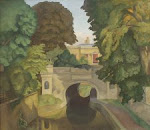

Yes, I know there is a vast, clamorous World out there. But, as I have observed on more than one occasion, there is something to be said for appreciating, and cultivating, the commonplace.
Reciprocity
I do not think that skies and meadows are
Moral, or that the fixture of a star
Comes of a quiet spirit, or that trees
Have wisdom in their windless silences.
Yet these are things invested in my mood
With constancy, and peace, and fortitude,
That in my troubled season I can cry
Upon the wide composure of the sky,
And envy fields, and wish that I might be
As little daunted as a star or tree.
John Drinkwater, Tides (1917).
We mustn't fall prey to the Pathetic Fallacy, we are told. But I unabashedly confess that ants are "invested in my mood/With constancy, and peace, and fortitude." I cannot help myself. I wait for their reassurance each Spring, and I am comforted when they provide it.

Robert Lillie (1867-1949), "Flower Study, Narcissi"
I have an uneasy feeling that I am about to make a pretentious and annoying Pronouncement About Poetry. So let me first say that I deplore Pronouncements About Poetry. That being said, here is my Pronouncement: one of the benefits of good poetry is that it teaches us humility.
Flower in the crannied wall,
I pluck you out of the crannies,
I hold you here, root and all, in my hand,
Little flower -- but if I could understand
What you are, root and all, and all in all,
I should know what God and man is.
Alfred Tennyson, The Holy Grail and Other Poems (1869). The poem is untitled.
William Blake preceded Tennyson: "To see a World in a Grain of Sand/And a Heaven in a Wild Flower." ("Auguries of Innocence.") In our ironic "modern" world, this sort of thing is regarded as a cliché. But it's all true, you know.

Robert Lillie, "Part of My Studio Mantel"
For real humility before the wonder of the World, consider this:
Morning Glories
By the well side, morning glories I transplanted,
wild tendrils climbing the rail, angling this way and that:
before I know it the well rope's been completely seized --
now I beg water from the house next door.
Rokunyo (1734-1801) (translated by Burton Watson), in Burton Watson, Kanshi: The Poetry of Ishikawa Jozan and Other Edo-Period Poets (North Point Press 1990), page 48.
Rokunyo's poem was likely inspired by the following well-known haiku:
By morning glories
my well bucket's been seized --
borrowing water.
Chiyo-ni (also known as Kaga no Chiyo) (1703-1775) (translated by Burton Watson), Ibid.
Thus, perhaps Chiyo-ni and Rokunyo would not have plucked the flower in the crannied wall. This is not intended to be a criticism of Tennyson, by the way. I've plucked a flower or two in my day. As it turns out, Japanese poets are themselves of two minds about whether flowers ought to be plucked.
To pluck it is a pity,
To leave it is a pity,
Ah, this violet!
Naojo (translated by R. H. Blyth), in R. H. Blyth, Haiku, Volume 2: Spring (Hokuseido Press 1950), page 380.
The violet:
Held in the hand,
Yet more lovely.
Koshu (translated by R. H. Blyth), Ibid, page 381.
Whether the flower is plucked or not plucked, the underlying lesson is one of humility.

Robert Lillie, "Japanese Anemones"
I know nothing about how to live. I have no wisdom to impart. But I have come to learn that truisms are, well, true. The commonplace World -- the World right there in front of us at this moment -- is all that we need. Its wonders are inexhaustible. We owe it our humility.
Life Hurries By
Life hurries by, and who can stay
One winged Hour upon her way?
The broken trellis then restore
And train the woodbine round the door.
Walter Savage Landor, Dry Sticks (1858).

Robert Lillie, "The Paisley Shawl"


