Showing posts with label F. T. Prince. Show all posts

Monday, September 10, 2018

A Life

I suppose I'm just a sentimental old fool.  (Although, as I have noted here in the past, I find nothing wrong with sentimentality, and will choose it over cold and soulless modern irony any day of the week.) Hence, certain poems never fail to move me.  An elegy for Thomasine ("Tamsin") Trenoweth of Cornwall.  An epitaph for Claudia of Rome. A haiku written in memory of the nun Jutei.  Names.  But more than mere names.

Over the past weekend, I came upon this, and another name.

                         Anne's Book

And so, Anne Everard, in those leafy Junes
Long withered; in those ancient, dark Decembers,
Deep in the drift of time, haunted by tunes
Long silent; you, beside the homely embers,
Or in some garden fragrant and precise
Were diligent and attentive all day long!
Fashioning with bright wool and stitches nice
Your sampler, did you hear the thrushes' song
Wistfully?  While, in orderly array,
Six rounded trees grew up; the alphabet,
Stout and uncompromising, done in grey;
The Lord's Prayer, and your age, in violet;
Did you, Anne Everard, dream from hour to hour
How the young wind was crying on the hill,
And the young world was breaking into flower?
With small head meekly bent, all mute and still,
Earnest to win the promised great reward,
Did you not see the birds, at shadow-time,
Come hopping all across the dewy sward?
Did you not hear the bells of Faery chime
Liquidly, where the brittle hyacinths grew?
Your dream -- attention; diligence, your aim!
And when the last long needleful was through,
When, laboured for so long, the guerdon came --
Thomson, his Seasons, neatly bound in green --
How brightly would the golden letters shine!
Ah! many a petalled May the moon has seen
Since Anne -- attentive, diligent, aetat nine --
Puckering her young brow, read the stately phrases.
Sampler and book are here without a stain --
Only Anne Everard lies beneath the daisies;
Only Anne Everard will not come again.

Mary Webb (1881-1927), Poems and The Spring of Joy (Jonathan Cape 1928).

Mary Webb was born in Shropshire, and lived there most of her life. After her death, an edition of James Thomson's The Seasons was found in her library.  The signature "Anne Everard" appears on the front flyleaf of the book.

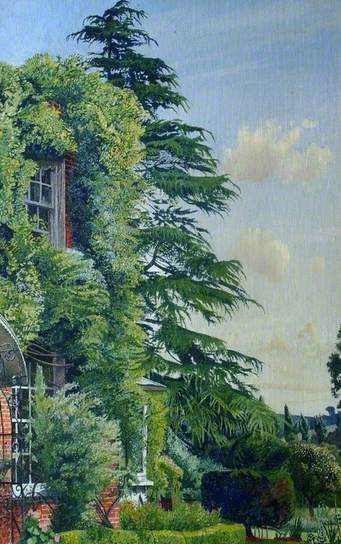
Stanley Gardiner (1887-1952), "Lamorna Valley, Evening"

Something written by Thomas Hardy in one of his notebooks comes to mind:

"The most prosaic man becomes a poem when you stand by his grave at his funeral and think of him."

Thomas Hardy, notebook entry for May 29, 1872, in Richard Taylor (editor), The Personal Notebooks of Thomas Hardy (Macmillan 1978), page 10.

F. T. Prince uses Hardy's observation as the basis for a poem:

          Last Poem

Stand at the grave's head
Of any common
Man or woman,
Thomas Hardy said,
And in the silence
What they were,
Their life, becomes a poem.

And so with my dead,
As I know them
Now, in his
And her
Long silences;
And wait for, yet a while hence,
My own silence.

F. T. Prince (1912-2003), Collected Poems: 1935-1992 (The Sheep Meadow Press 1993).

I find it surprising that Prince chooses to use the word "common" in the second line, rather than Hardy's "prosaic":  the transition from "prosaic" to "poem" is what makes Hardy's thought so touching and beautiful.  Still, Prince's poem is lovely as well.

We are all "prosaic," we are all "common," aren't we?  But, when I read of Anne Everard, Tamsin Trenoweth, Claudia of Rome, and the nun Jutei, I feel compelled to say: Not entirely.

There cannot be, confusion of our sound forgot,
A single soul that lacks a sweet crystalline cry.

W. B. Yeats, "Paudeen," in Responsibilities and Other Poems (Macmillan 1916).

Kathleen Wilson (d. 1936), "Thatched Cottages"

If I may, this is for Anne Everard, Tamsin Trenoweth, Claudia of Rome, and the nun Jutei.

            Parta Quies

Good-night; ensured release,
Imperishable peace,
     Have these for yours,
While sea abides, and land,
And earth's foundations stand,
     And heaven endures.

When earth's foundations flee,
Nor sky nor land nor sea
     At all is found,
Content you, let them burn:
It is not your concern;
     Sleep on, sleep sound.

A. E. Housman, More Poems (Jonathan Cape 1936).

Lewis Fry (1832-1921), "View from Clifton Hill"

Tuesday, June 30, 2015

Becoming A Poem

Those who have departed often return unexpectedly.  One then feels ashamed for having failed to properly attend to one's memories of them. This is not a matter of ghosts or of spirits, but of full-bodied presences in the mind's-eye:  when they return, they are right there in front of us.  Silent.

          Last Poem

Stand at the grave's head
Of any common
Man or woman,
Thomas Hardy said,
And in the silence
What they were,
Their life, becomes a poem.

And so with my dead,
As I know them
Now, in his
And her
Long silences;
And wait for, yet a while hence,
My own silence.

F. T. Prince, Collected Poems: 1935-1992 (The Sheep Meadow Press 1993).

Here is the lovely inspiration for Prince's poem:

"The most prosaic man becomes a poem when you stand by his grave at his funeral and think of him."

Thomas Hardy, notebook entry for May 29, 1872, in Richard Taylor (editor), The Personal Notebooks of Thomas Hardy (Macmillan 1978).

I'm surprised that Prince uses "common" rather than Hardy's "prosaic": the transition from "prosaic" to "poem" is wonderful.  I'd wager that Hardy would have described himself as prosaic.  Aren't we all?  And "common" as well.  Anyone who thinks otherwise hasn't faced the facts.

James McIntosh Patrick (1907-1998), "Midsummer, East Fife" (1936)

The following passage perhaps provides a roundabout instance of what Hardy has in mind.

Thus did he speak.  "I see around me here
Things which you cannot see:  we die, my Friend,
Nor we alone, but that which each man loved
And prized in his peculiar nook of earth
Dies with him, or is changed; and very soon
Even of the good is no memorial left."

William Wordsworth, "Book First: The Wanderer," lines 469-474, The Excursion, in Ernest de Selincourt and Helen Darbishire (editors), The Poetical Works of William Wordsworth, Volume V (Oxford University Press 1949), page 24.

The lines are spoken by "the Wanderer."  "The Author" has found him drowsing in the sun, "the shadows of the breezy elms above/Dappling his face."  Ibid, lines 440-441.  The Excursion is a diffuse poem, with a tendency towards the long-winded, but one of the things that Wordsworth may be getting at is that we all have it in us to live, like the Wanderer, in our own "peculiar nook of earth."  But does that nook indeed die with us?  Is there "no memorial left" of how we have lived?

Hardy suggests that each of us ("prosaic" though we are), together with our peculiar nook, becomes a poem.  It certainly seems that way when the departed return to visit us.  A sentimental notion, I concede.  But I have no quarrel with sentimentality.

James McIntosh Patrick, "A Castle in Scotland"

I suspect that the subject matter of this post may be traceable to the fact that I have been visiting Thomas Hardy's poetry over the past few weeks.  As I have noted in the past, communings with the departed are a matter-of-fact occurrence in Hardy's poetry.  Things are seen out of the corner of one's eye.  There are tappings on windows and whispers in the boughs of trees. But these signals are never a cause for alarm.  Hardy -- sunk in the past as he was -- treats them as commonplaces.  Who does not think of the dead? And who's to say they are not thinking of us?

Hardy admired the poetry of Charlotte Mew, and he, along with others, helped procure a Civil List Pension for her when she was in financial straits.  The departed are plentiful in her poetry as well.

                              Here Lies a Prisoner

               Leave him:  he's quiet enough:  and what matter
               Out of his body or in, you can scatter
The frozen breath of his silenced soul, of his outraged soul to the winds
          that rave:
Quieter now than he used to be, but listening still to the magpie chatter
                                   Over his grave.

Charlotte Mew, Complete Poems (edited by John Newton) (Penguin 2000).

James McIntosh Patrick, "Downie Mill" (1962)

In the end, we all return to silence, don't we?

       The Best Thing to Say

The best thing to say is nothing
And that I do not say,
But I will say it, when I lie
In silence all the day.

C. H. Sisson, Collected Poems (Carcanet 1998).

"The Best Thing to Say" is one of Sisson's harrowing final poems, a selection of which appeared here five years ago.  He doesn't present a pretty picture.  Thus, it falls upon Thomas Hardy -- the purported "pessimist" -- to provide us with hope.  Yes, each of us returns to silence.  But we each become a poem.

James McIntosh Patrick, "Braes o' Lundie"

Saturday, March 2, 2013

Four-Line Poems, Part Three: "The Wind In The Tree"

Tens of thousands of poems have been written about love:  found love, lost love, requited love, unrequited love -- love in all of its permutations and guises.  The lovers have aired their emotions in sonnets, canzoni, odes, and other traditional poetic forms, often going to great lengths to articulate that which may be ultimately inexpressible.

However, I respectfully suggest that it may be possible to capture love (momentarily and evanescently) in a four-line poem.

Stanley Spencer, "The Ferry Hotel Lawn, Cookham" (1936)

               The Wind in the Tree

She has decided that she no longer loves me.
There is nothing to be done.  I long ago
As a child thought the tree sighed 'Do I know
Whether my motion makes the wind that moves me?'

F. T. Prince, Poems (1938).

Stanley Spencer
"Englefield House, Cookham" (1951)

The following is my humble contribution to the genre of the four-line lost love poem.

     The Land with Wind in the Leaves

Distance cannot remove me from that place.
I stand half a world away and here it is:
A green sway and roar -- blue, vast, open
And refusing always to let me depart.

     Yorkshire 1987 -- Tokyo 1992

sip (Tokyo/Seattle 1992).

I wish to strongly emphasize:  it does not, of course, hold a candle to "The Wind in the Tree."  But, to borrow from Louis MacNeice ("Star-gazer"):  "To me if to no one else the [subject] is of some interest."  I wrote the poem before I encountered "The Wind in the Tree."

And that's all I have to say about that.

Stanley Spencer, "Garden at Whitehouse, Northern Ireland" (1952)

Sunday, February 13, 2011

Trees And Vanished Love: Three Poems

I recently came across a lovely poem by Sheila Wingfield (1906-1992), whose poetry I had not encountered previously.  The poem brought to mind two other poems that go together well with it.  (I have previously posted those two poems, but I think it is worthwhile to see all of the poems together.)  The theme is Vanished Love -- although, having said that, I notice that I am violating one of my cardinal rules:  "Do not attempt to paraphrase or summarize a poem."  In any event, here are the poems.

                       Winter

The tree still bends over the lake,
And I try to recall our love,
Our love which had a thousand leaves.

Sheila Wingfield, Collected Poems: 1938-1983 (Enitharmon Press 1983).

                    John Brett, "February in the Isle of Wight" (1866)

                    The Wind in the Tree

She has decided that she no longer loves me.
There is nothing to be done.  I long ago
As a child thought the tree sighed 'Do I know
Whether my motion makes the wind that moves me?'

F. T. Prince, Collected Poems (1979).

                            J. M. W. Turner, "Mortlake Terrace" (1827)

                       Revaluation

Now I remember nothing of our love
So well as the crushed bracken and the wings
Of doves among dim branches far above --
Strange how the count of time revalues things!

Patrick MacDonogh, Poems (The Gallery Press 2001).

Tuesday, April 20, 2010

Wind. Leaves.

A benefit and bane of growing older: certain items of experience become yoked together, whether you want them to be or not.  A happy example: whenever I read one of these poems, it reminds me of the other two.

     Kayenta, Arizona, May 1977

I fall asleep to the sound of rain,
But there is no rain in the desert.
The leaves of the trader's little cottonwoods
Turn, turn in the wind.

Janet Lewis, The Selected Poems of Janet Lewis, edited by R. L. Barth (2000).

        The Wind in the Tree

She has decided that she no longer loves me.
There is nothing to be done.  I long ago
As a child thought the tree sighed 'Do I know
Whether my motion makes the wind that moves me?'

F. T. Prince, Poems (1938).

And, finally, the last stanza of "The Trees" by Philip Larkin:

Yet still the unresting castles thresh
In fullgrown thickness every May.
Last year is dead, they seem to say,
Begin afresh, afresh, afresh.

High Windows (1974).

                 George Mackley (1900-1983), The House by the Lake