Showing posts with label Kenkō. Show all posts

Tuesday, January 6, 2026

The Wind in the Pines

In this part of the world, the deciduous trees are empty, save for a few leaves fluttering drily on otherwise bare branches.  Gone (at least for now) are the green days of whispering, soughing, and roaring boughs.  Passing through a leafless grove on a windy day, one hears the empty branches clacking and clicking against one another high overhead.  The trunks and large limbs creak and groan, like the masts of a sailing ship in a storm as described in a seafaring tale.

But, ah! -- the wind in the pines is always with us.  

When the wind passes
     in the pines, autumn already
          seems lonely enough --
and then a fulling block echoes
     through Tamakawa Village.  

Minamoto no Toshiyori (1055-1129) (translated by Steven Carter), in Steven Carter (editor), Traditional Japanese Poetry: An Anthology (Stanford University Press 1991), page 136.  The poem is a waka (as are the two poems which appear below).  The sound of fulling blocks in the night signifies deep autumn in Japanese poetry (and in turn reflects the influence of Chinese poetry (in which the sound of fulling blocks on an autumn night is often heard) on Japanese poets).  For more on fulling blocks in Japanese and Chinese poetry, please see an earlier post from 2021.

The continuity of Japanese poetry up until the 20th century is a wonderful thing.  A beautiful poem (or an evocative, beautiful image or phrase within a poem) was never forgotten by poets or readers, and its echo might return years or centuries later in a new poem.  The new poem did not identify the source of the echo.  No footnotes were provided.  Nor were they necessary.  Everyone who read the poem, or heard it recited, recognized the echo.  And thus the earlier poem's beauty was preserved, renewed, and brought into a new world.  A long string of resonating echoes developed.  Nothing was lost to Time, or left behind.  Imagine that.

I come so seldom,
and yet how sad in the night
     sounds the wind in the pines.
And she, there beneath the moss --
does she too hear it, endlessly?

Fujiwara no Shunzei (1114-1204) (translated by Steven Carter), Ibid, page 153.  The occasion for the writing of the poem was Fujiwara no Shunzei's visit to the grave of his wife.  He spent the night at a nearby Buddhist temple.  Ibid, page 153.

Saigyō, a friend of Fujiwara no Shunzei, and a reclusive dweller in the countryside for much of his life, wrote this: 

Mountain village
where wind makes sad noises
in the pines --
and adding to the loneliness,
the cry of an evening cicada.

Saigyō (1118-1190) (translated by Burton Watson), in Burton Watson (editor), Saigyō: Poems of a Mountain Home (Columbia University Press 1991), page 146.  The sound of cicadas (or, alternatively, crickets) in the twilight of late summer or early autumn provides another memorable series of lovely echoes in Japanese poetry.  But that requires a post of its own, at another time.  As does the cry of quail at evening in the deep grass.

Paul Nash (1889-1946), "Berkshire Downs" (1922)

Of course, I am not suggesting that Japanese poets alone are sensitive to the allure (be it melancholic or soothing) of the wind in the pines.  For instance, quite some time ago I discovered this poem in The Oxford Book of Victorian Verse, which was compiled in 1912 by the redoubtable Arthur Quiller-Couch:

      Dirge in Woods

A wind sways the pines,
        And below
Not a breath of wild air;
Still as the mosses that glow
On the flooring and over the lines
Of the roots here and there.
The pine-tree drops its dead;
They are quiet, as under the sea.
Overhead, overhead
Rushes life in a race,
As the clouds the clouds chase;
        And we go,
And we drop like the fruits of the tree,
        Even we,
        Even so.

George Meredith, in Arthur Quiller-Couch (editor), The Oxford Book of Victorian Verse (Oxford University Press 1912), page 465.  The poem was originally published in Meredith's A Reading of Earth (Macmillan 1888).  One of those poems which, once read, is not forgotten.  (An aside.  I have Quiller-Couch's book beside me as I write this, and I notice that my copy bears a Tokyo bookstore's small decorative paper label on the inner flap of the dust-jacket.  I often visited the bookstore during two extended stays in Tokyo in 1993 and 2000, and I purchased the book during one of those visits.  How time passes.  "Overhead, overhead/Rushes life in a race,/As the clouds the clouds chase.")

Meredith's poem captures wonderfully how it feels to stand or sit within a grove of pines.  The stillness.  The silence.  The soft ground surrounding the trunks of the trees.  The mull and duff.  I remember "mull and duff" from Howard Nemerov's lovely poem "Again": "the nevergreen/Needles and mull and duff of the forest floor."  (Howard Nemerov, The Western Approaches, Poems 1973-1975 (University of Chicago Press 1975), page 52.  "Nevergreen" is a neologism of Nemerov's invention, it would appear.)

"A wind sways the pines."  Reading Meredith's opening line, I cannot help but think of this:

            The Region November

It is hard to hear the north wind again,
And to watch the treetops, as they sway.

They sway, deeply and loudly, in an effort,
So much less than feeling, so much less than speech,

Saying and saying, the way things say
On the level of that which is not yet knowledge:

A revelation not yet intended.
It is like a critic of God, the world

And human nature, pensively seated
On the waste throne of his own wilderness.

Deeplier, deeplier, loudlier, loudlier,
The trees are swaying, swaying, swaying.

Wallace Stevens, Collected Poetry and Prose (The Library of America 1997), page 472.  "The Region November" was not published during Stevens' lifetime.  It was likely written in 1954, the year prior to his death.  (Wallace Stevens, Opus Posthumous (edited by Milton Bates) (Alfred A. Knopf 1989), page 324.)

Pines are not specifically mentioned in "The Region November," but the "swaying, swaying, swaying" brings to mind the look of pines in the wind, at least for me.  And, speaking of echoes of past poems, consider these lines from Stevens' "The Snow Man," published in Harmonium in 1923, thirty years before he wrote "The Region November": "One must have a mind of winter/To regard the frost and the boughs/Of the pine-trees crusted with snow . . . and not to think/Of any misery in the sound of the wind."               

John Nash (1893-1977), "Autumn Berkshire" (1951)

The three waka from 11th and 12th century Japan and the poems by Meredith and Stevens suggest that hearing or seeing or feeling the wind in the pines is an occasion of pensive melancholy, with accompanying intimations of mortality.  I suspect that many of us might agree.  And yet . . .

Last week I came upon a group of busy, chattering sparrows flitting and hopping and pecking in the dry, leaning stalks of wild grass alongside a paved pathway.  As I have noted here in the past, I have come to think of the sparrows (and also the robins) as my winter companions.  I doubt if they regard me in that fashion.  As I came nearer, the entire group flew several yards away onto the lower branches of a tall pine standing alone out in the meadow beside the pathway.  They disappeared into the dark boughs, twittering and clucking.  How warm, dry, and soft it must be within the depths of that pine.  Calm, still, and quiet.  Even when the wind blows.  A place of shelter, refuge, and rest.  Or do those enveloping boughs provide only a brief respite?

The wind in the pines.  Over the centuries, the echoes continue in Japanese poetry. 

     A cool breeze;
The vault of heaven is filled
     With the voices of pine trees.

Onitsura (1660-1738) (translated by R. H. Blyth), in R. H. Blyth, A History of Haiku, Volume One (Hokuseido Press 1963), page 97.

And this:

One learns to bear solitude 
     from the sound of the pine-wind. 

Shōhaku (1443-1527) (translated by Steven Carter), in Steven Carter (editor), Traditional Japanese Poetry: An Anthology, page 319.  This two-line verse appears as verse 64 in Minase Sangin Hyakuin ("Three Poets at Minase"), a hundred-verse renga written in 1488, with Shōhaku, Sōgi (1421-1502), and Sōchō (1448-1532) as the contributing poets.  Ibid, pages 303-326.

And, finally, this:

Twilight -- the only conversation
     on this hill
Is the wind blowing through the pines.

Ryōkan (1758-1831) (translated by John Stevens), in John Stevens (editor), One Robe, One Bowl: The Zen Poetry of Ryōkan (Weatherhill 1977), page 76.  The poem is a waka.

This small gathering of poems about the wind in the pines is but a limited introduction, the product of my inadequate knowledge and memory.  It also serves as an admonition to my sleepwalking self: Pay attention.  Be grateful.

Christopher Nevinson (1889-1946)
"View of the Sussex Weald" (1927)

Postscript.  The beautiful particulars of the World may lose their color, wither away.  Change or vanish.  But the World bestows compensations, dispensations, gifts.  A sunset in the distant pines.  No wind.

Winter Twilight (Discovery Park, Seattle)

"The most precious thing in life is its uncertainty.  Consider living creatures -- none lives so long as man.  The May fly waits not for the evening, the summer cicada knows neither spring nor autumn.  What a wonderfully unhurried feeling it is to live even a single year in perfect serenity!  If that is not enough for you, you might live a thousand years and still feel it was but a single night's dream."  Kenkō (1283-1350), Tsurezuregusa (Chapter 7), in Donald Keene (translator), Essays in Idleness: The Tsurezuregusa of Kenkō (Columbia University Press 1967), pages 7-8.

Monday, August 5, 2024

Home

This modest (and, of late, fitful) undertaking owes its name to Edward Thomas.  I expressed my thanks to him (accompanied by the touching elegy "To E. T.: 1917" written by his friend Walter de la Mare) in my first post here: Tuesday, March 9, 2010.  A month later, I posted this comment about "Adlestrop": "No doubt many of us first encountered Edward Thomas by discovering 'Adlestrop' in an anthology.  And many of us recognized upon reading it that something had changed for us.  How so?  This is the best that I can come up with: 'At last.  This is the real thing.'"

I memorized "Adlestrop" on the day I first read it.  Forty years ago? Or is it closer to fifty?  Since that day it has always been with me.  But now and then I still open Thomas' Collected Poems to read it, wanting to see it on the page.  Nothing has changed.

                 Adlestrop

Yes.  I remember Adlestrop --
The name, because one afternoon
Of heat the express-train drew up there
Unwontedly.  It was late June.

The steam hissed.  Someone cleared his throat.
No one left and no one came
On the bare platform.  What I saw
Was Adlestrop -- only the name

And willows, willow-herb, and grass,
And meadowsweet, and haycocks dry,
No whit less still and lonely fair
Than the high cloudlets in the sky.

And for that minute a blackbird sang
Close by, and round him, mistier,
Farther and farther, all the birds
Of Oxfordshire and Gloucestershire.

Edward Thomas, The Annotated Collected Poems (edited by Edna Longley) (Bloodaxe Books 2008), page 51.  The poem was written on January 8, 1915.  Ibid, page 176.  Thomas had written his first poem a month earlier, on December 3, 1914.  Ibid, page 143.

We've had a surprising string of sunny and warm (even hot) days in this part of the world.  No rain to speak of, and nary a cloud in sight. On a recent afternoon, as I walked beside a meadow that slopes down to the waters of Puget Sound, a ladybug landed on my right forearm. Landed "unwontedly," one might say.  That wonderful way in which the World works.  

I stopped walking, and watched as the visitor investigated my arm. After a few moments, it flew away on its own, its diaphanous wings glittering in the sunlight.  Over a lifetime, it is these unwonted moments we remember, isn't it?

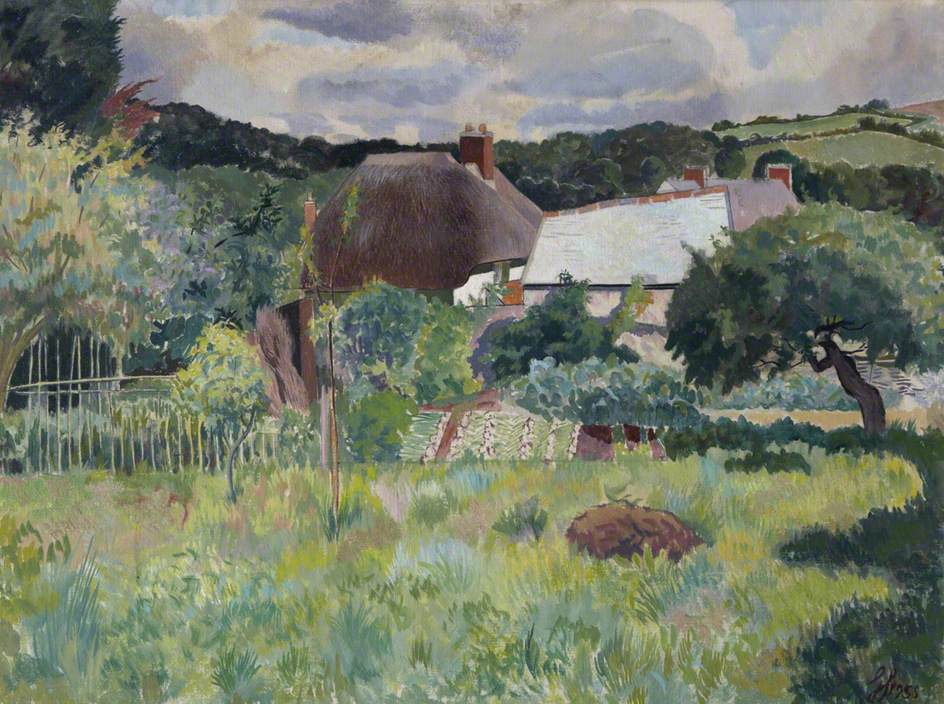
George Mackley (1900-1983), "Kentish Oast"

In one sense, Edward Thomas had found his home in the World from the day he was born.

"So on Tuesday, July 27th [1915] I lunched for the first time with Edward in uniform.  It might have been next year when we were walking in the country that I asked him the question his friends had asked him when he joined up, but I put it differently.  'Do you know what you are fighting for?'  He stopped, and picked up a pinch of earth.  'Literally, for this.'  He crumbled it between finger and thumb, and let it fall."

Eleanor Farjeon, Edward Thomas: The Last Four Years (Oxford University Press 1958), page 154.

Hence, "Adlestrop."  But there is a great deal more to "Adlestrop." And there is a great deal more to Edward Thomas.  As I was thinking about him lately, this came to mind: "He was always a seeker after something in the world that is there in no satisfying measure, or not at all."  More on this in a moment.

                      Home

Often I had gone this way before:
But now it seemed I never could be
And never had been anywhere else;
'Twas home; one nationality
We had, I and the birds that sang,
One memory.

They welcomed me.  I had come back
That eve somehow from somewhere far:
The April mist, the chill, the calm,
Meant the same thing familiar 
And pleasant to us, and strange too,
Yet with no bar.

The thrush on the oaktop in the lane
Sang his last song, or last but one;
And as he ended, on the elm
Another had but just begun
His last; they knew no more than I
The day was done.

Then past his dark white cottage front
A labourer went along, his tread
Slow, half with weariness, half with ease;
And, through the silence, from his shed
The sound of sawing rounded all
That silence said.

Edward Thomas, The Annotated Collected Poems, page 81.  The poem was written on April 17, 1915, four months after "Adlestrop" was written.  Ibid, page 226.  Thomas wrote two other poems titled "Home."  The first was written on February 23, 1915.  Ibid, page 197. (It begins: "Not the end: but there's nothing more."  Ibid, page 64.) The second was written on March 7 and 10, 1916.  Ibid, page 282.  (It begins: "Fair was the morning, fair our tempers, and/We had seen nothing fairer than that land."  Ibid, page 113.)

"He was always a seeker after something in the world that is there in no satisfying measure, or not at all."  An observation bound to catch the attention of melancholic romantics and romantic melancholics. (I'm afraid I shall have to plead guilty to that offense.)  It is the final sentence in Walter Pater's "A Prince of Court Painters," a fictional "imaginary portrait" of the painter Jean-Antoine Watteau (1684-1721) which takes the form of journal entries written over a 20-year period by a woman who knew him.  (Walter Pater, Imaginary Portraits (Macmillan 1887), pages 1-48.)  Edward Thomas read Pater's works, and wrote a book about him: Walter Pater: A Critical Study (Martin Secker 1913).  The book contains a short chapter on Imaginary Portraits, but the sentence I have quoted from "A Prince of Court Painters" is not mentioned.

Have no fear: it is not my intention to undertake literary detective work along the lines of, say, "Walter Pater's Influence on the Poetry of  Edward Thomas."  Rather, Pater's sentence simply returned to me on its own as I thought about Thomas, his life, the four poems that appear here, and his poetry as a whole.  I would never wish to be reductive when it comes to Edward Thomas.  More importantly, as I have often noted here in the past: the poems speak for themselves; no interpretation or explication is necessary.

John Aldridge (1905-1983), "Beslyn's Pond, Great Bardfield"

"It is enough, it would seem, to have been born into this world for a man to desire many things."  (Kenkō (1283-1350), Tsurezuregusa, Chapter 1 (translated by Donald Keene), in Keene (editor), Essays in Idleness: The Tsurezuregusa of Kenkō (Columbia University Press 1967), page 3.)  As a Buddhist monk, Kenkō would have been well-acquainted with the snares of desire in the lives of human beings, and of the need for us to avoid, or to extricate ourselves from, those snares.  On the other hand, desires are innumerable, and come in various forms.  For instance, what of a desire for home?  Aren't most of us in search of home, whatever that may mean? 

                                 The Ash Grove

Half of the grove stood dead, and those that yet lived made
Little more than the dead ones made of shade.
If they led to a house, long before they had seen its fall:
But they welcomed me; I was glad without cause and delayed.

Scarce a hundred paces under the trees was the interval --
Paces each sweeter than sweetest miles -- but nothing at all,
Not even the spirits of memory and fear with restless wing,
Could climb down to molest me over the wall

That I passed through at either end without noticing.
And now an ash grove far from those hills can bring
The same tranquillity in which I wander a ghost
With a ghostly gladness, as if I heard a girl sing

The song of the Ash Grove soft as love uncrossed,
And then in a crowd or in distance it were lost,
But the moment unveiled something unwilling to die
And I had what most I desired, without search or desert or cost.

Edward Thomas, The Annotated Collected Poems, page 108.  The poem was written from February 4 through February 9, 1916.  Ibid, page 272.

"But the moment unveiled something unwilling to die/And I had what most I desired, without search or desert or cost."  As in "Adlestrop" and "Home," a moment is sufficient to find oneself at home.  And, although "desire" is involved, Thomas arrives at home "without search or desert or cost."  As in "Adlestrop": ". . . the express-train drew up there/Unwontedly."  And as in "Home": "I had come back/That eve somehow from somewhere far."  How wonderful to know that one may arrive at home when one least expects it, if only for a moment.  But perhaps this is a better way to put it: how wonderful to know that home may arrive when one least expects it, if only for a moment.

     Bent over by the rain,
The ears of barley
     Make it a narrow path.

Jōsō (1661-1704) (translated by R. H. Blyth), in Blyth, Haiku, Volume 3: Summer-Autumn (Hokuseido Press 1952), page 322.  Blyth follows the haiku with this commentary:

"In old-fashioned novels, we often have the situation of a man or a woman who realizes only at the end of the book, and usually when it is too late, who it was he or she had loved for many years without knowing it.  So a great many haiku tell us something that we have seen but not seen.  They do not give us a satori, an enlightenment; they show us that we have had an enlightenment, had it often, -- and not recognized it."

Ibid, page 322 (italics in the original text).

Or, another way of looking at it:

"Attachment to the self renders life more opaque.  One moment of complete forgetting and all the screens, one behind the other, become transparent so that you can perceive clarity to its very depths, as far as the eye can see; and at the same time everything becomes weightless.  Thus does the soul truly become a bird."

Philippe Jaccottet (translated by Tess Lewis), notebook entry in May of 1954, in Philippe Jaccottet, Seedtime: Notebooks 1954-1979 (Seagull Books 2013), page 1.

George Mackley, "House by a Lane"

"And now an ash grove far from those hills can bring/The same tranquillity in which I wander a ghost/With a ghostly gladness." "Gladness."  The word appears again in this poem, written by Thomas three months after he wrote "The Ash Grove":

   I Never Saw That Land Before

I never saw that land before,
And now can never see it again;
Yet, as if by acquaintance hoar
Endeared, by gladness and by pain,
Great was the affection that I bore

To the valley and the river small,
The cattle, the grass, the bare ash trees,
The chickens from the farmsteads, all
Elm-hidden, and the tributaries
Descending at equal interval;

The blackthorns down along the brook
With wounds yellow as crocuses
Where yesterday the labourer's hook
Had sliced them cleanly; and the breeze
That hinted all and nothing spoke.

I neither expected anything
Nor yet remembered: but some goal
I touched then; and if I could sing
What would not even whisper my soul
As I went on my journeying,

I should use, as the trees and birds did,
A language not to be betrayed;
And what was hid should still be hid
Excepting from those like me made
Who answer when such whispers bid.

Edward Thomas, The Annotated Collected Poems, page 120.  The poem was written on May 5, 1916.  Ibid, page 292.

Having said earlier that I would never wish to be reductive when it comes to Edward Thomas, I'm afraid this thought comes to mind: where would his poems be without birds, without trees?  Consider just the four poems appearing here.  In "Adlestrop": a blackbird; "all the birds/Of Oxfordshire and Gloucestershire;" willows.  In "Home": two thrushes; an oak; an elm.  In "The Ash Grove": ash trees, of course.  In "I Never Saw that Land Before": "the bare ash trees;" elms.  All of them brought together beautifully in these lines: ". . . and if I could sing/What would not even whisper my soul/As I went on my journeying,//I should use, as the trees and birds did,/A language not to be betrayed."  Try to imagine home without trees or birds.  

This undated entry appears on one of the final pages of the diary kept by Thomas after he arrived in France in January of 1917: "And no more singing for the bird . . ."  (R. George Thomas (editor), The Collected Poems of Edward Thomas (Oxford University Press 1981), page 194 (ellipses in the original text).)

On April 9, 1917, Edward Thomas died in France on the first day of the Battle of Arras.

James McIntosh Patrick (1907-1998)
"Stobo Kirk, Peeblessshire" (1936)

[A final note.  Edward Thomas did not begin to write poetry until the last four years of his life.  But I venture to say that no one in the United Kingdom during his lifetime had a greater knowledge of, and feeling for, first, what the essence of poetry consists of, and, second, what it means to be a poet.  This is, of course, embodied in his own poetry. But his thoughts and feelings on the heart of poetry may also be found in his prose writings.  I find this to be his finest articulation of what poetry is:

"What [poets] say is not chosen to represent what they feel or think, but is itself the very substance of what had before lain dark and unapparent, is itself all that survives of feeling and thought, and cannot be expanded or reduced without dulling or falsification.  If this is not so, and if we do not believe it to be so, then poetry is of no greater importance than wallpaper, or a wayside drink to one who is not thirsty.  But if it is so, then we are on the way to understand why poetry is mighty; for if what poets say is true and not feigning, then of how little account are our ordinary assumptions, our feigned interests, our playful and our serious pastimes spread out between birth and death.  Poetry is and must always be apparently revolutionary if active, anarchic if passive.  It is the utterance of the human spirit when it is in touch with a world to which the affairs of 'this world' are parochial.  Hence the strangeness and thrill and painful delight of poetry at all times, and the deep response to it of youth and of love; and because love is wild, strange, and full of astonishment, is one reason why poetry deals so much in love, and why all poetry is in a sense love poetry."

Edward Thomas, Feminine Influence on the Poets (Martin Secker 1910), page 86-87.

We should remain mindful of a proviso included by Thomas in the passage above: "if what poets say is true and not feigning." Part of what this means is expressed wonderfully by Kingsley Amis, with Thomas in mind: "How a poet convinces you he will not tell you anything he does not think or feel, since you have only his word for it, is hard to discover, but Edward Thomas is one of those who do it."(Kingsley Amis, The Amis Anthology (Hutchinson 1988), page 339.)]

George Mackley, "Brackie's Burn, Northumberland"

Tuesday, June 18, 2024

One Thing Leads to Another, Part Two: Two Poems on a Spring Day

Each morning, I read a poem.  A long-time habit.  I began a recent spring day with this:

     Tilling the field;
From the temple among the trees,
     The funeral bell tolls.

Buson (1716-1784) (translated by R. H. Blyth), in R. H. Blyth, Haiku, Volume 2: Spring (Hokuseido Press 1950), page 161.

In his four-volume Haiku, R. H. Blyth collects haiku relating to each season into chapters based upon general categories (e.g., "Sky and Elements"; "Fields and Mountains"; "Human Affairs"; "Birds and Beasts"; "Trees and Flowers").  Within each category, the haiku are in turn organized by specific subjects.  This description sounds much more rigid than how things play out in practice.  Blyth translates hundreds of haiku, but he does not simply provide an anthology. Rather, as I have noted here in the past, Blyth's journey through haiku is accompanied by a wide-ranging and impressionistic (yet learned and thorough) running commentary.  The entire World, past and present, is open to examination and contemplation.  Therein lies the beauty and charm of Blyth's achievement.

Making the journey in the company of the World's beautiful particulars makes perfect sense.  Say, for instance: willows; skylarks; cicadas (semi in Japanese); the River of Heaven (what is called in English "the Milky Way").  ("River of Heaven" is one way of translating the Japanese phrase ama no gawa.  Ama means "the heavens" or "the sky"; no is a particle corresponding to "of"; gawa is the euphonic version of the word kawa, which  means "river."  After coming across ama no gawa years ago, I no longer had need for "the Milky Way.")

On the morning in question, I had decided to return to the haiku collected by Blyth in a section titled "Tilling the Field" in the "Human Affairs" chapter of his Spring volume.  I did not go specifically in search of Buson's haiku, but I know it well.  One of those poems that is not likely to be forgotten, once it has come into your life.  A lovely way to start the day.

Samuel Birch (1869-1955), "Nancledra: Old Cornish Village" (1931)

I am a creature of habit: in addition to reading a poem each morning, I read one in the evening.  I have returned to the poetry of Andrew Young of late, having been away from it for too long a time.  On the day that I read Buson's "tilling the field" haiku in the morning, I came upon this in the evening:

                         Spring

I never noticed, till I saw today
How budding birches stand in their green spray
And bracken like a snake from earth upheaves,
How many in this wood are last year's leaves.

Andrew Young, in Edward Lowbury and Alison Young (editors), The Poetical Works of Andrew Young (Secker & Warburg 1985), page 127.

As was the case with Buson's haiku, I hadn't gone in search of "Spring."  But, suddenly, there they were: two poems on the same theme (or so it seems to me) arriving on the same day.  A matter of mere happenstance.  But evidence, perhaps, that there are indeed benefits to growing old.  Sometimes (as long as memory remains intact), the poems that have accumulated within us over the years find their way to each other.  Where do they reside in the meantime? In the mind, in the heart, in the soul?  All of the above.

A small bit of serendipity in the larger scheme of things, one might say.  But one might also say that seven lines of poetry (three lines from Japan in the 18th century; four lines from England in the 20th century) may go some way to articulating, with beauty, what it means to spend our short time here in Paradise.  "Gifts are still occasionally given us, particularly when we have not asked for them, and I cling to the hope of understanding the link between certain of them and our inner life, their meaning in relation to our most persistent dreams." (Philippe Jaccottet (translated by Mark Treharne), Landscapes with Absent Figures (Delos Press/Menard Press 1997), page 3.)

Gilbert Spencer (1892-1979), "Blackmoor Vale" (1931)

"If man were never to fade away like the dews of Adashino, never to vanish like the smoke over Toribeyama, but lingered on forever in the world, how things would lose their power to move us!  The most precious thing in life is its uncertainty.  Consider living creatures -- none lives so long as man.  The May fly waits not for the evening, the summer cicada knows neither spring nor autumn.  What a wonderfully unhurried feeling it is to live even a single year in perfect serenity!  If that is not enough for you, you might live a thousand years and still feel it was but a single night's dream."

Kenkō (1283-1350) Tsurezuregusa (Chapter 7), in Donald Keene (translator), Essays in Idleness: The Tsurezuregusa of Kenkō (Columbia University Press 1967), pages 7-8.  Keene provides this note to "Adashino": "Adashino was the name of a graveyard, apparently situated northwest of Kyoto.  The word adashi (impermanence), contained in the place name, accounted for the frequent use of Adashino in poetry as a symbol of impermanence. The dew is also often used with that meaning."  Ibid, page 8.  Keene also provides a note to "Toribeyama": "Toribeyama is still the chief graveyard of Kyoto.  Mention of smoke suggests that bodies were cremated there."  Ibid, page 8.

I have certainly made quite a leap based upon two short poems, haven't I?  But they do go together well.  Daily consideration of our evanescence is always a good thing.  Who knows?  It may lead to equanimity and gratitude.  Dread or melancholy will get us nowhere.

In any case, as I have noted here in the past, when it comes to Beauty, one thing leads to another.  Hence, after encountering Buson's haiku, I followed its path, coming first to this:

     Even on a small island,
A man tilling the field,
     A lark singing above it.

Issa (1763-1828) (translated by R. H. Blyth), in Blyth, Haiku, Volume 2: Spring, page 199.

Followed by this (another haiku by Buson):

     Tilling the field:
The cloud that never moved
     Is gone.

Buson (translated by R. H. Blyth), Ibid, page 167.

And, finally, Buson again:

     Tilling the field:
The man who asked the way
     Has disappeared.

Buson (translated by R. H. Blyth), Ibid, page 165.

Long-time (and much-appreciated!) readers of this blog may recall my fundamental poetic principle: Explanation and explication are the death of poetry.  Thus, no doubt wrenching his words completely out of context, I turn to Ludwig Wittgenstein: "What we cannot speak about we must pass over in silence."  (Ludwig Wittgenstein, Proposition 7, Tractatus Logico-Philosophicus (1921) (translated by David Pears and Brian McGuiness).)

Roger Fry (1866-1934), "Village in the Valley" (1926)

"Remember what an Atom your Person stands for in respect of the Universe, what a Minute of unmeasurable Time comes to your share, and what a small Concern you are in the Empire of Fate!"  (Marcus Aurelius (translated by Jeremy Collier), Meditations, Book V, Section 24, in Jeremy Collier (1650-1726), The Emperor Marcus Antoninus: His Conversation with Himself (1701), page 78.)  "The Empire of Fate" is a wonderful touch by Collier.  Even more piquant is this: "Manage all your Actions and Thoughts in such a Manner as if you were just going to step into the Grave."  (Marcus Aurelius (translated by Jeremy Collier), Meditations, Book II, Section 11, Ibid, page 21.)

[A side-note: Collier's translation of the Meditations has been criticized for its lack of strict fidelity to the original text.  However, his late 17th century/early 18th century prose style is marvelous. In a review of George Long's now-standard 19th century translation of the Meditations, Matthew Arnold chides Long for being "a great deal too hard" on Collier.  (Matthew Arnold, "Marcus Aurelius," in Essays in Criticism (Macmillan 1865), page 275.)  Arnold contends that Collier's translation "deserves respect for its genuine spirit and vigour, the spirit and vigour of the age of Dryden.  Jeremy Collier too, like Mr. Long, regarded in Marcus Aurelius the living moralist, and not the dead classic; and his warmth of feeling gave to his style an impetuosity and rhythm which from Mr. Long's style (I do not blame it on that account) are absent."  (Ibid, pages 275-276.)  I usually rely upon the 1742 translation by Francis Hutcheson and James Moor (a product of the Scottish Enlightenment).  However, I agree with Arnold's view, and often turn to Collier's version in order to enjoy (to use Arnold's phrase) "its genuine spirit and vigour."]

Just as one thing led to another when it came to Buson's "tilling the field" haiku, Andrew Young's "Spring" led me to several other poems by Young.  First, I remembered this:

     Walking in Beech Leaves

I tread on many autumns here
     But with no pride,
For at the leaf-fall of each year
     I also died.

This is last autumn, crisp and brown,
     That my knees feel;
But through how many years sinks down
     My sullen heel.

Andrew Young, in Edward Lowbury and Alison Young (editors), The Poetical Works of Andrew Young, page 53.

But, beyond the lingering dead leaves of vanished years, I thought next of this:

                    The Nest

Four blue stones in this thrush's nest
I leave, content to make the best
Of turquoise, lapis lazuli
Or for that matter of the whole blue sky.

Andrew Young, Ibid, page 54.

And, as always, I soon found my way to this, my favorite among Young's poems:

               A Dead Mole

Strong-shouldered mole,
That so much lived below the ground,
Dug, fought and loved, hunted and fed,
For you to raise a mound
Was as for us to make a hole;
What wonder now that being dead
Your body lies here stout and square
Buried within the blue vault of the air?

Andrew Young, Ibid, page 63.

Yes, when it comes to Beauty, one thing leads to another.  I think of something written by Kenkō: "A certain hermit once said, 'There is one thing that even I, who have no worldly entanglements, would be sorry to give up, the beauty of the sky.'  I can understand why he should have felt that way."  (Kenkō, Tsurezuregusa, Chapter 20, in Donald Keene (translator), Essays in Idleness: The Tsurezuregusa of Kenkō, page 22.)  The sky: blue, grey, mottled with white clouds, or otherwise.  "Manage all your Actions and Thoughts in such a Manner as if you were just going to step into the Grave."  "The most precious thing in life is its uncertainty."

William Birch (1895-1968)
"Morning in June, the Vale of Dedham, Essex"

Tuesday, November 28, 2023

No Grieving

Most of the leaves have fallen.  One day last week -- a proverbial "brilliant autumn day" -- I walked past a grove of big-leaf maples bordering a small glade.  The ground beneath the maples was covered with red, russet, and yellow leaves.  There was no wind.  Now and then, a few of the remaining leaves drifted down.  Each one made a soft tick as it landed on the dry, deep leaf-carpet.

     People are few;
A leaf falls here,
     Falls there.

Issa (1763-1828) (translated by R. H. Blyth), in R. H. Blyth, Haiku, Volume 4: Autumn-Winter (Hokuseido Press 1952), page 364.

A single leaf falls in a sunlight-pierced, shadowed grove, joining its predecessors.  I cannot help but return to the lines from Yeats which appeared in my most recent post: ". . . and the yellow leaves/Fell like faint meteors in the gloom."  (W. B. Yeats, "Ephemera.")  There is something to be said for waning autumn.

     Leaves falling,
Lie one on another;
     The rain beats on the rain.

Gyōdai (1732-1793) (translated by R. H. Blyth), in R. H. Blyth, Haiku, Volume 4: Autumn-Winter, page 365.

The haiku by Issa and Gyōdai are statements of fact.  Lovely statements of fact.  Records of two evanescent moments made by two evanescent human beings.  But there is much more afoot.  "The real nature of each thing, and more so, of all things, is a poetical one. . . . Haiku shows us what we knew all the time, but did not know we knew; it shows us that we are poets in so far as we live at all."  (R. H. Blyth, Haiku, Volume 1: Eastern Culture (Hokuseido Press 1949), page x.)  

And this:

"In old-fashioned novels, we often have the situation of a man or a woman who realizes only at the end of the book, and usually when it is too late, who it was that he or she had loved for many years without knowing it.  So a great many haiku tell us something that we have seen but not seen.  They do not give us a satori, an enlightenment; they show us that we have had an enlightenment, had it often, -- and not recognized it."

R. H. Blyth, Haiku, Volume 3: Summer-Autumn (Hokuseido Press 1952), page 322 (the italics are in the original text).

In noting that Issa's and Gyōdai's haiku are "statements of fact," I am not suggesting that the poems are emotionless observations, devoid of feeling.  Any fine haiku is an embodiment of kokoro, a Japanese word (based on the Chinese character for the Chinese word xin) which can mean "heart," "mind," or "spirit" or, in certain contexts, all three of them at once: heart-mind-spirit.  Thus, the distinctive melancholy of autumn inhabits both of the two haiku: that combination of heartbreaking beauty and resigned acceptance each of us knows so well.  

Alexander Jamieson (1873-1937)
"The Old Mill, Weston Turville" (1927)

Autumn's particular form of melancholy is, not surprisingly, present in my favorite autumnal poem by Thomas Hardy.  As is so often the case (at least for me) when reading Hardy's poetry, the poem contains a line which, once encountered, stays with you for a lifetime.

   Autumn in King's Hintock Park

Here by the baring bough
     Raking up leaves,
Often I ponder how
     Springtime deceives, --
I, an old woman now,
     Raking up leaves.

Here in the avenue
     Raking up leaves,
Lords' ladies pass in view,
     Until one heaves
Sighs at life's russet hue,
     Raking up leaves!

Just as my shape you see
     Raking up leaves,
I saw, when fresh and free,
     Those memory weaves
Into grey ghosts by me,
     Raking up leaves.

Yet, Dear, though one may sigh,
     Raking up leaves,
New leaves will dance on high --
     Earth never grieves! --
Will not, when missed am I
     Raking up leaves.

Thomas Hardy, Time's Laughingstocks and Other Verses (Macmillan 1909).  Hardy added the subscript "1901" at the bottom of the poem. The date may be put into context by Hardy's comment on the poem in a letter he wrote to a friend in December of 1906: "I happened to be walking, or cycling, through [the park] years ago, when the incident occurred on which the verses are based."  (J. O. Bailey, The Poetry of Thomas Hardy: A Handbook and Commentary (University of North Carolina Press 1970), page 207.) 

"Earth never grieves!"  This is the line that has stayed with me for several decades.  Years after having first come across it, I was delighted to discover this passage in a letter written by Philip Larkin to Monica Jones, his long-time companion: "Earth never grieves, I thought, walking across the park, watching seagulls cruising greedily above the ground looking for heaven knows what.  Don't you think it's a good line?  A very good line."  (Philip Larkin, letter to Monica Jones (January 29, 1958), in Philip Larkin, Letters to Monica (edited by Anthony Thwaite) (Faber and Faber 2010), page 235.)  I also heartily agree with another comment made by Larkin relating to Hardy (which has appeared here on more than one occasion): "[M]ay I trumpet the assurance that one reader at least would not wish Hardy's Collected Poems a single page shorter, and regards it as many times over the best body of poetic work this century so far has to show?"  (Philip Larkin, "Wanted: Good Hardy Critic" (1966), in Philip Larkin, Required Writing: Miscellaneous Pieces 1955-1982 (Faber and Faber 1983), page 174.)  Larkin's comment was correct at the time he wrote it in 1966.  It remains correct.

[A side-note.  Hardy's comment on the source of "Autumn in King's Hintock Park" brings to mind a statement attributed to him in The Life and Work of Thomas Hardy (a biography which was ascribed to his wife, Florence Hardy, when it was first published, but which was actually written mostly by Hardy): "I believe it would be said by people who knew me well that I have a faculty (possibly not uncommon) for burying an emotion in my heart or brain for forty years, and exhuming it at the end of that time as fresh as when interred."  (Thomas Hardy and Florence Hardy, The Life and Work of Thomas Hardy (edited by Michael Millgate) (Macmillan 1985), page 408.)  These lines from one of Hardy's poems come to mind: "O the regrettings infinite/When the night-processions flit/Through the mind!"  (Thomas Hardy, "The Peace-Offering.")  We each have our own "regrettings infinite" and flitting "night-processions," don't we?

A poem about Hardy by Siegfried Sassoon, who often visited Hardy at his home in Dorset, provides an evocative glimpse of Hardy and his haunting, ever-present past.

                     At Max Gate

Old Mr. Hardy, upright in his chair,
Courteous to visiting acquaintance chatted
With unaloof alertness while he patted
The sheep dog whose society he preferred.
He wore an air of never having heard
That there was much that needed putting right.
Hardy, the Wessex wizard, wasn't there.
Good care was taken to keep him out of sight.

Head propped on hand, he sat with me alone,
Silent, the log fire flickering on his face.
Here was the seer whose words the world had known.
Someone had taken Mr. Hardy's place.

Siegfried Sassoon, Collected Poems: 1908-1956 (Faber and Faber 1961).  "Max Gate" was the name of Hardy's home in Dorchester.  The younger poets of Hardy's time often tended to make their way to Hardy in his later years.  For instance, in addition to Sassoon, Walter de la Mare and Edmund Blunden became his friends, and were invited for visits.  Like Sassoon, both of them wrote poems about Hardy.]

James McIntosh Patrick (1907-1998), "A City Garden" (1940)

"Earth never grieves!"  As for us, there is no escape from grief and grieving, is there?  This is neither a complaint nor a lament.  Grief and grieving are part and parcel of the beauty of the World.  What can one do?  Continue to pay attention to the beautiful particulars of the World.  Above all else, remain grateful.

When I was young, not knowing the taste of grief,
I loved to climb the storied tower,
loved to climb the storied tower,
and in my new songs I'd make it a point to speak of grief.

But now I know all about the taste of grief.
About to speak of it, I stop;
about to speak of it, I stop
and say instead, "Days so cool -- what a lovely autumn!"

Hsin Ch'i-chi (1140-1207) (translated by Burton Watson), in Burton Watson, The Columbia Book of Chinese Poetry: From Early Times to the Thirteenth Century (Columbia University Press 1984), page 371. The poem is untitled.

"Days so cool -- what a lovely autumn!"  One can only hope to find the equanimity of Hsin Ch'i-chi.  Or the equanimity (and the beauty and truth) of this:

"Are we to look at cherry blossoms only in full bloom, the moon only when it is cloudless?  To long for the moon while looking on the rain, to lower the blinds and be unaware of the passing of the spring -- these are even more deeply moving.  Branches about to blossom or gardens strewn with faded flowers are worthier of our admiration. Are poems written on such themes as 'Going to view the cherry blossoms only to find they had scattered' or 'On being prevented from visiting the blossoms' inferior to those on 'Seeing the blossoms'? People commonly regret that the cherry blossoms scatter or that the moon sinks in the sky, and this is natural; but only an exceptionally insensitive man would say, 'This branch and that branch have lost their blossoms.  There is nothing worth seeing now.'

"In all things, it is the beginnings and ends that are interesting.  Does the love between men and women refer only to the moments when they are in each other's arms?  The man who grieves over a love affair broken off before it was fulfilled, who bewails empty vows, who spends long autumn nights alone, who lets his thoughts wander to distant skies, who yearns for the past in a dilapidated house -- such a man truly knows what love means."

Kenkō (1283-1350) (translated by Donald Keene), Tsurezuregusa, Chapter 137, in Donald Keene (editor), Essays in Idleness: The Tsurezuregusa of Kenkō (Columbia University Press 1967), pages 115 and 118.

James Paterson (1854-1932), "Moniaive" (1885)

After all my long-windedness, I find myself returning once again to my favorite poem of autumn.  (For which I beg the forbearance of long-time -- and much-appreciated! -- readers of this blog.)

                Leaves

The prisoners of infinite choice
Have built their house
In a field below the wood
And are at peace.

It is autumn, and dead leaves
On their way to the river
Scratch like birds at the windows
Or tick on the road.

Somewhere there is an afterlife
Of dead leaves,
A stadium filled with an infinite
Rustling and sighing.

Somewhere in the heaven
Of lost futures
The lives we might have led
Have found their own fulfilment

Derek Mahon, The Snow Party (Oxford University Press 1975).

Come to think of it, "Leaves" has something to say about grieving, equanimity, and beauty.

As does this:

The wind has brought
     enough fallen leaves
To make a fire.

Ryōkan (translated by John Stevens), in John Stevens, One Robe, One Bowl: The Zen Poetry of Ryōkan (Weatherhill 1977), page 67.

Gilbert Spencer (1892-1979)
"Burdens Farm, with Melbury Beacon" (1943)

Friday, March 3, 2023

Dreams

Each year I grow fonder of the robins who spend the winter here, gathering into small flocks, making their way across the meadows and through the woodlands.  I suspect this fondness is partly a product of aging.  Growing up in Minnesota, I was always on the lookout for rarer, more colorful birds: cardinals and Baltimore orioles, for instance.  Robins were generally regarded as being lovable, but commonplace, with one exception: in the dark, cold, snowbound, and legendary Minnesota winters of yesteryear we all awaited "the first robin of Spring."

Ah, what an inattentive, distracted, and somnolent life I have lived! The robins stroll and peck and chatter with one another, the flock spread out widely across a bright green field on a sunny late winter afternoon: alone, but together; each one of them catching the slanting yellow light, each one of them unlike anything else in the World. Agleam.  I have been fast asleep.

                           In the Fields

Lord, when I look at lovely things which pass,
     Under old trees the shadows of young leaves
Dancing to please the wind along the grass,
     Or the gold stillness of the August sun on the August sheaves,
Can I believe there is a heavenlier world than this?
     And if there is
Will the strange heart of any everlasting thing
     Bring me these dreams that take my breath away?
They come at evening with the home-flying rooks and the scent of hay,
     Over the fields.  They come in Spring.

Charlotte Mew, Complete Poems (edited by John Newton) (Penguin 2000), page 71.  The poem was first published in March of 1923. Ibid, page 121.

"These dreams that take my breath away."  More on this anon.  But, in the meantime, here is something complementary to put beside "In the Fields":

"Lessons from the world around us: certain localities, certain moments, 'incline' us towards them; there seems to be the pressure of a hand, an invisible hand, urging a change of direction (of the footsteps, the gaze, or the thoughts); the hand could also be a breath, like the breath behind leaves, clouds, sailing boats.  An insinuation, in an undertone like someone whispering 'look,' 'listen,' or merely 'wait.'  But is there still the time, the patience to wait?  And is 'waiting' really the right word?"

Philippe Jaccottet (translated by Mark Treharne), Cherry Tree (Le Cerisier) (The Delos Press 1991), pages 13-14.

Gilbert Spencer (1892-1979), "Little Park, Lyme Regis" (1956)

At times, Charlotte Mew's poetry seems to echo the religious concerns found throughout Christina Rossetti's poetry.  However, there is a hesitation, a questioning, in Mew's poems which is seldom present in Rossetti's work (which can perhaps be described as devotional).  Thus, "In the Fields" begins with a query to God: "Can I believe there is a heavenlier world than this?"  Mew continues: "And if there is/Will the strange heart of any everlasting thing/Bring me these dreams that take my breath away?"  What might have seemed a straightforward hymn to Nature and Creation is transformed into something else entirely by those four lovely and remarkable lines. (By the way, "the strange heart of any everlasting thing" deserves a great deal of attention in itself.  "Strange heart"?  Wonderful.)

But I fear I am wandering too far into the much-to-be-avoided territory of explanation and explication.  It is the beguiling beauty of "these dreams that take my breath away" which captures me, and which in turn leads to this:

               Do Dreams Lie Deeper?

          His dust looks up to the changing sky
               Through daisies' eyes;
          And when a swallow flies
               Only so high
          He hears her going by
     As daisies do.  He does not die
In this brown earth where he was glad enough to lie.
          But looking up from that other bed,
     "There is something more my own," he said,
     "Than hands or feet or this restless head
          That must be buried when I am dead.
     The Trumpet may wake every other sleeper.
               Do dreams lie deeper --?
                    And what sunrise
     When these are shut shall open their little eyes?
     They are my children, they have very lovely faces --
          And how does one bury the breathless dreams?
          They are not of the earth and not of the sea,
They have no friends here but the flakes of the falling snow;
               You and I will go down two paces --
                    Where do they go?"

Charlotte Mew, Complete Poems, pages 73-74.  The poem was first published in The Rambling Sailor (Poetry Bookshop 1929) after Mew's death in 1928.  

I confess that I have never known quite what to make of this, other than to say that I love it.  I do not propose to pick apart its many wonders.  But please compare "Will the strange heart of any everlasting thing/Bring me these dreams that take my breath away?" with this: "And how does one bury the breathless dreams?"  One senses the hesitation and questioning that I mentioned above.  But, again, it is the beauty which captures me.  "And how does one bury the breathless dreams?"  As well as this: "Do dreams lie deeper --?" And this: "You and I will go down two paces --/Where do they go?"

Once more, some thoughts by Philippe Jaccottet may be apt, not as a direct commentary on Mew's two poems, but as a kindred exploration of the World:

"Of all my uncertainties, the least uncertain (the one least removed from the first glimmers of a belief) is the one given to me by poetic experience: the thought that there is something unknown, something evasive, at the origin of things, at the very centre of our being.  But I am incapable of attributing to this unknown, to that, any of the names allotted to it in turn by history.  Can it therefore teach me no lesson -- outside the poetry in which it speaks --, offer me no directive in the way I conduct my life?

"As I reflect on all this I begin to see nonetheless that the poetic experience does give me direction, at least towards a sense of the high; and this is because I am quite naturally led to see poetry as a glimpse of the Highest and to regard it in a sense (and why not?) as it has been regarded from its very beginnings, as a mirror of the heavens."

Philippe Jaccottet (translated by Mark Treharne), Landscapes with Absent Figures (The Delos Press/The Menard Press 1997), page 157. The italics appear in the original text.

Gilbert Spencer, "From My Studio" (1959)

"There is something unknown, something evasive, at the origin of things, at the very centre of our being."  In his poetry and prose, Philippe Jaccottet is an eloquent, patient, and painstaking observer of the beautiful particulars of the World, but a key feature of his work is his continual recognition of the ineffable mystery that lies at the heart of the World.  Words will always fail us.

Dreams: absolute clarity coupled with evanescence.  Gone in an instant, never to be recalled.  "These dreams that take my breath away."  "And how does one bury the breathless dreams?"  Charlotte Mew was onto something.  But the mystery remains.

                     The Sunlit House

White through the gate it gleamed and slept
     In shuttered sunshine: the parched garden flowers,
Their fallen petals from the beds unswept,
     Like children unloved and ill-kept
               Dreamed through the hours.
Two blue hydrangeas by the blistered door, burned brown,
     Watched there and no one in the town
     Cared to go past it, night or day,
     Though why this was they wouldn't say.
But I, the stranger, knew that I must stay,
     Pace up the weed-grown paths and down,
     Till one afternoon -- there is just a doubt --
     But I fancy I heard a tiny shout --
     From an upper window a bird flew out --
               And I went my way.

Charlotte Mew, Complete Poems, page 55.  The poem was written before July 29, 1913, and was first published in 1921.  Ibid, page 117.

Philippe Jaccottet has also written of a garden:

"I should very much like to go beyond these meagre findings, to extract from these scattered signs an entire sentence which would act as a commandment.  I cannot.  I claimed in the past to be a 'servant of the visible world.'  Yet what I do is more like the work of a gardener tending a garden and too often neglecting it: the weeds of time.

"Where are the gods of this garden?  I sometimes see my uncertainties as the snowflakes whirled by the wind, stirred, blown upwards, abandoned, or the birds half obeying the wind, half playing with it, and offering us the sight of wings which are sometimes as black as night, sometimes gleaming with the reflection of some strange light.

"(So it would be possible to live without definite hopes, but not without help, with the thought -- so close to certainty -- that if there is a single hope, a single opening for man, it would not be refused to someone who had lived 'beneath this sky.')

"(The highest hope would be that the whole sky were really a gaze.)"

Philippe Jaccottet (translated by Mark Treharne), Landscapes with Absent Figures, page 159.

Gilbert Spencer, "Wooded Landscape"

"The most precious thing in life is its uncertainty.  Consider living creatures -- none lives so long as man.  The May fly waits not for the evening, the summer cicada knows neither spring nor autumn.  What a wonderfully unhurried feeling it is to live even a single year in perfect serenity!  If that is not enough for you, you might live a thousand years and still feel it was but a single night's dream."

Kenkō (1283-1350) (translated by Donald Keene), Tsurezuregusa, Chapter 7, in Donald Keene (editor and translator), Essays in Idleness: The Tsurezuregusa of Kenkō (Columbia University Press 1967), pages 7-8.

Perhaps we should think of this uncertain life as a series of dreams. If we are attentive -- and, above all else, grateful -- these dreams can take our breath away.

To a mountain village
   at nightfall on a spring day
      I came and saw this:
blossoms scattering on echoes
   from the vespers bell.

Nōin (988-1050) (translated by Steven Carter), in Steven Carter (editor), Traditional Japanese Poetry: An Anthology (Stanford University Press 1991), page 134.

All winter long, the robins have charmingly chattered amongst themselves about practical matters (the weather, the search for food, where to spend the night) as they walked and flitted across the meadows.  But, at this time of year, by ones and twos they fly up into the bare branches of the bordering trees and begin to sing.

          On the Road on a Spring Day

There is no coming, there is no going.
From what quarter departed?  Toward what quarter bound?
Pity him! in the midst of his journey, journeying --
Flowers and willows in spring profusion, everywhere fragrance.

Ryūsen Reisai (d. 1365) (translated by Marian Ury), in Marian Ury (editor), Poems of the Five Mountains (Center for Japanese Studies, University of Michigan 1992), page 33.  Ury provides this note to the poem: "The poem begins with a Zen truism, which is expanded into a personal statement."  Ibid, page 33.

Gilbert Spencer, "The Cottage Window" (c. 1937)

Friday, November 12, 2021

Reticence

I'm spending this week in the high desert to the east of the Cascades, in the town of Bend, Oregon.  A wide and open World of plains, buttes, and peaks, of Ponderosa pines, sagebrush, tufts of wild grass, and junipers.  A mostly quiet World.  Of course, the other world is continually going about its business, and it lurks here in this computer, and over there across the room in an iPhone.  

In the mornings and evenings, I travel to Japan to visit Kenkō and Ryōkan.  A quiet World as well.

"When people meet they are never silent a moment.  There is always talk about something.  If you listen to their conversations, most of what they say is meaningless chatter.  Their gossip about society and their criticisms of other people cause much harm and little profit, either for themselves or others.  When people are gabbling over these things, they never seem to realize that it does neither party any good."

Kenkō (1283-1350) (translated by Donald Keene), Tsurezuregusa, Chapter 164, in Donald Keene (editor and translator), Essays in Idleness: The Tsurezuregusa of Kenkō (Columbia University Press 1967), page 143.

During the last three decades of his life Ryōkan lived in a small hut in the hills near the Sea of Japan.  He was a kind and sociable man, but he was alone most of the time.

Twilight — the only conversation
     on this hill
Is the wind blowing through the pines.

Ryōkan (1758-1831) (translated by John Stevens), in John Stevens (editor and translator), One Robe, One Bowl: The Zen Poetry of Ryōkan (Weatherhill 1977), page 76.

David Murray (1849-1933), "Landscape" (1885)

One tries to keep the noisy world at arm's length and at bay, but the sheer volume of words is unstoppable and insidious, and always will be.  Being weak-willed, I am often undone by the briefest of forays into the electronic world: words, words, and ever more words (including the words I am writing at this moment).  One comes to value reticence.

"I wonder what feelings inspire a man to complain of 'having nothing to do.'  I am happiest when I have nothing to distract me and I am completely alone. . . . Even if a man has not yet discovered the path of enlightenment, as long as he removes himself from his worldly ties, leads a quiet life, and maintains his peace of mind by avoiding entanglements, he may be said to be happy, at least for the time being."

Kenkō (translated by Donald Keene), Tsurezuregusa, Chapter 75, in Donald Keene, Essays in Idleness: The Tsurezuregusa of Kenkō, pages 66-67.

Ryōkan found his path of enlightenment in the hills, but it was never an easy one, and he never claimed that it was the only path.

My hut lies in the middle of a dense forest;
Every year the green ivy grows longer.
No news of the affairs of men,
Only the occasional song of a woodcutter.
The sun shines and I mend my robe;
When the moon comes out I read Buddhist poems.
I have nothing to report, my friends.
If you want to find the meaning, stop chasing after so many things.

Ryōkan (translated by John Stevens), in John Stevens, One Robe, One Bowl: The Zen Poetry of Ryōkan, page 43.

David Murray, "Crofts on the Island of Lewis" (1921)

Tuesday, February 16, 2021

Noted In Passing

The Saturday before last was a changeable day.  Lines of dark rain squalls moved from the southwest to the northeast across Puget Sound, followed by intervals of open skies and sunlight.  Lovely.  Not unusual in this part of the world at this time of year.  Ah, but then came the denouement.

At around 4:50 (I looked at my watch), the sun emerged from beneath the last line of white (no longer grey-hearted) clouds over the waters of the Sound.  I happened to be out on my walk, so I stopped beneath a tall, leafless maple to watch the sunset.  However, it was the sky, not the sun, that caught my eye.  Pale blue-yellow at the horizon (just above the Olympic Mountains), it proceeded upward through changing shades of blue.  I followed the deepening progression: powder blue, cornflower blue, azure.  But, at the zenith  -- my head tilted back, the tangled lattice of empty branches overhead set against the depth of the sky -- the names of colors no longer held any meaning.  The eloquent blueness of that patch of sky was beyond the reach of words.  At such times, the only appropriate response is to pay attention, to not turn away.  There is nothing to be said.

A thought by Philippe Jaccottet which appeared in my last post comes to mind: "A thing is beautiful to the extent that it does not let itself be caught."  (Philippe Jaccottet (translated by John Taylor), from "Blazon in Green and White," in Philippe Jaccottet, And, Nonetheless: Selected Prose and Poetry 1990-2009 (Chelsea Editions 2011), page 53.)  A thought by Ludwig Wittgenstein which has appeared here on numerous occasions comes to mind as well: "What we cannot speak about we must pass over in silence."  (Ludwig Wittgenstein, Tractatus Logico-Philosophicus, Proposition 7 (1921) (translated by David Pears and Brian McGuinness).)  An alternative translation: "Whereof one cannot speak, thereof one must be silent." (Translated by C. K. Ogden.)  Yet, here I am, dear readers, providing you with a ten-day old, useless weather report, ending with an inadequate paean to the blue sky.  

Perhaps it is best to approach the beautiful particulars of the World aslant, lest we betray them.

                      The Nest

Four blue stones in this thrush's nest
I leave, content to make the best
Of turquoise, lapis lazuli
Or for that matter of the whole blue sky.

Andrew Young, Collected Poems (Jonathan Cape 1936).

James Craig (1877-1944), "The Kerry Coast" (c. 1928)

"There is a glass bowl with ten goldfish in it on my desk.  I am gazing at it from my bed, as the pain assaults me.  I feel the pain and see the beauty."  Masaoka Shiki (1867-1902) wrote this journal entry on April 15, 1901.  It appears in A Drop of Ink, a journal he wrote from January 24 through May 21, 1901.  His entries over this period were published in the Tokyo daily newspaper Nihon as he wrote them. (Janine Beichman-Yamamoto, "Masaoka Shiki's A Drop of Ink," Monumenta Nipponica, Volume 30, Number 3 (1975), pages 291-315.)  Shiki had been suffering from tuberculosis since 1889, and had been essentially bedridden since 1897.  He died on September 19, 1902, at the age of 34 -- one year and five months after writing this entry.

The poets remind us again and again: Pay attention.  Do not turn away.

               A Dead Mole

Strong-shouldered mole,
That so much lived below the ground,
Dug, fought and loved, hunted and fed,
For you to raise a mound
Was as for us to make a hole;
What wonder now that being dead
Your body lies here stout and square
Buried within the blue vault of the air?

Andrew Young, Collected Poems.

Where would we be without the blue sky, come what may?

"A certain hermit once said, 'There is one thing that even I, who have no worldly entanglements, would be sorry to give up, the beauty of the sky.'  I can understand why he should have felt that way."

Kenkō (1283-1350), Tsurezuregusa, Chapter 20, in Donald Keene (translator), Essays in Idleness: The Tsurezuregusa of Kenkō (Columbia University Press 1967), page 22.

John William Inchbold (1830-1888)
"A Study, in March" (c. 1855)

Between Thursday evening and Saturday afternoon eight or so inches of snow fell.  A warming spell began on Sunday, and on Monday the back garden was alive with birds.  Robins and sparrows, of course. But I also saw a dove beside a bare rose bush, pecking the snowy ground, and a woodpecker atop a post, watching the activity.  They may have been surprised into shelter and silence by the snow, but now -- darting back and forth in brief flight, chattering -- they had no air of winter about them.

Think you, 'mid all this mighty sum
Of things for ever speaking,
That nothing of itself will come,
But we must still be seeking?

William Wordsworth, seventh stanza of "Expostulation and Reply," in Ernest de Selincourt and Helen Darbishire (editors), The Poetical Works of William Wordsworth, Volume Four (Oxford University Press 1947).

And so we make our way through the World.  Beneath an ever-changing sky, blue at times.

     Butterflies a-flutter,
The lullaby changes again and again
     As she walks along.

Masaoka Shiki (translated by R. H. Blyth), in R. H. Blyth, A History of Haiku, Volume Two (Hokuseido Press 1964), page 88.

David Murray (1849-1933), "The Tithe Barns" (1905)