
Showing posts with label Louis MacNeice. Show all posts

Friday, March 4, 2022

Gulls

I am content to live my life in accordance with certain truisms.  For instance: Human nature has never changed, and never will.  And one of its corollaries: Yet man is born unto trouble, as the sparks fly upward.  Both of these seem quite apt in light of the events of the past week.  

I suspect that the utility of truisms becomes more apparent as one ages.  This is not necessarily a matter of attaining wisdom (I can attest to that).  Rather, it reflects a paring away of that which is inessential, beside the point.  There is little time left.  Why expend any of it on the sophistries of the world?

                      The Truisms

His father gave him a box of truisms
Shaped like a coffin, then his father died;
The truisms remained on the mantelpiece
As wooden as the playbox they had been packed in
Or that other his father skulked inside.

Then he left home, left the truisms behind him
Still on the mantelpiece, met love, met war,
Sordor, disappointment, defeat, betrayal,
Till through disbeliefs he arrived at a house
He could not remember seeing before.

And he walked straight in; it was where he had come from
And something told him the way to behave.
He raised his hand and blessed his home;
The truisms flew and perched on his shoulders
And a tall tree sprouted from his father's grave.

Louis MacNeice, Solstices (Faber and Faber 1961).

Charles Ginner (1878-1952), "Hartland Point from Boscastle" (1941)

The truisms mostly provide a framework for the world of humans, happenstance, and history, the world of fortune and of fate.  As for the World -- the World of beautiful particulars -- that is something else entirely.  I expect no explanations, answers, or solutions to arrive.  That being said, I am always on the lookout for glimmers and glimpses, calls and whispers, from near or far.  Yesterday, I came across thousands of tangled bare branches, a few passing white clouds, and a blue sky -- all floating on the surface of a puddle along the edge of a pathway.  Birdsong was with me wherever I walked.

Still, there are truisms that apply both to the world and the World.  For example: One thing leads to another.  As I have noted here in the past, one of the charms of poetry is that you never know where a poem will take you.  A few mornings ago, I read this:

        Evening Rain by the Bridge

Showering, the rain by the bridge,
Under shadow, at nightfall is not yet hushed.
A fisherman in straw coat waits hesitant on the bluff;
The monks' gong sounds across the central stream.
Sad and still, bush clover at twilight --
Blue into the distance, water oats in autumn.
How beautiful is the clear shallow water!
Tranquil: a single sand gull.

Ichū Tsūjo (1349-1429) (translated by Marian Ury), in Marian Ury, Poems of the Five Mountains: An Introduction to the Literature of the Zen Monasteries (Center for Japanese Studies, University of Michigan 1992).

The poem is a kanshi: a poem written in Chinese characters by a Japanese poet.  The writing of kanshi developed due to the popularity of classical Chinese poetry in Japan.  A kanshi replicates the formal structures and prosodic features of Chinese poetry (the number of lines in a particular lyric form, the prescribed number of characters in each line, as well as requirements relating to rhyme, tonal patterns, and verbal parallelisms).  

Although very few of the Japanese poets who wrote kanshi were fluent in, or spoke, Chinese, they were familiar with Chinese characters (known as kanji in Japanese) given that the characters are used in the Japanese writing system.  For many years (particularly during the 14th and 15th centuries), the writing of kanshi was popular among Zen Buddhist monks due to Zen's origin in Chinese Ch'an Buddhism.  A number of these monks had traveled to China to study Ch'an, and, while living there, had also grown fond of Chinese poetry.

Charles Ginner, "Dahlias and Cornflowers" (1929)

Ichū Tsūjo's "Tranquil: a single sand gull" soon brought to mind one of Tu Fu's best-known, most-beloved poems:

   A Traveler at Night Writes His Thoughts

Delicate grasses, faint wind on the bank;
stark mast, a lone night boat:
stars hang down, over broad fields sweeping;
the moon boils up, on the great river flowing.
Fame -- how can my writings win me that?
Office -- age and sickness have brought it to an end.
Fluttering, fluttering -- where is my likeness?
Sky and earth and one sandy gull.

Tu Fu (712-770) (translated by Burton Watson), in Burton Watson, The Columbia Book of Chinese Poetry: From Early Times to the Thirteenth Century (Columbia University Press 1984).

Very little has been written about Ichū Tsūjo in English, so I am not qualified to opine upon his familiarity either with Chinese poetry in general or with Tu Fu's poetry in particular.  However, I suspect that he was familiar with both Tu Fu's poetry and with "A Traveler at Night Writes His Thoughts."  I would also not be surprised if "Tranquil: a single sand gull" is a conscious echo of "Fluttering, fluttering -- where is my likeness?/Sky and earth and one sandy gull."

Charles Ginner, "Novar Cottage, Bearley, Warwickshire" (1933)

Tu Fu's "one sandy gull" in turn brought me to this, one of my favorite poems of spring:

   The Chinese Restaurant in Portrush

Before the first visitor comes the spring
Softening the sharp air of the coast
In time for the first seasonal 'invasion.'
Today the place is as it might have been,
Gentle and almost hospitable.  A girl
Strides past the Northern Counties Hotel,
Light-footed, swinging a book-bag,
And the doors that were shut all winter
Against the north wind and the sea-mist
Lie open to the street, where one
By one the gulls go window-shopping
And an old wolfhound dozes in the sun.

While I sit with my paper and prawn chow mein
Under a framed photograph of Hong Kong
The proprietor of the Chinese restaurant
Stands at the door as if the world were young,
Watching the first yacht hoist a sail
-- An ideogram on sea-cloud -- and the light
Of heaven upon the hills of Donegal;
And whistles a little tune, dreaming of home.

Derek Mahon, Collected Poems (The Gallery Press 1999).

Gulls.  One thing leads to another: from the banks of a village stream in 14th century Japan, to a boat anchored in a great river in 8th century China, and, finally, to a seaside town in 20th century Northern Ireland.  Are such journeys idle indulgences in a world of misery, calamity, and evil?  Or are such journeys absolute necessities in a world of misery, calamity, and evil?

Charles Ginner, "Yellow Chrysanthemums" (1929)

Monday, January 11, 2021

Presence

As I have remarked here in the past, the feeling that the world is going to Hell in a hand-basket is a timeless feature of human nature. The world has always been, and will always be, going to Hell in a hand-basket.  Still, one pauses: after all, there was someone living an ordinary life in Rome when it was sacked by the barbarians.  It's a matter of timing.  You never know what you're in for.

                                 To Posterity

When books have all seized up like the books in graveyards
And reading and even speaking have been replaced
By other, less difficult, media, we wonder if you
Will find in flowers and fruit the same colour and taste
They held for us for whom they were framed in words,
And will your grass be green, your sky be blue,
Or will your birds be always wingless birds?

Louis MacNeice, Visitations (Faber and Faber 1957).

Thus wrote MacNeice sixty-four years ago.  He was not wrong. Moreover, as I have noted here on several occasions, Wordsworth was not wrong in his preface to the 1802 edition of Lyrical Ballads:

"[A] multitude of causes, unknown to former times, are now acting with a combined force to blunt the discriminating powers of the mind, and, unfitting it for all voluntary exertion, to reduce it to a state of almost savage torpor.  The most effective of these causes are the great national events which are daily taking place, and the increasing accumulation of men in cities, where the uniformity of their occupations produces a craving for extraordinary incident, which the rapid communication of intelligence hourly gratifies."  

Hence, the theme is not new.  Only the technology changes.  So here we are again.  But all is not lost.  Some of us continue to love, and attempt to preserve, what Wordsworth and MacNeice loved (and feared for).  Yet at times one does think of the Roman living contentedly, going about his or her daily business, seeing dust on the horizon, having never heard of Visigoths, Ostrogoths, and Vandals.

William Rothenstein (1872-1945)
"Oakridge Farm, Late Summer" (c. 1925)

I try to keep things in perspective, but since 1968 (the year of the White Album, a memorable World Series between the Tigers and the Cardinals, and nothing else good) I have been of the opinion that the world (as distinguished from the World) is indeed going to Hell in a hand-basket.  However, don't mind me: I suspect I had the same feeling as I emerged bawling from the womb, gasping for air, during the first term of the Eisenhower administration.  Withal, come what may, I have remained quite cheerful.  I simply step outside and take a look around at the World and its beautiful particulars.  How can one be anything but astonished and grateful?

   On Looking Up by Chance at the Constellations

You'll wait a long, long time for anything much
To happen in heaven beyond the floats of cloud
And the Northern Lights that run like tingling nerves.
The sun and moon get crossed, but they never touch,
Nor strike out fire from each other, nor crash out loud.
The planets seem to interfere in their curves,
But nothing ever happens, no harm is done.
We may as well go patiently on with our life,
And look elsewhere than to stars and moon and sun
For the shocks and changes we need to keep us sane.
It is true the longest drouth will end in rain,
The longest peace in China will end in strife.
Still it wouldn't reward the watcher to stay awake
In hopes of seeing the calm of heaven break
On his particular time and personal sight.
That calm seems certainly safe to last tonight.

Robert Frost, West-Running Brook (Henry Holt and Company 1928).

William Rothenstein, "St Martin's Summer"

Nevertheless, one cannot help but take notice of certain things.  Of things that have permanently vanished.  Of irreplaceable things, now broken, that appear to be irreparable.  There's no help for it.  One does notice.  Is this merely a product of growing older, of feeling that it is time to leave the stage, an outdated relic?  Perhaps.  But that denizen of Rome haunts me.

Suddenly, another Roman arrives to remind me:

"If, I say, you separate from the governing principle within you those things which are, as it were, appended to it by its vehement passions, and the times past and future, you make yourself like the firm World of Empedocles, A sphere rejoicing 'midst the circling eddy.  Be solicitous only to live well for the present; and you may go on till death, to spend what remains of life, with tranquillity, with true dignity, and complacence with the divinity within you."

Marcus Aurelius, Meditations, Book XII, Section 3, in Francis Hutcheson and James Moor (translators), The Meditations of the Emperor Marcus Aurelius Antoninus (1742).

Life is ever a matter of attention and gratitude, don't you think?

   On Something Observed

Torn remains of a cobweb,
     one strand dangling down --
a stray petal fluttering by
     has been tangled, caught in its skein,
all day to dance and turn,
     never once resting --
elsewhere in my garden,
     no breeze stirs.

Kokan Shiren (1278-1346) (translated by Burton Watson), in Burton Watson, Japanese Literature in Chinese, Volume 2 (Columbia University Press  1976), page 27.

William Rothenstein, "Oakridge Farm, Late Summer" (1933)

Sunday, July 5, 2020

How To Live, Part Twenty-Nine: Some Things Never Change

I am easy to please.  Each summer, I take delight in watching the tree tunnels I love further deepen, further interlace, as the boughs extend themselves outwards and upwards.  I notice the empty spaces that remain high up in the green and restless canopy, the sky that remains open, and I wonder how many years will pass before new bridges of leaves arch overhead.  Will I be here to see it happen?  Perhaps not. After all, I am merely an onlooker, passing through.  This is neither a lament nor a complaint.  To be aware that one is part of an ever-changing yet timeless World is a source of serenity.

                      The Truisms

His father gave him a box of truisms
Shaped like a coffin, then his father died;
The truisms remained on the mantelpiece
As wooden as the playbox they had been packed in
Or that other his father skulked inside.

Then he left home, left the truisms behind him
Still on the mantelpiece, met love, met war,
Sordor, disappointment, defeat, betrayal,
Till through disbeliefs he arrived at a house
He could not remember seeing before.

And he walked straight in; it was where he had come from
And something told him the way to behave.
He raised his hand and blessed his home;
The truisms flew and perched on his shoulders
And a tall tree sprouted from his father's grave.

Louis MacNeice, Solstices (Faber and Faber 1961).

As is often the case with MacNeice, there is an undertone of ironic knowingness present in "The Truisms," but I am willing to take the poem at face value.  As I have noted here before, I am quite content to live my life in accordance with certain truisms because, well, they are true.

Joshua Anderson Hague (1850-1916), "Landscape in North Wales"

Given the clamor of catastrophe and crisis we human beings are so fond of (2020 is no different than any other year in the history of humanity in this regard), an awareness of the World's continuity is not a bad thing.  It's not as if the World hasn't seen it all before.  Each of us has seen it all before as well, unless we haven't been awake.  

"Whoever lives two or three generations feels like the spectator who, during the fair, sees the performances of all kinds of jugglers and, if he remains seated in the booth, sees them repeated two or three times.  As the tricks were meant only for one performance, they no longer make any impression after the illusion and novelty have vanished."

Arthur Schopenhauer (translated by E. F. J. Payne), "Additional Remarks on the Doctrine of the Suffering of the World," in Parerga and Paralipomena: Short Philosophical Essays, Volume 2 (1851; Oxford University Press 1974), page 299.

            Crofter

Last thing at night
he steps outside to breathe
the smell of winter.

The stars, so shy in summer,
glare down
from a huge emptiness.

In a huge silence he listens
for small sounds.  His eyes
are filled with friendliness.

What's history to him?
He's an emblem of it
in its pure state.

And proves it.  He goes inside.
The door closes and the light
dies in the window.

Norman MacCaig, in Ewen McCaig (editor), The Poems of Norman MacCaig (Polygon 2005).

Joshua Anderson Hague, "Late Autumn"

In January of 2019, I wrote here about the falling of a nearby big-leaf maple in a winter storm.  Yesterday afternoon, I walked past the space it once occupied.  I still feel the loss.  But its companions remain, and I know that in time the emptiness of the air will be filled.

                 Thoughts on T'ien-chin Bridge

The countless great lords and statesmen of past regimes --
later ages know them merely as a list of names.
Only the water under T'ien-chin Bridge
goes on year after year,  making the same sound.

Shao Yung (1011-1077) (translated by Burton Watson), in Burton Watson, The Columbia Book of Chinese Poetry: From Early Times to the Thirteenth Century (Columbia University Press 1984), page 336.

Joshua Anderson Hague, "Haymaking"

Friday, May 17, 2019

Lilacs And Azaleas And Ant Hills

I have returned to the shores of Puget Sound after my visit to the shores of the Pacific, and I find myself in a burgeoned and burgeoning green World, a leafy Paradise.  But that is not all:  as ever, mid-May is the time of lilacs and azaleas and ant hills.  This is only a partial inventory, of course.  "World is crazier and more of it than we think,/Incorrigibly plural."  (Louis MacNeice, "Snow.")

The lilacs and the azaleas are lovely, but it is the ant hills that are dearest to my heart.  The never-failing punctuality of those intent beings annually impresses and moves me.  Yes, yes, I am quite aware of the dangers of anthropomorphization.  But the sight of the humble yet brave sand mounds rising in the seams of the sidewalks right on schedule each May provokes tender feelings, and I cannot help but feel that we and the ants are companions in this journey of ours. Which means that I can be accused of sentimentality as well, I suppose.  So be it.  An anthropomorphizing sentimentalist I am.

I do know this:  long after I have returned to the dust, the ant hills will continue to rise each May.  I find this comforting, a source of serenity and equanimity.

   Flowers and Moonlight on the Spring River

The evening river is level and motionless --
The spring colours just open to their full.
Suddenly a wave carries the moon away
And the tidal water comes with its freight of stars.

Yang-ti (Seventh Century) (translated by Arthur Waley), in Arthur Waley, One Hundred and Seventy Chinese Poems (Constable 1918).

Fairlie Harmar (1876-1945), "L'Aveyron" (c. 1932)

Sunday, September 7, 2014

"Nine Leaves A Minute"

October has long been my favorite month.  However, the astonishing beauty of this past week is prompting me to equivocate.  What, then, of September?

Yesterday afternoon, beneath a cloudless sky, I walked west down an avenue of trees beside a marina.  A pleasant breeze -- without the underlying chill that often accompanies late summer breezes -- caused the rigging of the sailboats on my left to whistle and whirr, while the tackle tinkled like cowbells in a distant Alpine meadow.

A hundred or so yards in front of me, the waters of Puget Sound glittered silver and blue, stretching to the green-blue islands and mountains on the opposite shore.  Out on the Sound, about a quarter of a mile away, a large white cruise ship headed north to Canada and Alaska.

And the leaves, what of the leaves?  The leaves are still mostly green, although a few yellow precursors spun down around me as I walked.  A few others followed me down the path toward the water.  Gentle reminders.

As I walked, a thought occurred to me:  "What if eternity is like this?"

James McIntosh Patrick (1907-1998), "Byroad near Kingoodie" (1962)

Thomas Hardy dated the following poem "November 8, 1923."  Yet I think the poem has a September feel to it.

          The Best She Could

        Nine leaves a minute
        Swim down shakily;
        Each one fain would spin it
        Straight to earth; but, see,
        How the sharp airs win it
Slantwise away! -- Hear it say,
"Now we have finished our summer show
Of what we knew the way to do:
Alas, not much!  But, as things go,
As fair as any.  And night-time calls,
        And the curtain falls!"

        Sunlight goes on shining
        As if no frost were here,
        Blackbirds seem designing
        Where to build next year;
        Yet is warmth declining:
And still the day seems to say,
"Saw you how Dame Summer drest?
Of all God taught her she bethought her!
Alas, not much!  And yet the best
She could, within the too short time
        Granted her prime."

Thomas Hardy, Human Shows, Far Phantasies, Songs, and Trifles (1925).

"Nine leaves a minute/Swim down shakily" brings to mind a lovely line by Edward Thomas:  "The hundred last leaves stream upon the willow."

James McIntosh Patrick, "Road to Craigowl"

For me, September has two opposing poles.  First:  "Before us lies eternity; our souls/Are love, and a continual farewell."  The prelude to which is this:

The woods were round them, and the yellow leaves
Fell like faint meteors in the gloom, and once
A rabbit old and lame limped down the path --
Autumn was over him.

W. B. Yeats, "Ephemera," The Wanderings of Oisin and Other Poems (1889).

Here is the other pole.

                      This Solitude of Cataracts

He never felt twice the same about the flecked river,
Which kept flowing and never the same way twice, flowing

Through many places, as if it stood still in one,
Fixed like a lake on which the wild ducks fluttered,

Ruffling its common reflections, thought-like Monadnocks.
There seemed to be an apostrophe that was not spoken.

There was so much that was real that was not real at all.
He wanted to feel the same way over and over.

He wanted the river to go on flowing the same way,
To keep on flowing.  He wanted to walk beside it,

Under the buttonwoods, beneath a moon nailed fast.
He wanted his heart to stop beating and his mind to rest

In a permanent realization, without any wild ducks
Or mountains that were not mountains, just to know how it would be,

Just to know how it would feel, released from destruction,
To be a bronze man breathing under archaic lapis,

Without the oscillations of planetary pass-pass,
Breathing his bronzen breath at the azury center of time.

Wallace Stevens, The Auroras of Autumn (1950).

The poem begins with a restated version of Heraclitus's famous dictum, which has often been visited by poets.  (For instance, Derek Mahon in "Heraclitus on Rivers" and Louis MacNeice in "Variation on Heraclitus.") But Stevens is not content with Heraclitus's axiom.  Thus, the heart of the poem begins with:  "He wanted to feel the same way over and over./He wanted the river to go on flowing the same way,/To keep on flowing." Which leads, ultimately, to the wish to be "released from destruction."

But Stevens, Yeats, and the rest of us know that release from destruction is not in the cards.

And yet, and yet . . . as I walked down the path yesterday under the trees, toward the glittering water, I wanted the moment never to end.

James McIntosh Patrick, "Autumn Afternoon"

Wednesday, July 2, 2014

Life Explained, Part Thirty-Two: "A Single Grain Of Rice Falling -- Into The Great Barn"

Human beings tend to believe that the times in which they live are unique or unprecedented.  This belief is particularly prevalent among the social engineers (politicians, scientists, assorted busybodies, and their ilk) who put their faith in Progress.  Truisms come in handy at this point.  There is nothing new under the sun.  The more things change, the more things stay the same.

The technological baubles of each successive "Modern Age" mean nothing. The human emotions that swirl within our hearts and minds and souls have not altered a whit in centuries.  When I wander through, say, The Greek Anthology or Robert Herrick's Hesperides I come across local peculiarities that mark out the age in which the poems were written.  But the clearest impression I take away is this:  They are the same as us.

Frederick William Hayes, "Cwm Silyn" (c. 1880)

Thus, twelve centuries ago, a Chinese poet spoke for us all, the living and the dead.  Nothing has changed.

            Climbing the Ling-Ying Terrace and Looking North

Mounting on high I begin to realize the smallness of Man's Domain;
Gazing into distance I begin to know the vanity of the Carnal World.
I turn my head and hurry home -- back to the Court and Market,
A single grain of rice falling -- into the Great Barn.

Po Chu-i (772-846) (translated by Arthur Waley), in One Hundred and Seventy Chinese Poems (1918).

Frederick William Hayes, "A Waterfall" (c. 1880)

"A single grain of rice falling -- into the Great Barn."  I cannot claim to have lived in a manner that reflects the wisdom implicit in that line.  I doubt that I ever will.  But it is something to aspire to.  In the meantime, I am happy to jettison (to the best of my limited ability) any notions of uniqueness or novelty in myself or in my times and embrace truisms (which are, after all, true).

                         The Truisms

His father gave him a box of truisms
Shaped like a coffin, then his father died;
The truisms remained on the mantelpiece
As wooden as the playbox they had been packed in
Or that other his father skulked inside.

Then he left home, left the truisms behind him
Still on the mantelpiece, met love, met war,
Sordor, disappointment, defeat, betrayal,
Till through disbeliefs he arrived at a house
He could not remember seeing before.

And he walked straight in; it was where he had come from
And something told him the way to behave.
He raised his hand and blessed his home;
The truisms flew and perched on his shoulders
And a tall tree sprouted from his father's grave.

Louis MacNeice, Solstices (Faber and Faber 1961).  MacNeice's father was a cleric who eventually became a bishop in the Church of Ireland.  He died in 1942, when MacNeice was 34.

MacNeice's poetry generally has a sardonic streak running through it.  But there are times when it gives way, at least in part, and for a moment only.

Frederick William Hayes, "Rock and Mountains" (c. 1880)

                 Realizing the Futility of Life

Ever since the time when I was a lusty boy
Down till now when I am ill and old,
The things I have cared for have been different at different times,
But my being busy, that has never changed.
Then on the shore -- building sand-pagodas.
Now, at Court, covered with tinkling jade.
This and that -- equally childish games,
Things whose substance passes in a moment of time!
While the hands are busy, the heart cannot understand;
When there is no Attachment, Doctrine is sound.
Even should one zealously strive to learn the Way,
That very striving will make one's error more.

Po Chu-i (translated by Arthur Waley), in One Hundred and Seventy Chinese Poems (1918).

The final four lines have a distinct Taoist and Buddhist component, particularly the concepts of non-attachment and "the Way."  However, it should be noted that these sorts of truths are not limited to Taoism or Buddhism.

Sand-pagodas or sand-castles:  it is all the same.

Frederick William Hayes, "Rocks in the Colwyn" (c. 1881)

Saturday, January 25, 2014

Millennia

Two of my recent posts have featured poems by Callimachus, who wrote in Greek in the third century B. C. (to the best of our knowledge).  For all of their antiquity, Callimachus's poems are not outdated.  Although we are quite enamored with our modern selves, and have deceived ourselves into believing that humanity has "progressed" in the past few millennia, nothing has changed when it comes to the human heart (for good or evil).

With respect to Greek sepulchral epigrams in particular (for instance, Callimachus's epigrams on a dead shipwrecked sailor and a dead poet), the following passage is worth considering:

"[The sepulchral epigrams of The Greek Anthology] have such a natural dignity and delicacy of feeling about death that no change of nationality or even religion can estrange us wholly from them.  What else is the achievement of Greece than this, that her people thought beautifully and justly, and expressed their thought in a most sure-fingered adequacy of form, about matters which flesh and blood can never cease to be concerned with, all apparent revolutions and progresses of civilization notwithstanding?  About all such bottomless contrasts as the difference between town and country, night and day, sea and land, youth and age, life and death, nobody writes the better for all the development of human ingenuity."

J. S. Phillimore, "Crinagoras of Mitylene," The Dublin Review, Volume CXXXIX (1906), page 82.

Yes, "human ingenuity" (exalted -- nay, worshipped -- in our time; see, e.g., science and technology) and "humanity" are two entirely different things, aren't they?

Jan Beerstraten (1622-1666), "A Winter Landscape near Castle Buren"

  To a Poet a Thousand Years Hence

I who am dead a thousand years,
     And wrote this sweet archaic song,
Send you my words for messengers
     The way I shall not pass along.

I care not if you bridge the seas,
     Or ride secure the cruel sky,
Or build consummate palaces
     Of metal or of masonry.

But have you wine and music still,
     And statues and a bright-eyed love,
And foolish thoughts of good and ill,
     And prayers to them who sit above?

How shall we conquer?  Like a wind
     That falls at eve our fancies blow,
And old Maeonides the blind
     Said it three thousand years ago.

O friend unseen, unborn, unknown,
     Student of our sweet English tongue,
Read out my words at night, alone:
     I was a poet, I was young.

Since I can never see your face,
     And never shake you by the hand,
I send my soul through time and space
     To greet you.  You will understand.

James Elroy Flecker, Forty-Two Poems (1911).  "Old Maeonides the blind" (line 15) refers to Homer, who is said to have been from Maeonia (Lydia), and was thus a Maeonide.

Although the poem is directed "to a poet" and although it speaks in terms of "our sweet English tongue," I think that it can apply as well to readers of poetry, in any tongue.

Jan Beerstraten, "Skating Scene"

On a broader note:

                                    To Posterity

When books have all seized up like the books in graveyards
And reading and even speaking have been replaced
By other, less difficult, media, we wonder if you
Will find in flowers and fruit the same colour and taste
They held for us for whom they were framed in words,
And will your grass be green, your sky be blue,
Or will your birds be always wingless birds?

Louis MacNeice, Visitations (Faber and Faber 1957).

"Other, less difficult, media."  Sounds about right.  It has happened more quickly than MacNeice might have imagined.  And, although he never experienced ebooks, Kindles, and iPads, MacNeice was inadvertently prescient in one particular:  "when books have all seized up like the books in graveyards."  (I apologize to those who swear by such contraptions. Personally, I require the feel of paper and the turning of pages.  Except for blogs, of course!)

Jan Beerstraten, "The Castle of Muiden in Winter" (1658)

Thursday, September 12, 2013

Wolves

September and -- strange to say -- it is 90 degrees and clear in the Land of Mist and Moss.  It seems an odd time to be thinking of wolves.  Such thoughts seem better suited to a bleak mid-winter night.  But I have been mulling over the first stanza of Patrick Kavanagh's "To a Child," which appeared in my previous post:

Child, do not go
Into the dark places of soul,
For there the grey wolves whine,
The lean grey wolves.

The wolves are inside as well as outside.  They have a way of finding us out, don't they?  Are you craven?  Vain?  Disingenuous?  Hypocritical?  The wolves know.  And no amount of rationalizing and speechifying can save you.

Peter Graham, "Along the Cliffs" (1868)

                  The Grey Wolf

The grey wolf comes again:  I had made fast
The door with chains; how has the grey wolf passed
My threshold?  I have nothing left to give;
Go from me now, grey wolf, and let me live!
I have fed you once, given all you would, given all
I had to give.  I have been prodigal;
I am poor now, the table is but spread
With water and a little wheaten bread;
You have taken all I ever had from me:
Go from me now, grey wolf, and let me be!

The grey wolf, crouching by the bolted door,
Waits, watching for his food upon the floor;
I see the old hunger and the old thirst of blood
Rise up, under his eyelids, like a flood;
What shall I do that the grey wolf may go?
This time, I have no store of meat to throw;
He waits; but I have nothing, and I stand
Helpless, and his eyes fasten on my hand.
O grey wolf, grey wolf, will you not depart,
This time, unless I feed you with my heart?

Arthur Symons, The Loom of Dreams (1901).

Peter Graham, "A Spate in the Highlands" (1866)

"Wolves," which has appeared here before, is one of Louis MacNeice's best-known poems.  But I prefer this:

                              The Riddle

'What is it that goes round and round the house'
The riddle began.  A wolf, we thought, or a ghost?
Our cold backs turned to the chink in the kitchen shutter,
The range made our small scared faces warm as toast.

But now the cook is dead and the cooking, no doubt, electric,
No room for draught or dream, for child or mouse,
Though we, in another place, still put ourselves the question:
What is it that goes round and round the house?

Louis MacNeice, Solstices (Faber and Faber 1961).

Peter Graham, "Wandering Shadows" (1878)

Friday, July 26, 2013

"That Yew-Tree's Shade"

I haven't done the research, but I wouldn't be surprised if someone has written a book (or at least a long essay) about yew trees in churchyards in English literature.  The association between yews and death (as well as immortality) is a long one, and crosses cultural boundaries.  But it is especially prevalent in English poetry.

Thomas Gray's "Elegy Written in a Country Churchyard" is a natural place to start:

Beneath those rugged elms, that yew-tree's shade,
Where heaves the turf in many a mouldering heap,
Each in his narrow cell for ever laid,
The rude forefathers of the hamlet sleep.

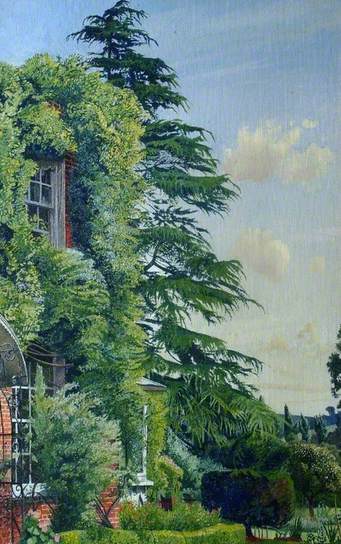
Stanley Spencer, "The Vale of Health, Hampstead" (c. 1940)

Did Thomas Hardy have Gray's "yew-tree's shade" in mind when he wrote the closing lines of the following poem?

                                    Lying Awake

You, Morningtide Star, now are steady-eyed, over the east,
     I know it as if I saw you;
You, Beeches, engrave on the sky your thin twigs, even the least;
     Had I paper and pencil I'd draw you.

You, Meadow, are white with your counterpane cover of dew,
     I see it as if I were there;
You, Churchyard, are lightening faint from the shade of the yew,
     The names creeping out everywhere.

Thomas Hardy, Winter Words in Various Moods and Metres (1928).

Putting aside yews for a moment, notice the downward movement of the poem:  from the Morningtide Star in the sky, to the twigs of the Beeches against the sky, to the earth of the Meadow, and then to the Churchyard, with its graves.  "The names creeping out everywhere" is marvelous, isn't it? The combination of emotional impact and exactly-accurate description (picture in your mind's eye the engraved names on the tombstones gradually becoming more distinct as the sun rises -- the shadows in the recessed letters) is wonderful.  It is one of Hardy's finest lines, I think.

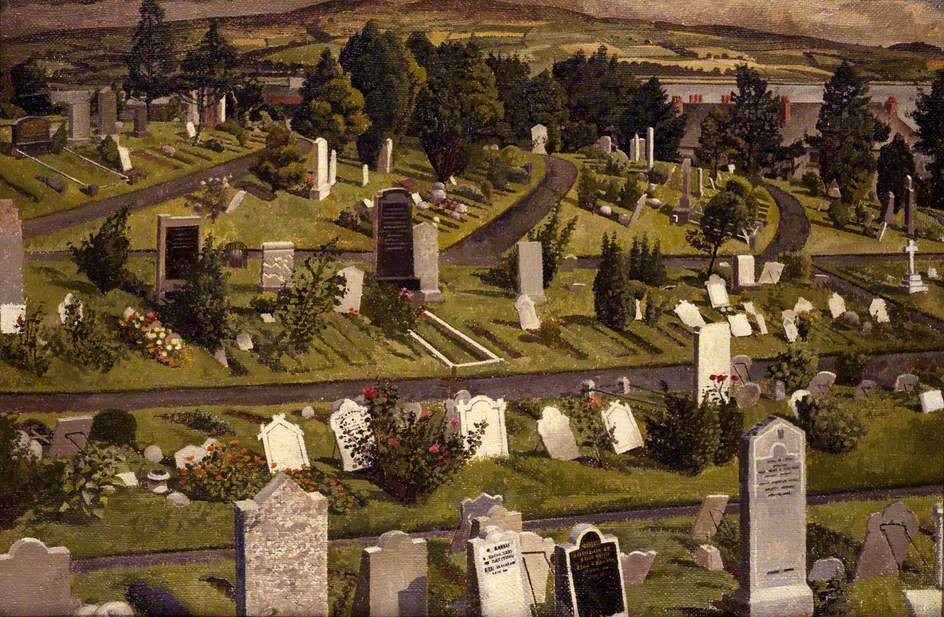
Stanley Spencer, "Port Glasgow Cemetery" (1957)

On a more humorous note, here is the final stanza (fittingly) of Louis MacNeice's "Tree Party":

Your health, Master Yew.  My bones are few
And I fully admit my rent is due,
But do not be vexed, I will postdate a cheque for you.

Louis MacNeice, The Burning Perch (1963).

Stanley Spencer, "Rock Gardens, Cookham Dean" (1940-1947)

                         The Yew

The moon gave no light.
The clouds rode slowly over, broad and white,
From the soft south west.
The wind, that cannot rest,
Soothed and then waked the darkness of the yew
Until the tree was restless too.

Of all the winds I knew
I thought, and how they muttered in the yew,
Or raved under the eaves,
Or nosed the fallen dry leaves,
Or with harsh voice holloa'd the orchard round,
With snapped limbs littering the ground.

And I thought how the yew
Between the window and the west his shadow threw,
Grave and immense,
Darkening the dark past thought and sense,
And how the moon would make the darkness heavenly bright:
But the moon gave no light.

John Freeman, Poems New and Old (1920).

Stanley Spencer, "Landscape, Cookham Dean" (c. 1939)

Saturday, March 2, 2013

Four-Line Poems, Part Three: "The Wind In The Tree"

Tens of thousands of poems have been written about love:  found love, lost love, requited love, unrequited love -- love in all of its permutations and guises.  The lovers have aired their emotions in sonnets, canzoni, odes, and other traditional poetic forms, often going to great lengths to articulate that which may be ultimately inexpressible.

However, I respectfully suggest that it may be possible to capture love (momentarily and evanescently) in a four-line poem.

Stanley Spencer, "The Ferry Hotel Lawn, Cookham" (1936)

               The Wind in the Tree

She has decided that she no longer loves me.
There is nothing to be done.  I long ago
As a child thought the tree sighed 'Do I know
Whether my motion makes the wind that moves me?'

F. T. Prince, Poems (1938).

Stanley Spencer
"Englefield House, Cookham" (1951)

The following is my humble contribution to the genre of the four-line lost love poem.

     The Land with Wind in the Leaves

Distance cannot remove me from that place.
I stand half a world away and here it is:
A green sway and roar -- blue, vast, open
And refusing always to let me depart.

     Yorkshire 1987 -- Tokyo 1992

sip (Tokyo/Seattle 1992).

I wish to strongly emphasize:  it does not, of course, hold a candle to "The Wind in the Tree."  But, to borrow from Louis MacNeice ("Star-gazer"):  "To me if to no one else the [subject] is of some interest."  I wrote the poem before I encountered "The Wind in the Tree."

And that's all I have to say about that.

Stanley Spencer, "Garden at Whitehouse, Northern Ireland" (1952)

Wednesday, January 9, 2013

"A Glimpse Of Immaculate Sand That Awaits Our Footprints"

Louis MacNeice's and Seamus Heaney's like-titled poems "The Strand" reminded me of the closing image of a lovely poem by Michael Longley, who has written many fine poems that are set along the margins of the sea.

                        Bjorn Olinder's Pictures

I have learned about dying by looking at two pictures
Bjorn Olinder needed to look at when he was dying:
A girl whose features are obscured by the fall of her hair
Planting a flower,
                                   and a seascape:  beyond the headland
A glimpse of immaculate sand that awaits our footprints.

Michael Longley, The Weather in Japan (Jonathan Cape 2000).

                                   William Baziotes, "Water Forms" (1961)

Many of Longley's seaside poems are inspired by Carrigskeewaun in County Mayo.  I suspect that the following poem may be set there.

                         Phosphorescence

There was light without heat between the stepping stones
And the duach, at every stride the Milky Way.
Her four or five petals hanging from an eyelash,
Venus bloomed like brookweed next to the Pleiades.

Michael Longley, Gorse Fires (1991).  In a note to his collection Snow Water (Jonathan Cape 2004) Longley writes:  "machair is Irish and Scots Gaelic for a sandy plain found behind dunes and affording some pasturage: duach, the Irish for sandbanks or dunes, means in Mayo the same as machair."

An aside:  the Japanese word for what in English is called "the Milky Way" is amanogawa.  "Ama" means "sky" or "the heavens"; "no" means "of"; "gawa" (i.e., "kawa," which often changes to "gawa" in compound words) means "river."  Thus, two possible translations might be:  "river of the sky" or "river of the heavens."  Beautiful:  a river of stars.

                                    William Baziotes, "Opalescent" (1962)

Regarding the sea, the night sky, and the Pleiades, the following untitled poem by A. E. Housman (which I have previously posted) comes to mind:

The weeping Pleiads wester,
     And the moon is under seas;
From bourn to bourn of midnight
     Far sighs the rainy breeze:

It sighs from a lost country
     To a land I have not known;
The weeping Pleiads wester,
     And I lie down alone.

A. E. Housman, Poem X, More Poems (1936).  Housman composed an alternate version of the poem, which appears in my previous post as well. Both of the poems are based, in part, on a poem by Sappho.

William Baziotes, "Sea Phantoms" (1952)

Monday, January 7, 2013

"The Strand"

On my daily walk, I sometimes visit a lighthouse that is located on a point that juts out into Puget Sound.  The beach is strewn with driftwood -- large grey-white logs in many cases, especially in winter, when the wind and the currents have brought them across the Sound from the west.

Ocean freighters arrive and depart out on the horizon.  I have seen no "quinquireme of Nineveh from distant Ophir."  (John Masefield, "Cargoes.")  Rather, these ships have come from, or are bound for, places such as Shanghai, Qingdao, Yantian, and Ningbo.

                                      W. E. Leadley, "Driftwood" (1960)

                           The Strand

White Tintoretto clouds beneath my naked feet,
This mirror of wet sand imputes a lasting mood
To island truancies; my steps repeat

Someone's who now has left such strands for good
Carrying his boots and paddling like a child,
A square black figure whom the horizon understood --

My father.  Who for all his responsibly compiled
Account books of a devout, precise routine
Kept something in him solitary and wild,

So loved the western sea and no tree's green
Fulfilled him like these contours of Slievemore
Menaun and Croaghaun and the bogs between.

Sixty-odd years behind him and twelve before,
Eyeing the flange of steel in the turning belt of brine
It was sixteen years ago he walked this shore

And the mirror caught his shape which catches mine
But then as now the floor-mop of the foam
Blotted the bright reflections -- and no sign

Remains of face or feet when visitors have gone home.

Louis MacNeice, Holes in the Sky (1948).

                                                Paul Nash, "Plage" (1928)

MacNeice wrote "The Strand" in 1945.  A half-century later, Seamus Heaney published the following poem.  The players are the same:  a father, a son, and the strand.  But Heaney has distilled things down to three lines. And has perhaps come to a different conclusion.

                      The Strand

The dotted line my father's ashplant made
On Sandymount Strand
Is something else the tide won't wash away.

Seamus Heaney, The Spirit Level (Faber and Faber 1996).

  Maxwell Armfield, "Seven Sisters" (1944)

Thursday, January 3, 2013

"The Piers Are Pummelled By The Waves"

The ode by Horace that I discussed in my previous post contains an image of a tempestuous Tyrrhenian Sea in winter.  In Derek Mahon's translation of the ode, the winter is described as one that "flings the high Tyrrhenian waves on the stone piers."  Louis MacNeice uses similar imagery in his translation:  the winter "on the ramparts of rock is exhausting the battering waves."

Something about the wind-tossed Tyrrhenian waves pounding the shore seemed vaguely familiar.  At my age, these inklings sometimes remain inchoate.  However, if I wait patiently, what I am looking for may arrive unexpectedly.  I eventually remembered the following poem by W. H. Auden.

                                Richard Eurich, "Marine Harvest" (1949)

            The Fall of Rome

The piers are pummelled by the waves;
In a lonely field the rain
Lashes an abandoned train;
Outlaws fill the mountain caves.

Fantastic grow the evening gowns;
Agents of the Fisc pursue
Absconding tax-defaulters through
The sewers of provincial towns.

Private rites of magic send
The temple prostitutes to sleep;
All the literati keep
An imaginary friend.

Cerebrotonic Cato may
Extol the Ancient Disciplines,
But the muscle-bound Marines
Mutiny for food and pay.

Caesar's double-bed is warm
As an unimportant clerk
Writes I DO NOT LIKE MY WORK
On a pink official form.

Unendowed with wealth or pity,
Little birds with scarlet legs,
Sitting on their speckled eggs,
Eye each flu-infected city.

Altogether elsewhere, vast
Herds of reindeer move across
Miles and miles of golden moss,
Silently and very fast.

W. H. Auden, Nones (1951).  Auden wrote the poem in 1947.

I'm afraid that I have no arcane or profound parallels of any sort to draw between Auden and Horace.  I was only thinking of the waves of the Tyrrhenian Sea ("mare Tyrrhenum") crashing upon piers in winter.

                       Richard Eurich, "Coast Scene with a Rainbow" (1952)

Tuesday, January 1, 2013

How To Live, Part Nineteen: The New Year

I am not one for making New Year's resolutions.  But I am willing to listen to advice.  Perhaps the best-known piece of advice on How to Live was given by Horace:  carpe diem, quam minimum credula postero.  In The Oxford Dictionary of Latin Words and Phrases (1998) the phrase is translated as follows:  "seize the day, trusting as little as possible to the morrow."  Yes, of course:  carpe diem.  We've all heard it before.  Like most well-meaning advice, easier said than done.

The phrase appears in Ode 11 of Book One of Horace's Odes.  As one might expect, the poem has been translated into English numerous times, with varying degrees of fidelity to the original.  The following version is by Derek Mahon.

                              How to Live

Don't waste your time, Leuconoe, living in fear and hope
of the imprevisible future; forget the horoscope.
Accept whatever happens.  Whether the gods allow
us fifty winters more or drop us at this one now
which flings the high Tyrrhenian waves on the stone piers,
decant your wine.  The days are more fun than the years
which pass us by while we discuss them.  Act with zest
one day at a time, and never mind the rest.

Derek Mahon, Selected Poems (Viking/The Gallery Press 1991).

          Osmund Caine, "Wedding at Twickenham Parish Church" (1948)

Louis MacNeice also tried his hand at it:

Do not, Leuconoe, seek to inquire what is forbidden, what
End the gods have assigned to you or to me; nor do you meddle with
Astrological numbers.  What shall arise count to your balance if
God marks down to you more winters -- or perhaps this very one is the
Last which now on the rocks wears out the fierce Mediterranean
Sea; but be wise and have wine, wine on the board, prune to a minimum
Long-drawn hopes.  While we chat, envious time threatens to give us the
Slip; so gather the day, never an inch trusting futurity.

E. R. Dodds (editor), Collected Poems of Louis MacNeice (Faber and Faber 1966).

                            Osmund Caine, "Washing at No. 25, Kingston"

I have a soft spot for the following version by Sir Thomas Hawkins (from 1625):

Strive not, Leuconoe, to know what end
The gods above to me or thee will send;
Nor with astrologers consult at all,
That thou mayst better know what can befall;
Whether thou liv'st more winters, or thy last
Be this, which Tyrrhen waves 'gainst rocks do cast.
Be wise!  drink free, and in so short a space
Do not protracted hopes of life embrace,
Whilst we are talking, envious time doth slide:
This day's thine own; the next may be denied.

Horace, The Odes, Epodes, Satires, and Epistles, Translated by the Most Eminent English Scholars and Poets (1889).

The Elizabethans, though oftentimes flowery, were pretty good at getting to the heart of the matter in a pithy, lovely fashion when they wanted to.  I am put in mind of, for instance, Robert Devereux's "Happy were he could finish forth his fate/In some unhaunted desert," which I have posted here previously.

There was something about the intrigue and the danger of the time which, I think, tended to concentrate the mind (to borrow from Samuel Johnson in another context).  I am reminded of, say, Walter Raleigh and Henry Howard, Earl of Surrey, writing poetry in their dungeons as they awaited their beheadings.  (A fate shared by Devereux as well.)

                      Osmund Caine, "The Hoby Effigies, Bisham Church"

Monday, November 26, 2012

Compensations, Revisited

In a recent post, I suggested that autumn's losses are accompanied by compensations.  One of those compensations is the sound of empty trees. The other day I walked down an avenue of mostly leafless trees -- only a few stragglers remained, most of them, curiously, out on the tips of branches.

The day was breezy.  The trunks creaked, as I imagine the masts of a wooden ship might creak in a wind.  Higher up, the empty branches clacked and clattered against each other.  To borrow from Wallace Stevens's "The Region November":  the trees seemed to be "saying and saying."  But not, alas, in any known language.  Which is not to say that communication is wholly impossible.

The fairy tale atmosphere of James Elroy Flecker's "November Eves" and Louis MacNeice's "The Riddle" may be apt as well.  As may be the following poem by Thomas Hardy.

                                    Emily Carr, "Inside a Forest" (c. 1935)

             Night-Time in Mid-Fall

It is a storm-strid night, winds footing swift
          Through the blind profound;
     I know the happenings from their sound;
Leaves totter down still green, and spin and drift;
The tree-trunks rock to their roots, which wrench and lift
The loam where they run onward underground.

The streams are muddy and swollen; eels migrate
          To a new abode;
     Even cross, 'tis said, the turnpike-road;
(Men's feet have felt their crawl, home-coming late):
The westward fronts of towers are saturate,
Church-timbers crack, and witches ride abroad.

Thomas Hardy, Human Shows, Far Phantasies, Songs and Trifles (1925).

                                          Emily Carr, "Clearing" (1942)

Saturday, November 24, 2012

"November Eves"

I am writing this in the cold clime in which I was born, visiting relatives for Thanksgiving.  Yesterday, the temperature dropped about 25 degrees in the space of 12 hours or so.  Borne on an icy wind, snow arrived in the evening.

This morning, a childhood of winters came rushing back.  "The snows of yesteryear" and all that.  Not in minute detail, but in the form of emotion. The sort of emotion that sank down into your bones decades ago, without your knowing it.  Now, here it is again, all of it.

                      John Piper, "The Tithe Barn, Great Coxwell" (c. 1940)

                November Eves

November Evenings!  Damp and still
They used to cloak Leckhampton hill,
And lie down close on the grey plain,
And dim the dripping window-pane,
And send queer winds like Harlequins
That seized our elms for violins
And struck a note so sharp and low
Even a child could feel the woe.

Now fire chased shadow round the room;
Tables and chairs grew vast in gloom:
We crept about like mice, while Nurse
Sat mending, solemn as a hearse,
And even our unlearned eyes
Half closed with choking memories.

Is it the mist or the dead leaves,
Or the dead men -- November eves?

James Elroy Flecker, The Old Ships (1917).

                    John Piper, "The River Approach, Fawley Court" (1940)

The fairy tale feeling of Flecker's poem is reminiscent of a poem by Louis MacNeice.

                             The Riddle

'What is it that goes round and round the house'
The riddle began.  A wolf, we thought, or a ghost?
Our cold backs turned to the chink in the kitchen shutter,
The range made our small scared faces warm as toast.

But now the cook is dead and the cooking, no doubt, electric,
No room for draught or dream, for child or mouse,
Though we, in another place, still put ourselves the question:
What is it that goes round and round the house?

Louis MacNeice, Solstices (1961).

                                                      John Piper
      "Tombstones, Holy Trinity Churchyard, Hinton-in-the-Hedges (1940)

Thursday, July 19, 2012

Hospital Poems, Part Five: "And If I Am Lucky, Find Some Link, Some Link"

I have previously suggested that Bernard Spencer (1909-1963) is a "neglected poet."  Thus, I am pleased to report that his poems have recently come back into print (Complete Poetry, Translations and Selected Prose, edited by Peter Robinson, Bloodaxe Books).  As I noted in my earlier post on Spencer, his poetry reminds me of that of Louis MacNeice (they were, in fact, acquaintances; they both died too young in September of 1963). Perhaps the resemblance has something to do with an urbanity of tone, together with a certain irony, with a bit of reserve thrown in.  (I suppose that this description fits a number of English poets of the Thirties, Forties, and Fifties.  A. S. J. Tessimond comes to mind, for instance.)

Spencer worked for the British Council in various European (usually Mediterranean) countries.  His poetry vividly reflects all of the locations in which he lived.  At one point, he contracted tuberculosis, and, as a result, spent some time in a hospital in Switzerland in 1948.  The following poem is about that hospital stay.

               William Ratcliffe (1870-1955), "The Conservatory Window"

               In a Foreign Hospital

Valleys away in the August dark the thunder
roots and tramples: lightning sharply prints
for an instant trees, hills, chimneys on the night.
We lie here in our similar rooms with the white
furniture, with our bit of Death inside us
(nearer than that Death our whole life lies under);
the man in the next room with the low voice,
the brown-skinned boy, the child among its toys
and I and others.  Against my bedside light
a small green insect flings itself with a noise
tiny and regular, a 'tink; tink, tink'.

A Nun stands rustling by, saying good night,
hooded and starched and smiling with her kind
lifeless, religious eyes.  'Is there anything
you want?' -- 'Sister, why yes, so many things:'
England is somewhere far away to my right
and all Your letter promised; days behind
my left hand or my head (or a whole age)
are dearer names and easier beds than here.
But since tonight must lack for all of these
I am free to keep my watch with images,
a bare white room, the World, an insect's rage,
and if I am lucky, find some link, some link.

Bernard Spencer, With Luck Lasting (1963).

The phrase "all Your letter promised" in line 17 may refer to his first wife Nora, who died of tuberculosis-related heart failure in June of 1947.  His lovely poem "At Courmayeur" (which I have previously posted) is based upon their planned holiday in the Alps that was foreclosed by her death.

                      William Ratcliffe, "Regent's Canal at Hammersmith"