
Sunday, June 8, 2014

No Escape, Part Thirteen: "Switch Love, Move House -- You Will Soon Be Back Where You Started"

I am intimately familiar with both the dream of Escape and its companion, the Siren song of the Ideal Place.  A long-time reader of this blog recently commented that he had spent his holiday in the Lincolnshire Wolds. Being unfamiliar with the area, I did some Internet research.  Upon seeing how lovely the area is, I soon began dreaming of spending my remaining years in a secluded vale amid the Wolds, "and a small cabin build there, of clay and wattles made."  With occasional treks eastward to the North Sea for a walk along the shingle.  And so it goes . . .

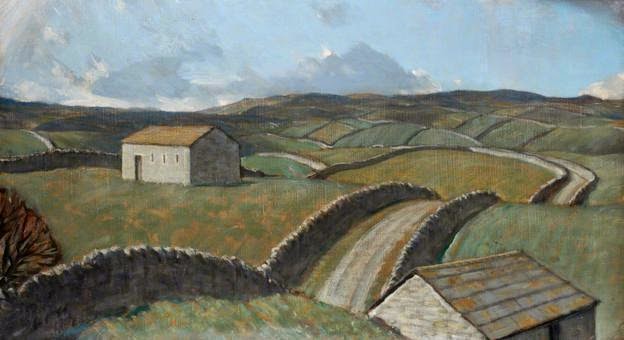
Harry Epworth Allen (1894-1958), "Summer" (1940)

The theme of this "No Escape" series of posts is:  "Wherever you go, there you are."  As I have noted before, this notion is not a contemporary pop psychology platitude.

"Ambition, avarice, irresolution, fear, and lust do not leave us when we change our country . . . Someone said to Socrates that a certain man had grown no better by his travels.  'I should think not,' he said, 'he took himself along with him.'"

Michel de Montaigne, "Of Solitude," The Complete Essays of Montaigne (translated by Donald Frame) (Stanford University Press 1958).

Two centuries or so later Samuel Johnson retraced Montaigne's steps:

"The general remedy of those, who are uneasy without knowing the cause, is change of place; they are willing to imagine that their pain is the consequence of some local inconvenience, and endeavour to fly from it, as children from their shadows; always hoping for more satisfactory delight from every new scene, and always returning home with disappointments and complaints. . . . [H]e, who has so little knowledge of human nature, as to seek happiness by changing any thing, but his own dispositions, will waste his life in fruitless efforts, and multiply the griefs which he purposes to remove."

Samuel Johnson, The Rambler, Number 6 (April 7, 1750).

Yes, yes, well said, sirs.  But easier said than done.

Harry Epworth Allen, "The Caravan"

                         Ideal Home

                                   1

Never would there be lives enough for all
The comely places --
Glimpsed from a car, a train, or loitered past --
That lift their faces
To be admired, murmuring 'Live with me.'

House with a well,
Or a ghost; by a stream; on a hill; in a hollow: breathing
Woodsmoke appeal,
Fresh paint, or simply a prayer to be kept warm,
Each casts her spell.

Life, claims each, will look different from my windows,
Your furniture be
Transformed in these rooms, your chaos sorted out here.
Ask for the key.
Walk in, and take me.  Then you shall live again.

                                   2

. . . Nor lives enough
For all the fair ones, dark ones, chestnut-haired ones
Promising love --
I'll be your roof, your hearth, your paradise orchard
And treasure-trove.
With puritan scents -- rosemary, thyme, verbena,
With midnight musk,
Or the plaintive, memoried sweetness tobacco-plants
Exhale at dusk,
They lure the footloose traveller to dream of
One fixed demesne,
The stay-at-home to look for his true self elsewhere.
I will remain
Your real, your ideal property.  Possess me.
Be born again.

                                   3

If only there could be lives enough, you're wishing? . . .
For one or two
Of all the possible loves a dozen lifetimes
Would hardly do:
Oak learns to be oak through a rooted discipline.

Such desirableness
Of place or person is chiefly a glamour cast by
Your unsuccess
In growing your self.  Rebirth needs more than a change of
Flesh or address.

Switch love, move house -- you will soon be back where you started,
On the same ground,
With a replica of the old romantic phantom
That will confound
Your need for roots with a craving to be unrooted.

C. Day Lewis, The Gate and Other Poems (1962).

Harry Epworth Allen, "A Derbyshire Farmstead"

Thursday, June 5, 2014

Fish

A confession:  I don't find puns humorous.  Mind you, I find much in life and in the world that is quite humorous.  But puns?  No, not puns.  I realize that there are those who find puns delightful and highly entertaining.  Just as there are those who find mimes and limericks and clowns to be delightful and highly entertaining.  I shan't pass judgment.

William Wigley (1880-1943), "Mevagissey Quay, Cornwall"

I do reserve the right to make rare (extremely rare) and wholly arbitrary exceptions.  Thus, I shall give Derek Mahon a pass on the following poem.

                    Soles

'I caught four soles this morning'
said the man with the beard;
cloud shifted and a sun-
shaft pierced the sea.
Fisher of soles, did you reflect
the water you walked on
contains so very many souls,
the living and the dead,
you could never begin to count them?

Somewhere a god waits,
rod in hand,
to add you to their number.

Derek Mahon, Poems 1962-1978 (Oxford University Press 1979).

As a child 50-odd years ago in Scandinavian, Lutheran Minnesota, I attended what was called "Sunday school."  Every so often we would sing, as a group, a song called "I Will Make You Fishers Of Men."  As we sang, we made casting and reeling-in motions with our arms and hands.  I offer this simply as a random recollection of a lost world, not in the service of any message or creed.

William Peters Vannet, "Arbroath Harbour" (c. 1940)

"Soles" puts me in mind of this:

     Fisherman and/or Fish

There was a time when I,
The river's least adept,
Eagerly leapt, leapt
To the barbed, flirtatious fly.

Thrills all along the line,
A tail thrashing -- the sport
Enthralled: but which was caught,
Which reeled the other in?

Anglers aver they angle
For love of the fish they play
(Arched spine and glazing eye,
A gasping on the shingle).

I've risen from safe pools
And gulped hook line and sinker
(Oh, the soft merciless fingers
Fumbling at my gills!)

Let last time be the last time
For me with net or gaff.
I've had more than enough
Of this too thrilling pastime.

The river's veteran, I
Shall flick my rod, my fin,
Where nothing can drag me in
Nor land me high and dry.

C. Day Lewis, The Gate and Other Poems (1962).

C. Day Lewis is usually lumped together with W. H. Auden, Louis MacNeice, and Stephen Spender as one of the "Thirties Poets."  I prefer the more personal lyrical poetry of his later years.  His earlier poetry has a political cast (no pun intended!) that I find boring.

But I am one of those who believes that "political poetry" is an oxymoron. Hence, for example, a phrase such as "the poetry of witness" gives me the willies.  (And makes me want to immediately immerse myself in the poetry of, say, Ernest Dowson or Philip Larkin or Emily Bronte.)  But to each their own.  We all have our own peculiar axes to grind and oxen to gore.

Richard Eurich, "Coast Scene with a Rainbow" (1952)

Sunday, June 1, 2014

Watermills

Given that windmills were the subject of my previous post, I ought to consider watermills as well.  Those that were once bustling, but are now abandoned, have often been an evocative subject for poets.

          Requiem for a Mill

They took away the water-wheel,
Scrap-ironed all the corn-mill;
The water now cascades with no
Audience pacing to and fro
Taking in with casual glance
Experience.

The cold wet blustery winter day
And all that's happening will stay
Alive in the mind: the bleak
Water-flushed meadows speak
An enduring story
To a man indifferent in a doorway.

Packaged, pre-cooked flakes have left
A land of that old mill bereft.
The ghosts that were so local coloured
Hiding behind bags of pollard
Have gone from those empty walls.
The weir still curves its waterfalls
But lets them drop in the tailrace
No longer wildly chivalrous.

And with this mention we withdraw
To things above the temporal law.

Patrick Kavanagh, Come Dance with Kitty Stobling and Other Poems (1960).

Stanley Bryan, "Botley Flour Mill Loading Barn" (1955)

Like Kavanagh, Edward Thomas notices the ghostly feel of an idle mill.

                    The Mill-Water

Only the sound remains
Of the old mill;
Gone is the wheel;
On the prone roof and walls the nettle reigns.

Water that toils no more
Dangles white locks
And, falling, mocks
The music of the mill-wheel's busy roar.

Pretty to see, by day
Its sound is naught
Compared with thought
And talk and noise of labour and of play.

Night makes the difference.
In calm moonlight,
Gloom infinite,
The sound comes surging in upon the sense:

Solitude, company, --
When it is night, --
Grief or delight
By it must haunted or concluded be.

Often the silentness
Has but this one
Companion;
Wherever one creeps in the other is:

Sometimes a thought is drowned
By it, sometimes
Out of it climbs;
All thoughts begin or end upon this sound,

Only the idle foam
Of water falling
Changelessly calling,
Where once men had a work-place and a home.

Edna Longley (editor), Edward Thomas: The Annotated Collected Poems (Bloodaxe Books 2008).

Perhaps I am overreaching, but I hear in the fifth stanza a hint of what was to come in Thomas's second-to-last poem.  The poem has appeared here before, but here is its final stanza:

How weak and little is the light,
All the universe of sight,
Love and delight,
Before the might,
If you love it not, of night.

Edward Thomas, "Out in the Dark," Ibid.

In connection with "The Mill-Water," Edna Longley points us to a prose passage by Thomas about "a lifeless mill":

"Each evening, just when the first nightjar was skimming the wood, the sedge-warblers began to sing all together round the pool.  The song might have been the abstract voice of some old pain, feebly persistent.  It went far into the night with a power of ghostly alarms, and attuned to such thoughts as come when night in certain places is malign, reverses the sweet work of the day, and gives the likeness of a dragon to the pleasant corner of a wood. The birds were full of prelusive dark sayings about the approaching night."

Ibid, page 253, quoting from Edward Thomas, "Isoud with the White Hands," Horae Solitariae (1902), pages 178-179.

"Prelusive dark sayings about the approaching night" is wonderful, isn't it?

George Vicat Cole, "Iffley Mill" (1884)

The following poem could pass for a haiku, save for its length, and save for the fact that it was written in Victorian England.

                       A Mill

Two leaps the water from its race
     Made to the brook below,
The first leap it was curving glass,
     The second bounding snow.

William Allingham, By the Way: Verses, Fragments, and Notes (1912).

John Aldridge, "Old Mill, West Harnham" (1948)

Wednesday, May 28, 2014

Windmills

I recently stumbled across a movie that I hadn't seen in years:  Foreign Correspondent, which was directed by Alfred Hitchcock.  Although it was originally released in August of 1940, when the war had already begun, it has an atmosphere that is similar to (though lightened up by Hollywood) the pre-war Eric Ambler novels of that time:  Background to Danger, A Coffin for Dimitrios, and Cause for Alarm.

It is entertaining, witty, and -- to borrow a word from my previous post -- charming.  I will risk being found out as a curmudgeon by saying:  "They don't make movies like that anymore!"  Well, they don't.

One of its best scenes takes place outside and inside a clattering windmill located on a wide, windy plain, beneath a louring sky, in the Dutch countryside (i.e., in a studio in California).  Why do I bring this up? Because I highly recommend both the scene and the movie.  And because it provides a segue (however tenuous) to two poems about windmills by Arthur Symons, one of Ernest Dowson's fellow Decadent poets.

Robert Burford (1791-1861)
"View of Chelsea Hospital from the South Bank at Battersea" (1812)

           The Windmill

The day is enough for delight;
Why, as I lie on the grass,
And watch the clouds as they pass,
Do I reason of wrong and right?

Only to be, and the breath
I take is all that I need,
Were I but as the flower and weed
That live without thought of death.

But death and right and wrong,
As the windmill turns on the hill
Turn like a burden still
That I cannot cast out of my song.

Arthur Symons, Knave of Hearts (1913).

Symons wrote "The Windmill" in 1906 at the age of 41.  Thus, it does not have the youthful melancholy and the free-floating romantic longing that one finds in the typical poems of the Nineties.  The century had turned.  The moment had passed.  And Symons was three years away from a severe mental breakdown.

John Samuel Raven, "A Sussex Mill" (1858)

On the other hand, the following poem does have a classic Decadent feel to it, and not merely because it was written in 1897, and not merely because of its theme of lost love and lacerating memory.

                              A Tune

A foolish rhythm turns in my idle head
As a windmill turns in the wind on an empty sky.
Why is it when love, which men call deathless, is dead,
That memory, men call fugitive, will not die?
Is love not dead? yet I hear that tune if I lie
Dreaming awake in the night on my lonely bed,
And an old thought turns with the old tune in my head
As a windmill turns in the wind on an empty sky.

Arthur Symons, Images of Good and Evil (1899).

The character of the Nineties is, I think, evident in the sound and rhythm of the poem.  For instance:  "And an old thought turns with the old tune in my head/As a windmill turns in the wind on an empty sky."  Note that the final line is a repetition of the second line.  These sorts of repetitions are a typical feature of Nineties poetry:  the Decadents were fond of repeating words, phrases, and lines within a poem in order to create a sonorous, dreamlike flow.

And this is wonderful:  "Dreaming awake in the night on my lonely bed."  A line such as this could almost be viewed as a parody of the Decadent worldview.  "Dreaming awake"!  But, as I have noted before, I can't help myself:  I have a genuine, wholly unironic fondness for the poets of the Nineties.

John Linnell, "The Windmill" (1844)

Sunday, May 25, 2014

Robins And Thrushes

One of the beguiling features of both the Elizabethan poets and the Cavalier poets of the early seventeenth century is their charm.  They lived in a world that was every bit as contingent as ours -- more so in fact, what with the prospect of the Plague arriving at one's doorstep, or of a speedy beheading for running afoul of the monarch -- but there is no mewling in their poetry. We, on the other hand, live in the Age of Mewling: everyone, it seems, is nursing a grievance of some sort, and is demanding immediate attention and (needless to say) restitution.

The Elizabethans and the Cavaliers write of mortality and death without complaint, and with a grace and wit and good-natured stoicism that are refreshing.  They knew that life is a bubble and that we are best to enjoy it   -- and bear its vicissitudes with dignity and good humor -- while we can, since tomorrow we may be in the ground.  Hence their charm.

John Milne Donald, "The Tree" (1861)

Here, then, is charm without mewling.

               To Robin Redbreast

Laid out for dead, let thy last kindness be
With leaves and moss-work for to cover me:
And while the wood-nymphs my cold corpse inter,
Sing thou my dirge, sweet-warbling chorister!
For epitaph, in foliage, next write this:
Here, here the tomb of Robin Herrick is.

Robert Herrick, Hesperides (1648).

William Samuel Jay (1843-1933)
"The Ring Dove's Elysium"

Speaking of beheadings, Robert Devereux, Earl of Essex, suffered that fate for intriguing against Elizabeth I.  During his brief but crowded life he had occasion to write the following untitled poem, which has appeared here previously, but is always worth revisiting.

Happy were he could finish forth his fate
     In some unhaunted desert, most obscure
From all societies, from love and hate
     Of worldly folk;  then might he sleep secure;
Then wake again, and give God ever praise,
     Content with hips and haws and bramble-berry;
In contemplation spending all his days,
     And change of holy thoughts to make him merry;
Where, when he dies, his tomb may be a bush,
Where harmless robin dwells with gentle thrush.

Robert Devereux, Earl of Essex, in Norman Ault (editor), Elizabethan Lyrics (1949).

Herrick and Devereux knew quite well what we all are in for.  But they were not the sort to whine about it.  Better to contemplate with equanimity a future transformation amongst the robins and the thrushes.  Charming.

W. N. Narbett, "Woodlands in May" (c. 1967)

Wednesday, May 21, 2014

"I Write Of Hell; I Sing (And Ever Shall) Of Heaven, And Hope To Have It After All"

This afternoon I walked down an alley of trees, beneath a canopy of leaves. Shadows and sunlight shifted back and forth on the ground as the boughs overhead swayed in the wind.  Seeing this play of dark and light, a Decadent poet of the Nineties would likely focus on the shadows, seeing in them the impending loss of Love or the menacing approach of Oblivion.

What a difference a couple of centuries makes!  A Cavalier poet of the first half of the 17th century -- although living in tempestuous and dangerous times, and being well aware of the fragility of life -- would likely focus on the sunlight, imagining it dancing in gaiety beneath an interlaced green and blue firmament.

Here, for example, is Robert Herrick (1591-1674) in the opening poem of his Hesperides:

               The Argument of His Book

I sing of brooks, of blossoms, birds and bowers,
Of April, May, of June and July-flowers;
I sing of May-poles, hock-carts, wassails, wakes,
Of bridegrooms, brides and of their bridal cakes;
I write of youth, of love, and have access
By these to sing of cleanly wantonness;
I sing of dews, of rains, and piece by piece
Of balm, of oil, of spice and ambergris;
I sing of times trans-shifting, and I write
How roses first came red and lilies white;
I write of groves, of twilights, and I sing
The Court of Mab, and of the Fairy King;
I write of hell; I sing (and ever shall)
Of heaven, and hope to have it after all.

Robert Herrick, Hesperides (1648).

What a lovely list!  And it is not all sweetness and light.  Nor is the World, of course.  But Herrick accepts -- and delights in -- whatever comes his way.

Rex Vicat Cole (1870-1940), "Cartmel Priory, Cumbria" (1935)

I am certainly not suggesting that Herrick is "right" and the Decadents are "wrong."  The beauty of poetry lies in the uncountable and inexhaustible ways human beings attempt to make sense of the World through words arranged in a particular order.

Here is Herrick on death, a subject dear to the hearts of the Decadents.

     After Autumn, Winter

Die ere long, I'm sure, I shall;
After leaves, the tree must fall.

Immediately following the above poem in Hesperides comes this:

               A Good Death

For truth I may this sentence tell,
No man dies ill, that liveth well.

When it comes to death, are these two poems lovelier, or "truer," than "Out of a misty dream/Our path emerges for a while, then closes/Within a dream"?  Who can say?  It is not a competition.  Some of us will opt for Herrick, some for Ernest Dowson.  I opt for both.

Rex Vicat Cole, "The Mill" (1922)

Be you a Decadent, or be you a Cavalier, there's no quarrelling with this, either as Art or as Life:

             The Coming of Good Luck

So good luck came, and on my roof did light,
Like noiseless snow, or as the dew of night:
Not all at once, but gently, as the trees
Are by the sunbeams tickled by degrees.

Robert Herrick, Ibid.

Rex Vicat Cole, "Kensington Gardens"

Saturday, May 17, 2014

"Isles Of Paradise"

Yearning is one of the defining characteristics of the poems written by the Decadent poets of the 1890s.  I will state at the outset that I find nothing wrong with yearning per se.  It is the twin of hope (albeit with more of an edge of desire and longing), which Samuel Johnson was wont to identify as an essential feature of what it means to be human.

For me, at least, the yearning of the Nineties poets is yearning at its best. Resigned, yes; melancholy, yes; but, for the most part, not querulous.  This is in contrast to our modern world, in which the yearning is whiny, and all about things.  The Decadent poets were not materialists.  Their yearning was romantic and spiritual and aesthetic.  I cannot fault them for this.  Did they sometimes take their yearning too far?  Perhaps.  But better that than, say, placing one's faith in Science and Progress and Politics.  We can all see where that has gotten us.

Harald Sohlberg, "Midsummer Night" (c. 1910)

                 Vanitas

Beyond the need of weeping,
     Beyond the reach of hands,
May she be quietly sleeping,
     In what dim nebulous lands?
Ah, she who understands!

The long, long winter weather,
     These many years and days,
Since she, and Death, together,
     Left me the wearier ways:
And now, these tardy bays!

The crown and victor's token:
     How are they worth to-day?
The one word left unspoken,
     It were late now to say:
But cast the palm away!

For once, ah once, to meet her,
     Drop laurel from tired hands:
Her cypress were the sweeter,
     In her oblivious lands:
Haply she understands!

Yet, crossed that weary river,
     In some ulterior land,
Or anywhere, or ever,
     Will she stretch out a hand?
And will she understand?

Ernest Dowson, Verses (1896).

Yes, it all seems -- to use Dowson's own words -- "dim" and "nebulous," doesn't it?  Who is "she"?  I haven't a clue.  The practical-minded among us will say "bosh!" or "humbug!"  Not I.

Harald Sohlberg, "Night" (1904)

On the other hand, we mustn't think that the late-19th century was all of a piece.  Consider, for instance, this:

I have trod the upward and the downward slope;
I have endured and done in days before;
I have longed for all, and bid farewell to hope;
And I have lived and loved, and closed the door.

Robert Louis Stevenson, Songs of Travel and Other Verses (1896).

One is not likely to think of Stevenson as a dreamy Nineties aesthete. There is a note of fortitude sounded here which one seldom finds in the Decadent poets.  Bear in mind that Stevenson, given his poor health, was always staring Death in the face.  He is certainly entitled to invoke some Decadent fatalism and melancholy.  And perhaps he does, just a bit:  "I have longed for all, and bid farewell to hope."  But overall the tone is resolute -- similar to that of his "Requiem" (which has appeared here previously):  "Glad did I live and gladly die,/And I laid me down with a will."

Moreover, Stevenson was willing to allow for the attainment, however brief, of Paradise on Earth.

Fair Isle at Sea -- thy lovely name
Soft in my ear like music came.
That sea I loved, and once or twice
I touched at isles of Paradise.

Robert Louis Stevenson, Poems (1916).  The "fair Isle at Sea" is Samoa.

A small poem, a slight poem some might say, but I can never get over its loveliness.

Harald Sohlberg, "Flower Meadow in the North" (1905)

Wednesday, May 14, 2014

"This Is The End Of All The Songs Man Sings"

The arrival of poetic moods is a funny thing.  In this part of the world, we are in the midst of a summer-like week:  all is bright and warm and abloom.  Yet, I have unaccountably found myself drawn into the twilit, misty, dream-laden, death-haunted world of the Decadent poets of the Nineties (the 1890s, that is).  Moreover, I am feeling perfectly serene and equable.  I am not cultivating gloom and melancholy.  As a matter of fact, reading their poetry makes me feel quite cheerful and at peace with the world.

Here, for instance, is the quintessential Nineties poem by the quintessential Nineties poet.  And a lovely poem it is.

Vitae summa brevis spem nos vetat incohare longam

They are not long, the weeping and the laughter,
          Love and desire and hate:
I think they have no portion in us after
          We pass the gate.

They are not long, the days of wine and roses:
          Out of a misty dream
Our path emerges for a while, then closes
          Within a dream.

Ernest Dowson, Verses (1896).

The title of the poem comes from Horace's Odes, I.iv, line 15, and may be translated as: "the short span of our life forbids us to indulge in a long-term hope."  Ernest Dowson, Collected Poems (edited by R. K. R. Thornton) (University of Birmingham Press 2003), page 225.

Paul Maitland, "Kensington Gardens" (c. 1890)

"Vitae summa brevis" is a carefree stroll in the park compared with this:

                                Dregs

The fire is out, and spent the warmth thereof,
(This is the end of every song man sings!)
The golden wine is drunk, the dregs remain,
Bitter as wormwood and as salt as pain;
And health and hope have gone the way of love
Into the drear oblivion of lost things.
Ghosts go along with us until the end;
This was a mistress, this, perhaps, a friend.
With pale, indifferent eyes, we sit and wait
For the dropt curtain and the closing gate:
This is the end of all the songs man sings.

Ernest Dowson, Decorations: In Verse and Prose (1899).

The basic elements of a Nineties poem are all here: "golden wine," ghosts, "pale, indifferent eyes," and wormwood (the source of absinthe, mais oui). And I cannot help but be seduced by the music of it all.  "This is the end of all the songs man sings" is wonderful, both in sound and sense.

Paul Maitland, "The Flower Walk, Kensington Gardens" (c. 1897)

Every respectable Decadent poet has to pay a visit to Hades and its five rivers.  In this case, the river is Acheron, haunt of Charon the Ferryman. However, Charon does not make an appearance here.  In his stead, we have a more illustrious figure:  Persephone, Queen of the Underworld.

          Villanelle of Acheron

By the pale marge of Acheron,
     Methinks we shall pass restfully,
Beyond the scope of any sun.

There all men hie them one by one,
     Far from the stress of earth and sea,
By the pale marge of Acheron.

'Tis well when life and love is done,
     'Tis very well at last to be,
Beyond the scope of any sun.

No busy voices there shall stun
     Our ears:  the stream flows silently
By the pale marge of Acheron.

There is the crown of labour won,
     The sleep of immortality,
Beyond the scope of any sun.

Life, of thy gifts I will have none,
     My queen is that Persephone,
By the pale marge of Acheron,
     Beyond the scope of any sun.

Ernest Dowson, Ibid.

Mind you, I am not in any way mocking these poems.  I admire them a great deal, and they always bring me pleasure.  No one does this sort of thing better than the Nineties poets.

Paul Maitland, "Fall of the Leaves, Kensington Gardens" (c. 1900)

Saturday, May 10, 2014

Corn

Growing up in Minnesota, my earliest images of excursions outside of the city were of lakes and cornfields.  Corn was emblematic of the farmlands that spread in all directions.  "Up North" lay the endless woods and the dark, granite lakes of the Iron Range.

My sharpest memories of corn are autumnal:  dry, rustling harvested stalks and, all around on the ground, bright yellow kernels.  All suffused with corn-scent.  And -- if we were lucky -- a huge sky full of Canadian geese flying southward in large, straggling V-formations, a wondrous and thrilling clamor of honks coming down from overhead.

But spring and summer were lovely as well:  row upon row of whispering and waving, deep-green limber stalks -- like fields of tall grass.  "Knee high by the Fourth of July" was what they used to say.

John Nash, "Ripe Corn" (1946)

These things never change, do they?  The following poem was written in China about 16 centuries ago.

                    New Corn

Swiftly the years, beyond recall.
Solemn the stillness of this fair morning.
I will clothe myself in spring-clothing
And visit the slopes of the Eastern Hill.
By the mountain-stream a mist hovers,
Hovers a moment, then scatters.
There comes a wind blowing from the south
That brushes the fields of new corn.

T'ao Ch'ien (365-427) (translated by Arthur Waley), in Arthur Waley, One Hundred and Seventy Chinese Poems (1918).

This poem is an excellent example of the beauty of Waley's translations. He is always faithful to the literal and emotional sense of the original.  But he is also a wonderful poet in his own right, with a fine sensibility.  Thus: "Swiftly the years, beyond recall."  One gets the feeling that this line is a bit more romantic than the Chinese original:  it seems to come out of centuries of English poetry.  But one is willing to give Waley the benefit of the doubt, because it is clear throughout his translations that he has immersed himself in a long-vanished world.

John Nash, "The Cornfield" (1918)

The next poem is of a different nature altogether.  It perhaps reflects the life of the man who wrote it, a life that was harsh and brutal in its beginnings. But withal I find it lovely.

                    The Villain

While joy gave clouds the light of stars,
     That beamed where'er they looked;
And calves and lambs had tottering knees,
     Excited, while they sucked;
While every bird enjoyed his song,
Without one thought of harm or wrong --
I turned my head and saw the wind,
     Not far from where I stood,
Dragging the corn by her golden hair,
     Into a dark and lonely wood.

W. H. Davies, The Song of Life and Other Poems (1920).

John Nash, "Cornfield at Wiston-by-Nayland, Suffolk" (1932)

Wednesday, May 7, 2014

"A Spark Of Fire Within A Beating Clod"

My recent preoccupation with "voices" or "intimations" from the World may leave me open to charges of wishful thinking.  I confess this may be true. At one time or another, I suspect that most of us have sighed:  "Is this all there is?"

                           Self-question

Is this wide world not large enough to fill thee,
     Nor Nature, nor that deep man's Nature, Art?
Are they too thin, too weak and poor to still thee,
                    Thou little heart?

Dust art thou, and to dust again returnest,
     A spark of fire within a beating clod.
Should that be infinite for which thou burnest?
                    Must it be God?

Mary Coleridge, in Theresa Whistler (editor), The Collected Poems of Mary Coleridge (Rupert Hart-Davis 1954).

"A spark of fire within a beating clod" is very fine indeed.

The yearning for intimations from outside of one's self is captured quite well in:  "Is this wide world not large enough to fill thee?"  Mary Coleridge wrote this poem in 1892.  Given the modern world's predilection for nonstop, superficial distraction and entertainment at all costs, her observation is even more compelling today.

Charles John Holmes, "A Moorland Road" (1923)

"A spark of fire within a beating clod" brings to mind "animula vagula blandula," which I mentioned in my previous post.  This is the first line of the poem that the Emperor Hadrian (76-138) is purported to have spoken on his death-bed.  The story may be apocryphal, but the poem -- whoever wrote it -- is lovely.

The poem has been translated out of Latin into other languages hundreds of times.  For instance, one can find 116 attempts in Translations, Literal and Free, of the Dying Hadrian's Address to His Soul (published in 1876). Here is Matthew Prior's version, which he describes as an "imitation":

Poor little, pretty, flutt'ring thing,
     Must we no longer live together?
And dost thou prune thy trembling wing,
     To take thy flight thou know'st not whither?

Thy humorous vein, thy pleasing folly
     Lies all neglected, all forgot:
And pensive, wav'ring, melancholy,
     Thou dread'st and hop'st thou know'st not what.

Matthew Prior, Poems on Several Occasions (1709).

The reference to "this clay" in the following translation by Byron echoes Coleridge's "beating clod":

Ah! gentle, fleeting, wav'ring sprite,
Friend and associate of this clay!
     To what unknown region borne,
Wilt thou, now, wing thy distant flight?
No more, with wonted humour gay,
     But pallid, cheerless, and forlorn.

George Gordon, Lord Byron, Hours of Idleness (1807).

Charles John Holmes, "The Yellow Wall, Blackburn" (1932)

Finally, the following poem by James Reeves goes very well with Coleridge's poem (and with "animula vagula blandula").

               Animula

No one knows, no one cares --
An old soul
In a narrow cottage,
A parlour,
A kitchen,
And upstairs
A narrow bedroom,
A narrow bed --
A particle of immemorial life.

James Reeves, Poems and Paraphrases (Heinemann 1972).

Charles John Holmes, "Bude Canal" (1915)