Tuesday, April 21, 2020

Here

What most human beings want is a little peace and quiet, don't you think?  Although we may be caught up in unwonted Events at the present time, the cultivation of "A Quiet Normal Life" goes on. Marcus Aurelius is correct: "The things themselves reach not to the soul, but stand without, still and motionless.  All your perturbation comes from inward opinions about them."  Meditations, Book IV, Section 3 (translated by Francis Hutcheson and James Moor, 1742). This is a roundabout way of telling you, dear readers, that it is once again time (begging your forbearance) to revisit my "April poem" (companion to my May, August, and November poems):

                    Wet Evening in April

The birds sang in the wet trees
And as I listened to them it was a hundred years from now
And I was dead and someone else was listening to them.
But I was glad I had recorded for him the melancholy.

Patrick Kavanagh, Collected Poems (edited by Antoinette Quinn) (Penguin 2004).

Most Aprils when I return to "Wet Evening in April" the weather in this part of the world is in harmony with the setting and the mood of the poem.  Thus, on more than one occasion I have read the poem on a rainy evening as birds converse in the trees before they settle down for the night.  But this April has been gratuitously brilliant, and on my walk this afternoon I passed through a "bee-loud glade," and the trees in all directions whispered: "Begin afresh, afresh, afresh."  I'm afraid I cannot muster any melancholy.  Yet the poem is as beautiful as ever.  We never know who we will be, or where we will find ourselves, when we revisit a poem, do we?

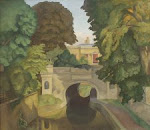
Robert Fowler (1853-1926), "Knaresborough"

The Events come and go, and take us or leave us.  But Patrick Kavanagh and Marcus Aurelius intimate that there is more to each of us than meets the eye.  The Events are not us.  Philippe Jaccottet brings this to our attention as well: "The imperceptible movement of an invisible soul and the enormous sun."  Philippe Jaccottet, notebook entry (October, 1967), in Seedtime: Notebooks, 1954-79 (translated by Tess Lewis) (Seagull Books 2013), page 159.  And this:

"Attachment to the self renders life more opaque.  One moment of complete forgetting and all the screens, one behind the other, become transparent so that you can perceive clarity to its very depths, as far as the eye can see; and at the same time everything becomes weightless.  Thus does the soul truly become a bird."

Philippe Jaccottet, notebook entry (May, 1954), Ibid, page 1.

In each moment, the Events are absent, meaningless.  There is more afoot in the World.

     The spring rain:
Between the trees is seen
     A path to the sea.

Otsuji (1881-1920) (translated by R. H. Blyth), in R. H. Blyth, Haiku, Volume 2: Spring (Hokuseido Press 1950), page 104.

William Mouncey (1852-1901), "Kirkcudbright Harbour"

Sunday, April 12, 2020

Events

Odd, the feeling of appearing to be at the whim of Events.  Surprising, disconcerting, interesting, and by turns a great deal else.  One's thoughts range from "Am I going to perish in the plague?" to "What if I run out of toilet paper?"  Not to minimize the situation in which we find ourselves, but those two queries (or ones of a similar nature and import) could have been posed a year ago -- or at any time between the present moment and the moment when each of us emerged out of the darkness into the bright World.

Well, then, here we are.  The Events have arrived.  Or perhaps they have been with us all along.  What shall we do?  Think back.  Hasn't that always been the pertinent question?

                              History

Sometimes, when walls and occupation seem
A prison merely, a dark barrier
Between me everywhere
And life, or the larger province of the mind,
As dreams confined,
As the trouble of a dream,
I seek to make again a life long gone,
To be
My mind's approach and consolation,
To give it form's lucidity,
Resilient form, as porcelain pieces thrown
In buried China by a wrist unknown,
Or mirrored brigs upon Fowey sea.

Then to my memory comes nothing great
Of purpose, or debate,
Or perfect end,
Pomp, nor love's rapture, nor heroic hours to spend --
But most, and strangely, for long and so much have I seen,
Comes back an afternoon
Of a June
Sunday at Elsfield, that is up on a green
Hill, and there,
Through a little farm parlour door,
A floor
Of red tiles and blue,
And the air
Sweet with the hot June sun cascading through
The vine-leaves under the glass, and a scarlet fume
Of geranium flower, and soft and yellow bloom
Of musk, and stains of scarlet and yellow glass.

Such are the things remain
Quietly, and for ever, in the brain,
And the things that they choose for history-making pass.

John Drinkwater, Loyalties (Sidgwick & Jackson 1919).

Harold Jones (1904-1992), "The Black Door"

In this part of the world, we are walking in the warm sunlight amidst snow showers of pink and white petals -- cherry, plum, and pear. What else can one do?

     Simply trust:
Do not also the petals flutter down,
     Just like that?

Issa (1763-1827) (translated by R. H. Blyth), in R. H. Blyth, Haiku, Volume 2: Spring (Hokuseido Press 1950), page 363.

Adrian Paul Allinson (1890-1959), "The Cornish April"

Saturday, April 4, 2020

Another April

"But it is a sort of April weather life that we lead in this world.  A little sunshine is generally the prelude to a storm."  Thus wrote William Cowper in a letter dated January 3, 1787.  And now, here we are: another April.  More of the same, don't you think?

Yesterday was the sort of April day described by Cowper.  In the evening, I drove to a neighborhood sushi restaurant to pick up dinner.  (Although restaurants are closed for dining, take out is still permitted, and it makes sense to support family-owned businesses.) Just then the sun was out, but it would soon set beyond Puget Sound and the Olympic Mountains, both at my back.  The street I took runs straight down a long steep hill, levels out for a few blocks, then runs straight up another steep hill to the east.  From the top of the hill, I could see the cherry trees -- in peak white bloom -- lining both sides of the street that climbs the opposite slope.  The slope, and the houses on it, were covered in sunlight.  A rainbow suddenly appeared above the hill on the other side of the valley.  Descending, I passed blooming cherry trees, and, here and there, tall magnolia trees full of large pink-white blossoms.

Another April.  More of the same.  A paradise.

            A Short Ode

All things then stood before us
        as they were,
Not in comparison,
But each most rare;
The 'tree, of many, one,'
The lock of hair,
The weir in the morning sun,
The hill in the darkening air,
Each in its soleness, then and there,
Created one; that one, creation's care.

Edmund Blunden, A Hong Kong House: Poems 1951-1961 (Collins 1962).

The quotation in line 5 comes from William Wordsworth's "Ode: Intimations of Immortality from Recollections of Early Childhood": "But there's a tree, of many, one,/A single field which I have look'd upon,/Both of them speak of something that is gone."  I presume this reference accounts for Blunden's title (contrasting his ode of ten lines with Wordsworth's of over 200 lines).

Samuel Llewellyn (1858-1941), "Sailing at Blakeney" (c. 1938)

As is my usual practice, I have been doing my best to avoid "news."  I hear about things such as "lockdowns" by word-of-mouth.  But snippets inevitably seep through the interstices, despite my vigilance. For instance, I have recently been seeing and hearing the word "unprecedented" quite often.  "Unprecedented."  Is that so?

As is also my usual practice, I have been reading a poem soon after waking up each morning.  Yesterday morning I read this, a haiku of which I have long been fond:

     A night of stars;
The cherry blossoms are falling
     On the water of the rice seedlings.

Buson (1716-1783) (translated by R. H. Blyth), in R. H. Blyth, Haiku, Volume 2: Spring (Hokuseido Press 1950), page 170.

I fell asleep last night thinking about stars in a dark sky and cherry blossom petals floating in dark water among rice seedlings.  Today I went out for a walk.  In puddles left by yesterday's rain, I saw blue sky, white clouds, and infinitely intricate tree branches, floating at my feet.  Another April.  Unprecedented.

Christopher Sanders (1905-1991)
"Sunlight Through a Willow Tree at Kew" (c. 1958)

Saturday, March 28, 2020

Light

"Tightly-folded bud."  This is the first line of Philip Larkin's "Born Yesterday," which was written in January of 1954 "for Sally Amis" (Kingsley Amis' daughter) to celebrate her birth.  I thought of the line each afternoon this past week as I walked past the low-hanging branches of trees that are now in bud.  As I write this, two lines by Larkin from "The Trees" (that lovely poem of spring) come to mind: "The trees are coming into leaf/Like something almost being said." Everything changes.  Every thing changes.  Nothing changes.

               Gift

Some ask the world
        and are diminished
in the receiving
        of it.  You gave me

only this small pool
        that the more I drink
from, the more overflows
        me with sourceless light.

R. S. Thomas, Experimenting with an Amen (Macmillan 1986).

Bertram Priestman (1868-1951)
"The Sun-Veiled Hills of Wharfedale" (1917)

Thousands of buds at the tips of twigs, yet each in its own singularity: delicate and full of intent.  "Tightly-folded bud."  A flower of leaf. Mostly shades of green, though often streaked, speckled, or swirled with browns or yellows or reds.  Suspended beneath the sky, precarious.  But lucent, potent with life.  And, from all around, the singing of robins.

               The Bright Field

I have seen the sun break through
to illuminate a small field
for a while, and gone my way
and forgotten it.  But that was the pearl
of great price, the one field that had
the treasure in it.  I realize now
that I must give all that I have
to possess it.  Life is not hurrying

on to a receding future, nor hankering after
an imagined past.  It is the turning
aside like Moses to the miracle
of the lit bush, to a brightness
that seemed as transitory as your youth
once, but is the eternity that awaits you.

R. S. Thomas, Laboratories of the Spirit (Macmillan 1975).

Francis Armstrong (1849-1920), "Cader Idris, Snowdonia" (1918)

Wednesday, March 18, 2020

A Thought In Passing

The neighborhood dogs are quite pleased with the current state of affairs.  People are working at home.  The schools are closed.  The weather has been lovely.  What better thing for a family to do than take a walk, or frolic in the park?  I have been doing so nearly every afternoon for many years, and I always return home in a state of contentment.

Look at the dogs walking with their families, or chasing a ball in the park:  they seem a bit perplexed by this sudden turn of events; but, dwellers in the moment that they are, they couldn't be happier -- more time with the people they love!  We humans are alone with our thoughts, as ever.  Well, thinking about the plague isn't going to change anything.  Why not go for a walk?  You never know what you may come across as you fare through the World.

               The Mayo Tao

I have abandoned the dream kitchens for a low fire
     and a prescriptive
          literature of the spirit.
A storm snores on the desolate sea.

The nearest shop is four miles away.
     When I walk there
          through the shambles of the morning
for tea and firelighters,
     the mountain paces me
          in a snow-lit silence.

My days are spent in conversation
     with stags and blackbirds;
          at night fox and badger
               gather at my door.

I have stood for hours watching
     a salmon doze
          in the tea-gold dark,
for weeks watching a spider weave
     in a pale light, for months
listening to the sob-story
     of a stone on the road --
          the best, most monotonous
sob-story I have ever heard.

I am an expert on frost crystals
     and the silence of crickets,
a confidant of the stinking shore,
     the stars in the mud.

(There is an immanence in these things
     which drives me, despite
          my scepticism, almost
     to the point of speech --
          like sunlight cleaving
     the lake mist at morning
or when tepid water runs cold at last from the tap.)

I have been working for years
     on a four-line poem
          about the life of a leaf.
I think it may come out right this winter.

Derek Mahon, Poems 1962-1978 (Oxford University Press 1979).

James McIntosh Patrick (1907-1998), "Springtime in Eskdale" (1935)

Saturday, March 14, 2020

Ephemeral

As ever, spring arrives in fits and starts.  On a sunny day, there seems to be no stopping it:  the deep green lawns and fields are bordered with purple, yellow, white, and red.  The next day, a cold wind settles in.  Up in the grey sky, the branches -- budding, but still empty of leaves -- click and clatter, and the thick limbs groan.  A lone goose passes overhead, calling.  Where has its flock gone?  Out on a wide meadow, a group of crows stand in a circle, quarreling.

Yet, as I noted in my previous post, a threshold has been crossed:  the cherry trees have begun to blossom.  You may recall, dear readers, that I am wont to visit A. E. Housman at cherry blossom time.  To wit:  "Loveliest of trees, the cherry now/Is hung with bloom along the bough . . ."  But I have been reading Horace's odes recently, so this year a translation by Housman of one of the odes will take the place of my old standby.

                        Diffugere Nives

The snows are fled away, leaves on the shaws
     And grasses in the mead renew their birth,
The river to the river-bed withdraws,
     And altered is the fashion of the earth.

The Nymphs and Graces three put off their fear
     And unapparelled in the woodland play.
The swift hour and the brief prime of the year
     Say to the soul, Thou wast not born for aye.

Thaw follows frost; hard on the heel of spring
     Treads summer sure to die, for hard on hers
Comes autumn, with his apples scattering;
     Then back to wintertide, when nothing stirs.

But oh, whate'er the sky-led seasons mar,
     Moon upon moon rebuilds it with her beams:
Come we where Tullus and where Ancus are,
     And good Aeneas, we are dust and dreams.

Torquatus, if the gods in heaven shall add
     The morrow to the day, what tongue has told?
Feast then thy heart, for what thy heart has had
     The fingers of no heir will ever hold.

When thou descendest once the shades among,
     The stern assize and equal judgment o'er,
Not thy long lineage nor thy golden tongue,
     No, nor thy righteousness, shall friend thee more.

Night holds Hippolytus the pure of stain,
     Diana steads him nothing, he must stay;
And Theseus leaves Pirithoüs in the chain
     The love of comrades cannot take away.

A. E. Housman, in Archie Burnett (editor), The Poems of A. E. Housman (Oxford University Press 1997).  This is the seventh ode of Book IV of the Odes.  "Diffugere nives" are the opening words of Horace's Latin text, and may be translated as "the snow disperses" or "the snow melts."

One can understand why this poem appealed to Housman.  There is a lovely anecdote about Housman and the poem.  The anecdote has appeared here before, but it is worth revisiting.

"During my time at Cambridge, I attended [Housman's] lectures for two years.  At five minutes past 11 he used to walk to the desk, open his manuscript, and begin to read.  At the end of the hour he folded his papers and left the room.  He never looked either at us or at the row of dons in the front.  One morning in May, 1914, when the trees in Cambridge were covered with blossom, he reached in his lecture Ode 7 in Horace's Fourth Book, 'Diffugere nives, redeunt iam gramina campis.'  This ode he dissected with the usual display of brilliance, wit, and sarcasm.

"Then for the first time in two years he looked up at us, and in quite a different voice said:  'I should like to spend the last few minutes considering this ode simply as poetry.'  Our previous experience of Professor Housman would have made us sure that he would regard such a proceeding as beneath contempt.  He read the ode aloud with deep emotion, first in Latin and then in an English translation of his own.  'That,' he said hurriedly, almost like a man betraying a secret, 'I regard as the most beautiful poem in ancient literature,' and walked quickly out of the room.

"A scholar of Trinity (since killed in the War), who walked with me to our next lecture, expressed in undergraduate style our feeling that we had seen something not really meant for us.  'I felt quite uncomfortable,' he said.  'I was afraid the old fellow was going to cry.'"

Mrs. T. W. Pym, Letter to The Times (May 5, 1936), in Richard Gaskin, Horace and Housman (Palgrave Macmillan 2013), page 12.

Gilbert Spencer (1892-1979), "From My Studio" (1959)

The snow has vanished and the cherry blossoms (soon to flutter down in a drift of petals, alas!) have arrived.  But this is never the end of "change and chancefulness" (Thomas Hardy, "The Temporary the All"), is it?  How could it be otherwise?  Why would we expect it to be otherwise?  (With the exception, in my case, of wishing to spend Eternity lying in the grass on a never-ending late summer or early autumn afternoon, looking up into the green-leaved, sun-and-shadow-mottled, wind-swaying boughs of a tree.)

Marcus Aurelius has wise words for us:  "How ridiculous, and like a stranger is he, who is surprised at any thing which happens in life!" (Marcus Aurelius (translated by Francis Hutcheson and James Moor), Meditations, Book XII, Section 13.)  Spring is here.  But not for long.  Anything is possible.

                                Kinsale

The kind of rain we knew is a thing of the past --
deep-delving, dark, deliberate you would say,
browsing on spire and bogland; but today
our sky-blue slates are steaming in the sun,
our yachts tinkling and dancing in the bay
like racehorses.  We contemplate at last
shining windows, a future forbidden to no one.

Derek Mahon, Collected Poems (The Gallery Press 1999).

Derwent Lees (1885-1931), "Aldbourne" (1915)

Recently, the robins have changed their tune.  The flat, matter-of-fact chirping of the short winter days has been replaced by song.  From all directions, from out of the fields and the bushes and the trees, come the voices of the unseen singers.  The music continues into the night.

  Flowers and Moonlight on the Spring River

The evening river is level and motionless --
The spring colours just open to their full.
Suddenly a wave carries the moon away
And the tidal water comes with its freight of stars.

Yang-ti (Seventh Century A.D.) (translated by Arthur Waley), in Arthur Waley, One Hundred and Seventy Chinese Poems (Constable 1918), page 92.

Trevor Makinson, "Maryhill Goods Yard"

Friday, February 28, 2020

In An Election Year

In this great and wonderful country of mine, land that I love, we are in the midst of an election year.  This past week the cherry trees (and the plum trees and the pear trees) have begun to blossom.  What is one to do?

             The Valley Wind

Living in retirement beyond the World,
Silently enjoying isolation,
I pull the rope of my door tighter
And bind firmly this cracked jar.
My spirit is tuned to the Spring-season;
At the fall of the year there is autumn in my heart.
Thus imitating cosmic changes
My cottage becomes a Universe.

Lu Yün (Fourth Century A.D.) (translated by Arthur Waley), in Arthur Waley, Chinese Poems (George Allen and Unwin 1946), page 89.

James McIntosh Patrick (1907-1998), "A City Garden" (1940)

Friday, February 14, 2020

River

The vision of life as the flowing of a river (or a stream, a brook) is a lovely and felicitous one.  Not surprisingly, poets return to the image again and again, in all times and in all places.

As I mentioned in my previous post, I am fond of the fragments of blank verse that appear in William Wordsworth's Alfoxden notebook, which he kept from January through March of 1798.  In the notebook, one finds this:

                    They rest upon their oars
Float down the mighty stream of tendency
In a calm mood of holy indolence
A most wise passiveness in which the heart
Lies open and is well content to feel
As nature feels and to receive her shapes
As she has made them.

William Wordsworth, in James Butler (editor), The Ruined Cottage and The Pedlar (Cornell University Press 1979), page 115.

"Holy indolence" deserves our attention.  As does "a most wise passiveness," another beguiling combination of words.  However, since our subject at the moment is life as the flowing of a watercourse, we shall have to save our consideration of these lovely combinations for another time.  This brings us to "the mighty stream of tendency."  Wordsworth was quite taken with the phrase.  It first appears in a fragment on the previous page in the Alfoxden notebook:

Some men there are who like insects &c
dart and dart against the mighty
stream of tendency[,] others with
no vulgar sense of their existence
To no vulgar end float calmly
down.

William Wordsworth, Ibid, page 113.

The phrase eventually found its way into Book IX of The Excursion, as part of the "Discourse of the Wanderer":

What more than this, that we thereby should gain
Fresh power to commune with the invisible world,
And hear the mighty stream of tendency
Uttering, for elevation of our thought,
A clear sonorous voice.

William Wordsworth, The Excursion (1814), Book IX, lines 85-89 (edited by Sally Bushell, James Butler, Michael Jaye) (Cornell University Press 2007).

In addition to "the mighty stream of tendency," in an earlier section of The Excursion Wordsworth gives us these lines, spoken by "the Solitary":

                                                         The tenor
Which my life holds, he readily may conceive
Whoe'er hath stood to watch a mountain Brook
In some still passage of its course, and seen,
Within the depths of its capacious breast,
Inverted trees, and rocks, and azure sky;
And, on its glassy surface, specks of foam,
And conglobated bubbles undissolved,
Numerous as stars; that, by their onward lapse,
Betray to sight the motion of the stream,
Else imperceptible; meanwhile, is heard
Perchance, a roar or murmur; and the sound
Though soothing, and the little floating isles
Though beautiful, are both by Nature charged
With the same pensive office; and make known
Through what perplexing labyrinths, abrupt
Precipitations, and untoward straits,
The earth-born wanderer hath passed; and quickly,
That respite o'er, like traverses and toils
Must be again encountered -- Such a stream
Is human Life; and so the Spirit fares
In the best quiet to its course allow'd:
And such is mine, -- save only for a hope
That my particular current soon will reach
The unfathomable gulph, where all is still!

William Wordsworth, Ibid, Book III, lines 974-998.

One either likes this sort of thing in Wordsworth or one does not.  I am among the former.  Walter Pater wrote one of the finest essays on Wordsworth.  Among many other perceptive observations, he notes: "And the mixture in his work, as it actually stands, is so perplexed, that one fears to miss the least promising composition even, lest some precious morsel should be lying hidden within -- the few perfect lines, the phrase, the single word perhaps, to which he often works up mechanically through a poem, almost the whole of which may be tame enough."  (Walter Pater, "Wordsworth," in Appreciations, with an Essay on Style (Macmillan 1889), page 39.)

Samuel Birch (1869-1955), "Our Little Stream, Lamorna" (c. 1926)

"Such a stream/Is human Life; and so the Spirit fares/In the best quiet to its course allow'd."  These lines fit well with "the mighty stream of tendency," "holy indolence," and "a most wise passiveness." Once again:

                    They rest upon their oars
Float down the mighty stream of tendency
In a calm mood of holy indolence
A most wise passiveness in which the heart
Lies open and is well content to feel
As nature feels and to receive her shapes
As she has made them.

It is the floating, the "calm mood," the "passiveness," "the best quiet to its course allow'd" that are alluring:  a willing surrender to an unceasing flow.

I return to an entry from a notebook of Samuel Taylor Coleridge which has appeared here before:

"The Whale followed by Waves -- I would glide down the rivulet of quiet Life, a Trout!"

Kathleen Coburn (editor), The Notebooks of Samuel Taylor Coleridge, Volume 1: 1794-1804 (Pantheon Books 1957), Notebook Entry 54 (1795-1796).  As I noted in my previous post, there was a time when Wordsworth and Coleridge were thinking the same thoughts.  Another way to put it is that they were completing each other's thoughts.  A wonderful time it was.

These two passages in turn bring this to mind:

         The River

Stir not, whisper not,
Trouble not the giver
Of quiet who gives
This calm-flowing river,

Whose whispering willows,
Whose murmuring reeds
Make silence more still
Than the thought it breeds,

Until thought drops down
From the motionless mind
Like a quiet brown leaf
Without any wind;

It falls on the river
And floats with its flowing,
Unhurrying still
Past caring, past knowing.

Ask not, answer not,
Trouble not the giver
Of quiet who gives
This calm-flowing river.

Patrick MacDonogh, Poems (edited by Derek Mahon) (The Gallery Press 2001).

Samuel Birch, "A Cornish Stream"

All this talk of rivers and of life inevitably brings me to one of my favorite poems.  I beg your forbearance, dear readers, for it has appeared here on three previous occasions.  My only excuse is that I have carried this poem within me for over forty years, and, although I do not think of it daily, I know it is always there.

    The River of Rivers in Connecticut

There is a great river this side of Stygia,
Before one comes to the first black cataracts
And trees that lack the intelligence of trees.

In that river, far this side of Stygia,
The mere flowing of the water is a gayety,
Flashing and flashing in the sun.  On its banks,

No shadow walks.  The river is fateful,
Like the last one.  But there is no ferryman.
He could not bend against its propelling force.

It is not to be seen beneath the appearances
That tell of it.  The steeple at Farmington
Stands glistening and Haddam shines and sways.

It is the third commonness with light and air,
A curriculum, a vigor, a local abstraction . . .
Call it, once more, a river, an unnamed flowing,

Space-filled, reflecting the seasons, the folk-lore
Of each of the senses; call it, again and again,
The river that flows nowhere, like a sea.

Wallace Stevens,  The Collected Poems of Wallace Stevens (Alfred A. Knopf 1954).

Samuel Birch, "The Stream at Lamorna" (c. 1914)

Friday, January 31, 2020

Timeless

We live in a mysterious and wonderful World, dear readers.  Each of us is on a one-way journey to a certain end.  But the date and place of that end are unknown to us.  In the meantime, the seasons come and go, and our planet hurtles through space.  And they will continue to do so long after our flesh and bones have turned to dust.  As for the fate of our souls, we each work that out on our own, alone.

As I have noted here before, an awareness of one's mortality within the ever-turning, never-ending round of the seasons and the universe can be a source of serenity and equanimity.  This will all go on without me.  A comforting thought.  It can be quite exhilarating as well.  And an occasion for gratitude on a daily basis.

Poems can be reminders of this mortality within Eternity.  This past week, I have been reading the poetry of Janet Lewis.  I have long been fond of this:

     Kayenta, Arizona, May 1977

I fall asleep to the sound of rain,
But there is no rain in the desert.
The leaves of the trader's little cottonwoods
Turn, turn in the wind.

Janet Lewis, in R. L. Barth (editor), The Selected Poems of Janet Lewis (Swallow Press/Ohio University Press 2000).

Lewis' poem always brings this to mind:

The riverbed, dried-up, half-full of leaves.
Us, listening to a river in the trees.

Seamus Heaney, The Haw Lantern (Faber and Faber 1987).  The poem is untitled.

What would we do without the sound of the wind in the leaves?  My wish is to spend Eternity lying on the grass, looking up into swaying green boughs and the blue, cloud-dappled sky, as the leaves flutter and flicker in sunlight and shadow, rustling and sighing in the wind. Not likely, you say?  Consider this:  "If we take eternity to mean not infinite temporal duration but timelessness, then eternal life belongs to those who live in the present."  (Ludwig Wittgenstein, Proposition 6.4311, Tractatus Logico-Philosophicus (1921) (translated by David Pears and Brian McGuinness).)

Dudley Holland (1915-1956), "Winter Morning" (1945)

Here is another of my favorite poems by Lewis:

          Early Morning

The path
The spider makes through the air,
Invisible,
Until the light touches it.

The path
The light takes through the air,
Invisible,
Until it finds the spider's web.

Janet Lewis, in R. L. Barth (editor), The Selected Poems of Janet Lewis.

I often return to the fragments of blank verse found in William Wordsworth's Alfoxden notebook, which he kept between January and March of 1798.  In one fragment  he writes:  "In all forms of things/There is a mind."  (Ernest de Selincourt and Helen Darbishire (editors), The Poetical Works of William Wordsworth, Volume Five (Oxford University Press 1949), page 340.)  For a few charmed years, Wordsworth and Samuel Taylor Coleridge were thinking the same thoughts.  Thus, it is not surprising to discover this in one of Coleridge's notebooks:  "The paradise of Flowers' & Butterflies' Spirits." (Kathleen Coburn (editor), The Notebooks of Samuel Taylor Coleridge, Volume 1: 1794-1804 (Pantheon Books 1957), Notebook Entry 1736 (December 1803).)

An outmoded way of looking at the World, some moderns might say. Oh, I don't know.  Who is in a position to exclude any possibility? Wittgenstein again:  "We feel that even when all possible scientific questions have been answered, the problems of life remain completely untouched."  (Ludwig Wittgenstein, Proposition 6.52 (italics in the original), Tractatus Logico-Philosophicus (translated by David Pears and Brian McGuinness).)  And this:  "There are, indeed, things that cannot be put into words.  They make themselves manifest.  They are what is mystical."  (Ibid, Proposition 6.522 (italics in the original).)

But I have gone too far afield.  Poems can bring us back to what is in front of us at each moment, if we pay attention.  A gossamer and timeless World.

Drops of dew
strung on filaments
of spider web --
such are the trappings
that deck out this world.

Saigyō (1118-1190) (translated by Burton Watson), in Burton Watson, Saigyō: Poems of a Mountain Home (Columbia University Press 1991), page 200.

Charles Dawson (1863-1949), "Accrington from My Window" (1932)

Tuesday, January 14, 2020

Rocks And Stones

One of my long-term projects is to work my way through Coleridge's notebooks.  My progress has been fitful, but I intend to persist, since the rewards are great.  I have been keeping a commonplace book in which I enter gems that I come across.  In preparation for my latest visit, I reviewed some of my entries, and found this:

"The rocks and Stones seemed to live put on a vital semblance; and Life itself thereby seemed to forego its restlessness, to anticipate in its own nature an infinite repose, and to become, as it were, compatible with Immoveability."

Samuel Taylor Coleridge, in Kathleen Coburn (editor), The Notebooks of Samuel Taylor Coleridge, Volume 1: 1794-1802 (Pantheon Books 1957), Notebook Entry 1189 (April-May, 1802).

The striking-through of "seemed to live," with the change to "put on a vital semblance," is interesting.  Coleridge's observation appeals to the pantheist in me, to the part of me that is prepared to encounter Immanence at any moment.  On another note, the observation demonstrates why Coleridge and Wordsworth developed (at least for a time) such a close bond.  (More on Wordsworth in a moment.)

James Whitelaw Hamilton (1860-1932), "Glen Fruin"

But it is the movement from the opening clause to the conclusion that makes Coleridge's entry so wonderful:  "Life itself thereby seemed to forego its restlessness, to anticipate in its own nature an infinite repose, and to become, as it were, compatible with Immoveability." This is a beguiling, moving, and beautiful thought.

The word "Immoveability" brings to mind Wallace Stevens' "This Solitude of Cataracts":  "He wanted his heart to stop beating and his mind to rest//In a permanent realization . . . Without the oscillations of planetary pass-pass,/Breathing his bronzen breath at the azury center of time."  However, the comparison is not wholly apt:  Stevens' conception is colder and more abstract than the warmth and emotion in Coleridge's observation -- in Coleridge, one senses a poignant longing for serenity, for a home.  "Infinite repose."  Of course, Coleridge's thoughts and emotions were a maelstrom and a universe unto themselves, so I am not trying to reduce him to a single strand of his personality.  But I do think this feeling is one that often recurs in his prose and poetry.

In mid-December, I read the following poem, and I immediately thought of it when I came upon Coleridge's entry.

            The Stone on the Hilltop

Autumn wind:  ten thousand trees wither;
spring rain:  a hundred grasses grow.
Is this really some plan of the Creator,
this flowering and fading, each season that comes?
Only the stone there on the hilltop,
its months and years too many to count,
knows nothing of the four-season round,
wearing its constant colors unchanged.
The old man has lived all his life in these hills;
though his legs fail him, he still clambers up,
now and then strokes the rock and sighs three sighs:
how can I make myself stony like you?

Lu Yu (1125-1210) (translated by Burton Watson), in Burton Watson, The Old Man Who Does As He Pleases: Selections from the Poetry and Prose of Lu Yu (Columbia University Press 1973), page 42.

James Whitelaw Hamilton, "Upper Wharfedale"

In his selected edition of Coleridge's notebooks, Seamus Perry provides this comment on Notebook Entry 1189:

"Rocks and stones are invested with life in [William Wordsworth's] poetry: there is a sea-beast-like stone in 'Resolution and Independence' . . .; and the Pedlar, an idealized self-portrait [Wordsworth] had described in blank verse written in the Coleridgean spring of 1798, enjoys the same sort of enlivening vision: 'To every natural form, rock, fruit, and flower,/Even the loose stones that cover the highway,/He gave a moral life' ('The Pedlar,' ll. 332-4: Jonathan Wordsworth, The Music of Humanity (1969), 182)."

Seamus Perry (editor), Coleridge's Notebooks: A Selection (Oxford University Press 2002), page 172.

The lines that Perry quotes first appeared in Wordsworth's manuscript of "The Ruined Cottage" before making their way into "The Pedlar" (and eventually into Book Third of "The Prelude").  This is the passage in which the lines are originally found:

To him was given an ear which deeply felt
The voice of Nature in the obscure wind,
The sounding mountain and the running stream.
To every natural form, rock, fruit and flower,
Even the loose stones that cover the highway,
He gave a moral life, he saw them feel
Or linked them to some feeling.  In all shapes
He found a secret and mysterious soul,
A fragrance and a spirit of strange meaning.

William Wordsworth, "The Ruined Cottage," Part 1, lines 273-281, in Ernest de Selincourt and Helen Darbishire (editors), The Poetical Works of William Wordsworth, Volume Five (Oxford University Press 1949), page 388.

I am aware that there are those who have no time for these sorts of passages in Wordsworth.  I am not out to convince anyone to change their opinion.  As for me, passages such as this are what keep me coming back to Wordsworth's long narrative poems.  I confess that I avoided the poems for years.  And I will not deny that they can at times be prolix and tedious.  But then I arrive at lines like these, and the effort is rewarded.

[A side-note: one cannot speak of rocks and stones and Wordsworth without mentioning this:

A slumber did my spirit seal;
     I had no human fears:
She seemed a thing that could not feel
     The touch of earthly years.

No motion has she now, no force;
     She neither hears nor sees;
Rolled round in earth's diurnal course,
     With rocks, and stones, and trees.

William Wordsworth, in Ernest de Selincourt and Helen Darbishire (editors), The Poetical Works of William Wordsworth, Volume Two (Oxford University Press 1952), page 216.

I have written about this poem previously.  Hence, I will not repeat myself, other than to say that the poem is indeed a marvelous thing.]

James Whitelaw Hamilton, "Loch Long Hills"

In Chinese poetry, one often hears of recluses living in the mountains amidst the rocks and stones and trees and mists and white clouds. They might be Buddhist monks or Taoist adepts or woodcutters. Chinese poets would go in search of them in order to obtain wisdom, but would usually come back without having found them.  They would then write a poem about their journey.

However, a few of the recluses were themselves poets.  They are more circumspect than Coleridge and Wordsworth when it comes to the place of rocks and stones in the larger scheme of things.  They are not fond of abstractions and explanations.  They point things out.

                   In Reply to Questions

I happened to come to the foot of a pine tree,
lay down and slept soundly on pillows of stone.
There are no calendars here in the mountain;
the cold passes but I don't know what year it is.

The Recluse T'ai-Shang (T'ang Dynasty; dates of birth and death unknown) (translated by Burton Watson), in Burton Watson, The Columbia Book of Chinese Poetry: From Early Times to the Thirteenth Century (Columbia University Press 1984), page 294.

James Whitelaw Hamilton, "Wharfedale"