Sunday, April 8, 2012

"These Things Go Too Deep For Mere Words"

Easter Monday falls on April 9 this year.  Easter Monday also fell on April 9 in 1917.  Edward Thomas was killed that day at the Battle of Arras.

In her memoirs, his friend Eleanor Farjeon writes:

When Helen [Thomas] came to know Edward's Captain, Franklin Lushington, he told her that as Edward stood by his dugout lighting his pipe all the Germans had retreated, but a last shell they sent over passed so close to him that the blast of air stopped his heart.  'He told me,' Helen writes, 'there was no wound and his beloved body was not injured.  This was borne out by the fact that when the contents of his pockets were returned to me -- a bundle of letters, a note-book and the Shakespeare Sonnets I had given him, they were all strangely creased as though subject to some terrible pressure, most strange to see.  There was no wound or disfigurement at all.  He just died standing there in the early morning after the battle.'  Captain Lushington told Helen that Edward could have had a job 'back and safe, but he chose the dangerous front observation post.'

Eleanor Farjeon, Edward Thomas: The Last Four Years (Oxford University Press 1958), page 263.
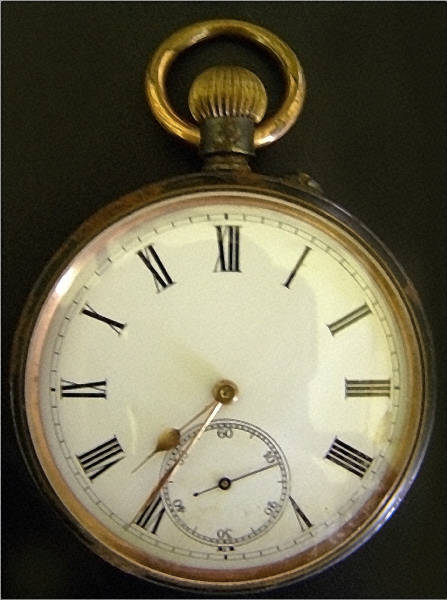
                                         Edward Thomas's Pocket Watch
                                        Cardiff University Library Archive

On April 10, 1917, Captain Lushington wrote this in a letter to Helen Thomas:

I cannot express to you adequately in words how deep our sympathy is for you and your children in your great loss.  These things go too deep for mere words.  We, officers and men, all mourn our own loss.  Your husband was very greatly loved in this battery, and his going has been a personal loss to each of us.  He was rather older than most of the officers and we all looked up to him as the kind of father of our happy family.

He was always the same, quietly cheerful, and ready to do any job that was going with the same steadfast unassuming spirit.  The day before his death we were rather heavily shelled and he had a very narrow shave.  But he went about his work quite quietly and ordinarily as if nothing was happening.  I wish I could convey to you the picture of him, a picture we had all learnt to love, of the old clay pipe, gum boots, oilskin coat, and steel helmet.
. . . . .
We buried him in a little military cemetery a few hundred yards from the battery:  the exact spot will be notified to you by the parson.  As we stood by his grave the sun came and the guns round seemed to stop firing for a short time.  This typified to me what stood out most in your husband's character -- the spirit of quiet, sunny, unassuming cheerfulness.

Ibid, pages 263-264.

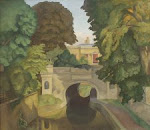
                                 Cecil Lawson, "Outside Arras" (c. 1917)

Many poems have been written in memory of Edward Thomas.  My favorite is by his friend Walter de la Mare.  As I have noted before, the poem is remarkable in conveying (in eight short lines) the pain of the loss suffered by those who knew and loved Thomas, as well as something essential about Thomas himself.

                 To E. T.: 1917

You sleep too well -- too far away,
   For sorrowing word to soothe or wound;
Your very quiet seems to say
   How longed-for a peace you have found.

Else, had not death so lured you on,
   You would have grieved -- 'twixt joy and fear --
To know how my small loving son
   Had wept for you, my dear.

Walter de la Mare, Motley and Other Poems (1918).

                                       Cecil Lawson, "Arras" (c. 1917)

Friday, April 6, 2012

Clouds

Please bear with me as I stay with Robert Bridges's "April 1885" a moment longer.  My favorite lines of the poem are these:  "On high the hot sun smiles, and banks of cloud uptower/In bulging heads that crowd for miles the dazzling south."  I am reminded of the paintings and drawings by Samuel Palmer that appear in this post.  Clouds -- white clouds, bright clouds -- were an essential part of Palmer's visionary vision of the world.

                              Samuel Palmer, "The White Cloud" (c. 1832)

The lines also remind me of the final stanza of Philip Larkin's "Cut Grass"(another of those un-Larkinesque Larkin poems that often go unnoticed):

White lilac bowed,
Lost lanes of Queen Anne's lace,
And that high-builded cloud
Moving at summer's pace.

Philip Larkin, High Windows (Faber and Faber 1974).

                          Samuel Palmer, "The Bright Cloud" (c. 1833-1834)

And, finally, the clouds of another visionary, Ivor Gurney:

               There Was Such Beauty

There was such beauty in the dappled valley
As hurt the sight, as stabbed the heart to tears.
The gathered loveliness of all the years
Hovered thereover, it seemed, eternally
Set for men's joy.  Town, tower, trees, river
Under a royal azure sky for ever
Up-piled with snowy towering bulks of cloud:
A herald-day of spring more wonderful
Than her true own.  Trumpets cried aloud
In sky, earth, blood; no beast, no clod so dull
But the power felt of the day, and of the giver
Was glad for life, humble at once and proud.
Kyrie Eleison, and Gloria,
Credo, Jubilate, Magnificat:
The whole world gathered strength to praise the day.

P. J. Kavanagh (editor), Collected Poems of Ivor Gurney (Oxford University Press 1982).

           Samuel Palmer, "Drawing for 'The Bright Cloud'" (c. 1831-1832)

A non-cloud-related note:  I may be guilty of oversimplification, but I think that "as stabbed the heart to tears" gets close to the emotional core of a great deal of Gurney's poetry.  But I hasten to add that I am no expert on the matter.  It's just a thought.

                               Samuel Palmer, "The Bright Cloud" (c. 1834)

Wednesday, April 4, 2012

"In The Bee-Loud Glade"

Robert Bridges's line "all day in the sweet box-tree the bee for pleasure hummeth" (from "April 1885," which appeared in my previous post) brings to mind W. B. Yeats's well-known vision of paradise: "Nine bean-rows will I have there, a hive for the honey-bee,/And live alone in the bee-loud glade."

What do you do with a poem like "The Lake Isle of Innisfree"?  It is difficult to see afresh, isn't it?  And one is hampered by the hard-to-envision spectacle of Yeats, the ambitious, grandiose, cape-wearing bard, taking himself off to the woods to live in a self-built (!) clay-and-wattle cabin and tend to nine rows of beans.  Not likely.  (Although I should note, in fairness to Yeats, that the poem was written when he was in his mid-twenties, before he had become a "smiling public man" (as he describes himself in "Among School Children") and a national treasure.)

But, in spite of all this, the poem always beguiles me.  It does, after all, speak to something that most of us can understand.  It is a lovely poem.

                          Derek Clarke, "Runner Beans, Stoughton" (1948)

                  The Lake Isle of Innisfree

I will arise and go now, and go to Innisfree,
And a small cabin build there, of clay and wattles made:
Nine bean-rows will I have there, a hive for the honey-bee,
And live alone in the bee-loud glade.

And I shall have some peace there, for peace comes dropping slow,
Dropping from the veils of the morning to where the cricket sings;
There midnight's all a glimmer, and noon a purple glow,
And evening full of the linnet's wings.

I will arise and go now, for always night and day
I hear lake water lapping with low sounds by the shore;
While I stand on the roadway, or on the pavements grey,
I hear it in the deep heart's core.

W. B. Yeats, The Countess Kathleen and Various Legends and Lyrics (1895).

               Cedric Lockwood Morris, "Connemara Landscape" (c. 1940)

Monday, April 2, 2012

April: "Exactly"

April feels like the beginning of a monumental undertaking.  All of this will culminate sometime in the middle of August, when the yellow light goes aslant and the daytime shadows sharpen.  But enough of that for now. There will be plenty of time to mull that over.  In the meantime, April is most certainly not "the cruellest month."

                             Adrian Paul Allinson, "The Cornish April"

                                 April 1885

Wanton with long delay the gay spring leaping cometh;
The blackthorn starreth now his bough on the eve of May:
All day in the sweet box-tree the bee for pleasure hummeth:
The cuckoo sends afloat his note on the air all day.

Now dewy nights again and rain in gentle shower
At root of tree and flower have quenched the winter's drouth:
On high the hot sun smiles, and banks of cloud uptower
In bulging heads that crowd for miles the dazzling south.

Robert Bridges, The Shorter Poems (1891).

         Eileen Aldridge, "The Downs near Brighton, East Sussex" (1962)

                   April

Exactly:  where the winter was
The spring has come:  I see her now
In the fields, and as she goes
The flowers spring, nobody knows how.

C. H. Sisson, What and Who (1994).

                  James McIntosh Patrick, "Springtime in Eskdale" (1935)

Saturday, March 31, 2012

A Proper Place, Part Two: "On One Who Lived And Died Where He Was Born"

One's Proper Place may be where one is right now.  And where one is right now may be where one has been for ever.  Although it may be hard to imagine in today's world, there was a time in which one lived and died where one was born.  And this is still the case in many parts of the world. Perhaps this was not (and is not) such a bad thing.

                      Christopher Wood, "Lemons in a Blue Basket" (1922)

   On One Who Lived and Died
           Where He Was Born

When a night in November
     Blew forth its bleared airs
An infant descended
     His birth-chamber stairs
     For the very first time,
     At the still, midnight chime;
All unapprehended
     His mission, his aim. --
Thus, first, one November,
An infant descended
        The stairs.

On a night in November
     Of weariful cares,
A frail aged figure
     Ascended those stairs
     For the very last time:
     All gone his life's prime,
All vanished his vigour,
     And fine, forceful frame:
Thus, last, one November
Ascended that figure
        Upstairs.

On those nights in November --
     Apart eighty years --
The babe and the bent one
     Who traversed those stairs
     From the early first time
     To the last feeble climb --
That fresh and that spent one --
     Were even the same:
Yea, who passed in November
As infant, as bent one,
        Those stairs.

Wise child of November!
     From birth to blanched hairs
Descending, ascending,
     Wealth-wantless, those stairs;
     Who saw quick in time
     As a vain pantomime
Life's tending, its ending,
     The worth of its fame.
Wise child of November,
Descending, ascending
        Those stairs!

Thomas Hardy, Late Lyrics and Earlier, with Many Other Verses (1922).

Not surprisingly, the world-view of the "wise child of November" sounds a great deal like Hardy's own.  This world-view is distilled in "He Never Expected Much" (written by Hardy when he was eighty-six), which begins:

Well, World, you have kept faith with me,
           Kept faith with me;
Upon the whole you have proved to be
           Much as you said you were.

                  Christopher Wood, "Angelfish, London Aquarium" (1930)

Thursday, March 29, 2012

Memory: Variations On A Theme

Thomas Hardy claimed that he could clearly remember incidents that occurred 40 or 50 years earlier in his life.  I have no reason to doubt his claim, particularly given the large number of poems that he wrote about scenes from his life, scenes in which the details -- both factual and emotional -- are quite specific.  I suppose that this ability to remember was a blessing for Hardy's art, but a mixed blessing in terms of getting through an ordinary day:  in some of his poems, the pain of recollection is palpable.

The following two poems address the oftentimes equivocal guises of memory.

        In an Edinburgh Pub

An old fellow, hunched over a half pint
I hope he's remembering.
I hope he's not thinking.

Which comes first?

Memory, as always,
Lazarus of the past --

who comes sad or joyful,
but always carrying with him
a whiff of grave clothes.

Ewen McCaig, The Poems of Norman MacCaig (Polygon 2009).  MacCaig wrote the poem in January of 1989, at the age of seventy-eight.  This leads one to speculate who the "old fellow" in the poem might be (or at least who he might remind MacCaig of).

                                Charles Sheeler, "American Interior" (1932)

                          Emendations

"I fear this" should read:  "as far away as."
"I remember" should read:  "my memory fails me."
"I was aghast" should read:  "I was, alas, distracted."
"The day was clear" should read:  "the day is a blur."

In the penultimate sentence,
"I shall forever regret" should read:  "I shall never regret"
Or, in the alternative:  "my memory once again fails me."

The final sentence should be removed in its entirety.

sip (2011).   
      
                                 Charles Sheeler, "Spring Interior" (1927)

Tuesday, March 27, 2012

A Proper Place, Part One: "I Like It As It Is"

In a series of posts titled "No Escape" I have looked at the well-known phenomenon of "wherever you go, there you are."  To wit:  we imagine that everything in our life will fall magically into place if we can simply find the Ideal Place that, until now, has eluded us.  It comes as no surprise that this is a delusion, a delusion that has been remarked upon by Montaigne, Johnson, and a host of others.

However, although the Ideal Place may be a chimera, a case may be made that a Proper Place can be found.  I realize that this may seem like a distinction without a difference.  But I see the distinction (somewhat fuzzily) as this:  finding one's Proper Place does not guarantee "happiness" (whatever that is) or provide Big Answers (to allude to Elizabeth Jennings's poem "Answers"); however, a Proper Place may provide equanimity and content ("content" as in A. E. Housman's "that is the land of lost content/I see it shining plain").

The following poem by Neil Powell provides an example of what I am (inadequately) trying to articulate.

                             Charles Ginner, "Flask Walk, Skyline" (1934)

                           Covehithe

In my dream they said:  "You must go to Covehithe."
I crossed over the causeway between two blue lakes
And I found myself on a long forest path
With a few wooden shacks and a glimpse of the sea.
I thought after all it was a place that might suit me.
But they said:  "You must learn from your mistakes."

So, I have come to Covehithe.  Low winter sun
Scans fields of pigs, dead skeletal trees,
Collapsing cliffs.  There are ships on the horizon.
The great church, wrecked by civil war, not storm,
Now shields a smaller church from further harm.
And they were wrong:  I like it as it is.

Neil Powell, The Times Literary Supplement, February 7, 2003.

             Charles Ginner, "Lancaster from Castle Hill Terrace" (c. 1947)

Sunday, March 25, 2012

"When Oats Were Reaped"

The delights of Thomas Hardy's poetry are inexhaustible.  First, given that he wrote so many poems (the 1976 Macmillan edition of his complete poems contains 947), one is likely to encounter a previously unread poem when opening a volume of his poems at random.  Second, one is also likely to discover something fresh when returning to a poem one knows.  This may be due to having failed to pay sufficient attention the first time around, and/or to reading the poem after the passage of time, which may change the way you look at it.

I have read the following poem a few times over the years, but I fear that I let much of it pass me by in the past.  On the surface, it may be viewed as a sly commentary on the proverbial phrase "sowing one's wild oats."  To wit: we usually reap what we sow.  It is just the sort of irony that Hardy was wont to fasten upon.  But beneath the ostensibly simple surface a great deal of artifice is at work.

                James McIntosh Patrick, "Stobo Kirk, Peeblesshire" (1936)

                         When Oats Were Reaped

That day when oats were reaped, and wheat was ripe, and barley ripening,
     The road-dust hot, and the bleaching grasses dry,
          I walked along and said,
While looking just ahead to where some silent people lie:

'I wounded one who's there, and now know well I wounded her;
     But, ah, she does not know that she wounded me!'
          And not an air stirred,
Nor a bill of any bird; and no response accorded she.

Thomas Hardy, Human Shows, Far Phantasies, Songs and Trifles (1925).

Of course, there is the sound.  In line 1: "reaped . . . ripe . . . ripening."  In line 5: "wounded one . . . well . . . wounded."  The rhyming of "said" at the end of line 3 with "ahead" in the middle of line 4.  And a repeat of that rhyming technique with "stirred" at the end of line 7 and "bird" in the middle of line 8.

Then there are the fine phrases.  In line 4, Hardy refers to a place up ahead "where some silent people lie."  Why did he not simply call it a "cemetery" or a "graveyard"?  (Assuming that a rhyme could be found.)  First, because, for Hardy (both in his life and in his art), the dead are never really dead, but are always with us.  Second, because the silence of these people -- and of this person in particular -- is crucial to the poem: "no response accorded she."

I love the "ah" in line 6: "But, ah, she does not know that she wounded me!" Read the line without the "ah" and see if it makes a difference.  I also like the ambiguity of the line (and, thus, of the poem as a whole).  (Although perhaps it is just me being slow on the uptake that makes it seem ambiguous.)  Is the speaker relieved that the dead woman never had to suffer guilt or grief for having wounded him, and now sleeps in peace? Or, is the speaker perturbed because the dead woman never had to suffer guilt or grief for having wounded him, and now sleeps in peace?

                       James McIntosh Patrick, "Autumn, Kinnordy" (1936)

Friday, March 23, 2012

"Virtue"

There is something to be said for staying the course.  (While being mindful that "everything passes and vanishes," as William Allingham writes.)  Or does staying the course only seem admirable from without?  Perhaps what is seen as faith and fortitude from the outside is resignation and habit from the inside.  On the other hand, this line by Bob Dylan has haunted me for quite some time (since 1975, to be exact):  "And old men with broken teeth stranded without love."  ("Shelter from the Storm," Blood on the Tracks.)

The following poem by Bernard O'Donoghue is, along with Norman MacCaig's "Old Couple in a Bar," offered as a further commentary on (i.e., an attempt to escape from) Charlotte Mew's "frozen ghosts" of Brittany.

                              George Bellows, "The Lone Tenement" (1909)

                           Virtue

He had been unfaithful once, unlikely
as that seemed when, silver-haired and blind,
he let her lead him up the aisle each Sunday.
Some Jezebel, the story was, had lured him
off to Blackpool one weekend, long in the past.
I went along to Mass when I came home,
and enjoyed hearing the praise on every side
of such an exemplary grandnephew.
After he died, she moved to sheltered housing
somewhere near Parbold in the scenic north
of Lancashire, but we sometimes still went
to take her to Mass, tearfully sniffing
into her scented hankie, recalling George
and how she missed his arm upon her shoulder.

Bernard O'Donoghue, The Times Literary Supplement (November 19, 2004).

                                George Bellows, "Blue Morning" (1909)

Wednesday, March 21, 2012

"Old Couple In A Bar"

Charlotte Mew's vision of the old couple in Brittany as a pair of "frozen ghosts" is a bit discomfiting.  Thus, an alternative view of love in old age is worth considering.

                       Old Couple in a Bar

They sit without speaking, looking straight ahead.
They've said it all before, they've seen it all before.
They're content.

They sit without moving: Ozymandias and Sphinx.

He says something! -- and she answers, smiling,
and taps him flirtatiously on the arm:
Daphnis and Chloe: with Edinburgh accents.

Ewen McCaig, The Poems of Norman MacCaig (Polygon 2009).  MacCaig wrote the poem in December of 1980, at the age of 70.

                                     Samuel Palmer, "Sheep in the Shade"

MacCaig performs a neat trick by moving from the "frown, and wrinkled lip" of the "shattered visage" of Shelley's Ozymandias to the pastoral love of Daphnis and Chloe on a timeless Greek island.  A shepherdess and a shepherd ("with Edinburgh accents") sitting in a pub.  Yes, this is indeed preferable to "frozen ghosts."  (Although there is a time and a place for frozen ghosts as well.  I would not wish to be without them entirely.)

                   Samuel Palmer, "Pastoral with a Horse-Chestnut Tree"