In a recent post I suggested that we might wish to consider what our epitaph will be. Another way of looking at this sort of thing may be: what trace, if any, will our soul leave behind?
Before proceeding further, I should make clear that I am not using the term "soul" in any religious or sectarian sense. Heaven, Hell, Paradise, Nirvana, et cetera, et cetera are of no moment to me.
But I do believe that we each have a soul. Call it, say, an animating spirit -- indefinable, ineffable, untouchable . . . flitting and transient. "Animula vagula blandula." What trace will this fluttering, fleeting thing leave behind?
Adrian Stokes, "Olive Trees" (1958)
Mary Coleridge considers this subject in the following untitled poem.
Some in a child would live, some in a book;
When I am dead let there remain of me
Less than a word -- a little passing look,
Some sign the soul had once, ere she forsook
The form of life to live eternally.
Theresa Whistler (editor), The Collected Poems of Mary Coleridge (1954).
Frances Macdonald, "Tympanum, Abbey Porch, Malmesbury" (1941)
Coleridge's poem brings to mind the following untitled poem by William Allingham. The poem is not necessarily about souls, but I think that it nicely complements Coleridge's "less than a word -- a little passing look" and "some sign the soul had once."
Everything passes and vanishes;
Everything leaves its trace;
And often you see in a footstep
What you could not see in a face.
William Allingham, Evil May-Day (1883).
Adrian Stokes, "Landscape, West Penwith Moor" (1937)
Friday, June 29, 2012
Wednesday, June 27, 2012
The Sound Of Waves
In my previous post, I suggested that Tu Fu's "Thoughts while Travelling at Night" is the most famous on-board-ship poem of the T'ang Dynasty. Others may argue that the following poem by Po Chu-i (772-846) claims that distinction. On further reflection, I recognize that "most famous" is a hollow and superficial description -- "most beloved" or "most admired" are, I think, preferable. In any event, both poems are lovely.
Aboard A Boat, Reading Yuan Chen's Poems
I pick up your scroll of poems, read in front of the lamp;
the poems are ended, the lamp gutters, the sky not yet light.
My eyes hurt, I put out the lamp, go on sitting in the dark;
a sound of waves blown up by head winds, sloshing against the boat.
Po Chu-i (translated by Burton Watson), Burton Watson (editor), The Columbia Book of Chinese Poetry: From Early Times to the Thirteenth Century (1984).
Laura Knight (1877-1970), "A Valley at Evening"
Here is a second translation of the same poem by Arthur Waley (1889-1966), who was one of the pioneering translators of Chinese poetry into English. Waley's translations have a lyricism to them that is not often present in other translations, yet he still remains faithful to the original texts.
On Board Ship: Reading Yuan Chen's Poems
I take your poems in my hand and read them beside the candle;
The poems are finished, the candle is low, dawn not yet come.
My eyes smart; I put out the lamp and go on sitting in the dark,
Listening to waves that, driven by the wind, strike the prow of the ship.
Arthur Waley (translator), Chinese Poems (1946).
Nearly ten years after Yuan Chen's death, Po Chu-i wrote the following poem.
On Hearing Someone Sing A Poem By Yuan Chen
No new poems his brush will trace;
Even his fame is dead.
His old poems are deep in dust
At the bottom of boxes and cupboards.
Once lately, when someone was singing,
Suddenly I heard a verse --
Before I had time to catch the words
A pain had stabbed my heart.
Arthur Waley (translator), Ibid.
Laura Knight, "Sundown" (c. 1940)
Aboard A Boat, Reading Yuan Chen's Poems
I pick up your scroll of poems, read in front of the lamp;
the poems are ended, the lamp gutters, the sky not yet light.
My eyes hurt, I put out the lamp, go on sitting in the dark;
a sound of waves blown up by head winds, sloshing against the boat.
Po Chu-i (translated by Burton Watson), Burton Watson (editor), The Columbia Book of Chinese Poetry: From Early Times to the Thirteenth Century (1984).
Laura Knight (1877-1970), "A Valley at Evening"
On Board Ship: Reading Yuan Chen's Poems
I take your poems in my hand and read them beside the candle;
The poems are finished, the candle is low, dawn not yet come.
My eyes smart; I put out the lamp and go on sitting in the dark,
Listening to waves that, driven by the wind, strike the prow of the ship.
Arthur Waley (translator), Chinese Poems (1946).
Nearly ten years after Yuan Chen's death, Po Chu-i wrote the following poem.
On Hearing Someone Sing A Poem By Yuan Chen
No new poems his brush will trace;
Even his fame is dead.
His old poems are deep in dust
At the bottom of boxes and cupboards.
Once lately, when someone was singing,
Suddenly I heard a verse --
Before I had time to catch the words
A pain had stabbed my heart.
Arthur Waley (translator), Ibid.
Laura Knight, "Sundown" (c. 1940)
Labels:
Arthur Waley,
Burton Watson,
Po Chu-i,
Tu Fu
Monday, June 25, 2012
On A Boat At Night
Chinese poets of the T'ang Dynasty (618-907) were fond of writing poems while on journeys. Many of the poets were government officials, and it seems that, if they were not travelling the provincial frontiers on routine bureaucratic business, they were going into exile due to having fallen out of favor with the powers that be. (This may also account for the large number of farewell poems written by the T'ang poets -- they seem to be always bidding tearful farewells to one another.)
Quite a few of these poems were written on board ship, usually while travelling on a river. I would hazard to say that the following poem by Tu Fu (712-770) is perhaps the most famous of these on-board-ship poems. But I hasten to add that the poem goes much deeper than the circumstances of its composition.
Henry Moore (1831-1895), "Catspaws Off The Land" (1885)
A Traveler At Night Writes His Thoughts
Delicate grasses, faint wind on the bank;
stark mast, a lone night boat:
stars hang down, over broad fields sweeping;
the moon boils up, on the great river flowing.
Fame -- how can my writings win me that?
Office -- age and sickness have brought it to an end.
Fluttering, fluttering -- where is my likeness?
Sky and earth and one sandy gull.
Tu Fu (translated by Burton Watson), Burton Watson (editor), The Columbia Book of Chinese Poetry: From Early Times to the Thirteenth Century (Columbia University Press 1984).
W. E. Leadley, "Driftwood" (1960)
Here is another translation of the same poem.
Thoughts While Travelling At Night
Light breeze on the fine grass.
I stand alone at the mast.
Stars lean on the vast wild plain.
Moon bobs in the Great River's spate.
Letters have brought no fame.
Office? Too old to obtain.
Drifting, what am I like?
A gull between earth and sky.
Vikram Seth (translator), Three Chinese Poets (1992).
As I have noted before, although English translations of traditional Chinese poetry tend to come across as fairly prose-like and casual, the originals were subject to strict rules relating to the number of lines, the number of characters (ideograms) per line, end-rhyme, and tonal parallelism. According to Burton Watson, the original of this poem was in the form of 8-line, 5-character per line "regulated verse" (which requires a single rhyme to be used at the end of the second, fourth, sixth, and eighth lines, and internal tonal parallelism). It is extremely difficult (if not impossible) to carry over these formal features into English translations, and translators seldom attempt to do so.
Geoffrey Spink Bagley (1901-1992), "Rye Harbour"
Quite a few of these poems were written on board ship, usually while travelling on a river. I would hazard to say that the following poem by Tu Fu (712-770) is perhaps the most famous of these on-board-ship poems. But I hasten to add that the poem goes much deeper than the circumstances of its composition.
A Traveler At Night Writes His Thoughts
Delicate grasses, faint wind on the bank;
stark mast, a lone night boat:
stars hang down, over broad fields sweeping;
the moon boils up, on the great river flowing.
Fame -- how can my writings win me that?
Office -- age and sickness have brought it to an end.
Fluttering, fluttering -- where is my likeness?
Sky and earth and one sandy gull.
Tu Fu (translated by Burton Watson), Burton Watson (editor), The Columbia Book of Chinese Poetry: From Early Times to the Thirteenth Century (Columbia University Press 1984).
W. E. Leadley, "Driftwood" (1960)
Here is another translation of the same poem.
Thoughts While Travelling At Night
Light breeze on the fine grass.
I stand alone at the mast.
Stars lean on the vast wild plain.
Moon bobs in the Great River's spate.
Letters have brought no fame.
Office? Too old to obtain.
Drifting, what am I like?
A gull between earth and sky.
Vikram Seth (translator), Three Chinese Poets (1992).
As I have noted before, although English translations of traditional Chinese poetry tend to come across as fairly prose-like and casual, the originals were subject to strict rules relating to the number of lines, the number of characters (ideograms) per line, end-rhyme, and tonal parallelism. According to Burton Watson, the original of this poem was in the form of 8-line, 5-character per line "regulated verse" (which requires a single rhyme to be used at the end of the second, fourth, sixth, and eighth lines, and internal tonal parallelism). It is extremely difficult (if not impossible) to carry over these formal features into English translations, and translators seldom attempt to do so.
Geoffrey Spink Bagley (1901-1992), "Rye Harbour"
Saturday, June 23, 2012
Empty Houses. Wind.
Well, as I said in my previous post, when I think of Robert Frost, I'm apt to think of Edward Thomas, and vice-versa. And, sure enough, Thomas's "Aspens" has sent me in the direction of another poem by Frost.
The following poem is one of many that puts to paid the once-common notion that Frost is simply a kindly (albeit slightly cranky) cracker-barrel Yankee philosopher. You know what I mean: "Two roads diverged in a yellow wood" and all that. Of course, I make no claim to originality in observing that Frost has a "darker" side. This is, by now, a common notion as well. (Perhaps the emphasis has gone too far in that direction.)
John Aldridge, "The River Pant near Sculpin's Bridge" (1961)
Bereft
Where had I heard this wind before
Change like this to a deeper roar?
What would it take my standing there for,
Holding open a restive door,
Looking down hill to a frothy shore?
Summer was past and day was past.
Somber clouds in the west were massed.
Out in the porch's sagging floor,
Leaves got up in a coil and hissed,
Blindly struck at my knee and missed.
Something sinister in the tone
Told me my secret must be known:
Word I was in the house alone
Somehow must have gotten abroad,
Word I was in my life alone,
Word I had no one left but God.
Robert Frost, West-Running Brook (1928).
Yes, there is "darkness" in Frost, but I wonder whether he isn't pulling our legs at the same time. At least a bit. That would be just like Frost.
But there is no gainsaying the fact that both Frost and Thomas were aware of what it means to be "in the house alone," to be "in my life alone," as the wind soughs. Not that they would complain about it, or ask us to feel sorry for them, mind you. But they both knew that it has to be faced up to.
John Aldridge, "Richmond, Yorkshire"
And thus comes yet another turn from Frost back to Thomas. Again, we find ourselves in an empty house. As the wind soughs.
The New House
Now first, as I shut the door,
I was alone
In the new house; and the wind
Began to moan.
Old at once was the house,
And I was old;
My ears were teased with the dread
Of what was foretold,
Nights of storm, days of mist, without end;
Sad days when the sun
Shone in vain: old griefs, and griefs
Not yet begun.
All was foretold me; naught
Could I foresee;
But I learnt how the wind would sound
After these things should be.
Edna Longley (editor), Edward Thomas: The Annotated Collected Poems (Bloodaxe Books 2008).
John Aldridge, "The Pink Farm" (1940)
The following poem is one of many that puts to paid the once-common notion that Frost is simply a kindly (albeit slightly cranky) cracker-barrel Yankee philosopher. You know what I mean: "Two roads diverged in a yellow wood" and all that. Of course, I make no claim to originality in observing that Frost has a "darker" side. This is, by now, a common notion as well. (Perhaps the emphasis has gone too far in that direction.)
John Aldridge, "The River Pant near Sculpin's Bridge" (1961)
Bereft
Where had I heard this wind before
Change like this to a deeper roar?
What would it take my standing there for,
Holding open a restive door,
Looking down hill to a frothy shore?
Summer was past and day was past.
Somber clouds in the west were massed.
Out in the porch's sagging floor,
Leaves got up in a coil and hissed,
Blindly struck at my knee and missed.
Something sinister in the tone
Told me my secret must be known:
Word I was in the house alone
Somehow must have gotten abroad,
Word I was in my life alone,
Word I had no one left but God.
Robert Frost, West-Running Brook (1928).
Yes, there is "darkness" in Frost, but I wonder whether he isn't pulling our legs at the same time. At least a bit. That would be just like Frost.
But there is no gainsaying the fact that both Frost and Thomas were aware of what it means to be "in the house alone," to be "in my life alone," as the wind soughs. Not that they would complain about it, or ask us to feel sorry for them, mind you. But they both knew that it has to be faced up to.
And thus comes yet another turn from Frost back to Thomas. Again, we find ourselves in an empty house. As the wind soughs.
The New House
Now first, as I shut the door,
I was alone
In the new house; and the wind
Began to moan.
Old at once was the house,
And I was old;
My ears were teased with the dread
Of what was foretold,
Nights of storm, days of mist, without end;
Sad days when the sun
Shone in vain: old griefs, and griefs
Not yet begun.
All was foretold me; naught
Could I foresee;
But I learnt how the wind would sound
After these things should be.
Edna Longley (editor), Edward Thomas: The Annotated Collected Poems (Bloodaxe Books 2008).
John Aldridge, "The Pink Farm" (1940)
Thursday, June 21, 2012
"The Aspens At The Cross-Roads Talk Together"
Long-time readers of this blog may have noticed that, when Robert Frost's name comes up, I am likely to think of Edward Thomas. And vice-versa. Thus, not surprisingly, Frost's "Tree at My Window" (which appeared in my previous post) got me to thinking about one of my favorite poems by Thomas.
Again, the subject is talking trees. Please note the final stanza and, in particular, the final line, which are pure Thomas and pure Frost. It is easy to understand why, after Thomas's death, Frost wrote: "Edward Thomas was the only brother I ever had." The stanza provides, I think, a great deal of insight into the characters of both men.
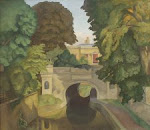
Edward Bawden, "The Temple of Concord, Audley End"
Aspens
All day and night, save winter, every weather,
Above the inn, the smithy, and the shop,
The aspens at the cross-roads talk together
Of rain, until their last leaves fall from the top.
Out of the blacksmith's cavern comes the ringing
Of hammer, shoe, and anvil; out of the inn
The clink, the hum, the roar, the random singing --
The sounds that for these fifty years have been.
The whisper of the aspens is not drowned,
And over lightless pane and footless road,
Empty as sky, with every other sound
Not ceasing, calls their ghosts from their abode,
A silent smithy, a silent inn, nor fails
In the bare moonlight or the thick-furred gloom,
In tempest or the night of nightingales,
To turn the cross-roads to a ghostly room.
And it would be the same were no house near.
Over all sorts of weather, men, and times,
Aspens must shake their leaves and men may hear
But need not listen, more than to my rhymes.
Whatever wind blows, while they and I have leaves
We cannot other than an aspen be
That ceaselessly, unreasonably grieves,
Or so men think who like a different tree.
Edna Longley (editor), Edward Thomas: The Annotated Collected Poems (Bloodaxe Books 2008).
Edward Bawden, "Craigievar Castle"
Thomas wrote "Aspens" in July of 1915. It was among a set of poems that he sent to Frost that month. In a letter to Thomas commenting on the poems, Frost wrote: "Your last poem 'Aspens' seems the loveliest of all." Selected Letters of Robert Frost (1964), page 185.
Thomas also sent a copy of the poem to Eleanor Farjeon. After receiving her comments on the poem, Thomas wrote back to her on July 21, 1915:
"About 'Aspens' you missed just the turn that I thought essential. I was the aspen. 'We' meant the trees and I with my dejected shyness. Does that clear it up, or do you think in rereading it that I have not emphasized it enough?"
Eleanor Farjeon, Edward Thomas: The Last Four Years (Oxford University Press 1958), pages 152-153.
A final note: "the night of nightingales" is very risky, but very lovely.
Edward Bawden, "The Bell Inn" (1939)
Tuesday, June 19, 2012
"Tree At My Window"
I would like to stay with the subject of the wind in the leaves a moment longer by considering a poem by Robert Frost. Frost visited the image of trees and wind (and their sound) on more than one occasion. In fact, one of his poems (which appeared here in May of last year) is titled "The Sound of the Trees." On the same theme, here is another:
Tree at My Window
Tree at my window, window tree,
My sash is lowered when night comes on;
But let there never be curtain drawn
Between you and me.
Vague dream-head lifted out of the ground,
And thing next most diffuse to cloud,
Not all your light tongues talking aloud
Could be profound.
But, tree, I have seen you taken and tossed,
And if you have seen me when I slept,
You have seen me when I was taken and swept
And all but lost.
That day she put our heads together,
Fate had her imagination about her,
Your head so much concerned with outer,
Mine with inner, weather.
Robert Frost, West-Running Brook (1928).
Norman Clark (1913-1992)
"Still Life by a Window with The Listener"
Frost seems to be of two minds about the tree. Is he wary of the pathetic fallacy? Of anthropomorphism? But, then again, Frost is nearly always of two minds about most things. Just like his friend Edward Thomas.
On the one hand, he suggests that the tree has nothing of importance to say: "Not all your light tongues talking aloud/Could be profound." Nonetheless, he feels an affinity with the tree (which is "taken and tossed" -- just as Frost is "taken and swept/And all but lost" in his sleep). Perhaps the tree is, after all, impassive. But still companionable: "But let there never be curtain drawn/Between you and me." One could do worse.
A side-note: Frost was pleased with his rhymes in the final stanza ("about her"/"with outer"). Of the stanza, he said: "No matter what I think it means, I'm infatuated with the way the rhymes come off here." Reginald Cook, Robert Frost: A Living Voice (University of Massachusetts Press 1974), page 125.
Doris Boulton-Maude (1893-1961)
"The Garden Window" (c. 1940)
Sunday, June 17, 2012
"O Voice That Ever Wanderest O'er The Earth"
Today was blustery, and along the road I walked I could see and hear the green "unresting castles thresh." I know full well that the World keeps its own counsel. But it is hard not to listen for a message in these leafy, emphatic iterations.
Wind
O voice that ever wanderest o'er the earth
Lamenting, roaring, sighing,
Where was thy place of birth,
And where shall be thy dying?
Theresa Whistler (editor), The Collected Poems of Mary Coleridge (1954).
Trevor Makinson, "Street Scene" (1948)
Coleridge's poem is reminiscent of a poem by Wallace Stevens (which has appeared here before):
To the Roaring Wind
What syllable are you seeking,
Vocalissimus,
In the distances of sleep?
Speak it.
Wallace Stevens, Harmonium (1923).
Trevor Makinson, "Fishing Boats" (1946)
And, on a quieter closing note:
Twilight -- the only conversation
on this hill
Is the wind blowing through the pines.
Ryokan, in John Stevens (translator), One Robe, One Bowl: The Zen Poetry of Ryokan (1977).
Trevor Makinson, "Maryhill Goods Yard"
Labels:
Mary Coleridge,
Philip Larkin,
Ryokan,
Wallace Stevens
Friday, June 15, 2012
"Only A Man Who Lives Not In Time But In The Present Is Happy"
"Only a man who lives not in time but in the present is happy." So wrote Ludwig Wittgenstein. (The statement appears in his Notebooks 1914-1916, as translated by G. E. M. Anscombe.) Easier said than done, of course.
Duncan Grant, "Girl at the Piano" (1940)
"To-morrow -- double Janus-headed to-morrow -- blessing and curse of frail humanity. But for thee, the pleasure of to-day would be Heaven, but for thee, to-day's load of misery could not be borne, but for thee, we should be immortal, and but for thee, I should make my will this instant. What art thou? Nothing -- here in Time, where all is to-day. Everything in that eternity which is but a succession of To-morrows."
Mary Coleridge, in Edith Sichel (editor), Gathered Leaves from the Prose of Mary E. Coleridge (1910), page 217.
Coleridge's references to immortality and eternity are reminiscent of something else that Wittgenstein wrote: "If we take eternity to mean not infinite temporal duration but timelessness, then eternal life belongs to those who live in the present." Ludwig Wittgenstein, Tractatus Logico-Philosophicus, Proposition 6.4311 (translation by David Pears and Brian McGuinness). An alternative translation (by C. K. Ogden) is: "If by eternity is understood not endless temporal duration but timelessness, then he lives eternally who lives in the present."
David Chatterton (1900-1963), "Vase with Yellow Chrysanthemums"
All of this can quickly become too abstract, too hard to get a grip on. The goal -- again, easier said than done -- is to free ourselves of the tyranny of the clock and the calendar.
Empty Room
The clock disserts on punctuation, syntax.
The clock's voice, thin and dry, asserts, repeats.
The clock insists: a lecturer demonstrating,
Loudly, with finger raised, when the class has gone.
But time flows through the room, light flows through the room
Like someone picking flowers, like someone whistling
Without a tune, like talk in front of a fire,
Like a woman knitting or a child snipping at paper.
A. S. J. Tessimond, The Walls of Glass (1934).
Norman Clark (1913-1992)
"Flying Kites by a Gas Works near Bexhill"
Duncan Grant, "Girl at the Piano" (1940)
"To-morrow -- double Janus-headed to-morrow -- blessing and curse of frail humanity. But for thee, the pleasure of to-day would be Heaven, but for thee, to-day's load of misery could not be borne, but for thee, we should be immortal, and but for thee, I should make my will this instant. What art thou? Nothing -- here in Time, where all is to-day. Everything in that eternity which is but a succession of To-morrows."
Mary Coleridge, in Edith Sichel (editor), Gathered Leaves from the Prose of Mary E. Coleridge (1910), page 217.
Coleridge's references to immortality and eternity are reminiscent of something else that Wittgenstein wrote: "If we take eternity to mean not infinite temporal duration but timelessness, then eternal life belongs to those who live in the present." Ludwig Wittgenstein, Tractatus Logico-Philosophicus, Proposition 6.4311 (translation by David Pears and Brian McGuinness). An alternative translation (by C. K. Ogden) is: "If by eternity is understood not endless temporal duration but timelessness, then he lives eternally who lives in the present."
All of this can quickly become too abstract, too hard to get a grip on. The goal -- again, easier said than done -- is to free ourselves of the tyranny of the clock and the calendar.
Empty Room
The clock disserts on punctuation, syntax.
The clock's voice, thin and dry, asserts, repeats.
The clock insists: a lecturer demonstrating,
Loudly, with finger raised, when the class has gone.
But time flows through the room, light flows through the room
Like someone picking flowers, like someone whistling
Without a tune, like talk in front of a fire,
Like a woman knitting or a child snipping at paper.
A. S. J. Tessimond, The Walls of Glass (1934).
Norman Clark (1913-1992)
"Flying Kites by a Gas Works near Bexhill"
Labels:
A. S. J. Tessimond,
Mary Coleridge,
Wittgenstein
Wednesday, June 13, 2012
"One Day In Every Year/A Hope That Is A Fear/Comes Very Near"
Although I am quite fond of the following poem by Mary Coleridge (1861-1907), I have never known quite what to make of it. Some might say that it is an instance of Victorian "fatalism" -- along the lines of, say, Christina Rossetti or Thomas Hardy. Perhaps. (Bearing in mind that one person's "fatalism" is another person's "realism," "level-headedness," or, even, "wisdom.")
However, a good poem can never be "explained" by a single word (or by any number of words, for that matter) -- if, indeed, it can be "explained" at all without draining it of life. In fact, Mary Coleridge makes this point very well in the following observation (which is about poetry in general, not about the poem at hand):
"There are some words that are like a flight of steps that end in mid-air, and there is nothing but the sky above them."
Edith Sichel (editor), Gathered Leaves from the Prose of Mary E. Coleridge (1910), page 252.
Charles Holmes, "Bude Canal" (1915)
One Day in Every Year
One day in every year
A hope that is a fear
Comes very near.
Once, every year, I say,
"Less long now the delay
Shorter the way."
Whether for joy or woe
I say that this is so
I do not know.
Only one thing is clear:
A hope that is a fear
Comes near.
Theresa Whistler (editor), The Collected Poems of Mary Coleridge (1954).
Charles Holmes, "The Yellow Wall, Blackburn" (1932)
As for the "meaning" of the poem, something that Coleridge wrote elsewhere may or may not be helpful:
"Birthdays now seem to me to be like the lamp-posts along a road, when you are nearing the end of a long, dark, delicious drive, and however tired you may be, are still absolutely uninclined to make the effort of getting out of the comfortable home of a carriage, and settling yourself in a new house."
Edith Sichel (editor), Gathered Leaves from the Prose of Mary E. Coleridge (1910), page 43.
This is interesting, but I am content to stick with "a flight of steps that end in mid-air, and there is nothing but the sky above them."
Charles Holmes, "A Moorland Road" (1923)
However, a good poem can never be "explained" by a single word (or by any number of words, for that matter) -- if, indeed, it can be "explained" at all without draining it of life. In fact, Mary Coleridge makes this point very well in the following observation (which is about poetry in general, not about the poem at hand):
"There are some words that are like a flight of steps that end in mid-air, and there is nothing but the sky above them."
Edith Sichel (editor), Gathered Leaves from the Prose of Mary E. Coleridge (1910), page 252.
One Day in Every Year
One day in every year
A hope that is a fear
Comes very near.
Once, every year, I say,
"Less long now the delay
Shorter the way."
Whether for joy or woe
I say that this is so
I do not know.
Only one thing is clear:
A hope that is a fear
Comes near.
Theresa Whistler (editor), The Collected Poems of Mary Coleridge (1954).
Charles Holmes, "The Yellow Wall, Blackburn" (1932)
As for the "meaning" of the poem, something that Coleridge wrote elsewhere may or may not be helpful:
"Birthdays now seem to me to be like the lamp-posts along a road, when you are nearing the end of a long, dark, delicious drive, and however tired you may be, are still absolutely uninclined to make the effort of getting out of the comfortable home of a carriage, and settling yourself in a new house."
Edith Sichel (editor), Gathered Leaves from the Prose of Mary E. Coleridge (1910), page 43.
This is interesting, but I am content to stick with "a flight of steps that end in mid-air, and there is nothing but the sky above them."
Monday, June 11, 2012
Life Explained, Part Twenty-Six: "World-Strangeness"
I suspect that, at one time or another, each of us has felt the "world-strangeness" that William Watson (1858-1935) writes of in the following poem. Of course, feeling "world-strangeness" on a daily basis may be a sign that one does not have an adequate purchase on reality.
On the other hand, there is something to be said for a spell of "world-strangeness" now and then. It may prompt one to look at the world afresh -- as if you were a castaway on an unknown island, seeing things for the first time, free of everydayness.
James McIntosh Patrick (1907-1998), "The Artist's Studio"
World-Strangeness
Strange the world about me lies,
Never yet familiar grown --
Still disturbs me with surprise,
Haunts me like a face half known.
In this house with starry dome,
Floored with gemlike plains and seas,
Shall I never feel at home,
Never wholly be at ease?
On from room to room I stray,
Yet my Host can ne'er espy,
And I know not to this day
Whether guest or captive I.
So, between the starry dome
And the floor of plains and seas,
I have never felt at home,
Never wholly been at ease.
William Watson, Wordsworth's Grave and Other Poems (1890). A side-note: "World-Strangeness" was apparently set to music by Ivor Gurney in 1925 or thereabouts. However, I have never discovered a recording of Gurney's setting of the poem.
Stanhope Forbes, "The Harbour Window" (1910)
Labels:
Ivor Gurney,
Life Explained,
Victorian Poetry,
William Watson
Subscribe to:
Posts (Atom)