Friday, January 9, 2015

Skylark

I have always been fond of sparrows -- those dappled, cheerful, humble creatures.  So the thought of the soul as a sparrow passing "from cold to cold" during our flitting, fleeting time on earth is, for me, a lovely and congenial one.

Birds are, in general, well-suited to serve as emblems of the soul, don't you think?  Today a huge blue sky suddenly appeared, mottled with high, sunlight-filled swathes of white fish-scale clouds.  It could have been a mid-summer's day.  I thought of the skylark, that sprite of the upper air.

     In the midst of the plain
Sings the skylark,
     Free of all things.

Basho (translated by R. H. Blyth), in R. H. Blyth, Haiku, Volume 2: Spring (Hokuseido Press 1950), page 198.

Here is an alternative translation:

above the moor
not attached to anything
a skylark sings

Basho (translated by Makoto Ueda), in Makoto Ueda, Basho and His Interpreters: Selected Hokku with Commentary (Stanford University Press 1991), page 156.

Blyth and Ueda differ most markedly in their translation of the middle phrase of Basho's haiku: "mono ni mo tsukazu."  Mono means "thing."  In this context, ni means "to" and mo means "even."  Tsukazu is a negative form of the verb meaning "to be attached."  Hence, the phrase might be translated (extremely roughly) as: "to thing not even attached."

Ueda's translation is, therefore, closer to the literal meaning.  Blyth takes more liberties with "free of all things" (including moving the phrase to the end of the haiku).  But I think that both interpretations are lovely, and I find it difficult to choose between the two.  And I think they both capture the essence of the haiku (which, of course, best remains unspoken).

Bernard Priestman, "Kilnsey Crag, Wharfedale, Yorkshire" (1929)

I'd say that the skylark and the nightingale vie for the honor of the bird most apostrophized by William Wordsworth and the other Romantic poets. (Come to think of it, this may be true of all poets.)  Both birds make an appearance in the following poem by Wordsworth.  They are not explicitly linked to the human soul.  However, when it comes to Romantic poetry, nearly everything is presumed to be, as a matter of course, either an embodiment, or a reflection, of our souls.  This is not a criticism, merely an observation.

                         To a Skylark

Ethereal minstrel!  pilgrim of the sky!
Dost thou despise the earth where cares abound?
Or, while the wings aspire, are heart and eye
Both with thy nest upon the dewy ground?
Thy nest which thou canst drop into at will,
Those quivering wings composed, that music still!

Leave to the nightingale her shady wood;
A privacy of glorious light is thine;
Whence thou dost pour upon the world a flood
Of harmony, with instinct more divine;
Type of the wise who soar, but never roam;
True to the kindred points of Heaven and Home!

William Wordsworth, The Poetical Works, Volume II (1849).

The poem was composed in 1825.  When it was first published in 1827, it contained the following additional stanza after the first stanza:

To the last point of vision, and beyond,
Mount, daring warbler! that love-prompted strain,
('Twixt thee and thine a never-failing bond)
Thrills not the less the bosom of the plain:
Yet might'st thou seem, proud privilege! to sing
All independent of the leafy spring.

William Wordsworth, The Poetical Works, Volume II (1827).

After 1843, Wordsworth removed the stanza in editions of his Poetical Works.  To me, the stanza seems somewhat diffuse, and detracts from the comparison between the skylark and the nightingale, as well as from the "Heaven and Home" theme.  I think that the poem is better without it. (However, Wordsworth did make use of the stanza: he inserted it in "A Morning Exercise.")

Samuel Llewellyn, "Sailing at Blakeney" (c. 1938)

Wordsworth's emphasis on the contrast between the skylark's homely nest on the ground and its towering lyrical flights -- the contrast between Home and Heaven -- is also the subject of the following poem, although in a different key.

               Lark Descending

A singing firework; the sun's darling;
     Hark how creation pleads!
Then silence:  see, a small gray bird
     That runs among the weeds.

Edmund Blunden, Poems 1930-1940 (Macmillan 1940).

"The lark ascending" is the phrase that we are accustomed to see.  (When I see that phrase, I immediately think of Ralph Vaughan Williams's beautiful composition with that title, which was in turn inspired by George Meredith's poem of that name.)  Blunden accomplishes a great deal in a small space.  If we removed the second line, we would have something that looks and sounds a great deal like a haiku.

Joseph Kavanagh (1856-1918), "Gipsy Encampment on the Curragh"

A theme begins to emerge, doesn't it?  The skylark is earthbound, yet drawn towards the heavens, singing.  Perfectly at home in both places, it would seem.

     All the long day --
Yet not long enough for the skylark,
     Singing, singing.

Basho (translated by R. H. Blyth), in R. H. Blyth, Haiku, Volume 2: Spring, page 195.

Here is another translation:

all this long day
and yet wanting to sing more
a skylark

Basho (translated by Makoto Ueda), in Makoto Ueda, Basho and His Interpreters: Selected Hokku with Commentary, page 155.

However, when considering the skylark as an emblem of the soul, it is perhaps best to conclude with this, which adds the necessary element of irresolvable mystery that each of us carries with us.

     The skylark:
Its voice alone fell,
     Leaving nothing behind.

Ampu (translated by R. H. Blyth), in R. H. Blyth, Haiku, Volume 1: Eastern Culture (Hokuseido Press 1949), page 165.

Francis Armstrong (1849-1920), "Shap Fells, Westmorland"

Monday, January 5, 2015

A Sparrow. A Fluttering Thing.

Any time is a good time to contemplate the fleeting nature of our life.  But the beginning of a new year is an especially appropriate time to do so. There is a sense of the slate having been wiped clean (well, as much as it can be), and of a fresh opportunity to fully appreciate the yet-unused moments that lie before us.

I had first thought to write:  "Any time is a good time to contemplate the fleeting nature of our soul."  But I thought better of it.  There is no doubt that life is fleeting.  But is that true of the soul?

I realize that, for some moderns, the very idea of the existence of a "soul" is beyond the realm of possibility, and is viewed by them as an outdated superstition of which they have been disabused.  I'm afraid that I have not been disabused.  Thus, the following poem is not simply a historical curiosity for me.  Nor is it anachronistic.  And I find it worth a visit at the turning of the year.

                             Persuasion

"Man's life is like a Sparrow, mighty King!
That -- while at banquet with your Chiefs you sit
Housed near a blazing fire -- is seen to flit
Safe from the wintry tempest.  Fluttering,
Here did it enter; there, on hasty wing,
Flies out, and passes on from cold to cold;
But whence it came we know not, nor behold
Whither it goes.  Even such, that transient Thing,
The human Soul; not utterly unknown
While in the Body lodged, her warm abode;
But from what world She came, what woe or weal
On her departure waits, no tongue hath shown;
This mystery if the Stranger can reveal,
His be a welcome cordially bestowed!"

William Wordsworth, in Abbie Findlay Potts, The Ecclesiastical Sonnets of William Wordsworth: A Critical Edition (Yale University Press 1922).

"The Stranger" referred to in line 13 is Paulinus, who, in 601, was sent to England by Pope Gregory I to convert the inhabitants to Christianity.  The scene took place during Paulinus's visit to King Edwin of Northumbria in 625 or thereabouts (the date is not certain).

Utagawa Hiroshige (1797-1858), "Mount Yuga in Bizen Province"

The incident upon which Wordsworth's sonnet is based is found in the Venerable Bede's Ecclesiastical History of the English People (c. 731):

"The present life of man upon earth, O king, seems to me, in comparison with that time which is unknown to us, like to the swift flight of a sparrow through the house wherein you sit at supper in winter, with your ealdormen and thegns, while the fire blazes in the midst, and the hall is warmed, but the wintry storms of rain or snow are raging abroad.  The sparrow, flying in at one door and immediately out at another, whilst he is within, is safe from the wintry tempest; but after a short space of fair weather, he immediately vanishes out of your sight, passing from winter into winter again.  So this life of man appears for a little while, but of what is to follow or what went before we know nothing at all.  If, therefore, this new doctrine tells us something more certain, it seems justly to deserve to be followed."

A. M. Sellar (translator), Bede's Ecclesiastical History of the English People (G. Bell and Sons 1917), pages 116-117.

In her edition of The Ecclesiastical Sonnets, Potts suggests that, based upon certain verbal parallels in his sonnet, Wordsworth likely first encountered Bede's story in The Church History of Britain (1655) by Thomas Fuller (1608-1661).  Potts, The Ecclesiastical Sonnets of William Wordsworth: A Critical Edition, page 224.  Here is Fuller's version:

"Man's life," said he, "O King, is like unto a little sparrow, which, whilst your majesty is feasting by the fire in your parlor with your royal retinue, flies in at one window, and out at another.  Indeed, we see it that short time it remaineth in the house, and then is it well sheltered from wind and weather; but presently it passeth from cold to cold; and whence it came, and whither it goes, we are altogether ignorant.  Thus, we can give some account of our soul during its abode in the body, whilst housed and harbored therein; but where it was before, and how it fareth after, is to us altogether unknown.  If therefore Paulinus's preaching will certainly inform us herein, he deserveth, in my opinion, to be entertained."

Ibid, page 224.

Utagawa Hiroshige, "Uraga in Sagami Province"

The flight of the sparrow in Bede's chronicle brings to mind the death-bed poem of the Emperor Hadrian (76-138), which begins with the line "animula vagula blandula."  The line has been variously translated as:  "My little wand'ring sportful Soule" (John Donne, 1611); "My soul, my pleasant soul and witty" (Henry Vaughan, 1652); "Little soul so sleek and smiling" (Stevie Smith, 1966).  Adrian Poole and Jeremy Maule (editors), The Oxford Book of Classical Verse in Translation (Oxford University Press 1995), pages 508-509.  Very sparrow-like.

The following two translations of the entire poem go together quite well with the sparrow in King Edwin's Northumbrian hall, I think.

Ah! gentle, fleeting, wav'ring sprite,
Friend and associate of this clay!
    To what unknown region borne,
Wilt thou, now, wing thy distant flight?
No more, with wonted humour gay,
     But pallid, cheerless, and forlorn.

George Gordon, Lord Byron, Hours of Idleness (1807).

Poor little, pretty, flutt'ring thing,
     Must we no longer live together?
And dost thou prune thy trembling wing,
     To take thy flight thou know'st not whither?

Thy humorous vein, thy pleasing folly
     Lies all neglected, all forgot:
And pensive, wav'ring, melancholy,
     Thou dread'st and hop'st thou know'st not what.

Matthew Prior, Poems on Several Occasions (1709).

Utagawa Hiroshige, "Ishiyakushi"

As for the fate of the soul, this poem, which has appeared here before, is worth revisiting on this occasion.

                      The Soul's Progress

It enters life it knows not whence; there lies
A mist behind it and a mist before.
It stands between a closed and open door.
It follows hope, yet feeds on memories.
The years are with it, and the years are wise;
It learns the mournful lesson of their lore.
It hears strange voices from an unknown shore,
Voices that will not answer to its cries.

Blindly it treads dim ways that wind and twist;
It sows for knowledge, and it gathers pain;
Stakes all on love, and loses utterly.
Then, going down into the darker mist,
Naked, and blind, and blown with wind and rain,
It staggers out into eternity.

Arthur Symons, Days and Nights (1889).

There is no mistaking the vital stream that runs from Hadrian through Bede through Wordsworth through Symons.  This progression seems absolutely fresh and contemporary to me.  It makes modern irony and know-it-allness seem stodgy, old-fashioned, and -- no other word fits -- soulless.

Utagawa Hiroshige, "Snow Falling on a Town"

Thursday, January 1, 2015

A New Year

How one takes the following New Year's haiku depends upon one's disposition.  I choose to take it in good humor, with a touch of wistfulness.

     I intended
Never to grow old, --
     But the temple bell sounds!

Jokun (translated by R. H. Blyth), in R. H. Blyth, Haiku, Volume 4: Autumn-Winter (Hokuseido Press 1952), page 202.

At the turning of the New Year in Japan, the bells of the Buddhist temples are rung 108 times:  once for each of the 108 desires that are the cause of our life of suffering.  The purpose of the ringing is to bid farewell to those desires.

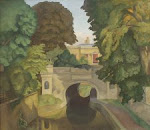
Josephine Haswell Miller (1890-1975), "The House on the Canal"

As I have noted here in the past, I am not one to draw up New Year's resolutions.  But, if I were of a mind to do so, I would choose this each year:

               . . . we should be careful

Of each other, we should be kind
While there is still time.

Philip Larkin, "The Mower," Collected Poems (Faber and Faber 1988).

A lifetime's work.  Never finished.

Best wishes for the New Year, dear readers.

Dudley Holland, "Winter Morning" (1945)

Monday, December 29, 2014

Ice And Stars

Here we are "in the bleak mid-winter."  I realize that, by the calendar, winter began just a week ago.  But, as a matter of emotion, it feels as though winter begins sometime in mid- to late-November, when the wind whirrs through the empty trees.  Or so it seems to me.

But things are not all that bleak.  The sun has passed through its lowest arc.  The longest night is behind us.  Things are afoot in the heavens. Dorothy Wordsworth wrote this in another season, but it seems apt now: "The crooked arm of the old oak tree points upwards to the moon."  Dorothy Wordsworth, journal entry for March 24, 1798, The Grasmere and Alfoxden Journals (edited by Pamela Woof) (Oxford University Press 2002), page 150.

"Skating on the K.s' pond last night after eating too much ham.  Eight-thirty.  Many stars.  No moon.  Orion's sword and girdle brilliant and all the other constellations whose names I have forgotten or never knew.  I am reminded of my youth and its skating ponds, of the ardor for strength, courage, and purpose excited in me then by the starlight.  It is nearly the same.  My feelings may be less ardent, the stars seem to burn more tenderly these days, but my openmouthed delight in finding them hung above the dark ice is no less."

John Cheever, in Robert Gottlieb (editor), The Journals of John Cheever (Alfred A. Knopf 1991), page  88.

Richard Eurich, "The Frozen Tarn" (1940)

Although I was never much of a skater during my childhood in Minnesota, I can still recall the lakes being turned into skating rinks in the winter.  My fondest memories are of those lakes at night:  a black expanse overhead; the sound of the slicing skates.  (There is another thread in the pattern as well:  my maternal grandparents first met while skating on Lake of the Isles in Minneapolis.)

So through the darkness and the cold we flew,
And not a voice was idle; with the din,
Meanwhile, the precipices rang aloud,
The leafless trees, and every icy crag
Tinkled like iron, while the distant hills
Into the tumult sent an alien sound
Of melancholy, not unnoticed, while the stars,
Eastward, were sparkling clear, and in the west
The orange sky of evening died away.

     Not seldom from the uproar I retired
Into a silent bay, or sportively
Glanced sideway, leaving the tumultuous throng,
To cut across the image of a star
That gleam'd upon the ice:  and oftentimes
When we had given our bodies to the wind,
And all the shadowy banks, on either side,
Came sweeping through the darkness, spinning still
The rapid line of motion; then at once
Have I, reclining back upon my heels,
Stopp'd short, yet still the solitary Cliffs
Wheeled by me, even as if the earth had roll'd
With visible motion her diurnal round;
Behind me did they stretch in solemn train
Feebler and feebler, and I stood and watch'd
Till all was tranquil as a dreamless sleep.

William Wordsworth, The Prelude (1805 manuscript), Book I, lines 465-489, in Ernest de Selincourt and Helen Darbishire (editors), The Prelude (Oxford University Press 1959), page 28.

"As if the earth had roll'd/With visible motion her diurnal round" brings to mind "roll'd round in earth's diurnal course" from "A slumber did my spirit seal," which was written in the same year as the passage quoted above.

David Macbeth Sutherland (1883-1973)
"Winter Landscape, West Cults, Aberdeen" (1940)

A dome of darkness overhead.  Dark depths below.  Between the two, skaters curving on a sheet of ice.  The poetic possibilities are obvious. (More so than, say, ice-fishing.  Although ice-fishing does have its charms.)

      The Midnight Skaters

The hop-poles stand in cones,
     The icy pond lurks under,
The pole-tops steeple to the thrones
     Of stars, sound gulfs of wonder;
But not the tallest there, 'tis said,
Could fathom to this pond's black bed.

Then is not death at watch
     Within those secret waters?
What wants he but to catch
     Earth's heedless sons and daughters?
With but a crystal parapet
Between, he has his engines set.

Then on, blood shouts, on, on,
     Twirl, wheel and whip above him,
Dance on this ball-floor thin and wan,
     Use him as though you love him;
Court him, elude him, reel and pass,
And let him hate you through the glass.

Edmund Blunden, English Poems (1925).

Ronald George Lampitt (1906-1988), "Skating By Moonlight"

Wednesday, December 24, 2014

Christmastide

In childhood, Christmas is a time of expectation and anticipation.  At some point -- ah, when? -- it becomes a time of reminiscence and reflection.  But I suppose that sounds a great deal like Life in general, doesn't it?

But one thing has not changed:  the lights.  Indoors, the lights on the tree, reflected in the ornaments.  Outdoors, the brightly-lit houses in the neighborhood.  The four white candles of the Swedish angel chimes.  A string of bubble lights.  Sentimentality?  Nostalgia?  Yes, of course.

          Yuletide in a Younger World

     We believed in highdays then,
          And could glimpse at night
               On Christmas Eve
Imminent oncomings of radiant revel --
          Doings of delight: --
          Now we have no such sight.

     We had eyes for phantoms then,
          And at bridge or stile
               On Christmas Eve
Clear beheld those countless ones who had crossed it
          Cross again in file: --
          Such has ceased longwhile!

     We liked divination then,
          And, as they homeward wound
               On Christmas Eve,
We could read men's dreams within them spinning
          Even as wheels spin round: --
          Now we are blinker-bound.

     We heard still small voices then,
          And, in the dim serene
               Of Christmas Eve,
Caught the far-time tones of fire-filled prophets
          Long on earth unseen. . . .
          -- Can such ever have been?

Thomas Hardy, Winter Words in Various Moods and Metres (1928).

Ben Nicholson, "1930 (Christmas Night)" (1930)

Back in October, I wrote about Thomas Hardy's humanity, honesty, and sincerity.  As fond as we moderns are of irony, we should put it aside when we read the following poem.

I take Hardy at his word.  And, with respect to the poem's last two lines, I would do exactly as Hardy says he would do.

                       The Oxen

Christmas Eve, and twelve of the clock.
     "Now they are all on their knees,"
An elder said as we sat in a flock
     By the embers in hearthside ease.

We pictured the meek mild creatures where
     They dwelt in their strawy pen,
Nor did it occur to one of us there
     To doubt they were kneeling then.

So fair a fancy few would weave
     In these years!  Yet, I feel,
If someone said on Christmas Eve,
     "Come; see the oxen kneel

"In the lonely barton by yonder coomb
     Our childhood used to know,"
I should go with him in the gloom,
     Hoping it might be so.

Thomas Hardy, Moments of Vision and Miscellaneous Verses (1917).

Harold Bush, "The Christmas Tree" (1933)

Hardy never condescends.  He may satirize and skewer the pretensions of those who think too well of themselves.  And, although he was acutely sensitive to criticism, both personal and literary, his humility was remarked upon by nearly everyone who met him in person.  That and his soft-spokenness.  Of course he was ambitious, but I think that in his heart of hearts he always thought of himself as a Dorset countryman.

               Christmastide

The rain-shafts splintered on me
     As despondently I strode;
The twilight gloomed upon me
     And bleared the blank high-road.
Each bush gave forth, when blown on
     By gusts in shower and shower,
A sigh, as it were sown on
     In handfuls by a sower.

A cheerful voice called, nigh me,
     "A merry Christmas, friend!" --
There rose a figure by me,
     Walking with townward trend,
A sodden tramp's, who, breaking
     Into thin song, bore straight
Ahead, direction taking
     Toward the Casuals' gate.

Thomas Hardy, Winter Words in Various Moods and Metres (1928).  "The Casuals' gate" refers to a gate of the Union House in Dorchester.  J. O. Bailey, The Poetry of Thomas Hardy: A Handbook and Commentary (University of North Carolina Press 1970), page 581.  "In Hardy's time any 'casual' (pauper or tramp) could apply to the police for a ticket, with which he would be admitted for supper, a bed, and breakfast."  Ibid.

A merry Christmas, friends!

Robin Tanner, "Christmas" (1929)

Saturday, December 20, 2014

"Unless, While With Admiring Eye We Gaze, We Also Learn To Love"

As I noted in my previous post, William Wordsworth is prone to high-flown rhetoric and prolixity.  But I am willing to cut him some slack.  Why? Because I have always felt that his poetry is animated by a depth of passion one seldom encounters.  That passion is the product of a love of the World, and of a love for the miraculous fact of our existence in the World.

Not surprisingly, "love" (meant in this broader sense) is a word that one comes across again and again in Wordsworth's poetry.  It is a word that goes to the very heart of what Wordsworth thought of as the vocation of "the Poet":

"He is the rock of defence of human nature; an upholder and preserver, carrying everywhere with him relationship and love."

William Wordsworth, Preface to 1802 edition of Lyrical Ballads, with Pastoral and Other Poems, page  xxxvii.  The phrase "relationship and love" is curious (and lovely), isn't it?  I've never quite figured it out.  But that does not stop me from liking it.

Earlier in the Preface, he speaks of "the Poet's art" as being "a task light and easy to him who looks at the world in the spirit of love."  Ibid, page xxxiii.

Wordsworth published the Preface at the age of 32.  Did his passion wane in his later years?  Well, passion does wane, doesn't it?  Yet he wrote this at the age of 72:

Glad sight wherever new with old
Is joined through some dear homeborn tie;
The life of all that we behold
Depends upon that mystery.
Vain is the glory of the sky,
The beauty vain of field and grove,
Unless, while with admiring eye
We gaze, we also learn to love.

William Wordsworth, Poems (1845).

Dane Maw (1909-1989), "Woolverton and Peart Woods" (1970)

Wordsworth's love is not an abstract, free-floating concept.  Through his poetry, it is intimately connected with, and is the product of, the daily miracle of the World around us.  This love, if we pay sufficient attention (a daunting task!), is one we all carry within us.

                       A Night-Piece

                                The sky is overspread
With a close veil of one continuous cloud
All whitened by the moon, that just appears,
A dim-seen orb, yet chequers not the ground
With any shadow -- plant, or tower, or tree.
At last a pleasant instantaneous light
Startles the musing man whose eyes are bent
To earth.  He looks around, the clouds are split
Asunder, and above his head he views
The clear moon and the glory of the heavens.
There in a black-blue vault she sails along
Followed by multitudes of stars, that small,
And bright, and sharp along the gloomy vault
Drive as she drives.  How fast they wheel away!
Yet vanish not!  The wind is in the trees;
But they are silent.  Still they roll along
Immeasurably distant, and the vault
Built round by those white clouds, enormous clouds,
Still deepens its interminable depth.
At length the vision closes, and the mind
Not undisturbed by the deep joy it feels,
Which slowly settles into peaceful calm,
Is left to muse upon the solemn scene.

William Wordsworth, 1798 manuscript, in Beth Darlington, "Two Early Texts: A Night-Piece and The Discharged Soldier," in Jonathan Wordsworth (editor), Bicentenary Wordsworth Studies in Memory of John Alban Finch (Cornell University Press 1970), page 431.

A side-note: as I have noted previously in connection with Samuel Taylor Coleridge's line "The one red leaf, the last of its clan," the journal entries of Wordsworth's sister Dorothy provided, on more than one occasion, the source for poems written by Wordsworth and Coleridge.  Such is the case with "A Night-Piece."  On January 25, 1798, she wrote:

"The sky spread over with one continuous cloud, whitened by the light of the moon, which, though her dim shape was seen, did not throw forth so strong a light as to chequer the earth with shadows.  At once the clouds seemed to cleave asunder, and left her in the centre of a black-blue vault. She sailed  along, followed by multitudes of stars, small, and bright, and sharp."

Dorothy Wordsworth, The Grasmere and Alfoxden Journals (Oxford University Press 2002), page 142.

Dane Maw, "Scottish Landscape, Air Dubh"

Like the other Romantic poets, Wordsworth produced his fair share of paeans to the moon and the stars, and to the other wondrous immensities of the Universe.  But we mustn't forget that his love is catholic.  The minute particulars (to borrow one of William Blake's favorite phrases) are worthy of -- deserve -- our attention.

                       To a Child
            Written in Her Album

Small service is true service while it lasts:
Of humblest Friends, bright Creature! scorn not one:
The Daisy, by the shadow that it casts,
Protects the lingering dew-drop from the Sun.

William Wordsworth, Yarrow Revisited, and Other Poems (1835).

Dane Maw, "Langdale Fells, Westmorland"

Tuesday, December 16, 2014

How To Live, Part Twenty-Four: "Quiet Sympathies With Things That Hold An Inarticulate Language"

I recently came across the following remarkable lines by William Wordsworth:

                                          Not useless do I deem
These quiet sympathies with things that hold
An inarticulate language; for the man
Once taught to love such objects as excite
No morbid passions, no disquietude,
No vengeance, and no hatred needs must feel
The joy of that pure principle of love
So deeply that, unsatisfied with aught
Less pure and exquisite, he cannot choose
But seek for objects of a kindred love
In fellow-natures and a kindred joy.
Accordingly he by degrees perceives
His feelings of aversion softened down,
A holy tenderness pervade his frame,
His sanity of reason not impaired,
Say rather all his thoughts now flowing clear,
From a clear fountain flowing, he looks round,
He seeks for good and finds the good he seeks
Till execration and contempt are things
He only knows by name and if he hears
From other mouths the language which they speak
He is compassionate and has no thought
No feeling which can overcome his love.

William Wordsworth, excerpt from manuscript of "The Ruined Cottage," in Ernest de Selincourt and Helen Darbishire (editors), The Poetical Works of William Wordsworth, Volume Five (Oxford University Press 1949), pages 400-401.  The lines were later incorporated, with revisions, into Book IV ("Despondency Corrected") of The Excursion (1814).

James McIntosh Patrick, "Springtime in Eskdale" (1935)

Over the years, I have made only desultory, occasional forays into Wordsworth's lengthy philosophical/narrative poems (e.g., The Prelude, The Excursion, The Recluse).  I confess that their prolixity and their often high-flown rhetoric have been a barrier.  However, a passage such as this makes me feel that I have been remiss, and inexcusably lazy.  Yes, there is some prolixity and rhetoric in these lines, but they are outweighed by the simple truth of what Wordsworth says -- and the beautiful way in which he says it.

Wordsworth wrote this passage at a time when his friendship with Samuel Taylor Coleridge was at its strongest.  Thus, it is not surprising that, in a letter to his brother written in March or April of 1798, Coleridge quotes the first 18 lines of the passage (indicating that Wordsworth had shared the manuscript with him).  Immediately prior to quoting the lines, Coleridge writes:

"I love fields and woods and mountains with almost a visionary fondness. And because I have found benevolence and quietness growing within me as that fondness has increased, therefore I should wish to be the means of implanting it in others, and to destroy the bad passions not by combating them but by keeping them in inaction."

Samuel Taylor Coleridge, Letter to George Coleridge, in Ernest Hartley Coleridge (editor), Letters of Samuel Taylor Coleridge, Volume I (1895), pages 243-244.

James McIntosh Patrick, "Glamis Village" (1939)

For some reason, two poems by R. S. Thomas came to mind as I was mulling over Wordsworth's lines.  I do not consider them to be reiterations of what Wordsworth has to say.  Rather, I think of them as being instances of how Wordsworth's thoughts may play out in our lives.

                    Arrival

Not conscious
         that you have been seeking
                 suddenly
         you come upon it

the village in the Welsh hills
                 dust free
         with no road out
but the one you came in by.

                 A bird chimes
         from a green tree
the hour that is no hour
         you know.  The river dawdles
to hold a mirror for you
where you may see yourself
         as you are, a traveller
                 with the moon's halo
         above him, who has arrived
         after long journeying where he
                 began, catching this
         one truth by surprise
that there is everything to look forward to.

R. S. Thomas, Later Poems (1983).

For me, the most profound, and the loveliest, statement in Wordsworth's passage is this:  "Not useless do I deem/These quiet sympathies with things that hold/An inarticulate language."  I think this statement sets forth a principle (to use Wordsworth's word) that provides the link between Thomas's poems and Wordsworth's meditation.  That principle, as expressed by both Wordsworth and Thomas, requires openness, receptiveness, repose, and contemplation.  Not easy qualities to attain.  A lifetime in the making, and then, if one is lucky, one may finally touch them.  In the meantime, we can only strive.

               The Bright Field

I have seen the sun break through
to illuminate a small field
for a while, and gone my way
and forgotten it.  But that was the pearl
of great price, the one field that had
the treasure in it.  I realize now
that I must give all that I have
to possess it.  Life is not hurrying

on to a receding future, nor hankering after
an imagined past.  It is the turning
aside like Moses to the miracle
of the lit bush, to a brightness
that seemed as transitory as your youth
once, but is the eternity that awaits you.

R. S. Thomas, Laboratories of the Spirit (1975).

Thomas's phrase "the eternity that awaits you" prompts me to think of a statement by Ludwig Wittgenstein that I have posted here on more than one occasion: "If we take eternity to mean not infinite temporal duration but timelessness, then eternal life belongs to those who live in the present." Ludwig Wittgenstein, Tractatus Logico-Philosophicus (1921), Proposition 6.4311 (translated by David Pears and Brian McGuinness).

James McIntosh Patrick, "Boreland Mill, Kirkmichael" (1950)

Everything is right there in front of us, if only we pay attention, if only we look.

     To wake, alive, in this world,
What happiness!
     Winter rain.

Shoha (1727-1771) (translated by R. H. Blyth), in R. H. Blyth, Haiku, Volume 4: Autumn-Winter (Hokuseido Press 1952), page 217.

James McIntosh Patrick, "A City Garden" (1940)

Friday, December 12, 2014

Silences

Although they traffic in words, poets are not averse to offering paeans to silence.  Which, come to think of it, raises a question:  are the words of poets silent or spoken?  In the interest of full disclosure (and recognizing the spoken or sung origins of ancient poetry), I confess that I have no interest in hearing poets recite their poems.

As is so often the case, Philip Larkin hits the nail on the head:

"Hearing a poem, as opposed to reading it on the page, means you miss so much -- the shape, the punctuation, the italics, even knowing how far you are from the end.  Reading it on the page means you can go your own pace, taking it in properly; hearing it means you're dragged along at the speaker's own rate, missing things, not taking it in, confusing 'there' and 'their' and things like that.  And the speaker may interpose his own personality between you and the poem, for better or worse.  For that matter, so may the audience. . . . When you write a poem, you put everything into it that's needed: the reader should 'hear' it just as clearly as if you were in the room saying it to him.  And of course this fashion for poetry readings has led to a kind of poetry that you can understand first go: easy rhythms, easy emotions, easy syntax.  I don't think it stands up on the page."

Philip Larkin, "An Interview with Paris Review" (1982), in Philip Larkin, Required Writing: Miscellaneous Pieces 1955-1982 (Faber and Faber 1982), page 61 (italics in original).

It is not unlikely that Larkin, as he was wont to do, is engaging in a bit of interviewer-baiting here, as well as trying to perpetuate the curmudgeonly caricature that he fashioned for the media.  But he is exactly right.  Things have steadily worsened in the ensuing 30 years:  in addition to universities offering academic degrees in, of all things, the writing of poetry, we have a never-ending circuit of poetry readings in which poets become known for their entertainment value.  The dramatic posturing is horrendous and risible at the same time.  And wholly typical of our age.

Now that I have finished my own curmudgeonly rant, let's return to poets and silence.

David Young Cameron (1865-1945), "En Provence" (1922)

There are times when we each of us longs for "a little peace and quiet." Imagine a place without the background hum of modern civilization in your ears.  I have experienced such a silence a few times:  for instance, on an atoll in the Cook Islands, in the high desert of eastern Utah, up in the Sierra Nevada of California in the early 1970s, and on the Isle of Skye.  It takes some getting used to.

Poets are sometimes inclined to take this thought to its natural conclusion. But perhaps the ultimate silence of our "implacable fate" is not such a bad thing after all.

    Beata Solitudo

What land of Silence,
     Where pale stars shine
On apple-blossom
     And dew-drenched vine,
     Is yours and mine?

The silent valley
     That we will find,
Where all the voices
     Of humankind
     Are left behind.

There all forgetting,
     Forgotten quite,
We will repose us,
     With our delight
     Hid out of sight.

The world forsaken,
     And out of mind
Honour and labour,
     We shall not find
     The stars unkind.

And men shall travail,
     And laugh and weep;
But we have vistas
     Of gods asleep,
     With dreams as deep.

A land of Silence,
     Where pale stars shine
On apple-blossoms
     And dew-drenched vine,
     Be yours and mine!

Ernest Dowson, Verses (1896).  "Beata solitudo" may be translated as "blessed solitude."

An aside:  the phrases "laugh and weep" (line 22) and "with dreams as deep" (line 25) remind me that all of Ernest Dowson's poems seem to be a variation on the poem that captures the essence of his poetry (and of most of the poetry of the 1890s as well).  I say this with a genuine sense of affection, and not as a criticism.  I am very fond of Dowson's poetry, and there are times when I am in perfect sympathy with his view of the world. Here is the poem of which I speak (it has appeared here before, but it is always worth revisiting):

Vitae summa brevis spem nos vetat incohare longam

They are not long, the weeping and the laughter,
     Love and desire and hate:
I think they have no portion in us after
     We pass the gate.

They are not long, the days of wine and roses:
     Out of a misty dream
Our path emerges for a while, then closes
     Within a dream.

Ernest Downson, Ibid.  "Vitae summa brevis spem nos vetat incohare longam" is a line from one of Horace's Odes (I.iv), and may be translated as:  "the short span of our life forbids us to indulge in long-term hope."

David Young Cameron, "The Hill of the Winds" (c. 1913)

Ernest Dowson and Christina Rossetti could not be more different. Dowson, like many poets of the 1890s, flirted with Catholicism while living a dissolute life.  Catholicism held some sort of aesthetic attraction for these poets.  I sense that it added a measure of self-created drama to their lives, providing a contrast to the hedonistic, love-sick melancholy in which they found themselves.  Rossetti, in contrast, was a devout Christian.  She was a member of the Church of England, with ties to the Oxford Movement of the Victorian era.  A great deal of her poetry consists of devotional verse, and she wrote a number of devotional prose works.

Yet, when I read the following poem by Rossetti, I cannot help but think that she and Dowson do not sound so far apart.  Perhaps I am stretching the point, but if the poems were unknown to me, and if I was not told who had written them, it would not seem strange to me that Dowson wrote "Golden Silences" and that Rossetti wrote "Beata Solitudo."

               Golden Silences

There is silence that saith, "Ah me!"
     There is silence that nothing saith;
          One the silence of life forlorn,
     One the silence of death;
One is, and the other shall be.

One we know and have known for long,
     One we know not, but we shall know,
          All we who have ever been born;
     Even so, be it so, --
There is silence, despite a song.

Sowing day is a silent day,
     Resting night is a silent night;
          But whoso reaps the ripened corn
     Shall shout in his delight,
While silences vanish away.

Christina Rossetti, A Pageant and Other Poems (1881).

David Young Cameron
"The Norman Arch" (c. 1918)

Rossetti and Dowson come from the ethereal side of silence.  On the other hand, and as one might expect, Thomas Hardy arrives at silence through the minute particulars of the World.

                         Silences

There is the silence of a copse or croft
            When the wind sinks dumb,
            And of a belfry-loft
When the tenor after tolling stops its hum.

And there's the silence of a lonely pond
            Where a man was drowned,
            Nor nigh nor yond
A newt, frog, toad, to make the merest sound.

But the rapt silence of an empty house
            Where oneself was born,
            Dwelt, held carouse
With friends, is of all silences most forlorn!

Past are remembered songs and music-strains
            Once audible there:
            Roof, rafters, panes
Look absent-thoughted, tranced, or locked in prayer.

It seems no power on earth can waken it
            Or rouse its rooms,
            Or its past permit
The present to stir a torpor like a tomb's.

Thomas Hardy, Winter Words in Various Moods and Metres (1928).

A side-note:  Hardy often recalled, and mused upon, what appears to have been a happy childhood.   Thus, "Silences" is reminiscent of an earlier poem of his which was also prompted by a visit to his old family home.

       The Self-Unseeing

Here is the ancient floor,
Footworn and hollowed and thin,
Here was the former door
Where the dead feet walked in.

She sat here in her chair,
Smiling into the fire;
He who played stood there,
Bowing it higher and higher.

Childlike, I danced in a dream;
Blessings emblazoned that day;
Everything glowed with a gleam;
Yet we were looking away!

Thomas Hardy, Poems of the Past and the Present (1901).

David Young Cameron, "A Little Town in Provence" (1922)

Monday, December 8, 2014

A Lost World, Part Four: Antiquity

Simonides of Ceos (c. 556 - c. 468 B. C.) is best known as the author of the inscription that appeared on the monument to the Spartans that was erected after the battle of Thermopylae.  The inscription was recorded by Herodotus:

Go, stranger, and to Lacedaemon tell
That here, obeying her behests, we fell.

George Rawlinson (translator), The History of Herodotus, Volume IV (1860), Book VII, Section 228, page 180.  The inscription has traditionally been ascribed to Simonides, although there has been scholarly debate on this point.

I am fond of this translation:

Go, tell the Spartans, thou who passest by,
That here, obedient to their laws, we lie.

Simonides (translated by William Lisle Bowles), in Henry Wellesley (editor), Anthologia Polyglotta: A Selection of Versions in Various Languages, Chiefly from The Greek Anthology (1849).

This sort of restraint -- a restraint charged with unspoken emotion -- is largely absent from the modern world.  I do not wish to romanticize the ancient world:  it was a harsh and brutal place.  But there is a seemliness and a sense of proportion at work that are mostly missing in our own time.

Edward William Cooke
"Scheveningen Pincks Off the Coast of Yarmouth" (1864)

In the late 1890s, a marble block with a two-line inscription carved into it was discovered on the Greek island of Salamis, which gave its name to the culminating naval battle of the Greek-Persian Wars.  The Corinthians who died in the battle were buried on Salamis.  Here is the inscription, which has been attributed to Simonides:

O stranger, once we dwelt in Corinth blest with fountains;
Now the isle of Ajax holds our bones.

Simonides, quoted in Dio Chrysostom, The Thirty-Seventh, or Corinthian, Discourse, in H. Lamar Crosby (translator), Dio Chrysostom, Volume IV (Harvard University Press 1946).

Here is an alternative, sparer, translation.

Friend, we once were alive in the harbor city of Korinth.
Now the island city of Salamis is our grave.

Richmond Lattimore, Greek Lyrics (University of Chicago Press 1955).

Edward William Cooke
"A Dutch Galliot Aground on a Sandbank on the Biesbosch" (1878)

In Book I of De Divinatione, Cicero tells the following story of Simonides:

"[Simonides] once saw the dead body of some unknown man lying exposed and buried it.  Later, when he had it in mind to go on board a ship, he was warned in a vision by the person to whom he had given burial not to do so and that if he did he would perish in a shipwreck.  Therefore he turned back and all the others who sailed were lost."

Cicero, in William Armistead Falconer (translator), Cicero: De Senectute, De Amicitia, De Divinatione (Harvard University Press 1923).

William Wordsworth, who admired the poetry of Simonides, wrote the following untitled sonnet about the incident related by Cicero.

I find it written of Simonides
That travelling in strange countries once he found
A corpse that lay expos'd upon the ground,
For which, with pains, he caused due obsequies
To be performed, and paid all holy fees.
Soon after, this man's Ghost unto him came
And told him not to sail as was his aim,
On board a ship then ready for the seas.
Simonides, admonished by the ghost,
Remained behind; the ship the following day
Set sail, was wrecked, and all on board were lost.
Thus was the tenderest Poet that could be,
Who sang in ancient Greece his moving lay,
Saved out of many by his piety.

William Wordsworth, in Ernest de Selincourt and Helen Darbishire (editors), The Poetical Works of William Wordsworth, Volume Three (Oxford University Press 1954).  The poem was first published on October 10, 1803, in The Morning Post.

Edward William Cooke
"Venetian Fishing Craft Caught in a 'Borasca'" (1873)

As I have noted on a previous occasion, the fate of unfortunate mariners was a common subject of the Greek poetry of antiquity.  The following lovely poem by Callimachus has appeared here before, but it is worth revisiting at this time due to its resemblance to the story of Simonides and the abandoned corpse.

Stranger, whoe'er thou art, found stranded here,
O'er thee Leontichus heaped up this grave,
Whilst at his own hard lot he dropped a tear:
He too, a restless sea-bird, roams the wave.

Callimachus (translated by Henry Wellesley), in Henry Wellesley (editor), Anthologia Polyglotta: A Selection of Versions in Various Languages, Chiefly from The Greek Anthology (1849).

Given the role of the sea in the life of the Greeks, it is not surprising that Simonides wrote a number of poems about the misfortunes of seafarers. This is an inscription for a cenotaph.

O cloud-capt Geraneia, rock unblest!
Would thou hadst reared far hence thy haughty crest,
By Tanais wild, or wastes where Ister flows;
Nor looked on Sciron from thy silent snows!
A cold, cold corpse he lies beneath the wave,
This tomb speaks, tenantless, his ocean grave.

Simonides (translated by Robert Bland), in J. H. Merivale (editor), Collections from The Greek Anthology (1833).  Mount Geraneia is located on the Isthmus of Corinth.  Tanais was a Greek colony located on the far northeastern corner of the Sea of Azov, on the banks of the River Don.  Ister was the Greek name for the Danube.  Sciron (also spelled "Sceiron") probably refers to the Sceironian Rocks, a rugged region on the Isthmus of Corinth.

Here is an epitaph.

A land not thine hath shed its dust o'er thee,
A fated wanderer o'er the Pontic sea:
No joys for thee of sweet regretted home;
To sea-girt Chios thou didst never come.

Simonides (translated by Robert Bland), Ibid.  The Pontic Sea was the Greek name for the Black Sea.  Chios is an island in the Aegean Sea near the coast of Turkey.

Edward William Cooke, "Off the Port of Havre" (1840)

Thursday, December 4, 2014

A Finger Pointing To The Moon

Each of us knows that the popular culture which surrounds us is vacuous and vacant.  But our age is not unique.  It has ever been thus.  The perpetrators have new identities; the crimes are the same.

"[A] multitude of causes, unknown to former times, are now acting with a combined force to blunt the discriminating powers of the mind, and, unfitting it for all voluntary exertion, to reduce it to a state of almost savage torpor.  The most effective of these causes are the great national events which are daily taking place, and the increasing accumulation of men in cities, where the uniformity of their occupations produces a craving for extraordinary incident, which the rapid communication of intelligence hourly gratifies.  To this tendency of life and manners the literature and theatrical exhibitions of the country have conformed themselves."

William Wordsworth, Preface to the 1802 Edition of Lyrical Ballads, with Other Poems.

Sound familiar?

The dichotomy between the real and the contrived has always been with us. And it has always been a matter of choice.

                    The Sea and the Skylark

On ear and ear two noises too old to end
     Trench -- right, the tide that ramps against the shore;
     With a flood or a fall, low lull-off or all roar,
Frequenting there while moon shall wear and wend.

Left hand, off land, I hear the lark ascend,
     His rash-fresh re-winded new-skeined score
     In crisps of curl off wild winch whirl, and pour
And pelt music, till none's to spill nor spend.

How these two shame this shallow and frail town!
     How ring right out our sordid turbid time,
Being pure!  We, life's pride and cared-for crown,

     Have lost that cheer and charm of earth's past prime:
Our make and making break, are breaking, down
     To man's last dust, drain fast towards man's first slime.

Gerard Manley Hopkins, in W. H. Gardner and N. H. Mackenzie (editors), The Poems of Gerard Manley Hopkins (Oxford University Press 1967).

Cecil Gordon Lawson, "The Hop-Gardens of England" (1874)

"The Sea and the Skylark" brings to mind the following poem.  It is a poem that, because it is so familiar, is sometimes difficult to see afresh.  Some may feel that it simply states a truism (a truism that is, moreover, fairly malleable, depending upon one's agenda).  But, as I am wont to say: "Truisms are true."  And all the better if they come wrapped in beauty.

The world is too much with us; late and soon,
Getting and spending, we lay waste our powers:
Little we see in Nature that is ours;
We have given our hearts away, a sordid boon!
This Sea that bares her bosom to the moon;
The winds that will be howling at all hours
And are up-gathered now like sleeping flowers;
For this, for everything, we are out of tune;
It moves us not.  Great God!  I'd rather be
A Pagan suckled in a creed outworn;
So might I, standing on this pleasant lea,
Have glimpses that would make me less forlorn;
Have sight of Proteus coming from the sea;
Or hear old Triton blow his wreathed horn.

William Wordsworth, Poems, in Two Volumes (1807).  In 1827, Wordsworth changed "coming" to "rising" in line 13.


Alexander Fraser, "Broughty Castle" (c. 1860)

As one might expect from the content of this blog, I'm inclined to think that poetry may be of some assistance to us if we find ourselves to be "out of tune."  But, have no fear!  I am not about to launch into a sententious apostrophe upon "the transformative power of poetry" or "poetry and the examined life."  I will simply offer a couple of clues.

In the following passages, R. H. Blyth is speaking of haiku in particular. However, his observations are applicable to poetry in general.

"The real nature of each thing, and more so, of all things, is a poetical one. . . . Haiku shows us what we knew all the time, but did not know we knew; it shows us that we are poets in so far as we live at all."

"All things around us are asking for our apprehension, working for our enlightenment.  But our thoughts are of folly.  What is worse, every day, and many times in the day, we are enlightened, we are Buddha, a poet, -- but do not know it, and remain an ordinary man.  For our sake haiku isolate, as far as it is possible, significance from the mere brute fact or circumstance.  It is a single finger pointing to the moon."

R. H. Blyth, Haiku, Volume 1: Eastern Culture (Hokuseido Press 1949), page x; Haiku, Volume 3: Summer-Autumn (Hokuseido Press 1952), page i.

The final sentence of the second passage comes from a well-known Buddhist saying which emphasizes that the Buddha's teachings (and, by extension, any words) are merely a finger pointing at the moon; they are not the moon.

James McLachlan Nairn, "Kildonan" (1886)

Here is one view as to where poetry stands in the Modern Age.

               Postscript

As life improved, their poems
Grew sadder and sadder.  Was there oil
For the machine?  It was
The vinegar in the poets' cup.

The tins marched to the music
Of the conveyor belt.  A billion
Mouths opened.  Production,
Production, the wheels

Whistled.  Among the forests
Of metal the one human
Sound was the lament of
The poets for deciduous language.

R. S. Thomas, H'm (1972).

In his poetry, Thomas was preoccupied (among other things) with modern mechanization and the conflicting claims of God and Science.   But I think poetry has always been in the position he describes, regardless of the immediate particulars of the parlous or vacant times in which it finds itself. "Deciduous language."  Yes, "deciduous language" is what is required and necessary.  A finger pointing to the moon.

Henry Moore (1831-1895), "Albury Heath, Surrey"