Friday, September 25, 2015

Dwelling

First and foremost, autumn awakens an impulse to run out into the World before it is too late.  Time is passing.  And the duration of autumn's beauty is numbered by the leaves on the trees.

But autumn also awakens a contrary impulse:  an urge to settle in, to turn inward.  Consider the endearing activity of the squirrels at this time of year: when I see them intently scurrying about among the fallen leaves, I think of the long nights that await both them and us. Yes, it is time to make ready a burrow, a nest, a refuge.

This little house
No smaller than the world
Nor I lonely
Dwelling in all that is.

Kathleen Raine, from "Short Poems," The Oracle in the Heart (Dolmen Press 1980).

But, whether our movement be outward or inward, I suspect that for most of us the emotional tenor of either movement is the same:  that pensive, wistful, and bittersweet autumnal feeling that we have come to know so well.  It only deepens with the years.  But this is not a bad thing.  Far from it.  Many of us live for autumn.

"They seek retirements in the country, on the sea-coasts, or mountains: you too used to be fond of such things.  But this is all from ignorance.  A man may any hour he pleases retire into himself; and nowhere will he find a place of more quiet and leisure than in his own soul:  especially if he has that furniture within, the view of which immediately gives him the fullest tranquillity.  By tranquillity, I mean the most graceful order.  Allow yourself continually this retirement, and refresh and renew your self."

Marcus Aurelius, Meditations, Book IV, Section 3 (translated by Francis Hutcheson and James Moor), in Francis Hutcheson and James Moor, The Meditations of the Emperor Marcus Aurelius Antoninus (1742).

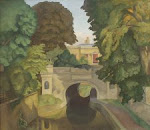
Paul Drury, "September" (1928)

As I have noted here on more than one occasion, I see nothing wrong with sentimentality.  The default modern posture is irony.  The essence of modern irony is self-regarding knowingness and distance from life.  Who needs that?  I will take sentimentality over irony any day.  It is a matter of choosing warmth over coldness.

"The unspeakable blessedness of having a home!  Much as my imagination has dwelt upon it for thirty years, I never knew how deep and exquisite a joy could lie in the assurance that one is at home for ever.  Again and again I come back upon this thought; nothing but Death can oust me from my abiding place.  And Death I would fain learn to regard as a friend, who will but intensify the peace I now relish."

George Gissing, The Private Papers of Henry Ryecroft (1903), page 112.

"A Quiet Normal Life."  Isn't this what most of us want?  "Here in his house and in his room,/In his chair, the most tranquil thought grew peaked . . ."

                    Her Room

At first, not breathed on,
Not a leaf or a flower knew you were gone,
Then, one by one,

The little things put away,
The glass tray
Of medicines empty,

The poems still loved
Long after sight failed
With other closed books shelved,

And from your cabinet
Remembrances to one and another friend
Who will forget

How the little owl, the rose-bowl,
The Brig-o' Doone paperweight,
The Japanese tea-set

Lived on their shelf, just here,
So long, and there,
Binding memories together,

Binding your love,
Husband and daughter in an old photograph,
Your woven texture of life

A torn cobweb dusted down,
Swept from the silent room
That was home.

Kathleen Raine, The Oval Portrait and Other Poems (Enitharmon Press 1977).

Robin Tanner, "The Gamekeeper's Cottage" (1928)

The outward and inward movements of autumn take place within a larger context, of course.  The seasonal round feels as if it will go on for ever.  The wistfulness of autumn is, we know, a prelude to "the bleak mid-winter," which has its own charms, but which will in turn awaken in us thoughts of "the cherry hung with snow."  And so it beautifully goes.

There is, though, a deeper theme at work beneath it all.

                       Words in the Air

The clear air said:  'I was your home once
but other guests have taken your place;
where will you go who liked it here so much?
You looked at me through the thick dust
of the earth, and your eyes were known to me.
You sang sometimes, you even whispered low
to someone else who was often asleep,
you told her the light of the earth
was too pure not to point a direction
which somehow avoided death.  You imagined
yourself advancing in that direction;
but now I no longer hear you.  What have you done?
Above all, what is your lover going to think?'

And she, his friend, replied through tears of happiness:
'He has changed into the shade that pleased him best.'

Philippe Jaccottet (translated by Derek Mahon), in Derek Mahon, Words in the Air: A Selection of Poems by Philippe Jaccottet (The Gallery Press 1998).

Paul Drury, "March Morning" (1933)

Inhabitants of the air?  Yes.  There's no getting around that.  But, in the meantime, here we are.

My hut lies in the middle of a dense forest;
Every year the green ivy grows longer.
No news of the affairs of men,
Only the occasional song of a woodcutter.
The sun shines and I mend my robe;
When the moon comes out I read Buddhist poems.
I have nothing to report, my friends.
If you want to find the meaning, stop chasing after so many things.

Ryōkan (1758-1831) (translated by John Stevens), in John Stevens, One Robe, One Bowl: The Zen Poetry of Ryōkan (Weatherhill 1977), page 43.

Robin Tanner, "Martin's Hovel" (1927)

Friday, September 18, 2015

Glimmers

A few days ago, when I got into my car, I noticed a tiny, barely visible brown spider hanging by a thread from my rear-view mirror.  As I watched, the thread lengthened and the spider swung downward towards the dashboard.  It landed, and crawled into an air vent.

"Continually regard the World as one living thing, composed of one substance and one soul.  And reflect how all things have relation to its one perception; how it does all things by one impulse; how all things are the joint causes of all that come into being; and how closely they are interwoven and knit together."

Marcus Aurelius, Meditations, Book IV, Section 40 (translated by Hastings Crossley), in Hastings Crossley, The Fourth Book of the Meditations of Marcus Aurelius Antoninus (1882), page 35.

     A lantern
Entered a house
     On the withered moor.

Masaoka Shiki (translated by R. H. Blyth), in R. H. Blyth, Haiku, Volume 4: Autumn-Winter (Hokuseido Press 1952), page 283.

Norman Garstin, "Moulin de la Ville, Quimperlé" (1901)

We live in a politicized world.  Those who participate in that world talk and talk and talk.  The underlying premise of all this talk is:  I am right; you are wrong.  It is a world of nursed grievances and perceived injustices. Nursing these grievances and perceiving these injustices enables the politicized to feel better about themselves:  Look at me.  I am enlightened and concerned.  I care.

The politicized world has nothing whatsoever to do with the individual human soul.

                       Distances

Swifts turn in the heights of the air;
higher still turn the invisible stars.
When day withdraws to the ends of the earth
their fires shine on a dark expanse of sand.

We live in a world of motion and distance.
The heart flies from tree to bird,
from bird to distant star,
from star to love; and love grows
in the quiet house, turning and working,
servant of thought, a lamp held in one hand.

Philippe Jaccottet (translated by Derek Mahon), in Derek Mahon, Words in the Air: A Selection of Poems by Phillipe Jaccottet (The Gallery Press 1998).

     The long night;
A light passes along
     Outside the shōji.

 Masaoka Shiki (translated by R. H. Blyth), in R. H. Blyth, Haiku, Volume 3: Summer-Autumn (Hokuseido Press  1952), page 356.

Harriet Backer, "By Lamplight" (1890)

A meadow that I pass through on my afternoon walk is dotted with clumps of flowering weeds:  purple, yellow, and white.  Their names are unknown to me.  I am content to remain ignorant.  I needn't know their names to think of them as companions.

     The names unknown,
But to every weed its flower,
     And loveliness.

Sampū (translated by R. H. Blyth), in R. H. Blyth, Haiku, Volume 4: Autumn-Winter, page 123.

As I looked at the flowers this week, it occurred to me that these random galaxies of purple, yellow, and white will remain, returning each year in late summer and early autumn, long after I have turned into dust.  This was not an occasion for alarm.  Instead, the thought was a restful and comforting one.

"That which remembers and that which is remembered are alike creatures of a day."

Marcus Aurelius, Meditations, Book IV, Section 35 (translated by Hastings Crossley), in Hastings Crossley, The Fourth Book of the Meditations of Marcus Aurelius Antoninus, page 31.

     The light in the next room also
Goes out;
     The night is chill.

Masaoka Shiki (translated by R. H. Blyth), in R. H. Blyth, Haiku, Volume 3: Summer-Autumn, page 328.

Terrick Williams, "Quiet Twilight, Honfleur" (c. 1922)

We are surrounded by, and headed towards, darkness.  To me, this darkness has an intimate feel to it.  It is not a political or a historical darkness.  It cannot be explained by Science.  Filling one's life with distractions will not cause the darkness to vanish.

                       House Fear

Always -- I tell you this they learned --
Always at night when they returned
To the lonely house from far away
To lamps unlighted and fire gone gray,
They learned to rattle the lock and key
To give whatever might chance to be
Warning and time to be off in flight:
And preferring the out- to the in-door night,
They learned to leave the house-door wide
Until they had lit the lamp inside.

Robert Frost, from "The Hill Wife," Mountain Interval (1916).

The darkness is not tragic, nor is it romantic.  It is not a cause for despair, nor is it a cause for celebration.  But it cannot be dispelled.

Because this darkness is intimate, each of us must find our own way of becoming acquainted with it.  But we are not companionless.  We are all in this together.

                                 Anchored at Night in a Creek

I climbed upon the river embankment, and stood there in the darkness;
The river breeze and frosty air chilled me.
When I turned and looked where the boat lay deep in the creek,
Among the flowers of reed and lespedeza was one point of light.

Po Chu-i (translated by R. H. Blyth), Ibid, page 334.  "Lespedeza" is commonly known as "bush clover."  It blooms at this time of year.

     Loneliness;
After the fireworks,
     A falling star.

Masaoka Shiki (translated by R. H. Blyth), in R. H. Blyth, Haiku, Volume 4: Autumn-Winter, page 24.

Algernon Newton, "The Surrey Canal, Camberwell" (1935)

Friday, September 11, 2015

Pause

The goal of the purveyors of popular culture is to steal Time from us. Popular culture is always about the pursuit of the newest and the latest chimera.  It loathes quiet space and reverie.  Hence the freneticism we see around us.  Mind you, it has always been this way.  Modern technology merely speeds up the proliferation and demise of the distractions provided to us by the thieves of Time.

Space was holy to
pilgrims of old, till the plane
stopped all that nonsense.

W. H. Auden, from "Shorts I," Epistle to a Godson and Other Poems (Faber and Faber 1972).

Gilbert Spencer (1892-1979) "The Cottage Window"

Let me be clear:  I do not claim to view popular culture from an Olympian height.  I am definitely not above it all.  How could I be?  I was born in the United States of America in the middle of the 1950s.  It has been a non-stop carnival of distraction since my arrival during the first term of the Eisenhower Administration.

I have no complaints.  I have the ability to choose.  And I am in no position to adopt an ironic, superior attitude to what goes on in this land, as long as no one is harmed in the process.

At some point, however, one wants to get off the Tilt-A-Whirl.

In willow shade
where clear water flows
by the wayside --
"Just a while!" I said
as I stopped to rest.

Saigyō (translated by Burton Watson), in Burton Watson, Saigyō: Poems of a Mountain Home (Columbia University Press 1991), page 61.

William Ratcliffe, "Cottage Interior" (1920)

"Space was holy to pilgrims of old."  Auden seems to have had physical space in mind -- the distances we travel.  But I think the notion of temporal space is apt as well.

We have to be jealous of the temporal space that we are allotted, for, in the end, it is all that we have.  Popular culture abhors a vacuum.  I would humbly suggest that this is where poetry and art come in.  Poets and artists create a space -- an arrested, timeless moment -- that then becomes available to all of us.  But, with all that is going on around us, it requires an act of will to inhabit that moment.

                         One Almost Might

Wouldn't you say,
Wouldn't you say:  one day,
With a little more time or a little more patience, one might
Disentangle for separate, deliberate, slow delight
One of the moment's hundred strands, unfray
Beginnings from endings, this from that, survey
Say a square inch of the ground one stands on, touch
Part of oneself or a leaf or a sound (not clutch
Or cuff or bruise but touch with finger-tip, ear-
Tip, eyetip, creeping near yet not too near);
Might take up life and lay it on one's palm
And, encircling it in closeness, warmth and calm,
Let it lie still, then stir smooth-softly, and
Tendril by tendril unfold, there on one's hand . . .

One might examine eternity's cross-section
For a second, with slightly more patience, more time for reflection?

A. S. J. Tessimond, The Walls of Glass (Methuen 1934).

Tessimond's poetry is full of references (both approving and disapproving) to the popular culture of his day, and he worked for a time as a copywriter in the advertising business.  He does not hold himself aloof from the modern world, nor does he disparage his fellow denizens.  He knows that we are all in this together.  As in these two poems, he often reflects in a wistful, affecting fashion about what has gone missing from our lives.

                           Empty Room

The clock disserts on punctuation, syntax.
The clock's voice, thin and dry, asserts, repeats.
The clock insists:  a lecturer demonstrating,
Loudly, with finger raised, when the class has gone.

But time flows through the room, light flows through the room
Like someone picking flowers, like someone whistling
Without a tune, like talk in front of a fire,
Like a woman knitting or a child snipping at paper.

A. S. J. Tessimond, Ibid.

Anthony Eyton, "A Kitchen Range" (c. 1984)

Looking back at what I have written in this post, I fear that I sound annoyingly haughty or high-minded on the subject of popular culture.  But, as I said above, I have no complaints.  I am wholly a product of it, it is where I live, and I take the good with the bad.  Please take what I have written as an admonition to myself.  Something along these lines:

"Some think that sloth, one of the capital sins, means ordinary laziness," I began.  "Sticking in the mud.  Sleeping at the switch.  But sloth has to cover a great deal of despair.  Sloth is really a busy condition, hyperactive.  This activity drives off the wonderful rest or balance without which there can be no poetry or art or thought -- none of the highest human functions.  These slothful sinners are not able to acquiesce in their own being, as some philosophers say.  They labor because rest terrifies them.  The old philosophy distinguished between knowledge achieved by effort (ratio) and knowledge received (intellectus) by the listening soul that can hear the essence of things and comes to understand the marvelous.  But this calls for unusual strength of soul.  The more so since society claims more and more and more of your inner self and infects you with its restlessness.  It trains you in distraction, colonizes consciousness as fast as consciousness advances.  The true poise, that of contemplation or imagination, sits right on the border of sleep and dreaming."

Saul Bellow, Humboldt's Gift (Viking 1975), page 306.

                    Five Minutes

"I'm having five minutes," he said,
Fitting the shelter of the cobble wall
Over his shoulders like a cape.  His head
Was wrapped in a cap as green
As the lichened stone he sat on.  The winter wind
Whined in the ashes like a saw,
And thorn and briar shook their red
Badges of hip and haw;
The fields were white with smoke of blowing lime;
Rusty iron brackets of sorel stood
In grass grey as the whiskers round an old dog's nose.
"Just five minutes," he said;
And the next day I heard that he was dead,
Having five minutes to the end of time.

Norman Nicholson, The Pot Geranium and Other Poems (Faber and Faber 1954).

Harold Jones, "The Black Door" (c. 1935)

Saturday, September 5, 2015

"The First Winds Of Autumn"

As I have observed here in the past, the turning of the seasons is a matter of emotion and of sensory impressions.  The seasons come to our hearts when they come, regardless of equinoxes and solstices, or of dates on the calendar.

Last week, I received the first hint that autumn was imminent.  As I walked towards a favorite tree, I noticed a single spray of bright red leaves amidst its uppermost boughs.  Then, just as I passed into the tree's shadow, a lone red leaf fluttered down in front of me and landed at my feet.  This was a lovely and gentle signal.

This week, autumn arrived in earnest.  As I passed through a meadow on my afternoon walk, a row of trees on my left, a sudden breeze crossed the field from the west.  There was no mistaking the underlying chill -- however subtle -- in that breeze.  Autumn had arrived.

Even in a person
most times indifferent
to things around him
they waken feelings --
the first winds of autumn.

Saigyō (1118-1190) (translated by Burton Watson), in Burton Watston, Saigyō: Poems of a Mountain Home (Columbia University Press 1991), page 67.

In the original Japanese, the word that Burton Watson translates as "feelings" is kokoro.  Kokoro is a wonderful word which means both "heart, feelings" and "mind, mentality."  Kodansha's Romanized Japanese-English Dictionary (Kodansha 1993), page 263.  I like to think of it as an amalgam:  something along the lines of "heart-mind-soul."

Note that Saigyō uses kokoro, not a value-laden word such as "sadness" or "happiness."  Kokoro is perfect, for it covers any and all of the emotions that may arise when we feel the first winds of autumn.

George Vicat Cole, "Iffley Mill" (1884)

The image of Robert Frost as a kindly, homily-spinning nature poet is by now a cliché.  It is an image that Frost worked hard to create, probably to throw us off track.  In fact, Nature and the Universe are often indifferent, and sometimes even threatening, in Frost's poetry.

                   Now Close the Windows

Now close the windows and hush all the fields:
     If the trees must, let them silently toss;
No bird is singing now, and if there is,
     Be it my loss.

It will be long ere the marshes resume,
     It will be long ere the earliest bird:
So close the windows and not hear the wind,
     But see all wind-stirred.

Robert Frost, A Boy's Will (1913).

I've never known quite what to make of this poem.  It appears to be set in autumn, just before the onset of winter:  is there something foreboding in that prospect that makes the speaker want to shut out Nature?  On the other hand, the speaker only desires Nature to be silent:  he remains willing to "see all wind-stirred."  There is something beautiful in seeing the trees "silently toss," isn't there?  Is Frost telling us that we ought to keep all of our senses awake to what is around us?  At this point I feel myself venturing close to "explanation" and "explication," the death of poetry. Time to stop.

Trevor Makinson, "Maryhill Goods Yard"

As long-time readers of this blog know, I am very fond of the Poets of the Nineties, particularly Arthur Symons and Ernest Dowson.  Their dreamy world of wistful longing is one that I am willing to dwell in for days at a time.

Although the Poets of the Nineties are certainly not "nature poets," they are quite good at teasing out the emotional implications of those parts of Nature that are dear to their hearts:  twilight, mists, autumn, birds twittering in the shadows, the sound of a stream flowing in the distance, wind . . .

                    The Lovers of the Wind

Can any man be quiet in his soul
And love the wind?  Men love the sea, the hills:
The bright sea drags them under, and the hills
Beckon them up into the deadly air;
They have sharp joys, and a sure end of them.
But he who loves the wind is like a man
Who loves a ghost, and by a loveliness
Ever unseen is haunted, and he sees
No dewdrop shaken from a blade of grass,
No handle lifted, yet she comes and goes,
And breathes beside him.  And the man, because
Something, he knows, is nearer than his breath
To bodily life, and nearer to himself
Than his own soul, loves with exceeding fear.
And so is every man that loves the wind.
How shall a man be quiet in his soul
When a more restless spirit than a bird's
Cries to him, and his heart answers the cry?
Therefore have fear, all ye who love the wind.
There is no promise in the voice of the wind,
It is a seeking and a pleading voice
That wanders asking in an unknown tongue
Infinite unimaginable things.
Shall not the lovers of the wind become
Even as the wind is, gatherers of the dust,
Hunters of the impossible, like men
Who go by night into the woods with nets
To snare the shadow of the moon in pools?

Arthur Symons, The Fool of the World and Other Poems (1906).

I realize that this sort of thing is not everybody's cup of tea.  But I think it is a wonderful poem.  It is the sort of poem that only a poet of the Nineties could write.  I love the repetitions (a characteristic Nineties technique): "Can any man be quiet in his soul;" "How shall a man be quiet in his soul." And: "he who loves the wind;" "every man that loves the wind;" "all ye who love the wind;" "the lovers of the wind."  I love the fact that Symons uses the word "soul" three times.  It is a crucial word in Nineties poetry.  And what a lovely image at the end:  "like men/Who go by night into the woods with nets/To snare the shadow of the moon in pools."  Yes, there is something in the poetry of the Nineties that cannot be found anywhere else.

Walter Goodin, "The River Beverley" (1938)

A return to spareness is in order as we consider autumn, and what follows.

     To the Roaring Wind

What syllable are you seeking,
Vocalissimus,
In the distances of sleep?
Speak it.

Wallace Stevens, Harmonium (1923).

This poem provides a good counterpoint to Saigyō's poem.  Stevens was not one to talk openly of "feelings."  At first thought, I would not associate the word "kokoro" with Stevens's poetry:  it is a pretty cerebral business.  Yet I think my first thought does Stevens a disservice:  he has a different way of bringing "feelings" and emotions into his poetry.  But they are there.

Thomas Train (1890-1978), "Headlights"

Saturday, August 29, 2015

Longing

It was a clear, windy autumn morning on the western shore of the Isle of Skye.  I paused.  The person I was with continued walking through a green field toward the ruins of a grey stone tower that stood on the edge of a cliff. Beyond her, the waters of the Little Minch were brilliant blue and white-capped, stretching to the Outer Hebrides in the distance.  There was no one else around.

As the moment unfolded, I knew that it was perfect.  At the same instant, I felt a sudden awareness of the passing of time.  This awareness came in the form of a catch of breath.  It was immediately followed by a longing, a longing for I knew not what.  The wind buffeted in my ears.  I continued walking.

That was long ago, and I was young.  But the autumn morning on Skye was not my first encounter with this peculiar sort of longing, nor was it the last.

The moment returned to me this week after I read this:

     I am in Kyoto,
Yet at the voice of the hototogisu,
     Longing for Kyoto.

Bashō (translated by R. H. Blyth), in R. H. Blyth, Haiku, Volume 3: Summer-Autumn (Hokuseido Press 1952), page 175.

"The hototogisu corresponds more or less to the English cuckoo.  The breast of the male is blackish, with white blotches.  The breast of the female is white, the inside of the mouth red; it has a crest of hair on the head. . . . From early summer, it sings day and night, and ceases in autumn."

Ibid, page 161.

John Nash (1893-1977), "Dorset Landscape" (1930)

Here is an alternative translation:

     Even in Kyoto --
hearing the cuckoo's cry --
     I long for Kyoto.

Bashō (translated by Robert Hass), in Robert Hass (editor), The Essential Haiku: Versions of Bashō, Buson, and Issa (The Ecco Press 1994), page 11.

The original Japanese is simple (on the surface):

     kyō nite mo  
kyō natsukashi ya   
     hototogisu

Kyō is an earlier name for Kyoto; nite is "in;" mo is "even;" natsukashi is "long-for;" ya is a particle of emphasis (similar to "!" in English, but less emphatic; there is a softer aesthetic element to it); hototogisu is "cuckoo." Note that there is no reference to the cuckoo's "voice" or "cry":  those are interpolations made by Blyth and Hass.

The following translation perhaps captures best the deep simplicity of the original:

even in Kyoto
I long for Kyoto --
a hototogisu

Bashō (translated by Makoto Ueda), in Makoto Ueda, Bashō and His Interpreters: Selected Hokku with Commentary (Stanford University Press 1991), page 294.

John Nash, "The Barn, Wormingford" (1954)

The standard interpretation of Bashō's haiku is that the Kyoto that is longed for is the old, vanished Kyoto.  Thus, Blyth writes:  "Bashō is at this moment living in Kyoto, but at the sound of the voice of the hototogisu a wave of yearning flows over him for the past, the Kyoto of dead and gone poets of old."  Blyth, Haiku, Volume 3: Summer-Autumn, page 175.

Perhaps.  But I wonder if the "longing" of which Bashō writes is the sort of longing that I experienced for a moment on the Isle of Skye.  A Japanese commenter on the haiku articulates what I am trying to get at:  "Somehow we tend to feel nostalgic in early summer, when hototogisu cry.  At times we get homesick, too, while in our own home."  Nunami Keion (1877-1927) (translated by Makoto Ueda), in Ueda, Bashō and His Interpreters: Selected Hokku with Commentary, page 294.

"At times we get homesick, too, while in our own home."  Exactly.

          Nostalgia for the Present

At that very instant:
Oh, what I would not give for the joy
of being at your side in Iceland
inside the great unmoving daytime
and of sharing this now
the way one shares music
or the taste of fruit.
At that very instant
the man was at her side in Iceland.

Jorge Luis Borges (translated by Alan Trueblood), in Jorge Luis Borges, Selected Poems (edited by Alexander Coleman) (Viking 1999).

Borges's phrase hits the nail on the head:  "Nostalgia for the Present."

A longing for the present in the present.  Which makes no sense, of course. But it happens.

John Nash, "A Gloucestershire Landscape" (1914)

There is a dreamlike quality to this experience.  But, at the same time, the present moment -- and everything that surrounds you at that moment -- is crystal clear and luminous.  You will never be more wide awake.

                              Abersoch

There was that headland, asleep on the sea,
The air full of thunder and the far air
Brittle with lightning; there was that girl
Riding her cycle, hair at half-mast,
And the men smoking, the dinghies at rest
On the calm tide.  There were people going
About their business, while the storm grew
Louder and nearer and did not break.

Why do I remember these few things,
That were rumours of life, not life itself
That was being lived fiercely, where the storm raged?
Was it just that the girl smiled,
Though not at me, and the men smoking
Had the look of those who have come safely home?

R. S. Thomas, Tares (Rupert Hart-Davis 1961).

John Nash, "Mill Building, Boxted" (1962)

Sunday, August 23, 2015

Evanescence

When it comes to this business of growing old, I have no advice to give. This is the first time I've done it, so what do I know?  I presume that, like life in general, nothing will go as planned.  And I already know the end of the story.  What remains is the filling in of an undetermined amount of blank space.

I do know that wisdom is not guaranteed.  I question the notion that wisdom comes with age.  I suspect that it is more the case that the opportunities for folly decrease with age.

I also know that I am going to try my best not to be querulous.  Yes, above all, I do not wish to be querulous.

        Animal Tranquillity and Decay

                         The little hedgerow birds,
That peck along the road, regard him not.
He travels on, and in his face, his step,
His gait, is one expression:  every limb,
His look and bending figure, all bespeak
A man who does not move with pain, but moves
With thought. -- He is insensibly subdued
To settled quiet:  he is one by whom
All effort seems forgotten; one to whom
Long patience hath such mild composure given,
That patience now doth seem a thing of which
He hath no need.  He is by nature led
To peace so perfect that the young behold
With envy, what the Old Man hardly feels.

William Wordsworth, Poems (1815).

The poem was first published in Lyrical Ballads in 1798, under the title "Old Man Travelling; Animal Tranquillity and Decay, A Sketch."  When originally published, the poem closed with these six additional lines:

I asked him whither he was bound, and what
The object of his journey; he replied
"Sir!  I am going many miles to take
A last leave of my son, a mariner,
Who from a sea-fight has been brought to Falmouth,
And there is dying in an hospital."

William Wordsworth and Samuel Taylor Coleridge, Lyrical Ballads, with a Few Other Poems (1798).

I think that Wordsworth was wise to remove these lines from his final version of the poem.  Taking the lines out transforms the poem from an anecdote -- albeit an affecting one -- into a universal meditation on how we make our way through the world.

David Birch (1895-1968), "Morning in June, the Vale of Dedham, Essex"

A parent will sometimes say to a misbehaving child:  "Act your age!"  The same advice seems apt as we grow old.  We ought not to mistake senescence for juvenescence.

Po Chu-i wrote the following poem at the age of 70.

                  A Dream of Mountaineering

At night, in my dream, I stoutly climbed a mountain,
Going out alone with my staff of holly-wood.
A thousand crags, a hundred hundred valleys --
In my dream-journey none were unexplored
And all the while my feet never grew tired
And my step was as strong as in my young days.
Can it be that when the mind travels backward
The body also returns to its old state?
And can it be, as between body and soul,
That the body may languish, while the soul is still strong?
Soul and body -- both are vanities;
Dreaming and waking -- both alike unreal.
In the day my feet are palsied and tottering;
In the night my steps go striding over the hills.
As day and night are divided in equal parts --
Between the two, I get as much as I lose.

Po Chu-i (translated by Arthur Waley), in Arthur Waley, One Hundred and Seventy Chinese Poems (Constable 1918).

In my country, our candidates for President are sometimes in their sixties or seventies.  Don't they have something better to do with themselves at that age?  They ought to be attending to their souls, not displaying narcissistic megalomania.

My advice to all such candidates, left, right, or Martian: "Act your age!" Haven't they read Wang Wei?  "In the sunset years of my life, all I desire is quietude;/The ten thousand affairs of this world no longer involve my heart."  But who am I to judge?  The souls of politicians are beyond my ken. I only know that politicians are among the ten thousand affairs of this world that no longer involve my heart.

Malcolm Midwood Milne (1887-1954), "Barrow Hill" (1939)

Po Chu-i's suggestion that aging involves a balance is a good one.  No more mountaineering perhaps.  But, if we are fortunate, "the soul is still strong."  Just as one ought not to be querulous, one ought not to be funereal.  After all, the World outside is going to go on being its beautiful and wondrous self, regardless of whether we are young or old.

                        The Rapids

Grieve must my heart.  Age hastens by.
No longing can stay Time's torrent now.
Once would the sun in eastern sky
Pause on the solemn mountain's brow.
Rare flowers he still to bloom may bring,
But day approaches evening;
And ah, how swift their withering!

The birds, that used to sing, sang then
As if in an eternal day;
Ev'n sweeter yet their grace notes, when
Farewell . . . farewell is theirs to say.
Yet, as a thorn its drop of dew
Treasures in shadow, crystal clear,
All that I loved I love anew,
          Now parting draweth near.

Walter de la Mare, The Burning-Glass and Other Poems (Faber and Faber 1945).

As de la Mare suggests, we are entitled to some wistfulness.  The prospect of loss always involves wistfulness.  But, if one lives well -- a big if -- our love of the World will never wane.  Mind you, I don't claim to have "lived well."  Who could ever say that?  Each day is a battle against outer distraction and inner sloth.  We need the World to bring us to our senses.

Alex Kirk (1872-1950)
"Cranborne Chase, Dorset, a View towards Horton Tower" (1935)

We ought to keep our wits about us.  The culture we live in encourages us to worship the false god of Eternal Youth.  Aging provides us with the opportunity to let this false god go.  Just as we should let vanity and self-importance go.  Easier said than done, of course.  A lifetime job.

A bourne awaits us.  I'm not suggesting that we rush towards it.  Dawdling is perfectly fine.  But we should remain mindful of where we are bound.

                         Things to Come

The shadow of a fat man in the moonlight
     Precedes me on the road down which I go;
And should I turn and run, he would pursue me:
     This is the man whom I must get to know.

James Reeves, The Questioning Tiger (Heinemann 1964).

Eric Hesketh Hubbard (1892-1957), "The Cuckmere Valley, East Sussex"

Monday, August 17, 2015

Blue

As I am wont to do, I was recently contemplating the obvious:  where would the loveliness of the world be without all of its variations on blue?  And for me, any consideration of blue begins and ends with the sky.  Isn't the blue of the sky the standard by which we judge all beauty?

What could be purer?  Or more serene?  What could hold more mystery, while at the same time providing the calm assurance that all is well?  It is hard to turn away from.  Closing the door on it seems a betrayal.  But there it remains, impassive and perfect.  It is not going anywhere.

          This Loafer

In a sun-crazed orchard
Busy with blossomings
This loafer, unaware of
What toil or weather brings,
Lumpish sleeps -- a chrysalis
Waiting, no doubt, for wings.

And when he does get active,
It's not for business -- no
Bee-lines to thyme and heather,
No earnest to-and-fro
Of thrushes:  pure caprice tells him
Where and how to go.

All he can ever do
Is to be entrancing,
So that a child may think,
Upon a chalk-blue chancing,
"Today was special.  I met
A piece of the sky dancing."

C. Day Lewis, The Room and Other Poems (Jonathan Cape 1965).

Harald Sohlberg, "Night" (1904)

A brief aside before we proceed further into blue:  C. Day Lewis's description of the butterfly's way of moving through the world is reminiscent of a poem by Robert Graves that has appeared here before.

             Flying Crooked

The butterfly, a cabbage-white,
(His honest idiocy of flight)
Will never now, it is too late,
Master the art of flying straight,
Yet has -- who knows so well as I? --
A just sense of how not to fly:
He lurches here and here by guess
And God and hope and hopelessness.
Even the aerobatic swift
Has not his flying-crooked gift.

Robert Graves, Poems 1926-1930 (1931).

As much as we may admire the single-minded and diligent bees of the world, isn't it the butterflies that charm us?

I am reminded of the Emperor Hadrian's death-bed description of his soul: animula vagula blandula.  "My little wand'ring sportful Soul."  (John Donne, 1611.)  "Poor little, pretty, fluttering thing."  (Matthew Prior, 1709.) "Ah! gentle, fleeting, wav'ring sprite."  (Lord Byron, 1806.)  A butterfly making its way, this way and that, around a garden.

Henry Moore, "Catspaws Off the Land" (1885)

"A piece of the sky dancing" naturally leads to "sky-flakes":

                    Blue-Butterfly Day

It is blue-butterfly day here in spring,
And with these sky-flakes down in flurry on flurry
There is more unmixed color on the wing
Than flowers will show for days unless they hurry.

But these are flowers that fly and all but sing:
And now from having ridden out desire
They lie closed over in the wind and cling
Where wheels have freshly sliced the April mire.

Robert Frost, New Hampshire (1923).

Flowers that fly and flakes of the sky lead in turn to this lovely thought:

     A flower unknown
To bird and butterfly, --
     The sky of autumn.

Basho (translated by R. H. Blyth), in R. H. Blyth, Haiku, Volume 4: Autumn-Winter (Hokuseido Press 1952), page xxxii.

Francis Dodd, "Ely" (1926)

It all comes back to the sky, doesn't it?  But perhaps my opening paean was too simplistic.  Robert Frost is infinitely more canny (and eloquent) about these things than I can ever hope to be.  He understands the seductiveness of the sky, but . . .

                    Fragmentary Blue

Why make so much of fragmentary blue
In here and there a bird, or butterfly,
Or flower, or wearing-stone, or open eye,
When heaven presents in sheets the solid hue?

Since earth is earth, perhaps, not heaven (as yet) --
Though some savants make earth include the sky;
And blue so far above us comes so high,
It only gives our wish for blue a whet.

Robert Frost, New Hampshire (1923).

Frost has a point.  I ought not to get too carried away.  The sky -- perfect, but impassive -- is no place to dwell.  Our world is one of butterflies and birds and flowers.  As he says in "Birches":  "Earth's the right place for love."

John Brett, "Britannia's Realm" (1880)

So let us, then, keep the blue of the sky in perspective.  Yes, there are times when we look up into it and say:  I wish this moment could last for ever. Yet, here is Frost again in "Birches":  "I'd like to get away from earth awhile/And then come back to it and begin over."  Our world is one of fragmentary blue.  But not any the less lovely for that.

                  L'Oiseau Bleu

The lake lay blue below the hill.
     O'er it, as I looked, there flew
Across the waters, cold and still,
     A bird whose wings were palest blue.

The sky above was blue at last,
     The sky beneath me blue in blue.
A moment, ere the bird had passed,
     It caught his image as he flew.

Mary Coleridge, in Theresa Whistler (editor), The Collected Poems of Mary Coleridge (Rupert Hart-Davis 1954).

Still, I persist in thinking that the blue of the sky remains the standard by which we judge all else.  Where would the infinite, ever-changing blues of the water be without it?  And what of the trees -- green, or gold and red, or empty -- that stand before it?

                         The Nest

Four blue stones in this thrush's nest
I leave, content to make the best
Of turquoise, lapis lazuli
Or for that matter of the whole blue sky.

Andrew Young, in Leonard Clark (editor), The Collected Poems of Andrew Young (Rupert Hart-Davis 1960).

Now I hear the water and the trees say:  Ah, but where would the blue of the sky be without us?

Gerald Dewsbury, "Sycamore and Oak" (1992)

Tuesday, August 11, 2015

Enchanted Or Disenchanted, Part Four: Absences

I am one of those who tends to believe that the World is going to Hell in a handbasket.  Some of you may share the same view.  But, as I have noted in this space in the past, we need to maintain perspective on our feelings: after all, the World has always been going to Hell in a handbasket.

I have no doubt that, if one had surveyed the denizens of, say, classical Athens in its Golden Age, Alexandria at the apex of Hellenistic civilization, China in the T'ang Dynasty, or Italy in the quattrocento, a sizable portion of the populace would have said:  "The World is going to Hell in a handbasket."  Or some variation thereof.

So, yes, the World is for ever in a state of decay when it comes to culture, morality, and basic human decency.  It has always been thus.  Still, certain human beings -- at every time and in every place -- will feel that the Good, the True, and the Beautiful have been submerged in a wave of decadence and thoughtlessness.  But, as it turns out, the Good, the True, and the Beautiful always survive by a slender margin.

                         Poseidonians

The Poseidonians forgot the Greek language
after so many centuries of mingling
with Tyrrhenians, Latins, and other foreigners.
The only thing surviving from their ancestors
was a Greek festival, with beautiful rites,
with lyres and flutes, contests and wreaths.
And it was their habit toward the festival's end
to tell each other about their ancient customs
and once again to speak Greek names
that only a few of them still recognized.
And so their festival always had a melancholy ending
because they remembered that they too were Greeks,
they too once upon a time were citizens of Magna Graecia;
and how low they'd fallen now, what they'd become,
living and speaking like barbarians,
cut off so disastrously from the Greek way of life.

C. P. Cavafy (translated by Edmund Keeley and Philip Sherrard) in C. P. Cavafy, Collected Poems (Princeton University Press 1992).

Poseidonia, which is also known as Paestum (its later Latin name), is located on the Italian coast, south of Salerno.  Three magnificent Greek temples remain on its site.

Cavafy includes the following epigraph to the poem:

"(We behave like) the Poseidonians in the Tyrrhenian Gulf, who although of Greek origin, became barbarized as Tyrrhenians or Romans and changed their speech and the customs of their ancestors.  But they observe one Greek festival even to this day; during this they gather together and call up from memory their ancient names and customs, and then, lamenting loudly to each other and weeping, they go away."

C. P. Cavafy (translated by Edmund Keeley and Philip Sherrard), Ibid. Cavafy identifies the source of the passage as "Athenaios [Athenaeus], Deipnosophistai, Book 14, 31A (632)."

Herbert Hughes-Stanton, "Welsh Hills near Barmouth" (1918)

And yet, even if this going-to-Hell-in-a-handbasket feeling is timeless, I cannot escape the sense -- as suggested by "Poseidonians" -- that something is uniquely missing in the "modern" age.  There is an absence. There is a lack.  Matthew Arnold's lines come to mind:  "The Sea of Faith/Was once, too, at the full, and round earth's shore/Lay like the folds of a bright girdle furled."  ("Dover Beach.")  Arnold no doubt had Christianity in mind, but we should not limit ourselves:  the gods have disappeared from the woods, the vales, the meadows, and the watery shores.

In his edition of Cavafy's Collected Poems, translator Daniel Mendelsohn suggests that it was Cavafy's reading of an essay by John Addington Symonds (1840-1893) which led him to his epigraph to "Poseidonians."   C. P. Cavafy, Collected Poems (translated by Daniel Mendelsohn) (Alfred A. Knopf 2009), pages 523-524.  Symonds includes the following translation of the passage in his essay:

"'We do the same,' said Aristoxenus in his Convivial Miscellanies, 'as the men of Poseidonia, who dwell on the Tyrrehenian Gulf.  It befell them, having been at first true Hellenes, to be utterly barbarised, changing to Tyrrhenes or Romans, and altering their language, together with their customs.  Yet they still observe one Hellenic festival, when they meet together and call to remembrance their old names and bygone institutions; and having lamented one to the other, and shed bitter tears, they afterwards depart to their own homes.  Even thus a few of us also, now that our theatres have been barbarised, and this art of music has gone to ruin and vulgarity, meet together and remember what once music was.'"

John Addington Symonds, "Amalfi, Paestum, Capri," in Sketches and Studies in Italy (1879), page 13.  Symonds cites "Athenaeus, xiv.632" as the source of his translation.

After quoting the passage, Symonds continues:

"This passage has a strange pathos, considering how it was penned, and how it has come down to us, tossed by the dark indifferent stream of time. The Aristoxenus, who wrote it, was a pupil of the Peripatetic School, born at Tarentum, and therefore familiar with the vicissitudes of Magna Graecia. The study of music was his chief preoccupation; and he used this episode in the agony of an enslaved Greek city, to point his own conservative disgust for innovations in an art of which we have no knowledge left.  The works of Aristoxenus have perished, and the fragment I have quoted is imbedded in the gossip of Egyptian Athenaeus.

In this careless fashion has opened for us, as it were, a little window on a grief now buried in the oblivion of a hundred generations.  After reading his words one May morning, beneath the pediment of Paestum's noblest ruin, I could not refrain from thinking that if the spirits of those captive Hellenes were to revisit their old habitations, they would change their note of wailing into a thin ghostly paean, when they found that Romans and Lucanians had passed away, that Christians and Saracens had left alike no trace behind, while the houses of their own dawn-facing deities were still abiding in the pride of immemorial strength.

Who knows whether buffalo-driver or bandit may not ere now have seen processions of these Poseidonian phantoms, bearing laurels and chaunting hymns on the spot where once they fell each on the other's neck to weep?  Gathering his cloak around him and cowering closer to his fire of sticks, the night-watcher in those empty colonnades may have mistaken the Hellenic outlines of his shadowy visitants for fevered dreams, and the melody of their evanished music for the whistling of night winds or the cry of owls."

John Addington Symonds, Ibid, pages 13-14.

Herbert Hughes-Stanton, "Chateau Gaillard, Les Andelys" (1907)

At this juncture, a poem that has been posted here previously deserves a return visit.

                         Ionic

That we've broken their statues,
that we've driven them out of their temples,
doesn't mean at all that the gods are dead.
O land of Ionia, they're still in love with you,
their souls still keep your memory.
When an August dawn wakes over you,
your atmosphere is potent with their life,
and sometimes a young ethereal figure,
indistinct, in rapid flight,
wings across your hills.

C. P. Cavafy (translated by Edmund Keeley and Philip Sherrard), in C. P. Cavafy, Collected Poems.

Cavafy does something lovely here:  it is the gods, not the humans, who are bereft; it is the gods who mourn the loss of their beloved Ionia (and, by extension, the loss of the Ionian people).

Think of it:  who would choose to disenchant their life and their world?  Let me introduce you to the so-called Age of Enlightenment (also known as, believe it or not, the Age of Reason).  And let me introduce you as well to your new gods:  "Science" and "Progress."

Herbert Hughes-Stanton, "The Mill in the Valley" (1892)

A disenchanted world is a world without mystery.  What could be more mysterious than the human soul?  Will any of us go to the grave, or return to the dust, having solved that mystery?

An enchanted world is one in which the gods are every bit as mysterious as our souls.  When they visit us, they do not claim to be the bearers of Truth. But they are humanly truthful.

                    Shinto

When sorrow lays us low
for a second we are saved
by humble windfalls
of mindfulness or memory:
the taste of a fruit, the taste of water,
that face given back to us by a dream,
the first jasmine of November,
the endless yearning of the compass,
a book we thought was lost,
the throb of a hexameter,
the slight key that opens a house to us,
the smell of a library, or of sandalwood,
the former name of a street,
the colors of a map,
an unforeseen etymology,
the smoothness of a filed fingernail,
the date we were looking for,
the twelve dark bell-strokes, tolling as we count,
a sudden physical pain.

Eight million Shinto deities
travel secretly throughout the earth.
Those modest gods touch us --
touch us and move on.

Jorge Luis Borges (translated by Hoyt Rogers), in Jorge Luis Borges, Selected Poems (edited by Alexander Coleman) (Viking 1999).

Herbert Hughes-Stantion, "Villeneuve les Avignon" (1921)

Wednesday, August 5, 2015

Two Rabbits And A Paramour

Gentle readers, Time's winged chariot has brought us to August, which calls for a visit to my August poem.  As long-time visitors may remember, I make it a practice to annually visit my April poem (Patrick Kavanagh's "Wet Evening in April"), my May poem (Philip Larkin's "The Trees"), my August poem,  and my November poem (Wallace Stevens's "The Region November").  Please humor me:  I like the familiarity of these stepping stones that await me across the year.  I'm slow on the uptake and I need reminding of where I have been and where I am going.

     Journeying through the world, --
To and fro, to and fro,
     Harrowing the small field.

Basho (translated by R. H. Blyth), in R. H. Blyth, Haiku, Volume 4: Autumn-Winter (Hokuseido Press 1952), page 290.

I'm content to harrow my small field.

Josephine Haswell Miller (1890-1975), "Studio Window" (1934)

Here is another way of looking at it:  are any of us the same person we were a year ago?  Who knows what revisiting a poem might reveal?  Thus, each year I beg your indulgence as we revisit a rabbit in August, "the most peaceful month."

       A Rabbit as King of the Ghosts

The difficulty to think at the end of day,
When the shapeless shadow covers the sun
And nothing is left except light on your fur --

There was the cat slopping its milk all day,
Fat cat, red tongue, green mind, white milk
And August the most peaceful month.

To be, in the grass, in the peacefullest time,
Without that monument of cat,
The cat forgotten in the moon;

And to feel that the light is a rabbit-light,
In which everything is meant for you
And nothing need be explained;

Then there is nothing to think of.  It comes of itself;
And east rushes west and west rushes down,
No matter.  The grass is full

And full of yourself.  The trees around are for you,
The whole of the wideness of night is for you,
A self that touches all edges,

You become a self that fills the four corners of night.
The red cat hides away in the fur-light
And there you are humped high, humped up,

You are humped higher and higher, black as stone --
You sit with your head like a carving in space
And the little green cat is a bug in the grass.

Wallace Stevens, Parts of a World (1942).

I've lived with this poem for 35 years or so, but I am not able to "explain" it. I once made a feeble attempt at "explanation," which may be found here, for anyone who is interested.  But I confess:  the first time I saw the title, I was certain I would love the poem.  And that's how it turned out.

There's no accounting for these things, is there?  At a different level, I feel much the same way about, for instance, Glen Campbell singing "Wichita Lineman," circa 1968.  Some things find their way to you and just stay with you.  But there is a single thread that winds through them all.

I acknowledge that some of you may regard the poem as nonsense, as a trifle.  I completely understand that reaction.  But I would gently suggest -- without twisting your arm -- that you give it time, let it revolve in your mind for a while.  Come to think of it, that goes for "Wichita Lineman" as well.

Josephine Haswell Miller, "Winter Afternoon"

The following poem features a more down-to-earth rabbit.  It is a compendium of the lineaments of rabbit-hood.  Or so it seems.

                 The Rabbit's Advice

I have been away too long.
Some of you think I am only a nursery tale,
One which you've grown out of.
Or perhaps you saw a movie and laughed at my ears
But rather envied my carrot.
I must tell you that I exist.

I'm a puff of wool leaping across a field,
Quick to all noises,
Smelling my burrow of safety.
I am easily frightened.  A bird
Is tame compared to me.
Perhaps you have seen my fat white cousin who sits,
Constantly twitching his nose,
Behind bars in a hutch at the end of a garden.
If not, imagine those nights when you lie awake
Afraid to turn over, afraid
Of night and dawn and sleep.
Terror is what I am made
Of partly, partly of speed.

But I am a figure of fun.
I have no dignity
Which means I am never free.
So, when you are frightened or being teased, think of
My twitching whiskers, my absurd white puff of a tail,
Of all that I mean by 'me'
And my ludicrous craving for love.

Elizabeth Jennings, After the Ark (Oxford University Press 1978).

Jennings admired the poetry of Wallace Stevens (although I am not suggesting that "The Rabbit's Advice" owes anything to "A Rabbit as King of the Ghosts").  The following poem by her sheds some light on what Stevens was generally up to.

                         Wonder
     (Homage to Wallace Stevens)

Wonder exerts itself now as the sky
Holds back a crescent moon, contains the stars.
So we are painters of a yesterday
Cold and decisive.  We are feverish
With meditations of a Winter Law
Though Spring was brandished at us for a day.

Citizens of climate we depend
Not on the comfortable clock, the warm
Cry of a morning song, but on the shape
Of hope, the heralding imagination,
The sanguine making and the lonely rites
We exercise in space we leave alone.

Prophets may preside and they will choose
Clouds for a throne.  The background to their speech
Will be those fiery peaks a painter gives
As a composer shares an interval,
As poet pauses, holding sound away
From wood, as worshippers draw back from gods.

Elizabeth Jennings, Growing Points (Carcanet 1975).

Stevens's characteristic vocabulary appears throughout the poem. "Meditation" and "imagination" are his talismans. "Winter Law" (line 5) may refer to "The Snow Man" (although winter is a recurring presence throughout Stevens's poetry).  "Citizens of climate" (line 7) echoes Stevens's poem "The Poems of Our Climate."  The lines "The sanguine making and the lonely rites/We exercise in space we leave alone" apply to the poetry of Stevens as a whole, but they also provide a clue as to what is happening in "A Rabbit as King of the Ghosts" in particular:  "You sit with your head like a carving in space."

Josephine Haswell Miller, "Memories of the Sea" (1936)

As I have observed in the past, Stevens believed that the constant interplay between Imagination and Reality is the essential human activity.  There is, however, a risk of coldness and abstraction in acting upon this belief. Stevens seemed to realize this in his final years.  Consider the opening lines of "First Warmth":  "I wonder, have I lived a skeleton's life/As a questioner about reality,//A countryman of all the bones in the world?"

Still, in a poem that was published one year prior to his death, Stevens returns to his great theme.

     Final Soliloquy of the Interior Paramour

Light the first light of evening, as in a room
In which we rest and, for small reason, think
The world imagined is the ultimate good.

This is, therefore, the intensest rendezvous.
It is in that thought that we collect ourselves,
Out of all the indifferences, into one thing:

Within a single thing, a single shawl
Wrapped tightly round us, since we are poor, a warmth,
A light, a power, the miraculous influence.

Here, now, we forget each other and ourselves.
We feel the obscurity of an order, a whole,
A knowledge, that which arranged the rendezvous,

Within its vital boundary, in the mind.
We say God and the imagination are one . . .
How high that highest candle lights the dark.

Out of this same light, out of the central mind,
We make a dwelling in the evening air,
In which being there together is enough.

Wallace Stevens, The Rock (1954), in Collected Poetry and Prose (Library of America 1997).

The poem feels like a restatement and a reaffirmation of "A Rabbit as King of the Ghosts."  We are the rabbit:  "The whole of the wideness of night is for you,/A self that touches all edges."  And we are the interior paramour: "We make a dwelling in the evening air,/In which being there together is enough."

Perhaps these are abstractions, but, if so, they are deeply felt, profoundly moving abstractions.  Think of what is at stake here:  "We collect ourselves,/Out of all the indifferences, into one thing."  What could be more human?

Josephine Haswell Miller, "The House on the Canal"

Thursday, July 30, 2015

Echoes And Reflections

As I have observed here before, the older I get, the simpler Life seems to become.  I'm dumbfounded at the amount of extraneous luggage my mind carried around for years.  All those eventualities that never materialized, good or bad.  Scores of roundabouts and dead-ends, all bound for nowhere.

Yesterday afternoon -- the sky absolutely clear -- I walked through a tunnel of trees, beneath a canopy of interwoven branches.  Overhead, a thousand shades of green, shot through with blue and yellow.  "Life is too short," I thought, "for anything but this."

Cosmic trivia
we all are, but none of us
are unessential.

W. H. Auden, from "Shorts I," Epistle to a Godson and Other Poems (Random House 1972).

In the early 1960s, Auden began to write short poems in imitation of haiku: seventeen syllables in three lines.  He usually, but not always, used the traditional number of syllables per line: 5-7-5.  The poems by Auden in this post are all in this form.  Auden's "haiku" tend to be more philosophical and less imagistic than traditional haiku.  But he captures well the coy, oblique directness of the form.  No "symbols" or "metaphors" or "allegories," mind you.  But depth upon depth of implication.

Reading Auden's short poems, I began to think of Robert Herrick, and then of Basho.

      Upon Prew His Maid

In this little urn is laid
Prewdence Baldwin (once my maid)
From whose happy spark here let
Spring the purple violet.

Robert Herrick, Hesperides, Poem 782 (1648).  A side-note:  Herrick was fond of his maid Prewdence (or Prudence), and wrote several poems about her.  This "epitaph" was actually written, with affection, while she was alive.  In fact, she outlived Herrick by four years.

     In the midst of the plain
Sings the skylark,
     Free of all things.

Basho (translated by R. H. Blyth), in R. H. Blyth, Haiku, Volume 1: Eastern Culture (Hokuseido Press 1949), page 26.

Christopher Sanders, "Sunlight through a Willow Tree at Kew" (1958)

All of us are walking the same paths, aren't we?  Just as each human being has been doing for millennia.  No wonder that a poet from the 20th-century and two poets from the 17th-century sometimes seem to echo each other.

Thoughts of his own death,
like the distant roll
of thunder at a picnic.

W. H. Auden, from "Marginalia," City Without Walls and Other Poems (Random House 1969).  An aside:  this is one of the "haiku" in which Auden uses the requisite 17 syllables, but alters the syllable count in each line to a non-traditional 5-5-7.

      After Autumn, Winter

Die ere long I'm sure, I shall;
After leaves, the tree must fall.

Robert Herrick, Hesperides Poem 1058.

     Ill on a journey;
My dreams wander
     Over a withered moor.

Basho (translated by R. H. Blyth), in R. H. Blyth, Haiku, Volume 4: Autumn-Winter (Hokuseido Press 1952), page 288.

Alfred Munnings (1878-1959), "Willows at Flatford, Suffolk"

Each "modern" era's self-flattering belief that it embodies the cutting-edge of humanity's "progress" is quaint and risible.  As I have noted on more than one occasion:  "Progress?  What progress?"  I suspect that your experience is similar to mine:  if you turn on the television after the latest outrage has occurred somewhere in the world, a panel of "experts" will be expressing incredulity at the atrocity, and will be debating (with shock on their faces) how this sort of thing can be "explained" given the advanced state of enlightenment in which we now live.

Do poets live in a simpler world?

A signpost points him out his road:
But names no place,
Numbers no distance.

W. H. Auden, from "Symmetries and Asymmetries," About the House (Random House 1965).

               Man's Dying-Place Uncertain

Man knows where first he ships himself; but he
Never can tell, where shall his landing be.

Robert Herrick, Hesperides, Poem 468.

     Along this road
Goes no one,
     This autumn eve.

Basho (translated by R. H. Blyth), in R. H. Blyth, Haiku, Volume 1: Eastern Culture, page 179.

Robert Ball, "Mrs Barclay's Pond, Harborne" (1949)

Looking at the poems that appear in this post, I notice that there is no shortage of musing over our mortality.  But how could it be otherwise? Poetry, unlike "progress," is about the individual human soul.  The soul, unless distracted by the noise around it, is concerned with Love and Death. "All poetry is in a sense love-poetry."  So says Edward Thomas.  But I would respectfully and deferentially add this:  elegiac love-poetry.

What is Death?  A Life
disintegrating into
smaller simpler ones.

W. H. Auden, from "Shorts I," Epistle to a Godson and Other Poems.

                         On Himself

Some parts may perish; die thou canst not all:
The most of thee shall scape the funeral.

Robert Herrick, Hesperides, Poem 554.

     A clear waterfall;
Into the ripples
     Fall green pine needles.

Basho (translated by R. H. Blyth), in R. H. Blyth, Haiku, Volume 3: Summer-Autumn (Hokuseido Press 1952), page 90.

Thomas Corsan Morton (1859-1928), "Sunny Woodlands"