
But the past week the World was full of chattering and singing. This likely had something to do with the unseasonably warm and dry weather, together with the ever-lengthening hours of daylight. Whatever the cause, the sounds were charming and touching. One felt the force of Life that is always around us, but can sometimes be difficult to find. The voices seemed to have a resolute tentativeness, a hesitant confidence. One could sense the beginning of a change. But not quite yet.
My soul, sit thou a patient looker on;
Judge not the play before the play is done:
Her plot has many changes: ev'ry day
Speaks a new scene; the last act crowns the play.
Francis Quarles (1592-1644), Emblems, Divine and Moral (1635).

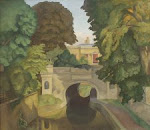
Richard Eurich (1903-1992), "The Window"
Yes, we are well-advised to patiently wait for the denouement. In the meantime, it is best not to jump to conclusions, or to take anything for granted. We live in a time when there is far too much preternatural self-assurance abroad in the human world. There is something to be said for the acceptance, and cultivation, of uncertainty. We are, after all, abiding in "the vale of Soul-making." Only one thing is certain.
Patience. "All in good time, all in good time," say the voices in the woods and in the fields.
Poor little, pretty, fluttering thing,
Must we no longer live together?
And dost thou prune thy trembling wing,
To take thy flight thou know'st not whither?
Thy humorous vein, thy pleasing folly,
Lies all neglected, all forgot;
And pensive, wav'ring, melancholy,
Thou dread'st and hop'st thou know'st not what.
Matthew Prior (1664-1721), Poems on Several Occasions (1709). The poem is untitled. It is Prior's version of the Emperor Hadrian's death-bed poem ("animula vagula blandula"), which is addressed to his soul.

Richard Eurich, "The Road to Grassington" (1971)

