
Showing posts with label Wordsworth. Show all posts

Wednesday, May 24, 2023

Presences

It is that time of year once again: I step out the front door, walk for an hour or so, and return, all the while accompanied by birdsong (occasionally punctuated by a crow's caw-caw-caw from off in the distance, or from directly above -- out of the blue).  In the meadows, solitary birds now and then fly up out of the wild grass or hop down a path, voiceless.  But the surrounding woods are full of unseen, unceasing choristers.

                    For Their Own Sake

Come down to the woods where the buds burst
Into fragrances, where the leaves make havoc
Of cloudy skies.  Listen to birds
Obeying their instincts but also singing
For singing's sake.  By the same token
Let us be silent for silence's sake,
Watching the buds, hearing the break
Free of fledgelings, the branches swinging
The sun, and never a word need be spoken.

Elizabeth Jennings, Consequently I Rejoice (Carcanet 1977).

This comes to mind: "the calm oblivious tendencies/Of Nature."  (William Wordsworth, The Excursion, Book I ("The Wanderer"), lines 963-964 (1814).)  One of those gnomic utterances found so often in the younger Wordsworth (of whom I am fond, although I recognize that others may find him tiresome).  "Oblivious" has always given me pause.  For instance, how does one reconcile it with immanence?  One can lose one's way in trying to unravel the euphoria and contradictions of the marvelous Wordsworthian-Coleridgean pantheism that emerged in 1797, and flourished for a few charmed years.

Jennings' poem suggests a reasonable approach: "oblivious" or not, the beautiful particulars of the World are enough in themselves, "for their own sake."  Her final words are exactly right: ". . . and never a word need be spoken."  For another perspective, we can turn to a lovely poem that has appeared here on more than one occasion: a different note, but in the same neighborhood.

                       Reciprocity

I do not think that skies and meadows are
Moral, or that the fixture of a star
Comes of a quiet spirit, or that trees
Have wisdom in their windless silences.
Yet these are things invested in my mood
With constancy, and peace, and fortitude,
That in my troubled season I can cry
Upon the wide composure of the sky,
And envy fields, and wish that I might be
As little daunted as a star or tree.

John Drinkwater, Tides (Sidgwick & Jackson 1917).

Winter over, the robins no longer gather in flocks.  Leaving a meadow and passing through a dark grove of pines, one hears them singing high overhead, each in its own tree.
 
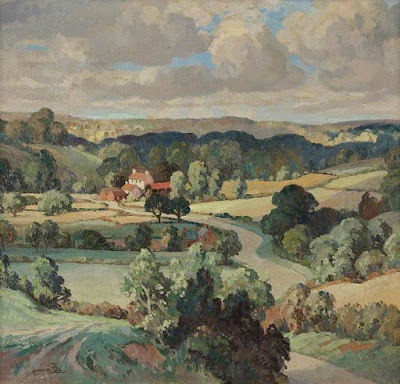
George Mackley (1900-1983), "Brackie's Burn, Northumberland"

On a breezy day, the new deep-green grass in the meadows turns silver as it sways and flows in the morning or afternoon sunlight.  And the sound of the rising and falling and threshing silver-green waves, how does one describe that?  A rustling?  A whispering?  A sighing?  A soughing?  A susurration?  All of the above.  But words ultimately fail, don't they?  Elizabeth Jennings is correct: ". . . and never a word need be spoken."  You simply have to be there.  No words are necessary.  No words are sufficient.

My favorite poem of May is Philip Larkin's "The Trees," to which I owe "threshing" in the paragraph immediately above.  The source is the poem's final stanza: "Yet still the unresting castles thresh/In fullgrown thickness every May./Last year is dead, they seem to say,/Begin afresh, afresh, afresh."  (Philip Larkin, High Windows (Faber and Faber 1974).)  However, when it comes to the grass of the meadows in May, I return each year to this:

          Consider the Grass Growing

Consider the grass growing
As it grew last year and the year before,
Cool about the ankles like summer rivers,
When we walked on a May evening through the meadows
To watch the mare that was going to foal.

Patrick Kavanagh, Collected Poems (edited by Antoinette Quinn) (Penguin 2005).  The poem was first published in The Irish Press on May 21, 1943.  Ibid, page 271.

May is an effulgent yet wistful month.  It does not have the wistful bittersweetness, or the bittersweet wistfulness, of, say, September or October: Spring continues to burgeon.  But the fallen cherry, plum, and magnolia petals lay scattered on the sidewalks, strewn across the grass.  On the other hand, along the paths and in the glades five-petaled pink wild roses (called the "Nootka rose" in this part of the world) and purple lupines are in bloom.  The "unresting castles" soon will be in their "fullgrown thickness" of green.  Ah, yes: "The paradise of Flowers' and Butterflies' Spirits."  (Samuel Taylor Coleridge, in Kathleen Coburn (editor), The Notebooks of Samuel Taylor Coleridge, Volume 1: 1794-1804 (Pantheon 1957), Notebook Entry 1736 (December 1803).)

                       The One

Green, blue, yellow and red --
God is down in the swamps and marshes,
Sensational as April and almost incred-
     ible the flowering of our catharsis.
A humble scene in a backward place
Where no one important ever looked;
The raving flowers looked up in the face
Of the One and the Endless, the Mind that has baulked
The profoundest of mortals.  A primrose, a violet,
A violent wild iris -- but mostly anonymous performers,
Yet an important occasion as the Muse at her toilet
Prepared to inform the local farmers
That beautiful, beautiful, beautiful God
Was breathing His love by a cut-away bog.

Patrick Kavanagh, Collected Poems.  By splitting "incredible" in lines three and four, Kavanagh is able to contrive a sonnet.  (And the rhyming of "marshes" and "catharsis" in lines two and four is no mean feat either.)  "The One" was written during Kavanagh's ecstatic "Canal Bank period" of 1955 through 1958, which was prompted by his survival after a brush with lung cancer (with accompanying surgery) in March and April of 1955.  Ibid, page 284.  The poem was first published in the journal Nonplus in October of 1959.  Ibid, page 286.

Anne Isabella Brooke (1916-2002)
"Wharfedale From Above Bolton Abbey" (c. 1954)

"All things around us are asking for our apprehension, working for our enlightenment.  But our thoughts are of folly.  What is worse, every day, and many times in the day, we are enlightened, we are Buddha, a poet, -- but do not know it, and remain an ordinary man.  For our sake haiku isolate, as far as it is possible, significance from the mere brute fact or circumstance.  It is a single finger pointing to the moon.  If you say it is only a finger, and often not a very beautiful one at that, this is so.  If the hand is beautiful and bejeweled, we may forget what it is pointing at.  Recording a conversation with Blake, [Henry] Crabb Robinson gives us an example of the indifference, or rather the cowardice, of average human nature, in its failure to recognize truth, poetry, when confronted with it in its unornamented form; the lines he quotes from Wordsworth are a "haiku."  'I had been in the habit, when reading this marvellous Ode to friends, to omit one or two passages, especially that beginning,
          But there's a Tree, of many, one,
     A single field
          That I have looked upon, 
lest I should be rendered ridiculous, being unable to explain precisely what I admired.  Not that I acknowledged this to be a fair test.  But with Blake I could fear nothing of the kind.  And it was this very stanza which threw him almost into a hysterical rapture'."

R. H. Blyth, Haiku, Volume III: Summer-Autumn (Hokuseido Press 1952), pages i-ii.  The passage quoted by Blyth from Henry Crabb Robinson's papers may be found in Arthur Symons, William Blake (Archibald Constable and Company 1907), pages 296-297 ("Extracts from the Diary, Letters, and Reminiscences of Henry Crabb Robinson").  The "Ode" referred to by Crabb Robinson is "Ode: Intimations of Immortality from Recollections of Early Childhood."

Of course, Blyth's intention is to make a case for the unique beauty and power of haiku.  This was, in fact, his mission in life.  In my humble opinion, Blyth is entirely correct in his assessment of the Beauty and Truth that may be found in the best haiku, and of the ability of haiku to provide enlightenment (regardless of whether or not such enlightenment occurs within the context of Buddhism).  However, as Blyth suggests in this passage (and as he makes clear throughout his writings), the best poetry, in all places and at all times, "is a single finger pointing to the moon."  Thus, his observations on haiku are intertwined with references to, and comparisons with, English poetry and Chinese poetry in particular, and world literature and philosophy in general.  This catholic approach is one of the features which (again, in my humble opinion) makes his works so interesting, provocative, and, yes, wise, and gives them such charm.

All of which leads me (lengthily) to this:

                  Now

The longed-for summer goes;
Dwindles away
To its last rose,
Its narrowest day.

No heaven-sweet air but must die;
Softlier float,
Breathe lingeringly
Its final note.

Oh, what dull truths to tell!
Now is the all-sufficing all
Wherein to love the lovely well,
Whate'er befall.

Walter de la Mare, O Lovely England and Other Poems (Faber and Faber 1953).

"Now" perfectly complements the observations made by Blyth in the passage quoted above.  "Now is the all-sufficing all/Wherein to love the lovely well,/Whate'er befall."  Consider this from Blyth: "All things around us are asking for our apprehension, working for our enlightenment."  Or this: "every day, and many times in the day, we are enlightened, we are Buddha, a poet, -- but do not know it, and remain an ordinary man."  As I noted above, although Blyth is making a case for the beauty and power of haiku, his observations are arguably applicable to all of the best poetry (although I certainly agree that haiku does have a special beauty and power that is the product of a unique and wonderful culture and language).

Leonard Pike (1887-1959), "The Chasing Shadows"

Who knows why we are here in this "paradise of Flowers' and Butterflies' Spirits."  During the short time we have, we should pay attention, and -- above all -- be grateful.  Speaking for myself, I fail each day.  But the poets daily remind me to attend to the World.

                                 Night

That shining moon -- watched by that one faint star:
Sure now am I, beyond the fear of change,
The lovely in life is the familiar,
And only the lovelier for continuing strange.

Walter de la Mare, Memory and Other Poems (Constable 1938).

One sometimes feels at a loss.  But then you happen upon something like this:

     A night of stars;
The cherry blossoms are falling
     On the water of the rice seedlings.

Buson (1716-1784) (translated by R. H. Blyth), in R. H. Blyth, Haiku, Volume II: Spring (Hokuseido Press 1950), page 170.

And the reflections of the stars float with the fallen cherry petals on the water, among the rice seedlings.

 Herbert Hughes-Stanton (1870-1937)
"The Mill in the Valley" (1892)

Monday, June 13, 2022

Utilitarianism

Here are the opening lines of a poem to which we shall return in a moment:

I live still, to love still
     Things quiet and unconcerned, --

The lines were written in the twentieth century by an English poet. They are engraved on the poet's tomb, which lies in the churchyard of Holy Trinity Church, Long Melford, Suffolk.

James Torrington Bell (1898-1970), "Braes of Downie" (1938)

My daily walk takes me through a wide, treeless meadow which slopes gently upward to the west.  At this time of the year, the wild grasses in the meadow are knee high, even hip high in places.  One wades through green along a narrow dirt path.  If the day is breezy, you are surrounded by swaying, rustling waves of green.  When you reach the top, the view suddenly opens up, and there they are, spread out to the horizon: Puget Sound and the Olympic Mountains.

"Against this predominance of machinery in our existence, Wordsworth's poetry, like all great art and poetry, is a continual protest.  Justify rather the end by the means, it seems to say: whatever may become of the fruit, make sure of the flowers and the leaves. 
     *     *     *     *     *
That the end of life is not action but contemplation -- being as distinct from doing -- a certain disposition of the mind: is, in some shape or other, the principle of all the higher morality. . . . To treat life in the spirit of art, is to make life a thing in which means and ends are identified: to encourage such treatment, the true moral significance of art and poetry.  Wordsworth, and other poets who have been like him in ancient or more recent times, are the masters, the experts, in this art of impassioned contemplation.  Their work is, not to teach lessons, or enforce rules, or even to stimulate us to noble ends; but to withdraw the thoughts for a little while from the mere machinery of life, to fix them, with appropriate emotions, on the spectacle of those great facts in man's existence which no machinery affects."

Walter Pater, "Wordsworth," in Appreciations, with an Essay on Style (Macmillan 1889), pages 61-62 (italics in original text).

Pater's essay is, I think, one of the finest things ever written about Wordsworth.  But you should take what I say with a grain of salt: as I have said here before, I am a Wordsworthian pantheist (the Wordsworthian-Coleridgean pantheism of 1797 through 1799), so what Pater has to say falls on sympathetic ears.  On the other hand, there are those who find Wordsworth insufferably dull.  That's how these things go.

Eric Hubbard (1892-1957), "The Cuckmere Valley, East Sussex"

From within the trees and bushes around the margins of the meadow, the birdsong never ceases.  Now and then you may hear the brief, rapid, hollow knocking of a woodpecker, far off in a dark wood.  You seldom see birds out in the meadow, but, when you do, it is a lovely surprise: a small, lone wanderer unexpectedly hops out of the deep grass beside the path, a few feet in front of you, and then hurries away down the long green tunnel -- as startled as you -- alert, but not greatly alarmed.  

                  Not for Use

A little of Summer spilled over, ran
In splashes of gold on geometry slates.
The grass unstiffened to pressure of sun.
I looked at the melting gates

Where icicles dropped a twinkling rain,
Clusters of shining in early December,
Each window a flaring, effulgent stain.
And easy now to remember

The world's for delight and each of us
Is a joy whether in or out of love.
'No one must ever be used for use,'
Was what I was thinking of.

Elizabeth Jennings, Growing Points (Carcanet 1975).

"Things quiet and unconcerned."  This falling away and paring away of things as the years go by is a welcome development.

Dane Maw (1906-1989), "Langdell Fells, Westmorland"

And now, to return to our English poet.  He was a gentle man who loved cricket and pubs.  He and Thomas Hardy became good friends. He spent more days at the front than any of the other poets of the First World War.  "Yes, I still remember/The whole thing in a way;/Edge and exactitude/Depend on the day."  (Edmund Blunden, "Can You Remember?")  He knew full well the uses to which a human being can be put.  But he never ceased loving the World.

                 Seers

I live still, to love still
          Things quiet and unconcerned, --
                 And many can say this.
                 I watch their bliss,
To these things they have ever returned.

One who has passed beyond
          Sits in my room with me,
But is sitting beside a pond
                 On a fallen tree,
And the pictured water-countenance
Is his day's ample inheritance.

And one died young who passed
          An hour or two away
From war, where windows were glassed
          And kept their kind display,
There he stands rapt, -- the china, the clocks,
Gollywogs, chessmen, postcards, frocks.

Enough it was also for her
          Whose life was toil on toil
If sometimes a wanderer
          Where bracken fronds uncoil,
Or silverweeds in woodways shone
She might regard them one by one.

Edmund Blunden, A Hong Kong House: Poems 1951-1961 (Collins 1962).

He closes his best-known poem with this line: "Over there are faith, life, virtue in the sun."

George Mackley (1900-1983), "Brackie's Burn, Northumberland"

Sunday, January 23, 2022

Web

I came across this a few days ago: "Even a man who is perfectly adjusted to a deranged society can prepare himself, if he so desires, to become adjusted to the Nature of Things."  It comes from Aldous Huxley's foreword to the first English translation of Hubert Benoit's The Supreme Doctrine: Psychological Studies in Zen Thought (Routledge & Kegan Paul 1955).  I encountered the sentence in "The Frontiers of Criticism," an essay by T. S. Eliot which was published in 1956, and later collected in his On Poetry and Poets (Faber and Faber 1957).  It should be noted that Eliot did not quote the final clause of Huxley's sentence: "as it manifests itself in the universe at large and in his own mind-body."

Given the current state of affairs in the world (the spectacle of madness we witness on a daily basis), the phrase "a deranged society" immediately caught my attention, as did Eliot's reference to The Supreme Doctrine as "that remarkable book."  (T. S. Eliot, On Poetry and Poets, page 116.)  I haven't read Benoit's book, but Huxley argues that Benoit "has offered a searching criticism of Western psychology and Western psychotherapy as they appear in the light of Zen." Based upon the summary provided in Huxley's foreword, and having now read some portions of The Supreme Doctrine that can be found on the internet, it would appear that Benoit feels that Western psychology and psychotherapy leave something crucial out of account.  This seems accurate.

But, in thinking further about the wonderful sentence from Huxley and the excerpts I have read from The Supreme Doctrine, it all seems too abstract to me.  Far too many words.  Still, Huxley's "a deranged society" is right on the mark, as is the idea that, if one is "perfectly adjusted" to that society, such an adjustment means absolutely nothing when deciding how to live one's life, how to preserve one's soul.

My no doubt simplistic view is that, when it comes to dealing with a deranged society, the solution is to step outside into the World.  I suppose this is the Wordsworthian pantheist in me.  Or perhaps I should say the Wordsworthian-Coleridgean pantheist (circa 1797 through 1799).

I have returned to  Coleridge's notebooks the past month, and happened upon this:

"On St Herbert's Island I saw a large Spider with most beautiful legs floating in the air on his Back by a single Thread which he was spinning out, and still as he spun, heaving in the air, as if the air beneath were a pavement elastic to his Strokes/ -- from the Top of a very high Tree he had spun his Line, at length reached the Bottom, tied his Thread round a piece of Grass, & re-ascended, to spin another/a net to hang as a fisherman's Sea net hangs in the Sun & Wind, to dry."

Samuel Taylor Coleridge, in Kathleen Coburn (editor), The Notebooks of Samuel Taylor Coleridge, Volume 1: 1794-1804 (Pantheon Books 1957), Notebook Entry 1598 (October 1803).

W. G. Poole, "Savernake Forest" (1938)

It all begins and ends with the beautiful particulars of the World. "The paradise of Flowers' & Butterflies' Spirits."  (Samuel Taylor Coleridge, Ibid, Notebook Entry 1736 (December 1803).)  And, as Coleridge reveals in his previous notebook entry, the paradise of spiders' Spirits as well.  He was not the first to notice.

                    The Spider

There is craft in this smallest insect,
with strands of web spinning out his thoughts;
in his tiny body finding rest,
and with the wind lightly turning.
Before the eaves he stakes out his broad earth;
for a moment on the hedge top lives through his life.
The ten thousand things should all be thus,
the way the Creator meant us to be.

Sugawara no Michizane (845-903) (translated by Burton Watson), in Burton Watson, Japanese Literature in Chinese, Volume 1: Poetry and Prose in Chinese by Japanese Writers of the Early Period (Columbia University Press 1975), page 107.

"For a moment on the hedge top lives through his life."  Lovely.  The beautiful particulars of the World are, like us, contingent and evanescent, but they are sufficient to keep us attentive and enthralled for a lifetime, if we choose.

          No Jewel

No jewel from the rock
Is lovely as the dew,
Flashing with flamelike red
With sea-like blue.

No web the merchant weaves
Can rival hers --
The silk the spider spins
Across the furze.

Walter de la Mare, Bells and Grass: A Book of Rhymes (Faber and Faber 1941).

Leslie Duncan (b. 1932), "Birchwood"

I'm not certain about the notion of becoming "adjusted to the Nature of Things, as it manifests itself in the universe at large and in [one's] own mind-body."  It seems to me that attentiveness and gratitude are what is required, not "adjustment," although I may be quibbling with words.  In any case, paying attention and being grateful is a daily struggle (and, speaking for myself, a matter of daily failure).  Yet the World goes on being the World, and has always done so.  It patiently awaits us. 

All the while, of course, the lower-case world goes on in its wonted way.  "Deranged society" follows upon "deranged society."  Human nature has never changed, and never will.  Best then to dwell with our companions the spiders.  And with the poets who pay attention to them.

   On Something Observed

Torn remains of a cobweb,
     one strand dangling down --
a stray petal fluttering by
     has been tangled, caught in its skein,
all day to dance and turn,
     never once resting --
elsewhere in my garden,
     no breeze stirs.

Kokan Shiren (1278-1346) (translated by Burton Watson), in Burton Watson, Japanese Literature in Chinese, Volume 2: Poetry and Prose in Chinese by Japanese Writers of the Later Period (Columbia University Press 1976), page 27.

Yes, the World awaits us, but it is reticent.  We shouldn't expect it to spell things out for us.  And yet, messages do arrive.  Glimmers. "Quiet stream, with all its eddies, & the moonlight playing on them, quiet as if they were Ideas in the divine mind anterior to the Creation." (Samuel Taylor Coleridge, in Kathleen Coburn (editor), The Notebooks of Samuel Taylor Coleridge, Volume 1: 1794-1804, Notebook Entry 1154 (March - April 1802).)  

spider -- what is it, 
what is it you are crying?
autumn wind

Bashō (1644-1694) (translated by Makoto Ueda), in Makoto Ueda, Bashō and His Interpreters: Selected Hokku with Commentary (Stanford University Press 1991), page 54.

Dudley Holland (1915-1956), "Winter Morning" (1945)

All of this unfolds, as I suggested above, within a context of contingency and evanescence.  Coleridge captures this in another beautiful notebook entry: "September 1 -- the beards of Thistle & dandelions flying above the lonely mountains like life, & I saw them thro' the Trees skimming the lake like Swallows --"  (Samuel Taylor Coleridge, in Kathleen Coburn (editor), The Notebooks of Samuel Taylor Coleridge, Volume 1: 1794-1804, Notebook Entry 799 (September 1800).)  ". . . like life."  Wonderful.

Drops of dew
strung on filaments
of spider web --
such are the trappings
that deck out this world

Saigyō (1118-1190) (translated by Burton Watson), in Burton Watson, Saigyō: Poems of a Mountain Home (Columbia University Press 1991), page 200.

Charles Cundall (1890-1971), "Temeside, Ludlow" (1923)

Tuesday, June 15, 2021

A Blade of Grass

I recently read the following haiku by Bashō:

a dragonfly
vainly trying to settle
onto a blade of grass

Bashō (1644-1694) (translated by Makoto Ueda), in Makoto Ueda, Bashō and His Interpreters: Selected Hokku with Commentary (Stanford University Press 1991), page 297.

Ueda's book consists of a selection of Bashō's haiku, each followed by excerpts of commentaries on the poem offered by Japanese critics over the years.  Of this haiku, one critic writes: "This looks like a simple descriptive poem, and yet it makes us wonder whether Bashō's eyes were not observing something important in the very heart of nature."  (Ibid, page 297, quoting Momota Sōji (1893-1955).)

True, but a bit of an understatement, R. H. Blyth might say, for he wrote this of Bashō (in comparing him to Shakespeare, Homer, Dante, Goethe, and Cervantes, in that order):  "In what point is Bashō equal or superior to these great men?  In his touching the very nerve of life, his unerring knowledge of those moments in time which, put together, make up our real, our eternal life.  He is awake in the world that for almost all men exists as a world of dreams."  (R. H. Blyth, Haiku, Volume 4: Autumn-Winter (Hokuseido Press 1952), page iii.) (Blyth's observation brings Wordsworth's "spots of time" to mind.) Many of you may be skeptical of Blyth's claim.  After all, he devoted much of his life to writing about haiku, and thus was not a disinterested party.  Knowing Blyth, he was likely also exaggerating for effect.  Still, I confess I am not unsympathetic.

But let's leave all that aside.  It is simply a matter of a blade of grass, of a dragonfly.

Stanley Spencer (1891-1959)
"Bluebells, Cornflowers, and Rhododendrons" (1945)

About a week later, having decided to travel to the world of W. B. Yeats, I came upon this:

   Gratitude to the Unknown Instructors

What they undertook to do
They brought to pass;
All things hang like a drop of dew
Upon a blade of grass.

W. B. Yeats, The Winding Stair and Other Poems (Macmillan 1933).

This poem has its source in Yeats' esoteric philosophical explorations. A daunting world in which to venture.  It tends to leave me befuddled.  However, I have been fond of Yeats from an impressionable age, and I will never cease returning to him.

But, there it was again, out of the blue: "a blade of grass."  Poetry is a wonderful thing, isn't it?  You never know what will happen the next time you open a book of poems.  A week earlier, I had been marveling at a dragonfly and a blade of grass.  Now, suddenly, serendipitously (I hadn't gone looking for "Gratitude to the Unknown Instructors"), there it was: "a blade of grass."

Stanley Spencer, "Peonies" (1939)

Yet, there was one more step to take.  A blade of grass.  A dragonfly. Something was nagging at me.  In poetry, one thing always leads to another.  Ah, yes, a dragonfly:

Being but man, forbear to say
Beyond to-night what thing shall be,
And date no man's felicity.
        For know, all things
        Make briefer stay
Than dragonflies, whose slender wings
    Hover, and whip away.

Simonides (c. 556-c. 468 B. C.) (translated by T. F. Higham), in T. F. Higham and C. M. Bowra (editors), The Oxford Book of Greek Verse in Translation (Oxford University Press 1938), page 234.

One of the joys of poetry is the way in which a poem you have read remains inside of you, waiting patiently.  A poem from 17th century Japan.  A poem written by an Irish poet in the 20th century.  A poem born in Greece 2,500 years ago.

It is all a matter of a blade of grass.  Or of a dragonfly.

Stanley Spencer, "Scarecrow, Cookham" (1934)

Tuesday, February 16, 2021

Noted In Passing

The Saturday before last was a changeable day.  Lines of dark rain squalls moved from the southwest to the northeast across Puget Sound, followed by intervals of open skies and sunlight.  Lovely.  Not unusual in this part of the world at this time of year.  Ah, but then came the denouement.

At around 4:50 (I looked at my watch), the sun emerged from beneath the last line of white (no longer grey-hearted) clouds over the waters of the Sound.  I happened to be out on my walk, so I stopped beneath a tall, leafless maple to watch the sunset.  However, it was the sky, not the sun, that caught my eye.  Pale blue-yellow at the horizon (just above the Olympic Mountains), it proceeded upward through changing shades of blue.  I followed the deepening progression: powder blue, cornflower blue, azure.  But, at the zenith  -- my head tilted back, the tangled lattice of empty branches overhead set against the depth of the sky -- the names of colors no longer held any meaning.  The eloquent blueness of that patch of sky was beyond the reach of words.  At such times, the only appropriate response is to pay attention, to not turn away.  There is nothing to be said.

A thought by Philippe Jaccottet which appeared in my last post comes to mind: "A thing is beautiful to the extent that it does not let itself be caught."  (Philippe Jaccottet (translated by John Taylor), from "Blazon in Green and White," in Philippe Jaccottet, And, Nonetheless: Selected Prose and Poetry 1990-2009 (Chelsea Editions 2011), page 53.)  A thought by Ludwig Wittgenstein which has appeared here on numerous occasions comes to mind as well: "What we cannot speak about we must pass over in silence."  (Ludwig Wittgenstein, Tractatus Logico-Philosophicus, Proposition 7 (1921) (translated by David Pears and Brian McGuinness).)  An alternative translation: "Whereof one cannot speak, thereof one must be silent." (Translated by C. K. Ogden.)  Yet, here I am, dear readers, providing you with a ten-day old, useless weather report, ending with an inadequate paean to the blue sky.  

Perhaps it is best to approach the beautiful particulars of the World aslant, lest we betray them.

                      The Nest

Four blue stones in this thrush's nest
I leave, content to make the best
Of turquoise, lapis lazuli
Or for that matter of the whole blue sky.

Andrew Young, Collected Poems (Jonathan Cape 1936).

James Craig (1877-1944), "The Kerry Coast" (c. 1928)

"There is a glass bowl with ten goldfish in it on my desk.  I am gazing at it from my bed, as the pain assaults me.  I feel the pain and see the beauty."  Masaoka Shiki (1867-1902) wrote this journal entry on April 15, 1901.  It appears in A Drop of Ink, a journal he wrote from January 24 through May 21, 1901.  His entries over this period were published in the Tokyo daily newspaper Nihon as he wrote them. (Janine Beichman-Yamamoto, "Masaoka Shiki's A Drop of Ink," Monumenta Nipponica, Volume 30, Number 3 (1975), pages 291-315.)  Shiki had been suffering from tuberculosis since 1889, and had been essentially bedridden since 1897.  He died on September 19, 1902, at the age of 34 -- one year and five months after writing this entry.

The poets remind us again and again: Pay attention.  Do not turn away.

               A Dead Mole

Strong-shouldered mole,
That so much lived below the ground,
Dug, fought and loved, hunted and fed,
For you to raise a mound
Was as for us to make a hole;
What wonder now that being dead
Your body lies here stout and square
Buried within the blue vault of the air?

Andrew Young, Collected Poems.

Where would we be without the blue sky, come what may?

"A certain hermit once said, 'There is one thing that even I, who have no worldly entanglements, would be sorry to give up, the beauty of the sky.'  I can understand why he should have felt that way."

Kenkō (1283-1350), Tsurezuregusa, Chapter 20, in Donald Keene (translator), Essays in Idleness: The Tsurezuregusa of Kenkō (Columbia University Press 1967), page 22.

John William Inchbold (1830-1888)
"A Study, in March" (c. 1855)

Between Thursday evening and Saturday afternoon eight or so inches of snow fell.  A warming spell began on Sunday, and on Monday the back garden was alive with birds.  Robins and sparrows, of course. But I also saw a dove beside a bare rose bush, pecking the snowy ground, and a woodpecker atop a post, watching the activity.  They may have been surprised into shelter and silence by the snow, but now -- darting back and forth in brief flight, chattering -- they had no air of winter about them.

Think you, 'mid all this mighty sum
Of things for ever speaking,
That nothing of itself will come,
But we must still be seeking?

William Wordsworth, seventh stanza of "Expostulation and Reply," in Ernest de Selincourt and Helen Darbishire (editors), The Poetical Works of William Wordsworth, Volume Four (Oxford University Press 1947).

And so we make our way through the World.  Beneath an ever-changing sky, blue at times.

     Butterflies a-flutter,
The lullaby changes again and again
     As she walks along.

Masaoka Shiki (translated by R. H. Blyth), in R. H. Blyth, A History of Haiku, Volume Two (Hokuseido Press 1964), page 88.

David Murray (1849-1933), "The Tithe Barns" (1905)

Monday, January 11, 2021

Presence

As I have remarked here in the past, the feeling that the world is going to Hell in a hand-basket is a timeless feature of human nature. The world has always been, and will always be, going to Hell in a hand-basket.  Still, one pauses: after all, there was someone living an ordinary life in Rome when it was sacked by the barbarians.  It's a matter of timing.  You never know what you're in for.

                                 To Posterity

When books have all seized up like the books in graveyards
And reading and even speaking have been replaced
By other, less difficult, media, we wonder if you
Will find in flowers and fruit the same colour and taste
They held for us for whom they were framed in words,
And will your grass be green, your sky be blue,
Or will your birds be always wingless birds?

Louis MacNeice, Visitations (Faber and Faber 1957).

Thus wrote MacNeice sixty-four years ago.  He was not wrong. Moreover, as I have noted here on several occasions, Wordsworth was not wrong in his preface to the 1802 edition of Lyrical Ballads:

"[A] multitude of causes, unknown to former times, are now acting with a combined force to blunt the discriminating powers of the mind, and, unfitting it for all voluntary exertion, to reduce it to a state of almost savage torpor.  The most effective of these causes are the great national events which are daily taking place, and the increasing accumulation of men in cities, where the uniformity of their occupations produces a craving for extraordinary incident, which the rapid communication of intelligence hourly gratifies."  

Hence, the theme is not new.  Only the technology changes.  So here we are again.  But all is not lost.  Some of us continue to love, and attempt to preserve, what Wordsworth and MacNeice loved (and feared for).  Yet at times one does think of the Roman living contentedly, going about his or her daily business, seeing dust on the horizon, having never heard of Visigoths, Ostrogoths, and Vandals.

William Rothenstein (1872-1945)
"Oakridge Farm, Late Summer" (c. 1925)

I try to keep things in perspective, but since 1968 (the year of the White Album, a memorable World Series between the Tigers and the Cardinals, and nothing else good) I have been of the opinion that the world (as distinguished from the World) is indeed going to Hell in a hand-basket.  However, don't mind me: I suspect I had the same feeling as I emerged bawling from the womb, gasping for air, during the first term of the Eisenhower administration.  Withal, come what may, I have remained quite cheerful.  I simply step outside and take a look around at the World and its beautiful particulars.  How can one be anything but astonished and grateful?

   On Looking Up by Chance at the Constellations

You'll wait a long, long time for anything much
To happen in heaven beyond the floats of cloud
And the Northern Lights that run like tingling nerves.
The sun and moon get crossed, but they never touch,
Nor strike out fire from each other, nor crash out loud.
The planets seem to interfere in their curves,
But nothing ever happens, no harm is done.
We may as well go patiently on with our life,
And look elsewhere than to stars and moon and sun
For the shocks and changes we need to keep us sane.
It is true the longest drouth will end in rain,
The longest peace in China will end in strife.
Still it wouldn't reward the watcher to stay awake
In hopes of seeing the calm of heaven break
On his particular time and personal sight.
That calm seems certainly safe to last tonight.

Robert Frost, West-Running Brook (Henry Holt and Company 1928).

William Rothenstein, "St Martin's Summer"

Nevertheless, one cannot help but take notice of certain things.  Of things that have permanently vanished.  Of irreplaceable things, now broken, that appear to be irreparable.  There's no help for it.  One does notice.  Is this merely a product of growing older, of feeling that it is time to leave the stage, an outdated relic?  Perhaps.  But that denizen of Rome haunts me.

Suddenly, another Roman arrives to remind me:

"If, I say, you separate from the governing principle within you those things which are, as it were, appended to it by its vehement passions, and the times past and future, you make yourself like the firm World of Empedocles, A sphere rejoicing 'midst the circling eddy.  Be solicitous only to live well for the present; and you may go on till death, to spend what remains of life, with tranquillity, with true dignity, and complacence with the divinity within you."

Marcus Aurelius, Meditations, Book XII, Section 3, in Francis Hutcheson and James Moor (translators), The Meditations of the Emperor Marcus Aurelius Antoninus (1742).

Life is ever a matter of attention and gratitude, don't you think?

   On Something Observed

Torn remains of a cobweb,
     one strand dangling down --
a stray petal fluttering by
     has been tangled, caught in its skein,
all day to dance and turn,
     never once resting --
elsewhere in my garden,
     no breeze stirs.

Kokan Shiren (1278-1346) (translated by Burton Watson), in Burton Watson, Japanese Literature in Chinese, Volume 2 (Columbia University Press  1976), page 27.

William Rothenstein, "Oakridge Farm, Late Summer" (1933)

Friday, December 18, 2020

Companion

As autumn departs, a thought: 

All Night Long Regretting
      the End of Autumn

Regret as I may,
even the bell
has a different sound now,
and soon frost will fall
in place of morning dew.

Saigyō (1118-1190) (translated by Burton Watson), in Burton Watson, Saigyō: Poems of a Mountain Home (Columbia University Press 1991), page 84.

I shall never quarrel with my beloved Saigyō, and his thought strikes home.  He and Marcus Aurelius are in agreement: "The world is a continual change."  (Marcus Aurelius, Meditations, Book IV, Section 3, in Francis Hutcheson and James Moor (translators), The Meditations of the Emperor Marcus Aurelius Antoninus (1742).)

And yet.  Last evening I saw a lovely crescent moon high in the southwestern sky over Puget Sound.  Constancy in the midst of change.  Apart from new meteor craters, cosmic debris, and human detritus scattered in a few places, has the moon altered over the millennia for those of us here on the ground, looking upward?  Hasn't it always been our unchanged, unchangeable, reliable companion?
  
     Autumn's bright moon,
However far I walked, still afar off
     In an unknown sky.

Chiyo-ni (1701-1775) (translated by R. H. Blyth), in R. H. Blyth, Haiku, Volume 3: Summer-Autumn (Hokuseido Press 1952), page 388.

Of Chiyo-ni's haiku, Blyth writes: "There is a feeling of separateness here which is not to be denied.  The poetess realizes that she and the moon are two different entities, in a different sky, in a different world."  (Ibid, page 388.)  He then provides a waka which, as Blyth puts it, "expresses that other side of truth":

     Down from the mountain,
The moon
     Accompanied me,
And when I opened the gate,
The moon too entered.

Kotomichi (1798-1868) (translated by R. H. Blyth), Ibid, page 388.

One need not make a choice.  Both are beautiful.  Both are true.

John Aldridge (1905-1983), "Autumn" (1946)

Perhaps Chiyo-ni's view and Kotomichi's view are merged and reconciled in William Wordsworth's lunar encounter in the winter of 1798:

                    A Night-Piece

                            The sky is overspread
With a close veil of one continuous cloud
All whitened by the moon, that just appears,
A dim-seen orb, yet chequers not the ground
With any shadow -- plant, or tower, or tree.
At last a pleasant instantaneous light
Startles the musing man whose eyes are bent
To earth.  He looks around, the clouds are split
Asunder, and above his head he views
The clear moon and the glory of the heavens.
There in a black-blue vault she sails along
Followed by multitudes of stars, that small,
And bright, and sharp along the gloomy vault
Drive as she drives.  How fast they wheel away!
Yet vanish not!  The wind is in the trees;
But they are silent.  Still they roll along
Immeasurably distant, and the vault
Built round by those white clouds, enormous clouds,
Still deepens its interminable depth.
At length the vision closes, and the mind
Not undisturbed by the deep joy it feels,
Which slowly settles into peaceful calm,
Is left to muse upon the solemn scene.

William Wordsworth, 1798 manuscript, in Beth Darlington, "Two Early Texts: A Night-Piece and The Discharged Soldier," in Jonathan Wordsworth (editor), Bicentenary Wordsworth Studies in Memory of John Alban Finch (Cornell University Press 1970), page 431.

1798: that charmed year for William and Dorothy Wordsworth (and for Samuel Taylor Coleridge as well).  Commentators on the poem have noted that it has its origin in a journal entry made by Dorothy on January 25, 1798.  (See, for example: Lucy Newlyn, William and Dorothy Wordsworth: 'All in Each Other' (Oxford University Press 2013), pages 57-59; Kenneth Johnston, The Hidden Wordsworth: Poet, Lover, Rebel, Spy (W. W. Norton 1998), pages 552-553.)  The thought is that William and Dorothy witnessed the scene together while out walking.

"The sky spread over with one continuous cloud, whitened by the light of the moon, which, though her dim shape was seen, did not throw forth so strong a light as to chequer the earth with shadows.  At once the clouds seemed to cleave asunder, and left her in the centre of a black-blue vault.  She sailed along, followed by multitudes of stars, small, and bright, and sharp."

Dorothy Wordsworth, The Grasmere and Alfoxden Journals (Oxford University Press 2002), page 142.

The "vision" recounted by Wordsworth brings to mind one of the fragments of blank verse in his Alfoxden notebook, which he kept during the first three months of 1798:

Of unknown modes of being which on earth,
Or in the heavens, or in the heavens and earth
Exist by mighty combinations, bound
Together by a link, and with a soul
Which makes all one.

William Wordsworth, fragment from the Alfoxden notebook, in Ernest de Selincourt and Helen Darbishire (editors), The Poetical Works of William Wordsworth, Volume 5 (Oxford University Press 1949), pages 340-341.

John Aldridge, "First Frost"

The moon is constant.  But, ah, dear readers, what of us?  

                    The Limit

The silent friendship of the moon
(I misquote Virgil) has kept you company
since that one night or evening
now lost in time, when your restless
eyes first made her out for always
in a patio or a garden since gone to dust.
For always?  I know that someday someone
will find a way of telling you this truth:
"You'll never see the moon aglow again.
You've now attained the limit set for you
by destiny.  No use opening every window
throughout the world.  Too late.  You'll never find her."
Our life is spent discovering and forgetting
that gentle habit of the night.
Take a good look.  It could be the last.

Jorge Luis Borges (translated by Alan Trueblood), in Jorge Luis Borges, Selected Poems (edited by Alexander Coleman) (Viking 1999).

This is no cause for gloom, or melancholy.  Our quickly passing interval of "silent friendship" with the moon, with all the beautiful particulars of the World, is no small thing.  And the thought that the World will go on without us, the moon and the seasons forever coming and going, can be a source of comfort and serenity.

But Saigyō -- wonderful Saigyō -- takes us in another direction altogether:

Were we sure of seeing
a moon like this
in existences to come,
who would be sorry
to leave this life?

Saigyō (translated by Burton Watson), in Burton Watson, Saigyō: Poems of a Mountain Home, page 158.

John Aldridge, "Beslyn's Pond, Great Bardfield"

Saturday, July 18, 2020

Near and Far

I find this to be an accurate and reasonable assessment of the present age:

"[A] multitude of causes, unknown to former times, are now acting with a combined force to blunt the discriminating powers of the mind, and, unfitting it for all voluntary exertion, to reduce it to a state of almost savage torpor.  The most effective of these causes are the great national events which are daily taking place, and the increasing accumulation of men in cities, where the uniformity of their occupations produces a craving for extraordinary incident, which the rapid communication of intelligence hourly gratifies."

And this, it seems to me, is a sound response to our distempered and unseemly contemporary world:

"More than half a century of existence has taught me that most of the wrong and folly which darken earth is due to those who cannot possess their souls in quiet; that most of the good which saves mankind from destruction comes of life that is led in thoughtful stillness.  Every day the world grows noisier; I, for one, will have no part in that increasing clamour, and, were it only by my silence, I confer a boon on all."

I suspect that many of you will have noticed that the two quoted passages come, not from our own time, but from the past.  The first passage is 218 years old: it appears in William Wordsworth's preface to the 1802 edition of Lyrical Ballads.  The second passage is 117 years old: it is from George Gissing's The Private Papers of Henry Ryecroft, which was published in 1903.  Hence, pick your truism. The more things change, the more they stay the same.  Or, if you prefer: There is nothing new under the sun.

Roger Fry (1886-1934), "Village in the Valley" (1926)

"They are not long, the days of wine and roses:/Out of a misty dream/Our path emerges for a while, then closes/Within a dream." Yesterday, while driving in my car, I heard Glen Campbell sing "Gentle on My Mind."  1967.  Ah, well.  All those years.  I was born during the first term of the Eisenhower administration.  Of history and its events, what remains for me is the death of President Kennedy (our elementary school principal announced it over the public address system on a sunny afternoon), the moon landing, the Vietnam War, and 9/11.  Unexpectedly hearing "Gentle on My Mind" on the car radio on an ordinary July afternoon.  How many times have I heard that song?  Where was I each time I heard it?  Who was I with?  What has become of them?  One song.  An entire lifetime returns.  History vanishes.

        Rising from My Sickbed

Alone and ill, I was confined to bed
But my dreams kept returning to my old haunts
This morning, at last, I managed to rise and
     stand beside the river
An endless trail of peach petals
     drifting down the stream

Ryōkan (1758-1831) (translated by Ryūichi Abé and Peter Haskel), in Ryūichi Abé and Peter Haskel, Great Fool: Zen Master Ryōkan: Poems, Letters, and Other Writings (University of Hawai'i Press 1996), page 123.

James Prowett (1865-1946), "Cruive Dykes, Craigforth" 

Is it inevitably the case that, as one grows older, the world of human affairs takes on an alien aspect, while the World of beautiful particulars becomes ever more hospitable?  On the other hand, one might arrive at that feeling at a young age, and find its truth confirmed by life.  Either way, there is indeed something to be said for possessing one's soul in quiet, for living "in thoughtful stillness," for having no part in the "increasing clamour." 

Happy were he could finish forth his fate
     In some unhaunted desert, most obscure
From all societies, from love and hate
     Of worldly folk; then might he sleep secure;
Then wake again, and give God ever praise,
     Content with hips and haws and bramble-berry;
In contemplation spending all his days,
     And change of holy thoughts to make him merry;
Where, when he dies, his tomb may be a bush,
Where harmless robin dwells with gentle thrush.

Robert Devereux, Earl of Essex (1566-1601), in E. K. Chambers (editor), The Oxford Book of Sixteenth Century Verse (Oxford University Press 1932).  The poem is untitled.

Percy Horton (1897-1970), "A Corner of Ambleside" (1943)

Friday, February 14, 2020

River

The vision of life as the flowing of a river (or a stream, a brook) is a lovely and felicitous one.  Not surprisingly, poets return to the image again and again, in all times and in all places.

As I mentioned in my previous post, I am fond of the fragments of blank verse that appear in William Wordsworth's Alfoxden notebook, which he kept from January through March of 1798.  In the notebook, one finds this:

                    They rest upon their oars
Float down the mighty stream of tendency
In a calm mood of holy indolence
A most wise passiveness in which the heart
Lies open and is well content to feel
As nature feels and to receive her shapes
As she has made them.

William Wordsworth, in James Butler (editor), The Ruined Cottage and The Pedlar (Cornell University Press 1979), page 115.

"Holy indolence" deserves our attention.  As does "a most wise passiveness," another beguiling combination of words.  However, since our subject at the moment is life as the flowing of a watercourse, we shall have to save our consideration of these lovely combinations for another time.  This brings us to "the mighty stream of tendency."  Wordsworth was quite taken with the phrase.  It first appears in a fragment on the previous page in the Alfoxden notebook:

Some men there are who like insects &c
dart and dart against the mighty
stream of tendency[,] others with
no vulgar sense of their existence
To no vulgar end float calmly
down.

William Wordsworth, Ibid, page 113.

The phrase eventually found its way into Book IX of The Excursion, as part of the "Discourse of the Wanderer":

What more than this, that we thereby should gain
Fresh power to commune with the invisible world,
And hear the mighty stream of tendency
Uttering, for elevation of our thought,
A clear sonorous voice.

William Wordsworth, The Excursion (1814), Book IX, lines 85-89 (edited by Sally Bushell, James Butler, Michael Jaye) (Cornell University Press 2007).

In addition to "the mighty stream of tendency," in an earlier section of The Excursion Wordsworth gives us these lines, spoken by "the Solitary":

                                                         The tenor
Which my life holds, he readily may conceive
Whoe'er hath stood to watch a mountain Brook
In some still passage of its course, and seen,
Within the depths of its capacious breast,
Inverted trees, and rocks, and azure sky;
And, on its glassy surface, specks of foam,
And conglobated bubbles undissolved,
Numerous as stars; that, by their onward lapse,
Betray to sight the motion of the stream,
Else imperceptible; meanwhile, is heard
Perchance, a roar or murmur; and the sound
Though soothing, and the little floating isles
Though beautiful, are both by Nature charged
With the same pensive office; and make known
Through what perplexing labyrinths, abrupt
Precipitations, and untoward straits,
The earth-born wanderer hath passed; and quickly,
That respite o'er, like traverses and toils
Must be again encountered -- Such a stream
Is human Life; and so the Spirit fares
In the best quiet to its course allow'd:
And such is mine, -- save only for a hope
That my particular current soon will reach
The unfathomable gulph, where all is still!

William Wordsworth, Ibid, Book III, lines 974-998.

One either likes this sort of thing in Wordsworth or one does not.  I am among the former.  Walter Pater wrote one of the finest essays on Wordsworth.  Among many other perceptive observations, he notes: "And the mixture in his work, as it actually stands, is so perplexed, that one fears to miss the least promising composition even, lest some precious morsel should be lying hidden within -- the few perfect lines, the phrase, the single word perhaps, to which he often works up mechanically through a poem, almost the whole of which may be tame enough."  (Walter Pater, "Wordsworth," in Appreciations, with an Essay on Style (Macmillan 1889), page 39.)

Samuel Birch (1869-1955), "Our Little Stream, Lamorna" (c. 1926)

"Such a stream/Is human Life; and so the Spirit fares/In the best quiet to its course allow'd."  These lines fit well with "the mighty stream of tendency," "holy indolence," and "a most wise passiveness." Once again:

                    They rest upon their oars
Float down the mighty stream of tendency
In a calm mood of holy indolence
A most wise passiveness in which the heart
Lies open and is well content to feel
As nature feels and to receive her shapes
As she has made them.

It is the floating, the "calm mood," the "passiveness," "the best quiet to its course allow'd" that are alluring:  a willing surrender to an unceasing flow.

I return to an entry from a notebook of Samuel Taylor Coleridge which has appeared here before:

"The Whale followed by Waves -- I would glide down the rivulet of quiet Life, a Trout!"

Kathleen Coburn (editor), The Notebooks of Samuel Taylor Coleridge, Volume 1: 1794-1804 (Pantheon Books 1957), Notebook Entry 54 (1795-1796).  As I noted in my previous post, there was a time when Wordsworth and Coleridge were thinking the same thoughts.  Another way to put it is that they were completing each other's thoughts.  A wonderful time it was.

These two passages in turn bring this to mind:

         The River

Stir not, whisper not,
Trouble not the giver
Of quiet who gives
This calm-flowing river,

Whose whispering willows,
Whose murmuring reeds
Make silence more still
Than the thought it breeds,

Until thought drops down
From the motionless mind
Like a quiet brown leaf
Without any wind;

It falls on the river
And floats with its flowing,
Unhurrying still
Past caring, past knowing.

Ask not, answer not,
Trouble not the giver
Of quiet who gives
This calm-flowing river.

Patrick MacDonogh, Poems (edited by Derek Mahon) (The Gallery Press 2001).

Samuel Birch, "A Cornish Stream"

All this talk of rivers and of life inevitably brings me to one of my favorite poems.  I beg your forbearance, dear readers, for it has appeared here on three previous occasions.  My only excuse is that I have carried this poem within me for over forty years, and, although I do not think of it daily, I know it is always there.

    The River of Rivers in Connecticut

There is a great river this side of Stygia,
Before one comes to the first black cataracts
And trees that lack the intelligence of trees.

In that river, far this side of Stygia,
The mere flowing of the water is a gayety,
Flashing and flashing in the sun.  On its banks,

No shadow walks.  The river is fateful,
Like the last one.  But there is no ferryman.
He could not bend against its propelling force.

It is not to be seen beneath the appearances
That tell of it.  The steeple at Farmington
Stands glistening and Haddam shines and sways.

It is the third commonness with light and air,
A curriculum, a vigor, a local abstraction . . .
Call it, once more, a river, an unnamed flowing,

Space-filled, reflecting the seasons, the folk-lore
Of each of the senses; call it, again and again,
The river that flows nowhere, like a sea.

Wallace Stevens,  The Collected Poems of Wallace Stevens (Alfred A. Knopf 1954).

Samuel Birch, "The Stream at Lamorna" (c. 1914)

Friday, January 31, 2020

Timeless

We live in a mysterious and wonderful World, dear readers.  Each of us is on a one-way journey to a certain end.  But the date and place of that end are unknown to us.  In the meantime, the seasons come and go, and our planet hurtles through space.  And they will continue to do so long after our flesh and bones have turned to dust.  As for the fate of our souls, we each work that out on our own, alone.

As I have noted here before, an awareness of one's mortality within the ever-turning, never-ending round of the seasons and the universe can be a source of serenity and equanimity.  This will all go on without me.  A comforting thought.  It can be quite exhilarating as well.  And an occasion for gratitude on a daily basis.

Poems can be reminders of this mortality within Eternity.  This past week, I have been reading the poetry of Janet Lewis.  I have long been fond of this:

     Kayenta, Arizona, May 1977

I fall asleep to the sound of rain,
But there is no rain in the desert.
The leaves of the trader's little cottonwoods
Turn, turn in the wind.

Janet Lewis, in R. L. Barth (editor), The Selected Poems of Janet Lewis (Swallow Press/Ohio University Press 2000).

Lewis' poem always brings this to mind:

The riverbed, dried-up, half-full of leaves.
Us, listening to a river in the trees.

Seamus Heaney, The Haw Lantern (Faber and Faber 1987).  The poem is untitled.

What would we do without the sound of the wind in the leaves?  My wish is to spend Eternity lying on the grass, looking up into swaying green boughs and the blue, cloud-dappled sky, as the leaves flutter and flicker in sunlight and shadow, rustling and sighing in the wind. Not likely, you say?  Consider this:  "If we take eternity to mean not infinite temporal duration but timelessness, then eternal life belongs to those who live in the present."  (Ludwig Wittgenstein, Proposition 6.4311, Tractatus Logico-Philosophicus (1921) (translated by David Pears and Brian McGuinness).)

Dudley Holland (1915-1956), "Winter Morning" (1945)

Here is another of my favorite poems by Lewis:

          Early Morning

The path
The spider makes through the air,
Invisible,
Until the light touches it.

The path
The light takes through the air,
Invisible,
Until it finds the spider's web.

Janet Lewis, in R. L. Barth (editor), The Selected Poems of Janet Lewis.

I often return to the fragments of blank verse found in William Wordsworth's Alfoxden notebook, which he kept between January and March of 1798.  In one fragment  he writes:  "In all forms of things/There is a mind."  (Ernest de Selincourt and Helen Darbishire (editors), The Poetical Works of William Wordsworth, Volume Five (Oxford University Press 1949), page 340.)  For a few charmed years, Wordsworth and Samuel Taylor Coleridge were thinking the same thoughts.  Thus, it is not surprising to discover this in one of Coleridge's notebooks:  "The paradise of Flowers' & Butterflies' Spirits." (Kathleen Coburn (editor), The Notebooks of Samuel Taylor Coleridge, Volume 1: 1794-1804 (Pantheon Books 1957), Notebook Entry 1736 (December 1803).)

An outmoded way of looking at the World, some moderns might say. Oh, I don't know.  Who is in a position to exclude any possibility? Wittgenstein again:  "We feel that even when all possible scientific questions have been answered, the problems of life remain completely untouched."  (Ludwig Wittgenstein, Proposition 6.52 (italics in the original), Tractatus Logico-Philosophicus (translated by David Pears and Brian McGuinness).)  And this:  "There are, indeed, things that cannot be put into words.  They make themselves manifest.  They are what is mystical."  (Ibid, Proposition 6.522 (italics in the original).)

But I have gone too far afield.  Poems can bring us back to what is in front of us at each moment, if we pay attention.  A gossamer and timeless World.

Drops of dew
strung on filaments
of spider web --
such are the trappings
that deck out this world.

Saigyō (1118-1190) (translated by Burton Watson), in Burton Watson, Saigyō: Poems of a Mountain Home (Columbia University Press 1991), page 200.

Charles Dawson (1863-1949), "Accrington from My Window" (1932)