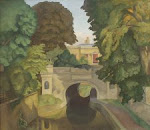
Showing posts with label Kokan Shiren. Show all posts

Saturday, August 26, 2023

Life and Art. Art and Life.

One morning this week, as I walked along a shadowy but sun-dappled path through a grove of trees, I came upon a single golden pine needle hovering vertically in mid-air, at eye-level, above the path. The needle was suspended on a single gossamer thread.  Unmoving, it captured the angled morning sunlight of late August.

I walked on.  A few minutes later, I remembered this (which has appeared here in the past):

    On Something Observed

Torn remains of a cobweb,
     one strand dangling down --
a stray petal fluttering by
     has been tangled, caught in its skein,
all day to dance and turn,
     never once resting --
elsewhere in my garden,
     no breeze stirs.

Kokan Shiren (1278-1346) (translated by Burton Watson), in Burton Watson, Japanese Literature in Chinese, Volume II: Poetry and Prose in Chinese by Japanese Writers of the Later Period (Columbia University Press 1976), page 27.  Kokan Shiren was a Zen Buddhist monk.

So goes our brief stay in Paradise.

Josephine Haswell Miller (1890-1975), "Studio Window" (1934)

Sunday, January 23, 2022

Web

I came across this a few days ago: "Even a man who is perfectly adjusted to a deranged society can prepare himself, if he so desires, to become adjusted to the Nature of Things."  It comes from Aldous Huxley's foreword to the first English translation of Hubert Benoit's The Supreme Doctrine: Psychological Studies in Zen Thought (Routledge & Kegan Paul 1955).  I encountered the sentence in "The Frontiers of Criticism," an essay by T. S. Eliot which was published in 1956, and later collected in his On Poetry and Poets (Faber and Faber 1957).  It should be noted that Eliot did not quote the final clause of Huxley's sentence: "as it manifests itself in the universe at large and in his own mind-body."

Given the current state of affairs in the world (the spectacle of madness we witness on a daily basis), the phrase "a deranged society" immediately caught my attention, as did Eliot's reference to The Supreme Doctrine as "that remarkable book."  (T. S. Eliot, On Poetry and Poets, page 116.)  I haven't read Benoit's book, but Huxley argues that Benoit "has offered a searching criticism of Western psychology and Western psychotherapy as they appear in the light of Zen." Based upon the summary provided in Huxley's foreword, and having now read some portions of The Supreme Doctrine that can be found on the internet, it would appear that Benoit feels that Western psychology and psychotherapy leave something crucial out of account.  This seems accurate.

But, in thinking further about the wonderful sentence from Huxley and the excerpts I have read from The Supreme Doctrine, it all seems too abstract to me.  Far too many words.  Still, Huxley's "a deranged society" is right on the mark, as is the idea that, if one is "perfectly adjusted" to that society, such an adjustment means absolutely nothing when deciding how to live one's life, how to preserve one's soul.

My no doubt simplistic view is that, when it comes to dealing with a deranged society, the solution is to step outside into the World.  I suppose this is the Wordsworthian pantheist in me.  Or perhaps I should say the Wordsworthian-Coleridgean pantheist (circa 1797 through 1799).

I have returned to  Coleridge's notebooks the past month, and happened upon this:

"On St Herbert's Island I saw a large Spider with most beautiful legs floating in the air on his Back by a single Thread which he was spinning out, and still as he spun, heaving in the air, as if the air beneath were a pavement elastic to his Strokes/ -- from the Top of a very high Tree he had spun his Line, at length reached the Bottom, tied his Thread round a piece of Grass, & re-ascended, to spin another/a net to hang as a fisherman's Sea net hangs in the Sun & Wind, to dry."

Samuel Taylor Coleridge, in Kathleen Coburn (editor), The Notebooks of Samuel Taylor Coleridge, Volume 1: 1794-1804 (Pantheon Books 1957), Notebook Entry 1598 (October 1803).

W. G. Poole, "Savernake Forest" (1938)

It all begins and ends with the beautiful particulars of the World. "The paradise of Flowers' & Butterflies' Spirits."  (Samuel Taylor Coleridge, Ibid, Notebook Entry 1736 (December 1803).)  And, as Coleridge reveals in his previous notebook entry, the paradise of spiders' Spirits as well.  He was not the first to notice.

                    The Spider

There is craft in this smallest insect,
with strands of web spinning out his thoughts;
in his tiny body finding rest,
and with the wind lightly turning.
Before the eaves he stakes out his broad earth;
for a moment on the hedge top lives through his life.
The ten thousand things should all be thus,
the way the Creator meant us to be.

Sugawara no Michizane (845-903) (translated by Burton Watson), in Burton Watson, Japanese Literature in Chinese, Volume 1: Poetry and Prose in Chinese by Japanese Writers of the Early Period (Columbia University Press 1975), page 107.

"For a moment on the hedge top lives through his life."  Lovely.  The beautiful particulars of the World are, like us, contingent and evanescent, but they are sufficient to keep us attentive and enthralled for a lifetime, if we choose.

          No Jewel

No jewel from the rock
Is lovely as the dew,
Flashing with flamelike red
With sea-like blue.

No web the merchant weaves
Can rival hers --
The silk the spider spins
Across the furze.

Walter de la Mare, Bells and Grass: A Book of Rhymes (Faber and Faber 1941).

Leslie Duncan (b. 1932), "Birchwood"

I'm not certain about the notion of becoming "adjusted to the Nature of Things, as it manifests itself in the universe at large and in [one's] own mind-body."  It seems to me that attentiveness and gratitude are what is required, not "adjustment," although I may be quibbling with words.  In any case, paying attention and being grateful is a daily struggle (and, speaking for myself, a matter of daily failure).  Yet the World goes on being the World, and has always done so.  It patiently awaits us. 

All the while, of course, the lower-case world goes on in its wonted way.  "Deranged society" follows upon "deranged society."  Human nature has never changed, and never will.  Best then to dwell with our companions the spiders.  And with the poets who pay attention to them.

   On Something Observed

Torn remains of a cobweb,
     one strand dangling down --
a stray petal fluttering by
     has been tangled, caught in its skein,
all day to dance and turn,
     never once resting --
elsewhere in my garden,
     no breeze stirs.

Kokan Shiren (1278-1346) (translated by Burton Watson), in Burton Watson, Japanese Literature in Chinese, Volume 2: Poetry and Prose in Chinese by Japanese Writers of the Later Period (Columbia University Press 1976), page 27.

Yes, the World awaits us, but it is reticent.  We shouldn't expect it to spell things out for us.  And yet, messages do arrive.  Glimmers. "Quiet stream, with all its eddies, & the moonlight playing on them, quiet as if they were Ideas in the divine mind anterior to the Creation." (Samuel Taylor Coleridge, in Kathleen Coburn (editor), The Notebooks of Samuel Taylor Coleridge, Volume 1: 1794-1804, Notebook Entry 1154 (March - April 1802).)  

spider -- what is it, 
what is it you are crying?
autumn wind

Bashō (1644-1694) (translated by Makoto Ueda), in Makoto Ueda, Bashō and His Interpreters: Selected Hokku with Commentary (Stanford University Press 1991), page 54.

Dudley Holland (1915-1956), "Winter Morning" (1945)

All of this unfolds, as I suggested above, within a context of contingency and evanescence.  Coleridge captures this in another beautiful notebook entry: "September 1 -- the beards of Thistle & dandelions flying above the lonely mountains like life, & I saw them thro' the Trees skimming the lake like Swallows --"  (Samuel Taylor Coleridge, in Kathleen Coburn (editor), The Notebooks of Samuel Taylor Coleridge, Volume 1: 1794-1804, Notebook Entry 799 (September 1800).)  ". . . like life."  Wonderful.

Drops of dew
strung on filaments
of spider web --
such are the trappings
that deck out this world

Saigyō (1118-1190) (translated by Burton Watson), in Burton Watson, Saigyō: Poems of a Mountain Home (Columbia University Press 1991), page 200.

Charles Cundall (1890-1971), "Temeside, Ludlow" (1923)

Monday, January 11, 2021

Presence

As I have remarked here in the past, the feeling that the world is going to Hell in a hand-basket is a timeless feature of human nature. The world has always been, and will always be, going to Hell in a hand-basket.  Still, one pauses: after all, there was someone living an ordinary life in Rome when it was sacked by the barbarians.  It's a matter of timing.  You never know what you're in for.

                                 To Posterity

When books have all seized up like the books in graveyards
And reading and even speaking have been replaced
By other, less difficult, media, we wonder if you
Will find in flowers and fruit the same colour and taste
They held for us for whom they were framed in words,
And will your grass be green, your sky be blue,
Or will your birds be always wingless birds?

Louis MacNeice, Visitations (Faber and Faber 1957).

Thus wrote MacNeice sixty-four years ago.  He was not wrong. Moreover, as I have noted here on several occasions, Wordsworth was not wrong in his preface to the 1802 edition of Lyrical Ballads:

"[A] multitude of causes, unknown to former times, are now acting with a combined force to blunt the discriminating powers of the mind, and, unfitting it for all voluntary exertion, to reduce it to a state of almost savage torpor.  The most effective of these causes are the great national events which are daily taking place, and the increasing accumulation of men in cities, where the uniformity of their occupations produces a craving for extraordinary incident, which the rapid communication of intelligence hourly gratifies."  

Hence, the theme is not new.  Only the technology changes.  So here we are again.  But all is not lost.  Some of us continue to love, and attempt to preserve, what Wordsworth and MacNeice loved (and feared for).  Yet at times one does think of the Roman living contentedly, going about his or her daily business, seeing dust on the horizon, having never heard of Visigoths, Ostrogoths, and Vandals.

William Rothenstein (1872-1945)
"Oakridge Farm, Late Summer" (c. 1925)

I try to keep things in perspective, but since 1968 (the year of the White Album, a memorable World Series between the Tigers and the Cardinals, and nothing else good) I have been of the opinion that the world (as distinguished from the World) is indeed going to Hell in a hand-basket.  However, don't mind me: I suspect I had the same feeling as I emerged bawling from the womb, gasping for air, during the first term of the Eisenhower administration.  Withal, come what may, I have remained quite cheerful.  I simply step outside and take a look around at the World and its beautiful particulars.  How can one be anything but astonished and grateful?

   On Looking Up by Chance at the Constellations

You'll wait a long, long time for anything much
To happen in heaven beyond the floats of cloud
And the Northern Lights that run like tingling nerves.
The sun and moon get crossed, but they never touch,
Nor strike out fire from each other, nor crash out loud.
The planets seem to interfere in their curves,
But nothing ever happens, no harm is done.
We may as well go patiently on with our life,
And look elsewhere than to stars and moon and sun
For the shocks and changes we need to keep us sane.
It is true the longest drouth will end in rain,
The longest peace in China will end in strife.
Still it wouldn't reward the watcher to stay awake
In hopes of seeing the calm of heaven break
On his particular time and personal sight.
That calm seems certainly safe to last tonight.

Robert Frost, West-Running Brook (Henry Holt and Company 1928).

William Rothenstein, "St Martin's Summer"

Nevertheless, one cannot help but take notice of certain things.  Of things that have permanently vanished.  Of irreplaceable things, now broken, that appear to be irreparable.  There's no help for it.  One does notice.  Is this merely a product of growing older, of feeling that it is time to leave the stage, an outdated relic?  Perhaps.  But that denizen of Rome haunts me.

Suddenly, another Roman arrives to remind me:

"If, I say, you separate from the governing principle within you those things which are, as it were, appended to it by its vehement passions, and the times past and future, you make yourself like the firm World of Empedocles, A sphere rejoicing 'midst the circling eddy.  Be solicitous only to live well for the present; and you may go on till death, to spend what remains of life, with tranquillity, with true dignity, and complacence with the divinity within you."

Marcus Aurelius, Meditations, Book XII, Section 3, in Francis Hutcheson and James Moor (translators), The Meditations of the Emperor Marcus Aurelius Antoninus (1742).

Life is ever a matter of attention and gratitude, don't you think?

   On Something Observed

Torn remains of a cobweb,
     one strand dangling down --
a stray petal fluttering by
     has been tangled, caught in its skein,
all day to dance and turn,
     never once resting --
elsewhere in my garden,
     no breeze stirs.

Kokan Shiren (1278-1346) (translated by Burton Watson), in Burton Watson, Japanese Literature in Chinese, Volume 2 (Columbia University Press  1976), page 27.

William Rothenstein, "Oakridge Farm, Late Summer" (1933)

Tuesday, July 31, 2018

How To Live, Part Twenty-Eight: Waiting and Watching

As I'm sure is the case with many of you, I have certain poems floating around inside me to which I return again and again: touchstones and talismans that have emerged from the winnowing of life and time.  A trail of breadcrumbs disappearing into -- or leading the way out of -- a dark forest.  Beauty and truth that, if we let them, find their way into an ordinary Wednesday afternoon.

"To those who value it, the one thing certain is that poetry, like wisdom, is a singularly rare thing, that the price of it is above rubies, and that it cannot be gotten for gold.  Once given potential life in words, it need never die; an ardent delight in it, and of this, too, there are many degrees, may be not only the joy of childhood, but a supreme and inexhaustible solace to the aged.  So long as we ourselves remain faithful, it will never prove false."

Walter de la Mare, Poetry in Prose: Warton Lecture on English Poetry, British Academy, 1935 (Oxford University Press 1935), page 42.

Stanhope Alexander Forbes (1857-1947)
"The Inner Harbour, Abbey Slip" (1921)

Thus, one evening last week I suddenly and unaccountably felt the urge to return to this:

          Waiting Both

A star looks down at me,
And says:  "Here I and you
Stand, each in our degree:
What do you mean to do, --
          Mean to do?"

I say:  "For all I know,
Wait, and let Time go by,
Till my change come." -- "Just so,"
The star says:  "So mean I: --
          So mean I."

Thomas Hardy, Human Shows, Far Phantasies, Songs, and Trifles (Macmillan 1925).

"Waiting Both" is the opening poem in a collection that was published in Hardy's 85th year.  I suppose that some (for instance, modern ironists) may find it to be of no interest, or, at best, quaint. Not I.  I may not think of this poem every day, but I know it is constantly with me, and has been since the day I first read it.  This is how poetry works.

"What [poets] say is not chosen to represent what they feel or think, but is itself the very substance of what had before lain dark and unapparent, is itself all that survives of feeling and thought, and cannot be expanded or reduced without dulling or falsification.  If this is not so, and if we do not believe it to be so, then poetry is of no greater importance than wallpaper, or a wayside drink to one who is not thirsty.  But if it is so, then we are on the way to understand why poetry is mighty; for if what poets say is true and not feigning, then of how little account are our ordinary assumptions, our feigned interests, our playful and our serious pastimes spread out between birth and death."

Edward Thomas, Feminine Influence on the Poets (Martin Secker 1910), page 86.

Stanhope Alexander Forbes, "On Paul Hill" (1922)

Still, one must be careful.  Poetry is not life.  Each of us knows this, of course.  "He has read well who has learnt that there is more to read outside books than in them."  Thomas Hardy, notebook entry for November 29, 1875, in The Life and Work of Thomas Hardy (edited by Michael Millgate) (Macmillan 1985), page 110.

Mind you, "Waiting Both" articulates a beautiful truth.  As do all those other poems that are talismans and touchstones and breadcrumbs for us.  But they are nothing without the World.  "May. In an orchard at Closeworth.  Cowslips under trees.  A light proceeds from them, as from Chinese lanterns or glow-worms."  Thomas Hardy, notebook entry for May of 1876, Ibid, page 112.

And so we wait.  And so we watch.  Enough to keep one busy for a lifetime.

waiting for what?
each day     each day
more fallen leaves pile up

Taneda Santōka (1882-1940) (translated by Burton Watson), in Burton Watson, For All My Walking: Free-Verse Haiku of Taneda Santōka, with Excerpts from His Diaries (Columbia University Press 2003), page 102.

The World is a daily miracle of beautiful and inexhaustible particularity amidst beautiful and inexhaustible multiplicity.  There is no better place to bide one's time.

     On Something Observed

Torn remains of a cobweb,
     one strand dangling down --
a stray petal fluttering by
     has been tangled, caught in its skein,
all day to dance and turn,
     never once resting --
elsewhere in my garden,
     no breeze stirs.

Kokan Shiren (1278-1346) (translated by Burton Watson), in Burton Watson, Japanese Literature in Chinese, Volume 2: Poetry and Prose in Chinese by Japanese Writers of the Later Period (Columbia University Press 1976), page 27.

Stanhope Alexander Forbes
"Village Rendezvous, Copperhouse Creek, near Hayle" (1938)

Monday, December 12, 2011

Frost, Blossoms, Snow, And Moonlight

I am fond of the following poem by W. H. Davies (1871-1940).  It often comes to mind at this time of year.

                 Nailsworth Hill

The Moon, that peeped as she came up,
   Is clear on top, with all her light;
She rests her chin on Nailsworth Hill,
   And, where she looks, the World is white.

White with her light -- or is it Frost,
   Or is it Snow her eyes have seen;
Or is it Cherry blossom there,
   Where no such trees have ever been?

W. H. Davies, Complete Poems (1963).

                     Utagawa Hiroshige (1797-1858), "Full Moon at Seba"

Over the past few months, when reading Chinese and Japanese poetry, I have been coming across images of frost and blossoms and snow and moonlight being confused.  From China, here is a poem by Li Po:

          Still Night Thoughts

Moonlight in front of my bed --
I took it for frost on the ground!
I lift my eyes to watch the mountain moon,
lower them and dream of home.

Li Po (translated by Burton Watson), The Columbia Book of Chinese Poetry: From Early Times to the Thirteenth Century (1984).

The following poem is by Po Chu-i:

                            Village Night

Gray gray of frosty grasses, insects chirp-chirping;
south of the village, north of the village, no sign of travelers.
Alone I go out in front of the gate, gazing over the fields;
in the bright moonlight, buckwheat blossoms are like snow.

Po Chu-i (translated by Burton Watson), Ibid.

                                                     Utagawa Hiroshige
                                            "Reflected Moon, Sarashima"

From Japan, here is a poem by Kokan Shiren (1278-1345):

                         Winter Moon

Opening the window at midnight, the night air cold,
Garden and roof a gleaming white,
I go to the verandah, stretch out my hand to scoop up some snow --
Didn't I know that moonlight won't make a ball?

Kokan Shiren (translated by David Pollack), Zen Poems of the Five Mountains (1985).

And, finally, from Ryokan:

Fresh morning snow in front of the shrine.
The trees!  Are they white with peach blossoms
Or white with snow?
The children and I joyfully throw snowballs.

Ryokan (translated by John Stevens), One Robe, One Bowl: The Zen Poetry of Ryokan (1977).

                                                     Utagawa Hiroshige
                           "Catching Fish by Moonlight on the Tama River"