Showing posts with label William Cowper. Show all posts

Monday, April 11, 2022

In Perpetuity

Once again, dear readers, it is time to return to my favorite poem of April.  Discovering a poem we love is a wonderful thing, but even more wonderful is the poem's continuing presence in our life over the years.  We are not the same, the world is not the same, as when we last visited the poem.  Who knows what awaits us when we arrive the next time?

                    Wet Evening in April

The birds sang in the wet trees
And as I listened to them it was a hundred years from now
And I was dead and someone else was listening to them.
But I was glad I had recorded for him the melancholy.

Patrick Kavanagh, Collected Poems (edited by Antoinette Quinn) (Penguin 2005).  The poem was first published in Kavanagh's Weekly on April 19, 1952.  Ibid, page 280.

No doubt I am a creature of habit, stuck in my settled ways.  But "Wet Evening in April" never ceases to move me, whether I return to it in April as a ritual, or whether it unaccountably rises to the surface of its own accord, in any season, at any moment.

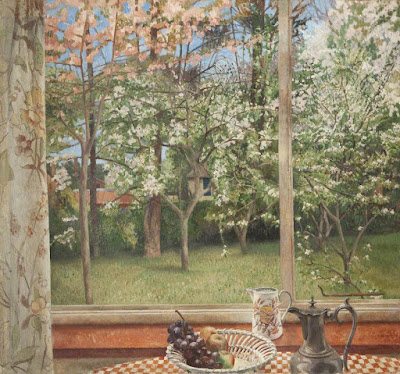
Richard Eurich (1903-1992), "The Window"

"But it is a sort of April weather life that we lead in this world.  A little sunshine is generally the prelude to a storm."  (William Cowper, letter to Walter Bagot (January 3, 1787), in James King and Charles Ryskamp (editors), The Letters and Prose Writings of William Cowper, Volume III: Letters 1787-1791 (Oxford University Press 1982), pages 5-6.)  So it was in this part of the world yesterday afternoon, as I walked through alternating showers and sunlight, the waters of Puget Sound by turns dark gray and dazzling.  So it is in the world at large.

Withal, there is an ever-present thread of beauty and truth running through our April weather life, through the April weather life of the world.  Poetry is an instance of the existence of that thread.

                    Homage to Arthur Waley

Seattle weather: it has rained for weeks in this town,
The dampness breeding moths and a gray summer.
I sit in the smoky room reading your book again,
My eyes raw, hearing the trains steaming below me
In the wet yard, and I wonder if you are still alive.
Turning the worn pages, reading once more:
"By misty waters and rainy sands, while the yellow dusk thickens."

Weldon Kees, in The Collected Poems of Weldon Kees (edited by Donald Justice) (University of Nebraska Press 1975).  The poem was first published in 1943.

As long time (and much appreciated!) readers of this blog may recall, Arthur Waley is one of my favorite translators of Chinese poetry into English (along with Burton Watson), and his translations have appeared here on many occasions.  Thus, I was delighted when I first came across Kees' poem (most likely on a rainy day in Seattle).

The quotation from Waley in the final line is from Waley's translation of a four-line poem (chüeh-chü) by Po Chü-i:

A bend of the river brings into view two triumphal arches;
That is the gate in the western wall of the suburbs of Hsün-yang.
I have still to travel in my solitary boat three or four leagues --
By misty waters and rainy sands, while the yellow dusk thickens.

Po Chü-i (772-846) (translated by Arthur Waley), in Arthur Waley, One Hundred and Seventy Chinese Poems (Constable 1918).  The poem is untitled.  It appears in a two-poem sequence titled "Arriving at Hsün-yang."  (By the way, Waley was in fact "still alive" when Kees wrote the poem: he died in 1966 at the age of 76.)

Richard Eurich, "The Rose" (1960)

Patrick Kavanagh meditates upon someone not yet born who will be listening to birds singing in wet trees in April a hundred years in the future, when Kavanagh will be long gone.  By virtue of the art of Arthur Waley, Weldon Kees reads a poem written by Po Chü-i a thousand years ago in China.  However fragile and contingent the world is, we mustn't forget this abiding thread.

   To a Poet a Thousand Years Hence

I who am dead a thousand years,
   And wrote this sweet archaic song,
Send you my words for messengers
   The way I shall not pass along.

I care not if you bridge the seas,
   Or ride secure the cruel sky,
Or build consummate palaces
   Of metal or of masonry.

But have you wine and music still,
   And statues and a bright-eyed love,
And foolish thoughts of good and ill,
   And prayers to them who sit above?

How shall we conquer?  Like a wind
   That falls at eve our fancies blow,
And old Maeonides the blind
   Said it three thousand years ago.

O friend unseen, unborn, unknown,
   Student of our sweet English tongue,
Read out my words at night, alone:
   I was a poet, I was young.

Since I can never see your face,
   And never shake you by the hand,
I send my soul through time and space
   To greet you.  You will understand.

James Elroy Flecker, in John Squire (editor), The Collected Poems of James Elroy Flecker (Secker and Warburg 1947).

Richard Eurich, "The Road to Grassington" (1971)

Thursday, April 29, 2021

April

I'm certain I'm not the only young man or woman whose budding interest in poetry was quickened by happening upon the following lines:

April is the cruellest month, breeding
Lilacs out of the dead land, mixing
Memory and desire, stirring
Dull roots with spring rain.

T. S. Eliot, The Waste Land (Boni and Liveright 1922).

I seem to recall that the presence of April, my birth month, played some role in why I was smitten with the lines.  But I could be misremembering.  On the other hand, I was a melancholy, bookish lad (some things never change), so I suspect my recollection may be accurate.  In any case, the lines have remained with me for nearly fifty years, even though my affections have long since migrated from The Waste Land to Four Quartets.

All of which leads (in a roundabout fashion), dear ever-patient readers, to our annual visit to my favorite April poem:

                         Wet Evening in April

The birds sang in the wet trees
And as I listened to them it was a hundred years from now
And I was dead and someone else was listening to them.
But I was glad I had recorded for him the melancholy.

Patrick Kavanagh, Collected Poems (edited by Antoinette Quinn) (Penguin 2004).  The poem was originally published on April 19, 1952, in Kavanagh's Weekly.  Ibid, page 280.

Allan Gwynne-Jones (1892-1982), "Spring Evening, Froxfield"

I suppose one might argue that "Wet Evening in April" is not a true "April poem" at all.  One expects something along these lines: "Loveliest of trees, the cherry now/Is hung with bloom along the bough . . ."  Or something even more effulgent and, yes, flowery:

                                   April, 1885

Wanton with long delay the gay spring leaping cometh;
The blackthorn starreth now his bough on the eve of May:
All day in the sweet box-tree the bee for pleasure hummeth:
The cuckoo sends afloat his note on the air all day.

Now dewy nights again and rain in gentle shower
At root of tree and flower have quenched the winter's drouth.
On high the hot sun smiles, and banks of cloud uptower
In bulging heads that crowd for miles the dazzling south.

Robert Bridges, The Shorter Poems (George Bell & Sons 1890). Caught up in his enthusiasm for the month, Bridges includes sprightly internal rhymes within the first five lines.

Or perhaps something more restrained, but still evocative of the month's beautiful and hopeful course:

                    April

Exactly: where the winter was
The spring has come: I see her now
In the fields, and as she goes
The flowers spring, nobody knows how.

C. H. Sisson, What and Who (Carcanet Press 1994).

Mind you, I am quite fond of each of these poems, and they have appeared here on more than one occasion.  Still, April would not be April without its characteristic tinge of melancholy.  All of those cherry, plum, and pear petals drifting down beneath a blue sky, carpeting the green grass and the sidewalks.  It's wonderful how April and October share a similar bittersweet wistfulness and wistful bittersweetness, isn't it?  Every six months, year after year, the falling of petals and the falling of leaves.  Trying to tell us something.

William Wood (1877-1958), "April Weather"

Ah, well, everything in the World and in our life eventually comes around to our evanescence, and the evanescence of the beautiful particulars that surround us.  "But it is a sort of April weather life that we lead in this world.  A little sunshine is generally the prelude to a storm."  (William Cowper, letter to Walter Bagot (January 3, 1787), in James King and Charles Ryskamp (editors), The Letters and Prose Writings of William Cowper, Volume III: Letters 1787-1791 (Oxford University Press 1982), pages 5-6.)  This is lovely, but perhaps too dramatic.  Life is a matter of petals and of leaves.  And of gratitude.

          Pear Blossoms by the Eastern Palisade

Pear blossoms pale white, willows deep green —
when willow fluff scatters, falling blossoms will fill the town.
Snowy boughs by the eastern palisade set me pondering —
in a lifetime how many springs do we see?

Su Tung-p'o (1036-1101) (translated by Burton Watson), in Burton Watson, Selected Poems of Su Tung-p'o (Copper Canyon Press 1994), page 68.

Adrian Paul Allinson (1890-1959), "The Cornish April"

Saturday, April 4, 2020

Another April

"But it is a sort of April weather life that we lead in this world.  A little sunshine is generally the prelude to a storm."  Thus wrote William Cowper in a letter dated January 3, 1787.  And now, here we are: another April.  More of the same, don't you think?

Yesterday was the sort of April day described by Cowper.  In the evening, I drove to a neighborhood sushi restaurant to pick up dinner.  (Although restaurants are closed for dining, take out is still permitted, and it makes sense to support family-owned businesses.) Just then the sun was out, but it would soon set beyond Puget Sound and the Olympic Mountains, both at my back.  The street I took runs straight down a long steep hill, levels out for a few blocks, then runs straight up another steep hill to the east.  From the top of the hill, I could see the cherry trees -- in peak white bloom -- lining both sides of the street that climbs the opposite slope.  The slope, and the houses on it, were covered in sunlight.  A rainbow suddenly appeared above the hill on the other side of the valley.  Descending, I passed blooming cherry trees, and, here and there, tall magnolia trees full of large pink-white blossoms.

Another April.  More of the same.  A paradise.

            A Short Ode

All things then stood before us
        as they were,
Not in comparison,
But each most rare;
The 'tree, of many, one,'
The lock of hair,
The weir in the morning sun,
The hill in the darkening air,
Each in its soleness, then and there,
Created one; that one, creation's care.

Edmund Blunden, A Hong Kong House: Poems 1951-1961 (Collins 1962).

The quotation in line 5 comes from William Wordsworth's "Ode: Intimations of Immortality from Recollections of Early Childhood": "But there's a tree, of many, one,/A single field which I have look'd upon,/Both of them speak of something that is gone."  I presume this reference accounts for Blunden's title (contrasting his ode of ten lines with Wordsworth's of over 200 lines).

Samuel Llewellyn (1858-1941), "Sailing at Blakeney" (c. 1938)

As is my usual practice, I have been doing my best to avoid "news."  I hear about things such as "lockdowns" by word-of-mouth.  But snippets inevitably seep through the interstices, despite my vigilance. For instance, I have recently been seeing and hearing the word "unprecedented" quite often.  "Unprecedented."  Is that so?

As is also my usual practice, I have been reading a poem soon after waking up each morning.  Yesterday morning I read this, a haiku of which I have long been fond:

     A night of stars;
The cherry blossoms are falling
     On the water of the rice seedlings.

Buson (1716-1783) (translated by R. H. Blyth), in R. H. Blyth, Haiku, Volume 2: Spring (Hokuseido Press 1950), page 170.

I fell asleep last night thinking about stars in a dark sky and cherry blossom petals floating in dark water among rice seedlings.  Today I went out for a walk.  In puddles left by yesterday's rain, I saw blue sky, white clouds, and infinitely intricate tree branches, floating at my feet.  Another April.  Unprecedented.

Christopher Sanders (1905-1991)
"Sunlight Through a Willow Tree at Kew" (c. 1958)

Sunday, March 26, 2017

Absence

My favorite poems from The Greek Anthology are the epitaphs and the elegies.  The best of them combine graceful, noble simplicity with deeply-felt, but restrained, emotion.  E. K. Chambers's poem in memory of Thomasine Trenoweth, which appeared in my previous post, prompted me to return to this lovely poem by Callimachus:

Their Crethis, with her prattle and her play,
The girls of Samos often miss to-day:
Their loved workmate, with flow of merry speech,
Here sleeps the sleep that comes to all and each.

Callimachus (c. 310 B.C. - c. 240 B. C.) (translated by A. H. Bullen), in      A. H. Bullen, Weeping-Cross and Other Rimes (Sidgwick & Jackson 1921).

This four-line poem accomplishes something remarkable in a brief space: it captures the essence of Crethis, of the personality which made her belovèd among her friends; it articulates, in a non-histrionic fashion, the grief of those friends upon losing her; and, finally, it places all of this within a context which embraces each of us, and which reminds us of a reality, often avoided, that we all must come to terms with, sooner or later.

Crethis, young prattler, full of graceful play,
Vainly the maids of Samos seek all day;
Cheerfullest workmate; ever talking; -- she
Sleeps here, -- that sleep, from which none born can flee.

Callimachus (translated by "F. H."), in The Classical Journal, Volume XXXIII (March and June, 1826), page 9.

Because I have no knowledge of Greek, I am not qualified to opine on the accuracy and fitness of the three translations that appear here.  I will only note that, despite the differences in the English words chosen by each of the translators, the emotional tenor of all three versions is quite consistent: we feel the charming vivacity of Crethis, and we also feel the aching and breathless sense of absence when a bright life is cut short.

The Samian maidens oft regret their friend,
     Sweet Crethis, full of play and cheer,
     Whose gossip lightened toil.  But here
She sleeps the sleep they all will sleep at end.

Callimachus (translated by Edward Cook), in Edward Cook, "The Charm of The Greek Anthology," More Literary Recreations (Macmillan 1919), page 317.

Algernon Cecil Newton (1880-1968), "The Avenue" (1944)

"All poetry is in a sense love-poetry."  Edward Thomas makes this suggestion at the end of a paragraph in which, discussing the unique power of poetry, he states:  "If what poets say is true and not feigning, then of how little account are our ordinary assumptions, our feigned interests, our playful and our serious pastimes spread out between birth and death. . . [Poetry] is the utterance of the human spirit when it is in touch with a world to which the affairs of 'this world' are parochial."  Edward Thomas, Feminine Influence on the Poets (Martin Secker 1910), pages 86-87.

I think that these are wonderful, and true, observations.  But might it not also be said that all poems are elegies?  This may be a case of six of one, half a dozen of the other:  an elegy is an expression of love (a greater or a lesser love, depending upon the nature of the relationship between the elegist and the departed).  There are various types and degrees of love, and the potential objects of our love are innumerable.  But what all love has in common is this:  the belovèd may leave us.  Hence, love poems.  Hence, elegies.  Edward Thomas again:  "First known when lost."

                           The Evening Star
     in memory of Catherine Mercer, 1994-96

The day we buried your two years and two months
So many crocuses and snowdrops came out for you
I tried to isolate from those galaxies one flower:
A snowdrop appeared in the sky at dayligone,

The evening star, the star in Sappho's epigram
Which brings back everything that shiny daybreak
Scatters, which brings the sheep and brings the goat
And brings the wean back home to her mammy.

Michael Longley, The Weather in Japan (Jonathan Cape 2000).  In a note, Longley explains that "dayligone" (line 4) is a "Scots (or Ulster Scots)" word which means "twilight, dusk."  Ibid, page 68.

"The evening star, the star in Sappho's epigram" likely refers to a two-line fragment by Sappho, which may be translated into prose as follows: "Evening, thou that bringest all that bright morning scattered; thou bringest the sheep, the goat, the child back to her mother."  Sappho (translated by Henry Thornton Wharton), in Henry Thornton Wharton, Sappho:  Memoir, Text, Selected Renderings, and a Literal Translation (David Stott 1887), page 131.

In Greek mythology, Hesperus (Venus) is the evening star.  Lord Byron adapts Sappho's lines, and links them to Hesperus, in Book III, Stanza 107, of Don Juan:

O Hesperus!  thou bringest all good things --
     Home to the weary, to the hungry cheer,
To the young bird the parent's brooding wings,
     The welcome stall to the o'erlaboured steer;
Whate'er of peace about our hearthstone clings,
     Whate'er our household gods protect of dear,
Are gathered round us by thy look of rest;
Thou bring'st the child, too, to the mother's breast.

A. E. Housman also incorporates the spirit of Sappho's lines (and Hesperus) into the third stanza of "Epithalamium":

     Happy bridegroom, Hesper brings
All desired and timely things.
All whom morning sends to roam,
Hesper loves to lead them home.
Home return who him behold,
Child to mother, sheep to fold,
Bird to nest from wandering wide:
Happy bridegroom, seek your bride.

A. E. Housman, Last Poems (Grant Richards 1922).

Algernon Cecil Newton, "The House by the Canal" (1945)

One  afternoon this past week, a heavy rain squall passed through about fifteen minutes before I headed out for my daily walk.  My course took me through a long avenue of trees.  By then, the sky had mostly cleared, and the green fields and bare trees glowed in the sunshine.

Wide puddles left by the just-departed storm ran continuously along both sides of the asphalt lane down which I walked.  As I have noted here in the past, to see the World reflected in a puddle, however small, is a wondrous thing.  But this was a replicated World of an entirely different magnitude: for two hundred yards or so the blue sky, the passing white clouds, and the intricate empty branches of the trees accompanied me, reflected in two bright ribbons of water.

As I walked, paused to gaze, and then walked on again, I was aware of the evanescence of the clear and brilliant World laid out at my feet.  Ripples, moving in tiny waves from south to north, occasionally disturbed the surface of the water as the wind gusted.  The blue sky and the white clouds and the tree branches reappeared when the wind subsided.  This bright and haunting World came to an end when the lane came to an end.  I could hear the rain water slowly gurgling into the storm drains.

"It is a commonplace of life that the greatest pleasure issues ultimately in the greatest grief.  Yet why -- why is it that this child of mine, who has not tasted half the pleasures that the world has to offer, who ought, by rights, to be as fresh and green as the vigorous young needles of the everlasting pine -- why must she lie here on her deathbed, swollen with blisters, caught in the loathsome clutches of the vile god of smallpox.  Being, as I am, her father, I can scarcely bear to watch her withering away -- a little more each day -- like some pure, untainted blossom that is ravished by the sudden onslaught of mud and rain.

"After two or three days, however, her blisters dried up and the scabs began to fall away -- like a hard crust of dirt that has been softened by melting snow.  In our joy we made what we call a 'priest in a straw robe.'  We poured hot wine ceremoniously over his body, and packed him and the god of smallpox off together.  Yet our hopes proved to be vain.  She grew weaker and weaker and finally, on the twenty-first of June, as the morning glories were just closing their flowers, she closed her eyes forever.

"Her mother embraced the cold body and cried bitterly.  For myself, I knew well it was no use to cry, that water once flown past the bridge does not return, and blossoms that are scattered are gone beyond recall.  Yet try as I would, I could not, simply could not, cut the binding cord of human love.

                              The world of dew
                         is the world of dew.
                              And yet, and yet -- "

Kobayashi Issa (prose translated by Nobuyuki Yuasa; haiku translated by Robert Hass), from A Year of My Life (1819), in Robert Hass, The Essential Haiku: Versions of Bashō, Buson, and Issa (The Ecco Press 1994), pages 227-228.

Visiting his daughter's grave a month after her death, Issa wrote this haiku:

Wind of autumn!
And the scarlet flowers are there
That she loved to pluck.

Kobayashi Issa (translated by Lewis Mackenzie), in Lewis Mackenzie, The Autumn Wind: A Selection from the Poems of Issa (John Murray 1957), page 100.

Here is another translation of the same haiku:

The red flower
you always wanted to pick --
now this autumn wind.

Kobayashi Issa (translated by Sam Hamill), in Kobayashi Issa, The Spring of My Life and Selected Haiku (translated by Sam Hamill) (Shambhala 1997), page 78.

Algernon Cecil Newton, "Landscape"

A lovely thought by William Cowper comes to mind:

"But it is a sort of April weather life that we lead in this world.  A little sunshine is generally the prelude to a storm."

William Cowper, letter to Walter Bagot (January 3, 1787), in James King and Charles Ryskamp (editors), The Letters and Prose Writings of William Cowper, Volume III: Letters 1787-1791 (Oxford University Press 1982), pages 5-6.

Yüan Chen (779-831) wrote a series of poems after the death of his wife. This is one of them.

          Bamboo Mat

I cannot bear to put away
the bamboo sleeping mat --

that first night I brought you home,
I watched you roll it out.

Yüan Chen (translated by Sam Hamill), in Sam Hamill, Crossing the Yellow River: Three Hundred Poems from the Chinese (BOA Editions 2000), page 191.

It is often the small things that matter, and that are not forgotten, as long as we remain here.  But they are not small things at all, are they?

Algernon Cecil Newton, "The Surrey Canal, Camberwell" (1935)

Monday, March 7, 2016

Earth, Lie Lightly

"Earth, lie lightly."  What a lovely request.  Much more evocative than, say, "rest in peace."  But it is not a phrase that one is apt to encounter first-hand in our times.  Which is a pity.  It is the cumulative tiny losses of such graceful touches that ultimately take their toll on the decency, seemliness, and nobility of civilization, not the day-to-day events of politics or economics, which are nothing but passing distractions.

"Earth, lie lightly."  One is likely to come across this gentle supplication (and variations upon it) in English poetry written prior to the 20th century. For instance, it is found in several translations of poems from The Greek Anthology.

Take to thy bosom, gentle earth, a swain
     With much hard labour in thy service worn.
He set the vines that clothe yon ample plain,
     And he these olives that the vale adorn.
He fill'd with grain the glebe; the rills he led
     Through this green herbage, and those fruitful bowers.
Thou, therefore, earth! lie lightly on his head,
     His hoary head, and deck his grave with flowers.

Anonymous (translated by William Cowper), in Henry Wellesley (editor), Anthologia Polyglotta: A Selection of Versions in Various Languages, Chiefly from the Greek Anthology (1849).

Stanley Spencer, "Bluebells, Cornflowers and Rhododendrons" (1945)

Too sentimental?  Too quaint?  Too old-fashioned?  It depends upon what sort of world you wish to live in.  One can, of course, take the ironic, hard-boiled "modern" approach and say that this sort of thing simply won't do anymore:  we have moved beyond it, we are now more knowing.

Ah, yes, have a look around you at the current state of the world.  What a wonderful place our superior knowingness and our irony have created for us!  I prefer this:

Full oft, of old, the islands changed their name,
And took new titles from some heir of fame:
Then dread not ye the wrath of gods above,
But change your own, and be the Isles of Love;
For Love's own name and shape the infant bore
Whom late we buried on your sandy shore.
Break softly there, thou never-weary wave,
And earth, lie light upon his little grave!

Crinagoras (translated by John William Burgon), Ibid.

Stanley Spencer, "The Roundabout" (1923)

Mind you, I am not suggesting that the essential humanity that one finds in The Greek Anthology has vanished from the world.  The love, hate, joy, sorrow, beauty, and transience of the ancients are ours as well.  Being human has always been a matter of life and death.

                            Life and Death

The two old, simple problems ever intertwined,
Close home, elusive, present, baffled, grappled.
By each successive age insoluble, pass'd on,
To ours to-day -- and we pass on the same.

Walt Whitman, Leaves of Grass (1891-1892).

"Insoluble."  Yet, it is entirely possible that the acceptance of this insolubility may be the only solution we need in order to pass our days in tranquility.  In any case, solution or no solution, we each have a choice to make:  shall we live in an enchanted world or a disenchanted world?

Earth, lightly press Ausigenes, for he,
Mother, ne'er set a heavy foot on thee.

Meleager (translated by John Besly), Anthologia Polyglotta.

Stanley Spencer, "Garden at Whitehouse, Northern Ireland" (1952)

Yes, we ought to tread softly.  As I have done here on more than one occasion in the past, I can only repeat Philip Larkin's lovely advice:

                . . . we should be careful

Of each other, we should be kind
While there is still time.

Philip Larkin, "The Mower," Collected Poems (Faber and Faber 1988).

A task for a lifetime, never completed.  And, if we are fortunate, a kind soul will request on our behalf, when we have vanished:  "Earth, lie lightly."

Lay a garland on my hearse
     Of the dismal yew;
Maidens, willow branches bear,
     Say I diëd true.

My Love was false, but I was firm
     From my hour of birth.
Upon my buried body lay
     Lightly, gently, earth.

John Fletcher, from The Maid's Tragedy (1622), in Norman Ault (editor), Elizabethan Lyrics (William Sloane 1949).

Stanley Spencer, "Scarecrow, Cookham" (1934)          

Monday, February 29, 2016

Life Explained, Part Thirty-Three: Snail

The sight of an empty snail shell in the garden or on the sidewalk always saddens me.  What fate befell the vanished inhabitant of that husk? "Moving at a snail's pace" will no doubt expose a creature to any number of misadventures.  And so the glimmering trail ends.

I realize, dear readers, that those of you who are gardeners may see the snail as a nuisance -- a single-minded engine of destruction.  I am also aware that some among you may consider the poems that follow to be instances of the worst sort of sentimental anthropomorphization, egregious examples of the Pathetic Fallacy.

I cannot muster a reasoned response to these potential objections.  The best that I can come up with is this:  there is no accounting for taste (mine, of course).  I came across the first poem a few weeks ago, and it immediately caught my fancy.  The three poems that follow it are long-time companions of which I am quite fond.  It occurred to me that it would be nice to see all of them together in one place.  As the benevolent (I hope!) dictator of this space, I can only beg your indulgence.

                       Upon the Snail

She goes but softly, but she goeth sure;
     She stumbles not as stronger creatures do:
Her journey's shorter, so she may endure
     Better than they which do much further go.

She makes no noise, but stilly seizeth on
     The flower or herb appointed for her food,
The which she quietly doth feed upon,
     While others range, and gare, but find no good.

And though she doth but very softly go,
     However 'tis not fast, nor slow, but sure;
And certainly they that do travel so,
     The prize they do aim at they do procure.

John Bunyan, A Book for Boys and Girls, or, Country Rhymes for Children (1686).

"Gare" (line 8) is glossed by one editor as "stare about."  Other editors (primarily in the 19th century) substitute "glare" in its place, apparently presuming that there was a misprint in the original text of 1686.  The adjectival form of "gare" means "eager, covetous, desirous of wealth."  OED. Given that Bunyan's book of children's poems was intended to edify, I would like to suggest (with absolutely no authority) that it would be nice to think of "gare" as meaning "to look about covetously."  Which a wise snail would never do, of course.

Charles Ginner (1878-1952), "Hartland Point from Boscastle" (1941)

It is the combination of self-sufficiency and leisurely, contemplative deliberativeness that makes the snail so beguiling and so sympathetic a character, don't you think?

                        The Snail

To grass, or leaf, or fruit, or wall,
The snail sticks close, nor fears to fall,
As if he grew there, house and all
                                             Together.

Within that house secure he hides,
When danger imminent betides
Of storm, or other harm besides
                                             Of weather.

Give but his horns the slightest touch,
His self-collecting power is such,
He shrinks into his house, with much
                                             Displeasure.

Where'er he dwells, he dwells alone,
Except himself has chattels none,
Well satisfied to be his own
                                             Whole treasure.

Thus, hermit-like, his life he leads,
Nor partner of his banquet needs,
And if he meets one, only feeds
                                             The faster.

Who seeks him must be worse than blind,
(He and his house are so combin'd)
If, finding it, he fails to find
                                             Its master.

Vincent Bourne (translated by William Cowper), in H. S. Milford (editor), The Complete Poetical Works of William Cowper (Oxford University Press 1907).

A side-note:  Vincent Bourne (1695-1747) was an Englishman who wrote poetry in Latin.  Cowper was a pupil of Bourne's at Westminster School. Later in his life, Cowper translated a number of Bourne's poems, including "The Jackdaw" and "The Thracian," which have appeared here previously.

"Well satisfied to be his own/Whole treasure":  yes, that's it, exactly!

Charles Ginner, "The Aqueduct, Bath" (1928)

The subject of my previous post was the role of "wonder" in the poetry of Walter de la Mare.  Wonder certainly plays a role in de la Mare's contemplation upon the snail in the following poem.  Having said that, I recognize that every good poem, on any subject, to some degree has its source in a poet's wonder at "the beauty and strangeness of creation" (to borrow W. H. Auden's words).

                         The Snail

All day shut fast in whorled retreat
You slumber where -- no wild bird knows;
While on your rounded roof-tree beat
The petals of the rose.
The grasses sigh above your house;
Through drifts of darkest azure sweep
The sun-motes where the mosses drowse
That soothe your noonday sleep.

But when to ashes in the west
Those sun-fires die; and, silver, slim,
Eve, with the moon upon her breast,
Smiles on the uplands dim;
Then, all your wreathèd house astir,
Horns reared, grim mouth, deliberate pace,
You glide in silken silence where
The feast awaits your grace.

Strange partners, Snail!  Then I, abed,
Consign the thick-darked vault to you,
Nor heed what sweetness night may shed
Nor moonshine's slumbrous dew.

Walter de la Mare, The Fleeting and Other Poems (Constable 1933).

The entire poem is lovely, but my favorite lines are these:  "While on your rounded roof-tree beat/The petals of the rose."  What a beautiful image and thought.  It is enough to make you envy a snail's life.

Charles Ginner, "Lancaster from Castle Hill Terrace" (1947)

"Strange partners, Snail!"  Yes, you and I and the snail and all else in the World are strange (and beautiful) partners during our short time together on earth.  "The divinest blessings are the commonest -- bestowed everywhere."  So says Walt Whitman.  (Richard Maurice Bucke (editor), Notes and Fragments: Left by Walt Whitman (1899), page 49.)

        Considering the Snail

The snail pushes through a green
night, for the grass is heavy
with water and meets over
the bright path he makes, where rain
has darkened the earth's dark.  He
moves in a wood of desire,

pale antlers barely stirring
as he hunts.  I cannot tell
what power is at work, drenched there
with purpose, knowing nothing.
What is a snail's fury?  All
I think is that if later

I parted the blades above
the tunnel and saw the thin
trail of broken white across
litter, I would never have
imagined the slow passion
to that deliberate progress.

Thom Gunn, My Sad Captains (Faber and Faber 1961).

"The slow passion/to that deliberate progress."  Can we speak of a snail's passion?  Yes, of course.  Why not?

Charles Ginner, "The Punt in the Mill Stream"

Sunday, April 5, 2015

April

I can assure you that my fondness for April is not attributable to the fact that I was born in this month (an Aries born in the Year of the Monkey). No, I am fond of April because of its sprightly fickleness:  anything can happen (even snow in some climes).  In my opinion, it is manifestly not "the cruellest month."

William Cowper is in the main correct about both April and life:  "It is a sort of April-weather life that we lead in this world.  A little sunshine is generally the prelude to a storm."  Still, despite its changefulness and "chancefulness" (Thomas Hardy, "The Temporary the All"), I believe that April carries with it an overall sense of blue- and yellow-hued promise.

                                   April, 1885

Wanton with long delay the gay spring leaping cometh;
The blackthorn starreth now his bough on the eve of May:
All day in the sweet box-tree the bee for pleasure hummeth:
The cuckoo sends afloat his note on the air all day.

Now dewy nights again and rain in gentle shower
At root of tree and flower have quenched the winter's drouth.
On high the hot sun smiles, and banks of cloud uptower
In bulging heads that crowd for miles the dazzling south.

Robert Bridges, The Shorter Poems (1896).

Note the internal rhymes within lines (delay/gay, now/bough, et cetera), the combination of end rhymes and internal rhymes across three lines (cometh/starreth/hummeth, shower/flower/uptower), and the internal rhymes across lines (smiles/miles, cloud/crowd).

Adrian Paul Allinson (1890-1959), "The Cornish April"

On my afternoon walk yesterday, I noticed that the tulips are beginning to peak.  The daffodils are on the wane.  Sidewalks and green lawns are strewn with the fallen creamy-white petals of magnolia trees.  April is a series of arrivals and departures.

              In the Valley

On this first evening of April
Things look wintry still:
Not a leaf on the tree,
Not a cloud in the sky,
Only a young moon high above the clear green west
And a few stars by and by.

Yet Spring inhabits round like a spirit.
I am sure of it
By the swoon on the sense,
By the dazzle on the eye,
By the long, long sigh that traverses my breast
And yet no reason why.

O lovely Quiet, am I never to be blest?
Time, even now you haste.
Between the lamb's bleat and the ewe's reply
A star has come into the sky.

Sylvia Townsend Warner, Time Importuned (1928).

I hadn't noticed this until I placed the two poems together in this post:  "the dazzling south" of Bridges and "the dazzle on the eye" of Warner.  And, coincidentally, Warner employs the same technique of end rhymes and internal rhymes across three lines used by Bridges:  sky/high/by; eye/sigh/why.

Lucien Pissarro, "April, Epping" (1894)

April's mutability is embodied in the trees:  their branches are still mostly bare, but, from a distance, they seem to be enveloped in a yellow-green haze.  Mutability and promise.  "Nature's first green is gold."

                      April

Exactly:  where the winter was
The spring has come:  I see her now
In the fields, and as she goes
The flowers spring, nobody knows how.

C. H. Sisson, What and Who (Carcanet Press 1994).

Victor Elford, "April Sunshine" (1971)

As long-time (and much-appreciated!) readers of this blog may recall, I have a May poem (Philip Larkin's "The Trees"), a November poem (Wallace Stevens's "The Region November"), and an April poem that I annually revisit in each of those months.  Please humor me as we pay a return visit to my April poem.

                      Wet Evening in April

The birds sang in the wet trees
And as I listened to them it was a hundred years from now
And I was dead and someone else was listening to them.
But I was glad I had recorded for him the melancholy.

Patrick Kavanagh, Collected Poems (edited by Antoinette Quinn) (Penguin 2004).  The poem was first published in Kavanagh's Weekly on April 19, 1952.

James McIntosh Patrick (1907-1998), "Glamis Village in April"

Sunday, October 5, 2014

Leaves

The Greek Anthology is, to a great degree, a chronicle of "change and chancefulness" (Thomas Hardy, "The Temporary the All"), woven through with a gentle and stoic thread of admonition:  Live well.  But be ever aware of That which awaits us all.  In other words, it is the perfect volume to peruse during the heart of autumn.  Doing so this week, I came upon this:

All human things are subject to decay;
And well the man of Chios tuned his lay,
"Like leaves on trees the race of man is found."
Yet few receive the melancholy sound,
Or in their breasts imprint this solemn truth;
For hope is near to all, but most to youth.
Hope's vernal season leads the laughing hours,
And strews o'er every path the fairest flowers.
To cloud the scene no distant mists appear,
Age moves no thought, and death awakes no fear.
Ah, how unmindful is the giddy crowd
Of the small span to youth and life allow'd!
Ye who reflect, the short-lived good employ,
And while the power remains, indulge your joy.

Simonides (translated by J. H. Merivale), in Robert Bland (editor), Collections from The Greek Anthology, and from the Pastoral, Elegiac, and Dramatic Poets of Greece (1813), page 185.

This sort of poem or epigram appears again and again in The Greek Anthology.  I readily confess that I cannot get enough of such things.  Mere truisms?  Yes, of course!  And wonderfully so.

James Torrington Bell (1898-1970), "Landscape"

The third line of Merivale's translation of Simonides' poem is taken from Alexander Pope's translation of Book VI of The Iliad.  "The man of Chios" (line 2) is Homer, who, by tradition, was thought to have been born on Chios, an island in the Aegean Sea in the region once known as Ionia. Which brings to mind (please pardon the digression) these lines from C. P. Cavafy's lovely poem "Ionic": "That we've broken their statues,/that we've driven them out of their temples,/doesn't mean at all that the gods are dead./O land of Ionia, they're still in love with you,/their souls still keep your memory."  (Translated by Edmund Keeley and Philip Sherrard.)

Here is Pope's line in context:

Like leaves on trees the race of man is found,
Now green in youth, now with'ring on the ground:
Another race the foll'wing spring supplies,
They fall successive, and successive rise;
So generations in their course decay,
So flourish these, when those are past away.

Here are the same lines of Homer as rendered by William Cowper:

For, as the leaves, such is the race of man.
The wind shakes down the leaves, the budding grove
Soon teems with others, and in spring they grow.
So pass mankind.  One generation meets
Its destined period, and a new succeeds.

James Sheard (1866-1921), "The Pride of Autumn"

All of this leads me inevitably to one of my favorite poems by Thomas Hardy, a poem that calls to me each year.  The poem has appeared here before, but, as long-time (and much-appreciated!) readers know, we need to circle back now and then to see how these things look in a new light.

   Autumn in King's Hintock Park

Here by the baring bough
     Raking up leaves,
Often I ponder how
     Springtime deceives, --
I, an old woman now,
     Raking up leaves.

Here in the avenue
     Raking up leaves,
Lords' ladies pass in view,
     Until one heaves
Sighs at life's russet hue,
     Raking up leaves!

Just as my shape you see
     Raking up leaves,
I saw, when fresh and free,
     Those memory weaves
Into grey ghosts by me,
     Raking up leaves.

Yet, Dear, though one may sigh,
     Raking up leaves,
New leaves will dance on high --
     Earth never grieves! --
Will not, when missed am I
     Raking up leaves.

Thomas Hardy, Time's Laughingstocks and Other Verses (1909).

I wonder:  did Hardy have Homer in mind when he wrote this?  Part of me hopes that he did not.  I love the thought of these two great poets arriving at the same place on their own, centuries apart.

Among the many beauties of the poem, this, in particular, always moves me:  "Earth never grieves!"

Andrew McCallum, "Oak Trees in Sherwood Forest" (1877)

I will close with two down-to-earth codas to this seasonal, generational, and cosmic falling and rising, rising and falling.

     Blowing from the west,
Fallen leaves gather
     In the east.

Yosa Buson (1716-1784) (translated by R. H. Blyth), in R. H. Blyth, Haiku, Volume 4: Autumn-Winter (Hokuseido 1952), page 362.

     People are few;
A leaf falls here,
     Falls there.

Kobayashi Issa (1763-1828) (translated by R. H. Blyth), Ibid, page 364.

James Bateman, "Lulington Church" (1939)

Thursday, April 17, 2014

"It Is A Sort Of April-Weather Life That We Lead In This World"

"But it is a sort of April-weather life that we lead in this world.  A little sunshine is generally the prelude to a storm."  So writes William Cowper in a January 3, 1787, letter to the Reverend Walter Bagot.  Cowper, who endured much, knew whereof he spoke.  It is he who wrote two of the most despairing lines in English verse:

I, fed with judgment, in a fleshly tomb, am
                                     Buried above ground.

The entire harrowing poem may be found here, where I suggest a comparison with John Clare's equally  harrowing "I am -- yet what I am, none cares or knows."

However, I do not wish to misrepresent Cowper with those two lines: despite his periods of deep melancholy, he seems to have been a good-natured, amiable, and kind man.  This is revealed in his correspondence, which is a delight to read.

Allan Gwynne-Jones, "Spring Evening, Froxfield" (1922)

                            Spring

There lurks a sadness in the April air
     For those who note the fate of earthly things;
     A dreamy sense of what the future brings
To those too good, too hopeful or too fair.

An underthought of heartache, as it were,
     Blends with the paean that the new leaf sings;
     And, as it were, a breeze from Death's great wings
Shakes down the blossoms that the fruit-trees bear.

The tide of sap flows up the forest trees;
     The birds exult in every bough on high;
The ivy bloom is full of humming bees;

But if you list, you hear the latent sigh;
     And each new leaf that rustles in the breeze
Proclaims the boundless mutability.

Eugene Lee-Hamilton, Sonnets of the Wingless Hours (1894).

Lee-Hamilton led an "April-weather life":  for 20 years he was confined to bed and sofa with a paralytic illness that has never been identified. Sonnets of the Wingless Hours was published in the year in which he recovered from the malady, which departed as mysteriously as it had arrived.

James Bateman, "Pastoral" (1928)

                           April Gale

The wind frightens my dog, but I bathe in it,
Sound, rush, scent of the Spring fields.

My dog's hairs are blown like feathers askew,
My coat's a demon, torturing like life.

Ivor Gurney, Selected Poems (edited by George Walter) (J. M. Dent 1996).

Gurney, like Cowper, was a gentle and afflicted soul.  Of course, things are much more complicated than that.  In most poets, a line such as "My coat's a demon, torturing like life" would seem over-dramatic -- an affectation. (So might:  "If one's heart is broken twenty times a day."  Or:  "The heart burns -- but has to keep out of face how heart burns.")  But not so with Gurney.  His was indeed an "April-weather life."  And he is only reporting exactly how it is.

Arthur Hathaway, "Spring Morning after Rain" (1940)

Thursday, July 11, 2013

"Untroubling, And Untroubled Where I Lie, The Grass Below -- Above The Vaulted Sky"

The following poem is perhaps John Clare's best-known poem.  This is ironic, because it is not really typical of his poetry.  Yet there is no gainsaying its emotional impact.

I am -- yet what I am, none cares or knows;
     My friends forsake me like a memory lost:--
I am the self-consumer of my woes:--
     They rise and vanish in oblivion's host,
Like shadows in love's frenzied stifled throes:--
And yet I am, and live -- like vapours tost

Into the nothingness of scorn and noise, --
     Into the living sea of waking dreams,
Where there is neither sense of life or joys,
     But the vast shipwreck of my life's esteems;
Even the dearest, that I love the best
Are strange -- nay, rather stranger than the rest.

I long for scenes where man hath never trod
     A place where woman never smiled or wept
There to abide with my Creator, God;
     And sleep as I in childhood sweetly slept,
Untroubling, and untroubled where I lie,
The grass below -- above the vaulted sky.

John Clare, in Eric Robinson, David Powell, and Margaret Grainger (editors), The Later Poems of John Clare, 1837-1864, Volume I (Oxford University Press 1984).

As I say, "I am . . ." is uncharacteristic of Clare.  He was not what we moderns would call a "confessional" poet.  He usually kept his counsel. (Which, in my humble opinion, is something that we all ought to do more often.)  The next poem catches his character quite well, I think.

Tristram Hillier, "Cutler's Green" (1944)

                         To John Clare

Well honest John how fare you now at home?
The spring is come and birds are building nests
The old cock robin to the stye is come
With olive feathers and its ruddy breast
And the old cock with wattles and red comb
Struts with the hens and seems to like some best
Then crows and looks about for little crumbs
Swept out by little folks an hour ago
The pigs sleep in the sty the bookman comes
The little boys lets home close nesting go
And pockets tops and tawes where daiseys bloom
To look at the new number just laid down
With lots of pictures and good stories too
And Jack the Giant-killer's high renown.

John Clare, Ibid, Volume II.  The spelling and punctuation are as they appear in Clare's original handwritten manuscript.  "The new number just laid down" (line 12) refers to a newly-published children's book or magazine sold by the bookman.

During his periods of madness, Clare sometimes spoke of a "John Clare" who was someone other than himself.  In this poem, "John Clare" makes an appearance as a younger version of the John Clare who is now residing in an asylum.  One feels the happiness and the innocence of the young and vanished "John Clare," but one also feels the sense of loss, and the longing, of the present-day John Clare dwelling against his will in a madhouse.  Or perhaps I am reading more into the poem than I ought to.

Tristram Hillier, "The Argument" (1943)

Clare's "I am . . ." brings to mind a remarkably (and eerily) similar poem by another poet who, like Clare, was beset with mental distress throughout much of his life.

Hatred and vengeance, my eternal portion,
Scarce can endure delay of execution,
Wait, with inpatient readiness, to seize my
                                   Soul in a moment.

Damn'd below Judas: more abhorr'd than he was,
Who for a few pence sold his holy Master.
Twice betrayed Jesus me, the last delinquent,
                                   Deems the profanest.

Man disavows, and Deity disowns me:
Hell might afford my miseries a shelter;
Therefore hell keeps her ever hungry mouths all
                                   Bolted against me.

Hard lot!  encompass'd with a thousand dangers;
Weary, faint, trembling with a thousand terrors;
I'm called, if vanquish'd, to receive a sentence
                                   Worse than Abiram's.

Him the vindictive rod of angry justice
Sent quick and howling to the centre headlong;
I, fed with judgment, in a fleshly tomb, am
                                   Buried above ground.

William Cowper, in H. S. Milford (editor), The Complete Poetical Works of William Cowper (1905).  The poem is sometimes printed with the title "Lines Written during a Period of Insanity."  However, the  poem was not published until after Cowper's death, and the title was likely added by an editor.

Tristram Hillier, "Flooded Meadow" (1949)

Thursday, September 30, 2010

"What Says He? -- 'Caw!'"

I wish that I was competent to distinguish between crows, ravens, rooks, and jackdaws.  I do know that the largest and most ominous specimens that I have encountered frequent the graveyards of Japan.  Loud, demanding, and huge-beaked they were.  I liked to think of them as ravens.  But who knows?

Jackdaws seem less ominous, more comical -- but still clever.  The following poem by William Cowper is a translation of the Latin original by Vincent Bourne.  As I mentioned in a recent post ("Herodotus And William Cowper: On Certain Customs Of Thrace"), Bourne was a teacher of Cowper's at Westminster School, and Cowper translated a number of his Latin poems. 

               The Jackdaw

There is a bird, who by his coat,
And by the hoarseness of his note,
   Might be supposed a crow;
A great frequenter of the church,
Where, bishop-like, he finds a perch,
   And dormitory too.

Above the steeple shines a plate,
That turns and turns, to indicate
   From what point blows the weather.
Look up -- your brains begin to swim,
'Tis in the clouds -- that pleases him,
   He chooses it the rather.

Fond of the speculative height,
Thither he wings his airy flight,
   And thence securely sees
The bustle and the raree-show,
That occupy mankind below,
   Secure and at his ease.

You think, no doubt, he sits and muses
On future broken bones and bruises,
   If he should chance to fall;
No; not a single thought like that
Employs his philosophic pate,
   Or troubles it at all.

He sees that this great roundabout,
The world, with all its motley rout,
   Church, army, physic, law,
Its customs and its businesses,
Is no concern at all of his,
   And says -- what says he? -- "Caw!"

Thrice happy bird!  I too have seen
Much of the vanities of men;
   And sick of having seen 'em,
Would cheerfully these limbs resign
For such a pair of wings as thine,
   And such a head between 'em.

                         James McIntosh Patrick, "Stobo Kirk" (1936)

Wednesday, September 22, 2010

Herodotus And William Cowper: On Certain Customs Of Thrace

Herodotus relates the following anecdote about the Trausi, who were one of the tribes of Thrace:

"The Trausi in all else resemble the other Thracians, but have customs at births and deaths which I will now describe.  When a child is born all its kindred sit round about it in a circle and weep for the woes it will have to undergo now that it is come into the world, making mention of every ill that falls to the lot of human kind; when, on the other hand, a man has died, they bury him with laughter and rejoicings, and say that now he is free from a host of sufferings, and enjoys the completest happiness."

Herodotus, The Histories, Book V, Chapter 4 (translated by George Rawlinson) (1859).  When I came across this passage, I realized that the Trausi may have anticipated the gloomy conclusion arrived at centuries later by Arthur Schopenhauer and Giacomo Leopardi:  that humans would be better off if they had never been born.  (As I said, gloomy.)

                                               Caspar David Friedrich
                                        "Graveyard under Snow" (1826)

I had not thought about the passage for a while, but recently I came across a poem titled "The Thracian." The poem is a translation by William Cowper of the Latin original, which was written by Vincent Bourne.  Bourne (1695-1747) was an Englishman who wrote poetry in Latin.  Cowper was a pupil of Bourne's at Westminster School.  Later in his life, Cowper translated a number of Bourne's poems.

               The Thracian

Thracian parents, at his birth,
   Mourn their babe with many a tear,
But with undissembled mirth
   Place him breathless on his bier.

Greece and Rome with equal scorn,
   "O the savages!" exclaim,
"Whether they rejoice or mourn,
   "Well entitled to the name!"

But the cause of this concern,
   And this pleasure, would they trace,
Even they might somewhat learn
   From the savages of Thrace.

                                                  Frans Francken
                   "Death Invites the Old Man for a Last Dance" (1635)

Monday, August 30, 2010

A Spaniel And A Water-Lily

From a letter of June 27, 1788, from William Cowper to his close friend Lady Hesketh:

"I must tell you a feat of my dog Beau.  Walking by the river side, I observed some water-lilies floating at a little distance from the bank.  They are a large white flower, with an orange-coloured eye, very beautiful.  I had a desire to gather one, and, having your long cane in my hand, by the help of it endeavoured to bring one of them within my reach.  But the attempt proved vain, and I walked forward.

Beau had all the while observed me very attentively.  Returning soon after toward the same place, I observed him plunge into the river, while I was about forty yards distant from him; and, when I had nearly reached the spot, he swam to land with a lily in his mouth, which he came and laid at my foot."

Cowper thereafter wrote a poem about Beau ("my spaniel, prettiest of his race") and the water-lily: "The Dog and the Water-Lily: No Fable."  Here are the last four stanzas of the poem:

My ramble finished, I return'd.
   Beau trotting far before
The floating wreath again discern'd,
   And plunging left the shore.

I saw him with that lily cropp'd
   Impatient swim to meet
My quick approach, and soon he dropp'd
   The treasure at my feet.

Charm'd with the sight, the world, I cried,
   Shall hear of this thy deed,
My dog shall mortify the pride
   Of man's superior breed;

But, chief, myself I will enjoin,
   Awake at duty's call,
To show a love as prompt as thine
  To Him who gives me all.

                     In memory of Emi (March, 1995 - August, 2009).
                                    She brought us countless lilies.

Saturday, May 22, 2010

William Cowper: "The Rapidity With Which Life Flies"

William Cowper -- that troubled man -- was a delightful correspondent.  Despite the mental distress that afflicted him most of his life, his letters are wise, observant, witty, and affectionate -- although the distress, and its attendant sadness, always hover nearby.  This passage is from a letter of October 26, 1790, to John Newton:

A yellow shower of leaves is falling continually from all the trees in the country.  A few moments only seem to have passed since they were buds; and in few moments more, they will have disappeared.  It is one advantage of a rural situation, that it affords many hints of the rapidity with which life flies, that do not occur in towns and cities.  It is impossible for a man, conversant with such scenes as surround me, not to advert daily to the shortness of his existence here, admonished of it, as he must be, by ten thousand objects.

There was a time when I could contemplate my present state, and consider myself as a thing of a day with pleasure; when I numbered the seasons as they passed in swift rotation, as a schoolboy numbers the days that interpose between the next vacation, when he shall see his parents and enjoy his home again.  But to make so just an estimate of life like this, is no longer in my power.  The consideration of my short continuance here, which was once grateful to me, now fills me with regret. I would live and live always, and am become such another wretch as Maecenas was, who wished for long life, he cared not at what expense of sufferings.
. . .
Adieu, my dear friend.  We are well; and, notwithstanding all that I have said, I am myself as cheerful as usual.