Some may disagree, but I think that Charlotte Mew and A. E. Housman do have something in common: their love poetry is nearly always about either unrequited love or love requited, but lost. The following poem by Mew seems to depart from the pattern. Still, I seem to detect a specter of future loss hovering at the edges. But perhaps I am being unfairly pessimistic. I would not wish to deprive Mew of any happiness she was able to find.
The Road to Kerity
Do you remember the two old people we passed on the road to Kerity,
Resting their sack, on the stones, by the drenched wayside,
Looking at us with their lightless eyes through the driving rain and then
out again
To the rocks and the long white line of the tide:
Frozen ghosts that were children once, husband and wife, father and
mother,
Looking at us with those frozen eyes --; have you ever seen anything quite
so chilled or so old?
But we -- with our arms about each other,
We did not feel the cold!
Charlotte Mew, The Farmer's Bride (1921). Kerity is a sea-side village in Brittany. Please note that lines 3, 5, and 6 are single lines, but the length limitations of this format do not permit them to appear as such.
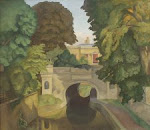
James McIntosh Patrick, "City Garden" (1979)
The following poem is, alas, more in keeping with the way Mew's life turned out. But here is the proverbial rub: poetry is oftentimes born of sadness, isn't it?
I so liked Spring
I so liked Spring last year
Because you were here; --
The thrushes too --
Because it was these you so liked to hear --
I so liked you --
This year's a different thing, --
I'll not think of you --
But I'll like Spring because it is simply Spring
As the thrushes do.
Charlotte Mew, The Rambling Sailor (1929).
James McIntosh Patrick, "A City Garden" (1940)
Monday, March 19, 2012
Saturday, March 17, 2012
Helpless
When I was a child I longed to be an adult. This longing was based upon two presumptions: first, that adults were free to do what they wanted to do (within the limits of law and morality, of course), and, second, that they knew exactly how to do these things (i.e., that they acted with complete self-assurance). I have since learned (speaking solely for myself) that those two presumptions were a bit optimistic.
The following poem by Frances Cornford (1886-1960) examines this state of affairs from a different angle, but it perhaps expresses part of what I am trying to get at.
Stanley Spencer, "The Ferry Hotel Lawn, Cookham" (1936)
Childhood
I used to think that grown-up people chose
To have stiff backs and wrinkles round their nose,
And veins like small fat snakes on either hand,
On purpose to be grand.
Till through the banisters I watched one day
My great-aunt Etty's friend who was going away,
And how her onyx beads had come unstrung.
I saw her grope to find them as they rolled;
And then I knew that she was helplessly old,
As I was helplessly young.
Frances Cornford, Collected Poems (1954).
Gilbert Spencer, "The Terrace" (1927)
The following poem by Frances Cornford (1886-1960) examines this state of affairs from a different angle, but it perhaps expresses part of what I am trying to get at.
Stanley Spencer, "The Ferry Hotel Lawn, Cookham" (1936)
Childhood
I used to think that grown-up people chose
To have stiff backs and wrinkles round their nose,
And veins like small fat snakes on either hand,
On purpose to be grand.
Till through the banisters I watched one day
My great-aunt Etty's friend who was going away,
And how her onyx beads had come unstrung.
I saw her grope to find them as they rolled;
And then I knew that she was helplessly old,
As I was helplessly young.
Frances Cornford, Collected Poems (1954).
Gilbert Spencer, "The Terrace" (1927)
Labels:
Frances Cornford,
Gilbert Spencer,
Stanley Spencer
Thursday, March 15, 2012
"Landfall"
Randolph Stow (1935-2010) is best known as a novelist -- a novelist who fell silent during the last 26 years of his life. (However, he did occasionally review books for The Times Literary Supplement.) I have not read all of his novels, but I do recommend Visitants, The Girl Green as Elderflower, and The Suburbs of Hell (his final novel, published in 1984). Stow was born in Australia, but his later years were spent in Suffolk and Essex.
He also wrote poetry. As an alternative to Christina Rossetti's sleep, Philip Larkin's extinction, and Mary Coleridge's interstellar travel, Stow offers a vision of our fate that seems very peaceful (and -- thankfully -- quiet).
Richard Eurich, "Dorset Cove" (1939)
Landfall
And indeed I shall anchor, one day -- some summer morning
of sunflowers and bougainvillaea and arid wind --
and smoking a black cigar, one hand on the mast,
turn, and unlade my eyes of all their cargo;
and the parrot will speed from my shoulder, and white yachts glide
welcoming out from the shore on the turquoise tide.
And when they ask me where I have been, I shall say
I do not remember.
And when they ask me what I have seen, I shall say
I remember nothing.
And if they should ever tempt me to speak again,
I shall smile, and refrain.
Randolph Stow, A Counterfeit Silence: Selected Poems (Angus & Robertson 1969).
Richard Eurich, "Mousehole, Cornwall" (1938)
He also wrote poetry. As an alternative to Christina Rossetti's sleep, Philip Larkin's extinction, and Mary Coleridge's interstellar travel, Stow offers a vision of our fate that seems very peaceful (and -- thankfully -- quiet).
Richard Eurich, "Dorset Cove" (1939)
Landfall
And indeed I shall anchor, one day -- some summer morning
of sunflowers and bougainvillaea and arid wind --
and smoking a black cigar, one hand on the mast,
turn, and unlade my eyes of all their cargo;
and the parrot will speed from my shoulder, and white yachts glide
welcoming out from the shore on the turquoise tide.
And when they ask me where I have been, I shall say
I do not remember.
And when they ask me what I have seen, I shall say
I remember nothing.
And if they should ever tempt me to speak again,
I shall smile, and refrain.
Randolph Stow, A Counterfeit Silence: Selected Poems (Angus & Robertson 1969).
Richard Eurich, "Mousehole, Cornwall" (1938)
Tuesday, March 13, 2012
"Are The Dead As Calm As Those They Leave Behind Them?"
At the beginning of the month, I posted a poem by Christina Rossetti ("Life and Death") that contains the lines: "Life is not sweet. One day it will be sweet/To shut our eyes and die." Because of her religious faith, Rossetti was probably able to view this prospect with equanimity. Others (Philip Larkin, for instance) look upon death with horror since, for them, it means extinction:
. . . no sight, no sound,
No touch or taste or smell, nothing to think with,
Nothing to love or link with,
The anaesthetic from which none come round.
Philip Larkin, from "Aubade," Collected Poems (Faber and Faber 1988).
Jack Airy, "A House and Cottage near the Quay at Orford" (c. 1940)
In the following untitled poem, Mary Coleridge looks at things differently: she sees neither peaceful sleep nor horrific extinction ahead, but something else entirely. The prospect she offers is intriguing: interstellar travel. In any event, time will tell for each of us, won't it? (Not that we will be able to report back, of course.)
Are the dead as calm as those
They leave behind them, friends or foes?
However a man may love or fight
Calm he falls asleep at night!
Fast the living sleeps and well;
But the spirits -- who can tell?
Are they as a rushing flame
For the Sun from whence it came,
Driven on from star to star,
Where the other dead men are?
Theresa Whistler, The Collected Poems of Mary Coleridge (Rupert Hart-Davis 1954).
Jack Airy, "St Bartholomew's Church, Orford" (c. 1940)
. . . no sight, no sound,
No touch or taste or smell, nothing to think with,
Nothing to love or link with,
The anaesthetic from which none come round.
Philip Larkin, from "Aubade," Collected Poems (Faber and Faber 1988).
Jack Airy, "A House and Cottage near the Quay at Orford" (c. 1940)
In the following untitled poem, Mary Coleridge looks at things differently: she sees neither peaceful sleep nor horrific extinction ahead, but something else entirely. The prospect she offers is intriguing: interstellar travel. In any event, time will tell for each of us, won't it? (Not that we will be able to report back, of course.)
Are the dead as calm as those
They leave behind them, friends or foes?
However a man may love or fight
Calm he falls asleep at night!
Fast the living sleeps and well;
But the spirits -- who can tell?
Are they as a rushing flame
For the Sun from whence it came,
Driven on from star to star,
Where the other dead men are?
Theresa Whistler, The Collected Poems of Mary Coleridge (Rupert Hart-Davis 1954).
Jack Airy, "St Bartholomew's Church, Orford" (c. 1940)
Labels:
Christina Rossetti,
Mary Coleridge,
Philip Larkin
Sunday, March 11, 2012
"Is The Noise I Hear From An Important Quarter?"
The quiet, self-contained life of a hedgehog seems romantically preferable to the noisy world in which we abide. As C. H. Sisson notes in the poem that appeared in my previous post: "The noise is more/Than ever it has been before." A great deal of this noise comes in the form of "news" (an extremely loose term in this day and age). The following poem by Sisson may serve as a further comment on the theme of "noise."
News
They live in the excitement of the news.
Who is what? What is that? And is the noise
I hear from an important quarter? When
Is what to happen? Who is what, finally?
Finally nobody is anything.
That is the end of it, my busy friend
And just as what you hear has no beginning
It has, assuredly, no certain end.
The end that comes is not the end of what,
The end of who perhaps, and perhaps not;
The rattle and the flashing lights are over,
Death is overt, but all the rest lies hidden.
Think of what you will, nothing will come of that,
What you intend is of all things the least;
As you spin on the lathe of circumstance
You are shaped, it is all the shape you have.
C. H. Sisson, Collected Poems (Carcanet 1998).
Kenneth Rowntree, "New Church, Llangelynnin" (1941)
Perhaps one of the secrets of freeing oneself from the news -- of becoming hedgehog-like -- is to come to the realization that there is no "important quarter" from which one can expect to hear news. There are no important quarters out there. All perspective has vanished, along with all credibility and decency. Mary Coleridge has the right idea.
No Newspapers
Where, to me, is the loss
Of the scenes they saw -- of the sounds they heard;
A butterfly flits across,
Or a bird;
The moss is growing on the wall,
I heard the leaf of the poppy fall.
Theresa Whistler (editor), The Collected Poems of Mary Coleridge (Rupert Hart-Davis 1954).
Mary Coleridge wrote "No Newspapers" in 1900, and thus had not yet encountered radio, television, and what not. Hence, perhaps we may silently consider "newspapers" to include a host of evils unknown to her.
Kenneth Rowntree, "Black Chapel, North End" (c. 1940)
News
They live in the excitement of the news.
Who is what? What is that? And is the noise
I hear from an important quarter? When
Is what to happen? Who is what, finally?
Finally nobody is anything.
That is the end of it, my busy friend
And just as what you hear has no beginning
It has, assuredly, no certain end.
The end that comes is not the end of what,
The end of who perhaps, and perhaps not;
The rattle and the flashing lights are over,
Death is overt, but all the rest lies hidden.
Think of what you will, nothing will come of that,
What you intend is of all things the least;
As you spin on the lathe of circumstance
You are shaped, it is all the shape you have.
C. H. Sisson, Collected Poems (Carcanet 1998).
Kenneth Rowntree, "New Church, Llangelynnin" (1941)
Perhaps one of the secrets of freeing oneself from the news -- of becoming hedgehog-like -- is to come to the realization that there is no "important quarter" from which one can expect to hear news. There are no important quarters out there. All perspective has vanished, along with all credibility and decency. Mary Coleridge has the right idea.
No Newspapers
Where, to me, is the loss
Of the scenes they saw -- of the sounds they heard;
A butterfly flits across,
Or a bird;
The moss is growing on the wall,
I heard the leaf of the poppy fall.
Theresa Whistler (editor), The Collected Poems of Mary Coleridge (Rupert Hart-Davis 1954).
Mary Coleridge wrote "No Newspapers" in 1900, and thus had not yet encountered radio, television, and what not. Hence, perhaps we may silently consider "newspapers" to include a host of evils unknown to her.
Kenneth Rowntree, "Black Chapel, North End" (c. 1940)
Labels:
C. H. Sisson,
Mary Coleridge
Friday, March 9, 2012
"The Noise Is More Than Ever It Has Been Before"
Periodically, I vow to tune out the babbling media world in which we live. (Hypocritically disregarding the fact that, as I type these words, I am, after a fashion (in a tiny way), participating in that world.) And, periodically, my vow is soon broken. Which does not stop me from (hypocritically) decrying this state of affairs.
The Trade
The language fades. The noise is more
Than ever it has been before,
But all the words grow pale and thin
For lack of sense has done them in.
What wonder, when it is for pay
Millions are spoken every day?
It is the number, not the sense
That brings the speakers pounds and pence.
The words are stretched across the air
Vast distances from here to there,
Or there to here: it does not matter
So long as there is media chatter.
Turn up the sound and let there be
No talking between you and me:
What passes now for human speech
Must come from somewhere out of reach.
C. H. Sisson, What and Who (1994).
Louisa Puller, "Haymill, Downton Gorge" (1941)
Near the end of the 19th century, Stephen Crane (1871-1900) wrote poetry that was bewildering and ahead of its time. The poems are untitled. It feels as though one has stumbled into the middle of a conversation or a story. What one hears may be portentous, or merely trivial. But the poetry is (for me, at least) oddly alluring (in small doses). Much of it seems prescient. Or, put another way, timeless.
Yes, I have a thousand tongues,
And nine and ninety-nine lie.
Though I strive to use the one,
It will make no melody at my will,
But is dead in my mouth.
Stephen Crane, The Black Riders and Other Lines (1895).
Louisa Puller, "The Railway Station at Tetbury" (1942)
The Trade
The language fades. The noise is more
Than ever it has been before,
But all the words grow pale and thin
For lack of sense has done them in.
What wonder, when it is for pay
Millions are spoken every day?
It is the number, not the sense
That brings the speakers pounds and pence.
The words are stretched across the air
Vast distances from here to there,
Or there to here: it does not matter
So long as there is media chatter.
Turn up the sound and let there be
No talking between you and me:
What passes now for human speech
Must come from somewhere out of reach.
C. H. Sisson, What and Who (1994).
Louisa Puller, "Haymill, Downton Gorge" (1941)
Near the end of the 19th century, Stephen Crane (1871-1900) wrote poetry that was bewildering and ahead of its time. The poems are untitled. It feels as though one has stumbled into the middle of a conversation or a story. What one hears may be portentous, or merely trivial. But the poetry is (for me, at least) oddly alluring (in small doses). Much of it seems prescient. Or, put another way, timeless.
Yes, I have a thousand tongues,
And nine and ninety-nine lie.
Though I strive to use the one,
It will make no melody at my will,
But is dead in my mouth.
Stephen Crane, The Black Riders and Other Lines (1895).
Louisa Puller, "The Railway Station at Tetbury" (1942)
Labels:
C. H. Sisson,
Stephen Crane
Wednesday, March 7, 2012
"We Should Be Careful Of Each Other, We Should Be Kind While There Is Still Time"
The subject of hedgehogs brings to mind a lovely -- if sad -- poem by Philip Larkin. (Of course, "lovely -- if sad" perhaps describes the lion's share of his poems.) It is one of the few poems written by Larkin between the publication of High Windows in 1974 and his death in 1985.
John Nash, "Walled Pond, Little Bredy, Dorset" (1923)
The Mower
The mower stalled, twice; kneeling, I found
A hedgehog jammed up against the blades,
Killed. It had been in the long grass.
I had seen it before, and even fed it, once.
Now I had mauled its unobtrusive world
Unmendably. Burial was no help:
Next morning I got up and it did not.
The first day after a death, the new absence
Is always the same; we should be careful
Of each other, we should be kind
While there is still time.
Philip Larkin, Collected Poems (Faber and Faber 1988).
In a May 20, 1979, letter to his friend Judy Egerton, Larkin wrote: "At Easter I found a hedgehog cruising about my garden, clearly just woken up: it accepted milk, but went back to sleep I fancy, for I haven't seen it since." Anthony Thwaite (editor), Selected Letters of Philip Larkin, 1940-1985 (Faber and Faber 1992). On June 10 of the same year, Larkin wrote to Egerton: "This has been rather a depressing day: killed a hedgehog when mowing the lawn, by accident of course. It's upset me rather." Ibid. Larkin wrote "The Mower" on June 12.
Betty Mackereth, who worked with Larkin at the Brynmor Jones Library at the University of Hull, wrote the following comment about the poem:
"I remember too well Philip telling me of the death of the hedgehog: it was in his office the following morning with tears streaming down his face. The resultant poem ends with a message for everyone."
The Philip Larkin Society Website (May 2002).
John Nash, "Rocks and Water" (c. 1950)
John Nash, "Walled Pond, Little Bredy, Dorset" (1923)
The Mower
The mower stalled, twice; kneeling, I found
A hedgehog jammed up against the blades,
Killed. It had been in the long grass.
I had seen it before, and even fed it, once.
Now I had mauled its unobtrusive world
Unmendably. Burial was no help:
Next morning I got up and it did not.
The first day after a death, the new absence
Is always the same; we should be careful
Of each other, we should be kind
While there is still time.
Philip Larkin, Collected Poems (Faber and Faber 1988).
In a May 20, 1979, letter to his friend Judy Egerton, Larkin wrote: "At Easter I found a hedgehog cruising about my garden, clearly just woken up: it accepted milk, but went back to sleep I fancy, for I haven't seen it since." Anthony Thwaite (editor), Selected Letters of Philip Larkin, 1940-1985 (Faber and Faber 1992). On June 10 of the same year, Larkin wrote to Egerton: "This has been rather a depressing day: killed a hedgehog when mowing the lawn, by accident of course. It's upset me rather." Ibid. Larkin wrote "The Mower" on June 12.
Betty Mackereth, who worked with Larkin at the Brynmor Jones Library at the University of Hull, wrote the following comment about the poem:
"I remember too well Philip telling me of the death of the hedgehog: it was in his office the following morning with tears streaming down his face. The resultant poem ends with a message for everyone."
The Philip Larkin Society Website (May 2002).
John Nash, "Rocks and Water" (c. 1950)
Monday, March 5, 2012
Life Explained, Part Twenty-Five: "The Hedgehog"
A sweet-smelling garden at night. Beneath the stars, a hedgehog makes its rounds. Enough in themselves to provide a perfectly suitable Explanation of Life.
The Hedgehog
The garden is mysterious at night
And scented! and scented! in the night of stars.
The hedgehog snuffles somewhere among leaves,
Just by the arch-way. So it is with time
-- Mute night and then a voice that says nothing,
Busying itself, complaining and insisting:
When this has end, silence will come again.
C. H. Sisson, Collected Poems (Carcanet 1998).
Robin Tanner, "Wren and Primroses" (1935)
To think of Time as a hedgehog making its patient, imperturbable way through a garden, beneath a starry sky, is a fine image indeed, and is quite comforting.
"Those of us who have allowed our minds to be besotted by the pressure of personal affairs, who perhaps are wasting our time in amassing wealth that we can never hope to enjoy, might well have our folly corrected by an accidental glimpse of this self-contained individualist in his shirt of thorns moving out of the cavernous shadows of some cool odorous flower-bed.
Through the trembling leaves of the garden trees the summer stars shine bright on the outlandish back of the small quadruped, impressing the conscious intelligence with a clear comprehension of the wealth of earth-poetry revealed by the mere existence of so fabulous an urchin directing its activities by the light of the Milky Way."
Llewelyn Powys, "Hedgehogs."
Paul Drury, "March Morning" (1933)
The Hedgehog
The garden is mysterious at night
And scented! and scented! in the night of stars.
The hedgehog snuffles somewhere among leaves,
Just by the arch-way. So it is with time
-- Mute night and then a voice that says nothing,
Busying itself, complaining and insisting:
When this has end, silence will come again.
C. H. Sisson, Collected Poems (Carcanet 1998).
Robin Tanner, "Wren and Primroses" (1935)
To think of Time as a hedgehog making its patient, imperturbable way through a garden, beneath a starry sky, is a fine image indeed, and is quite comforting.
"Those of us who have allowed our minds to be besotted by the pressure of personal affairs, who perhaps are wasting our time in amassing wealth that we can never hope to enjoy, might well have our folly corrected by an accidental glimpse of this self-contained individualist in his shirt of thorns moving out of the cavernous shadows of some cool odorous flower-bed.
Through the trembling leaves of the garden trees the summer stars shine bright on the outlandish back of the small quadruped, impressing the conscious intelligence with a clear comprehension of the wealth of earth-poetry revealed by the mere existence of so fabulous an urchin directing its activities by the light of the Milky Way."
Llewelyn Powys, "Hedgehogs."
Paul Drury, "March Morning" (1933)
Labels:
C. H. Sisson,
Life Explained,
Llewelyn Powys
Subscribe to:
Posts (Atom)


