
Showing posts with label Stevie Smith. Show all posts

Sunday, October 9, 2011

Dahlias In Autumn

As age works away at my memory -- names, places, and dates are the usual victims -- I find that, for some reason, I have not yet lost the poems that I have read over the years.  I am certainly not claiming that they are all there, line by line, waiting to be brought up at will.  Far from it.  Rather, titles or images or lines unexpectedly reappear by association with something else.

Today, on my afternoon walk, I saw a pair of large pink and creamy-white dahlias bending towards the ground, not long for this autumn world.  And then I remembered the title of the following poem.  I have not read the poem for at least 10 years, probably longer.  But here it is again, brought back by the sight of two beautiful, unseasonable dahlias.

          Giant Decorative Dahlia

It is easy enough to love flowers but these
had never appealed to me before, so
out of proportion above my garden's
other coloured heads and steady stems.

This spring though, in warm soil, I set
an unnamed tuber, offered cheap, and,
when August came and still no sign,
assumed the slugs had eaten it.

                                Suddenly it showed;
began to grow, became a small tree.
It was a race between the dingy bud
and the elements.  It has beaten
the frost, rears now three feet above
the muddled autumn bed, barbaric petals
pink quilled with tangerine, turning
its great innocent face towards me
triumphantly through the damp afternoon.

I could not deny it love if I tried.

Molly Holden (1927-1981), To Make Me Grieve (1968).

                       Charles Ginner, "Dahlias and Cornflowers" (1929)

Lest one think that "love" is too strong a word for one's feelings towards a giant decorative dahlia, I shall refer you back to Patrick Kavanagh's "The Hospital":  "Nothing whatever is by love debarred."  And to Stevie Smith's "Oh Grateful Colours, Bright Looks!":  "Seize colours quick, heap them up while you can."

                        Charles Ginner, "Still Life with Flowers" (c. 1920)

Wednesday, May 18, 2011

"Do Not!"

Ah, a week of scandals among the ruling class.  In New York, a French politician is given an American "perp walk."  In California, the former governor reveals a (no longer) secret "love child."  And, in England, a politician and his spouse face questions about the lurid details of their . . . traffic tickets.  (Something to do with "speeding points" shenanigans.) 

I -- being craven and weak -- cannot help but hear the Siren call of Schadenfreude.  But I tell myself to resist that sweet sound.  Perhaps the following poem by Stevie Smith will help.

                              Do Not!

Do not despair of man, and do not scold him,
Who are you that you should so lightly hold him?
Are you not also a man, and in your heart
Are there not warlike thoughts and fear and smart?
Are you not also afraid and in fear cruel,
Do you not think of yourself as usual,
Faint for ambition, desire to be loved,
Prick at a virtuous thought by beauty moved?
You love your wife, you hold your children dear,
Then say not that Man is vile, but say they are.
But they are not.  So is your judgement shown
Presumptuous, false, quite vain, merely your own
Sadness for failed ambition set outside,
Made a philosophy of, prinked, beautified
In noble dress and into the world sent out
To run with the ill it most pretends to rout.
Oh know your own heart, that heart's not wholly evil,
And from the particular judge the general,
If judge you must, but with compassion see life,
Or else, of yourself despairing, flee strife.

Stevie Smith, Collected Poems (1975).

                                          Raymond Booth (1929- )
                               "Magpies in the Vegetable Garden"      

Thursday, March 17, 2011

"Oh Grateful Colours, Bright Looks!"

The poetry of Stevie Smith (1902-1971) is often a bit twee for me.  However, she does have her moments.  Philip Larkin, whose judgement is usually (apart from a few blind spots) unerring, has this to say about her:  "Her poems, to my mind, have two virtues:  they are completely original, and now and again they are moving.  These qualities alone set them above 95 per cent of present-day output."  Larkin also said (and herein lies a clue as to why he liked her poetry, given what we know of Larkin's temperament):  "Miss Smith's poems speak with the authority of sadness."  (Only Larkin could come up with a comment like that!)  Philip Larkin, "Frivolous and Vulnerable," in Required Writing (1983).

I recently posted Patrick Kavanagh's "The Hospital," which contains these wonderful lines:

        But nothing whatever is by love debarred,
        The common and banal her heat can know.

The poem closes: 

        For we must record love's mystery without claptrap,
        Snatch out of time the passionate transitory.

The following poem by Stevie Smith is, I think, a fine companion piece to "The Hospital."

     Oh Grateful Colours, Bright Looks!

The grass is green
The tulip is red
A ginger cat walks over
The pink almond petals on the flower bed.
Enough has been said to show
It is life we are talking about.  Oh
Grateful colours, bright looks!  Well, to go
On.  Fabricated things too -- front doors and gates,
Bricks, slates, paving stones -- are coloured
And as it has been raining and is sunny now
They shine.  Only that puddle
Which, reflecting the height of the sky
Quite gives one a feeling of vertigo, shows
No colour, is a negative.  Men!
Seize colours quick, heap them up while you can.
But perhaps it is a false tale that says
The landscape of the dead
Is colourless.

Stevie Smith, Collected Poems (1975).

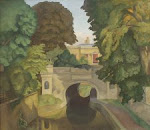
                            Stanley Roy Badmin, "Ludlow, Shropshire"