As I have noted on previous occasions, each generation believes that the World is going to Hell in a handbasket. How could it be otherwise? Whether it arrives via a footsore messenger, a sailing ship in port from distant lands, telegraph, television, or the Internet, the News of the World is not, and has never been, calculated to inspire confidence in the goodwill and beneficence of humanity.
Thus, when I launch into one of my periodic rants about Modernity (Science, Progress, the media, politicians,
et cetera), I ought to know better. Yes, of course: the World
is going to Hell in a handbasket. But this has never been the fault of current events, which are invariably horrendous and dispiriting. Nor is it the fault of the makeshift (and risible) political, economic, and scientific nostrums that are developed in each generation in order to "explain" and "correct" all that is wrong with the World. Rather, this has always been a matter of False Gods versus Eternal Verities.
Still, I must confess to believing this: when it comes to the balance between Eternal Verities and False Gods, there has been a grievous wrong-turning.
On a Vulgar Error
No. It's an impudent falsehood. Men did not
Invariably think the newer way
Prosaic, mad, inelegant, or what not.
Was the first pointed arch esteemed a blot
Upon the church? Did anybody say
How modern and how ugly? They did not.
Plate-armour, or windows glazed, or verse fire-hot
With rhymes from France, or spices from Cathay,
Were these at first a horror? They were not.
If, then, our present arts, laws, houses, food
All set us hankering after yesterday,
Need this be only an archaising mood?
Why, any man whose purse has been let blood
By sharpers, when he finds all drained away
Must compare how he stands with how he stood.
If a quack doctor's breezy ineptitude
Has cost me a leg, must I forget straightway
All that I can't do now, all that I could?
So, when our guides unanimously decry
The backward glance, I think we can guess why.
C. S. Lewis,
Poems (1964).
Dudley Holland, "Winter Morning" (1945)
The False Gods usually have the upper hand: their superficial appeal and their promise of immediate gratification are alluring. The Eternal Verities are, on the other hand, sober and tradition-bound. Old-fashioned. Sentimental. Boring.
You may have noticed that I have not attempted to define the False Gods and the Eternal Verities. Although I have no illusions about human nature, I persist in believing that most of us know the difference between the real and the feigned, the true and the false. In the final scene of
Mr. Sammler's Planet, Artur Sammler stands beside the body of his nephew Elya Gruner, which lies on a gurney in an autopsy room in the bowels of a hospital. In "a mental whisper," Sammler speaks the final words of the novel:
"At his best this man was much kinder than at my very best I have ever been or could ever be. He was aware that he must meet, and he did meet -- through all the confusion and degraded clowning of this life through which we are speeding -- he did meet the terms of his contract. The terms which, in his inmost heart, each man knows. As I know mine. As all know. For that is the truth of it -- that we all know, God, that we know, that we know, we know, we know."
Saul Bellow,
Mr. Sammler's Planet (Viking Press 1970).
Existence
Clearly this stupid world doesn't inspire
anything now but an intense antipathy,
an urge to vanish and be done with it;
you hardly dare pick up a newspaper.
Perhaps we should go back to the old home
where our ancestors lived under the eye
of heaven, and find the curious harmony
that sanctified their lives from womb to tomb.
It's some kind of faith for which we yearn,
some gentle web of close dependencies
transcending and containing our existence.
We can no longer live so far from the eternal.
Michel Houellebecq (translated by Derek Mahon), in Derek Mahon,
Echo's Grove (The Gallery Press 2013).
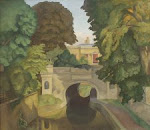
Charles Cundall, "Temeside, Ludlow" (1923)
A poem that Mahon wrote long before he translated Houellebecq's poem seems apt.
Nostalgias
The chair squeaks in a high wind,
Rain falls from its branches;
The kettle yearns for the mountain,
The soap for the sea.
In a tiny stone church
On a desolate headland
A lost tribe is singing 'Abide with Me.'
Derek Mahon,
Collected Poems (The Gallery Press 1999).
Lisbeth Jane Brand (1907-1970), "Winter"
The Eternal Verities are, well, eternal. Call them revenants, but they are always there. Let me be clear: I have only a vague notion of what they are. I remain in thrall to the False Gods. But the choice is ever ours. Perhaps abstention is the first step.
The Valley Wind
Living in retirement beyond the World,
Silently enjoying isolation,
I pull the rope of my door tighter
And stuff my window with roots and ferns.
My spirit is tuned to the Spring-season;
At the fall of the year there is autumn in my heart.
Thus imitating cosmic changes
My cottage becomes a Universe.
Lu Yun (4th century A. D.) (translated by Arthur Waley), in Arthur Waley,
One Hundred and Seventy Chinese Poems (1918).
Remember, and take heart: "They ain't quit doing it as long as I'm doing it." Flannery O'Connor,
Wise Blood (1952).
Charles Frederick Dawson, "Accrington From My Window" (1932)