Showing posts with label Charles Ginner. Show all posts

Saturday, April 23, 2016

Gratitude

Gentle readers, I beg your indulgence for the brevity of this post.  By way of explanation for the brevity, I must also beg you to indulge a brief foray into the personal.  First, nothing dire has occurred!  Rather, I am the grateful recipient of one of the many Modern Miracles of Medicine:  a hip replacement (right) as of this past Monday morning.

Given all that goes on in the world from moment to moment, I feel embarrassed for even having provided this information.  I consider myself both fortunate and coddled to live during a time, and in a place, in which such miracles are available.  I have nothing to complain about.  And I do not for a second take anything for granted.

     What a strange thing,
To be thus alive
     Beneath the cherry blossoms!

Issa (translated by R. H. Blyth), in R. H. Blyth, Haiku, Volume 2: Spring (Hokuseido Press 1950), page 350.

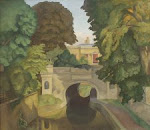
Charles Ginner (1878-1952)
"Through a Cottage Window, Shipley, Sussex"

Everything is a matter of perspective.  A hip replacement amounts to absolutely nothing in this world of ours, but it does provide an occasion for perspective.

I can only feebly echo Patrick Kavanagh, who was a trillion times more entitled than I to feel gratitude after having dodged death by lung cancer in 1955.  Soon after, he wrote this:

                              The Hospital

A year ago I fell in love with the functional ward
Of a chest hospital:  square cubicles in a row,
Plain concrete, wash basins -- an art lover's woe,
Not counting how the fellow in the next bed snored.
But nothing whatever is by love debarred,
The common and banal her heat can know.
The corridor led to a stairway and below
Was the inexhaustible adventure of a gravelled yard.

This is what love does to things:  the Rialto Bridge,
The main gate that was bent by a heavy lorry,
The seat at the back of a shed that was a suntrap.
Naming these things is the love-act and its pledge;
For we must record love's mystery without claptrap,
Snatch out of time the passionate transitory.

Patrick Kavanagh, Come Dance with Kitty Stobling and Other Poems (Longmans 1960).  Kavanagh was a patient at the Rialto Hospital in Dublin in March and April of 1955.  The Rialto Bridge spans Dublin's Grand Canal, which Kavanagh walked along during his recovery period.

Charles Ginner, "Chrysanthemums" (1929)

As I have stated here in the past, I know nothing whatsoever about how to live.  But, as one ages, certain key themes begin to emerge, however thick-headed one might be.  This week, one word keeps returning to me: Gratitude.

                                       Night

That shining moon -- watched by that one faint star:
Sure now am I, beyond the fear of change,
The lovely in life is the familiar,
And only the lovelier for continuing strange.

Walter de la Mare, Memory and Other Poems (Constable 1938).

Charles Ginner, "Plymouth Pier from the Hoe" (1923)

Monday, February 29, 2016

Life Explained, Part Thirty-Three: Snail

The sight of an empty snail shell in the garden or on the sidewalk always saddens me.  What fate befell the vanished inhabitant of that husk? "Moving at a snail's pace" will no doubt expose a creature to any number of misadventures.  And so the glimmering trail ends.

I realize, dear readers, that those of you who are gardeners may see the snail as a nuisance -- a single-minded engine of destruction.  I am also aware that some among you may consider the poems that follow to be instances of the worst sort of sentimental anthropomorphization, egregious examples of the Pathetic Fallacy.

I cannot muster a reasoned response to these potential objections.  The best that I can come up with is this:  there is no accounting for taste (mine, of course).  I came across the first poem a few weeks ago, and it immediately caught my fancy.  The three poems that follow it are long-time companions of which I am quite fond.  It occurred to me that it would be nice to see all of them together in one place.  As the benevolent (I hope!) dictator of this space, I can only beg your indulgence.

                       Upon the Snail

She goes but softly, but she goeth sure;
     She stumbles not as stronger creatures do:
Her journey's shorter, so she may endure
     Better than they which do much further go.

She makes no noise, but stilly seizeth on
     The flower or herb appointed for her food,
The which she quietly doth feed upon,
     While others range, and gare, but find no good.

And though she doth but very softly go,
     However 'tis not fast, nor slow, but sure;
And certainly they that do travel so,
     The prize they do aim at they do procure.

John Bunyan, A Book for Boys and Girls, or, Country Rhymes for Children (1686).

"Gare" (line 8) is glossed by one editor as "stare about."  Other editors (primarily in the 19th century) substitute "glare" in its place, apparently presuming that there was a misprint in the original text of 1686.  The adjectival form of "gare" means "eager, covetous, desirous of wealth."  OED. Given that Bunyan's book of children's poems was intended to edify, I would like to suggest (with absolutely no authority) that it would be nice to think of "gare" as meaning "to look about covetously."  Which a wise snail would never do, of course.

Charles Ginner (1878-1952), "Hartland Point from Boscastle" (1941)

It is the combination of self-sufficiency and leisurely, contemplative deliberativeness that makes the snail so beguiling and so sympathetic a character, don't you think?

                        The Snail

To grass, or leaf, or fruit, or wall,
The snail sticks close, nor fears to fall,
As if he grew there, house and all
                                             Together.

Within that house secure he hides,
When danger imminent betides
Of storm, or other harm besides
                                             Of weather.

Give but his horns the slightest touch,
His self-collecting power is such,
He shrinks into his house, with much
                                             Displeasure.

Where'er he dwells, he dwells alone,
Except himself has chattels none,
Well satisfied to be his own
                                             Whole treasure.

Thus, hermit-like, his life he leads,
Nor partner of his banquet needs,
And if he meets one, only feeds
                                             The faster.

Who seeks him must be worse than blind,
(He and his house are so combin'd)
If, finding it, he fails to find
                                             Its master.

Vincent Bourne (translated by William Cowper), in H. S. Milford (editor), The Complete Poetical Works of William Cowper (Oxford University Press 1907).

A side-note:  Vincent Bourne (1695-1747) was an Englishman who wrote poetry in Latin.  Cowper was a pupil of Bourne's at Westminster School. Later in his life, Cowper translated a number of Bourne's poems, including "The Jackdaw" and "The Thracian," which have appeared here previously.

"Well satisfied to be his own/Whole treasure":  yes, that's it, exactly!

Charles Ginner, "The Aqueduct, Bath" (1928)

The subject of my previous post was the role of "wonder" in the poetry of Walter de la Mare.  Wonder certainly plays a role in de la Mare's contemplation upon the snail in the following poem.  Having said that, I recognize that every good poem, on any subject, to some degree has its source in a poet's wonder at "the beauty and strangeness of creation" (to borrow W. H. Auden's words).

                         The Snail

All day shut fast in whorled retreat
You slumber where -- no wild bird knows;
While on your rounded roof-tree beat
The petals of the rose.
The grasses sigh above your house;
Through drifts of darkest azure sweep
The sun-motes where the mosses drowse
That soothe your noonday sleep.

But when to ashes in the west
Those sun-fires die; and, silver, slim,
Eve, with the moon upon her breast,
Smiles on the uplands dim;
Then, all your wreathèd house astir,
Horns reared, grim mouth, deliberate pace,
You glide in silken silence where
The feast awaits your grace.

Strange partners, Snail!  Then I, abed,
Consign the thick-darked vault to you,
Nor heed what sweetness night may shed
Nor moonshine's slumbrous dew.

Walter de la Mare, The Fleeting and Other Poems (Constable 1933).

The entire poem is lovely, but my favorite lines are these:  "While on your rounded roof-tree beat/The petals of the rose."  What a beautiful image and thought.  It is enough to make you envy a snail's life.

Charles Ginner, "Lancaster from Castle Hill Terrace" (1947)

"Strange partners, Snail!"  Yes, you and I and the snail and all else in the World are strange (and beautiful) partners during our short time together on earth.  "The divinest blessings are the commonest -- bestowed everywhere."  So says Walt Whitman.  (Richard Maurice Bucke (editor), Notes and Fragments: Left by Walt Whitman (1899), page 49.)

        Considering the Snail

The snail pushes through a green
night, for the grass is heavy
with water and meets over
the bright path he makes, where rain
has darkened the earth's dark.  He
moves in a wood of desire,

pale antlers barely stirring
as he hunts.  I cannot tell
what power is at work, drenched there
with purpose, knowing nothing.
What is a snail's fury?  All
I think is that if later

I parted the blades above
the tunnel and saw the thin
trail of broken white across
litter, I would never have
imagined the slow passion
to that deliberate progress.

Thom Gunn, My Sad Captains (Faber and Faber 1961).

"The slow passion/to that deliberate progress."  Can we speak of a snail's passion?  Yes, of course.  Why not?

Charles Ginner, "The Punt in the Mill Stream"

Tuesday, August 26, 2014

A Dream Beneath A Summer Moon

As I have mentioned before, Matsuo Basho (1644-1694) is the Shakespeare of Japan.  Or, to be fair:  Shakespeare is the Basho of England (and the English-speaking world).  Without Basho, haiku likely would not have developed into a serious form of art.  He transformed it from a sort of pleasant diversion -- an element of social gatherings in which sequences of poems were created -- into something else entirely.

This is one of Basho's best-known poems:

     an octopus pot --
inside, a short-lived dream
     under a summer moon.

Basho (translated by Makoto Ueda), in Makoto Ueda, Basho and His Interpreters: Selected Hokku with Commentary (Stanford University Press 1991), page 201.

Some background information.  "An octopus pot is an unglazed earthenware vessel made for trapping an octopus, which has the habit of escaping into a dark hole when it is alarmed.  Fishermen string a number of these pots on a rope, sink them into the sea, and pull them up after octopuses have entered them."  Ibid.  Basho wrote the haiku while visiting Akashi, a seaside town near Kobe.  The poem bears the heading:  "Staying overnight in Akashi."  Ibid.  Thus, as is the case with nearly all haiku, Basho's verse is based on direct personal experience -- a moment in time.

Charles Ginner (1878-1952), "Dahlias and Cornflowers" (1929)

Here is the original in romaji (transliterated Japanese using Romanized spelling):

tako-tsubo ya
hakanaki yume wo
natsu no tsuki

Tako is "octopus."  Tsubo is "pot" or "jar."  Ya is a particle of emphasis, akin to "!".  Hakanaki means "fleeting," "transient," "short-lived," or "ephemeral."  Yume is "dream" (as a noun).  Wo can be described as a "noun-following particle marking the direct object of a clause." Kodansha's Romanized Japanese-English Dictionary (1993), page 375.  Natsu is "summer."  Tsuki is "moon."  No is another "noun-following particle," which, in this case, turns the final line into: "moon of summer" or "summer moon."  It all seems fairly simple, doesn't it?  Deceptively simple, as is the case with all good haiku.

Charles Ginner, "Flask Walk, Skyline" (1934)

Here are a few other English translations of the haiku, for purposes of comparison.

     The octopus trap:
Fleeting dreams
     Under the summer moon.

R. H. Blyth, Haiku, Volume 3: Summer-Autumn (Hokuseido 1952), page 41.  When considering the various translations, bear in mind that, in Japanese, there are no plural forms of nouns:  singular or plural is a matter of context.  Nor is there an equivalent to "a" or "the."

     The jars of octopus --
brief dreams
     under the summer moon.

Robert Hass, The Essential Haiku: Versions of Basho, Buson, and Issa (The Ecco Press 1994), page 22.

     An octopus pot:
An ephemeral dream
     Under the summer moon.

Toshiharu Oseko, Basho's Haiku (Maruzen 1990), page 107.

Charles Ginner, "Hartland Point from Boscastle" (1941)

What, then, are we to make of this?  What does it "mean"?  The notion of "explaining" a haiku is one that I resist mightily.  With apologies, I will refer to a recent post:  a haiku is like a moose swimming across a lake and walking off into the deep woods.  Or like the buck emerging from the lake in Robert Frost's "The Most of It."  The moose and the buck are what they are.

Basho is reporting what he saw and felt.  Make no mistake:  there is consummate art in what he does.  But there is no symbolism.  And there are no "tropes" or metaphors or allegories.  Basho's moment is what it is.  But that does not mean that it does not have intimations and implications and depths beyond words.

Misty rain on Mount Ro, the incoming tide at Sekko --
Before you have been there, you have many regrets;
When you have been there and come back,
It is just simply misty rain on Mount Ro, the incoming tide at Sekko.

Su Tung-P'o (also known as Su Shih) (translated by R. H. Blyth), in R. H. Blyth, Haiku, Volume 1: Eastern Culture (Hokuseido 1949).

Charles Ginner, "Rooftops"

Thursday, March 20, 2014

"O Visitor, Fugitive Creature, Thing Of A Tide, Make Music, My Heart, Before The Long Silence"

When it comes to philosophical inquiry as a means of "explaining" the World (as opposed to philosophical inquiry as a means of learning how to live from day-to-day) I believe that Walter Pater's assessment of attempts to define "beauty" in the abstract applies to philosophy as a whole: "metaphysical questions, as unprofitable as metaphysical questions elsewhere."  Walter Pater, The Renaissance: Studies in Art and Poetry (1888 edition), page x.

This is why, when it comes to philosophers, I am fond of Ludwig Wittgenstein.  Although his arcane explorations into the nature of language are way over my head, his approach to philosophy is refreshingly practical:  "A philosophical problem always has the form:  'I simply don't know my way about'."  Ludwig Wittgenstein, The Big Typescript: TS 213 (translated by C. Grant Luckhardt and Maximilian A. E. Aue) (Blackwell 2005), page 310.

And, surprisingly (given his sometimes dour and prickly personality), there is this:  "Live happily!"  Ludwig Wittgenstein, Notebooks, 1914-1916 (translated by G. E. M. Anscombe) (1961), pages 75 and 78.

Charles Ginner, "Novar Cottage, Bearley, Warwickshire" (1933)

                         Garramor Bay

Now the long wave unfolded falls from the West,
The sandbirds run upon twittering, twinkling feet:
Life is perilous, poised on the lip of a wave,
And the weed that lay yesterday here is clean gone.

O visitor, fugitive creature, thing of a tide,
Make music, my heart, before the long silence.

L. A. G. Strong, Northern Light (1930).

Charles Ginner, "The Rib, Standon" (1939)

How does one live happily?  Perhaps by escaping Time.

"A man who is happy must have no fear.  Not even in face of death.

Only a man who lives not in time but in the present is happy.
. . . . . . . . . .
If by eternity is understood not infinite temporal duration but non-temporality, then it can be said that a man lives eternally if he lives in the present.
. . . . . . . . . .
Whoever lives in the present lives without fear and hope.
. . . . . . . . . .
It seems one can't say anything more than:  Live happily!"

Ludwig Wittgenstein, Notebooks, 1914-1916, pages 74-75, 76, 78.

In aphoristic statements such as these (which pop up suddenly throughout his work), Wittgenstein sounds like the Taoist and Buddhist sages who made essentially the same observations one or two millennia ago.  The essential truths have always been present.  Finding them -- and living them -- is another matter entirely.  The work of a lifetime, never finished.  One step forward and two steps back.

Charles Ginner, "The Old Paper Mill" (c. 1941)

                         The Instant

Where are the centuries, where is the dream
of sword-strife that the Tartars entertained,
where are the massive ramparts that they flattened?
Where is the wood of the Cross, the Tree of Adam?

The present is singular.  It is memory
that sets up time.  Both succession and error
come with the routine of the clock.  A year
is no less vanity than is history.

Between dawn and nightfall is an abyss
of agonies, felicities, and cares.
The face that looks back from the wasted mirrors,
the mirrors of night, is not the same face.
The fleeting day is frail and is eternal:
expect no other Heaven, no other Hell.

Jorge Luis Borges (translated by Alastair Reid), in Jorge Luis Borges, Selected Poems (edited by Alexander Coleman) (Viking 1999).

Charles Ginner, "Church Farm, Shipley" (c. 1933)

Saturday, February 15, 2014

In Memory Of Crethis

The angled light of early spring and early autumn is, I think, the loveliest light of the year.  It calls things to your attention, things that detain you, delightfully.

After a rain-filled night, today was bright and blustery.  It was a wide-open-sky day, a day that encouraged expansiveness.  But, as I walked, my attention was drawn to the various mosses lining the edges of the paths or filling the cracks in the sidewalks.  In the slanting yellow afternoon light they glowed in a range from bright lime green to deep forest green.

Some lines from Louis Simpson's poem "The Foggy Lane" come to mind: "Walking in the foggy lane/I try to keep my attention fixed/on the uneven, muddy surface."  The loud, importunate parts of the World -- the media, politics, economics, et cetera -- do their best to lure us into abstractions and categories and classifications.  But in our heart of hearts we know it is the particulars that matter.

John Aldridge, "Artichokes and Cathay Quinces" (1967)

Their Crethis, with her prattle and her play,
The girls of Samos often miss to-day:
Their loved workmate, with flow of merry speech,
Here sleeps the sleep that comes to all and each.

Callimachus (c. 310 B.C. - c. 240 B. C.) (translated by A. H. Bullen), in A. H. Bullen, Weeping-Cross and Other Rimes (1921).

Henry Lamb, "Tea Things" (1932)

Crethis, young prattler, full of graceful play,
Vainly the maids of Samos seek all day;
Cheerfullest workmate; ever talking; -- she
Sleeps here, -- that sleep, from which none born can flee.

Callimachus (translated by "F. H."), in The Classical Journal, Volume XXXIII (March and June, 1826), page 9.

Charles Mahoney, "Auriculas in Pots" (1956)

The Samian virgins us'd often to play
With Crethis the witty, the pleasant and gay,
But now, when they seek her, she cannot be found,
Their sportive companion sleeps here under ground,
Discharging the debt which to nature we owe;
For all must descend to the regions below.

Callimachus (translated by H. W. Tytler), in H. W. Tytler, The Works of Callimachus, Translated into English Verse (1793).

Thomas Henslow Barnard, "Still Life"

The Samian maidens oft regret their friend,
     Sweet Crethis, full of play and cheer,
     Whose gossip lightened toil.  But here
She sleeps the sleep they all will sleep at end.

Callimachus (translated by Edward Cook), in Edward Cook, "The Charm of The Greek Anthology," More Literary Recreations (1919).

Charles Ginner, "Yellow Chrysanthemums" (1929)

Saturday, September 21, 2013

Heartsease

I ought to be better versed in the names of flowers.  I do know that the dahlias are still flourishing at this time of year.  But I am in no position to distinguish one variety from another.  On my walks this week, I have been admiring a lovely purple flower that appears to be a daisy.  Whether it is an African daisy or an aster I do not know.  But I am content in my ignorance. Looking is sufficient.

Yesterday, I noticed a single purple and yellow flower beside a driveway.  It seemed pansy-like.  Might it have been heartsease?  I'd be the last to know.

David Chatterton (1900-1963), "Vase with Yellow Chrysanthemums"

               "Balm in Gilead"

Heartsease I found, where Love-lies-bleeding
     Empurpled all the ground:
Whatever flowers I missed unheeding,
     Heartsease I found.

     Yet still my garden mound
Stood sore in need of watering, weeding,
     And binding growths unbound.

Ah, when shades fell to light succeeding
     I scarcely dared look round:
"Love-lies-bleeding" was all my pleading,
     Heartsease I found.

Christina Rossetti, Verses (1893).

This is one of those poems by Rossetti that might be a religious poem (as suggested by the title), but might well be a tale of romantic heartbreak.  But I shouldn't sell her short:  it is entirely possible that it is both.

Charles Ginner, "Dahlias and Cornflowers" (1929)

According to the OED, "heart's ease" is "peace of mind; freedom from care or worry; contentment."  A thing rarely happened upon?

               The Heartsease

Do you remember that hour
In a nook of the flowing uplands
When you found for me, at the cornfield's edge,
A golden and purple flower?
Heartsease, you said.  I thought it might be
A token that love meant well by you and me.

I shall not find it again
With you no more to guide me.
I could not bear to find it now
With anyone else beside me.
And the heartsease is far less rare
Than what it is named for, what I can feel nowhere.

Once again it is summer:
Wildflowers beflag the lane
That takes me away from our golden uplands,
Heart-wrung and alone.
The best I can look for, by vale or hill,
A herb they tell me is common enough -- self-heal.

C. Day Lewis, Poems 1943-1947 (1948).

Adam Bruce Thomson, "Still Life at a Window" (c. 1944)

Wednesday, February 20, 2013

"The Soul's Progress" Revisited

Some might think that Arthur Symons's "The Soul's Progress" (which appeared in my previous post) presents a too-bleak view of our time on earth.  To wit:  "Blindly it treads dim ways that wind and twist" and so on. But, like most everything else (I'm afraid), it all depends on how you look at it.

For instance, Japanese poets have been writing about Existence for centuries, and they share Symons's view that we enter this world from a mist and depart into a mist.  But, the way they go about it, what sounds like a catalogue of horrors in an English sonnet sounds like a lovely walk in the park in a Japanese poem (filtered through Buddhism, with Taoism in the background).

Gilbert Spencer, "The Cottage Window"

     To what
Shall I compare the world?
     It is like the wake
Vanishing behind a boat
     that has rowed away at dawn.

Sami Manzei (8th century) (translated by Edward Cranston), A Waka Anthology, Volume 1: The Gem-Glistening Cup (Stanford University Press 1993).

Like dew that vanishes,
like a phantom that disappears,
or the light cast
     by a flash of lightning --
so should one think of oneself.

Ikkyu (1394-1481) (translated by Steven Carter), Traditional Japanese Poetry: An Anthology (Stanford University Press 1991).

     A temporary lodging
on this side of the road all
     must go, in the end.

To recover the time he rested,
The traveller hastens on.

Shinkei (1406-1475) (translated by Esperanza Ramirez-Christensen), Heart's Flower: The Life and Poetry of Shinkei (Stanford University Press 1994).

Bertha Ridley Bell
"Interior of a Cottage at Brockhampton" (c. 1950)

"Like the wake vanishing behind a boat that has rowed away at dawn." "Like dew that vanishes . . . or the light cast by a flash of lightning."  "The traveller hastens on."  A far cry from a soul that "staggers out into eternity," isn't it?

For the Japanese poets, this is simply the way that it is, and there is no need to bemoan that fact.  Thus, even as they describe the evanescence and the transience of our life, they do so in words that show their acute awareness of, and appreciation for, the beauty that surrounds us.  I recently quoted this line from Wallace Stevens, and it once again seems apt:  "Death is the mother of beauty, mystical."

Charles Ginner
"Through a Cottage Window, Shipley, Sussex"

Saturday, January 19, 2013

Life As A Work Of Art, Part Three: "The Prologue Often, And Then No Play"

The theme of this series of posts is the poetic conceit that life is akin to a work of art.  Perhaps the best-known instance of the conceit is the passage from Shakespeare's As You Like It:  "All the world's a stage, /And all the men and women merely players . . ."  Of course, Shakespeare was neither the first nor the last to employ this idea.

At some point in our lives, the thought may occur to us that we are playing (whether by choice or by fate) a role in an unfolding entertainment of some sort.  Whether that entertainment is drama, comedy, tragedy, or farce is the (unanswered) question.

                         Charles Ginner, "Flask Walk, Hampstead" (1922)

               Masque of All Men

In the cold-windy cavern of the Wings
With skeletons of unused sets above them
The actors' painted heads clustered,
Clustered and whispered.  One head whispered,
'This has been my life:  the Prologue often,
And then no Play.  Or when the play has come
The players have departed, the parts being played
By understudies, makeshifts, shifting
The balance, the play, the purpose:
The lines dissolving and the play transposing
Itself into another, an unrehearsed;
So that the prompter, script discarded, idly
Sits in the echoing cavern
Among cold winds beneath the unused sets.'

And others whispered, 'Your life?  Yes, and mine.'
'And mine.'  'And mine.'  'And mine.'
                                                            'And mine.'
                                                                   'And mine.'

A. S. J. Tessimond, Voices in a Giant City (1947).

Tessimond's description of the life we actors lead seems apt:  there never is a script, is there?  Nor a prompter.  I am reminded of the dream in which you show up to take an exam on the final day of class and suddenly realize that you have not attended any of the lectures and have not read any of the required course materials.  You are on your own.

                                                        Charles Ginner
                               "Flask Walk, Hampstead, at Night" (1933)

Sunday, November 4, 2012

Dance

A year or so ago, I posted Seamus Heaney's "Postscript," which is about an autumn drive "out west/Into County Clare, along the Flaggy Shore."  The poem concludes as follows:

                      . . . You are neither here nor there,
A hurry through which known and strange things pass
As big soft buffetings come at the car sideways
And catch the heart off guard and blow it open.

Seamus Heaney, The Spirit Level (Faber and Faber 1996).

The following poem by Charles Tomlinson is also about a drive in autumn, a drive in which the wind again plays a part.

                            Charles Ginner, "Spaniard's Corner" (c. 1920)

          Autumn Piece

Baffled
by the choreography of the season
the eye could not
with certainty see
whether it was wind
stripping the leaves or
the leaves were struggling to be free:

They came at you
in decaying spirals
plucked flung and regathered by the same
force that was twisting
the scarves of the vapour trails
dragging all certainties out of course:

As the car resisted it
you felt it in either hand
commanding car, tree, sky,
master of chances,
and at a curve was a red
board said 'Danger':
I thought it said dancer.

Charles Tomlinson, Written on Water (1972).

                                               Charles Ginner, "Rooftops"

Tomlinson's conflation of "danger" and "dance" puts me in mind of Dorothy Wordsworth's description of a last leaf dancing upon a tree, which I have previously posted here:

"William and I drank tea at Coleridge's. . . . Observed nothing particularly interesting. . . . One only leaf upon the top of a tree -- the sole remaining leaf -- danced round and round like a rag blown by the wind."

Both William Wordsworth and Coleridge were wont to appropriate observations made by Dorothy Wordsworth into their own poetry.  Thus, Coleridge later wrote in "Christabel":

The one red leaf, the last of its clan,
That dances as often as dance it can,
Hanging so light, and hanging so high,
On the topmost twig that looks up at the sky.

Samuel Taylor Coleridge, "Christabel."

                                       Charles Ginner, "Red Brick House"

Monday, September 3, 2012

"Summer Is Fading . . ."

The following poem by Philip Larkin beautifully evokes this summer-into-autumn time of year.  It is a risky poem.  For instance, the narrow-minded might say:  what business does a middle-aged man (a university librarian from Hull, mind you) have writing about the lives of young women?  And, what's more (they might say), Philip Larkin is a grumpy, old-fashioned, conservative misanthrope, isn't he?  This is what the misinformed -- who most likely haven't taken the time to actually read his poetry -- would have you believe.  They are wrong, of course.

            Charles Ginner (1878-1952), "Dahlias and Cornflowers" (1929)

          Afternoons

Summer is fading:
The leaves fall in ones and twos
From trees bordering
The new recreation ground.
In the hollows of afternoons
Young mothers assemble
At swing and sandpit
Setting free their children.

Behind them, at intervals,
Stand husbands in skilled trades,
An estateful of washing,
And the albums, lettered
Our Wedding, lying
Near the television:
Before them, the wind
Is ruining their courting-places

That are still courting-places
(But the lovers are all in school),
And their children, so intent on
Finding more unripe acorns,
Expect to be taken home.
Their beauty has thickened.
Something is pushing them
To the side of their own lives.

Philip Larkin, The Whitsun Weddings (Faber and Faber 1964).

                                                      Charles Ginner
                            "Through a Cottage Window, Shipley, Sussex"

Friday, April 20, 2012

"Wet Evening In April"

In this part of the world, one need not wait long for a wet evening in April to come calling.  And so, tonight, the following poem by Patrick Kavanagh comes to mind.

            Wet Evening in April

The birds sang in the wet trees
And as I listened to them it was a hundred years from now
And I was dead and someone else was listening to them.
But I was glad I had recorded for him the melancholy.

Patrick Kavanagh, Collected Poems (Allen Lane/Penguin 2004).

                             Charles Ginner, "St John's Church, Chester"

Patrick Kavanagh was more than a little preoccupied with the role of The Poet in society -- perhaps too much so.  He wasted a great deal of energy in literary quarreling and in producing satirical verse about the Irish literary and political world.  However, I think that "Wet Evening in April" is a lovely evocation of what a poet is capable of doing at his or her best.  After all, here we are -- not yet a hundred, but sixty years later -- reading about Patrick Kavanagh's birds singing in the wet April trees.  (And thank you, Mr. Kavanagh, for recording the melancholy.)

A serendipitous side-note:  I am writing this post on April 19, 2012.  In preparing to write the previous paragraph, I thought that I should find out exactly how long it has been since Kavanagh wrote "Wet Evening in April." I checked the Notes to his Collected Poems (edited by Antoinette Quinn) and this is what I found:  the poem was first published on April 19, 1952, in Kavanagh's Weekly.  Thus, a tiny, but nice, coincidence:  the poem was published exactly 60 years ago today.

                       Charles Ginner, "Hampstead Heath, Spring" (1932)

Friday, February 24, 2012

"Dwell In Some Decent Corner Of Your Being"

Pascal's best-known observation on the human condition is perhaps this: "I have often said, that all the Misfortune of Men proceeds from their not knowing how to keep themselves quiet in their Chamber."  The translation is by Joseph Walker, who published the first English translation of Pascal's Pensees in 1688.  In an edition published in 1908, W. F. Trotter translated the same passage as follows:  "I have discovered that all the unhappiness of men arises from one single fact, that they cannot stay quietly in their own chamber."

As one's youthful infatuation with utopian thought-projects dissipates (sooner rather than later for some; never for others -- e.g., politicians and other busybodies), one begins to see the wisdom of Pascal's view of things. Of course, staying in one's chamber is easier said than done, especially in our youth, when our physical and mental capacities seem limitless.  But, as we enter our middle and late years, it begins to make more sense:  one has seen enough to know that the World would be a much better place if some people just stayed put in their room.

                                                       Charles Ginner
                                       "Spring Day at Boscastle" (1943)

I offer the following poems by James Reeves and C. H. Sisson as possible corollaries to Pascal's thought.  I think of them from time-to-time, especially when the World seems madder than is usually the case.

                         Precept

Dwell in some decent corner of your being,
Where plates are orderly set and talk is quiet,
Not in its devious crooked corridors
Nor in its halls of riot.

James Reeves, The Questioning Tiger (1964).

                                       Charles Ginner, "The Greenhouse"

               The Commonplace

A commonplace is good for nothing now,
Yet that is how the world goes, all the same:
Nothing is what you had when you set out,
And nothing you will have when you go home.

C. H. Sisson, Exactions (1980).

                               Charles Ginner, "The Winged Faun" (1926)

Sunday, October 9, 2011

Dahlias In Autumn

As age works away at my memory -- names, places, and dates are the usual victims -- I find that, for some reason, I have not yet lost the poems that I have read over the years.  I am certainly not claiming that they are all there, line by line, waiting to be brought up at will.  Far from it.  Rather, titles or images or lines unexpectedly reappear by association with something else.

Today, on my afternoon walk, I saw a pair of large pink and creamy-white dahlias bending towards the ground, not long for this autumn world.  And then I remembered the title of the following poem.  I have not read the poem for at least 10 years, probably longer.  But here it is again, brought back by the sight of two beautiful, unseasonable dahlias.

          Giant Decorative Dahlia

It is easy enough to love flowers but these
had never appealed to me before, so
out of proportion above my garden's
other coloured heads and steady stems.

This spring though, in warm soil, I set
an unnamed tuber, offered cheap, and,
when August came and still no sign,
assumed the slugs had eaten it.

                                Suddenly it showed;
began to grow, became a small tree.
It was a race between the dingy bud
and the elements.  It has beaten
the frost, rears now three feet above
the muddled autumn bed, barbaric petals
pink quilled with tangerine, turning
its great innocent face towards me
triumphantly through the damp afternoon.

I could not deny it love if I tried.

Molly Holden (1927-1981), To Make Me Grieve (1968).

                       Charles Ginner, "Dahlias and Cornflowers" (1929)

Lest one think that "love" is too strong a word for one's feelings towards a giant decorative dahlia, I shall refer you back to Patrick Kavanagh's "The Hospital":  "Nothing whatever is by love debarred."  And to Stevie Smith's "Oh Grateful Colours, Bright Looks!":  "Seize colours quick, heap them up while you can."

                        Charles Ginner, "Still Life with Flowers" (c. 1920)

Tuesday, August 30, 2011

Life As A Work Of Art, Part One: "Written, Directed By And Starring . . ."

The poetic conceit that life may be compared to a work of art -- most commonly, a play -- is an old one:  Shakespeare's "all the world's a stage" being perhaps the best-known example.  But Sir Walter Raleigh tried his hand at the comparison as well:  "What is our life?  A play of passion . . ."  As, later, did Walter Savage Landor:

                         Plays

Alas, how soon the hours are over,
Counted us out to play the lover!
And how much narrower is the stage,
Allotted us to play the sage!

But when we play the fool, how wide
The theatre expands;  beside,
How long the audience sits before us!
How many prompters!  what a chorus!

John Forster (editor), The Works of Walter Savage Landor (1846).

                              Charles Ginner, "The Winged Faun" (1926)

The conceit continues to be visited in our time, and is often expanded to include novels, movies, and other entertainments.  The following poem is by James Simmons (1933-2001).

       Written, Directed by and Starring . . .

The scripts I used to write for the young actor --
me -- weren't used.  And now I couldn't play
the original parts and, as director,
I'd turn myself, if I applied, away.

My break will come; but now the star's mature
his parts need character and 'love' is out.
He learns to smile on birth and death, to endure:
it's strange I keep the old scripts lying about.

Looking them over I've at times forgot
they've never been put on.  I seem to spend
too much time reading through a final shot
where massed choirs sing, they kiss, and then THE END.

It's hard to start upon this middle phase
when my first period never reached the screen,
and there's no end now to my new screen-plays,
they just go on from scene to scene to scene.

The hero never hogs the screen because
his wife, his children, friends, events intrude.
When he's not on the story doesn't pause --
not if he dies.  I don't see why it should.

James Simmons, Late But In Earnest (1967).

                      John Lavery, "The Countess of Oxford and Asquith,
                                   The Wharf, Sutton Courtenay" (1925)

Sunday, August 28, 2011

"Beyond All This, The Wish To Be Alone"

Ah, the allure of solitude.  But it is likely that, after a stretch of being alone, we will long for company.  Even Montaigne found that, for reasons other than mere loneliness, retirement to a life of solitude was not all that it was cracked up to be:

"Lately when I retired to my home, determined so far as possible to bother about nothing except spending the little life I have left in rest and seclusion, it seemed to me I could do my mind no greater favor than to let it entertain itself in full idleness and stay and settle in itself, which I hoped it might do more easily now, having become weightier and riper with time.

But I find -- Ever idle hours breed wandering thoughts (Lucan) -- that, on the contrary, like a runaway horse, it gives itself a hundred times more trouble than it took for others, and gives birth to so many chimeras and fantastic monsters, one after another, without order or purpose, that in order to contemplate their ineptitude and strangeness at my pleasure, I have begun to put them in writing, hoping in time to make my mind ashamed of itself."

Michel de Montaigne, "Of Idleness," Essays (translated by Donald Frame) (1588).

Yet, a romantic notion about the pleasures of solitude persists, and I would be disingenuous if I claimed not to share that notion.  Hence, I confess that something like this appeals to me (even though I have never been a fan of D. H. Lawrence):

                         Delight of Being Alone

I know no greater delight than the sheer delight of being alone
It makes me realise the delicious pleasure of the moon
that she has in travelling by herself:  throughout time,
or the splendid growing of an ash-tree
alone, on a hill-side in the north, humming in the wind.

D. H. Lawrence, Last Poems (1932).

                     J. A. G. Acke "In the Stockholm Archipelago" (1910)

But, when it comes to the putative joys of being alone, Lawrence cannot (needless to say) hold a candle to Philip Larkin.  And thus, as is so often the case for me (which, I acknowledge, is surely a sign of some sort of malign pathology), I shall give the last word to Mr. Larkin (who, as always, is brutally honest, appalling, and, alas, correct -- after a fashion).

                            Wants

Beyond all this, the wish to be alone:
However the sky grows dark with invitation-cards
However we follow the printed directions of sex
However the family is photographed under the flagstaff --
Beyond all this, the wish to be alone.

Beneath it all, desire of oblivion runs:
Despite the artful tensions of the calendar,
The life insurance, the tabled fertility rites,
The costly aversion of the eyes from death --
Beneath it all, desire of oblivion runs.

Philip Larkin, The Less Deceived (1955).

When, decades ago, I first read "Wants," I was taken with "the wish to be alone" business.  Now, however, I think that the finest part of the poem is this:  "The costly aversion of the eyes from death."

                      Charles Ginner, "Dahlias and Cornflowers" (1929)

Wednesday, August 10, 2011

"I Only Came For Speech Of Beech And Beck -- I Only Came For Speech"

In view of my previous post on the wordlessness or wordiness -- take your pick -- of the wind (and, for that matter, of the World in general), the following poem may be pertinent.  That being said, I have always felt that I have never fully grasped its meaning.  But (as I am wont to say), it sounds lovely.  Which, in this instance, may be the point.

I have presumed (perhaps wrongly) that the title refers to the musical composition of that name, defined by the OED as "a species of musical composition in which the different parts take up the same subject one after another, either at the same or at a different pitch, in strict imitation."  For musical illiterates such as I, Wikipedia helpfully states that a "round" such as "Row, Row, Row Your Boat" or "Frere Jacques" is a type of canon.  Now that I can understand.

                 Canon
  Beside the paper-mill at
 Burneside, Westmorland

I only spoke to see the tree
In flood -- I only spoke to see.

I only looked to hear the weir
In song -- I only looked to hear.

I listened just to tell the yel-
low rag -- I listened just to tell

The yellow ragtail how to show
And teach the yellow ragwort how

I only came for speech of beech
And beck -- I only came for speech.

Norman Nicholson, The Pot Geranium (1954).

                               Charles Ginner, "The Rib, Standon" (1939)