Showing posts with label Eleanor Farjeon. Show all posts

Monday, August 5, 2024

Home

This modest (and, of late, fitful) undertaking owes its name to Edward Thomas.  I expressed my thanks to him (accompanied by the touching elegy "To E. T.: 1917" written by his friend Walter de la Mare) in my first post here: Tuesday, March 9, 2010.  A month later, I posted this comment about "Adlestrop": "No doubt many of us first encountered Edward Thomas by discovering 'Adlestrop' in an anthology.  And many of us recognized upon reading it that something had changed for us.  How so?  This is the best that I can come up with: 'At last.  This is the real thing.'"

I memorized "Adlestrop" on the day I first read it.  Forty years ago? Or is it closer to fifty?  Since that day it has always been with me.  But now and then I still open Thomas' Collected Poems to read it, wanting to see it on the page.  Nothing has changed.

                 Adlestrop

Yes.  I remember Adlestrop --
The name, because one afternoon
Of heat the express-train drew up there
Unwontedly.  It was late June.

The steam hissed.  Someone cleared his throat.
No one left and no one came
On the bare platform.  What I saw
Was Adlestrop -- only the name

And willows, willow-herb, and grass,
And meadowsweet, and haycocks dry,
No whit less still and lonely fair
Than the high cloudlets in the sky.

And for that minute a blackbird sang
Close by, and round him, mistier,
Farther and farther, all the birds
Of Oxfordshire and Gloucestershire.

Edward Thomas, The Annotated Collected Poems (edited by Edna Longley) (Bloodaxe Books 2008), page 51.  The poem was written on January 8, 1915.  Ibid, page 176.  Thomas had written his first poem a month earlier, on December 3, 1914.  Ibid, page 143.

We've had a surprising string of sunny and warm (even hot) days in this part of the world.  No rain to speak of, and nary a cloud in sight. On a recent afternoon, as I walked beside a meadow that slopes down to the waters of Puget Sound, a ladybug landed on my right forearm. Landed "unwontedly," one might say.  That wonderful way in which the World works.  

I stopped walking, and watched as the visitor investigated my arm. After a few moments, it flew away on its own, its diaphanous wings glittering in the sunlight.  Over a lifetime, it is these unwonted moments we remember, isn't it?

George Mackley (1900-1983), "Kentish Oast"

In one sense, Edward Thomas had found his home in the World from the day he was born.

"So on Tuesday, July 27th [1915] I lunched for the first time with Edward in uniform.  It might have been next year when we were walking in the country that I asked him the question his friends had asked him when he joined up, but I put it differently.  'Do you know what you are fighting for?'  He stopped, and picked up a pinch of earth.  'Literally, for this.'  He crumbled it between finger and thumb, and let it fall."

Eleanor Farjeon, Edward Thomas: The Last Four Years (Oxford University Press 1958), page 154.

Hence, "Adlestrop."  But there is a great deal more to "Adlestrop." And there is a great deal more to Edward Thomas.  As I was thinking about him lately, this came to mind: "He was always a seeker after something in the world that is there in no satisfying measure, or not at all."  More on this in a moment.

                      Home

Often I had gone this way before:
But now it seemed I never could be
And never had been anywhere else;
'Twas home; one nationality
We had, I and the birds that sang,
One memory.

They welcomed me.  I had come back
That eve somehow from somewhere far:
The April mist, the chill, the calm,
Meant the same thing familiar 
And pleasant to us, and strange too,
Yet with no bar.

The thrush on the oaktop in the lane
Sang his last song, or last but one;
And as he ended, on the elm
Another had but just begun
His last; they knew no more than I
The day was done.

Then past his dark white cottage front
A labourer went along, his tread
Slow, half with weariness, half with ease;
And, through the silence, from his shed
The sound of sawing rounded all
That silence said.

Edward Thomas, The Annotated Collected Poems, page 81.  The poem was written on April 17, 1915, four months after "Adlestrop" was written.  Ibid, page 226.  Thomas wrote two other poems titled "Home."  The first was written on February 23, 1915.  Ibid, page 197. (It begins: "Not the end: but there's nothing more."  Ibid, page 64.) The second was written on March 7 and 10, 1916.  Ibid, page 282.  (It begins: "Fair was the morning, fair our tempers, and/We had seen nothing fairer than that land."  Ibid, page 113.)

"He was always a seeker after something in the world that is there in no satisfying measure, or not at all."  An observation bound to catch the attention of melancholic romantics and romantic melancholics. (I'm afraid I shall have to plead guilty to that offense.)  It is the final sentence in Walter Pater's "A Prince of Court Painters," a fictional "imaginary portrait" of the painter Jean-Antoine Watteau (1684-1721) which takes the form of journal entries written over a 20-year period by a woman who knew him.  (Walter Pater, Imaginary Portraits (Macmillan 1887), pages 1-48.)  Edward Thomas read Pater's works, and wrote a book about him: Walter Pater: A Critical Study (Martin Secker 1913).  The book contains a short chapter on Imaginary Portraits, but the sentence I have quoted from "A Prince of Court Painters" is not mentioned.

Have no fear: it is not my intention to undertake literary detective work along the lines of, say, "Walter Pater's Influence on the Poetry of  Edward Thomas."  Rather, Pater's sentence simply returned to me on its own as I thought about Thomas, his life, the four poems that appear here, and his poetry as a whole.  I would never wish to be reductive when it comes to Edward Thomas.  More importantly, as I have often noted here in the past: the poems speak for themselves; no interpretation or explication is necessary.

John Aldridge (1905-1983), "Beslyn's Pond, Great Bardfield"

"It is enough, it would seem, to have been born into this world for a man to desire many things."  (Kenkō (1283-1350), Tsurezuregusa, Chapter 1 (translated by Donald Keene), in Keene (editor), Essays in Idleness: The Tsurezuregusa of Kenkō (Columbia University Press 1967), page 3.)  As a Buddhist monk, Kenkō would have been well-acquainted with the snares of desire in the lives of human beings, and of the need for us to avoid, or to extricate ourselves from, those snares.  On the other hand, desires are innumerable, and come in various forms.  For instance, what of a desire for home?  Aren't most of us in search of home, whatever that may mean? 

                                 The Ash Grove

Half of the grove stood dead, and those that yet lived made
Little more than the dead ones made of shade.
If they led to a house, long before they had seen its fall:
But they welcomed me; I was glad without cause and delayed.

Scarce a hundred paces under the trees was the interval --
Paces each sweeter than sweetest miles -- but nothing at all,
Not even the spirits of memory and fear with restless wing,
Could climb down to molest me over the wall

That I passed through at either end without noticing.
And now an ash grove far from those hills can bring
The same tranquillity in which I wander a ghost
With a ghostly gladness, as if I heard a girl sing

The song of the Ash Grove soft as love uncrossed,
And then in a crowd or in distance it were lost,
But the moment unveiled something unwilling to die
And I had what most I desired, without search or desert or cost.

Edward Thomas, The Annotated Collected Poems, page 108.  The poem was written from February 4 through February 9, 1916.  Ibid, page 272.

"But the moment unveiled something unwilling to die/And I had what most I desired, without search or desert or cost."  As in "Adlestrop" and "Home," a moment is sufficient to find oneself at home.  And, although "desire" is involved, Thomas arrives at home "without search or desert or cost."  As in "Adlestrop": ". . . the express-train drew up there/Unwontedly."  And as in "Home": "I had come back/That eve somehow from somewhere far."  How wonderful to know that one may arrive at home when one least expects it, if only for a moment.  But perhaps this is a better way to put it: how wonderful to know that home may arrive when one least expects it, if only for a moment.

     Bent over by the rain,
The ears of barley
     Make it a narrow path.

Jōsō (1661-1704) (translated by R. H. Blyth), in Blyth, Haiku, Volume 3: Summer-Autumn (Hokuseido Press 1952), page 322.  Blyth follows the haiku with this commentary:

"In old-fashioned novels, we often have the situation of a man or a woman who realizes only at the end of the book, and usually when it is too late, who it was he or she had loved for many years without knowing it.  So a great many haiku tell us something that we have seen but not seen.  They do not give us a satori, an enlightenment; they show us that we have had an enlightenment, had it often, -- and not recognized it."

Ibid, page 322 (italics in the original text).

Or, another way of looking at it:

"Attachment to the self renders life more opaque.  One moment of complete forgetting and all the screens, one behind the other, become transparent so that you can perceive clarity to its very depths, as far as the eye can see; and at the same time everything becomes weightless.  Thus does the soul truly become a bird."

Philippe Jaccottet (translated by Tess Lewis), notebook entry in May of 1954, in Philippe Jaccottet, Seedtime: Notebooks 1954-1979 (Seagull Books 2013), page 1.

George Mackley, "House by a Lane"

"And now an ash grove far from those hills can bring/The same tranquillity in which I wander a ghost/With a ghostly gladness." "Gladness."  The word appears again in this poem, written by Thomas three months after he wrote "The Ash Grove":

   I Never Saw That Land Before

I never saw that land before,
And now can never see it again;
Yet, as if by acquaintance hoar
Endeared, by gladness and by pain,
Great was the affection that I bore

To the valley and the river small,
The cattle, the grass, the bare ash trees,
The chickens from the farmsteads, all
Elm-hidden, and the tributaries
Descending at equal interval;

The blackthorns down along the brook
With wounds yellow as crocuses
Where yesterday the labourer's hook
Had sliced them cleanly; and the breeze
That hinted all and nothing spoke.

I neither expected anything
Nor yet remembered: but some goal
I touched then; and if I could sing
What would not even whisper my soul
As I went on my journeying,

I should use, as the trees and birds did,
A language not to be betrayed;
And what was hid should still be hid
Excepting from those like me made
Who answer when such whispers bid.

Edward Thomas, The Annotated Collected Poems, page 120.  The poem was written on May 5, 1916.  Ibid, page 292.

Having said earlier that I would never wish to be reductive when it comes to Edward Thomas, I'm afraid this thought comes to mind: where would his poems be without birds, without trees?  Consider just the four poems appearing here.  In "Adlestrop": a blackbird; "all the birds/Of Oxfordshire and Gloucestershire;" willows.  In "Home": two thrushes; an oak; an elm.  In "The Ash Grove": ash trees, of course.  In "I Never Saw that Land Before": "the bare ash trees;" elms.  All of them brought together beautifully in these lines: ". . . and if I could sing/What would not even whisper my soul/As I went on my journeying,//I should use, as the trees and birds did,/A language not to be betrayed."  Try to imagine home without trees or birds.  

This undated entry appears on one of the final pages of the diary kept by Thomas after he arrived in France in January of 1917: "And no more singing for the bird . . ."  (R. George Thomas (editor), The Collected Poems of Edward Thomas (Oxford University Press 1981), page 194 (ellipses in the original text).)

On April 9, 1917, Edward Thomas died in France on the first day of the Battle of Arras.

James McIntosh Patrick (1907-1998)
"Stobo Kirk, Peeblessshire" (1936)

[A final note.  Edward Thomas did not begin to write poetry until the last four years of his life.  But I venture to say that no one in the United Kingdom during his lifetime had a greater knowledge of, and feeling for, first, what the essence of poetry consists of, and, second, what it means to be a poet.  This is, of course, embodied in his own poetry. But his thoughts and feelings on the heart of poetry may also be found in his prose writings.  I find this to be his finest articulation of what poetry is:

"What [poets] say is not chosen to represent what they feel or think, but is itself the very substance of what had before lain dark and unapparent, is itself all that survives of feeling and thought, and cannot be expanded or reduced without dulling or falsification.  If this is not so, and if we do not believe it to be so, then poetry is of no greater importance than wallpaper, or a wayside drink to one who is not thirsty.  But if it is so, then we are on the way to understand why poetry is mighty; for if what poets say is true and not feigning, then of how little account are our ordinary assumptions, our feigned interests, our playful and our serious pastimes spread out between birth and death.  Poetry is and must always be apparently revolutionary if active, anarchic if passive.  It is the utterance of the human spirit when it is in touch with a world to which the affairs of 'this world' are parochial.  Hence the strangeness and thrill and painful delight of poetry at all times, and the deep response to it of youth and of love; and because love is wild, strange, and full of astonishment, is one reason why poetry deals so much in love, and why all poetry is in a sense love poetry."

Edward Thomas, Feminine Influence on the Poets (Martin Secker 1910), page 86-87.

We should remain mindful of a proviso included by Thomas in the passage above: "if what poets say is true and not feigning." Part of what this means is expressed wonderfully by Kingsley Amis, with Thomas in mind: "How a poet convinces you he will not tell you anything he does not think or feel, since you have only his word for it, is hard to discover, but Edward Thomas is one of those who do it."(Kingsley Amis, The Amis Anthology (Hutchinson 1988), page 339.)]

George Mackley, "Brackie's Burn, Northumberland"

Thursday, December 22, 2022

Beauty


" . . . like a dove/That slants unswerving to its home and love."

Earlier this week, about an hour before sunset, I was out for a walk, my attention drawn to the sky in the west.  The waters of Puget Sound were a dark slate-grey, with a slight undertone of purple. Beyond the Sound, on the horizon, the Olympic Mountains stood in a row.  The sky to the east was mostly clear.  But directly overhead was the leading edge of a layer of cloud which extended across the water, ending in a long straight line above the mountains.  

The descending sun was hidden.  Yet a glowing path of yellow sky ran from north to south between the silhouette of the mountain range and the far dark edge of the cloud layer.  That band of changing golden light -- soon to vanish -- demanded one's attention: what would come of it between now and sunset?

I kept walking, looking to the west.  The twilit road passed through a meadow, a scattering of trees on either side.  Suddenly, just ahead of me, an owl glided quickly and silently downward from left to right above the road, landing in a nearly leafless tree out in the meadow, beside a grove of pines.

Last week, I read this:

                               Beauty

What does it mean?  Tired, angry, and ill at ease,
No man, woman, or child alive could please
Me now.  And yet I almost dare to laugh
Because I sit and frame an epitaph --
'Here lies all that no one loved of him
And that loved no one.'  Then in a trice that whim
Has wearied.  But, though I am like a river
At fall of evening while it seems that never
Has the sun lighted it or warmed it, while
Cross breezes cut the surface to a file,
This heart, some fraction of me, happily
Floats through the window even now to a tree
Down in the misting, dim-lit, quiet vale,
Not like a pewit that returns to wail
For something it has lost, but like a dove
That slants unswerving to its home and love.
There I find my rest, and through the dusk air
Flies what yet lives in me.  Beauty is there.

Edward Thomas, The Annotated Collected Poems (edited by Edna Longley) (Bloodaxe Books 2008), page 58. Thomas wrote the poem on January 21, 1915.  Ibid, page 186.

Ethelbert White (1891-1972), "Edge of the Village" (1924)

Edward Thomas' life story tends to draw attention away from his poetry.  This is not surprising.  Born to be a poet, he married at a young age, left Oxford without taking a degree, and became a prolific writer of prose in order to support his family.  He was beset with melancholy, misery, and dejection.  Then, in the autumn of 1913, came the fated and wondrous meeting with Robert Frost.  This friendship, coupled with the beginning of war in 1914 and his subsequent enlistment, led to a poetic flowering which lasted just over two years (the first of his poems was written on December 3, 1914; the final poem was written on January 13, 1917).  The tragic end -- which cannot help but be in the back of our minds as we read his poems -- came at Arras in France on April 9, 1917.

Yes, the short arc of his life is compelling and moving.  But it is the 140 or so poems he wrote during those two charmed years that deserve our attention.  "I may as well write poetry.  Did anyone ever begin at 36 in the shade?"  So he wrote in a letter to Eleanor Farjeon on August 2, 1914.  (Eleanor Farjeon, Edward Thomas: The Last Four Years (Oxford University Press 1958), page 81.)  We are fortunate that he began "at 36 in the shade."  For he is in his poetry, and we are the better for it.  "Beauty" is a perfect instance.  The first ten lines are a harrowing and accurate account of who he was.  And yet the final eight lines (which begin with the wonderful turn at "This heart . . .") are an affecting, lovely, and equally accurate account of who he was.  He never dissembles or postures in his poetry.

Kingsley Amis (who was not easy to please) recognized this quality: "How a poet convinces you he will not tell you anything he does not think or feel, since you have only his word for it, is hard to discover, but Edward Thomas is one of those who do it."  (Kingsley Amis, The Amis Anthology (Hutchinson 1988), page 339.)  Amis' comment is reminiscent of something which Thom Gunn wrote of Thomas Hardy: "And we never for a moment doubt that Hardy means what he says. . . . [Y]ou never feel, even in Hardy's most boring and ridiculous poetry, that he is pretending -- he is never rhetorical. And there are not many poets of whom this can be said. . . . Much of what sustains me through the flatter parts of the Collected Poems is this feeling of contact with an honest man who will never lie to me." (Thom Gunn, "Hardy and the Ballads," in Thom Gunn, The Occasions of Poetry: Essays in Criticism and Autobiography (North Point Press 1985), pages 104-105.)  I believe that Gunn's comments apply equally well to Edward Thomas.  (It is not surprising to discover that Hardy admired Thomas' poetry, which he became aware of only after Thomas' death.)

As it happens, Amis' comment is in fact an echo of Thomas' own words about what it means to be a poet:

"Here, I think, in [John Clare's] 'Love lives beyond the tomb,' in this unprejudiced singing voice that knows not what it sings, is some reason for us to believe that poets are not merely writing figuratively when they say, 'My love is like a red, red rose,' that they are to be taken more literally than they commonly are, that they do not invent or 'make things up' as grown people do when they condescend to a child's game.  What they say is not chosen to represent what they feel or think, but is itself the very substance of what had before lain dark and unapparent, is itself all that survives of feeling and thought, and cannot be expanded or reduced without dulling or falsification.  If this is not so, and if we do not believe it to be so, then poetry is of no greater importance than wallpaper, or a wayside drink to one who is not thirsty.  But if it is so, then we are on the way to understand why poetry is mighty; for if what poets say is true and not feigning, then of how little account are our ordinary assumptions, our feigned interests, our playful and our serious pastimes spread out between birth and death."

Edward Thomas, Feminine Influence on the Poets (Martin Secker 1910), page 86.

Ethelbert White, "The Farm by the Brook" (1929)

"What are days for?/Days are where we live. . . . Where can we live but days?"  (Philip Larkin, "Days.")  "For the days are long --/From the first milk van/To the last shout in the night,/An eternity."  (Derek Mahon, "Dream Days.")  Here is a further thought for consideration: days are where beauty dwells.  "Beauty is there."

Eleanor Farjeon writes that Thomas' "secret self pined for beauty." (Eleanor Farjeon, Edward Thomas: The Last Four Years, page 41.) Yet, as Larkin perceptively observes: "What a strange talent his was: the poetry of almost infinitely-qualified states of mind."  (Philip Larkin, letter to Andrew Motion (May 16, 1979), in Anthony Thwaite (editor), Selected Letters of Philip Larkin 1940-1985 (Faber and Faber 1992), page 599.)  These two characteristics often appear together in Thomas' poems.  

But perhaps this gets to the heart of the matter for Thomas (and indeed for us as well):

"I am certain of nothing but of the holiness of the Heart's affections and the truth of Imagination -- What the imagination seizes as Beauty must be truth -- whether it existed before or not -- for I have the same Idea of all our Passions as of Love[:] they are all[,] in their sublime, creative of essential Beauty."

John Keats, letter to Benjamin Bailey (November 22, 1817), in Robert Gittings (editor), Letters of John Keats (Oxford University Press 1970), pages 36-37.  

As one might expect, Thomas was aware of the passage from Keats' letter.  He wrote a literary biography of Keats.  In a chapter titled "Keats and His Friends," Thomas mentions Benjamin Bailey, and then notes: "It was in a letter to Bailey that Keats said he was certain of nothing but 'the holiness of the Heart's affections, and the truth of imagination'."  (Edward Thomas, Keats (T. C. & E. C. Jack 1916), page 30.)

                               The Ash Grove

Half of the grove stood dead, and those that yet lived made
Little more than the dead ones made of shade.
If they led to a house, long before they had seen its fall:
But they welcomed me; I was glad without cause and delayed.

Scarce a hundred paces under the trees was the interval --
Paces each sweeter than sweetest miles -- but nothing at all,
Not even the spirits of memory and fear with restless wing,
Could climb down in to molest me over the wall

That I passed through at either end without noticing.
And now an ash grove far from those hills can bring
The same tranquillity in which I wander a ghost
With a ghostly gladness, as if I heard a girl sing

The song of the Ash Grove soft as love uncrossed,
And then in a crowd or in distance it were lost,
But the moment unveiled something unwilling to die
And I had what most I desired, without search or desert or cost.

Edward Thomas, The Annotated Collected Poems, page 108.  The poem was written on February 4 through February 9, 1916.  Ibid, page 272.

Ethelbert White, "Landscape with Cows and a Punt"

We all pine for beauty, don't we?  But, as Thomas reminds us in so many of his poems, beauty is not beauty without qualifications, without the contingency of evanescence.  Perhaps evanescence is at the heart of beauty -- is its essence.  "A thing is beautiful to the extent that it does not let itself be caught."  (Philippe Jaccottet (translated by John Taylor), "Blazon in Green and White," in Philippe Jaccottet, And, Nonetheless: Selected Prose and Poetry 1990-2009 (Chelsea Editions 2011), page 53.)

                    Over the Hills

Often and often it came back again
To mind, the day I passed the horizon ridge
To a new country, the path I had to find
By half-gaps that were stiles once in the hedge,
The pack of scarlet clouds running across
The harvest evening that seemed endless then
And after, and the inn where all were kind,
All were strangers.  I did not know my loss
Till one day twelve months later suddenly
I leaned upon my spade and saw it all,
Though far beyond the sky-line.  It became
Almost a habit through the year for me
To lean and see it and think to do the same
Again for two days and a night.  Recall
Was vain: no more could the restless brook
Ever turn back and climb the waterfall
To the lake that rests and stirs not in its nook,
As in the hollow of the collar-bone
Under the mountain's head of rush and stone.

Edward Thomas, The Annotated Collected Poems, page 52.  Thomas wrote the poem on January 9, 1915, the day after he wrote "Adelstrop," and twelve days before he wrote "Beauty."  Ibid, pages 176, 179, and 186.

Would that Edward Thomas had begun writing poetry earlier in his life.  Would that he had not died at so young an age.  How many more days in which he came upon beauty might he have given us in his poetry?  But we should be grateful for what he was able to give us from the days he spent in the countryside of England and Wales.   

Ethelbert White, "Landscape"  

Sunday, April 8, 2012

"These Things Go Too Deep For Mere Words"

Easter Monday falls on April 9 this year.  Easter Monday also fell on April 9 in 1917.  Edward Thomas was killed that day at the Battle of Arras.

In her memoirs, his friend Eleanor Farjeon writes:

When Helen [Thomas] came to know Edward's Captain, Franklin Lushington, he told her that as Edward stood by his dugout lighting his pipe all the Germans had retreated, but a last shell they sent over passed so close to him that the blast of air stopped his heart.  'He told me,' Helen writes, 'there was no wound and his beloved body was not injured.  This was borne out by the fact that when the contents of his pockets were returned to me -- a bundle of letters, a note-book and the Shakespeare Sonnets I had given him, they were all strangely creased as though subject to some terrible pressure, most strange to see.  There was no wound or disfigurement at all.  He just died standing there in the early morning after the battle.'  Captain Lushington told Helen that Edward could have had a job 'back and safe, but he chose the dangerous front observation post.'

Eleanor Farjeon, Edward Thomas: The Last Four Years (Oxford University Press 1958), page 263.

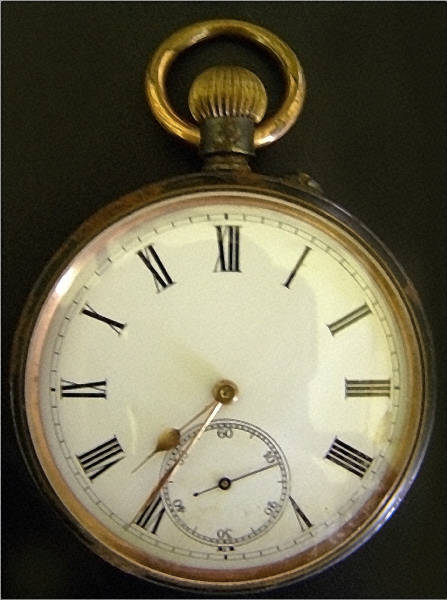
                                         Edward Thomas's Pocket Watch
                                        Cardiff University Library Archive

On April 10, 1917, Captain Lushington wrote this in a letter to Helen Thomas:

I cannot express to you adequately in words how deep our sympathy is for you and your children in your great loss.  These things go too deep for mere words.  We, officers and men, all mourn our own loss.  Your husband was very greatly loved in this battery, and his going has been a personal loss to each of us.  He was rather older than most of the officers and we all looked up to him as the kind of father of our happy family.

He was always the same, quietly cheerful, and ready to do any job that was going with the same steadfast unassuming spirit.  The day before his death we were rather heavily shelled and he had a very narrow shave.  But he went about his work quite quietly and ordinarily as if nothing was happening.  I wish I could convey to you the picture of him, a picture we had all learnt to love, of the old clay pipe, gum boots, oilskin coat, and steel helmet.
. . . . .
We buried him in a little military cemetery a few hundred yards from the battery:  the exact spot will be notified to you by the parson.  As we stood by his grave the sun came and the guns round seemed to stop firing for a short time.  This typified to me what stood out most in your husband's character -- the spirit of quiet, sunny, unassuming cheerfulness.

Ibid, pages 263-264.

                                 Cecil Lawson, "Outside Arras" (c. 1917)

Many poems have been written in memory of Edward Thomas.  My favorite is by his friend Walter de la Mare.  As I have noted before, the poem is remarkable in conveying (in eight short lines) the pain of the loss suffered by those who knew and loved Thomas, as well as something essential about Thomas himself.

                 To E. T.: 1917

You sleep too well -- too far away,
   For sorrowing word to soothe or wound;
Your very quiet seems to say
   How longed-for a peace you have found.

Else, had not death so lured you on,
   You would have grieved -- 'twixt joy and fear --
To know how my small loving son
   Had wept for you, my dear.

Walter de la Mare, Motley and Other Poems (1918).

                                       Cecil Lawson, "Arras" (c. 1917)

Thursday, October 27, 2011

"The Hundred Last Leaves Stream Upon The Willow"

In November of 1916, Edward Thomas sent a draft of "The Long Small Room" to Eleanor Farjeon.  After receiving her comments on the poem, Thomas wrote back:

"I am worried about the impression the willow made on you.  As a matter of fact I started with that last line as what I was working to.  I am only fearing it has a sort of Japanesy suddenness of ending.  But it is true, whether or not it is a legitimate switch to make."

Edward Thomas to Eleanor Farjeon (letter postmarked November 15, 1916), in Eleanor Farjeon, Edward Thomas: The Last Four Years (1958), page 221.

                    The Long Small Room

The long small room that showed willows in the west
Narrowed up to the end the fireplace filled,
Although not wide.  I liked it.  No one guessed
What need or accident made them so build.

Only the moon, the mouse and the sparrow peeped
In from the ivy round the casement thick.
Of all they saw and heard there they shall keep
The tale for the old ivy and older brick.

When I look back I am like moon, sparrow and mouse
That witnessed what they could never understand
Or alter or prevent in the dark house.
One thing remains the same -- this my right hand

Crawling crab-like over the clean white page,
Resting awhile each morning on the pillow,
Then once more starting to crawl on towards age.
The hundred last leaves stream upon the willow.

Edna Longley (editor), Edward Thomas: The Annotated Collected Poems (2008).

                              William Ratcliffe, "Cottage Interior" (1920)

The final line that Thomas worried about is, of course, beautiful.  It was certainly well worth "working to" once Thomas had found it.  After all, it passed his ultimate test, the test that causes us to remember his poetry:  "it is true."  And the line does, to use his words, give the poem something of a "Japanesy suddenness of ending."  (I would also suggest that the ending is reminiscent of a number of Chinese poems from the T'ang Dynasty.)  It is not likely that Thomas had any translations of Ryokan's poetry available to him, but the following poems perhaps provide a hint of what he was speaking of.

My gate has been unbolted for many days,
Yet no sign of anyone entering the peaceful garden.
The rainy season is over, green moss is all around;
Slowly the oak leaves float to earth.

John Stevens (translator), One Robe, One Bowl: The Zen Poetry of Ryokan (1977).

Returning to my hermitage after filling my rice bowl,
Now only the gentle glow of twilight.
Surrounded by mountain peaks and thinly scattered leaves;
In the forest a winter crow flies.

Ibid.

                      Norman Clark, "From an Upstairs Window" (c. 1969)

Friday, April 8, 2011

In Memory Of Edward Thomas

On April 9, 1917, Edward Thomas was killed at the Battle of Arras.  The following poem is by W. H. Auden.

                                        To E. T.

These thick walls never shake beneath the rumbling wheel
     No scratch of mole nor lisping worm you feel
          So surely do these windows seal.

But here and there your music and your words are read
     And savage learns what elm and badger said
          To you who loved them and are dead.

So when the blackbird tries his cadences anew
     There kindle still in eyes you never knew
          The light that would have shone in you.

W. H. Auden, in Anne Harvey (editor), Elected Friends: Poems for and about Edward Thomas (Enitharmon Press 1991).  The editor states that "To E. T." is an "unpublished manuscript poem" that was "written around 1925 and not published during Auden's lifetime."

Eleanor Farjeon (1881-1965) and her brother Herbert ("Bertie") were friends of Thomas's.  Farjeon later became well-known as a writer of children's stories and poetry.  She also wrote a memoir of her friendship with Thomas.  She was in love with Thomas (which he, and others, could see), but their relationship remained solely a friendship.  The memoir closes with his death.  This is the final sentence of the book:

Ten years afterwards Bertie said to me, "I wake in the night and cry for Edward still."

Eleanor Farjeon, Edward Thomas: The Last Four Years (1958), page 265.

                                           Edward Thomas (1878-1917)