
Tinker's Wife
I saw her amid the dunghill debris
Looking for things
Such as an old pair of shoes or gaiters.
She was a young woman,
A tinker's wife.
Her face had streaks of care
Like wires across it,
But she was supple
As a young goat
On a windy hill.
She searched on the dunghill debris,
Tripping gingerly
Over tin canisters
And sharp-broken
Dinner plates.
Patrick Kavanagh, Ploughman and Other Poems (Macmillan 1936).
In "Tinker's Wife," Kavanagh tells us what he has seen. Some of us will find the poem to be sensitive and empathetic. I do. Others, particularly thoroughly ironic moderns, may feel that Kavanagh has moved past empathy into pity, and past sensitivity into sentimentality. This is of no moment to me, for I have no objection to either pity or sentimentality, if they are grounded in a feeling of kinship with the souls in whose company we are passing through life.

Duncan Grant, "Girl at the Piano" (1940)
The utopian, inhuman worlds of politics and social science are concerned with groups and categories, not with individual human beings. Thus, many of those who are unhappy with the outcomes of the Brexit referendum and the American presidential election have reacted in a way that reveals a great deal (none of it good) about how they view their fellow human beings: they see caricatures and stereotypes, not individual souls. What the unhappy fail to realize is that, by objectifying others, they are at the same time objectifying themselves, and have in turn transformed themselves into caricatures and stereotypes. This is what happens when one becomes politicized.
Good poets and artists, on the other hand, are concerned with individual human souls. Which is not to say that they are saviors or saints. Nor are they out to edify us. Rather, they simply ask us to look at the beautiful particulars of the World. Those particulars may at times cause us to catch our breath in sadness and, yes, in pity. But this is life, not theory.
A Stranger
Her face was like sad things: was like the lights
Of a great city, seen from far off fields,
Or seen from sea: sad things, as are the fires
Lit in a land of furnaces by night:
Sad things, as are the reaches of a stream
Flowing beneath a golden moon alone.
And her clear voice, full of remembrances,
Came like faint music down the distant air.
As though she had a spirit of dead joy
About her, looked the sorrow of her ways:
If light there be, the dark hills are to climb
First: and if calm, far over the long sea.
Fallen from all the world apart she seemed,
Into a silence and a memory.
What had the thin hands done, that now they strained
Together in such passion? And those eyes,
What saw they long ago, that now they dreamed
Along the busy streets, blind but to dreams?
Her white lips mocked the world, and all therein:
She had known more than this; she wanted not
This, who had known the past so great a thing.
Moving about our ways, herself she moved
In things done, years remembered, places gone.
Lonely, amid the living crowds, as dead,
She walked with wonderful and sad regard:
With us, her passing image: but herself
Far over the dark hills and the long sea.
Lionel Johnson, Ireland, with Other Poems (Elkin Mathews 1897).

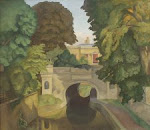
Gilbert Spencer
"The School on Peggy Hill, Ambleside" (1952)
I am fond of robins. I grow even fonder of them in winter, when they gather together in flocks. I was delighted this past week when, on a sunny afternoon, I saw a large group of them (50 or so) spread out over a newly-mown meadow. They were a companionable lot, chirping and clucking their leisurely way across the green field in the golden light. A few sparrows had worked their way into the strolling congregation. The robins had no objection.
I was once again reminded: we never know what the World will bestow upon us. With that in mind, we should be attentive, receptive, and -- above all -- grateful for the abiding mystery of it all.
Commuter
Deaf and dumb lovers in a misty dawn
On an open station platform in the Dordogne
Watched each other's hands and faces,
Making shapes with their fingers, tapping their palms
Then stopped and smiled and threw themselves
Open-mouthed into each other's arms
While the rest of us waited, standing beside our cases.
When it arrived she left him and climbed on the train
Her face like dawn because of their conversation.
She suddenly turned, grabbed his neck in the crook of her arm,
Gave him the bones of her head, the bones of her body, violently,
Then climbed on again alone. Her face hardened
In seconds as the train moved away from her island.
Tight lipped she looked around for a seat on the sea.
P. J. Kavanagh, Edward Thomas in Heaven (Chatto & Windus 1974).

Stanhope Forbes, "The Harbour Window" (1910)
At the beginning of 1694, the final year of his life, Bashō was living in Tokyo (then known as Edo). His health was poor. In April of the previous year, his beloved nephew Tōin, who Bashō had taken into his home and cared for, had died of tuberculosis. In the same year, he had "begun to look after a woman named Jutei and her three children, although, except for one of the children, they lived separately from him. Surviving records are vague on Jutei's identity, but they suggest Bashō had had some kind of close relationship with her in his young days. Her children, however, do not seem to have been fathered by Bashō." Makoto Ueda, Bashō and His Interpreters: Selected Hokku with Commentary (Stanford University Press 1991), page 348.
Sensing that his death was approaching, on June 3, 1694, Bashō set off on a journey to Ueno (his hometown), which is located approximately 350 kilometers southwest of Tokyo. He intended to see his relatives and friends for the last time. He arrived on June 20. Late in July, while still in Ueno, he learned that Jutei had died suddenly in Tokyo. Bashō never returned to Tokyo. He died in Osaka on November 28.
At the news of the nun Jutei's death
never think of yourself
as someone who did not count --
festival of the souls
Bashō (translated by Makoto Ueda), Ibid, page 393.
The Japanese word for "festival of the souls" is tamamatsuri. "Tamamatsuri, more commonly known as urabon (the bon festival), is an annual Buddhist rite at which each family offers prayers to the souls of its ancestors. In Bashō's time it was held for four days, beginning on the thirteenth of the lunar seventh month. In 1694, that day was September 2." Ibid, page 393.
What a beautiful thing Bashō has given us. I hesitate to say anything more, but these lines just came to mind:
There cannot be, confusion of our sound forgot,
A single soul that lacks a sweet crystalline cry.
W. B. Yeats, "Paudeen," Responsibilities and Other Poems (Macmillan 1916).

Stanley Spencer, "The Roundabout" (1923)


