Showing posts with label Stanley Spencer. Show all posts

Friday, November 11, 2016

Perspective

As I mentioned in a recent post, I did my best to completely ignore the presidential election.  I also chose not to vote in it:  I do not consider it my civic duty to cast a vote for the least unappealing candidate in a given election.  So I sat this one out.

However, I have been paying attention to the reactions of those who are not happy with the result of the election.  Their reactions are remarkably similar to the reactions of those who were not happy with the Brexit vote.  I expressed my feelings on this subject in a post I made on June 29 titled "Humanity."  Please bear with me, dear readers, but I feel compelled to restate those feelings at this time by reposting some of my thoughts:

"What concerns me is how the politicization of culture and of individual consciousness encourages people to adopt stereotypical, patronizing, and dehumanizing views of those who are on the other side of a political issue. This has been glaringly apparent in the aftermath of the Brexit vote, and it has been an ongoing feature of the presidential campaign.

"Who among us is in a position to adopt such views?  Do those who hold these views realize that they are in fact dehumanizing themselves in the process?  They have become exactly what the politicians, political 'activists,' and media oversimplifiers and crisis-mongers want them to be: political animals."

"Being politicized leads to evaluating and judging the world and other human beings in terms of classes, categories, and clichés.  Never underestimate the allure of a priori conclusions.  For the politicized, everything appears to be simple and subject to explanation.  Us and them. The enlightened versus the benighted.

"All of this has nothing whatsoever to do with the individual human being or with the individual human soul."

Thus concludes the homily for the day (and my unseemly quoting of myself, for which I apologize).

   Neither Out Far Nor In Deep

The people along the sand
All turn and look one way.
They turn their back on the land.
They look at the sea all day.

As long as it takes to pass
A ship keeps raising its hull;
The wetter ground like glass
Reflects a standing gull.

The land may vary more;
But wherever the truth may be --
The water comes ashore,
And the people look at the sea.

They cannot look out far.
They cannot look in deep.
But when was that ever a bar
To any watch they keep?

Robert Frost, A Further Range (Henry Holt 1936).

Make no mistake:  each of us is standing there on the sand.  "There cannot be, confusion of our sound forgot,/A single soul that lacks a sweet crystalline cry."

Stanley Spencer, "Scarecrow, Cookham" (1934)

On the morning after Election Day, I stepped out into the garden.  Birds were chirping.  Squirrels were busy gathering seeds and nuts for the coming winter.  The World was still here.  My beautiful and wonderful country was still here.  Nothing had changed.

     The autumn wind is blowing;
We are alive and can see each other,
     You and I.

Masaoka Shiki (translated by R. H. Blyth), in R. H. Blyth, Haiku, Volume 3: Summer-Autumn (Hokuseido Press 1952), page 413.

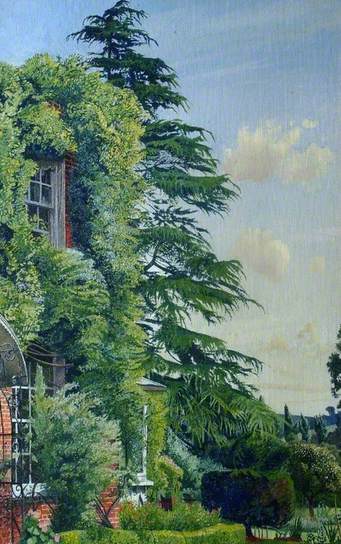
Gilbert Spencer (1892-1979), "The Cottage Window"

Monday, March 7, 2016

Earth, Lie Lightly

"Earth, lie lightly."  What a lovely request.  Much more evocative than, say, "rest in peace."  But it is not a phrase that one is apt to encounter first-hand in our times.  Which is a pity.  It is the cumulative tiny losses of such graceful touches that ultimately take their toll on the decency, seemliness, and nobility of civilization, not the day-to-day events of politics or economics, which are nothing but passing distractions.

"Earth, lie lightly."  One is likely to come across this gentle supplication (and variations upon it) in English poetry written prior to the 20th century. For instance, it is found in several translations of poems from The Greek Anthology.

Take to thy bosom, gentle earth, a swain
     With much hard labour in thy service worn.
He set the vines that clothe yon ample plain,
     And he these olives that the vale adorn.
He fill'd with grain the glebe; the rills he led
     Through this green herbage, and those fruitful bowers.
Thou, therefore, earth! lie lightly on his head,
     His hoary head, and deck his grave with flowers.

Anonymous (translated by William Cowper), in Henry Wellesley (editor), Anthologia Polyglotta: A Selection of Versions in Various Languages, Chiefly from the Greek Anthology (1849).

Stanley Spencer, "Bluebells, Cornflowers and Rhododendrons" (1945)

Too sentimental?  Too quaint?  Too old-fashioned?  It depends upon what sort of world you wish to live in.  One can, of course, take the ironic, hard-boiled "modern" approach and say that this sort of thing simply won't do anymore:  we have moved beyond it, we are now more knowing.

Ah, yes, have a look around you at the current state of the world.  What a wonderful place our superior knowingness and our irony have created for us!  I prefer this:

Full oft, of old, the islands changed their name,
And took new titles from some heir of fame:
Then dread not ye the wrath of gods above,
But change your own, and be the Isles of Love;
For Love's own name and shape the infant bore
Whom late we buried on your sandy shore.
Break softly there, thou never-weary wave,
And earth, lie light upon his little grave!

Crinagoras (translated by John William Burgon), Ibid.

Stanley Spencer, "The Roundabout" (1923)

Mind you, I am not suggesting that the essential humanity that one finds in The Greek Anthology has vanished from the world.  The love, hate, joy, sorrow, beauty, and transience of the ancients are ours as well.  Being human has always been a matter of life and death.

                            Life and Death

The two old, simple problems ever intertwined,
Close home, elusive, present, baffled, grappled.
By each successive age insoluble, pass'd on,
To ours to-day -- and we pass on the same.

Walt Whitman, Leaves of Grass (1891-1892).

"Insoluble."  Yet, it is entirely possible that the acceptance of this insolubility may be the only solution we need in order to pass our days in tranquility.  In any case, solution or no solution, we each have a choice to make:  shall we live in an enchanted world or a disenchanted world?

Earth, lightly press Ausigenes, for he,
Mother, ne'er set a heavy foot on thee.

Meleager (translated by John Besly), Anthologia Polyglotta.

Stanley Spencer, "Garden at Whitehouse, Northern Ireland" (1952)

Yes, we ought to tread softly.  As I have done here on more than one occasion in the past, I can only repeat Philip Larkin's lovely advice:

                . . . we should be careful

Of each other, we should be kind
While there is still time.

Philip Larkin, "The Mower," Collected Poems (Faber and Faber 1988).

A task for a lifetime, never completed.  And, if we are fortunate, a kind soul will request on our behalf, when we have vanished:  "Earth, lie lightly."

Lay a garland on my hearse
     Of the dismal yew;
Maidens, willow branches bear,
     Say I diëd true.

My Love was false, but I was firm
     From my hour of birth.
Upon my buried body lay
     Lightly, gently, earth.

John Fletcher, from The Maid's Tragedy (1622), in Norman Ault (editor), Elizabethan Lyrics (William Sloane 1949).

Stanley Spencer, "Scarecrow, Cookham" (1934)          

Wednesday, April 15, 2015

One Thing Leads To Another

I am in the midst of one of my recurrent avoid-the-news-of-the-world periods.  To steel my resolve, I paid a visit to a favorite poem:

               No Newspapers

Where, to me, is the loss
     Of the scenes they saw -- of the sounds they heard;
A butterfly flits across,
     Or a bird;
The moss is growing on the wall,
     I heard the leaf of the poppy fall.

Mary Coleridge, in Theresa Whistler (editor), The Collected Poems of Mary Coleridge (Rupert Hart-Davis 1954).

Stanley Spencer, "Bluebells, Cornflowers and Rhododendrons" (1945)

When it comes to poetry, one thing leads to another.  Thus, after I read "No Newspapers," I realized that I had not visited this poem in quite some time:

A newspaper is a collection of half-injustices
Which, bawled by boys from mile to mile,
Spreads its curious opinion
To a million merciful and sneering men,
While families cuddle the joys of the fireside
When spurred by tale of dire lone agony.
A newspaper is a court
Where every one is kindly and unfairly tried
By a squalor of honest men.
A newspaper is a market
Where wisdom sells its freedom
And melons are crowned by the crowd.
A newspaper is a game
Where his error scores the player victory
While another's skill wins death.
A newspaper is a symbol;
It is feckless life's chronicle,
A collection of loud tales
Concentrating eternal stupidities,
That in remote ages lived unhaltered,
Roaming through a fenceless world.

Stephen Crane, War Is Kind (1899).  The poem is untitled.

Newspapers still survive (barely).  But in their place (how fortunate for us!) we have any number of electronic purveyors of "news."  Of course, other than the technology of distribution, absolutely nothing has changed, has it?  "A court/Where every one is kindly and unfairly tried/By a squalor of honest men."  Exactly.  "A market/ Where wisdom sells its freedom/And melons are crowned by the crowd."  Perfect.  ("Melons are crowned by the crowd" is wonderful.)  "A collection of loud tales/Concentrating eternal stupidities."  Ah, yes.

Stephen Crane bucked me up:  I have abandoned The News of the World altogether.  I am quite certain that something is going on out there, but I have no reason to inquire.

Stanley Spencer, "The Ferry Hotel Lawn, Cookham" (1936)

But it turned out that I was not finished with Mary Coleridge yet.  I was preoccupied with newspapers and their ilk when I came to the poem.  But what stayed with me was the final line:  "I heard the leaf of the poppy fall."

Where would we be without poetic serendipity?  A week or so later, I happened upon this:

     The poppy flowers;
How calmly
     They fall.

Etsujin (1656-1739) (translated by R. H. Blyth), in R. H. Blyth, Haiku, Volume 3: Summer-Autumn (Hokuseido Press 1952), page 318.

Imagine those two poems existing independently of each other, going about their beautiful business in their own perfect way.  And then, by sheer accident, they come together.  Their coming together does not change the World.  Events of this sort shall never appear in the daily news.  Which is perfectly fine.

Stanley Spencer, "Peonies" (1939)

Finally, this week, the poppies of Coleridge and Etsujin led to this:

     Stillness:
The sound of the petals
     Sifting down together.

Chora (1729-1780) (translated by R. H. Blyth), in R. H. Blyth, Haiku, Volume 2: Spring (Hokuseido Press 1950), page 361.

Chora does not specify what sort of petals are falling:  he simply uses the phrase hana no oto.  Hana means "flower" or "blossom"; oto means "sound"; no means "of."  Hence:  "sound of flower" or "sound of blossom."  But the haiku is a Spring haiku, and thus cherry or plum petals are implied.

Do falling petals make a sound?  Perhaps so.  I know that falling snow can whisper.  I have heard it.

Does Chora's poem bring this excursion to an end?  Of course not.  This is how poetry works.

Stanley Spencer, "Scarecrow, Cookham" (1934)

Monday, February 16, 2015

Daffodils

This past week I saw the first daffodils of the year, and, beside them, the first crocuses.  Over the weekend, a couple of neighbors mowed their lawns.  (The hum of lawnmowers in the distance on a sunny day is an emblem of the stability and endurance of civilized life.)  But I wonder if, this early in the year, the flowers and the mowers are a bit optimistic.

Yet, as I have noted before, the turning of the seasons is a matter of emotion, not of equinoxes and solstices, or of dates on the calendar.  For me, autumn begins sometime in late August or early September.  And spring begins sometime in late February or early March.  As I have suggested in the past, these seasonal transitions have something to do with the cast of the light, the wind, bird-song, and the scent of the earth (the list is not exhaustive).  Not to mention internal weather.

In any event, I am delighted by these confident harbingers.  Which makes me wonder why the following poems by Robert Herrick come to mind.  Yes, the poems concern daffodils and tree blossoms, but Herrick's focus is elsewhere.

     Divination by a Daffodil

When a daffodil I see,
Hanging down his head t'wards me,
Guess I may, what I must be:
First, I shall decline my head;
Secondly, I shall be dead;
Lastly, safely buryed.

Robert Herrick, Hesperides (1648).

With one exception, I have modernized the spelling.  I hesitated to do so, since the spelling in the original 1648 edition is "daffadill," which I think is lovely.  However, I have retained "buryed" in the final line, since it is necessary for the metre (i.e., "bury-ed" rather than our modern "buried").

Stanley Spencer, "Hoe Garden Nursery" (1955)

Here again, Herrick considers daffodils as portents.

             To Daffodils

Fair daffodils, we weep to see
     You haste away so soon:
As yet the early-rising sun
     Has not attain'd his noon.
                                       Stay, stay,
     Until the hasting day
                                       Has run
     But to the even-song;
And, having pray'd together, we
          Will go with you along.

We have short time to stay, as you,
     We have as short a spring;
As quick a growth to meet decay,
     As you, or any thing.
                                       We die,
     As your hours do, and dry
                                       Away,
     Like to the summer's rain;
Or as the pearls of morning's dew
          Ne'r to be found again.

Robert Herrick, Ibid.

I fear that placing these two poems beside one another may misrepresent Herrick, for it perhaps gives the impression that he could not look at spring flowers without thinking of our mortality.  In fact, one of the charms of Hesperides is that poems such as these alternate, in nearly equal measure, with poems that are joyous, humorous, satirical, or ribald.

Herrick's subject matter is the world entire, which he makes clear in "The Argument of His Book" (which I have posted previously):  "I sing of brooks, of blossoms, birds, and bowers . . . I write of youth, of love, and have access/By these, to sing of cleanly-wantonness . . . I write of Hell; I sing (and ever shall)/Of Heaven, and hope to have it after all."

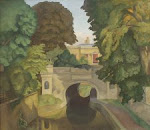
Stanley Spencer, "View from Cookham Bridge" (1936)

I also noticed a plum tree blossoming this week.  It, like the daffodils and the mowers, seems overly optimistic.  But who am I to second-guess a tree?

             To Blossoms

Fair pledges of a fruitful tree,
          Why do ye fall so fast?
          Your date is not so past;
But you may stay yet here a while,
          To blush and gently smile;
                         And go at last.

What, were ye born to be
          An hour or half's delight;
          And so to bid goodnight?
'Twas pity Nature brought ye forth
          Merely to show your worth,
                         And lose you quite.

But you are lovely leaves, where we
          May read how soon things have
          Their end, though ne'r so brave:
And after they have shown their pride,
          Like you a while:  They glide
                         Into the grave.

Robert Herrick, Ibid.

What makes Herrick so attractive, even in poems confronting our ultimate fate, is his unquenchable good nature.  This presiding spirit accounts for the empathy and loveliness with which he documents our lives from birth to death, highlighting the minute particulars, both good and ill, that we all share.

The final stanza of "To Blossoms" is a fine example of Herrick at his best: clear-sighted, not mincing words, but withal tender and beautiful.  "Lovely leaves" indeed.  And, yes:  "They glide into the grave."

Stanley Spencer, "Garden at Whitehouse, Northern Ireland" (1952)

Wednesday, August 6, 2014

Poetry: A Coda

I must ask for your forbearance today.  As a follow-up to my previous post, I hope to offer a humble instance of the mysterious way in which poetry may unfold in our lives when we least expect it.  The request for forbearance relates, first, to my need to provide a personal anecdote, which I am customarily loath to do.  It relates, second, to what could be perceived as an attempt to place myself in the company of Robert Frost -- believe me, nothing could be further from my intentions.  My personal experience only serves as a necessary prelude to Frost's poetry.

In the summer of 1977, I lived in a cabin on the south shore of a small mountain lake in the panhandle of Idaho, up near the Canadian border.  By some quirk of long-ago governmental land title issuance, the cabin was the only dwelling on the lake.  The lake was roughly circular, about three-quarters of a mile in diameter.  I spent a great deal of time reading in a deck chair on the lawn beside the water or out on the dock.  An odd detail that I recall:  I was reading Aleksandr Solzhenitsyn's August 1914 much of that summer.

Every week or so, a moose would swim across the lake from the north shore at a steady, leisurely pace.  Each time this occurred, he or she would swim in a straight line towards the dock.  It emerged slowly out of the water and stepped into the reeds and cat-tails along the shore, only a few yards from the cabin.  It then walked calmly off into the trackless woods, paying me no mind.

Stanley Spencer, "Garden at Whitehouse, Northern Ireland" (1952)

Twenty years later, thinking about the moose, I felt prompted to write this:

                    Watching the Lake

One summer, day after day, I watched a lake.
Nothing of that time remains in my hands.
Even then, I knew it would soon be gone.
None of it was, of course, mine to hold on to --
I'd watch the wind ripple from shore to shore
Till the rushes whispered in the shallows;
Once a week, a moose swam across the lake,
Stepped ashore, and walked off into the woods.
None of this, I knew, would pass my way again.

sip (October, 1997).

I offer this not for its negligible poetic merit, but solely as a record of the persistence of the moose in my memory.

Stanley Spencer, "The Ferry Hotel Lawn, Cookham" (1936)

I am ashamed to say that I did not begin to go deeply into the poetry of Robert Frost until about 15 years ago, when I decided to move beyond the old chestnuts.  Six or seven years ago, I came across this  poem for the first time.

                     The Most of It

He thought he kept the universe alone;
For all the voice in answer he could wake
Was but the mocking echo of his own
From some tree-hidden cliff across the lake.
Some morning from the boulder-broken beach
He would cry out on life, that what it wants
Is not its own love back in copy speech,
But counter-love, original response.
And nothing ever came of what he cried
Unless it was the embodiment that crashed
In the cliff's talus on the other side,
And then in the far distant water splashed,
But after a time allowed for it to swim,
Instead of proving human when it neared
And someone else additional to him,
As a great buck it powerfully appeared,
Pushing the crumpled water up ahead,
And landed pouring like a waterfall,
And stumbled through the rocks with horny tread,
And forced the underbrush -- and that was all.

Robert Frost, A Witness Tree (1942).

So that's it.  End of story.  Nothing earth-shattering.  A simple anecdote about life and poetry 30 years in the making.  You can imagine my emotions as I came to the end of "The Most of It."  Surprise and joy, of course.  And then a kind of serenity.  All serenity being short-lived.

I do not propose to draw some sort of all-purpose, all-encompassing moral to the story.  Poetry is not life.  Life is not poetry.  But, still . . .

Stanley Spencer, "Scarecrow, Cookham" (1934)

Thursday, December 5, 2013

The Dream Of The Butterfly

The older one gets, the more life begins to take on a dreamlike aspect. Why is this?  First, one's awareness of the transience of all things (including oneself) assumes a more concrete presence.  Mind you, this awareness needn't be accompanied by fear or anxiety.  In fact, one's reaction might well be:  "Ah, yes, so that's how it is.  I suspected as much."  Second, decades of exposure to the follies and capers (evil or absurd) of one's fellow human beings (again, including oneself) cannot help but make you wonder if you are living in a dream world (or a nightmare world).

I claim no originality in making these observations.  The ancient Greek philosophers (Heraclitus, for instance) and the ancient Chinese Taoist philosophers explained these things around 500 B.C. (or earlier).   So much for our Modern God of Progress.  If anything, we have gone backwards since those times.

Lao Tzu and Chuang Tzu were the two greatest Taoist philosophers.  Lao Tzu is known for the Tao Te Ching, and Chuang Tzu is known for the eponymous Chuang Tzu.  ("Chuang" was his surname; "Tzu" means "Master;" his given name was "Chou.")  Arguments have been made that neither man ever existed, and that the books are the products of various philosophers of the time whose names are unknown to us.

Chuang Tzu often wrote in allegories, the best-known of which is this:

"Once Chuang Chou dreamt he was a butterfly, a butterfly flitting and fluttering around, happy with himself and doing as he pleased.  He didn't know he was Chuang Chou.  Suddenly he woke up and there he was, solid and unmistakable Chuang Chou.  But he didn't know if he was Chuang Chou who had dreamt he was a butterfly, or a butterfly dreaming he was Chuang Chou.  Between Chuang Chou and a butterfly there must be some distinction!"

Burton Watson (translator), Chuang Tzu: Basic Writings (Columbia University Press 1964), page 45.

Stanley Spencer, "The Roundabout" (1923)

Li Po (701-762) was one of the five great T'ang Dynasty poets (the other four are Wang Wei, Tu Fu,  Po Chu-i, and Han Shan).  The poetry of all five is suffused with Taoism (together with greater and lesser degrees of Buddhism), but Li Po's poetry in particular reflects the riddling (and antic) qualities of Taoism.  Hence, it is not surprising that he would have written a poem about Chuang Tzu's dream of the butterfly.

       Chuang Tzu and the Butterfly

Dreaming, Chuang Tzu became a butterfly;
waking, the butterfly became the man.

Who knows which is real?
Who knows where endless changes end?

The waters of the deepest sea
return to the smallest stream.

The melon-grower outside the city gate
was once the King of the Hill.

Even rank and riches eventually disappear.
You know.  And still you toil.

Li Po, in Sam Hamill  (translator), Banished Immortal: Visions of Li T'ai-po (White Pine Press 1987).

Stanley Spencer, "The Boatbuilder's Yard, Cookham" (1936)

For purposes of comparison, here is another translation of the same poem:

          Chuang Tzu and the Butterfly

Chuang Chou in dream became a butterfly,
And the butterfly became Chuang Chou at waking.
Which was the real -- the butterfly or the man?
Who can tell the end of the endless changes of things?
The water that flows into the depth of the distant sea
Returns anon to the shallows of a transparent stream.
The man, raising melons outside the green gate of the city,
Was once the Prince of the East Hill.
So must rank and riches vanish.
You know it, still you toil and toil, -- what for?

Li Po, in Shigeyoshi Obata (translator), The Works of Li-Po (J. M. Dent 1923).

What, then, are we to do with this wisdom?  After all, we have to wake up each day and go about our business, butterfly dream or not.  But it can't hurt to have a little perspective.  A histrionic false world -- loud and vulgar and disingenuous -- clamors for our attention.  That world is nothing but a chimera.

Stanley Spencer, "Mending Cowls, Cookham" (1915)

Friday, November 29, 2013

Mangels

We have previously considered the poetic possibilities of the humble swede. It is now time to turn our attention to the mangel (also known as the mangel-wurzel and the mangold).  Those who are knowledgeable about such things (I am not a member of that group) are quick to point out that a mangel is a variety of beet, whereas a swede is a variety of turnip.  Thus, in my researches into this matter, I discovered an ancient English proverbial phrase:  "He doesn't know a swede from a mangel-wurzel!"

In any event, the mangel is a noble vegetable, and it has a noble poetic history.

Stanley Spencer, "Distant View of Maidenhead, Berkshire" (1939)

The following poem by Ivor Gurney begins with Edward Thomas, turns to mangels, and then heads off on one of Gurney's wonderful excursions.

                              The Mangel-bury

It was after War, Edward Thomas had fallen at Arras --
I was walking by Gloucester musing on such things
As fill his verse with goodness; it was February; the long house
Straw-thatched of the mangels stretched two wide wings;
And looked as part of the earth heaped up by dead soldiers
In the most fitting place -- along the hedges yet-bare-lines.
West spring breathed there early, that none foreign divines.
Across the flat country the rattling of the cart sounded;
Heavy of wood, jingling of iron; as he neared me, I waited
For the chance perhaps of heaving at those great rounded
Ruddy or orange things -- and right to be rolled and hefted
By a body like mine, soldier-still, and clean from water.
Silent he assented; till the cart was drifted
High with those creatures, so right in size and matter,
We threw them with our bodies swinging; blood in my ears singing:
His was the thick-set sort of farmer, but well-built --
Perhaps long before, his blood's name ruled all:
Watched all things for his own.  If my luck had so willed
Many questions of lordship I had heard him tell -- old
Names, rumours.  But my pain to more moving called
And him to some barn business far in the fifteen acre field.

Ivor Gurney, Selected Poems (edited by George Walter) (J. M. Dent 1996).

Of course, one wonders whether Gurney had Thomas's "Swedes" in mind, both when he was tossing mangels into the farm-cart and later when he wrote the poem.  I find the phrase "after War" (not "after the War," as one might expect) intriguing:  does Gurney have in mind "War" as a perennial human condition, rather than "the War" as a unique historical event?  But I may be reading too much into it.

Christopher Nevinson, "A Winter Landscape" (1926)

In 1932, Thomas's widow Helen visited Gurney in the asylum in which he was confined.  Her description of her initial meeting with Gurney is heart-breaking:

"We were walking along a bare corridor when we were met by a tall gaunt dishevelled man clad in pyjamas and dressing gown, to whom Miss [Marion] Scott introduced me.  He gazed with an intense stare into my face and took me silently by the hand.  Then I gave him the flowers, which he took with the same deeply moving intensity and silence.  He then said, 'You are Helen, Edward's wife and Edward is dead.'  And I said, 'Yes, let us talk of him.'

So we went into a little cell-like bedroom where the only furniture was a bed and a chair.  The window was high and barred and the walls bare and drab. He put the flowers on the bed for there was no vessel to put them in; there was nothing in the room that could in any way be used to do damage with -- no pottery or jars or pictures whose broken edge could be used as a weapon. . . . We spoke of country that he knew and which Edward knew too and he evidently identified Edward with the English countryside, especially that of Gloucestershire."

Helen Thomas, "Ivor Gurney," in Time and Again: Memoirs and Letters (edited by Myfanwy Thomas (Carcanet 1978).  The final stanza of "Adlestrop" comes immediately to mind:

And for that minute a blackbird sang
Close by, and round him, mistier,
Farther and farther, all the birds
Of Oxfordshire and Gloucestershire.

She then recounts her second visit to Gurney:

"The next time I went with Miss Scott I took with me Edward's own well-used ordnance maps of Gloucestershire where he had often walked. This proved to have been a sort of inspiration, for Ivor Gurney at once spread them out on his bed and he and I spent the whole time I was there tracing with our fingers the lanes and byways and villages of which Ivor Gurney knew every step and over which Edward had also walked.  He spent that hour in revisiting his home, in spotting a village or a track, a hill or a wood and seeing it all in his mind's eye, with flowers and trees, stiles and hedges, a mental vision sharper and more actual for his heightened intensity.  He trod, in a way we who were sane could not emulate, the lanes and fields he knew and loved so well, his guide being his finger tracing the way on the map.  It was most deeply moving, and I knew that I had hit on an idea that gave him more pleasure than anything else I could have thought of.  For he had Edward as companion in this strange perambulation and he was utterly happy, without being over-excited."

Ibid.

Kenneth Roberts, "Benvie, Gray and Gordie" (1988)

Gurney's encounter with the farmer is reminiscent of Edward Thomas's encounter with a farmer plowing a field in the untitled poem which begins "As the team's head-brass flashed out on the turn."  The poem takes place during the War, before Thomas was sent to France.  Here is part of the poem:

                  . . . Every time the horses turned
Instead of treading me down, the ploughman leaned
Upon the handles to say or ask a word,
About the weather, next about the war.
Scraping the share he faced towards the wood,
And screwed along the furrow till the brass flashed
Once more.
                      The blizzard felled the elm whose crest
I sat in, by a woodpecker's round hole,
The ploughman said.  'When will they take it away?'
'When the war's over.' . . .

Edna Longley (editor), Edward Thomas: The Annotated Collected Poems (Bloodaxe Books 2008).

Christopher Nevinson, "Near Leatherhead" (c. 1939)

Friday, July 26, 2013

"That Yew-Tree's Shade"

I haven't done the research, but I wouldn't be surprised if someone has written a book (or at least a long essay) about yew trees in churchyards in English literature.  The association between yews and death (as well as immortality) is a long one, and crosses cultural boundaries.  But it is especially prevalent in English poetry.

Thomas Gray's "Elegy Written in a Country Churchyard" is a natural place to start:

Beneath those rugged elms, that yew-tree's shade,
Where heaves the turf in many a mouldering heap,
Each in his narrow cell for ever laid,
The rude forefathers of the hamlet sleep.

Stanley Spencer, "The Vale of Health, Hampstead" (c. 1940)

Did Thomas Hardy have Gray's "yew-tree's shade" in mind when he wrote the closing lines of the following poem?

                                    Lying Awake

You, Morningtide Star, now are steady-eyed, over the east,
     I know it as if I saw you;
You, Beeches, engrave on the sky your thin twigs, even the least;
     Had I paper and pencil I'd draw you.

You, Meadow, are white with your counterpane cover of dew,
     I see it as if I were there;
You, Churchyard, are lightening faint from the shade of the yew,
     The names creeping out everywhere.

Thomas Hardy, Winter Words in Various Moods and Metres (1928).

Putting aside yews for a moment, notice the downward movement of the poem:  from the Morningtide Star in the sky, to the twigs of the Beeches against the sky, to the earth of the Meadow, and then to the Churchyard, with its graves.  "The names creeping out everywhere" is marvelous, isn't it? The combination of emotional impact and exactly-accurate description (picture in your mind's eye the engraved names on the tombstones gradually becoming more distinct as the sun rises -- the shadows in the recessed letters) is wonderful.  It is one of Hardy's finest lines, I think.

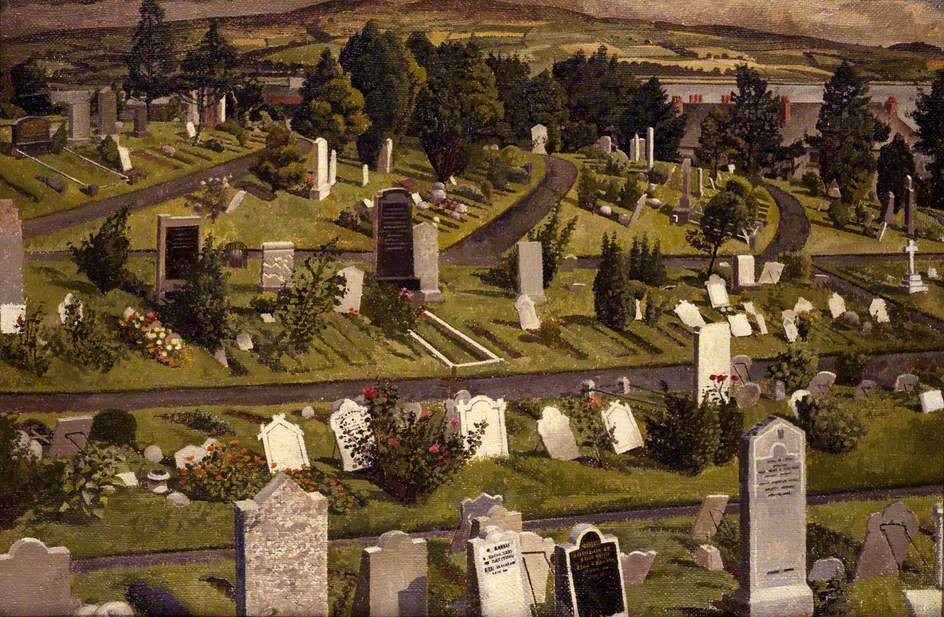
Stanley Spencer, "Port Glasgow Cemetery" (1957)

On a more humorous note, here is the final stanza (fittingly) of Louis MacNeice's "Tree Party":

Your health, Master Yew.  My bones are few
And I fully admit my rent is due,
But do not be vexed, I will postdate a cheque for you.

Louis MacNeice, The Burning Perch (1963).

Stanley Spencer, "Rock Gardens, Cookham Dean" (1940-1947)

                         The Yew

The moon gave no light.
The clouds rode slowly over, broad and white,
From the soft south west.
The wind, that cannot rest,
Soothed and then waked the darkness of the yew
Until the tree was restless too.

Of all the winds I knew
I thought, and how they muttered in the yew,
Or raved under the eaves,
Or nosed the fallen dry leaves,
Or with harsh voice holloa'd the orchard round,
With snapped limbs littering the ground.

And I thought how the yew
Between the window and the west his shadow threw,
Grave and immense,
Darkening the dark past thought and sense,
And how the moon would make the darkness heavenly bright:
But the moon gave no light.

John Freeman, Poems New and Old (1920).

Stanley Spencer, "Landscape, Cookham Dean" (c. 1939)

Tuesday, May 7, 2013

"In A Lifetime How Many Springs Do We See?"

I do not think that we ought to dwell unduly upon our mortality.  Unlike, say, the Elizabethans, I have no desire to place a skull on my mantelpiece as a reminder of where I am bound.  And I certainly do not wish to follow the example of John Donne, who is reputed to have occasionally slept in his coffin (which he kept inside his house).  Enough is enough.

Still, being mindful of the brevity of our days is, I think, a good idea.  If nothing else, it may help us to appreciate the moments as they fly away. Besides, in doing so, we keep ourselves in good company:  Su Tung-p'o and A. E. Housman, for instance.

Stanley Spencer, "Lilac and Clematis at Englefield" (1954)

       Pear Blossoms by the Eastern Palisade

Pear blossoms pale white, willows deep green --
when willow fluff scatters, falling blossoms will fill the town.
Snowy boughs by the eastern palisade set me pondering --
in a lifetime how many springs do we see?

Su Tung-p'o (1037-1101) (translated by Burton Watson), in Selected Poems of Su Tung-p'o (Copper Canyon Press 1994).

"In a lifetime how many springs do we see?"  For some of us, the question is not an idle one.  To wit:  at a certain age, the number of springs that we have already seen without a doubt exceeds the number of springs that we have yet to see.  Simple arithmetic, I'm afraid.  But this is not a cause for despair. However, to borrow from Samuel Johnson, it does serve to concentrate the mind wonderfully.

Stanley Spencer
"Wisteria at Englefield" (1955)

Loveliest of trees, the cherry now
Is hung with bloom along the bough,
And stands about the woodland ride
Wearing white for Eastertide.

Now, of my threescore years and ten,
Twenty will not come again,
And take from seventy springs a score,
It only leaves me fifty more.

And since to look at things in bloom
Fifty springs are little room,
About the woodlands I will go
To see the cherry hung with snow.

A. E. Housman, A Shropshire Lad (1896).

A side-note:  on the poetic comparison of snow and blossoms ("snowy boughs by the eastern palisade;" "to see the cherry hung with snow"), please see my previous post on W. H. Davies's "Nailsworth Hill" and Po Chu-i's "Village Night" ("buckwheat blossoms are like snow").

Stanley Spencer, "Garden at Whitehouse, Northern Ireland" (1952)

Friday, April 5, 2013

Grass

I am easy to please.  All seems right with the world when, on a sunny spring day, I can hear the hum of lawnmowers from various points in the distance, and the scent of freshly-cut grass arrives on a soft breeze.  Who says that there is no such thing as Paradise on Earth?

Here is John Ruskin (in one of those extravagant, wide-ranging apostrophes of his that make reading his books such a delight):

"The Greek, we have seen, delighted in the grass for its usefulness; the medieval, as also we moderns, for its colour and beauty.  But both dwell on it as the first element of the lovely landscape; we saw its use in Homer, we see also that Dante thinks the righteous spirits of the heathen enough comforted in Hades by having even the image of green grass put beneath their feet; the happy resting-place in Purgatory has no other delight than its grass and flowers; and, finally, in the terrestrial paradise, the feet of Matilda pause where the Lethe stream first bends the blades of grass.

Consider a little what a depth there is in this great instinct of the human race.  Gather a single blade of grass, and examine for a minute, quietly, its narrow sword-shaped strip of fluted green.  Nothing, as it seems there, of notable goodness or beauty.  A very little strength, and a very little tallness, and a few delicate long lines meeting in a point, -- not a perfect point either, but blunt and unfinished, by no means a creditable or apparently much cared-for example of Nature's workmanship; made, as it seems, only to be trodden on to-day, and to-morrow to be cast into the oven; and a little pale and hollow stalk, feeble and flaccid, leading down to the dull brown fibres of roots.  And yet, think of it well, and judge whether of all the gorgeous flowers that beam in summer air,  and of all strong and goodly trees, pleasant to the eyes or good for food, -- stately palm and pine, strong ash and oak, scented citron, burdened vine, -- there be any by man so deeply loved, by God so highly graced, as that narrow point of feeble green."

John Ruskin, Modern Painters, Volume III (1856), Part IV, Chapter XIV, Section 51 (italics in original).

Stanley Spencer, "Landscape, Cookham Dean" (c. 1939)
Wordsworth considers the subject in the following untitled poem.

This Lawn, a carpet all alive
With shadows flung from leaves -- to strive
     In dance, amid a press
Of sunshine, an apt emblem yields
Of Worldlings revelling in the fields
     Of strenuous idleness;

Less quick the stir when tide and breeze
Encounter, and to narrow seas
     Forbid a moment's rest;
The medley less when boreal Lights
Glance to and fro, like aery Sprites
     To feats of arms addrest!

Yet, spite of all this eager strife,
This ceaseless play, the genuine life
     That serves the stedfast hours,
Is in the grass beneath, that grows
Unheeded, and the mute repose
     Of sweetly-breathing flowers.

William Wordsworth, Yarrow Revisited, and Other Poems (1835).

James Torrington Bell, "Carnoustie House" (1962)

Wordsworth's poem fits well with some further remarks by Ruskin:

"Observe, the peculiar characters of the grass, which adapt it especially for the service of man, are its apparent humility, and cheerfulness.  Its humility, in that it seems created only for lowest service, -- appointed to be trodden on, and fed upon.  Its cheerfulness, in that it seems to exult under all kinds of violence and suffering.  You roll it, and it is stronger the next day; you mow it, and it multiplies its shoots, as if it were grateful; you tread upon it, and it only sends up richer perfume.  Spring comes, and it rejoices with all the earth, -- glowing with variegated flame of flowers, -- waving in soft depth of fruitful strength.  Winter comes, and though it will not mock its fellow plants by growing then, it will not pine and mourn, and turn colourless and leafless as they.  It is always green; and is only the brighter and gayer for the hoar-frost."

John Ruskin, Modern Painters, Volume III, Part IV, Chapter XIV, Section 52 (italics in original).

A side-note:  given Ruskin's invention of the term "pathetic fallacy," it is interesting to find him describing the "humility" and "cheerfulness" of grass.

James McIntosh Patrick, "City Garden" (1979)

Wednesday, April 3, 2013

"Nothing Was Ever Beautiful In Vain, Or All In Vain Was Good"

Christina Rossetti never ceases to surprise me.  Given that she wrote so many poems (about a thousand), you never know what you will come across when you open one of her collections.  In this respect, she resembles Thomas Hardy:  you can read their poetry for years, yet still come across undiscovered gems.

Thus, I recently stumbled upon the following poem by Rossetti.  It is one of those poems by her that leaves you wondering:  where did that come from?

Stanley Spencer, "Peonies" (c. 1939)

                  Buds and Babies

A million buds are born that never blow,
     That sweet with promise lift a pretty head
     To blush and wither on a barren bed
          And leave no fruit to show.

Sweet, unfulfilled.  Yet have I understood
     One joy, by their fragility made plain:
     Nothing was ever beautiful in vain,
          Or all in vain was good.

Christina Rossetti,  A Pageant and Other Poems (1881).  Rossetti uses "blow" (line 1) in a sense that has now mostly disappeared, but was commonly used in Romantic and Victorian poetry:  "to burst into flower; to blossom, bloom."  OED.

I suppose that an argument could be made that "Buds and Babies" is a conventional, sentimental Victorian poem.  Perhaps this is true of its subject matter and of its first stanza.  Perhaps.  But the second stanza is another matter entirely:  it is timeless and placeless, both in terms of its art and in terms of its content.

As is always the case with something this good, I hesitate to pick it apart for fear of destroying it.  But consider the setting apart of the lovely "Sweet, unfulfilled" at the beginning of the stanza.  Or consider the sound and rhythm of "by their fragility made plain."

And what are we to make of the closing lines?  Are they a mere truism?  A pious homily?  Perhaps I am simple-minded, but to me they come out of the depths and/or the heights of I know not where.  I am reminded of another line by Rossetti:  "Love hath a name of Death."  Paraphrase would be both futile and impertinent.  I will take the coward's way out and fall back on Wittgenstein:  "What we cannot speak about we must pass over in silence."

Stanley Spencer, "Poppies" (1938)

Thursday, March 28, 2013

Four-Line Poems, Part Six: "Of Humblest Friends, Bright Creature! Scorn Not One"

I would not describe William Wordsworth as a succinct poet.  He usually needs space to make his point.  However, there are exceptions.  For instance, there are the eight beautiful lines of "A slumber did my spirit seal."  And there is the following four-line poem, which came to mind in connection with my recent posts about the loveliness of familiar things.

                         To a Child
               Written in Her Album

Small service is true service while it lasts:
Of humblest Friends, bright Creature! scorn not one:
The Daisy, by the shadow that it casts,
Protects the lingering dew-drop from the Sun.

William Wordsworth, Poems (1845).

In commenting on the poem, Wordsworth stated:  "This quatrain was extempore on observing this image, as I had often done, on the lawn of Rydal Mount."

Stanley Spencer, "Lilac and Clematis at Englefield" (1954)

Wordsworth's poem is instructive:  we all ought to be on the look-out for dew-drops in the shadows of daisies.  Ivor Gurney offers similar advice.

                         The Escape

I believe in the increasing of life whatever
Leads to the seeing of small trifles . . . . .
Real, beautiful, is good, and an act never
Is worthier than in freeing spirit that stifles
Under ingratitude's weight; nor is anything done
Wiselier than the moving or breaking to sight
Of a thing hidden under by custom; revealed
Fulfilled, used, (sound-fashioned) any way out to delight.
.     .     .     .     .     .     .     .     .     .     .     .     .     .     .
Trefoil . . . . hedge sparrow . . . the stars on the edge of night.

Ivor Gurney, Selected Poems (edited by George Walter) (J. M. Dent 1996). The ellipses in lines 2 and 9, and between lines 8 and 9, are in the original.

It is difficult to be as attentive to the world around us as William Wordsworth and Ivor Gurney were.  But Gurney is right:  we must be careful not to find ourselves "under ingratitude's weight," lest we miss a great deal. Trefoil.  Hedge sparrow.  The stars on the edge of night.

Stanley Spencer, "Landscape, Cookham Dean" (c. 1939)

Saturday, March 2, 2013

Four-Line Poems, Part Three: "The Wind In The Tree"

Tens of thousands of poems have been written about love:  found love, lost love, requited love, unrequited love -- love in all of its permutations and guises.  The lovers have aired their emotions in sonnets, canzoni, odes, and other traditional poetic forms, often going to great lengths to articulate that which may be ultimately inexpressible.

However, I respectfully suggest that it may be possible to capture love (momentarily and evanescently) in a four-line poem.

Stanley Spencer, "The Ferry Hotel Lawn, Cookham" (1936)

               The Wind in the Tree

She has decided that she no longer loves me.
There is nothing to be done.  I long ago
As a child thought the tree sighed 'Do I know
Whether my motion makes the wind that moves me?'

F. T. Prince, Poems (1938).

Stanley Spencer
"Englefield House, Cookham" (1951)

The following is my humble contribution to the genre of the four-line lost love poem.

     The Land with Wind in the Leaves

Distance cannot remove me from that place.
I stand half a world away and here it is:
A green sway and roar -- blue, vast, open
And refusing always to let me depart.

     Yorkshire 1987 -- Tokyo 1992

sip (Tokyo/Seattle 1992).

I wish to strongly emphasize:  it does not, of course, hold a candle to "The Wind in the Tree."  But, to borrow from Louis MacNeice ("Star-gazer"):  "To me if to no one else the [subject] is of some interest."  I wrote the poem before I encountered "The Wind in the Tree."

And that's all I have to say about that.

Stanley Spencer, "Garden at Whitehouse, Northern Ireland" (1952)

Wednesday, January 23, 2013

Life As A Work Of Art, Part Five: "Grand Opera"

I have a confession to make.  A confession that does not reflect well on me at all.  Here it is:  I have never been able to develop an appreciation for opera.

For this bit of cultural ignorance, I beg the indulgence of any readers who are fond of the art form.  The fault is all mine.  I realize that there are opera devotees who will travel the globe to experience the latest version of The Ring Cycle in Bayreuth.  I can only envy them their good taste and their passion.  I, however, fell asleep during the last opera that I attended (Die Meistersinger von Nurnberg, a couple of decades ago).

                                                        Stanley Spencer
                                 "Swan Upping at Cookham" (1915-1919)

To demonstrate the depths of cultural depravity to which I have sunk, I shamefacedly admit that the opening lines of a song that I have been listening to off and on for over 40 years still give me a thrill each time I hear them:  "They're selling postcards of the hanging/They're painting the passports brown/The beauty parlor is filled with sailors/The circus is in town."  In contrast, the sublimest moments of opera leave me cold.  (An aside which further demonstrates my Philistinism:  when I discover that a poet whose work I admire has written a libretto, my heart sinks like a stone.)

Again, I am solely to blame for this blind spot.  But I fear that it is too late to be remedied.  I have sometimes toyed with the idea of learning ancient Greek in my autumn years.  But, attend another performance of Die Meistersinger?  I'm afraid not.

                            Stanley Spencer, "Scarecrow, Cookham" (1934)

All of this leads in a roundabout way to the following poem by James Reeves.  Opera may not be to my taste, but it may nonetheless be a mirror of Life.

                         Grand Opera

The lovers have poisoned themselves and died singing,
And the crushed peasant father howls in vain.
For his duplicity, lubricity and greed
The unspeakable base count is horribly slain.

After the music, after the applause,
The lights go up, the final curtain drops.
The clerks troop from the house, and some are thinking:
Why is life different when the singing stops?

All that hysteria and those histrionics,
All those coincidences were absurd.
But if there were no relevance to life,
Why were they moved to shudder and applaud?

Though they outlived that passion, it was theirs,
As was the jealousy, the sense of wrong
When some proud jack-in-office trampled them;
Only it did not goad them into song.

The accidents, the gross misunderstandings,
Paternal sorrow, amorous frustration
Have they not suffered?  Was the melodrama
An altogether baseless imitation?

James Reeves, The Questioning Tiger (1964).

                      Stanley Spencer, "Mending Cowls, Cookham" (1915)

Saturday, December 22, 2012

Christmas, Part Six: "The Hearth"

R. S. Thomas was never one to mince words.  Thus, not surprisingly, his Christmas poems (several of which I have posted here previously) have a touch of Thomas's fierceness to them.  But they also have an undercurrent of peace and serenity.  (Again, not surprisingly.  Thomas was not as much of a curmudgeon as he is sometimes made out to be.  Yes, he often presents a fairly brusque and forbidding surface, but this often serves as a mask, I think.)

The following poem is an instance of what I am trying to describe:  a bit of peace, a bit of serenity, even a whisper of love -- and a dose of fierceness for good measure.  There is nobody quite like R. S. Thomas.

                                     Stanley Spencer, "Fire Alight" (1936)

            The Hearth

In front of the fire
With you, the folk song
Of the wind in the chimney and the sparks'
Embroidery of the soot -- eternity
Is here in this small room,
In intervals that our love
Widens; and outside
Us is time and the victims
Of time, travellers
To a new Bethlehem, statesmen
And scientists with their hands full
Of the gifts that destroy.

R. S. Thomas, H'm (1972).

                                                  Charles Mahoney
                  "Christmas Tree Viewed Through Red Curtains" (c. 1952)

Tuesday, November 6, 2012

The First Tuesday After The First Monday In November

Today is Election Day in the country in which I was born.  Here is my prediction:  whatever the outcome, on Wednesday morning the United States of America will go on being the United States of America.  Thomas Jefferson, John Adams, Benjamin Franklin, James Madison, Alexander Hamilton, and the rest of that brilliant, star-crossed group knew a thing or two.  Here, in the words of Clint Eastwood, is one of the things they knew:

"I would just like to say something, ladies and gentlemen.  Something that I think is very important.  It is that you, we -- we own this country.  We own it. . . . It is not politicians owning it.  Politicians are employees of ours."

                       Stanley Spencer, "Mending Cowls, Cookham" (1915)

               Politics

You say a thousand things,
Persuasively,
And with strange passion hotly I agree,
And praise your zest,
And then
A blackbird sings
On April lilac, or fieldfaring men,
Ghostlike, with loaded wain,
Come down the twilit lane
To rest,
And what is all your argument to me?

Oh yes -- I know, I know,
It must be so --
You must devise
Your myriad policies,
For we are little wise,
And must be led and marshalled, lest we keep
Too fast a sleep
Far from the central world's realities.
Yes, we must heed --
For surely you reveal
Life's very heart; surely with flaming zeal
You search our folly and our secret need;
And surely it is wrong
To count my blackbird's song,
My cones of lilac, and my wagon team,
More than a world of dream.

But still
A voice calls from the hill --
I must away --
I cannot hear your argument to-day.

John Drinkwater, Tides (1917).

                               Stanley Spencer, "The Roundabout" (1923)

Monday, May 28, 2012

"Times Have Changed"

When a politician makes a public pronouncement, do you get the feeling that he or she thinks that the people to whom he or she is speaking (i.e., you and me) are credulous yokels?  Do you get the same feeling when a government bureaucrat or a media shill holds forth?

Do you notice that politicians, bureaucrats, and media shills have an infinite capacity to be both disingenuous and supercilious, no matter how sincere they attempt to sound?

It has ever been so, of course.  One Dark Age follows another.  Only the outer particulars change.

                                   Stanley Spencer, "The Bridge" (1920)

         Change

Times have changed.
Remember the helplessness
Of the serfs,
The inexplicable tyrannies
Of the lords.

But times have changed.
All is explained to us
In expert detail.
We trail the logic of our lords
Inch by inch.

The serfs devised religions,
And sad and helpful songs.
Sometimes they ran away,
There was somewhere to run to.
Times have changed.

D. J. Enright, The Old Adam (1965).

I harbor no illusions that we can dispense with this cast of characters.  I do know this: you can keep them away from your thoughts and your feelings. And, remember: they have absolutely nothing to do with poetry and art, which, to them, are alien and unreal spheres.  How fortunate for the rest of us.

                                Stanley Spencer, "The Roundabout" (1923)

Thursday, April 26, 2012

"Blue-Butterfly Day"

I'd like to stay with butterflies a moment longer in order to consider a poem by Robert Frost.  I recently posted a haiku by Moritake (1472-1549) in which a butterfly was mistaken for a falling flower:

     A fallen flower
Returning to the branch?
     It was a butterfly.

Moritake (translated by R. H. Blyth), in R. H. Blyth, Haiku, Volume 1: Eastern Culture (Hokuseido Press 1949), page 24.

The image is a beautiful one.  In the following poem, Frost speaks of "flowers that fly," thus echoing (unconsciously, I presume) Moritake.  But there is more:  Frost's opening image may perhaps be even lovelier.  (Not that this is a competition.)

                                                       Stanley Spencer
                                     "Englefield House, Cookham" (1951)

               Blue-Butterfly Day

It is blue-butterfly day here in spring,
And with these sky-flakes down in flurry on flurry
There is more unmixed color on the wing
Than flowers will show for days unless they hurry.

But these are flowers that fly and all but sing:
And now from having ridden out desire
They lie closed over in the wind and cling
Where wheels have freshly sliced the April mire.

Robert Frost, New Hampshire (1923).

It is fitting that a great poet of snow would think of blue-butterflies as "sky-flakes down in flurry on flurry."  And, as one might expect from Frost, there is a twist at the end.  Mud and sky.

Perhaps not surprisingly, "Blue-Butterfly Day" is followed in New Hampshire by "The Onset," which is about the first snow of winter.  It begins:  "Always the same, when on a fated night/At last the gathered snow lets down as white/As may be in dark woods."  Nor is it surprising that "The Onset" is in turn followed by "To Earthward."  With Frost (save when he is pontificating), one is usually asked to look at all sides of things.

                                                       Stanley Spencer
                                       "Cookham from Englefield" (1948)