Showing posts with label John Freeman. Show all posts

Saturday, January 13, 2018

Beyond Words

As human beings, we are adept (more or less) at putting things into words.  It is what we do.  Hence, for instance, poetry.  It has been argued that this trafficking in words is what sets us apart from the other creatures with whom we share the World.  Sets us apart for both good and ill, I would suggest.  Poetry, yes.  But a great deal of noisome noise as well.  There is no need to go into the particulars. You know them well.

However, there are some things that are simply unsayable, however articulate and clever we fancy ourselves to be.  Thus, as it wondrously happens, an awareness of the inexpressibility of certain fundamental elements of existence and of the World often accounts for the beauty and the truth of the poems that move us.

     'And so they came to live at Daffodil Water'

'And so they came to live at Daffodil Water.'
Such were the words that fell as by dictation
Into the cloud of my preoccupation,
And one by one they fluttered down like leaves,
Touching me with their strange illumination --
Like leaves the girls would catch at Butler's Cross
To bring themselves good luck, each leaf a year.

'And so they came to live at Daffodil Water.'
A grey-green light of depths that do not stir
Beneath the unfledged ash-bough's contemplation
Touches me now as I transcribe the words.
Such were the depths perhaps where Hylas drowned,
Such were the wreaths his temptresses would wear.
But who are they who came to shelter there
And live obscurely by that leaf-light crowned,
Patiently mending their storm-shattered minds?

Who came to live in grace at Daffodil Water,
And why they sheltered there and from what storm,
Neither the voice that speaks through my abstraction
Nor my own fantasy serves to inform.

James Reeves, The Talking Skull (Heinemann 1958).

Hylas (line 12) was a young man who was a companion to Heracles, and one of the Argonauts who accompanied Heracles and Jason in search of the Golden Fleece.  However, while on the journey, he was seduced by the temptations of the nymphs who haunted a spring and vanished beneath the water of a pond, never to be seen again.

Stanley Roy Badmin (1906-1989), "Stormy Evening, Glencoe"

The phrase "words fail me" usually carries with it a connotation of inadequacy or of frustration.  However, it may in fact represent a sign of progress.  To wit:

"There are, indeed, things that cannot be put into words.  They make themselves manifest.  They are what is mystical."

Ludwig Wittgenstein, Proposition 6.522, Tractatus Logico-Philosophicus (1921) (translated by David Pears and Brian McGuinness) (italics in the original).  An alternative translation is: "There is indeed the inexpressible.  This shows itself; it is the mystical."  (Translated by C. K. Ogden.)

The word "mystical" (whether used by Wittgenstein or by anyone else) causes some people (ironic moderns, for example) to raise their eyebrows.  The same is true of the word "Immanence."  I don't know why this should be the case.  Perhaps the modern temper is not as "open-minded" as it believes itself to be.  In truth, it is quite doctrinaire and intolerant.  But we are each free to follow our own path.

                              Abersoch

There was that headland, asleep on the sea,
The air full of thunder and the far air
Brittle with lightning; there was that girl
Riding her cycle, hair at half-mast,
And the men smoking, the dinghies at rest
On the calm tide.  There were people going
About their business, while the storm grew
Louder and nearer and did not break.

Why do I remember these few things,
That were rumours of life, not life itself
That was being lived fiercely, where the storm raged?
Was it just that the girl smiled,
Though not at me, and the men smoking
Had the look of those who have come safely home?

R. S. Thomas, Tares (Rupert Hart-Davis 1961).

Wittgenstein was fond of William James, and of The Varieties of Religious Experience in particular.  He is said to have read it in 1912 in Cambridge, nine years before Tractatus Logico-Philosophicus was published.  It was one of the books he often recommended (or gave) to friends (another such book, interestingly, was Samuel Johnson's Prayers and Meditations).  James identifies "ineffability" as one of the four defining features of mysticism, and states:

"The handiest of the marks by which I classify a state of mind as mystical is negative.  The subject of it immediately says that it defies expression, that no adequate report of its contents can be given in words.  It follows from this that its quality must be directly experienced; it cannot be imparted or transferred to others.  In this peculiarity mystical states are more like states of feeling than like states of intellect."

William James, The Varieties of Religious Experience: A Study in Human Nature (Longmans, Green 1902), page 380.

I am not attempting to pigeonhole 'And so they came to live at Daffodil Water' or "Abersoch" as "mystical" poems, or as poems about "Immanence":  they are, after all, composed of words and they do "say" something concrete.  But I think they also point to something ineffable and unsayable beyond themselves.  I am reminded of R. H. Blyth's comment (using a Buddhist saying) about how a haiku works:  "It is a single finger pointing to the moon."  R. H. Blyth, Haiku, Volume 3: Summer-Autumn (Hokuseido Press 1952), page i.  The Buddhist lesson is that we must ultimately look beyond the pointing finger.

Robert Coventry (1855-1914), "The Haven" (1908)

In the end, there are certain things -- likely the most important things -- that are beyond the reach of words.  To think otherwise is to give ourselves too much credit and too much power.  We are forever overestimating our ability to formulate dispositive explanations of existence and of the World that rely upon words.  There are certain things that are beyond words.  Wittgenstein's well-known proposition (which I have quoted here on numerous occasions) is true:  "What we cannot speak about we must pass over in silence."  Ludwig Wittgenstein, Proposition 7, Tractatus Logico-Philosophicus (translated by David Pears and Brian McGuinness).

And where does this leave us?  Bereft of words, we may feel hopelessly lost.  Ah, but that's the beauty of letting words go, and of accepting silence:  we are exactly where we ought to be.

                 The Forest of Dean

'Now here you could not lose your way,
Although you lost it,' seemed to say
Each path that ran to left or right
Through narrowing distance out of sight.

'Not here, not here,' whistled a thrush
And 'Never, never,' sighed a thorn-bush;
Primroses looked me in the face
With, 'O too lovely is this place.'

A larch-bough waved a loose green beard
And 'Never, never,' still I heard;
'Wayfarer, seek no more your track,
It lies each side and front and back.'

Andrew Young, Winter Harvest (Nonesuch Press 1933).

"The Forest of Dean" is prefigured in an earlier poem by Young:

                  In the New Forest

With branch on sighing branch reclined
     And wild rose beckoning wild rose,
I lose my way, only to find
     That no-one here his way can lose.

Andrew Young, in Edward Lowbury and Alison Young (editors), The Poetical Works of Andrew Young (Secker & Warburg 1985).  The poem appears in a letter that Young wrote to John Freeman in August of 1927.  Ibid, page 329.  He did not publish it during his lifetime.  Freeman was an acquaintance of both Edward Thomas and Walter de la Mare.  A few of his poems have appeared here in the past.

Daffodil Water, Abersoch, the Forest of Dean, the New Forest.  Here. With nothing more to be said, are we in precisely the right place?

Dane Maw (1906-1989), "Woolverton and Peart Woods" (1970)

Saturday, January 30, 2016

A Winter Night

There is nothing like a vast winter night sky to remind you of your place in the universe.  Such a vista might seem companionable during the December holiday season, when the neighborhood houses are decorated with colorful lights, and bright, bedecked Christmas trees can be seen in nearly every living room window.  The immensity and the depth of silence of that canopy seem manageable under those circumstances.  But the night sky tells a different story at the deep end of January.

                 A Winter Night

It was a chilly winter's night;
     And frost was glitt'ring on the ground,
And evening stars were twinkling bright;
     And from the gloomy plain around
               Came no sound,
But where, within the wood-girt tower,
The churchbell slowly struck the hour;

As if that all of human birth
     Had risen to the final day,
And soaring from the worn-out earth
     Were called in hurry and dismay,
               Far away;
And I alone of all mankind
Were left in loneliness behind.

William Barnes, Poems, Partly of Rural Life, in National English (1846).

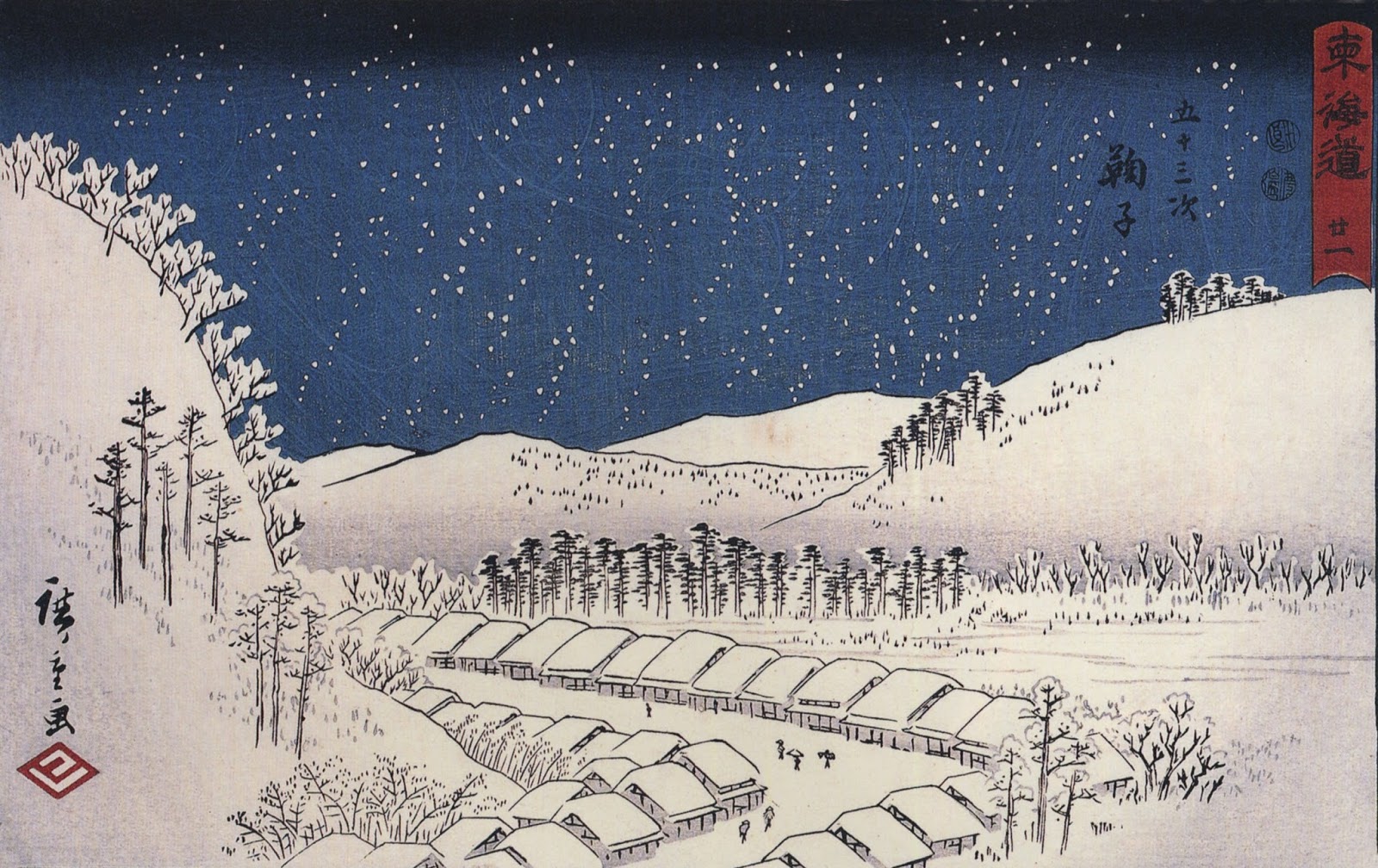
Utagawa Hiroshige (1797-1858), "Snow Falling on a Town"

However, we ought not to get too carried away with these dark-of-night contemplations.  An apostrophe on the "metaphysical" or "existential" loneliness of humanity in a mute and empty cosmos would be barren and abstract.  Rather, a clear winter night -- starry, vast, and eternally cold -- is simply a salutary reminder of how puny each of us is.  That's it.  Well, yes, loneliness does enter into it.  But it is the homely, small-scale, and individual soul-loneliness that we all experience on a daily basis.  "When the night-processions flit/Through the mind."  That sort of thing.  With a sharper, chillier edge.

                       The Hounds

Far off a lonely hound
Telling his loneliness all round
To the dark woods, dark hills, and darker sea;

And, answering, the sound
Of that yet lonelier sea-hound
Telling his loneliness to the solitary stars.

Hearing, the kennelled hound
Some neighbourhood and comfort found,
And slept beneath the comfortless high stars.

But that wild sea-hound
Unkennelled, called all night all round --
The unneighboured and uncomforted cold sea.

John Freeman, Stone Trees and Other Poems (Selwyn and Blount 1916).

I can sometimes hear sea lions barking in the night down along the shores of Puget Sound.  Are they "telling [their] loneliness all round" or "to the solitary stars"?  I find their voices to be comforting.

Harald Sohlberg, "Winter Night in the Mountains" (1918-1924)

When it comes to the silence and the emptiness of the universe, R. S. Thomas is the poet to go to.  Thomas's life-long waiting and waiting for a single whisper from something out there -- God, of course -- is perhaps the key theme of his poetry.  An odd thing to say of someone who was an Anglican priest, isn't it?  Did he ever hear the whisper?  I don't know.  But his waiting and listening led to the creation of a great many beautiful poems.

                     The Other

There are nights that are so still
that I can hear the small owl calling
far off and a fox barking
miles away.  It is then that I lie
in the lean hours awake listening
to the swell born somewhere in the Atlantic
rising and falling, rising and falling
wave on wave on the long shore
by the village, that is without light
and companionless.  And the thought comes
of that other being who is awake, too,
letting our prayers break on him,
not like this for a few hours,
but for days, years, for eternity.

R. S. Thomas, Destinations (Celandine Press 1985).

Utagawa Hiroshige, "Uraga in Sagami Province"

Now, having just said that R. S. Thomas "is the poet to go to" when it comes to the silence and the emptiness of the universe, what am I to do with Robert Frost?  An amendment is in order:  R. S. Thomas and Robert Frost are the poets to go to when it comes to the silence and the emptiness of the universe.

I've never had the sense that Frost is waiting upon God, however.  His intimate knowledge of silence and emptiness -- the universe's and his own -- is wholly personal.   Or so it seems to me.  "Acquainted with the Night." This acquaintance is not necessarily comforting.  "Harrowing" is the word that comes to mind.

                         Desert Places

Snow falling and night falling fast, oh, fast
In a field I looked into going past,
And the ground almost covered smooth in snow,
But a few weeds and stubble showing last.

The woods around it have it -- it is theirs.
All animals are smothered in their lairs.
I am too absent-spirited to count;
The loneliness includes me unawares.

And lonely as it is that loneliness
Will be more lonely ere it will be less --
A blanker whiteness of benighted snow
With no expression, nothing to express.

They cannot scare me with their empty spaces
Between stars -- on stars where no human race is.
I have it in me so much nearer home
To scare myself with my own desert places.

Robert Frost, A Further Range (Henry Holt 1936).

Harald Sohlberg, "Winter Night in the Mountains" (1911-1914)

Friday, July 26, 2013

"That Yew-Tree's Shade"

I haven't done the research, but I wouldn't be surprised if someone has written a book (or at least a long essay) about yew trees in churchyards in English literature.  The association between yews and death (as well as immortality) is a long one, and crosses cultural boundaries.  But it is especially prevalent in English poetry.

Thomas Gray's "Elegy Written in a Country Churchyard" is a natural place to start:

Beneath those rugged elms, that yew-tree's shade,
Where heaves the turf in many a mouldering heap,
Each in his narrow cell for ever laid,
The rude forefathers of the hamlet sleep.

Stanley Spencer, "The Vale of Health, Hampstead" (c. 1940)

Did Thomas Hardy have Gray's "yew-tree's shade" in mind when he wrote the closing lines of the following poem?

                                    Lying Awake

You, Morningtide Star, now are steady-eyed, over the east,
     I know it as if I saw you;
You, Beeches, engrave on the sky your thin twigs, even the least;
     Had I paper and pencil I'd draw you.

You, Meadow, are white with your counterpane cover of dew,
     I see it as if I were there;
You, Churchyard, are lightening faint from the shade of the yew,
     The names creeping out everywhere.

Thomas Hardy, Winter Words in Various Moods and Metres (1928).

Putting aside yews for a moment, notice the downward movement of the poem:  from the Morningtide Star in the sky, to the twigs of the Beeches against the sky, to the earth of the Meadow, and then to the Churchyard, with its graves.  "The names creeping out everywhere" is marvelous, isn't it? The combination of emotional impact and exactly-accurate description (picture in your mind's eye the engraved names on the tombstones gradually becoming more distinct as the sun rises -- the shadows in the recessed letters) is wonderful.  It is one of Hardy's finest lines, I think.

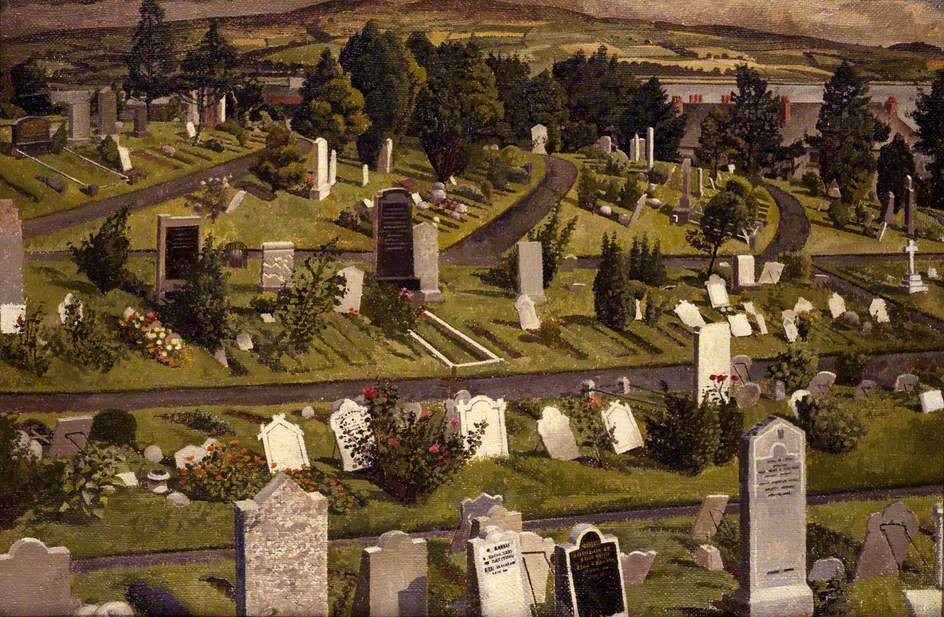
Stanley Spencer, "Port Glasgow Cemetery" (1957)

On a more humorous note, here is the final stanza (fittingly) of Louis MacNeice's "Tree Party":

Your health, Master Yew.  My bones are few
And I fully admit my rent is due,
But do not be vexed, I will postdate a cheque for you.

Louis MacNeice, The Burning Perch (1963).

Stanley Spencer, "Rock Gardens, Cookham Dean" (1940-1947)

                         The Yew

The moon gave no light.
The clouds rode slowly over, broad and white,
From the soft south west.
The wind, that cannot rest,
Soothed and then waked the darkness of the yew
Until the tree was restless too.

Of all the winds I knew
I thought, and how they muttered in the yew,
Or raved under the eaves,
Or nosed the fallen dry leaves,
Or with harsh voice holloa'd the orchard round,
With snapped limbs littering the ground.

And I thought how the yew
Between the window and the west his shadow threw,
Grave and immense,
Darkening the dark past thought and sense,
And how the moon would make the darkness heavenly bright:
But the moon gave no light.

John Freeman, Poems New and Old (1920).

Stanley Spencer, "Landscape, Cookham Dean" (c. 1939)

Thursday, February 28, 2013

"The Crying Of Water"

I'd like to stay with the sounds of the sea for a moment longer.  John Freeman's "The Hounds," which appeared in my previous post, is a fairly austere poem.  Austere, but still deeply felt.  Freeman was one of the early-20th century Georgian poets.  Although the verse of the Georgian poets may seem "traditional" (in subject matter and language) to "modern" tastes, the Georgians were themselves reacting against what they saw as the fripperies of "traditional" Victorian poetry.

They were also suspicious of the excesses of the Decadent poets of the Nineties.  Absinthe and all that.  As I have indicated on more than one occasion, I have a soft spot for the Nineties poets, whatever their excesses. This is simply a matter of mood.

The following poem by Arthur Symons -- a Decadent -- is higher-strung than "The Hounds."  The recurrent "woe-is-me" emotional tenor of the Nineties poets is definitely in evidence.  It is certainly a different sort of poem from "The Hounds," but it has its own appeal.  The sea haunts in many different fashions.

Johan Christian Dahl, "Krinborg Castle by Moonlight" (c. 1849)

                   The Crying of Water

O water, voice of my heart, crying in the sand,
All night long crying with a mournful cry,
As I lie and listen, and cannot understand
The voice of my heart in my side or the voice of the sea,
O water, crying for rest, is it I, is it I?
All night long the water is crying to me.

Unresting water, there shall never be rest
Till the last moon droop and the last tide fail,
And the fire of the end begin to burn in the west;
And the heart shall be weary and wonder and cry like the sea,
All life long crying without avail,
As the water all night long is crying to me.

Arthur Symons, The Loom of Dreams (1901).

Johan Christian Dahl, "View from Vaekero near Christiania" (1827)

In fact, Symons could operate at a less emotionally-intense level when he wanted to.  I suspect that it depended upon whether he was in the throes of a romantic and/or religious crisis.

               Sea Twilight

The sea, a pale blue crystal cup,
With pale water was brimmed up;
And there was seen, on either hand,
Liquid sky and shadowy sand.

The loud and bright and burning day,
Charred to ashes, ebbed away;
The listening twilight only heard
Water whispering one word.

Arthur Symons, The Fool of the World and Other Poems (1906).

Johan Christian Dahl, "Copenhagen Harbor by Moonlight" (1846)

Tuesday, February 26, 2013

"Telling His Loneliness To The Solitary Stars"

The closing lines of John Masefield's "The Dead Knight" -- "The mournful word the seas say/When tides are wandering out or in" -- brought to mind a lovely poem by John Freeman (1880-1929).  I recently spouted off to the effect that "it is the poem that matters, not the poet."  In retrospect, this sounds too highfalutin', but my point is this:  a large number of fine poems tend to be overlooked simply because they were not written by well-known poets.

As long-time (and much-appreciated!) readers of this blog may have noticed, I am determined (in my tiny way) to save some of these poems (and the poets who wrote them) from oblivion.  I harbor no illusions about what I am up against -- the news of the world, and all the other deafening noise out there -- but I am stubborn.

Christopher Nevinson (1889-1946), "The Old Harbour"

                    The Hounds

Far off a lonely hound
Telling his loneliness all round
To the dark woods, dark hills, and darker sea;

And, answering, the sound
Of that yet lonelier sea-hound
Telling his loneliness to the solitary stars.

Hearing, the kennelled hound
Some neighbourhood and comfort found,
And slept beneath the comfortless high stars.

But that wild sea-hound
Unkennelled, called all night all round --
The unneighboured and uncomforted cold sea.

John Freeman, Stone Trees and Other Poems (1916).

Perhaps I am deluded, but I would stack this small poem up against any number of poems written by "major" poets.  I loved this poem the first time that I read it, and it has stayed with me ever since.  Is it the simple, recurring rhymes?  (Which seem to mimic the cries of the hounds and the sway of the sea.)  Is it the repetition of certain words?  Or is it the lonely middle-of-the-night feeling that all of us know too well?  (If I am not being presumptuous.)

Best to leave it alone.

Dane Maw (1908-1989), "Scottish Landscape, Air Dubh"

Sunday, February 10, 2013

Winter Into Spring, Part One: "Last Hours"

In my previous post, I noted the imminent arrival of the crocus.  However, as I suggested, perhaps I shouldn't be too impatient.  All in good time.

This shoulder season of winter into spring does have its own attractions. The passing of winter does not possess the same wistfulness quotient as the passing of summer into autumn or of autumn into winter.  Yet, it is a time whose vanishing beauties cannot help but awaken a feeling of regret.

For instance, the sight of bare branches against the sky can be as lovely as the threshing and unresting castles (thank you, Philip Larkin) of spring and summer.  I will miss them.

                                 Gilbert Spencer, "From My Studio" (c. 1959)

                 Last Hours

        A gray day and quiet,
        With slow clouds of gray,
And in dull air a cloud that falls, falls,
                    All day.

        The naked and stiff branches
        Of oak, elm, thorn,
In the cold light are like men aged and
                    Forlorn.

        Only a gray sky,
        Grass, trees, grass again,
And all the air a cloud that drips, drips,
                    All day.

        Lovely the lonely
        Bare trees and green grass --
Lovelier now the last hours of slow winter
                    Slowly pass.

John Freeman, Memories of Childhood and Other Poems (1919).

             Gilbert Spencer, "Burdens Farm with Melbury Beacon" (c. 1943)

Wednesday, April 14, 2010

The Sea At Night

I recently visited the north shore of Lake Superior in Minnesota.  The ice was gone, and the weather was cool and clear -- a wide open, brilliant blue world.  If you travel far enough north, you lose sight of the south (Wisconsin) shore.  It becomes easy to imagine that you are at the edge of a sea.  One night, the following two poems came to mind. 

The first is by John Freeman (1880-1929):

          The Hounds

Far off a lonely hound
Telling his loneliness all round
To the dark woods, dark hills, and darker sea;

And, answering, the sound
Of that yet lonelier sea-hound
Telling his loneliness to the solitary stars.

Hearing, the kennelled hound
Some neighbourhood and comfort found,
And slept beneath the comfortless high stars.

But that wild sea-hound
Unkennelled, called all night all round --
The unneighboured and uncomforted cold sea.

The second is by R. S. Thomas:

          The Other

There are nights that are so still
that I can hear the small owl calling
far off and a fox barking
miles away.  It is then that I lie
in the lean hours awake listening
to the swell born somewhere in the Atlantic
rising and falling, rising and falling
wave on wave on the long shore
by the village, that is without light
and companionless.  And the thought comes
of that other being who is awake, too,
letting our prayers break on him,
not like this for a few hours,
but for days, years, for eternity.

       Caspar David Friedrich, "Northern Sea in the Moonlight" (1824)