The fields that I pass through on my daily walk are now full of deep-green wild grasses -- things are no longer matted and tangled and grey. A small item amid the news of the world, but one that bears attending to.
Consider the Grass Growing
Consider the grass growing
As it grew last year and the year before,
Cool about the ankles like summer rivers
When we walked on a May evening through the meadows
To watch the mare that was going to foal.
Patrick Kavanagh, Selected Poems (1996). Kavanagh wrote the poem in 1943.
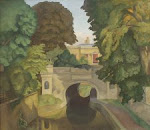
John Brett, "The River Dart" (1866)
Wednesday, April 20, 2011
Monday, April 18, 2011
"Let Us Go Home Across The Shires": W. S. Graham
My knowledge of the poetry of W. S. Graham (1918-1986) is limited to what I have encountered here and there in anthologies. I recently came across the following lovely poem by him.
The Stepping Stones
I have my yellow boots on to walk
Across the shires where I hide
Away from my true people and all
I can't put easily into my life.
So you will see I am stepping on
The stones between the runnels getting
Nowhere nowhere. It is almost
Embarrassing to be alive alone.
Take my hand and pull me over from
The last stone on to the moss and
The three celandines. Now my dear
Let us go home across the shires.
W. S. Graham, Collected Poems (Faber and Faber 1979).
I found the poem in The Bloodaxe Book of 20th Century Poetry (Bloodaxe Books 2000), which is edited by Edna Longley. We owe a debt of gratitude to Longley for her work on the poetry and prose of Edward Thomas, which culminated in The Annotated Collected Poems of 2008. Her criticism is excellent, and may be found in Poetry and Posterity, Poetry in the Wars, and other volumes. She is the wife of Michael Longley, whose admiration for Edward Thomas is evident in his own poetry.
Richard Eurich, "The Road to Grassington" (1971)
The Stepping Stones
I have my yellow boots on to walk
Across the shires where I hide
Away from my true people and all
I can't put easily into my life.
So you will see I am stepping on
The stones between the runnels getting
Nowhere nowhere. It is almost
Embarrassing to be alive alone.
Take my hand and pull me over from
The last stone on to the moss and
The three celandines. Now my dear
Let us go home across the shires.
W. S. Graham, Collected Poems (Faber and Faber 1979).
I found the poem in The Bloodaxe Book of 20th Century Poetry (Bloodaxe Books 2000), which is edited by Edna Longley. We owe a debt of gratitude to Longley for her work on the poetry and prose of Edward Thomas, which culminated in The Annotated Collected Poems of 2008. Her criticism is excellent, and may be found in Poetry and Posterity, Poetry in the Wars, and other volumes. She is the wife of Michael Longley, whose admiration for Edward Thomas is evident in his own poetry.
Richard Eurich, "The Road to Grassington" (1971)
Saturday, April 16, 2011
"Cut Grass Lies Frail"
Now, on sunny afternoons, the peaceful drone of lawn mowers can be heard in the distance. The scent of freshly-cut grass arrives on the breeze. White and yellow daffodils border the lawns. The magnolias and dogwoods are in bloom. The scene is like something out of a Philip Larkin pastoral. (Such scenes do exist -- together with a hint of mortality, of course.)
Cut Grass
Cut grass lies frail:
Brief is the breath
Mown stalks exhale.
Long, long the death
It dies in the white hours
Of young-leafed June
With chestnut flowers,
With hedges snowlike strewn,
White lilac bowed,
Lost lanes of Queen Anne's lace,
And that high-builded cloud
Moving at summer's pace.
Philip Larkin, High Windows (Faber and Faber 1974).
Stanley Roy Badmin, "Spring in the West Country" (1963)
Cut Grass
Cut grass lies frail:
Brief is the breath
Mown stalks exhale.
Long, long the death
It dies in the white hours
Of young-leafed June
With chestnut flowers,
With hedges snowlike strewn,
White lilac bowed,
Lost lanes of Queen Anne's lace,
And that high-builded cloud
Moving at summer's pace.
Philip Larkin, High Windows (Faber and Faber 1974).
Stanley Roy Badmin, "Spring in the West Country" (1963)
Thursday, April 14, 2011
Lists, Part Two: "The Ice-Cream Man"
Michael Longley is a master of listing. He has said: "nothing remains ordinary if you look at it for long enough." In the following poem -- one of his finest, I think -- Longley transforms a list into a profound lament for the human cost of the violence in his native Northern Ireland.
The Ice-cream Man
Rum and raisin, vanilla, butter-scotch, walnut, peach:
You would rhyme off the flavours. That was before
They murdered the ice-cream man on the Lisburn Road
And you bought carnations to lay outside his shop.
I named for you all the wild flowers of the Burren
I had seen in one day: thyme, valerian, loosestrife,
Meadowsweet, tway blade, crowfoot, ling, angelica,
Herb robert, marjoram, cow parsley, sundew, vetch,
Mountain avens, wood sage, ragged robin, stitchwort,
Yarrow, lady's bedstraw, bindweed, bog pimpernel.
Michael Longley, Gorse Fires (Cape 1991).
Who would have thought that a simple list of wild flowers could be so heartbreaking? Or could tell us so much about the value of life? I take it back: this is, of course, not a "simple" list at all.
Eero Jarnefelt, "Pond Water Crowfoot" (1895)
The Ice-cream Man
Rum and raisin, vanilla, butter-scotch, walnut, peach:
You would rhyme off the flavours. That was before
They murdered the ice-cream man on the Lisburn Road
And you bought carnations to lay outside his shop.
I named for you all the wild flowers of the Burren
I had seen in one day: thyme, valerian, loosestrife,
Meadowsweet, tway blade, crowfoot, ling, angelica,
Herb robert, marjoram, cow parsley, sundew, vetch,
Mountain avens, wood sage, ragged robin, stitchwort,
Yarrow, lady's bedstraw, bindweed, bog pimpernel.
Michael Longley, Gorse Fires (Cape 1991).
Who would have thought that a simple list of wild flowers could be so heartbreaking? Or could tell us so much about the value of life? I take it back: this is, of course, not a "simple" list at all.
Eero Jarnefelt, "Pond Water Crowfoot" (1895)
Tuesday, April 12, 2011
"Love Without Hope": Two Poems On The Same Theme
The following poem is one of Robert Graves's best-known poems -- at any rate, it seems to pop up in anthologies quite a bit. It shows that, when he isn't in one of his moony, mythological, exasperating "White Goddess" moods, Graves is very good indeed.
Love Without Hope
Love without hope, as when the young bird-catcher
Swept off his tall hat to the Squire's own daughter,
So let the imprisoned larks escape and fly
Singing about her head, as she rode by.
Robert Graves, The Welchman's Hose (1925).
For some reason, I thought of "Love Without Hope" in connection with a poem by Joan Barton. But now I wonder if these two poems are in fact "on the same theme." In any event . . .
The Mistress
The short cut home lay through the cemetery --
A suburban shrubbery swallowing up old graves
Iron palings tipped with rusted fleur-de-lys
A sort of cottage orne at the gates,
Ridiculous and sad;
And lost in their laurel groves,
Eaten up by moss,
Stained marble, flaking stone like hatches down,
The unloved unvisited dead:
In the no-man's-land of dusk a short cut home --
The exultant sense of life a trail of fire
Drawn into that tunnel roofed with the cypress smell
And walled with silence adding year to year:
Too far, too far: always
Under the smothering boughs in airless dark
The spirit dwindled, and the fire
Flickered then failed:
Gently implacably from the shade
The indecipherable dedications spoke
'Dear wife' . . . 'devoted mother' . . .
'Beloved child' . . .
Joan Barton, The Mistress and Other Poems (1972).
Richard Eurich, "Sea Wall" (1985)
Love Without Hope
Love without hope, as when the young bird-catcher
Swept off his tall hat to the Squire's own daughter,
So let the imprisoned larks escape and fly
Singing about her head, as she rode by.
Robert Graves, The Welchman's Hose (1925).
For some reason, I thought of "Love Without Hope" in connection with a poem by Joan Barton. But now I wonder if these two poems are in fact "on the same theme." In any event . . .
The Mistress
The short cut home lay through the cemetery --
A suburban shrubbery swallowing up old graves
Iron palings tipped with rusted fleur-de-lys
A sort of cottage orne at the gates,
Ridiculous and sad;
And lost in their laurel groves,
Eaten up by moss,
Stained marble, flaking stone like hatches down,
The unloved unvisited dead:
In the no-man's-land of dusk a short cut home --
The exultant sense of life a trail of fire
Drawn into that tunnel roofed with the cypress smell
And walled with silence adding year to year:
Too far, too far: always
Under the smothering boughs in airless dark
The spirit dwindled, and the fire
Flickered then failed:
Gently implacably from the shade
The indecipherable dedications spoke
'Dear wife' . . . 'devoted mother' . . .
'Beloved child' . . .
Joan Barton, The Mistress and Other Poems (1972).
Richard Eurich, "Sea Wall" (1985)
Sunday, April 10, 2011
Lists, Part One: "The Dearness Of Common Things"
When it comes to what I call "list poems" (a more imaginative term does not come to mind at the moment), Ivor Gurney is a good place to begin, for he was fond of lists. "Encounters" -- which I have previously posted -- is a wonderful example. Here is another.
Common Things
The dearness of common things --
Beech wood, tea, plate-shelves,
And the whole family of crockery --
Wood-axes, blades, helves.
Ivory milk, earth's coffee,
The white face of books
And the touch, feel, smell of paper --
Latin's lovely looks.
Earth fine to handle;
The touch of clouds,
When the imagining arm leaps out to caress
Grey worsted or wool clouds.
Wool, rope, cloth, old pipes
Gone, warped in service;
And the one herb of tobacco,
The herb of grace, the censer weed,
Of whorled, blue, finger-traced curves.
Ivor Gurney, Selected Poems (edited by George Walter) (J. M. Dent 1996).
In order to put Gurney's lists into perspective, the following poem may be helpful. (I have posted it before, but it bears revisiting.)
The Escape
I believe in the increasing of life whatever
Leads to the seeing of small trifles . . .
Real, beautiful, is good, and an act never
Is worthier than in freeing spirit that stifles
Under ingratitude's weight; nor is anything done
Wiselier than the moving or breaking to sight
Of a thing hidden under by custom; revealed
Fulfilled, used, (sound-fashioned) any way out to delight.
. . . . . . . . . . . . . .
Trefoil . . . . hedge sparrow . . . the stars on the edge of night.
Ibid. The ellipses are in the original. As is often the case with Gurney's poems (especially those that were not published in his lifetime), his punctuation (or lack thereof) can make things a bit puzzling. But the point is clear, I think: pay attention.
Evelyn Dunbar (1906-1960)
"A 1944 Pastoral: Land Girls Pruning at East Malling"
Common Things
The dearness of common things --
Beech wood, tea, plate-shelves,
And the whole family of crockery --
Wood-axes, blades, helves.
Ivory milk, earth's coffee,
The white face of books
And the touch, feel, smell of paper --
Latin's lovely looks.
Earth fine to handle;
The touch of clouds,
When the imagining arm leaps out to caress
Grey worsted or wool clouds.
Wool, rope, cloth, old pipes
Gone, warped in service;
And the one herb of tobacco,
The herb of grace, the censer weed,
Of whorled, blue, finger-traced curves.
Ivor Gurney, Selected Poems (edited by George Walter) (J. M. Dent 1996).
In order to put Gurney's lists into perspective, the following poem may be helpful. (I have posted it before, but it bears revisiting.)
The Escape
I believe in the increasing of life whatever
Leads to the seeing of small trifles . . .
Real, beautiful, is good, and an act never
Is worthier than in freeing spirit that stifles
Under ingratitude's weight; nor is anything done
Wiselier than the moving or breaking to sight
Of a thing hidden under by custom; revealed
Fulfilled, used, (sound-fashioned) any way out to delight.
. . . . . . . . . . . . . .
Trefoil . . . . hedge sparrow . . . the stars on the edge of night.
Ibid. The ellipses are in the original. As is often the case with Gurney's poems (especially those that were not published in his lifetime), his punctuation (or lack thereof) can make things a bit puzzling. But the point is clear, I think: pay attention.
Evelyn Dunbar (1906-1960)
"A 1944 Pastoral: Land Girls Pruning at East Malling"
Friday, April 8, 2011
In Memory Of Edward Thomas
On April 9, 1917, Edward Thomas was killed at the Battle of Arras. The following poem is by W. H. Auden.
To E. T.
These thick walls never shake beneath the rumbling wheel
No scratch of mole nor lisping worm you feel
So surely do these windows seal.
But here and there your music and your words are read
And savage learns what elm and badger said
To you who loved them and are dead.
So when the blackbird tries his cadences anew
There kindle still in eyes you never knew
The light that would have shone in you.
W. H. Auden, in Anne Harvey (editor), Elected Friends: Poems for and about Edward Thomas (Enitharmon Press 1991). The editor states that "To E. T." is an "unpublished manuscript poem" that was "written around 1925 and not published during Auden's lifetime."
Eleanor Farjeon (1881-1965) and her brother Herbert ("Bertie") were friends of Thomas's. Farjeon later became well-known as a writer of children's stories and poetry. She also wrote a memoir of her friendship with Thomas. She was in love with Thomas (which he, and others, could see), but their relationship remained solely a friendship. The memoir closes with his death. This is the final sentence of the book:
Ten years afterwards Bertie said to me, "I wake in the night and cry for Edward still."
Eleanor Farjeon, Edward Thomas: The Last Four Years (1958), page 265.
Edward Thomas (1878-1917)
To E. T.
These thick walls never shake beneath the rumbling wheel
No scratch of mole nor lisping worm you feel
So surely do these windows seal.
But here and there your music and your words are read
And savage learns what elm and badger said
To you who loved them and are dead.
So when the blackbird tries his cadences anew
There kindle still in eyes you never knew
The light that would have shone in you.
W. H. Auden, in Anne Harvey (editor), Elected Friends: Poems for and about Edward Thomas (Enitharmon Press 1991). The editor states that "To E. T." is an "unpublished manuscript poem" that was "written around 1925 and not published during Auden's lifetime."
Eleanor Farjeon (1881-1965) and her brother Herbert ("Bertie") were friends of Thomas's. Farjeon later became well-known as a writer of children's stories and poetry. She also wrote a memoir of her friendship with Thomas. She was in love with Thomas (which he, and others, could see), but their relationship remained solely a friendship. The memoir closes with his death. This is the final sentence of the book:
Ten years afterwards Bertie said to me, "I wake in the night and cry for Edward still."
Eleanor Farjeon, Edward Thomas: The Last Four Years (1958), page 265.
Edward Thomas (1878-1917)
Labels:
Edward Thomas,
Eleanor Farjeon,
W. H. Auden
Wednesday, April 6, 2011
"Six O'Clock In Princes Street": Wilfred Owen
One of my favorite poems by Wilfred Owen is set in Edinburgh. Yet the War still permeates the poem. Alfred Buckham's "Aerial View of Edinburgh" (circa 1920), which I have previously posted, brought it to mind.
Six O'Clock in Princes Street
In twos and threes, they have not far to roam,
Crowds that thread eastward, gay of eyes;
Those seek no further than their quiet home,
Wives, walking westward, slow and wise.
Neither should I go fooling over clouds,
Following gleams unsafe, untrue,
And tiring after beauty through star-crowds,
Dared I go side by side with you;
Or be you in the gutter where you stand,
Pale rain-flawed phantom of the place,
With news of all the nations in your hand,
And all their sorrows in your face.
C. Day Lewis (editor), The Collected Poems of Wilfred Owen (1963).
William Crozier, "Edinburgh from Salisbury Crags" (c. 1927)
Owen wrote the poem in the summer or autumn of 1917, during his stay at Craiglockhart War Hospital in Edinburgh. Craiglockhart was the psychiatric hospital for officers where Owen met Siegfried Sassoon, a fellow "patient." (Sassoon was there at the instance of Robert Graves, who was trying to prevent Sassoon from being court-martialed for his public protest against the War. Sassoon's psychiatric state was to be evaluated. The authorities were unsure what to do with a protester who had been awarded the Military Cross for his actions in battle.) Sassoon praised the manuscript poems that Owen showed him, and encouraged him to write about the War.
Owen was killed in action in France on November 4, 1918 -- one week before the Armistice. The image below is a draft of the poem in Owen's hand.
The British Library
The First World War Poetry Digital Archive
Six O'Clock in Princes Street
In twos and threes, they have not far to roam,
Crowds that thread eastward, gay of eyes;
Those seek no further than their quiet home,
Wives, walking westward, slow and wise.
Neither should I go fooling over clouds,
Following gleams unsafe, untrue,
And tiring after beauty through star-crowds,
Dared I go side by side with you;
Or be you in the gutter where you stand,
Pale rain-flawed phantom of the place,
With news of all the nations in your hand,
And all their sorrows in your face.
C. Day Lewis (editor), The Collected Poems of Wilfred Owen (1963).
William Crozier, "Edinburgh from Salisbury Crags" (c. 1927)
Owen wrote the poem in the summer or autumn of 1917, during his stay at Craiglockhart War Hospital in Edinburgh. Craiglockhart was the psychiatric hospital for officers where Owen met Siegfried Sassoon, a fellow "patient." (Sassoon was there at the instance of Robert Graves, who was trying to prevent Sassoon from being court-martialed for his public protest against the War. Sassoon's psychiatric state was to be evaluated. The authorities were unsure what to do with a protester who had been awarded the Military Cross for his actions in battle.) Sassoon praised the manuscript poems that Owen showed him, and encouraged him to write about the War.
Owen was killed in action in France on November 4, 1918 -- one week before the Armistice. The image below is a draft of the poem in Owen's hand.
The British Library
The First World War Poetry Digital Archive
Monday, April 4, 2011
"Born Yesterday"
A. S. J. Tessimond's "Footnotes on Happiness" got me to thinking of another contemplation on happiness. It comes from Philip Larkin. He began writing the following poem after learning of the birth of Kingsley Amis's daughter Sally on January 17, 1954. (Thus the title.) He finished it on January 20. He then sent it to Amis.
Born Yesterday
for Sally Amis
Tightly-folded bud,
I have wished you something
None of the others would:
Not the usual stuff
About being beautiful,
Or running off a spring
Of innocence and love --
They will all wish you that,
And should it prove possible,
Well, you're a lucky girl.
But if it shouldn't, then
May you be ordinary;
Have, like other women,
An average of talents:
Not ugly, not good-looking,
Nothing uncustomary
To pull you off your balance,
That, unworkable itself,
Stops all the rest from working.
In fact, may you be dull --
If that is what a skilled,
Vigilant, flexible,
Unemphasised, enthralled
Catching of happiness is called.
Philip Larkin, The Less Deceived (The Marvell Press 1955).
After receiving "Born Yesterday" from Larkin on January 22 or 23, Amis wrote to Larkin: "Sodding good and touching was the poem, moving me a great deal as poem and as friendship-assertion. I think it's about the nicest thing anyone could do for any new-born child." Zachary Leader (editor), The Letters of Kingsley Amis (Harper Collins 2000), page 361.
Norman Clark (1913-1992)
"Flying Kites By A Gas Works Near Bexhill"
Born Yesterday
for Sally Amis
Tightly-folded bud,
I have wished you something
None of the others would:
Not the usual stuff
About being beautiful,
Or running off a spring
Of innocence and love --
They will all wish you that,
And should it prove possible,
Well, you're a lucky girl.
But if it shouldn't, then
May you be ordinary;
Have, like other women,
An average of talents:
Not ugly, not good-looking,
Nothing uncustomary
To pull you off your balance,
That, unworkable itself,
Stops all the rest from working.
In fact, may you be dull --
If that is what a skilled,
Vigilant, flexible,
Unemphasised, enthralled
Catching of happiness is called.
Philip Larkin, The Less Deceived (The Marvell Press 1955).
After receiving "Born Yesterday" from Larkin on January 22 or 23, Amis wrote to Larkin: "Sodding good and touching was the poem, moving me a great deal as poem and as friendship-assertion. I think it's about the nicest thing anyone could do for any new-born child." Zachary Leader (editor), The Letters of Kingsley Amis (Harper Collins 2000), page 361.
Norman Clark (1913-1992)
"Flying Kites By A Gas Works Near Bexhill"
Labels:
A. S. J. Tessimond,
Kingsley Amis,
Philip Larkin
Saturday, April 2, 2011
Life Explained, Part Fifteen: "Footnotes On Happiness"
I once suggested that A. S. J. Tessimond was a "neglected" poet. However, thoughtful readers pointed out that he had recently been the subject of a feature on BBC Radio 4, and that a new edition of his Collected Poems was to be published in 2010. Thus, I am happy to report that I was wrong.
Here is a poem by Tessimond that perhaps qualifies as an Explanation of Life, or at least that part of Life known as "happiness." The tone of the poem -- wittily undeceived and cheerfully rueful -- is typical of Tessimond. I am reminded of Louis MacNeice and Philip Larkin. (But then, I tend to look for Larkin and MacNeice everywhere, I suppose.)
Footnotes on Happiness
Happiness filters
Out through a crack in the door, through the net's reticulations.
But also in.
The old cat Patience
Watching the hole with folded paws and quiet tail
Can seldom catch it.
Timetables fail.
It rarely stands at a certain moment a certain day
At a certain bus-stop.
You cannot say
It will keep an appointment, or pass the same street corner twice.
Nor say it won't.
Lavender, ice,
Camphor, glass cases, vacuum chambers hermetically sealed,
Won't keep it fresh.
It will not yield
Except to the light, the careless, the accidental hand,
And easily bruises.
It is brittle as sand.
It is more and less than you hoped to find. It has never quite
Your own ideas.
It shows no spite
Or favour in choosing its host. It is, like God,
Casual, odd.
A. S. J. Tessimond, Voices in a Giant City (1947).
An aside: Tessimond rhymes the second line of the first stanza with the first line of the second stanza (and so on through all eight stanzas) -- a clever touch that ties the "footnotes" together.
Here is a poem by Tessimond that perhaps qualifies as an Explanation of Life, or at least that part of Life known as "happiness." The tone of the poem -- wittily undeceived and cheerfully rueful -- is typical of Tessimond. I am reminded of Louis MacNeice and Philip Larkin. (But then, I tend to look for Larkin and MacNeice everywhere, I suppose.)
Footnotes on Happiness
Happiness filters
Out through a crack in the door, through the net's reticulations.
But also in.
The old cat Patience
Watching the hole with folded paws and quiet tail
Can seldom catch it.
Timetables fail.
It rarely stands at a certain moment a certain day
At a certain bus-stop.
You cannot say
It will keep an appointment, or pass the same street corner twice.
Nor say it won't.
Lavender, ice,
Camphor, glass cases, vacuum chambers hermetically sealed,
Won't keep it fresh.
It will not yield
Except to the light, the careless, the accidental hand,
And easily bruises.
It is brittle as sand.
It is more and less than you hoped to find. It has never quite
Your own ideas.
It shows no spite
Or favour in choosing its host. It is, like God,
Casual, odd.
A. S. J. Tessimond, Voices in a Giant City (1947).
An aside: Tessimond rhymes the second line of the first stanza with the first line of the second stanza (and so on through all eight stanzas) -- a clever touch that ties the "footnotes" together.
Charles Mahoney, "Still Life with Landscape" (1959)
Subscribe to:
Posts (Atom)