Thursday, September 3, 2020

Heraclitus in Japan

I've long felt that anything worth knowing with respect to how to live in the World has been known for centuries, and that our task is to seek out those who possessed that knowledge.  This feeling increases with age, particularly in times when human folly and malice make themselves more noisomely evident than they usually are. Comparisons (nearly always unflattering to the present age) are inevitable.

Better, then, to leave this age behind, and embark upon a search in more congenial regions.  For instance, one may discover Heraclitus in 13th century Japan:

"The river flows on unceasingly, but the water is never the same water as before.  Bubbles that bob on the surface of the still places disappear one moment, to reappear again the next, but they seldom endure for long.  And so it is with the people of this world and with the houses they live in.

"In the shining capital, ridgepoles soar side by side, roof tiles vie for height, and the dwellings of eminent and lowly alike seem to endure for generation on generation.  But if you inquire into the matter, you find that old houses are in fact very rare.  This one burned down a year ago and has just been rebuilt this year; that great mansion fell into ruin, to be replaced by smaller houses.  And it is the same with the people who live in them.  The sites are unchanged; the people occupying them are many.  But of those I used to know, hardly one or two out of twenty or thirty remain.  One dies in the morning, another is born at evening -- they come and go like froth on the water.

"These persons who are born and die -- no one knows where they come from or where they go.  And these dwellings of a moment -- no one knows why their owners fret their minds so over them or are so anxious to make them pleasing to the eye.  For both owner and dwelling are doomed to impermanence, no different from the dew on the morning glory.  Perhaps the dew may fall and the flower remain; yet though it remains, it will wilt in the morning sun.  Perhaps the flower may wither before the dew has dried; but though undried now, it will vanish by evening."

Kamo no Chōmei (1153-1216) (translated by Burton Watson), Record of the Ten-Foot-Square Hut (Hōjōki) (1212), in Burton Watson, Four Huts: Asian Writings on the Simple Life (Shambhala 2002), pp. 47-48.

Of course, Kamo no Chōmei knew nothing of Heraclitus.  His river meditation is the product of centuries of Japanese culture coupled with centuries of Buddhism, the Buddhism in turn flowing from China (with Taoism mixed in for good measure) by way of India.  And yet we have Heraclitus in Japan.  It is all one.

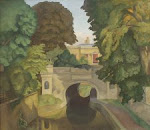
Alexander Jamieson (1873-1937), "Doldowlod on the Wye" (1935)

We do not know exactly what Heraclitus said about rivers, since all of his thoughts come to us second-hand: reports of what somebody said he said.  Plutarch gives us this: ". . . for it is impossible to step twice into the same river according to Heraclitus, or to lay hands twice on mortal substance in a fixed condition."  (G. S. Kirk, Heraclitus: The Cosmic Fragments (Cambridge University Press 1962), page 381.)

Plutarch's version finds its way into this:

               Heraclitus on Rivers

Nobody steps into the same river twice.
The same river is never the same
Because that is the nature of water.
Similarly your changing metabolism
Means that you are no longer you.
The cells die; and the precise
Configuration of the heavenly bodies
When she told you she loved you
Will not come again in this lifetime.

You will tell me that you have executed
A monument more lasting than bronze;
But even bronze is perishable.
Your best poem, you know the one I mean,
The very language in which the poem
Was written, and the idea of language,
All these things will pass away in time.

Derek Mahon, Poems 1962-1978 (Oxford University Press 1979).

Given what Kamo no Chōmei tells us, we could perhaps change the title of Mahon's poem to "Kamo no Chōmei on Rivers."  "The same river is never the same/Because that is the nature of water."  "The river flows on unceasingly, but the water is never the same water as before."  "All these things will pass away in time."  "For both owner and dwelling are doomed to impermanence, no different from the dew on the morning glory."  

Reginald Brundrit (1883-1960), "Autumn by the River"

But let us return to Heraclitus in Japan:

"The world is as unstable as the pools and shallows of Asuka River. Times change and things disappear: joy and sorrow come and go; a place that once thrived turns into an uninhabited moor; a house may remain unaltered, but its occupants will have changed.  The peach and the damson trees in the garden say nothing -- with whom is one to reminisce about the past?"

Kenkō (1284-1350) (translated by Donald Keene), in Donald Keene, Essays in Idleness: The Tsurezuregusa of Kenkō (Columbia University Press 1967), pages 25-26.  The Tsurezuregusa was likely written between 1330 and 1332.  (Ibid, page xiii.)

The passage is quite reminiscent of Kamo no Chōmei's passage.  One wonders if Kenkō had it in mind as he wrote.  On the other hand, Kenkō and Kamo no Chōmei both became Buddhist monks late in life, so the similarity may simply reflect their common spiritual pursuits.

Keene provides this note on the first sentence of the passage: "The Asuka River, a stream near Nara, figures prominently in Japanese poetry.  Reference is made here to the anonymous poem in Kokinshū, 'In this world what is constant?  In the Asuka River yesterday's pools are today's shallows'."  (Ibid, page 26.) The Kokinshū (a shortening of its longer title, Kokin Wakashū), which appeared in or about 905, was an imperial anthology of 1,100 poems.

The poem translated by Keene is a waka, and has been alternatively translated as follows:

     In this world of ours
what is there of constancy?
     Yesterday's deep pool
in the River of Tomorrow
today becomes a rapid.

Anonymous (translated by Helen Craig McCullough), in Helen Craig McCullough, Kokin Wakashū: The First Imperial Anthology of Japanese Poetry (Stanford University Press 1985), page 205.

This is the romanized (romaji) Japanese text of the waka: "yo no naka wa/nani ka tsune naru/asukagawa/kinō no fuchi zo/kyō wa se ni naru."  (Ibid, page 205.)  Asukagawa means "Asuka River." However, McCullough translates it as: "the River of Tomorrow."  She provides this explanation:  "The first part of the river name Asuka is homophonous with asu ('tomorrow').  This famous poem made the Asuka and its vagrant channel a symbol of change."  (Ibid, page 205.)

"The River of Tomorrow" is quite lovely, isn't it?  It also appears in another poem from the Kokinshū:

     Swift is their passage
as the flow of the Asuka,
     "Tomorrow River" --
the long months I spend saying
"yesterday," "today," "tomorrow."

Harumichi Tsuraki (d. 920) (translated by Helen Craig McCullough), Ibid, page 82.

On a sunny afternoon last week I came upon a spray of five green oak leaves that had fallen to the ground. Beside the spray lay an acorn.  I walked on, and soon a single rusty leaf rattled toward me on the asphalt pathway, spun by the wind.  A long thin river of feathery white cloud stretched from west to east.  The sky suddenly seemed to be an autumn sky: a slightly deeper blue.

Fred Stead (1863-1940), "River at Bingley, Yorkshire"

Thursday, August 20, 2020

Three Thoughts

I return often to the poetry of Walter de la Mare.  As is the case with all the poets of whom I am fond, I go there in search of Beauty and Truth.  But, when it comes to de la Mare, I also go because of his common sense, equanimity, wisdom, and goodwill.  His essential humanity is a wonderful thing to experience, and to learn from.  How I feel about him is captured quite well by one of his poems:

                       Rarities

Beauty, and grace, and wit are rare;
     And even intelligence:
But lovelier than hawthorn seen in May,
Or mistletoe berries on Innocent's Day
The face that, open as heaven, doth wear --
With kindness for its sunshine there --
     Good nature and good sense.

Walter de la Mare, Inward Companion: Poems (Faber and Faber 1950).

Revisiting his poetry over the past few weeks, I noticed these qualities more acutely.  I suspect this is due to the contrast between the humanity one finds in de la Mare and his poems and the unedifying spectacle we have been witnessing the past few months, which is the antithesis of all that is embodied in his life and art.

Looking for old favorites, I came upon this:

Ah, Stranger, breathe a sigh:
     For, where I lie,
Is but a handful of bright Beauty cast:
     It was; and now is past.

Walter de la Mare, The Complete Poems of Walter de la Mare (Faber and Faber 1969).

David Muirhead (1867-1930), "English Landscape"

"A handful of bright Beauty."  How lovely.  When it comes to poetry, one thing leads to another, doesn't it?  Something floated to mind.  So I took one of Norman Ault's fine anthologies down from the shelf and turned the pages to this:

     An Epitaph for a Godly Man's Tomb

Here lies a piece of Christ; a star in dust;
A vein of gold; a china dish that must
Be used in heaven, when God shall feast the just.

Robert Wild (1609-1679), in Norman Ault (editor), Seventeenth Century Lyrics from the Original Texts (Longmans, Green & Co. 1928).  The poem was first published in 1668.

I am no doubt getting old and cranky, but the 17th century seems like a seemly and hospitable place to me these days.  Does one reach a point in life where one feels that one has had enough, that it is now time to depart?  "But no longer at ease here, in the old dispensation,/With an alien people clutching their gods."  A different century, a different set of gods, yes.  And yet . . .

David Muirhead, "Woodland Scene" (1918)

"A star in dust."  Another lovely thought.  Another stepping stone.  I went to another shelf and sought out this:

What is Death?  A Life
disintegrating into
smaller simpler ones.

W. H. Auden, from the sequence "Shorts II," in Collected Poems (Faber and Faber 1976).

"A handful of bright Beauty."  "A star in dust."  "A Life/disintegrating into/smaller simpler ones."  Three thoughts randomly and unexpectedly coming together.  I do not place them here in an attempt at edification.  (The last thing I am in need of at the present time is unasked-for edification, thank you.  Thus, have no fear, dear readers, I am not a member of the edification police.)  As I have said here before, I am easy to please.  This is nothing more than a report on how I spent an evening.  Frolic and detour.

David Muirhead, "A Lowland Landscape"

I did not begin my evening expecting to have these three poems reappear.  But this is the way poetry works.  A poem that touches us never vanishes.  Who knows when it will return?  

One day an unbidden gift unaccountably arrives at our doorstep. Where did this come from?  One thing leads to another.

Onto the rain porch
     from somewhere outside it comes --
a fallen petal.

Takahama Kyoshi (1874-1959) (translated by Steven Carter), in Steven Carter, Traditional Japanese Poetry: An Anthology (Stanford University Press 1991), p. 443.

David Muirhead, "The Avenue" (1901)

Wednesday, August 5, 2020

What Matters

Over the course of the marvelous year we have been enjoying, various thoughts by Marcus Aurelius have been returning to me.  As ever, the good Emperor has been there before we have, and knows a thing or two.  For instance: "How ridiculous, and like a stranger is he, who is surprised at any thing which happens in life!"  (Marcus Aurelius, Meditations, Book XII, Section 13, in Francis Hutcheson and James Moor (translators), The Meditations of the Emperor Marcus Aurelius Antoninus (1742), p. 285.)  Jeremy Collier, in his always piquant early-18th century style, renders the passage thus: "How unacquainted is that Man with the World, and how ridiculous does he appear, that makes a wonder of any thing he meets with here?" (Jeremy Collier (translator), The Emperor Marcus Antoninus: His Conversation with Himself (1701), page 229.) 

He's right, of course.  Natural calamity and human miscreance and malfeasance are par for the course.  And I'm sure that even in the Emperor's time reports of disaster and human folly were spread far and wide in bad faith, ignorance, and self-interest by the supercilious newsmongers of the day (even in the absence of such hallmarks of Human Progress and Enlightenment as Twitter).

In the meantime, bad news or not, the creators and preservers of that which is important proceed quietly about their business.  

                                   The Just

A man who cultivates his garden, as Voltaire wished.
He who is grateful for the existence of music.
He who takes pleasure in tracing an etymology.
Two workmen playing, in a café in the South, a silent game of chess.
The potter, contemplating a color and a form.
The typographer who sets this page well, though it may not please
     him.
A woman and a man, who read the last tercets of a certain canto.
He who strokes a sleeping animal.
He who justifies, or wishes to, a wrong done him.
He who is grateful for the existence of Stevenson.
He who prefers others to be right.
These people, unaware, are saving the world.

Jorge Luis Borges (translated by Alastair Reid), in Jorge Luis Borges, Selected Poems (edited by Alexander Coleman) (Viking 1999), page 449.
Richard Eurich (1903-1992), "The Window"

In the autumn of 1923, Ivor Gurney remained involuntarily confined in an asylum, as he had been since September of 1922.  "In Hell I buried a score-depth, writing verse pages."  ("Hell's Prayer," in Ivor Gurney, Selected Poems (edited by George Walter) (J. M. Dent 1996), page 64.)  If you ponder it for long, his life will break your heart.  Yet, as sad, desperate, miserable, and bedeviled as we was, he was at times more lucid and acute than any of us can hope to be.  In or around October of 1923, he wrote this:

                           The Escape

I believe in the increasing of life whatever
Leads to the seeing of small trifles . . . . . .
Real, beautiful, is good, and an act never
Is worthier than in freeing spirit that stifles
Under ingratitude's weight; nor is anything done
Wiselier than the moving or breaking to sight
Of a thing hidden under by custom; revealed
Fulfilled, used, (sound-fashioned) any way out to delight.
.     .     .     .     .     .     .     .     .     .     .     .     .     .     .     .     .
Trefoil . . . . hedge sparrow . . . . the stars on the edge of night.

Ivor Gurney, Ibid, page 46.  The punctuation (or lack of it) and the ellipses are in the original typescript.  The poem was not published in his lifetime.

Perhaps it is not my place to say so, but I don't think Ivor Gurney would want us to break our hearts in pity for him.  Rather, he would want us to read his poems (and listen to his music).  They tell us what matters.  They are what matters.
Richard Eurich, "The Road to Grassington" (1971)

Saturday, July 18, 2020

Near and Far

I find this to be an accurate and reasonable assessment of the present age:

"[A] multitude of causes, unknown to former times, are now acting with a combined force to blunt the discriminating powers of the mind, and, unfitting it for all voluntary exertion, to reduce it to a state of almost savage torpor.  The most effective of these causes are the great national events which are daily taking place, and the increasing accumulation of men in cities, where the uniformity of their occupations produces a craving for extraordinary incident, which the rapid communication of intelligence hourly gratifies."

And this, it seems to me, is a sound response to our distempered and unseemly contemporary world:

"More than half a century of existence has taught me that most of the wrong and folly which darken earth is due to those who cannot possess their souls in quiet; that most of the good which saves mankind from destruction comes of life that is led in thoughtful stillness.  Every day the world grows noisier; I, for one, will have no part in that increasing clamour, and, were it only by my silence, I confer a boon on all."

I suspect that many of you will have noticed that the two quoted passages come, not from our own time, but from the past.  The first passage is 218 years old: it appears in William Wordsworth's preface to the 1802 edition of Lyrical Ballads.  The second passage is 117 years old: it is from George Gissing's The Private Papers of Henry Ryecroft, which was published in 1903.  Hence, pick your truism. The more things change, the more they stay the same.  Or, if you prefer: There is nothing new under the sun.

Roger Fry (1886-1934), "Village in the Valley" (1926)

"They are not long, the days of wine and roses:/Out of a misty dream/Our path emerges for a while, then closes/Within a dream." Yesterday, while driving in my car, I heard Glen Campbell sing "Gentle on My Mind."  1967.  Ah, well.  All those years.  I was born during the first term of the Eisenhower administration.  Of history and its events, what remains for me is the death of President Kennedy (our elementary school principal announced it over the public address system on a sunny afternoon), the moon landing, the Vietnam War, and 9/11.  Unexpectedly hearing "Gentle on My Mind" on the car radio on an ordinary July afternoon.  How many times have I heard that song?  Where was I each time I heard it?  Who was I with?  What has become of them?  One song.  An entire lifetime returns.  History vanishes.

        Rising from My Sickbed

Alone and ill, I was confined to bed
But my dreams kept returning to my old haunts
This morning, at last, I managed to rise and
     stand beside the river
An endless trail of peach petals
     drifting down the stream

Ryōkan (1758-1831) (translated by Ryūichi Abé and Peter Haskel), in Ryūichi Abé and Peter Haskel, Great Fool: Zen Master Ryōkan: Poems, Letters, and Other Writings (University of Hawai'i Press 1996), page 123.

James Prowett (1865-1946), "Cruive Dykes, Craigforth" 

Is it inevitably the case that, as one grows older, the world of human affairs takes on an alien aspect, while the World of beautiful particulars becomes ever more hospitable?  On the other hand, one might arrive at that feeling at a young age, and find its truth confirmed by life.  Either way, there is indeed something to be said for possessing one's soul in quiet, for living "in thoughtful stillness," for having no part in the "increasing clamour." 

Happy were he could finish forth his fate
     In some unhaunted desert, most obscure
From all societies, from love and hate
     Of worldly folk; then might he sleep secure;
Then wake again, and give God ever praise,
     Content with hips and haws and bramble-berry;
In contemplation spending all his days,
     And change of holy thoughts to make him merry;
Where, when he dies, his tomb may be a bush,
Where harmless robin dwells with gentle thrush.

Robert Devereux, Earl of Essex (1566-1601), in E. K. Chambers (editor), The Oxford Book of Sixteenth Century Verse (Oxford University Press 1932).  The poem is untitled.

Percy Horton (1897-1970), "A Corner of Ambleside" (1943)

Sunday, July 5, 2020

How To Live, Part Twenty-Nine: Some Things Never Change

I am easy to please.  Each summer, I take delight in watching the tree tunnels I love further deepen, further interlace, as the boughs extend themselves outwards and upwards.  I notice the empty spaces that remain high up in the green and restless canopy, the sky that remains open, and I wonder how many years will pass before new bridges of leaves arch overhead.  Will I be here to see it happen?  Perhaps not. After all, I am merely an onlooker, passing through.  This is neither a lament nor a complaint.  To be aware that one is part of an ever-changing yet timeless World is a source of serenity.

                      The Truisms

His father gave him a box of truisms
Shaped like a coffin, then his father died;
The truisms remained on the mantelpiece
As wooden as the playbox they had been packed in
Or that other his father skulked inside.

Then he left home, left the truisms behind him
Still on the mantelpiece, met love, met war,
Sordor, disappointment, defeat, betrayal,
Till through disbeliefs he arrived at a house
He could not remember seeing before.

And he walked straight in; it was where he had come from
And something told him the way to behave.
He raised his hand and blessed his home;
The truisms flew and perched on his shoulders
And a tall tree sprouted from his father's grave.

Louis MacNeice, Solstices (Faber and Faber 1961).

As is often the case with MacNeice, there is an undertone of ironic knowingness present in "The Truisms," but I am willing to take the poem at face value.  As I have noted here before, I am quite content to live my life in accordance with certain truisms because, well, they are true.

Joshua Anderson Hague (1850-1916), "Landscape in North Wales"

Given the clamor of catastrophe and crisis we human beings are so fond of (2020 is no different than any other year in the history of humanity in this regard), an awareness of the World's continuity is not a bad thing.  It's not as if the World hasn't seen it all before.  Each of us has seen it all before as well, unless we haven't been awake.  

"Whoever lives two or three generations feels like the spectator who, during the fair, sees the performances of all kinds of jugglers and, if he remains seated in the booth, sees them repeated two or three times.  As the tricks were meant only for one performance, they no longer make any impression after the illusion and novelty have vanished."

Arthur Schopenhauer (translated by E. F. J. Payne), "Additional Remarks on the Doctrine of the Suffering of the World," in Parerga and Paralipomena: Short Philosophical Essays, Volume 2 (1851; Oxford University Press 1974), page 299.

            Crofter

Last thing at night
he steps outside to breathe
the smell of winter.

The stars, so shy in summer,
glare down
from a huge emptiness.

In a huge silence he listens
for small sounds.  His eyes
are filled with friendliness.

What's history to him?
He's an emblem of it
in its pure state.

And proves it.  He goes inside.
The door closes and the light
dies in the window.

Norman MacCaig, in Ewen McCaig (editor), The Poems of Norman MacCaig (Polygon 2005).

Joshua Anderson Hague, "Late Autumn"

In January of 2019, I wrote here about the falling of a nearby big-leaf maple in a winter storm.  Yesterday afternoon, I walked past the space it once occupied.  I still feel the loss.  But its companions remain, and I know that in time the emptiness of the air will be filled.

                 Thoughts on T'ien-chin Bridge

The countless great lords and statesmen of past regimes --
later ages know them merely as a list of names.
Only the water under T'ien-chin Bridge
goes on year after year,  making the same sound.

Shao Yung (1011-1077) (translated by Burton Watson), in Burton Watson, The Columbia Book of Chinese Poetry: From Early Times to the Thirteenth Century (Columbia University Press 1984), page 336.

Joshua Anderson Hague, "Haymaking"

Saturday, June 20, 2020

Ever-present

In mid-May, the ants emerged from hibernation and immediately embarked upon their yearly castle-building.  Early in June, the first pink blossoms opened on the wild rose bushes.  As the meadow grasses grew tall, the swallows arrived, and now each afternoon they skim quickly over the fields, curving, climbing, and diving for insects. The past week or so, right on schedule, the purplish-pink sweet peas began to bloom, and, as always, they are making their way onto the paths from the edges of the meadows.

Imagine that: the World just goes on being the World.  Beautiful, mysterious, unfathomable.  Taciturn, yet eloquent with Immanence.

               Nobody Knows

Often I've heard the Wind sigh
     By the ivied orchard wall,
Over the leaves in the dark night,
     Breathe a sighing call,
And faint away in the silence,
     While I, in my bed,
Wondered, 'twixt dreaming and waking,
     What it said.

Nobody knows what the Wind is,
     Under the height of the sky,
Where the hosts of the stars keep far away house
     And its wave sweeps by --
Just a great wave of the air,
     Tossing the leaves in its sea,
And foaming under the eaves of the roof
     That covers me.

And so we live under deep water,
     All of us, beasts and men,
And our bodies are buried down under the sand,
     When we go again;
And leave, like the fishes, our shells,
     And float on the Wind and away,
To where, o'er the marvellous tides of the air,
     Burns day.

Walter de la Mare, Peacock Pie: A Book of Rhymes (Constable 1913).

Robert Ball (1918-2009), "Mrs Barclay's Pond, Harborne" (1949)

Thursday, June 11, 2020

Dew

And so, dear readers, our eventful year continues.  I tell myself that I should keep my counsel as the arsonists, statue-topplers, building-defacers, and looters articulate their deeply-held convictions about how the rest of us ought to think, feel, and live.  Their actions speak for themselves.  No gloss is necessary.  Yet I will say that two words have been in my mind over the past week or so:  "emptiness" and "vacuity."  As well as this:  "They have inquired and considered little, and do not always feel their own ignorance.  They are not much accustomed to be interrogated by others; and seem never to have thought upon interrogating themselves."  Samuel Johnson, A Journey to the Western Islands of Scotland (1775), page 272.

The evil and lack of human decency on display are nothing new, alas. They are part of human nature -- always have been, always will be. One chooses one's path.

                                The Nightjar

We loved our Nightjar, but she would not stay with us.
We had found her lying as dead, but soft and warm,
Under the apple tree beside the old thatched wall.
Two days we kept her in a basket by the fire,
Fed her, and thought she well might live -- till suddenly
In the very moment of most confiding hope
She raised herself all tense, quivered and drooped and died.
Tears sprang into my eyes -- why not? the heart of man
Soon sets itself to love a living companion,
The more so if by chance it asks some care of him.
And this one had the kind of loveliness that goes
Far deeper than the optic nerve -- full fathom five
To the soul's ocean cave, where Wonder and Reason
Tell their alternate dreams of how the world was made.
So wonderful she was -- her wings the wings of night
But powdered here and there with tiny golden clouds
And wave-line markings like sea-ripples on the sand.
O how I wish I might never forget that bird --
Never!
                    But even now, like all beauty of earth,
She is fading from me into the dusk of Time.

Henry Newbolt (1862-1938), A Perpetual Memory and Other Poems (John Murray 1939).

Herbert Hughes-Stanton (1870-1937)
"The Mill in the Valley" (1892)

Wednesday, June 3, 2020

Choristers

The wild grasses that cover the meadows are deep green and growing tall.  Scattered amidst the swaying green, close to the ground, are small pinkish-purple wildflowers.  You have to look closely, or you will miss them.  Their name is unknown to me.  But I am acquainted with them, and I look forward to their arrival each May.

     Among the grasses,
A flower blooms white,
     Its name unknown.

Masaoka Shiki (1867-1902) (translated by R. H. Blyth), in R. H. Blyth, Haiku, Volume 1: Eastern Culture (Hokuseido Press 1949), page 289.

There are those who seek to know the names of each of the beautiful particulars of the World, and I admire and envy their curiosity and diligence.  I wish them well.  We are all in pursuit of beauty, and I am in no position to say one path is better than another.  But I am, and shall remain, blissfully ignorant when it comes to the names of most of those beautiful particulars.  Thus, "the small pinkish-purple wildflower that comes in May" will suffice for me.

     The names unknown,
But to every weed its flower,
     And loveliness.

Sampū (1647-1732) (translated by R. H. Blyth), in R. H. Blyth, Haiku, Volume 4: Autumn-Winter (Hokuseido Press 1952), page 123.

Stanley Spencer (1891-1959)
"The Ferry Hotel Lawn, Cookham" (1936)

Despite the inevitable importunities of Events, as magnified and distorted by the clamor, bad faith, and ultimate emptiness of "news," the World -- the real World -- quietly runs its serene course, and always will.  Nameless, profound.  We can attend to it, or not.  The choice is ours.

               The Knight in the Wood

The thing itself was rough and crudely done,
Cut in coarse stone, spitefully placed aside
As merest lumber, where the light was worst
On a back staircase.  Overlooked it lay
In a great Roman palace crammed with art.
It had no number in the list of gems,
Weeded away long since, pushed out and banished,
Before insipid Guidos over-sweet
And Dolce's rose sensationalities,
And curly chirping angels spruce as birds.
And yet the motive of this thing ill-hewn
And hardly seen did touch me.  O, indeed,
The skill-less hand that carved it had belonged
To a most yearning and bewildered brain:
There was such desolation in the work;
And through its utter failure the thing spoke
With more of human message, heart to heart,
Than all these faultless, smirking, skin-deep saints,
In artificial troubles picturesque,
And martyred sweetly, not one curl awry --
Listen; a clumsy knight, who rode alone
Upon a stumbling jade in a great wood
Belated.  The poor beast with head low-bowed
Snuffing the treacherous ground.  The rider leant
Forward to sound the marish with his lance.
You saw the place was deadly; that doomed pair,
The wretched rider and the hide-bound steed,
Feared to advance, feared to return -- That's all!

John Leicester Warren, Rehearsals: A Book of Verses (Strahan & Company 1870). (A side-note: "marish" (line 25) is not a misspelling. It is a precursor of "marsh.")

Stanley Spencer, "Rock Gardens, Cookham Dene" (1947)

How the World presents itself to us is ever a source of surprise and mystery, isn't it?  We need to be attentive and receptive, for it often appears in a humble guise, without pretense, making no demands, easily missed.

                    Aboard a Boat, Listening to Insects

As though delighting, as though grieving, each with its own song --
an idler, listening, finds his ears washed completely clean.
As the boat draws away from grassy banks, they grow more distant,
till the many varied voices become one single voice.

Ōkubo Shibutsu (1767-1837) (translated by Burton Watson), in Burton Watson, Kanshi: The Poetry of Ishikawa Jōzan and Other Edo-Period Poets (North Point Press 1990), page 92).

Stanley Spencer, "Scarecrow, Cookham" (1934)

Saturday, May 23, 2020

Interval

"Days are where we live."  "For the days are long -- /From the first milk van/To the last shout in the night,/An eternity."  In the end, our life is a tangled skein of days.  From this welter, what can we retrieve, what remains with us?  Not days, but a handful of isolated, charmed moments.

The moments return, unaccountably, unbidden, in brilliant clarity. The days and years drop away.  Ah, yes.  So that was my life.  You may have known this at the time.  If so, you are fortunate.  Or you may come to know it only as a heart-catching pang of recognition -- distant, long-lost, but better late than never.

                                The Ash Grove

Half of the grove stood dead, and those that yet lived made
Little more than the dead ones made of shade.
If they led to a house, long before they had seen its fall:
But they welcomed me; I was glad without cause and delayed.

Scarce a hundred paces under the trees was the interval --
Paces each sweeter than sweetest miles -- but nothing at all,
Not even the spirits of memory and fear with restless wing,
Could climb down in to molest me over the wall

That I passed through at either end without noticing.
And now an ash grove far from those hills can bring
The same tranquillity in which I wander a ghost
With a ghostly gladness, as if I heard a girl sing

The song of the Ash Grove soft as love uncrossed,
And then in a crowd or in distance it were lost,
But the moment unveiled something unwilling to die
And I had what most I desired, without search or desert or cost.

Edward Thomas, The Annotated Collected Poems (edited by Edna Longley) (Bloodaxe Books 2008).

Duncan Grant (1885-1978), "Girl at the Piano" (1940)


"The way leads on . . . The road leads on."  "Does the road wind up-hill all the way?/Yes, to the very end."  Life is a journey.  We've heard that often.  Yet it is a few brief intervals of lucent stillness that ultimately stay with us.  "Scarce a hundred paces under the trees was the interval."  Evanescent.  But enough.  An aspect of eternity.

                            On the Road

Our roof was grapes and the broad hands of the vine
as we two drank in the vine-chinky shade
of harvest France;
and wherever the white road led we could not care,
it had brought us there
to the arbour built on a valley side where time,
if time any more existed, was that river
of so profound a current, it at once
both flowed and stayed.

We two.  And nothing in the whole world was lacking.
It is later one realizes.  I forget
the exact year or what we said.  But the place
for a lifetime glows with noon.  There are the rustic
table and the benches set; beyond the river
forests as soft as fallen clouds, and in
our wine and eyes I remember other noons.
It is a lot to say, nothing was lacking;
river, sun and leaves, and I am making
words to say 'grapes' and 'her skin.'

Bernard Spencer, With Luck Lasting (Hodder and Stoughton 1963).

Duncan Grant, "The Doorway" (1929)

Wednesday, May 13, 2020

Mystery

As I have mentioned here before, I often give myself this piece of advice as I begin my daily walk:  Stop thinking.  Pay attention.  I fail miserably each time, of course.  But the World always finds new and beautiful ways to gently shake us by the shoulders and whisper: "Wake up, pilgrim."  It is coy and persistent.  It demands nothing of us, but it is not going away.

Thus, on a recent afternoon, as I strolled in a daydream, I suddenly awoke to the sound of birdsong from all quarters of the earth and sky. An unrehearsed chorus of anonymous and solitary singers in a green and blue World, each of them singular and irreplaceable.

The notes they sang were "synonyms for joy," certainly.  But, coming from everywhere, in all their variations, unceasing yet uninsistent, the notes were something else as well.  Later that evening, this came to mind:  "One feels the life of that which gives life as it is."

                           The Wood

I walked a nut-wood's gloom.  And overhead
A pigeon's wing beat on the hidden boughs,
And shrews upon shy tunnelling woke thin
Late winter leaves with trickling sound.  Across
My narrow path I saw the carrier ants
Burdened with little pieces of bright straw.
These things I heard and saw, with senses fine
For all the little traffic of the wood,
While everywhere, above me, underfoot,
And haunting every avenue of leaves,
Was mystery, unresting, taciturn.
           .         .         .         .         .
And haunting the lucidities of life
That are my daily beauty, moves a theme,
Beating along my undiscovered mind.

John Drinkwater, Loyalties (Sidgwick & Jackson 1919).  The ellipses appear in the original.

Alfred Thornton (1863-1939)
"Hill Farm, Painswick, Gloucestershire"

"One feels the life of that which gives life as it is."  After I returned home from my walk, I noticed birds singing in the back garden.  They sang until the last pale light in the sky faded away.

     All the long day --
Yet not long enough for the skylark,
     Singing, singing.

Bashō (translated by R. H. Blyth), in R. H. Blyth, Haiku, Volume 2: Spring (Hokuseido Press 1950), page 195.

Alfred Thornton, "The Upper Severn"